
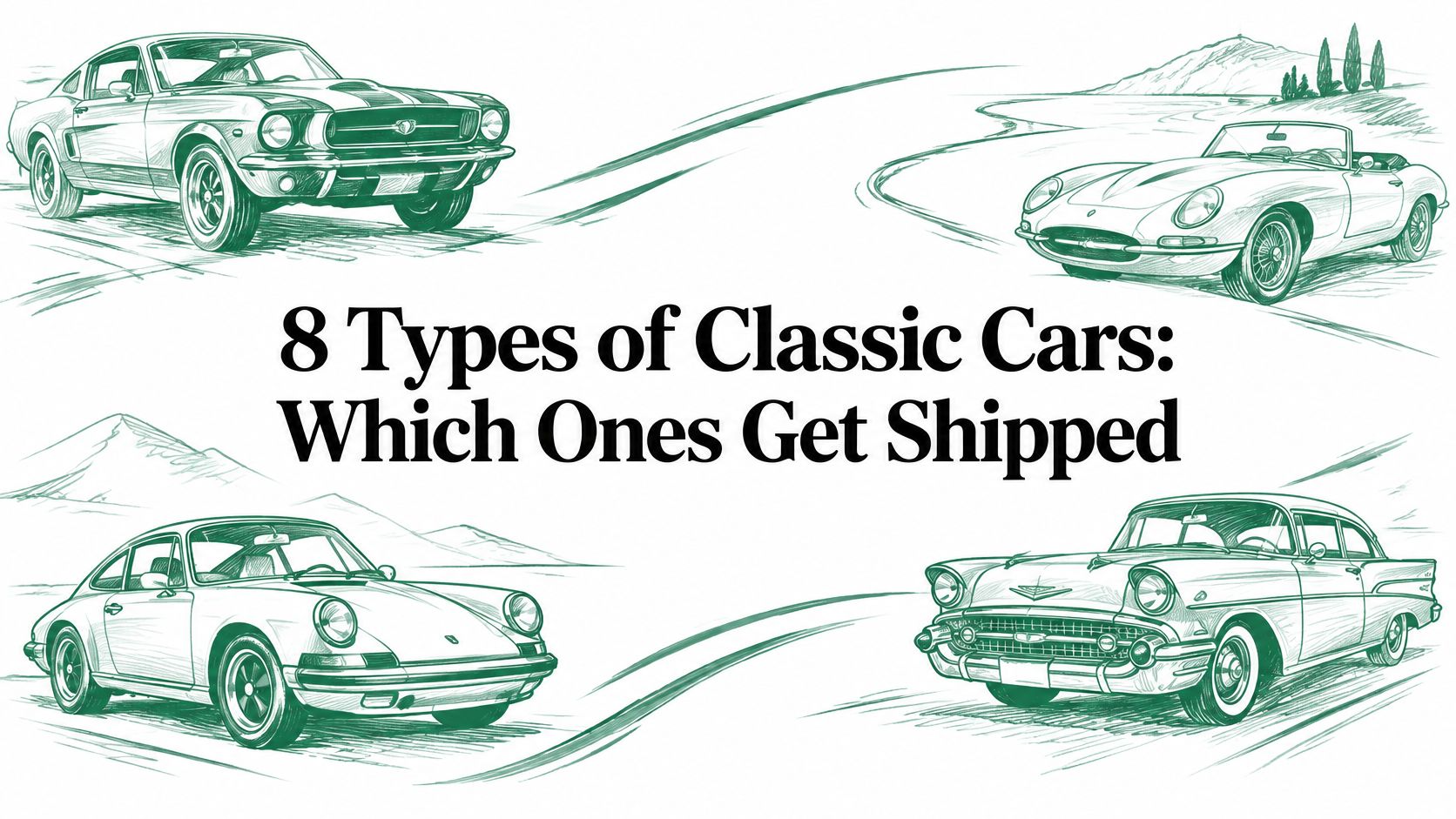
A 1969 Mustang Mach 1 rolling off a truck in Jacksonville, onto a ship, and into the Port of San Juan is a normal week on this lane, not a rare photo. If you're standing in a garage in Ohio, Texas, or New Jersey and picturing a driveway in Puerto Rico, the key question isn't only which types of classic cars you love. It's which one you can move without a surprise at the pier.
This is the short list I use when someone calls about a car going either direction, from any U.S. state or city to San Juan, or back to the mainland. Each category below gets the same treatment. What the car is, why owners keep it, and what changes the booking. Open versus enclosed, fuel level, ground clearance, and whether the arbitrios paperwork needs a declared value before the vessel sails.
Age is a weak sorting tool. A late-1980s car can be harder to load than a 1960s coupe if a splitter sits an inch off the pavement. Custom brackets, including work tied to automotive 3D printing applications, don't rewrite port rules. Title, running status, and ride height still pick the trailer.
National Car Transport books the move as one job: the door-to-door truck leg on the mainland and the ocean leg into San Juan, with the origin port and the handoff confirmed at booking. No two shipments match, but the intake stays the same. Does it run, roll, steer, and brake? A non-runner can still ship on a winch-equipped enclosed trailer as long as it rolls, steers, and brakes, and its condition is declared at booking. Do you want weather, road debris, and prying eyes off the paint? Then enclosed is the call. Transit on these classic moves is typically 1–10 days once the car is dispatched, with the ocean schedule sitting on top of the truck leg, and every car gets a photo-supported inspection on the Bill of Lading at pickup and at delivery.
Table of Contents
- 1. American Muscle Cars
- 2. Classic European Sports Cars
- 3. Vintage Volkswagen Beetles and Air-Cooled VWs
- 4. Classic American Pickup Trucks
- 5. Classic Japanese Sports Cars
- 6. Classic Luxury Sedans and Land Yachts
- 7. Classic Convertibles and Roadsters
- 8. Vintage Jeeps and Military Surplus Vehicles
- Classic Car Types Compared
- Ship Your Classic the Right Way, Mainland to San Juan and Back
1. American Muscle Cars
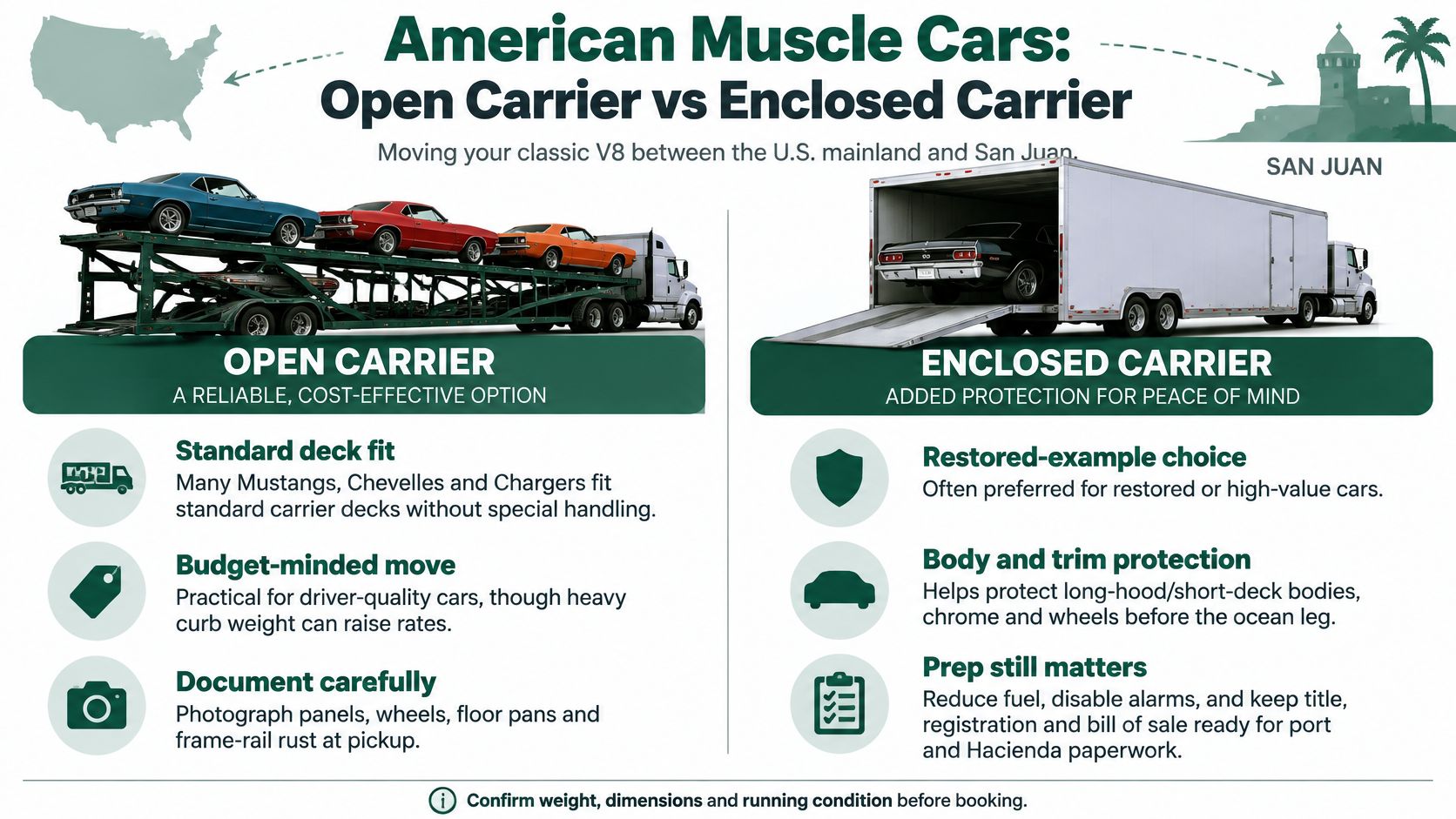
American muscle is what fills the most enclosed spots on the Jacksonville–San Juan run. These are rear-wheel-drive coupes and hardtops with big V8s, mostly from the late 1960s and early 1970s, built as attainable straight-line cars rather than limited European exotics. Hagerty's market review puts traditional 1964–1972 muscle cars at 5.3% of cars sold at auction in 2024, about $273 million in sales, and an average near $78,000 against $61,000 for all cars. That gap is why a driver-quality Chevelle and a restored Mach 1 shouldn't share one trailer plan.
A 1969 Ford Mustang Mach 1 leaving Florida for San Juan usually goes enclosed. A 1970 Chevrolet Chevelle SS 454 bound for an island collector gets the same question. Fresh paint, or a solid driver? A 1968 Dodge Charger R/T on a military permanent change of station often has a hard report date, so the port window beats the cheapest rate.
Planning Board route notes identify Jacksonville–San Juan as an established vehicle lane, with Trailer Bridge moving containers and vehicles on both roll-on/roll-off and lift-on/lift-off barges. Your quote should name the origin terminal, San Juan handling, and whether the car rides a vehicle deck or a container.
Before the driver arrives
Photograph every panel. Rust, wheels, and glass belong on the bill of lading. We record a photo-supported inspection at pickup and again at delivery.
Cut the fuel and kill the alarm. Leave only what the manufacturer allows for a short move.
Choose open or enclosed on purpose. Restored cars belong inside. Enclosed loads use soft tie-downs over the tires, never chains on the frame, plus hydraulic low-clearance loading.
Keep the original title, registration, and bill of sale ready for the port and for Hacienda. Trailer matching is covered in our classic car transport guide.
2. Classic European Sports Cars
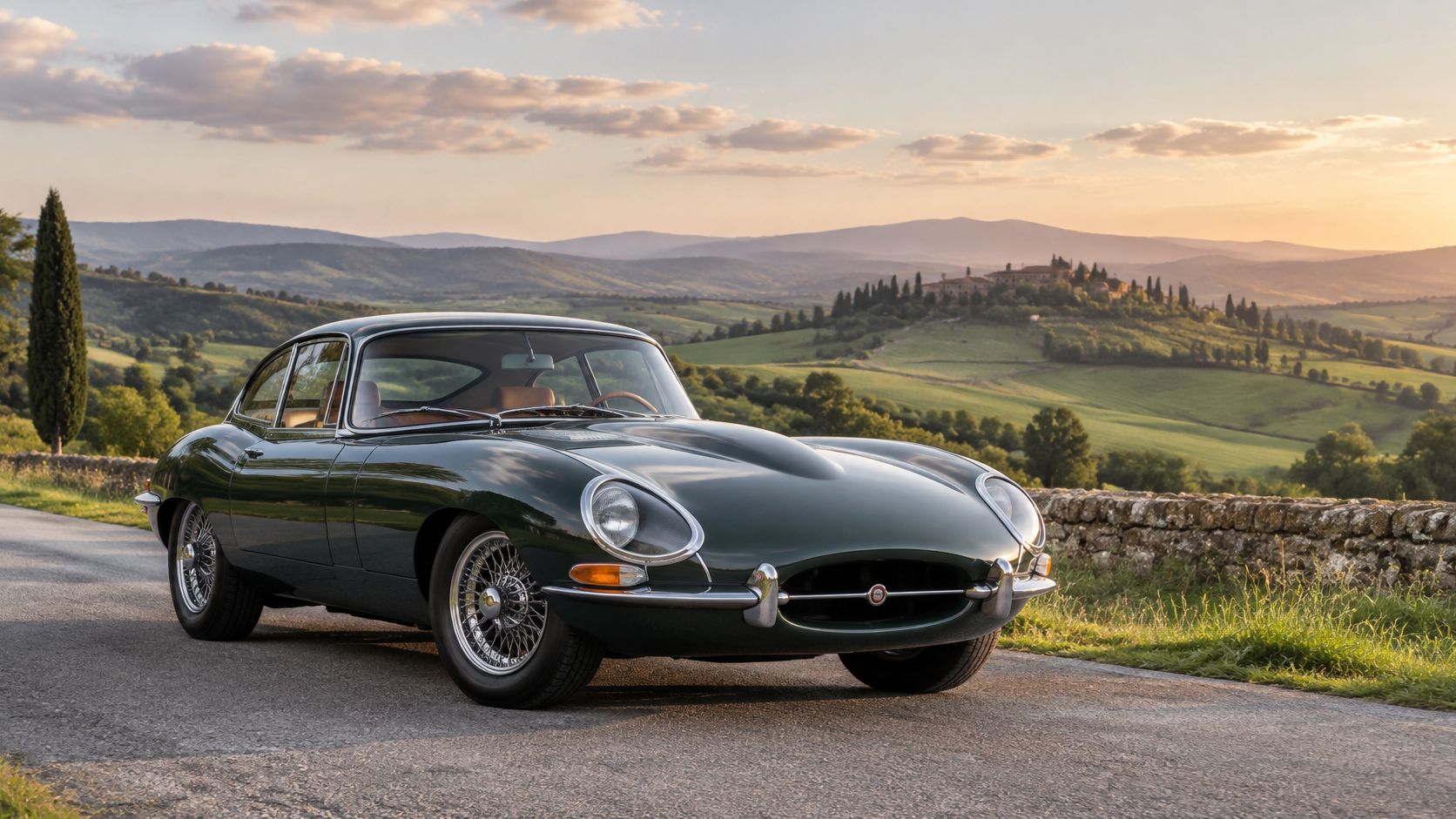
A low nose picks the trailer before the badge does. Jaguar, Porsche, Mercedes-Benz, and MG coupes and roadsters from the 1950s through the 1970s are light, valuable, and easy to scrape on a steep ramp. Collectors book them for a San Juan concours, a club meet, or a full relocation. I won't load a restored E-Type onto an open deck to shave the cost of the ocean leg.
Market age doesn't equal demand. In Hagerty's 2025 index read, the Best of British index, averaging cars from around 1962, sat at its lowest level since the index was created in 2018, while newer performance indexes held up better. Liquidity can run softer on an early British car than on a later 911, so condition photos and a clean title carry more weight than the year on the fender when the car changes hands at the port.
Concrete cases: a 1961 Jaguar E-Type Series 1 rolling to a San Juan show, a 1973 Porsche 911 Carrera following its owner south from New Jersey, a 1967 MG B headed to a private garage in Dorado. Ask the ramp angle before you lock a date. Pull luggage racks and loose trim, date-stamp the condition report, and match the registration and title to the name on the booking, because the arbitrios assessment at Hacienda reads those documents, not the story behind the car.
Practical rule: If the chin spoiler or exhaust would touch a standard ramp, book hydraulic low-clearance loading. Drivers who handle vintage brakes, steering, and cold starts are the ones you want on this car.
A corrected, show-grade finish like the one in AVOTTO Mobile's Superleggera detail showcase shows how much work sits in that paint. That's why enclosed transport is the default for these bodies: a closed trailer keeps weather and road debris off the nose through every handoff, and door-to-door delivery skips extra terminal touches. Scheduling and delivery windows sit in our classic car delivery notes.
3. Vintage Volkswagen Beetles and Air-Cooled VWs
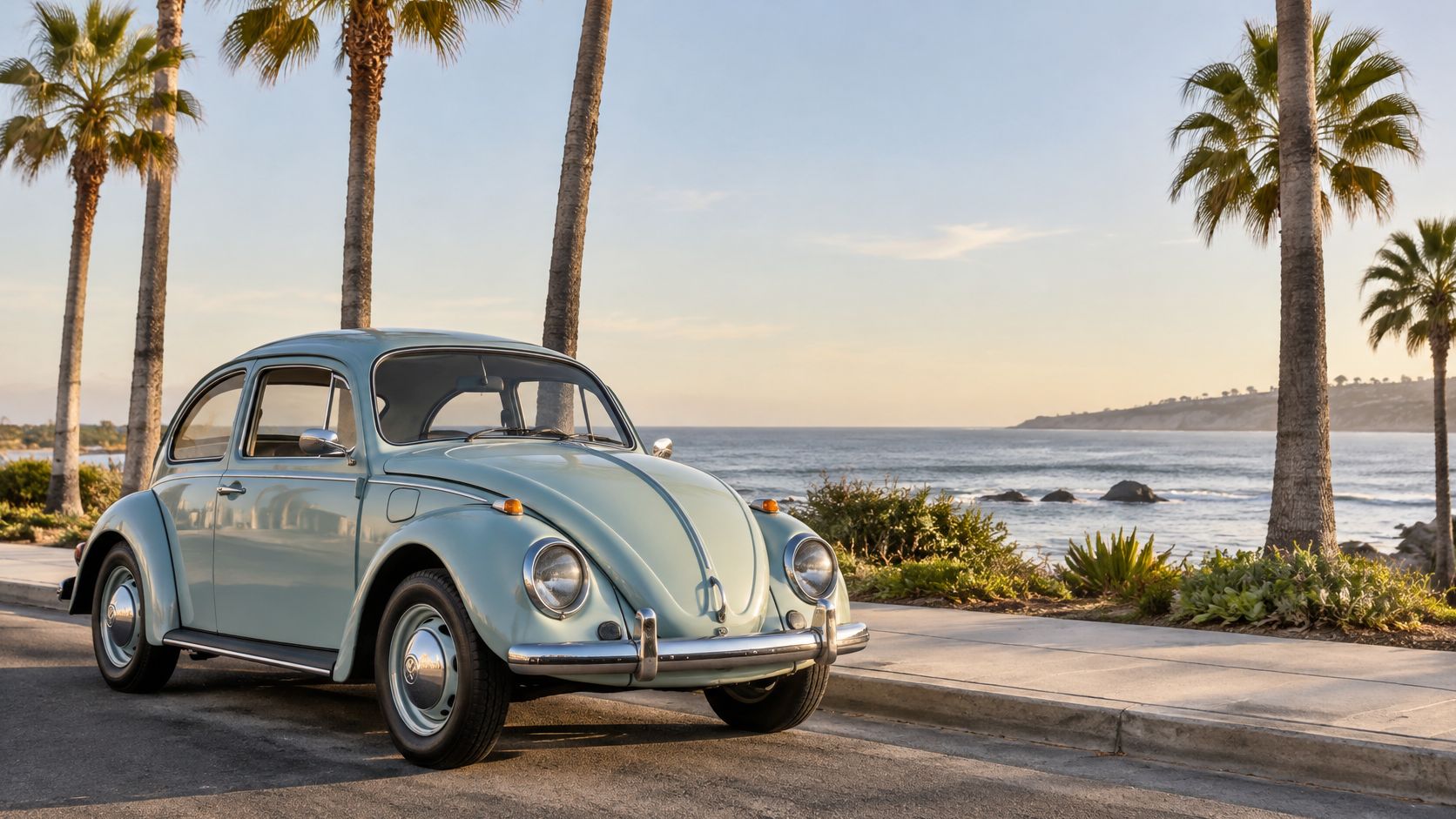
On a shared trailer out of Jacksonville, the smallest classic in the row is usually a Volkswagen. Beetles, Type 2 Buses, and Karmann Ghias are light, narrow, and easy to place, which makes them some of the cheapest classics to move between the mainland and San Juan when your dates can flex.
The labels matter less than the paperwork. What counts as vintage or classic depends on which club you ask and how old the car is, and plenty of owners keep a newer collectible alongside an older one. A 1972 Super Beetle won't satisfy every club's definition. It still gets the same photo-supported inspection on the Bill of Lading at pickup and delivery, and a mainland-to-San Juan move still runs through the same ocean leg and arbitrios paperwork as any bigger classic.
A light car still needs a paper trail
A 1972 Volkswagen Super Beetle often ships as the family car after a move to San Juan. A 1964 Type 2 goes to a surf-culture collector. A 1970 Karmann Ghia convertible may be headed to Ponce for rust work, not Sunday driving.
Share the deck when you can. A small running Beetle on a flexible window is the case for open transport or a shared enclosed spot. A restored convertible earns its enclosed space, which keeps weather, road debris, and prying eyes off the car.
Ask how it ties down. The right answer is soft straps over the tires, never chains on the frame or axles, plus wheel nets inside an enclosed trailer.
Strap the top. Cover soft panels so they don't flap on the barge.
Watch the fluids. Air-cooled engines seep oil, so note any drip on the condition report and keep fuel to the level the carrier asks for.
Shoot the floorpans. Undercarriage rust is the dispute that shows up in San Juan if you skipped it at pickup.
A project car that won't start can still move. Inoperable classics load on a winch-equipped enclosed trailer as long as they roll, steer, and brake, and the condition has to be declared at booking. Say it before the car reaches the terminal lot, where a seized brake is a bad discovery.
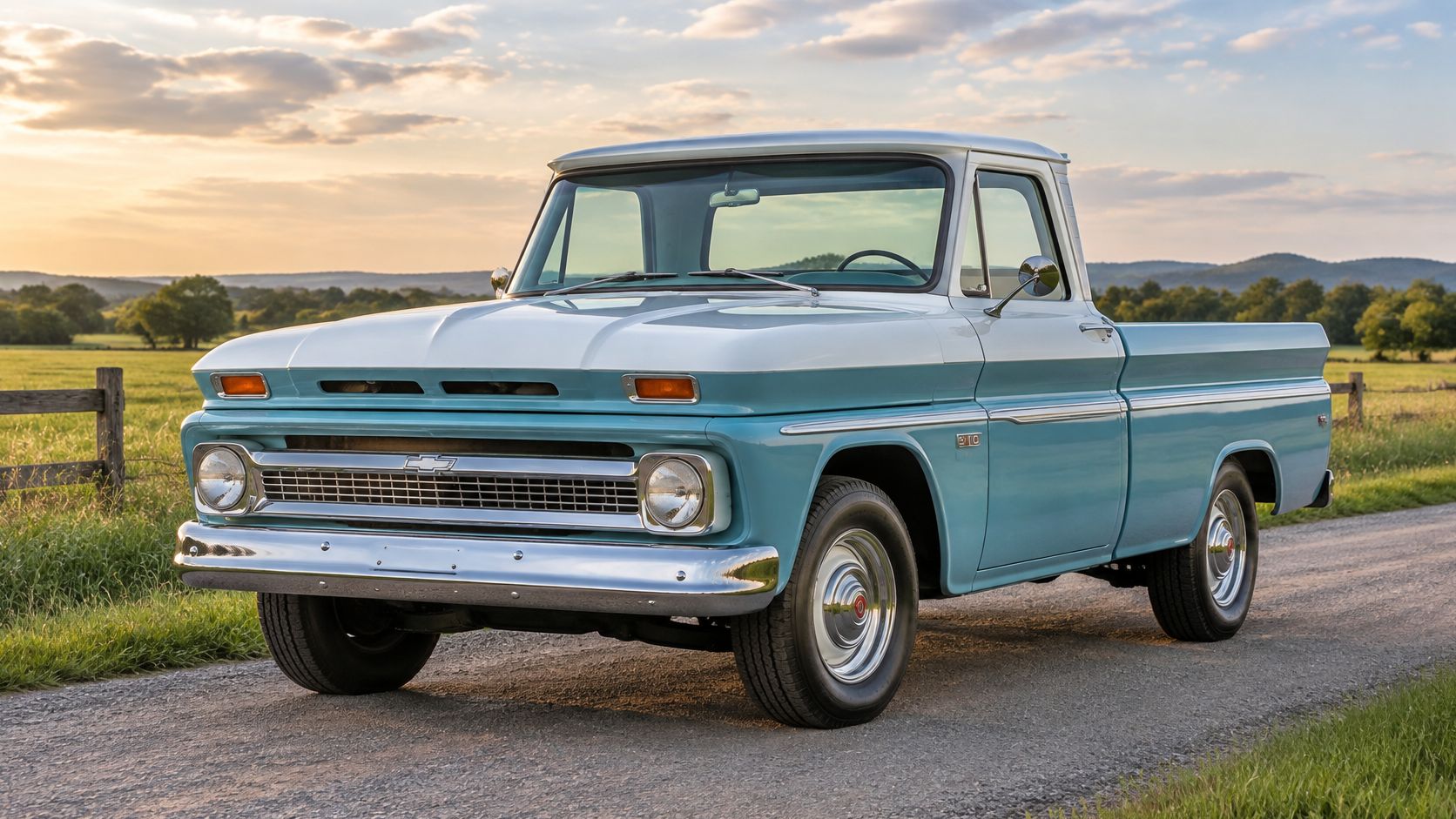
4. Classic American Pickup Trucks
A C10, an F-100, or a 1970s Dodge isn't a coupe with a bed bolted on. Body-on-frame trucks from the 1960s and 1970s haul on farms, job sites, and small businesses across Puerto Rico, and they also ride along when an owner relocates. Length, height, and a lift kit change the quote more than the badge does.
Taste is already moving that way. In Hagerty's 2024 Future of Driving survey, SUVs led at 38%, sedans followed at 26%, and pickup trucks sat at 19%. Gen Z interest in owning a classic was 60%, against 31% of Baby Boomers. A truck buyer on the island may be a contractor, not a concours judge. Treat the booking like freight with a title.
Picture a 1967 Chevrolet C10 for a farm outside San Juan, a 1971 Ford F-100 on a military move, or a restored 1978 Dodge Li'l Red Express for an island show.
Measure height, length, and weight with the bumper, rack, and tires that are actually on the truck. A number from a stock brochure will not fit the deck.
Disclose the extras. Lift kits, custom bumpers, and oversized tires have to be on the order before dispatch.
Empty the bed. Loose tools and an unstrapped tonneau cover are how glass gets cracked.
Say if it runs. A non-runner needs winch handling and a declared condition. If it only rolls, steers, and brakes, that still has to be on the booking.
Interstate legs before the port are a separate clock from the sailing. Our interstate classic transport notes walk through that handoff.
5. Classic Japanese Sports Cars
The 1971 Datsun 240Z, Toyota Celica GT, first-generation Mazda RX-7, and Toyota Supra MK3 are the cars younger buyers inquire about, then ask us to land in San Juan. They're lighter than a land yacht, parts are findable, and a lot of them still start. They're also full of bolt-on spoilers that don't survive a low trailer door.
Auction rooms have been kind to this era. Magneto's Monterey Car Week 2025 recap reported an 83% sell-through for 1980s cars, while 36% of 1990s cars offered sold above their top estimate. A weekend-track 240Z and a military family's Supra are both real bookings, not speculative trends.
What fails in transit
A 1971 Datsun 240Z for a weekend-track owner, a 1985 Supra MK3 on a permanent change of station, and a 1980 RX-7 into a San Juan garage all need the same intake. Running or not. Spoilers on or off. Leaks already in the floors.
Confirm running status first. That choice picks open, enclosed, or a winch trailer.
Pull race aero. If a wing stays on, it goes on the inspection report with a photo.
Date the paint chips. Pre-existing rash is how you avoid a delivery argument.
Check the carpets. Trapped water from a sunroof or hatch seal turns into mold on a warm barge. Dry it before pickup, not after.
These cars often clear ramps that a Corvette will not. Don't spend exclusive-trailer money unless the car is low, rare, or freshly painted. Shared enclosed space is the sensible middle.
6. Classic Luxury Sedans and Land Yachts
A 1976 Cadillac Fleetwood Brougham for an estate in San Juan, a 1966 Lincoln Continental convertible for a collector in Rincon, and a 1972 Mercedes-Benz 300SEL 6.3 on a corporate transfer all fail the same way. Someone booked them like a modern sedan. They're longer, heavier, and full of wood, leather, and loose trim that shifts when the barge rolls.
The shipping receipt is not the tax filing. Hacienda calls the Declaración de Arbitrios the document that lets you pay tax on merchandise brought into Puerto Rico, and it keeps separate motor-vehicle excise procedures. A bill of lading doesn't replace that declaration. Electronic options include ACH debit, credit card, and ACH credit where the requirements fit. For some alternative-fuel or hybrid reimbursement files, Hacienda specifically wants a copy of the bill of lading, so keep the ocean paper after delivery even on a gasoline Fleetwood. The tax follows Hacienda's valuation and the vehicle class, not the price you paid in Philadelphia.
Length, trim, and value
Send exact length and weight before we schedule. A Continental convertible with the top stack eats deck space a coupe doesn't.
Strip personal items. Ashtrays, brochures, and loose dash pieces shouldn't ride in the door pockets.
Photograph the cabin. Seats, dashboard, and brightwork, not just the outside.
Match coverage to the car. Ask for a limit that tracks an agreed value, not a guess from a quick sale. Enclosed quotes for these cars are written per vehicle, with a maximum of six on a trailer.
Estate cars and dealer inventory both move on this lane. If a lien is still on the title, fix that before the port date. Our take on when the enclosed premium pays for itself is in is enclosed car shipping worth it.
7. Classic Convertibles and Roadsters
Puerto Rico's weather is why these cars move. A 1962 Chevrolet Corvette C1 for a San Juan show, a 1965 Triumph TR4 with a seasonal resident, and a 1966 Ford Thunderbird convertible on a military relocation all have one weak point. The top.
First-generation Corvettes, the C1 cars built from 1953 to 1962, sit with postwar American sports cars rather than muscle. Hagerty's popularity read had their median condition-2 value up 11% over five years, with average values up 9%. That's a soft top and a fiberglass body riding a number you don't want to explain to an adjuster.
How the top should travel:
Latch it shut. Use the factory locks or straps. A half-folded top becomes a sail.
Ask before you add a cover. A breathable cover is fine only if the driver allows it.
Log the seals. Door glass and window fit go on the condition report. Water finds the gap you didn't photograph.
Prefer enclosed when the top, interior, or original paint is the value. We recommend enclosed for classic and luxury cars because it blocks weather, road debris, and casual looking.
Wedding and show dates are the bookings that can't slip a week. Timing for those open cars is laid out in our classic car wedding transportation piece. Snowbirds who split the year between a northern state and the island should book the southbound leg before fall capacity tightens, and the northbound leg before spring.
This short walk-through shows the tie-down and inspection habits that keep a soft top intact.
8. Vintage Jeeps and Military Surplus Vehicles
A 1944 Willys MB restored for a San Juan military history museum, a 1975 CJ-5 on a permanent change of station, and a 1985 CJ-7 headed to a family in Ceiba are boxy, tough, and still easy to damage. Doors, bows, and windshields that aren't latched become loose cargo. High-lift springs change the ramp angle.
Older iron is exactly where the tax estimator goes blank. Hacienda's SURI vehicle estimator lets you search by VIN, up to 17 characters, or by make, model, and year. The VIN is also on the title or registration. When the record isn't in SURI, which is common for older vehicles and for current-model-year cars, Hacienda points you to its office for a valuation off the official Black Book. Check that number before the Jeep ships. Mainland purchase price and freight are not the arbitrio.
What to secure
Doors, soft tops, and windshields. Strap them or take them off. A folding windshield that slams on a ramp is a glass claim.
Spares, racks, and winches. Fasten them or remove them. A swinging spare is a fender dent waiting.
Frame and missing parts. Rust, a bent frame, and absent panels belong on the pickup report.
Ramp angle. A lifted CJ needs the same clearance conversation as a lowered Corvette, just from the other direction.
If the Jeep is leaving mainland registration for good, keep the title lien-free and separate any export or entry papers from the carrier's bill of lading. Military families should send orders and a delivery window early. Museum pieces that don't drive still have to roll, steer, and brake for a winch load, and that condition has to be declared when you book.
Classic Car Types Compared
Each category above loads differently at the port. Read every row as a carrier-matching decision: era hints at parts fragility, body style sets the ramp and tie-down questions, and the challenge column names the issue most likely to surface on a condition report.
| Type | Typical Era | Body Style | Shipping Priority | Key Transport Challenge |
|---|---|---|---|---|
| American Muscle Cars | Late 1960s–early 1970s | Two-door coupes and hardtops | Enclosed transport often preferred for restored examples | Heavy weight and documenting rust or pre-existing damage |
| Classic European Sports Cars | 1950s–1970s | Two-seat roadsters and coupes | Enclosed transport frequently recommended | Low ground clearance and fragile components |
| Vintage Volkswagen Beetles and Air-Cooled VWs | 1930s–1970s | Compact cars, convertibles, and vans | Cost-efficient open transport is often suitable | Documenting rust and protecting tops and seals |
| Classic American Pickup Trucks | 1960s–1970s | Body-on-frame pickups | Match carrier to truck dimensions and weight | Heavy weight, modifications, and non-running condition |
| Classic Japanese Sports Cars | 1970s–1980s | Sporty coupes and hatchbacks | Enclosed transport is often chosen | Rust, specialized components, and trim condition |
| Classic Luxury Sedans and Land Yachts | 1950s–1980s | Large luxury sedans and convertibles | Enclosed or specialized transport often needed | Large size, weight, and delicate interiors |
| Classic Convertibles and Roadsters | 1950s–1970s | Open-top sports cars and roadsters | Enclosed transport often recommended | Protecting soft tops, seals, and interiors |
| Vintage Jeeps and Military Surplus Vehicles | 1940s–1980s | Compact open-body 4×4 vehicles | Standard transport with suitable ramp clearance | Securing removable parts and accommodating high ground clearance |
Two rows can share a decade and still need different trailers. A 1970s land yacht and a 1970s Beetle differ sharply in deck weight and footprint, and that gap decides trailer assignment before the quote settles. Match the carrier to the row, not just to the budget.
Ship Your Classic the Right Way, Mainland to San Juan and Back
Whatever sits in the garage, the basics don't change with the badge. Enclosed transport is the right call for value, original paint, and low clearance, and it is the method we recommend for classic and luxury cars because it shields them from weather, road debris, and prying eyes. Open transport is the economical path dealerships already use for new vehicles, and it can fit a driver-grade Beetle or a work truck if you accept weather and road dust. Document condition with photos on the Bill of Lading at both ends. Have the title, registration, bill of sale, and Hacienda paperwork in one folder before the port date. A carrier receipt still isn't the Declaración de Arbitrios.
National Car Transport is the desk that runs this lane. 25+ years in the business, an A+ BBB rating, and transparent flat-rate pricing with insurance included. A network of 25,000+ vetted carriers. Bilingual English and Spanish agents based in the USA support every file. Classic cars ride enclosed trailers with soft tie-downs over the tires and wheel nets, hydraulic low-clearance loading, and photo-supported inspections at pickup and delivery. We never chain a collector car to the frame or the axles.
A dedicated agent stays on your file from the first quote to the driveway, in San Juan or in any U.S. state. Military report dates, snowbird seasons, student moves, estate cars, and dealer inventory all get the same intake, because no two shipments are alike. Say whether the car runs. A non-runner can still move on a winch-equipped enclosed trailer, but it has to roll, steer, and brake, and you declare that condition at booking, not at the dock. Say if it's a show piece or a driver. Say which port side you're starting from, Jacksonville, Philadelphia, or the island. We'll match open, enclosed, or a winch trailer, and we'll keep the steps short.
If you're a dealer moving several classics, or a family moving one, request the flat-rate quote before you pick a sailing. That's how the car, the papers, and the trailer stay aligned.
National Car Transport moves classic cars door to door between any U.S. state and San Juan, with open or enclosed carriers and ocean options for the island leg. If your Mustang, Jeep, Corvette, or land yacht needs a vetted driver, a photo bill of lading, and a bilingual agent who already knows the port paperwork, start with a flat-rate quote. Visit National Car Transport and tell us the car, the direction, and the date you need it there.