
Is enclosed car shipping worth it if the biggest risk isn't the trailer price, but the way your vehicle must be loaded, insured, and handled? That question matters because a standard daily driver, a lowered sports car, a restored classic, and a vehicle moving by ocean freight to Puerto Rico don't face the same transport risks.
Open and enclosed car shipping are available throughout the continental United States, including routes serving Atlanta, Austin, Boston, Charlotte, Chicago, Cleveland, Columbus, Dallas, Denver, Detroit, Houston, Indianapolis, Jacksonville, Kansas City, Las Vegas, Los Angeles, Memphis, Miami, Milwaukee, Minneapolis, Nashville, New Orleans, New York City, Oklahoma City, Orlando, Philadelphia, Phoenix, Pittsburgh, Portland, Raleigh, Sacramento, Salt Lake City, San Antonio, San Diego, San Francisco, San Jose, Seattle, St. Louis, Tampa, Tucson, and Washington, D.C. Mainland-to-Puerto Rico moves add port coordination, container or ocean transport, and final delivery in or around San Juan.
Table of Contents
- Understanding the Enclosed Shipping Question
- Open Carriers vs Enclosed Trailers Explained
- The True Cost of Enclosed Auto Transport
- Scenarios Where Enclosed Shipping Makes Sense
- Insurance Coverage and Liability Realities
- Making Your Final Decision Framework
Understanding the Enclosed Shipping Question
Is enclosed car shipping worth the added cost when the vehicle, route, and handling requirements vary so much? A snowbird moving a restored convertible from Boston to Florida has a different risk profile from a military family relocating a newer SUV from Virginia to Texas. A dealership receiving an exotic from California and a student moving a reliable sedan between home and campus also need different answers.
The practical question is whether the specific protection and handling benefits justify the premium for your vehicle, route, and timing. Enclosure limits direct exposure to rain, snow, hail, dust, sunlight, and road debris. Open transport remains a professional, widely used choice for ordinary operable vehicles.
| Decision factor | Open transport | Enclosed transport |
|---|---|---|
| Weather and debris | Vehicle travels exposed to road grime and occasional debris | Vehicle is shielded from direct weather and road debris, as described in this industry comparison of open and enclosed transport |
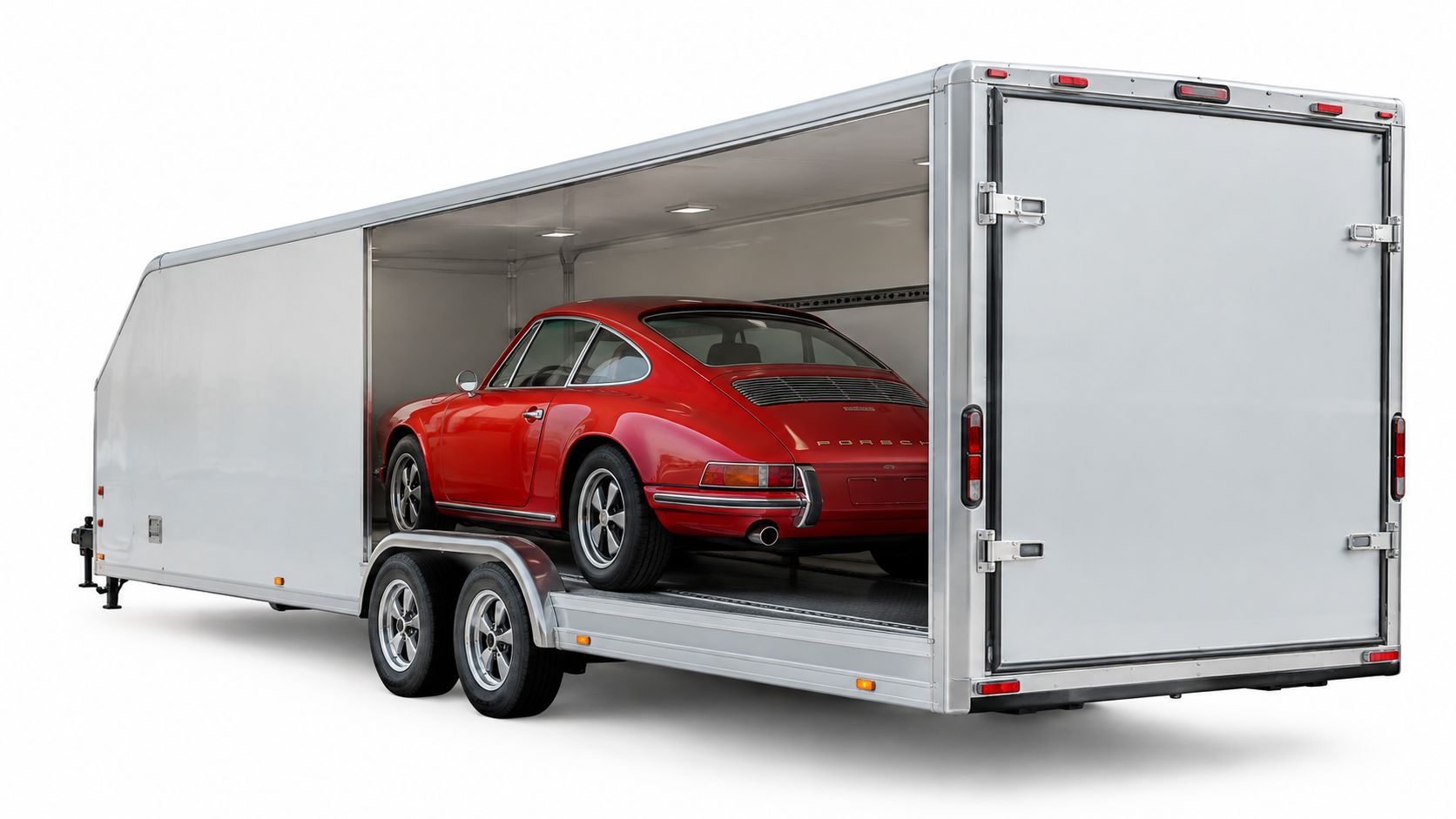
| Loading needs | Standard ramps work for most stock-height vehicles | Hydraulic liftgate loading is commonly available for low-clearance vehicles |
| Availability | Broad route coverage and generally easier carrier matching | Fewer carriers and lower capacity can mean more scheduling constraints |
| Best fit | Daily drivers, standard SUVs, pickups, and replaceable vehicles | Classics, exotics, modified cars, fresh wraps, and high-value vehicles |
| Price | Lower-cost option | Usually a premium service, often about 30% to 60% more than comparable open transport, per the FreightWaves open-versus-enclosed comparison linked above |
The most overlooked difference is often equipment compatibility rather than weather. A luxury daily driver with ordinary ground clearance may tolerate highway dust when its finish is replaceable. A freshly wrapped car with a low front splitter may require an enclosed trailer because the loading process presents the greater risk, even if the vehicle is not among the most expensive on the road.
The route changes the calculation
A dense route between major cities usually gives a coordinator more carrier choices than a remote pickup or an island shipment. Seasonal demand, vehicle dimensions, pickup flexibility, and specialized equipment can all affect the quote. The same vehicle may receive different pricing in different markets and at different times because enclosed equipment is not positioned evenly across the country.
Puerto Rico adds another planning layer. A vehicle traveling from a mainland origin to San Juan may require inland transport to a port, ocean or container service, customs documentation, and delivery after arrival. Enclosed protection may make sense for a classic, luxury vehicle, or delicate finish during the mainland leg. The booking should account for the entire movement as one coordinated shipment, rather than treating it like a standard interstate delivery.
A high-value daily driver and a collector car also deserve separate scrutiny. The daily driver may have meaningful replacement value but regular use, accessible parts, and a finish designed for road conditions. A collector car can carry restoration costs, originality concerns, and a narrower tolerance for handling or cosmetic changes.
Practical rule: Choose the transport method based on what could create a meaningful loss, not on how expensive the vehicle feels.
Open Carriers vs Enclosed Trailers Explained
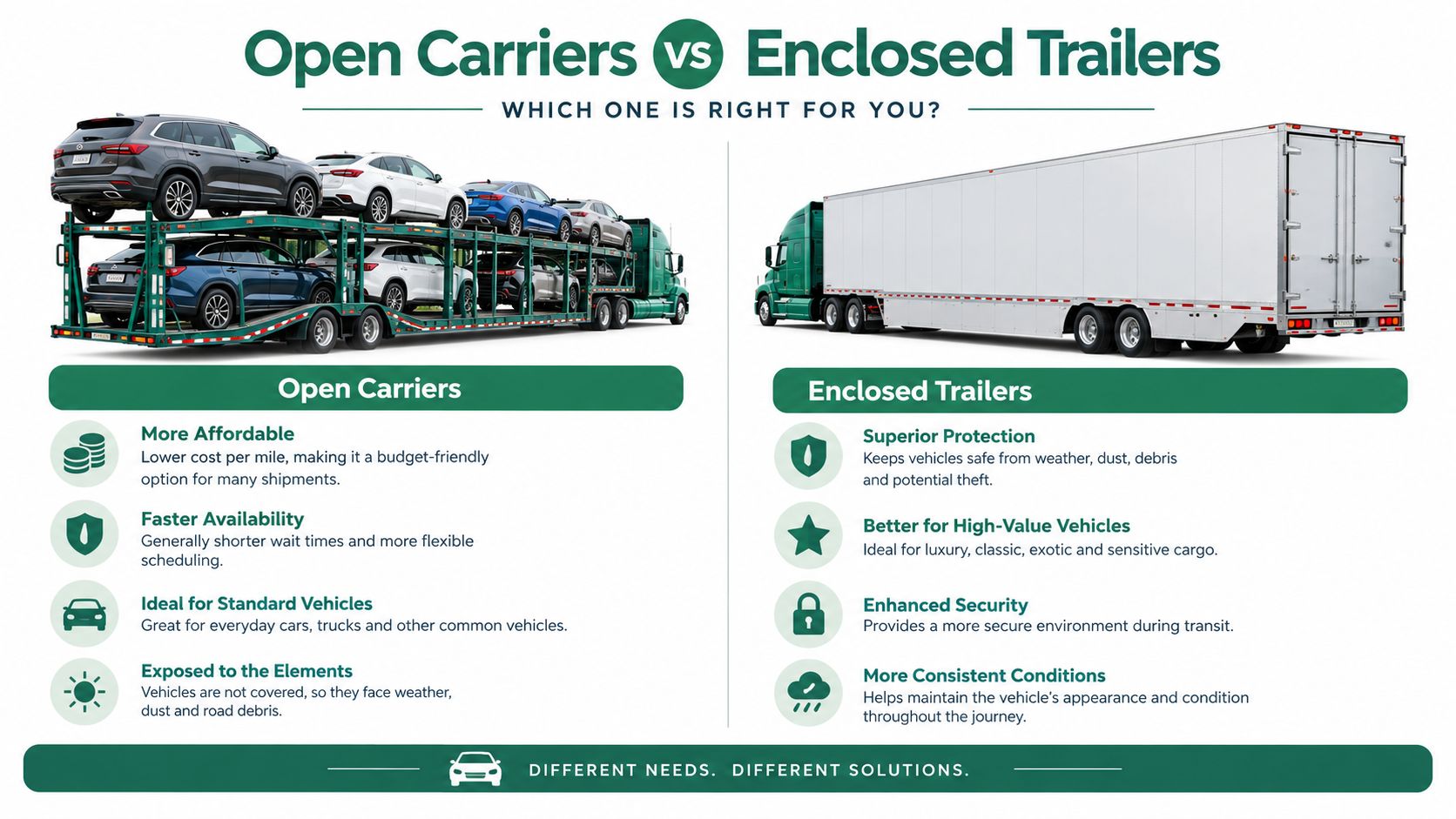
Open carriers are the familiar multi-level trucks used throughout the U.S. auto transport network. Their open sides and roofless design make loading and routing efficient, but the vehicles remain exposed to rain, snow, dust, sun, road spray, and debris. A car can arrive dirty without being damaged, yet exposure creates a cosmetic risk that some owners would rather eliminate.
Enclosed trailers function more like mobile garages. Solid or reinforced sides protect the vehicle from direct elements, and specialized operators often use soft straps and more deliberate loading procedures. Enclosed carriers move fewer vehicles per load, which helps explain both their higher price and their more limited availability.
Capacity affects scheduling
Open transport generally offers more route density because many carriers move standard vehicles between major population centers. That can make it easier to find a pickup opportunity for a family relocation, student move, dealership transfer, or ordinary car purchase.
Enclosed service requires a closer match between the trailer, vehicle dimensions, destination, and pickup conditions. A carrier may need suitable clearance, liftgate equipment, interior space, and a route that makes commercial sense. Fewer vehicles per load also mean the carrier has less capacity to spread operating costs across shipments. Customers may therefore face longer pickup lead times, particularly for rural locations, unusual vehicle dimensions, or dates with limited flexibility.
The open car transport service overview provides a useful reference point for customers whose vehicles are operable, stock-height, and suited to standard loading. That doesn't mean open transport is careless. It means the equipment is designed for a different risk profile.
Loading is where low-clearance vehicles separate themselves
A stock sedan usually reaches an open carrier through standard ramps. A lowered coupe, long-wheelbase exotic, or vehicle with a deep front splitter may not. Even a short change in approach angle can cause the bumper, undertray, exhaust, or side skirt to contact the ramp.
Hydraulic liftgate equipment can reduce that approach-angle problem by raising the vehicle to trailer level. Customers should confirm the actual equipment rather than accepting the word “enclosed” as a complete specification. Ask whether the trailer has a liftgate, how much clearance it can accommodate, whether the carrier uses soft straps, and whether the driver has handled similar vehicles.
A hard-sided trailer may offer a different interior height and loading arrangement from a soft-sided enclosed trailer. Vehicle length, width, height, tire condition, steering, and running status all affect fit. A coordinator who asks for photos, measurements, and details about modifications before quoting is doing useful work, not creating unnecessary friction.
The True Cost of Enclosed Auto Transport
Is the enclosed premium buying protection you will use, or only a higher number on the quote? Enclosed shipping costs more because the carrier provides a roof, specialized equipment, a lower-capacity trailer, different loading procedures, and access to a smaller pool of available trucks. On comparable routes, the premium commonly falls between 30% and 60%, depending on vehicle size, route density, season, and carrier availability, according to the route and service comparison published by Moving Rated.
For a move under 500 miles, the same comparison places enclosed transport at roughly $600 to $1,200, compared with about $350 to $800 for open transport. For a trip exceeding 1,500 miles, enclosed service may cost around $1,500 to $3,000 or more, while open transport may run approximately $1,000 to $1,900. Treat these figures as planning ranges, not guaranteed quotes.
What the premium buys
The premium can exceed $500 to $1,000 on many routes, but it varies by shipment. A standard sedan moving coast to coast may receive an enclosed quote around $1,600 to $2,200, compared with roughly $1,100 to $1,600 for open transport. The comparison identifies a premium often near $500 to $625.
The added cost pays for several specific differences:
- Shielding: The vehicle avoids direct exposure to highway weather, dust, and debris.
- Handling: Specialized carriers may use hydraulic liftgates and soft-strap procedures.
- Capacity: Fewer vehicles share the trailer, so each shipment carries more of the trip cost.
- Availability: A smaller enclosed fleet can make positioning and scheduling harder.
- Loading requirements: Low-clearance vehicles may require liftgate access or other equipment that costs more to dispatch.
A higher-priced trailer does not automatically provide broader insurance protection. Enclosed transport can reduce exposure to road debris and weather, yet the carrier's liability limits may still leave a gap between covered damage and the vehicle's market value. Ask what the policy covers, whether modifications are included, and how a claim would be valued before treating the premium as complete financial protection.
Compare the premium with the likely consequence of a blemish, wrap repair, paint correction, underbody scrape, or resale concern. A high-value daily driver may justify enclosure when its finish is expensive to repair or the vehicle is difficult to replace. A collector car may involve originality and parts availability, while an ordinary daily driver may only need a post-trip wash. The right decision depends on the financial consequence, not the vehicle label alone.
Price changes across the United States and Puerto Rico
A mainland route between large cities may be easier to cover than a rural pickup requiring a specialized carrier to travel out of its way. Quotes also change with narrow pickup windows, oversized vehicles, non-running conditions, and equipment requirements.
Puerto Rico introduces inland and ocean logistics. A vehicle traveling from Los Angeles, Chicago, Atlanta, New York, or another mainland location to San Juan may first need mainland transport to a port, followed by container or ocean movement and destination delivery. Enclosed handling can protect the vehicle before the port, but customers should ask how it will be secured, documented, and transferred at every stage.
A transparent quote should identify the transport method, pickup and delivery locations, vehicle condition, required equipment, and port-related services. National Car Transport's car shipping cost information helps explain why a flat-rate estimate must account for the actual route and vehicle requirements rather than mileage alone.
Scenarios Where Enclosed Shipping Makes Sense
Enclosed transport makes the strongest financial case when a particular risk has a clear consequence. The car doesn't need to be a museum piece. It may be a vehicle whose finish, clearance, condition, or replacement difficulty makes ordinary exposure unacceptable.
Collector and classic vehicles
A classic car can lose more than cleaning convenience when it arrives with a chip, scrape, or damaged original component. Paint matching may be difficult, period-correct parts may be unavailable, and a restoration owner may care about preserving originality even when the vehicle's book value doesn't fully capture its significance.
For those shipments, the question isn't “Can the carrier replace the part?” It is “Can the carrier restore the vehicle to the condition and authenticity it had at pickup?” The answer may be no. An enclosed trailer reduces exposure and gives the owner a more suitable handling environment. Customers arranging classic car shipping should discuss photographs, battery status, tire condition, ground clearance, alarm systems, and any nonstandard controls before dispatch.
Low-clearance and modified vehicles
A lowered vehicle may need enclosure because of loading geometry, not prestige. Front splitters, side skirts, extended exhaust components, air suspension, and custom undertrays can make a standard ramp unsuitable. A wrapped car has a different concern. Road grit and weather may not destroy the wrap, but they can undermine the owner's effort to preserve a carefully finished exterior.
Use this screening process before accepting a quote:
- Measure the vehicle accurately. Report the lowest point, total height, width, and length, including aftermarket parts.
- Describe how it runs. A vehicle that cannot steer, roll, or brake may require winch or liftgate support.
- Ask about the trailer. Confirm liftgate availability, interior clearance, soft straps, and loading experience.
- Send photographs. A side profile and front-angle image can reveal clearance issues that a generic vehicle description misses.
High-value daily drivers
A high-value daily driver requires more judgment than a classic. A modern luxury SUV may have a substantial purchase price but a durable factory finish, standard clearance, and readily available replacement parts. Enclosure may still be reasonable, particularly for a long route or a customer who places a high value on pristine delivery, but the financial case isn't automatic.
A high-value vehicle also needs a review of cargo coverage, not just a discussion of weather. If the carrier's policy cannot support the vehicle's declared value, an enclosed trailer alone doesn't close the financial gap. That is why the best quote conversation covers vehicle value, equipment, insurance, route, and delivery inspection together.
Insurance Coverage and Liability Realities
Enclosure lowers exposure, but it doesn't turn a shipment into a risk-free transaction. The carrier's cargo policy determines how much financial recovery may be available if covered damage occurs, and the policy limit may apply across multiple vehicles rather than to one vehicle individually.
One industry summary describes a federal baseline of $5,000 per vehicle and $10,000 per occurrence, while enclosed carriers often carry much higher cargo limits, commonly $250,000 to $1,000,000, according to this comparison of enclosed and open transport insurance considerations. Customers shouldn't assume that every carrier has the same policy or that a larger trailer automatically means sufficient coverage.
Ask for the policy, not a reassurance
Before pickup, ask for the carrier's current certificate of insurance and verify:
- Cargo limit: Is the vehicle's value within the applicable limit?
- Policy scope: Does the policy address collision, loading damage, theft, weather, and debris?
- Deductible: Who pays it, and under what circumstances?
- Exclusions: Are personal belongings, mechanical failures, pre-existing damage, or certain weather events excluded?
- Carrier identity: Does the certificate match the company and equipment assigned to the shipment?
An enclosed carrier may have higher cargo limits because it commonly handles more valuable vehicles, but the customer still needs to confirm the actual policy. A broker or coordinator that avoids sharing insurance information creates avoidable uncertainty.
Document condition at both ends
The bill of lading is the key condition record. At pickup, wash the exterior if practical, remove personal items, and photograph every side of the vehicle, including wheels, glass, bumpers, roof, and any existing scratches. Make sure the driver records pre-existing damage accurately before loading.
At delivery, inspect the vehicle in good light before signing the final condition report. Check the underside of low-clearance vehicles when possible, confirm that accessories and removable parts remain present, and record any new issue on the delivery paperwork. Insurance discussions become much harder when a customer notices damage after accepting delivery without documenting it.
Coverage is a recovery mechanism, not a substitute for careful loading, condition photos, and a carrier whose equipment fits the vehicle.
For Puerto Rico shipments, ask how responsibility is handled during mainland pickup, port transfer, ocean movement, and San Juan delivery. Those stages may involve different operating parties and documents. The shipment plan should explain who coordinates each handoff and where condition records are updated.
Making Your Final Decision Framework
The answer to “is enclosed car shipping worth it” becomes clearer when you score four factors: value, condition, clearance, and route.
Choose open transport when the vehicle is an operable, stock-height daily driver and the owner is primarily seeking an efficient move. A standard sedan, SUV, or pickup can be a sensible candidate, especially when the route is flexible and the customer accepts that the vehicle may need cleaning after transit.
Choose enclosed transport when one or more of these conditions apply:
- The car is a classic, collector vehicle, exotic, or freshly restored automobile.
- The vehicle has low clearance, aftermarket modifications, a wrap, or delicate exterior components.
- The car's value creates a meaningful gap between its worth and the carrier's available coverage.
- The route or season creates extended exposure to harsh weather, road debris, or road salt.
- The vehicle needs liftgate loading because it is non-running or difficult to load safely.
- The shipment involves a mainland-to-Puerto Rico move where the owner wants stronger protection during the inland portions and coordinated handling through San Juan.
For a practical quote comparison, request both methods from the same coordinator and provide identical information. Ask for the enclosed premium, carrier insurance limit, equipment details, pickup flexibility, port services if applicable, and the condition-inspection process. That gives you a real risk comparison instead of a vague promise of “extra protection.”
National Car Transport coordinates open and enclosed vehicle shipping through a network of 25,000+ vetted carriers, offers transparent flat-rate pricing, and has more than 25 years of experience with an A+ BBB rating. Its U.S.-based bilingual English and Spanish agents have more than 20 years of auto transport logistics experience, which can help individuals, snowbirds, military families, students, dealerships, and businesses plan shipments across the 48 states or to and from Puerto Rico. No two vehicle transports are alike, so having an experienced agent guide the equipment, route, and timing can make the process simpler and quicker at a practical value.
National Car Transport can arrange open or enclosed transport across the United States and coordinate mainland-to-Puerto Rico vehicle shipping, including route planning for delivery to San Juan. Visit National Car Transport to request a route-specific quote and speak with a bilingual U.S.-based agent about the protection and equipment your vehicle needs.