

You've just finished a painstaking restoration, or you've bought a classic car several states away, and the delivery date is tied to a buyer, a show, a move, or a flight. The car may look perfect in the garage, but the true test starts when a driver loads it onto a trailer. A missed tie-down point, a steep ramp, an incomplete condition report, or an unclear insurance process can turn a routine shipment into an expensive dispute.
Reliable classic car transport isn't defined by a polished sales pitch or the word “enclosed” on a quote. It means the vehicle is matched with suitable equipment, secured correctly, documented before and after transit, and supported by people who know what happens when something goes wrong. That standard applies to domestic moves across the 48 contiguous states, as well as mainland shipments to San Juan and other Puerto Rico destinations.
Table of Contents
- Shipping a Classic Car and Expecting It to Arrive Perfect
- What Reliable Classic Car Transport Actually Means
- Open vs Enclosed vs Container and Ocean Transport
- How to Vet a Carrier Before You Hand Over the Keys
- What Classic Car Shipping Really Costs in 2026
- Preparing Your Classic Car and the Pickup to Delivery Timeline
- Damage Claims, Common Myths, and Choosing the Right Partner
Shipping a Classic Car and Expecting It to Arrive Perfect
A restorer in California has spent two years completing a numbers-matching 1969 coupe. The paint is finished, the chrome is original, and the buyer in Florida has scheduled the car for a concours event. The delivery date isn't a preference. It controls the handoff, the inspection, and whether the vehicle appears at the event at all.
Reliable delivery in that situation means more than seeing the coupe arrive on a truck. The original chrome should be unmarked. The suspension should be settled. There shouldn't be fluid leaking beneath the car, and the paperwork should match the vehicle's condition at pickup. A classic car has irreplaceable trim, hand-shaped bodywork, older suspension components, and mechanical tolerances that can react badly to careless handling.
Dispatcher's rule: A classic car shipment is successful only when the vehicle, equipment, paperwork, and claims process all line up.
The same standard matters for a snowbird moving a restored convertible between states, a military family relocating a collector vehicle, a dealership sending a classic to an auction, or a business transporting a display car. Routes can begin in Los Angeles, San Francisco, Phoenix, Denver, Dallas, Chicago, Atlanta, New York, or any other major city across the United States, then continue to Florida, Texas, the Northeast, or a port serving Puerto Rico.
Four practical questions determine whether the move deserves your trust:
- How is the car restrained? The answer should cover the tires, the tie-down material, and the loading points.
- What environment will it travel in? Weather exposure, road debris, trailer suspension, and vehicle density all matter.
- What happens if damage is discovered? You need a carrier-specific insurance process and a stated deadline.
- What will prove the car's condition? Photos and a detailed Bill of Lading are essential.
The reliable option is the one that gives you auditable answers before pickup, not reassurance after a problem occurs.
What Reliable Classic Car Transport Actually Means
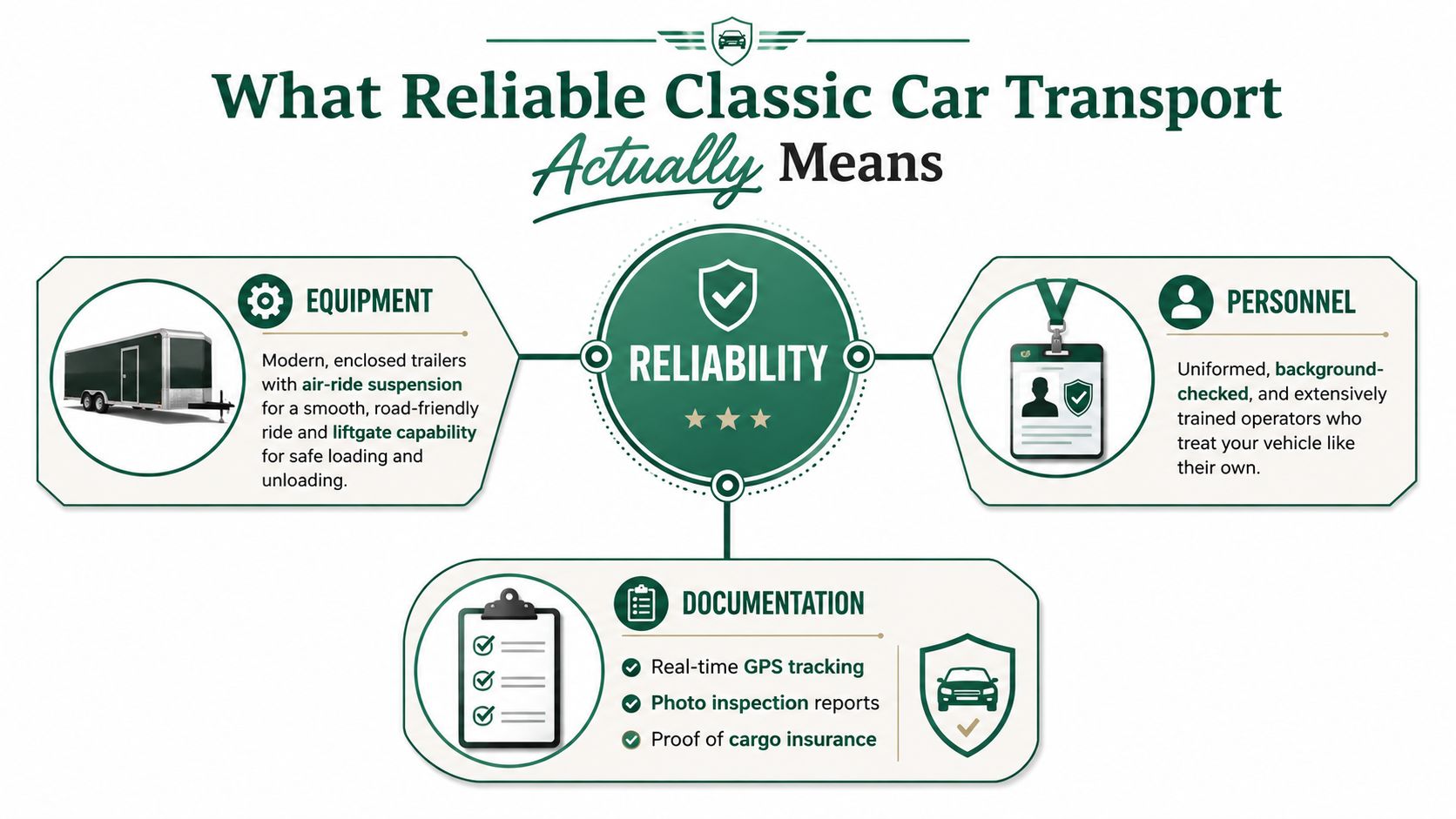
Reliable classic car transport is a documented chain of decisions. The right provider can explain the trailer, the driver, the restraint system, the insurance, the inspection process, and the claims contact without sending you from one vague answer to another.
Equipment must match the vehicle
For valuable classics, I recommend an enclosed trailer with air-ride suspension, soft-tie or wheel-net securement, and hydraulic or low-angle loading equipment when available. Low ground clearance makes the approach angle a major risk. A steep ramp can scrape a valance, exhaust, splitter, or rocker panel before the car has even entered the trailer.
The restraint baseline should be full four-point securement. Federal carrier guidance requires automobiles, light trucks, and vans to be restrained at both the front and rear with a minimum of two tiedowns, while wheel-type tiedowns must restrain movement in all three axes. The federal securement standard provides the technical reference.
In practice, the driver should secure the tires independently of the trailer walls, use soft material at the wheel or tire contact points, and prevent lateral, forward, rearward, and vertical movement. Chains should never contact chrome, painted suspension parts, or delicate bodywork. Equal tension across all four corners and a final walk-around before the trailer closes are basic quality control.
People and paperwork complete the system
A single assigned dispatcher should know the vehicle's modifications and delivery requirements. The driver should be able to discuss classic-car loading from experience, not improvise at the curb. You also need a claims contact who responds promptly when the delivery inspection raises a question.
The paperwork should include a written Bill of Lading, pre-existing damage photos, the carrier's active federal authority, and a certificate of insurance showing cargo coverage and limits. The carrier should also provide a clear claim timeline. If the dispatcher can't answer each item before booking, the move isn't ready.
Open vs Enclosed vs Container and Ocean Transport
Choose the transport method based on the car's condition, finish, clearance, value, and route. Open transport costs less and is widely available, but the vehicle remains exposed to weather, road film, and debris. Enclosed transport adds a roof and sidewalls, generally carries fewer vehicles, and gives delicate finishes a cleaner operating environment. Container and ocean transport add protection for international and island routes, while introducing port handling, vessel schedules, and additional custody handoffs.
Industry summaries report that open carriers commonly move 7 to 10 vehicles per trailer, while enclosed carriers usually handle 1 to 6 vehicles. Enclosed transport typically costs 30% to 60% more than open shipping, with reported enclosed rates around $1.00 to $2.50 per mile. Shipments under 500 miles commonly fall between $600 and $1,200. The enclosed transport industry summary connects trailer capacity with protection and price.
| Method | Avg. Cost per Mile (USD) | Protection Level | Typical Equipment | Best For |
|---|---|---|---|---|
| Open | Lower than enclosed | Basic exposure protection | Open multi-car trailer, standard ramps, vehicle tie-downs | Project cars and usable classics where budget matters |
| Enclosed | $1.00 to $2.50 per mile | High protection from weather and road debris | Hard-sided trailer, soft ties, wheel nets, possible air ride and liftgate | Valuable drivers, restored cars, show vehicles, and low-clearance classics |
| Container and ocean | Route-specific | Highest protection for vessel movement | Steel container, blocking and securement, ocean or barge service | Trailer queens, international shipments, and mainland-to-Puerto Rico moves |
An everyday classic may travel open when its condition and value justify the exposure. I recommend enclosed transport for freshly restored cars, custom builds, original finishes, low-clearance vehicles, and cars headed to a show or auction. For the highest-value vehicles, container service fits routes that include ocean freight, provided the blocking, restraint, and handoff records are documented.
Puerto Rico requires a separate logistics plan. Mainland vehicles generally travel through an ocean segment rather than a continuous over-the-road route. Crowley reports that the San Juan to Jacksonville voyage takes about two and a half days by ship, while barge service can take six days to a week. Crowley's Puerto Rico vehicle-shipping guidance explains how vessel scheduling affects delivery timing and custody changes.
Before booking, obtain the equipment plan in writing. Confirm air-ride suspension, soft ties, wheel nets, suitable ramps, and a liftgate when clearance requires it. “Enclosed” describes the trailer body, not the handling standard. Review this guide to enclosed auto transport for collector vehicles, then require the carrier to document loading, restraint, and each handoff.
How to Vet a Carrier Before You Hand Over the Keys
Treat carrier selection like a document audit. A legitimate provider should show active operating authority and insurance filings. FMCSA guidance explains that for-hire interstate carriers must obtain operating authority and file proof of insurance and supporting documentation through the federal registration system. FMCSA licensing and insurance requirements give shippers a concrete verification point.
Verify the company before discussing convenience
Ask for the carrier's MC or DOT information, then check its status through the FMCSA SAFER system. Confirm that the authority is active and that the listed company matches the party responsible for transporting the car. Don't rely on a logo, a review page, or a salesperson's promise.
Request cargo insurance details in writing. The certificate should identify the carrier, policy information, expiration date, and applicable cargo limits. If a broker arranges the shipment, identify the actual carrier and verify that the carrier's coverage applies to your vehicle.
Inspect the equipment plan
The dispatcher should answer these questions without hesitation:
- What experience does the assigned driver have with classic or low-clearance vehicles?
- Will the car travel in an enclosed trailer?
- Does that trailer use air-ride suspension?
- Will the driver use soft-tie straps or wheel nets over the tires?
- Where will the straps contact the car?
- Is a hydraulic liftgate or low-angle ramp available?
- Will the driver complete a detailed photo inspection at pickup?
- How will weather affect the route, especially on Puerto Rico shipments?
- Who is responsible if an owner-operator is subcontracted?
- Does that subcontracted carrier carry separate cargo coverage?
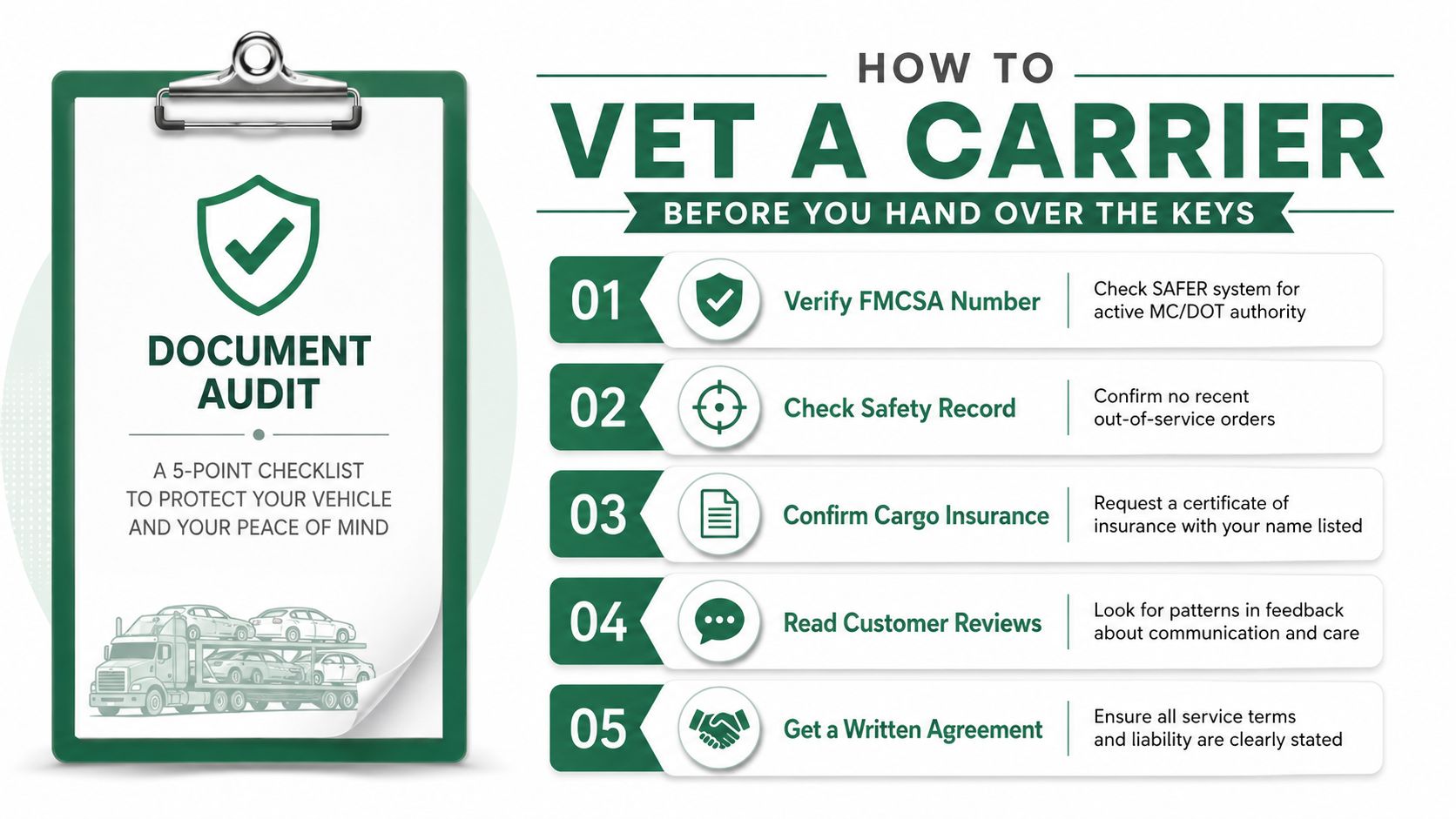
Pay attention to the answers, not just the price. A carrier that can't explain how it will load a low-slung classic won't become more careful after pickup.
A short video can help owners understand the carrier-vetting conversation and the questions that should be answered before booking.
What Classic Car Shipping Really Costs in 2026
A responsible quote starts with published ranges, then becomes vehicle-specific. Enclosed transport costs more than open service because the trailer carries fewer vehicles and may require specialized loading or suspension equipment. Vehicle size, condition, route, timing, and delivery requirements can change the final price.
Published enclosed-rate summaries place pricing at $1.00 to $2.50 per mile, while shipments under 500 miles commonly range from $600 to $1,200. Published enclosed auto transport pricing provides a planning benchmark, not a guaranteed rate for your route.
| Cost Driver | Typical Impact | 2026 Range |
|---|---|---|
| Enclosed equipment | Adds cost for covered space and lower vehicle density | 30% to 60% above open transport |
| Enclosed mileage | Depends on route and trailer availability | $1.00 to $2.50 per mile |
| Short domestic move | Often priced as a minimum shipment | $600 to $1,200 under 500 miles |
| Vehicle dimensions | Low, wide, tall, or non-running vehicles may need specialty handling | Quote-specific |
| Puerto Rico ocean segment | Adds vessel, port, and handoff planning | Quote-specific |
A published range is not a booking price. The carrier needs the vehicle's year, make, model, running condition, dimensions, pickup location, destination, transport method, and timing before pricing the move responsibly.
Puerto Rico requires tighter documentation. Crowley asks customers to provide the vehicle's make, model, year, current market value, weight, and measurements in cubic feet during booking. Crowley's Puerto Rico booking requirements explain why an island quote cannot be calculated from origin and destination alone. Those details support the same auditable handoff process used for a domestic move, with added vessel and port coordination.
National Car Transport publishes an estimated Puerto Rico range of $895 to $1,495, including ocean freight, on its carrier website. National Car Transport's published pricing information presents that figure as an estimate, so confirm the vehicle details, route, services, and timing before booking.
For a closer examination of the variables behind a quote, review classic car shipping cost factors. Ask what equipment, insurance, inspection records, restraint method, claim handling, and ocean or over-the-road services the price includes. A low number without that documentation is not a reliable comparison.
Preparing Your Classic Car and the Pickup to Delivery Timeline
Preparation creates the evidence that makes a delivery inspection useful. Start with a clean vehicle, good daylight, and a camera that can capture small paint marks, chrome imperfections, glass chips, interior stitching, and wheel condition.
Two weeks before pickup
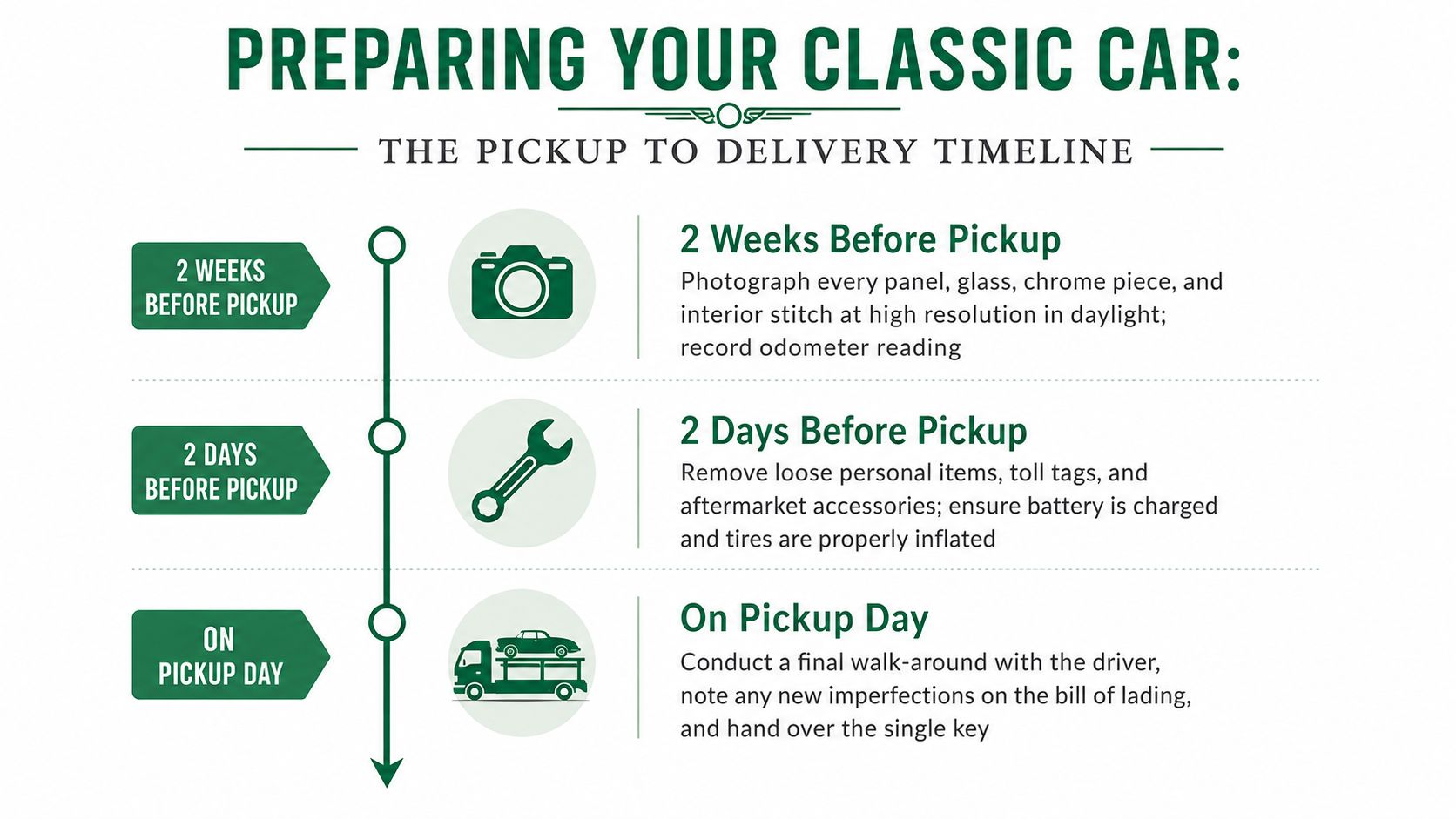
Photograph every exterior panel, window, trim piece, wheel, and interior surface. Record the odometer and fuel level, then save the files with the date and vehicle identification. Check the battery and tire pressures, disable alarm systems, and tell the dispatcher about lowered suspension, nonstandard starting procedures, oversized tires, or anything else that affects loading.
Remove personal property and loose accessories. Keep the title and important documents with you rather than inside the car. For additional paint-care guidance before handling, owners can review Titan Coatings flawless finish.
Pickup day
Walk around the vehicle with the driver and compare every panel to your photographs. Read the Bill of Lading line by line. Existing dents, chips, scratches, missing trim, and mechanical issues should appear in writing before loading begins.
Confirm the loading approach and the tie-down points. Ask the driver to use soft ties over the tires, avoid chrome and suspension components, and use the liftgate or low-angle ramp if the car needs it. Keep the keys, title, contact information, and spare paperwork separate from the vehicle, and hand over only the key needed for transport.
For door-to-door planning across the mainland or into the San Juan metro area, review door-to-door auto transport service. Door-to-door doesn't eliminate every handoff on an ocean route, so Puerto Rico customers should confirm the port and final delivery arrangements in writing.
Delivery day
Inspect the car in daylight before signing. Compare the current condition with the pickup report and photographs, checking the roof, hood, bumpers, chrome, glass, wheels, underside, and interior.
Write any new damage on the Bill of Lading before the driver leaves. Then follow the carrier's stated claim deadline. Guidance varies, but one carrier instruction requires notice within two working days, while another advises documenting damage immediately before leaving the delivery site. Damage-claim handling guidance shows why you should get the exact timeline before pickup, not after a dispute begins.
Damage Claims, Common Myths, and Choosing the Right Partner
Enclosed transport protects against weather and road debris. It doesn't excuse poor loading, careless restraint, rushed inspections, or weak claims administration. The carrier's cargo insurance is the relevant transport protection, not a broker's general policy or an owner's personal auto insurance.
The most common failure points are practical. A soft tie can be positioned incorrectly, a low car can scrape during liftgate loading, a terminal transfer can add an avoidable handoff, and a rushed condition report can make a later disagreement harder to resolve.
Claims rule: Photograph first, write the exception on the Bill of Lading, notify the carrier immediately, and keep every estimate and message.
| Myth | Reality |
|---|---|
| Enclosed transport guarantees no damage | It reduces exposure, but equipment and driver discipline still determine handling quality. |
| The broker's insurance automatically covers the car | Confirm the actual carrier's cargo coverage and limits in writing. |
| A verbal promise about delivery is enough | The route, timing, equipment, and claims terms belong in written documents. |
| Door-to-door means there are no port handoffs | Puerto Rico shipments require an ocean segment and coordinated handoffs. |
| Any classic-car insurance value will settle a transport claim | Coverage limits and claim documentation control the carrier's response. |
If damage appears, photograph it before moving the car, identify the issue on the delivery paperwork, notify the carrier and booking company, request the claim packet, and obtain repair estimates. If the carrier refuses to respond, an FMCSA complaint may be another escalation route. Owners who need to review valuation before shipping can use this resource to choose agreed value for custom cars.
National Car Transport fits this process as a U.S.-based coordinator with 25+ years of experience, an A+ BBB rating, transparent flat-rate pricing, and a network of 25,000+ vetted carriers, as stated by the company. Its service covers domestic moves, enclosed classic-car shipping, container and ocean routes, and Puerto Rico logistics, including San Juan-area delivery planning and port handoff coordination. The company also states that bilingual English and Spanish agents are based in the United States, with more than 20 years of auto transport logistics experience among its agents.
A reliable provider should make the shipment simple without pretending every vehicle is the same. National Car Transport's practical value is the assigned human guidance, carrier matching, paperwork coordination, and communication across the move. That matters to individuals, snowbirds, military families, students, dealerships, auction sellers, and Puerto Rico vehicle dealerships alike.
If your classic car needs a documented move across the mainland or between the United States and Puerto Rico, contact National Car Transport with the vehicle details, condition, dimensions, route, and required delivery date. Visit National Car Transport to request guidance on open, enclosed, container, or ocean transport and have a bilingual U.S.-based agent help coordinate the process.