

You're already deep in the wedding-day details, and the classic car is probably one of the last pieces that still feels exciting instead of stressful. The problem is that a beautiful arrival can fall apart fast when the car can't fit the venue entrance, the route gets tight, or the weather turns a convertible into a headache. Classic car wedding transportation works best when it's treated like a live logistics move, not a prop.
Table of Contents
- Why Classic Car Wedding Transportation Needs Real Logistics Planning
- Renting Locally Versus Shipping Your Own Classic Car
- Understanding Classic Car Wedding Transportation Costs
- Booking Timeline and Route Planning Strategy
- Venue Access and Body Style Decisions That Actually Matter
- Day-of Coordination and Contingency Planning Checklist
Why Classic Car Wedding Transportation Needs Real Logistics Planning
The most common failure I see is simple. A couple falls in love with a photo of a polished vintage coupe, books it for the look, then discovers on the wedding day that the car hates the venue's driveway, the bride's dress takes up half the back seat, and the photographer wants ten extra minutes the chauffeur never heard about. That's how a charming arrival becomes a delayed ceremony.
Classic car transport sits inside a large, professional market, not a hobbyist corner of weddings. The wedding-car rental market is estimated at USD 2.2 billion in 2026 and projected to reach USD 5.5 billion by 2036, with online reservation platforms expected to account for 45.0% of bookings in 2026, according to Future Market Insights. That matters because it means the best operators plan like transportation professionals, not decorators.
What goes wrong when planning is too casual
A classic car is a constrained asset. It has limited seating, limited luggage capacity, slower acceleration, and sometimes limited clearance or turning room, especially around older venues, tight city blocks, and gravel approaches. Convertibles add another layer of risk because wind, hair, and rain can ruin the comfort plan even when the photos look good.
Practical rule: if the car cannot reach the exact point where the couple enters, it is not the right car for the timeline.
That is why I treat the vehicle as part of the event schedule. A good fleet search starts with venue access, weather conditions, and the photo plan, then narrows to body style and finish. If you're evaluating options, it helps to browse Max's Luxury Rides fleet with that checklist in mind, because the right car is the one that works on the day, not only the one that photographs well.
The planning mindset is simple. Choose the car for the route, the weather, and the guest flow, not only for the aesthetic.
Renting Locally Versus Shipping Your Own Classic Car
Couples usually face two very different paths. They can rent a comparable classic car near the venue, or they can move their own vehicle to the wedding location. Renting locally is easier because the car is already positioned near the event, but it limits exact model choice. Shipping your own car gives you the sentimental vehicle you want, but it adds carrier selection, booking lead time, and cross-country or island logistics.
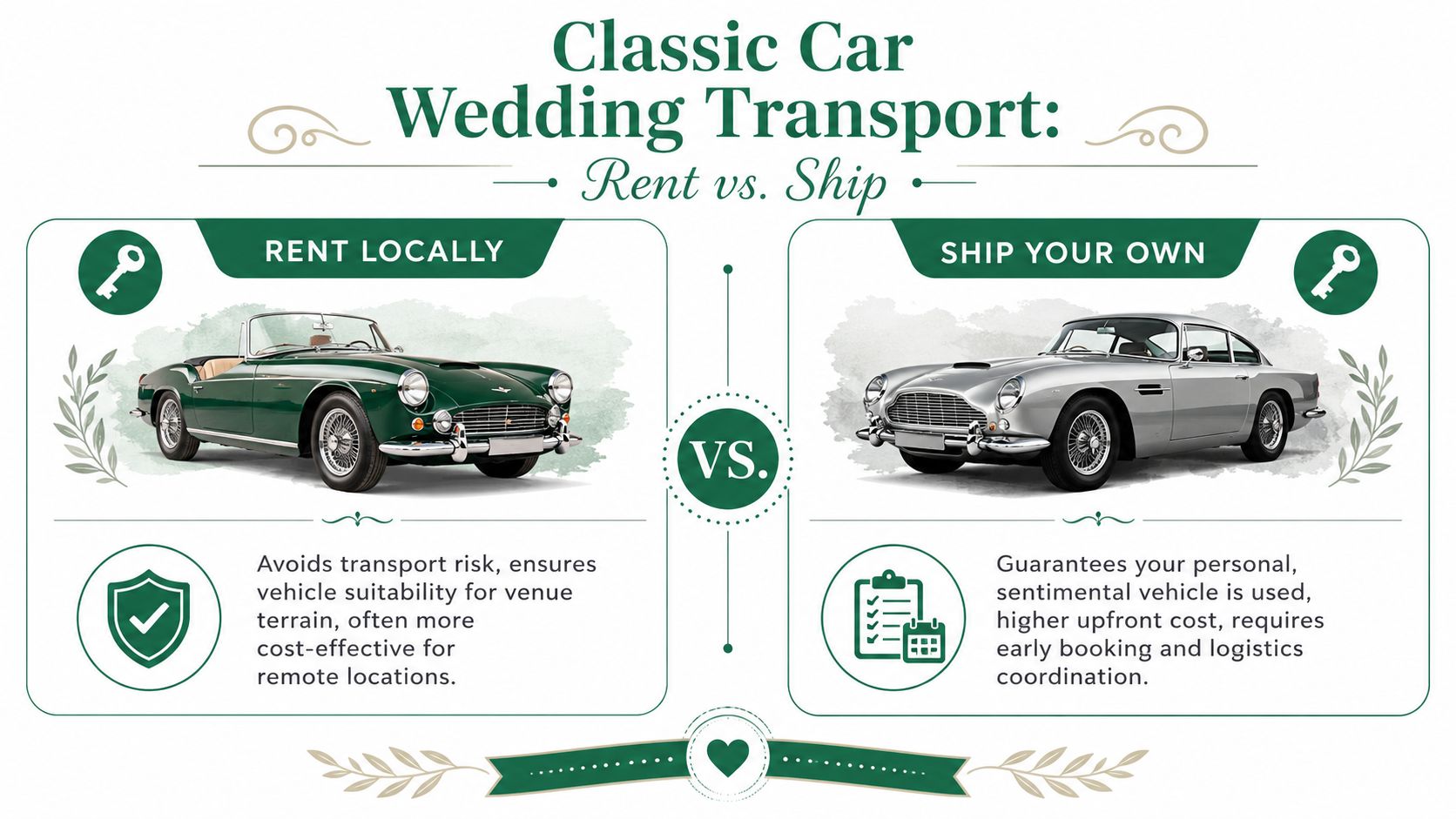
If the wedding is in the mainland U.S., local rental often wins when the couple doesn't care about exact make and model. If the car is personal, rare, or tied to the family story, shipping becomes the better choice. That's especially true for destination weddings and for moves between the mainland and Puerto Rico, where the car needs a transport plan before the wedding planner can lock the timeline.
How to choose between the two paths
Rent locally when the venue terrain is tricky, the route is short, or the couple values reliability over exact ownership. Ship your own car when the sentimental value outweighs the extra coordination and when the schedule has enough margin to absorb transit time. For either route, enclosed transport is usually the safer match for a vintage or high-value car because it offers more protection from weather and road debris.
National Car Transport's classic car shipping service is relevant here because it supports door-to-port and port-to-door moves with a network of 25,000+ vetted carriers, plus bilingual agents who can help simplify U.S. mainland and Puerto Rico coordination. For island moves, that kind of structure matters more than flashy marketing because the booking has to align with both the shipping schedule and the wedding date.
The right decision is rarely “cheapest.” It's the option that keeps the car available, protected, and on site when the photographer is ready.
For buyers comparing routes and vehicle handling costs, the same company's car shipping cost guide is useful for understanding how transport pricing is usually built before you decide whether to rent or ship.
Understanding Classic Car Wedding Transportation Costs
Wedding transportation budgets tend to look small until the vehicle, the hours, and the route all stack up. In The Knot's Real Weddings Study of nearly 17,000 people married in 2024, couples spent an average of $1,075 on wedding transportation overall, with destination weddings averaging $1,190, hometown weddings averaging $1,044, weddings with 50 or fewer guests averaging $583, and weddings with over 100 guests coming in at nearly $1,200 The Knot. That tells you a classic car is usually part of a broader day-of transport decision, not a standalone splurge.
The hourly model is where many couples get surprised. The Knot notes typical pricing of $75 to $150 per hour for town cars and wedding limousines, rising to $200 to $300 per hour for larger or more premium vehicles The Knot. Classic wedding cars are often booked by the hour, so the total cost depends on how much waiting, staging, and photo time the day requires.
Classic Car Wedding Transportation Cost Ranges
| Category | Estimated Cost | Key Variables |
|---|---|---|
| Classic or vintage wedding car rental | $300 to $1,000 | Model rarity, duration, location, and chauffeur service |
| Lower-end wedding rental minimum | around $250 | Shorter use window and simpler vehicle request |
| High-end or rare wedding car rental | above $3,000 in some cases | Premium vehicle, longer duration, and market constraints |
| Town car or wedding limousine hourly rate | $75 to $150 per hour | Vehicle type and service level |
| Premium or larger vehicle hourly rate | $200 to $300 per hour | Space, rarity, and higher-end presentation |
| Shipping your own vehicle | varies by carrier and route | Distance, carrier type, and protection level |
Shipping adds a separate line item, and that is where couples need to be realistic. A beautiful arrival can still be the right choice if the full transport budget is clear before the car is booked. The main mistake is treating shipping and wedding use as the same budget bucket, then getting squeezed by the last-mile details.
For couples who want a cleaner benchmark before requesting quotes, the National Car Transport car shipping cost page helps frame the transport side of the decision without mixing it up with wedding-service pricing.
Booking Timeline and Route Planning Strategy
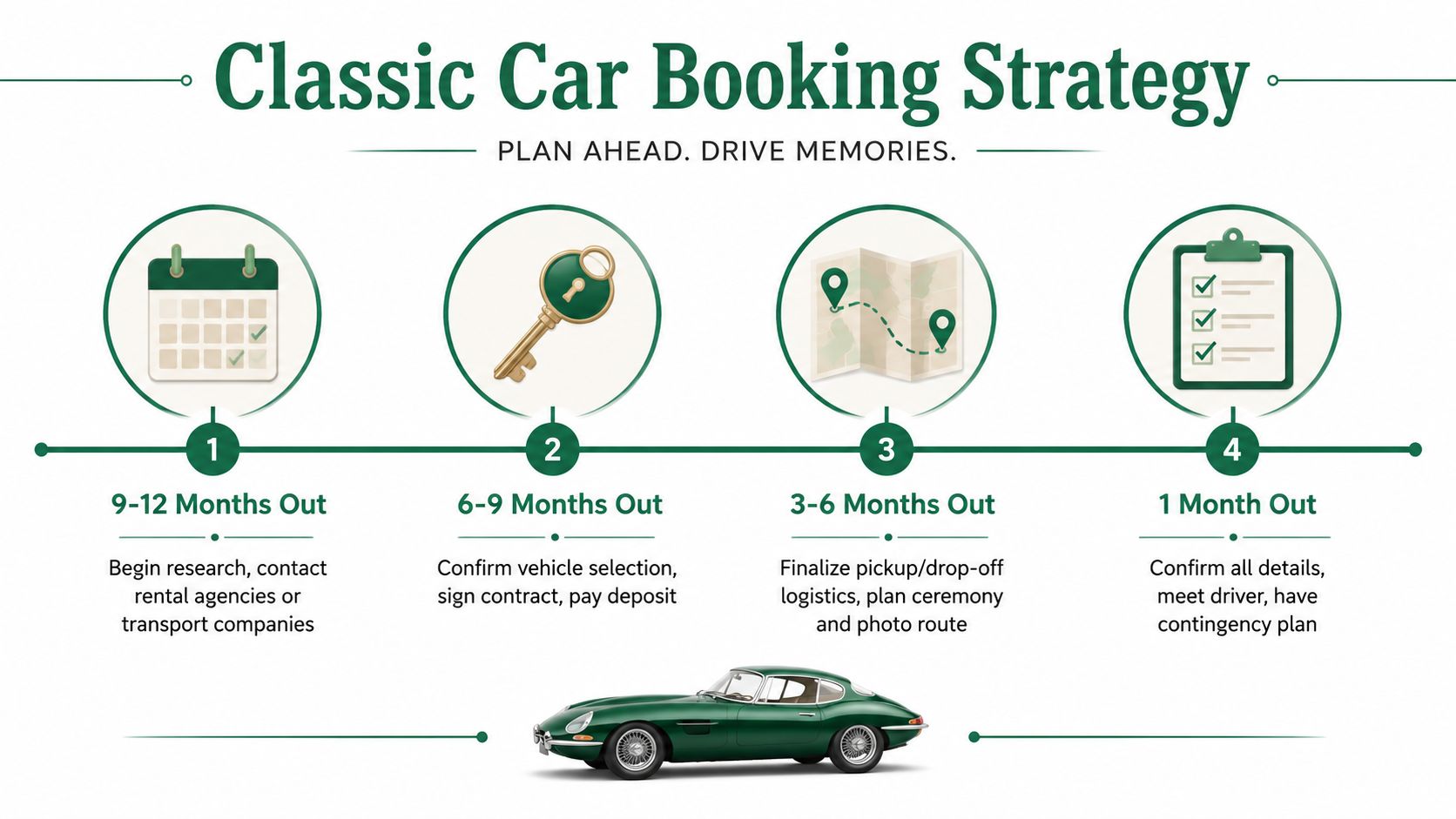
The safest wedding car bookings start early. Classic car specialists commonly advise reserving well in advance because a specific dream car can be limited and the reservation has to fit a one-day event window, not a flexible vacation schedule Dockx. That's especially true for peak-city and peak-season dates, where the margin for error disappears quickly.
For a practical timeline, think in four checkpoints. Start researching about a year out if the car matters to the look and the photos. Confirm the final vehicle once the venue and route are known. Then lock the pickup and drop-off sequence well before the wedding month so nobody is improvising on the day.
The route should be built backward
The right way to plan the day is backward from the ceremony time. Start with the venue coordinates, then map drive times, photo stops, loading time, and any pickup sequence for the couple or wedding party. Build in at least 10 to 20 minutes of padding, and some wedding planners recommend adding 30% extra time to each leg to cover traffic, photo delays, and loading The Knot.
A same-day-and-time trial drive is one of the most useful checks you can do. A route that feels fine on a quiet Tuesday morning might be a problem on a Saturday afternoon, especially if the venue is near a bottleneck, construction zone, or event-heavy district. I also like to identify at least two alternate routes so the chauffeur isn't locked into one traffic pattern.
Build the schedule around the car's weaknesses, not around hope.
What should happen before the wedding week
- Confirm the exact vehicle: Make sure the booked car matches the model, body style, and seating arrangement the couple expects.
- Test the route at the same time of day: Traffic patterns change by hour, not just by distance.
- Assign a backup pickup point: If the main entrance becomes blocked, the driver needs a second option already approved.
- Brief the chauffeur on passenger volume: Dress size, veil length, and photo stop duration all affect loading time.
The goal is simple. The vehicle should arrive when the photographer, planner, and venue staff are ready, not the other way around.
Venue Access and Body Style Decisions That Actually Matter
A classic car can look perfect and still be the wrong choice for a venue. I've seen couples fall for a car's chrome, then realize the entrance is too narrow, the turnaround is too tight, or the gravel driveway is too rough for comfortable loading. The smartest transportation decisions start with the site plan, not the mood board.
A photographer-focused source also pushes couples to check venue entrances, tight turns, and the car's dedicated time window, and to confirm placement in advance with the photographer. Another guide recommends building in 5 to 10 minute buffers each time the car appears, which fits the broader idea that the vehicle needs its own timing lane inside the wedding schedule YouTube video. That's the difference between a clean shot and a rushed scramble.
Body style should match the weather, not just the look
Convertibles can be stunning, but they create practical problems in wind, rain, and humidity. Closed-roof cars are usually the better choice for hot, rainy, or windy locations, especially when hair, makeup, and comfort have to survive a long day Fiore wedding weekend timeline insights. The photography plan also changes with body style because the car needs to be staged in the right light, not just parked wherever space is available.
How to check if the venue can actually handle the car
- Measure the entrance width: Gate posts and entry lanes can eliminate a car that looks small in photos.
- Review turning space: Older venues often have charming approaches that are too sharp for a long chassis.
- Confirm surface type: Gravel, mud, grass, and cobblestones can all change how the car loads and stops.
- Ask where the car can wait: If the driver has nowhere to stage, the schedule gets squeezed.
A beautiful car that can't reach the ceremony spot is just a complication with better styling.
The right planning partner matters more than a flashy brochure. The photographer needs a dedicated time window, the chauffeur needs a safe arrival point, and the couple needs a body style that works for the actual weather, not the hopeful forecast.
Day-of Coordination and Contingency Planning Checklist
The final handoff should be operational, not casual. By the morning of the wedding, the driver, planner, photographer, and couple should already know where the car enters, where it waits, and when it leaves. If that chain is fuzzy, the whole day starts absorbing avoidable delays.
A good checklist starts with the vehicle itself. The chauffeur should have the route, the timing, and the contact list. The couple should know what can and cannot be attached to the car, because paint, chrome, and trim are not forgiving when ribbons, magnets, or adhesive get involved.
The handoff that prevents most problems
- Pre-arrival: Driver shows up early, the car is clean, and the route is reviewed before anyone is waiting in formalwear.
- Decoration rules: Use approved ribbons or florals that won't damage the vehicle, and keep anything sticky off paint and trim.
- Contingency plan: Save the roadside assistance number, identify the backup pickup point, and know whether a replacement vehicle is even an option.
- Final handoff: Keys go to the driver, emergency contacts are shared, and the timeline gets one last review.
For shipped vehicles, enclosed transport is often the better safeguard when the car is rare, sentimental, or headed into a wedding window with no room for surprises. National Car Transport's enclosed auto transport service is the kind of option couples use when protection matters more than keeping the move as simple as possible.
If the photographer and chauffeur have not spoken before the wedding day, the timeline is already behind.
For communication, a simple QR-based contact sheet can help keep everyone on the same page without digging through texts. Wedding Studio's Wedding QR codes are useful for sharing event contacts, timeline notes, and location details in one place.
The best contingency plan is boring. That's a compliment. It means the backup is already identified, the weather risk has been acknowledged, and no one is making decisions from the passenger seat while the ceremony clock runs.
National Car Transport helps couples, families, and businesses move classic and specialty vehicles with clear scheduling, open and enclosed options, and bilingual support from agents who understand how important timing is on a wedding week. If you're planning a classic car arrival, a destination wedding move, or shipping a vehicle to Puerto Rico, visit National Car Transport to request guidance that fits your route, your vehicle, and your date.