

Enclosed carriers handle roughly 10%–15% of interstate vehicle shipments, usually cost 40%–60% more than open transport, and are the standard for most classic-car moves because they limit each load to 1–4 vehicles. If your restored Mustang is sitting in a garage waiting for a new home, the right carrier, loading method, and delivery inspection matter more than finding the lowest quote.
A Sunday morning spent trailer shopping can turn into a hard reality check. A flat-tow rental may look simple until you consider a long interstate route, low ground clearance, fragile chrome, an inoperative vehicle, or the risk of leaving an irreplaceable car exposed to weather and road debris. Classic car transport interstate is a specialized logistics job, not a routine drive with a trailer attached.
The most important decisions are straightforward. Choose equipment that matches the car, document its condition before loading, confirm how declared value is handled, and treat the delivery Bill of Lading as a claim document, not a formality. The following guidance applies to owners, snowbirds, military families, students, dealerships, auction buyers, and businesses moving vehicles across the 48 contiguous states, as well as mainland routes to and from San Juan, Puerto Rico.
Table of Contents
- Defining Classic Car Transport Interstate
- Open Versus Enclosed Carriers and Why the Choice Matters
- Preparing a Classic Car for Pickup Day
- Insurance, Declared Value, and the Claims Window
- How Specialty Loading and Securement Protect Original Cars
- Pricing and Transit Times for Cross-Country Classic Moves
- Balancing Protection, Price, and Environmental Impact
- Choosing a Carrier and Closing the Shipment Cleanly
Defining Classic Car Transport Interstate
A restored car waits behind a garage door in one state, while its next owner prepares for delivery in another. Moving it safely across state lines requires more than attaching a trailer and choosing the lowest quote. Classic car transport interstate is a specialized carrier service for valuable, sensitive, or unusual vehicles whose condition and handling can matter as much as the route.
The category includes pre-1980 vehicles, restored muscle cars, antiques, exotics, race cars, limited-edition models, resto-mods, pre-war brass-era cars, and one-off customs. Age alone does not decide the service level. A recently built custom with fragile paint or a high appraised value may require the same care as an older collector car.
A routine shipment treats the vehicle primarily as cargo. A classic move requires the dispatcher and driver to confirm the car's condition, clearance, operating status, securement points, declared value, and documentation before pickup. Specialty procedures limit unnecessary contact with original paint, polished trim, chrome, and numbers-matching components. Classic-car transport guidance identifies enclosed shipping, soft-strap wheel securement, and declared-value documentation as central parts of the process.
What the service includes
A properly arranged shipment can include door-to-door pickup and delivery, carrier matching, a condition inspection, enclosed or open equipment, loading assistance, shipment updates, and delivery paperwork. Coverage extends across the contiguous states, with routing set by carrier availability, vehicle condition, pickup access, and the required equipment. A rural address may require a nearby commercial meeting point if a large carrier cannot safely enter the property.
The dispatcher should know whether the car starts, rolls, steers, and brakes under its own power. An inoperative vehicle needs different loading equipment and more labor. Low ground clearance, a long wheelbase, delicate exhaust components, or nonstandard tie-down points should be disclosed before the quote is finalized. Hiding those details creates pickup delays and can force a last-minute equipment change.
The quote should also identify who inspects the car, which document records its condition, and what happens at delivery. Photograph every panel, wheel, trim piece, and interior area before loading. Record existing chips, cracks, scratches, mechanical issues, and loose components. Those records support a claim if the delivered condition differs from the pickup inspection.
The delivery signature carries real risk. Signing the Bill of Lading without recording visible damage can weaken your position later, even when the damage appears minor. Inspect the car in good light, compare it with the pickup photos, note discrepancies on the document, and keep a signed copy. Do not treat the signature as a simple receipt.
Declared value also needs a direct answer before release. It is not automatically the same as an appraisal, purchase price, or restoration cost. Ask what evidence the carrier uses to settle a covered loss, whether depreciation or repair cost affects the payment, and which exclusions apply. Coverage language controls the outcome, so obtain the terms in writing rather than relying on a sales call.
Puerto Rico shipments usually involve port logistics instead of a continuous highway move. Routes commonly connect the mainland through Jacksonville, Florida, with the vehicle moving through the Port of San Juan. Some services also use Eddystone, Pennsylvania. Jacksonville is identified as the primary mainland departure and arrival point in Puerto Rico vehicle shipping information.
This service is not a rental trailer, an ordinary economy shipment, or a general-freight flatbed load. Before releasing the car, settle four points: carrier type, declared value, loading method, and the delivery signature procedure. Then confirm the claim reporting deadline, because waiting past the post-delivery window can turn a documented problem into a difficult dispute.
Open Versus Enclosed Carriers and Why the Choice Matters
A freshly restored classic can arrive with a stone chip, road spray, or a new scrape before the owner notices anything went wrong. Carrier choice controls that exposure, along with scheduling, loading order, and the number of vehicles sharing the trip.
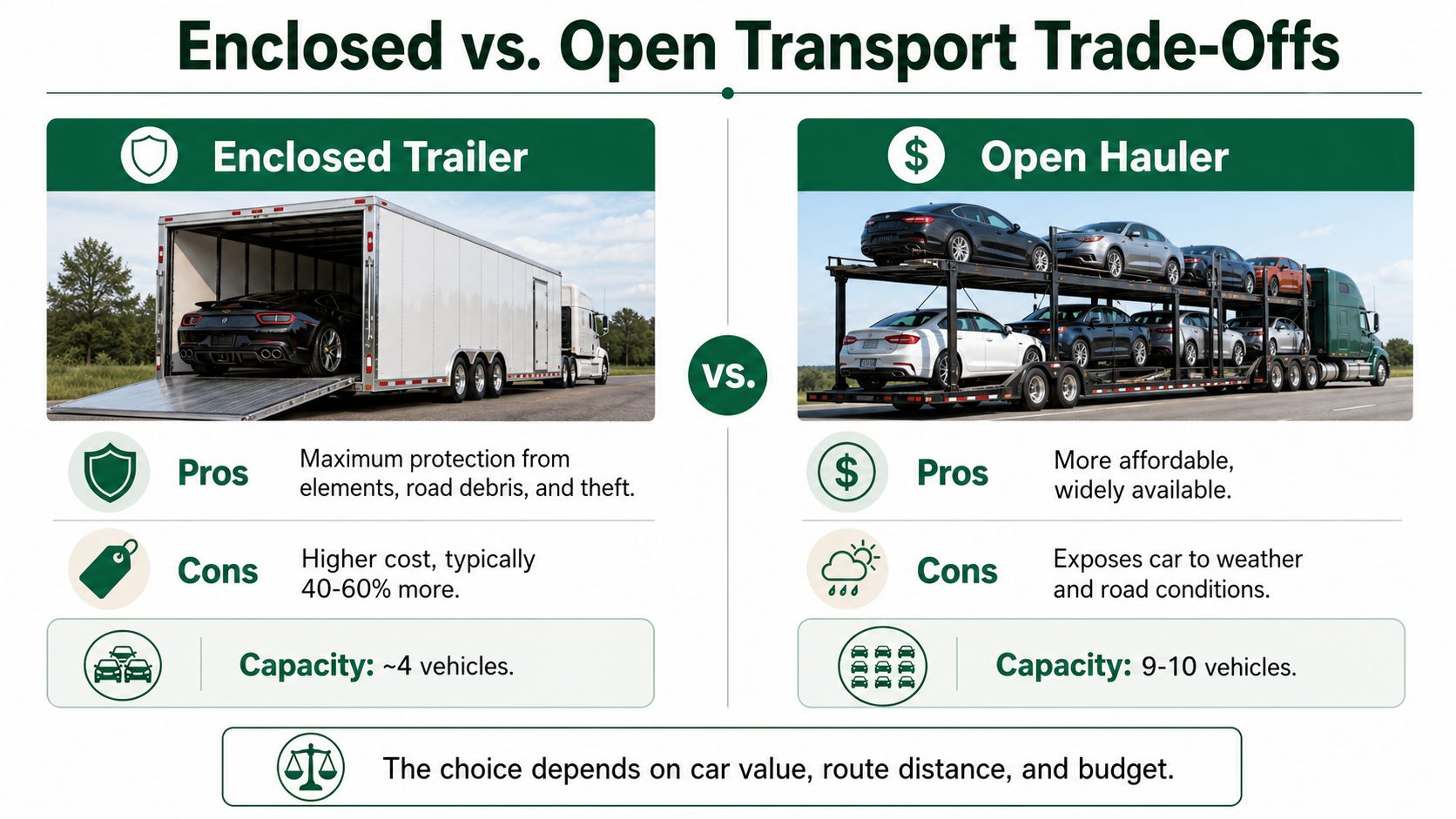
Open carriers are the common multilevel trailers used on major highways. They typically carry 7–10 vehicles, while enclosed trailers usually carry 1–4, according to enclosed auto transport data. Open equipment costs less and appears more often on common routes, but the car remains exposed to rain, dust, debris, road spray, and low branches.
Original single-stage paint, recent restoration work, rechromed bumpers, and delicate patina finishes deserve more protection. Enclosed equipment creates a physical barrier and generally gives the driver tighter control over the load. A market analysis of enclosed transport costs reports a typical enclosed premium of 40%–60% over open transport, although the final quote depends on the route, vehicle, and service.
A practical equipment comparison
| Factor | Open Carrier | Enclosed Carrier |
|---|---|---|
| Capacity | Usually 7–10 vehicles | Usually 1–4 vehicles |
| Protection | Exposed to weather and road debris | Covered protection from weather and debris |
| Cost | Lower baseline | Typically 40%–60% above open rates |
| Availability | More frequent on common lanes | Smaller capacity can mean longer scheduling windows |
| Best fit | Driver-quality classics and budget-led moves | Restorations, show cars, exotics, and high-value vehicles |
Choose enclosed transport for concours cars, numbers-matching restorations, show vehicles, and any car carrying a high declared value. The premium is sensible when repairing a chip, scrape, water intrusion issue, or contact damage would cost more than the added transport charge. A driver-quality classic with existing patina can use an open carrier, provided the owner accepts the exposure and the pickup condition is recorded carefully.
Lower clearance changes the equipment decision. Review drop deck trailer applications when the car needs reduced deck height or specialized clearance. Ask the dispatcher how the vehicle will be loaded, where it will sit, and whether the trailer can accommodate its approach angle.
Dispatcher's rule: If you'd be upset by a stone chip, don't put the car on an open trailer just to save money.
For a closer look at enclosed service procedures, review this enclosed auto transport service overview. Before booking, answer one question: Would repairing transport-related cosmetic damage cost more than paying the enclosed premium? If yes, choose enclosed. Also confirm the post-delivery claim window and inspect before signing the Bill of Lading, because a careless signature can weaken an otherwise valid claim.
Preparing a Classic Car for Pickup Day
The most important preparation step is simple: photograph every panel, wheel, glass surface, and piece of chrome in clear daylight within 24 hours of pickup, then store the time-stamped files somewhere besides your phone. Wash the car first so dust doesn't conceal a scratch, and include wide views plus close-ups of existing blemishes.
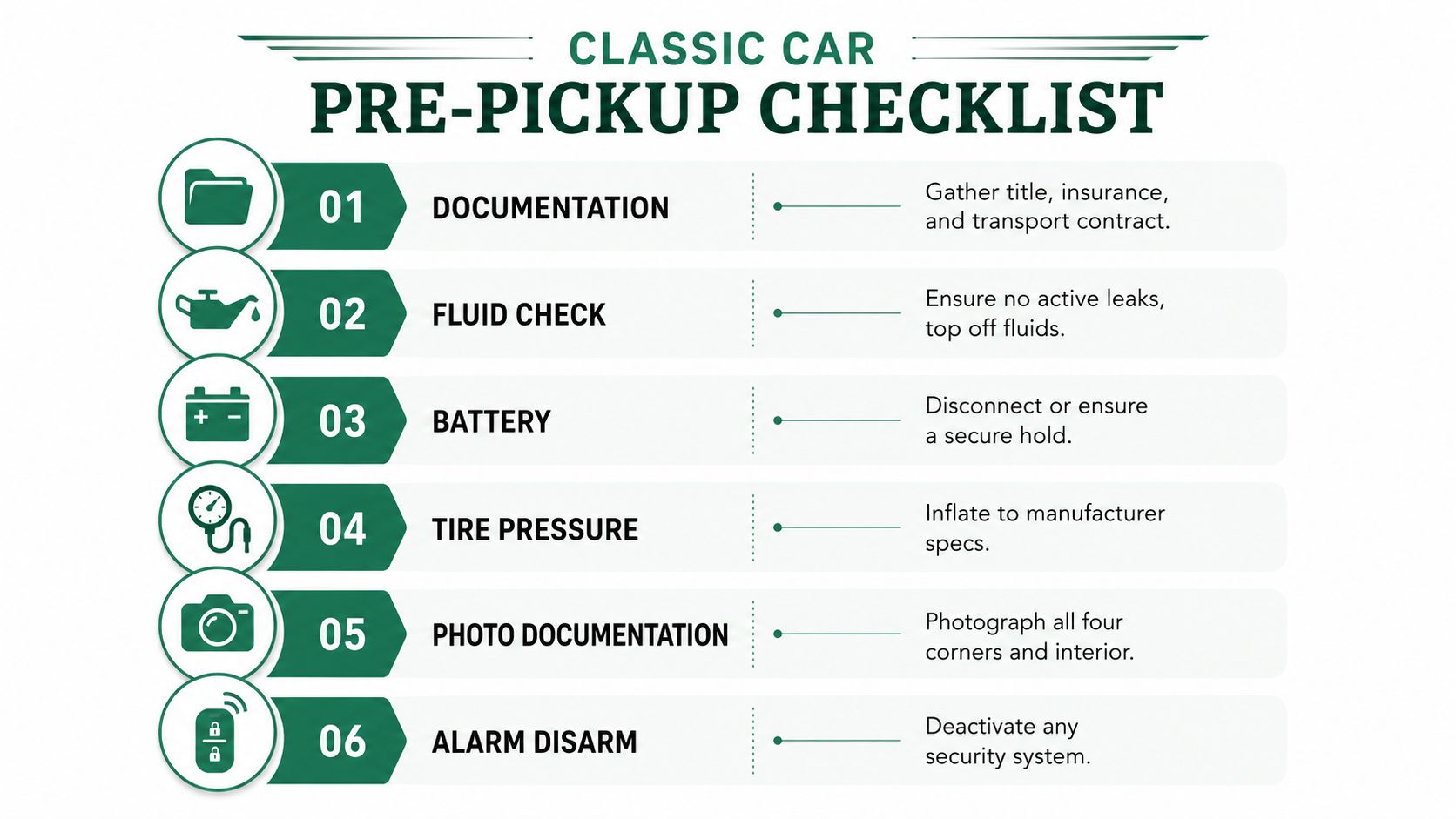
Work through the mechanical checklist
- Fuel level: Leave about one-quarter tank, enough for loading and repositioning without carrying unnecessary weight.
- Battery: Charge it fully and confirm that it's firmly secured. Tell the driver about a battery cut-off switch.
- Tire pressure: Inflate all tires to the manufacturer's specification. A soft tire complicates loading and securement.
- Fluid condition: Check for active leaks and record them in writing. An existing leak must appear on the pickup inspection.
- Operating status: Tell the dispatcher whether the car runs, steers, brakes, and rolls. A non-running classic needs the correct loading plan.
Documentation should follow the photos. Have the title or registration, bill of sale for valuation context, insurance declaration page, appraisal paperwork, and transport agreement available. The carrier may not need every document at the curb, but high-value vehicles should have a clear paper trail before loading.
Disable the alarm and any hidden kill switch, remove loose items from the cabin and trunk, take out toll devices, fold mirrors where clearance is tight, and protect a sharp hood ornament with suitable padding or a clearly marked cover. For owners who want the car cleaned before its baseline inspection, arranging to book full car detailing in Perth is a separate detailing decision, not a substitute for the carrier's condition report.
At pickup, walk around the car with the driver. Record every dent, chip, scuff, loose trim piece, and existing mark on the Bill of Lading before loading. Sign only after the written description matches the vehicle.
Insurance, Declared Value, and the Claims Window
A carrier's insurance certificate isn't the same thing as guaranteed recovery of a collector car's full value. Federal interstate carrier rules establish financial-responsibility requirements, and 49 CFR 387.9 sets a $750,000 minimum public-liability level for many for-hire property carriers, as summarized in interstate car-carrier insurance guidance. That floor doesn't automatically mean your particular classic has full replacement-value protection.
Coverage tiers require different evidence
| Coverage Tier | Maximum Payout | Best For | Documentation Required |
|---|---|---|---|
| Carrier liability | Subject to the carrier's policy and terms | Ordinary transport risk | Certificate of insurance, carrier policy, Bill of Lading |
| Declared-value arrangement | The agreed declared value, subject to policy terms | Valuable classics and restorations | Appraisal, bill of sale, photos, declared-value confirmation |
| Collector or agreed-value policy | The personal policy's agreed amount, subject to its terms | High-value or irreplaceable vehicles | Policy, appraisal, ownership records, condition evidence |
Ask for the carrier's current cargo policy and confirm how it treats an older vehicle, restoration work, parts, accessories, and pre-existing damage. Interstate authority filings may use BMC-91 or BMC-91X forms to document coverage, but a filing alone doesn't tell you whether the policy settles your vehicle at market value, declared value, repair cost, or another limit.
Declared value is where many owners get caught. The carrier needs a documented pre-shipment valuation, and the claim settlement depends on the evidence you supplied before loading. A specialist classic car appraisal policy resource for Charlotte, NC can help owners understand the difference between ordinary market-value coverage and an agreed-value collector policy.
The delivery signature controls the dispute
Inspect the car before signing the delivery paperwork. Compare the pickup photos with the car in daylight or strong shop lighting, examine wheels and chrome closely, and write specific damage on the Bill of Lading. Don't sign a clean receipt just because the driver is waiting.
Federal guidance allows up to 9 months to file a damage claim, but classic-car claim guidance emphasizes that immediate written notice, photos, and a clear delivery record create a stronger file. If damage is discovered, photograph it before cleaning or repairing anything, preserve the pickup and delivery paperwork, notify the carrier in writing, and follow its stated escalation process. Claims are commonly weakened when the owner signs without notation, cannot show the pre-shipment condition, or reports a problem without supporting photographs.
How Specialty Loading and Securement Protect Original Cars
A classic can be damaged before it reaches the highway. Low noses, air dams, side-exit exhausts, polished bumpers, and fragile suspension parts can catch on a steep ramp or be crushed by a tie-down placed against painted bodywork. Tell the carrier about every modification before pickup, not when the driver arrives.
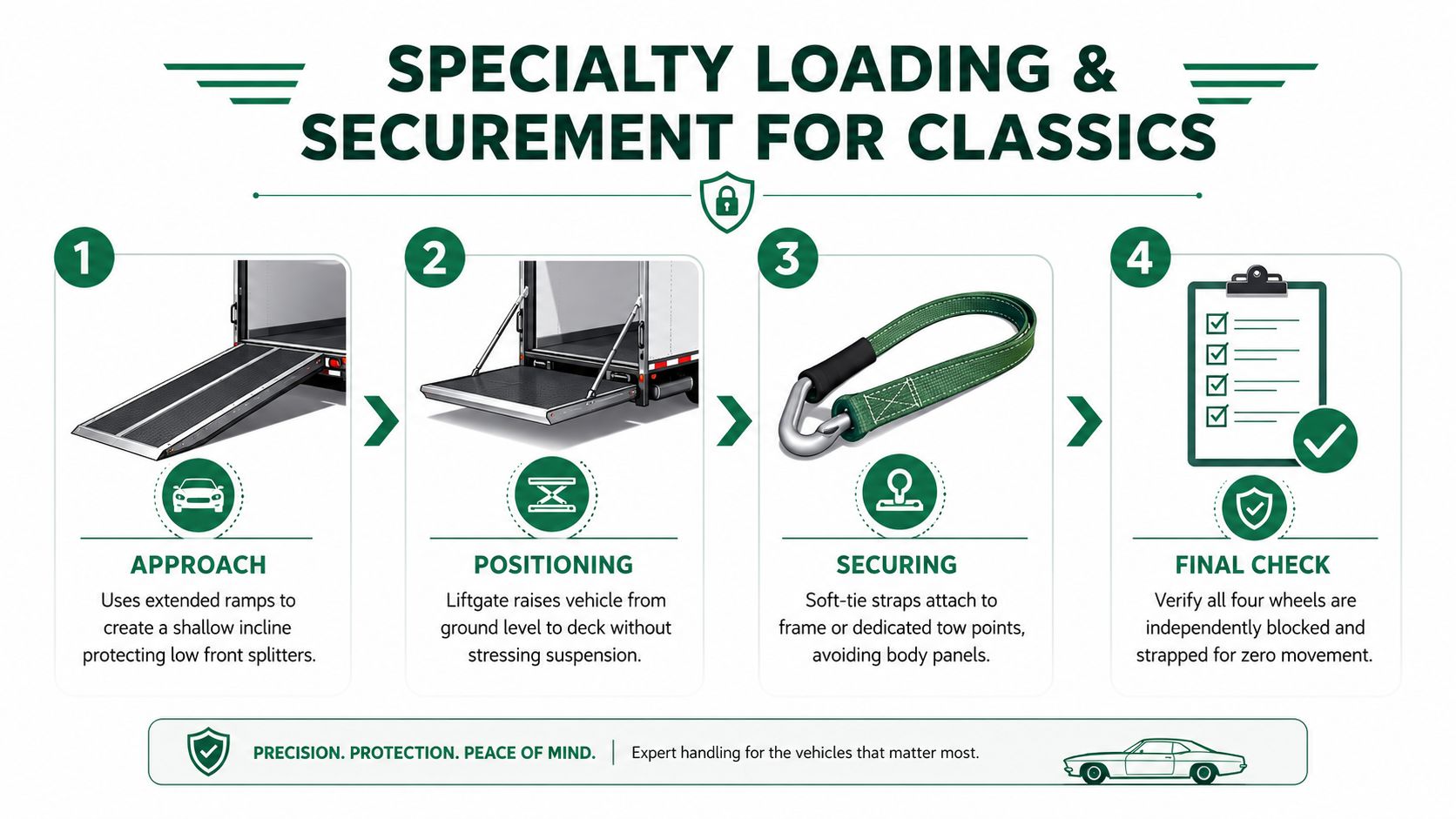
The driver should locate the car's lowest point and plan the approach around it. Hydraulic liftgates and extended low-angle ramps reduce the approach angle. A winch moves a non-running car without forcing its drivetrain or steering system to carry the load. Modified suspension, wide wheels, removable hardtops, and dedicated tow points also affect the loading plan.
Secure the wheels, not the finish
Specialty carriers should use soft nylon wheel nets or soft-loop straps around the tires. This keeps the securement equipment away from chrome, painted panels, delicate suspension components, and original finish. Classic-car transport practices describe this approach as a way to reduce contact with paint, patina, frame areas, and numbers-matching parts.
Each wheel should be secured independently, followed by a check that the car cannot shift during braking, turns, or loading transitions. A strap around a bumper, axle, exhaust pipe, or decorative trim is an unsafe shortcut, even if it appears convenient.
Photograph the VIN stamping, odometer, engine-bay identifiers, wheels, and existing blemishes before departure. Numbers-matching records give the Bill of Lading a visual baseline, helping separate transit damage from a pre-existing condition. Keep those photos with the pickup paperwork.
Inside-only loading provides more control when the carrier assigns the car to a protected trailer bay. It costs more and may not fit every route, but it suits fragile restorations that cannot tolerate weather, contact with other cargo, or repeated handling. Ask the dispatcher how the car will be loaded, where straps will sit, and what the driver will document before signing the pickup Bill of Lading.
Pricing and Transit Times for Cross-Country Classic Moves
Distance sets the starting point, but the carrier's equipment, route density, vehicle condition, and loading requirements determine the final quote. Short interstate moves commonly fall into these baseline ranges: 0–500 miles at $600–$900, 500–1,000 miles at $800–$1,200, and 1,000–2,500 or more miles at $1,100–$1,600 for enclosed service. Use those figures to test a quote, not to approve one automatically.
The route in practical bands
| Distance Band | Typical Transit Days | Enclosed Transport Range | Main Variables |
|---|---|---|---|
| 0–500 miles | Varies by route and scheduling | $600–$900 baseline market range | Equipment, access, pickup timing |
| 500–1,000 miles | Varies by route and scheduling | $800–$1,200 baseline market range | Route density and seasonal demand |
| 1,000–2,500+ miles | Long-haul scheduling required | $1,100–$1,600 baseline market range | Loading needs and delivery access |
| Over 2,500 miles | 7–10 days after pickup | Quoted by route and equipment | Long-haul scheduling and fuel |
For shipments over 2,500 miles, enclosed transport commonly takes 7–10 days after pickup, with carriers averaging 400–500 miles per day. Pickup is not transit time. The carrier must build the route, reach the origin, load the car safely, and coordinate delivery access before the clock reflects actual movement.
Fuel charges, route scarcity, seasonal demand, auction schedules, non-running status, low-clearance equipment, and liftgate requirements can push the quote above the baseline. A classic headed to an auction or restoration shop may need a fixed delivery appointment, narrowing the available carrier pool.
Transit estimates also change when the car cannot roll, steer, or brake under its own power. Tell the dispatcher before booking. Hiding that condition usually creates a pickup delay, a revised charge, or both.
Review this car shipping cost guidance before requesting quotes. Ask the dispatcher to separate the base transport price from equipment surcharges and accessorial fees. Require the written quote to state the equipment, pickup and delivery conditions, declared value, and any cancellation terms. A low number is useful only when the Bill of Lading and coverage paperwork confirm what it includes.
Balancing Protection, Price, and Environmental Impact
Environmental footprint depends on how many cars the equipment moves per trip, not solely on whether the trailer is enclosed. Enclosed trailers may carry about 4–6 vehicles, compared with 7–9 on open carriers, while enclosed rates commonly run 40%–60% higher on the same lane, as discussed in transportation-emissions analysis. Fewer vehicles sharing the route can mean less efficient transport per car.
Use that information as a planning framework. First, identify the finish or component least able to tolerate exposure. Next, assess the route's weather, road conditions, and distance. Then compare the likely cost of correcting exposure-related damage with the enclosed premium and its lower per-load efficiency.
Calculate the decision against risk
A numbers-matching original, low-production muscle car, pre-war brass-era vehicle, thin single-stage paint, polished aluminum, or fresh concours restoration usually has more to lose from exposure. A driver-quality classic with established patina or a project headed to a restoration shop may support a lower-impact choice when the owner accepts the exposure.
Keep the paperwork aligned with that decision. The declared value, appraisal, condition photographs, and policy terms should describe the same vehicle and condition. At delivery, inspect before signing the Bill of Lading. A clean signature can weaken a later claim, and the post-delivery claim window still depends on the carrier's written terms. Declared-value coverage also settles according to the policy and documented damage, not automatically at the car's full market or emotional value.
Practical rule: Protect the car's weakest finish, then verify the claim procedure before pickup.
Choose open transport when the car is operational, its condition supports the exposure, and reducing cost and per-car footprint matters. Choose enclosed service when the probable repair, appraisal dispute, or loss of an original finish outweighs the added price and equipment inefficiency.
Choosing a Carrier and Closing the Shipment Cleanly
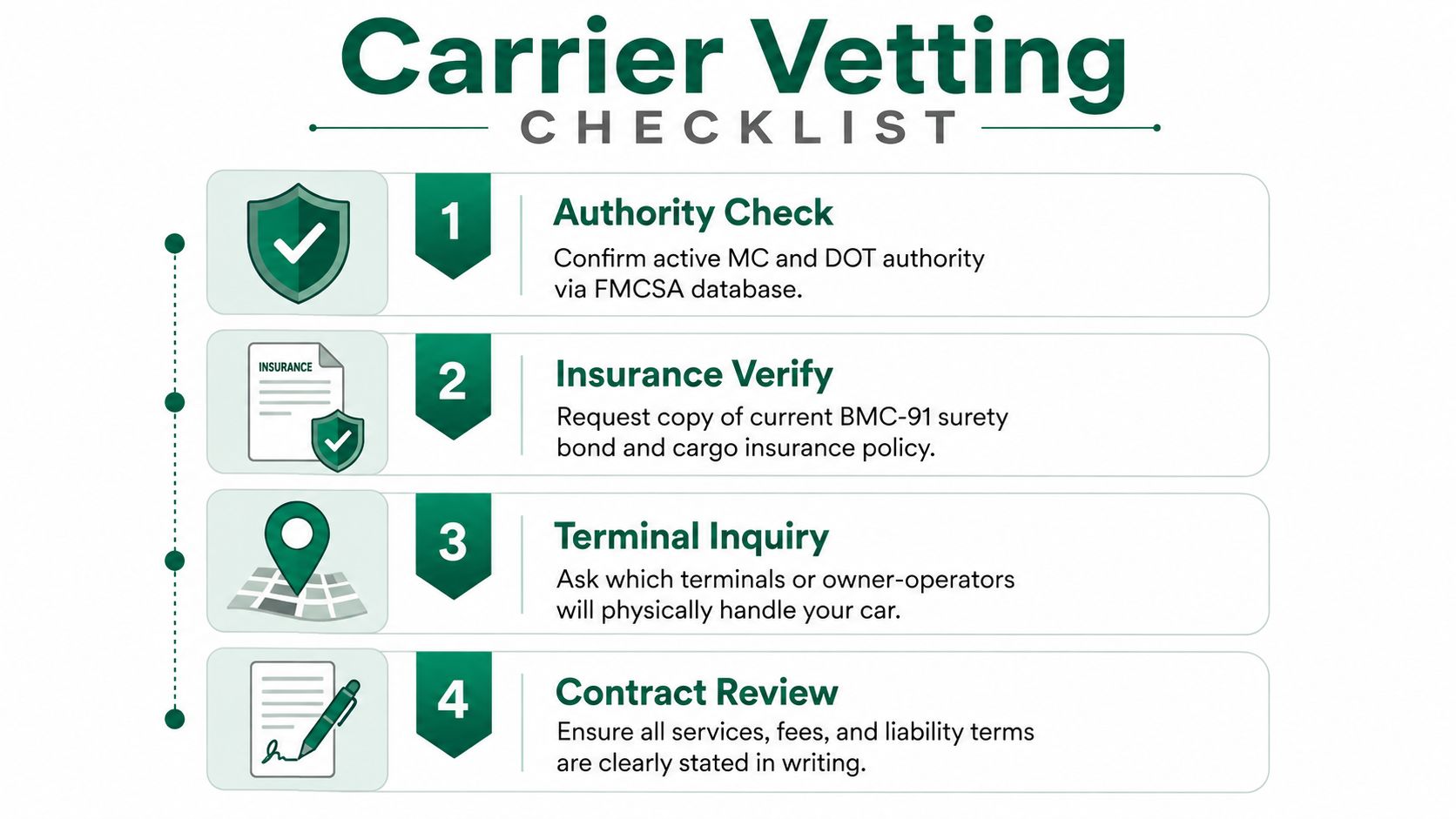
Carrier selection should begin with authority, not advertising. Confirm active MC and DOT authority, request current cargo insurance information, and ask whether the actual truck will be an owner-operator or a subcontracted carrier. For Puerto Rico routes, ask which mainland port handles the shipment and how the vehicle moves through San Juan.
A written dispatch sheet should identify the carrier, driver contact, pickup window, vehicle condition requirements, equipment type, and quoted services. Don't release the car based only on a phone promise. The person who quotes the shipment may not be the person arranging the truck, so get the operational details in writing.
At delivery, inspect under good lighting before signing. Compare every panel, wheel, glass surface, trim piece, and documented blemish with the pickup record. If damage exists, describe it specifically on the Bill of Lading, take timestamped photographs, retain the paperwork, and notify the carrier promptly. A blank or clean signature can make a later dispute harder, even when a federal filing period remains available.
Door-to-door service can reduce unnecessary terminal handling when the pickup and delivery streets accommodate the equipment. Owners can review door-to-door auto transport while comparing access restrictions, alternate meeting locations, and delivery lighting.
National Car Transport offers open and enclosed transport across the United States, including mainland routes connected with Puerto Rico, with 25+ years of experience, an A+ BBB rating, transparent flat-rate pricing, and a network of 25,000+ vetted carriers. Its USA-based bilingual English and Spanish agents have more than 20 years of auto transport logistics experience, and they can help individuals, snowbirds, military families, students, dealerships, and businesses plan a shipment because no two vehicle moves are alike.
If you're moving a restored classic across state lines or arranging mainland transport to San Juan, contact National Car Transport for a route-specific quote and a clear equipment recommendation. Ask the agent to review the vehicle's condition, declared value, loading requirements, pickup access, delivery inspection, and claim paperwork before you release the car.