Most car shipping guides tell you to spot an A+ Better Business Bureau badge on a shipper's homepage and book with confidence. That advice skips the actual risks of moving a vehicle between the U.S. mainland and San Juan, Puerto Rico. A national auto shipping BBB grade tracks how a company handles disputes, advertising accuracy, and public commitments, not whether the truck arriving in Jacksonville, FL or Philadelphia, PA will load your car on time and deliver it undamaged.
Understanding where that grade starts and stops protects everyone shipping across the water, from snowbirds and military families changing duty stations to students and dealerships moving inventory. According to the BBB History and Traditions overview, the organization traces its roots to 1912, when the National Vigilance Committee formed to curb deceptive advertising and encourage voluntary marketplace standards across the United States. That century-old framework gives you a solid starting point for judging business conduct, provided you pair it with carrier verification and Puerto Rico import or export paperwork.
Table of Contents
- What an A+ BBB Rating Actually Measures
- Read the BBB Profile Signals in One Pass
- Weighing Complaints and Reviews Without Being Misled
- Puerto Rico Paperwork for Arbitrios, Hacienda and Export Records
- Verify the Carrier Chain and Paperwork Before Pickup
- Decide If National Car Transport Fits Your Move
What an A+ BBB Rating Actually Measures
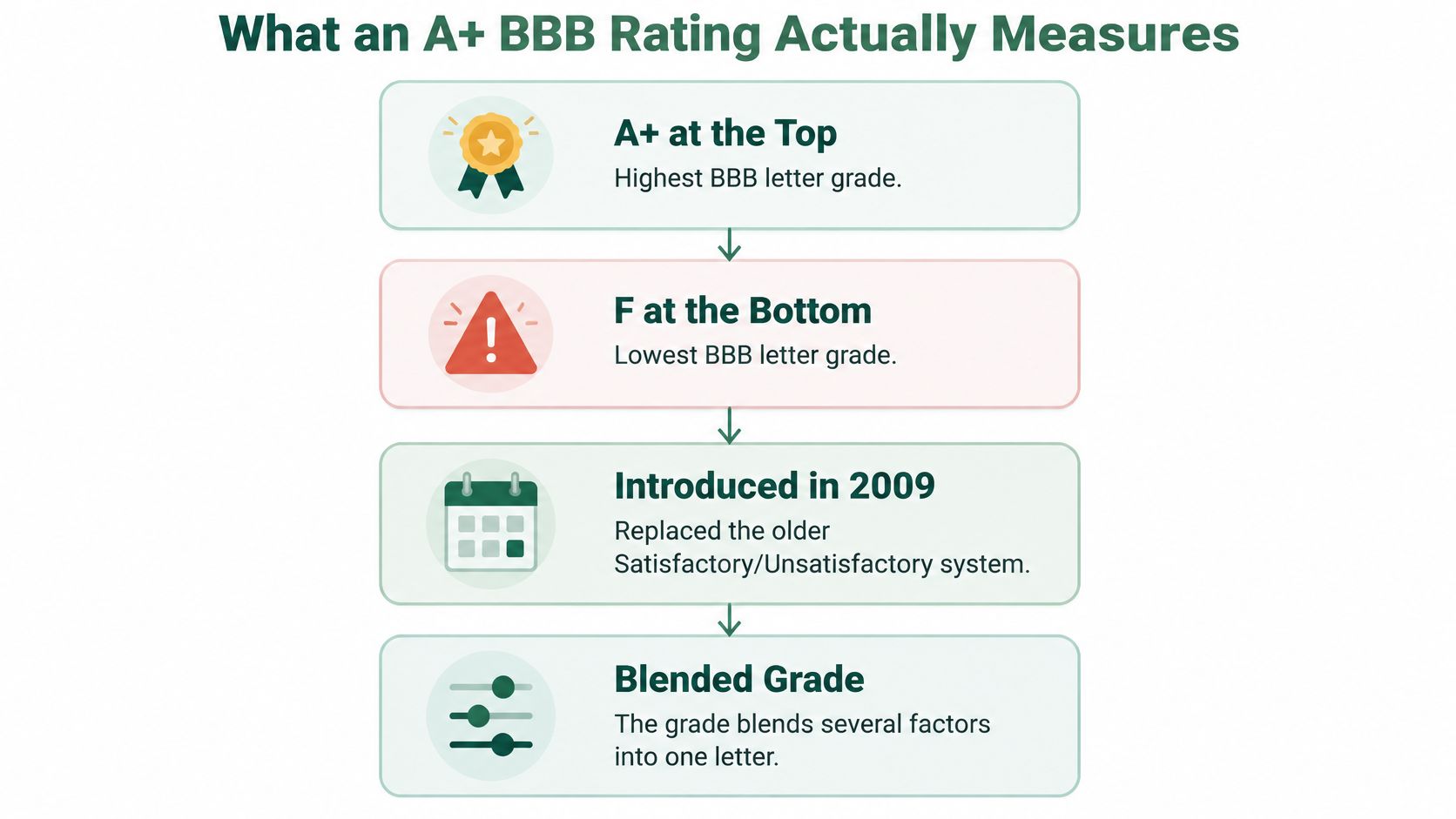
A Better Business Bureau letter grade summarizes business conduct, not mechanical reliability on the highway or at a maritime port. As detailed in the Better Business Bureau overview, the organization uses a scale running from A+ at the top to F at the bottom, a system introduced in 2009 to replace its older Satisfactory and Unsatisfactory labels. Rather than reflecting star ratings or customer sentiment alone, the grade weighs complaint patterns, transparency, advertising reliability, time in business, responsiveness, and whether a firm honors its commitments.
Think of the letter grade as a credit score for marketplace conduct. A strong credit score shows that a borrower has paid past bills on time and resolved discrepancies, yet it can't predict whether an unexpected delay will hit next month's invoice. In the same way, an A+ grade tells you how a vehicle transport company manages records and customer disputes under documented criteria, without certifying that an ocean crossing to San Juan or an overland haul from an inland U.S. city will run without weather delays or port congestion.
Separating the Letter Grade From Accreditation
Many shippers treat BBB Accreditation and an A+ rating as the same credential, yet they measure two distinct commitments. The letter grade evaluates performance signals across public filings and complaints, while accreditation confirms that a business meets specific behavioral standards and agrees to uphold them. Those standards require honest advertising, truthful representation, transparency, honoring promises, responding to customers, safeguarding privacy, and following applicable laws and licensing rules, along with operational expectations such as being in business for at least six months and resolving customer complaints.
Analyst note: Accreditation is an active standards agreement, while the letter grade is an ongoing conduct score. Verify both independently on the live profile before paying a deposit.
National Car Transport is US-based and holds A+ BBB Accredited status. Even when a provider holds top standing, you should never rely on a static logo pasted into a website footer. A BBB grade is a dated snapshot tied to a specific review cycle, so your first verification step when learning how to choose an auto transport company is to open the company's live BBB profile and check the current standing directly.
Read the BBB Profile Signals in One Pass
Opening a BBB listing only helps if you know which fields carry operational weight. Skimming the top banner takes five seconds and misses the details that separate an established Puerto Rico auto shipper from a shell brokerage. Use the seven-point checklist below to audit any profile in a single pass.
| Signal | Where to find it | What good looks like | Red flag |
|---|---|---|---|
| Letter grade | Profile header | A+ with a recent review date | Grade dropped or changed without explanation |
| Accreditation status | Accreditation section of the profile | Accredited status shown and current | Status missing, unclear or lapsed |
| Complaint volume and type | Complaints section | Count is low relative to shipment volume and most cases are resolved | Clusters of pickup delays, damage or cancellation disputes |
| Business responses | Individual complaint records | Specific, dated replies that reference the shipment and evidence | Generic template replies or no reply |
| Years in business | Business details | Long operating history listed on the profile | Recently formed company with no track record |
| Licensing and government actions | Business details | Licensing listed with no unresolved government actions | Open government actions or license problems |
| Customer reviews | Reviews section | Recent reviews that describe pickup and delivery in detail | Only old reviews or reviews with no specifics |
Start at the profile header and compare the current letter grade and its last review date against whatever badge the company displays on its homepage. If the website still claims an A+ rating while the live profile shows a lower grade or a recent change, ask the representative for a written explanation before signing anything.
Matching the Legal Entity and Applying the Decision Rule
Similar business names are common across U.S. auto logistics, so confirm that the legal entity name, street address, and phone number on the BBB profile match the exact party listed on your shipping contract. Checking those identifiers upfront is one of the fastest ways to guard against car transport scams that borrow a reputable brand's name to collect deposits. You can also see how dispatchers and carriers evaluate broker reputations in the brief walkthrough below.
Never judge a company by its raw complaint count alone. A high-volume shipper moving thousands of vehicles between U.S. mainland hubs and San Juan each year will naturally log more cases than a small regional operator, so weigh the total against operating scale and look closely at complaint categories. A clean grade backed by recent, detailed responses reads as strong operational discipline, while a clean grade paired with vague replies or repeated pickup disputes calls for deeper follow-up before you book.
Weighing Complaints and Reviews Without Being Misled
Consider a realistic shipping scenario. Say a snowbird books a Friday pickup in Ohio to catch a vessel departing Jacksonville, FL for San Juan, the driver arrives on Monday instead, and the customer files a BBB complaint citing the missed window. If the complaint reached the business promptly, the company replied with dispatch logs explaining the delay, and the case closed with a documented adjustment, that record tells you far more than a spotless profile with zero visible complaint history.
According to the BBB Frequently Asked Questions, accreditation itself is not a rating input and does not remove complaints from a company's public record. Instead, BBB tracks how reliably a business handles disputes under standard turnaround benchmarks, giving you a concrete yardstick for operational discipline.
| Stage | Typical timing | What to check |
|---|---|---|
| Complaint forwarded to the business | Within 2 business days | Confirm the case reached the company and is listed on the profile |
| Response requested from the business | 10-15 calendar days | Look for a reply that addresses the specific issue |
| Case often closed | Within 30 days | Look for a documented resolution or settlement |
How to Read Complaint Records and Customer Reviews
Sort the complaints tab chronologically and read the past twelve months first, since older disputes may reflect discontinued carriers or past staffing rather than current dispatch operations. Watch for recurring themes across separate customers, especially last-minute quote increases, disputed cancellation fees, missed port cutoffs, and stalled damage claims. Always view the total complaint figure alongside the company's shipping volume so you don't penalize an active nationwide carrier network for routine friction.
Pay close attention to the quality of each company response. A reply that cites inspection reports, bill of lading timestamps, payment receipts, or an agreed settlement demonstrates record-keeping discipline, whereas copy-and-pasted apologies signal weak internal tracking. Businesses operating across multiple hubs face real challenges keeping public feedback accurate, and companies researching choosing review help for multi-location businesses through TheBestReputation often focus on structured response workflows rather than suppressing legitimate issues.
Specific, evidence-backed replies to a handful of complaints prove more about claims readiness than an empty complaint log ever could.
Customer reviews add useful context after you finish the complaints tab, but judge them on specificity and recency instead of star averages. Reviews that name the origin state, the departure port, the vessel handoff in San Juan, and the delivery condition help you separate verified customer experiences from generic praise when evaluating reliable car transport reviews.
Puerto Rico Paperwork for Arbitrios, Hacienda and Export Records
A clean BBB profile won't clear a vehicle through Puerto Rico customs or release a title for mainland export. Shipping between the U.S. mainland and San Juan involves mandatory government filings on both sides of the route, and missing a single document can hold your vehicle at the port and trigger storage charges.
Shipping From the U.S. Mainland to San Juan
Vehicles arriving in Puerto Rico from any U.S. state face excise tax filings managed by Puerto Rico's Department of the Treasury (Hacienda). Before your car boards a vessel at Jacksonville, FL or Philadelphia, PA, gather the required records and estimate your tax obligation in advance:
- Excise Tax Declaration: Under Hacienda Informative Bulletin No. 05-04, every automobile imported from the U.S. mainland requires an Excise Tax Declaration listing the vehicle's make, model year, model, color, quantity, and vehicle identification number (VIN), along with the bill of lading and import date.
- Ocean Freight Supporting Documents: For maritime shipments, Hacienda's ocean freight excise declaration guide requires the commercial invoice, the bill of lading, and the Motor Vehicle Inspection Document (the vehicle appraisal or assessment document). The importer selects the corresponding bill of lading inside the electronic import declaration system and uploads the invoice and any additional requested files.
- Pre-Shipment Arbitrios Estimate: Never treat the ocean and trucking quote as your total landed cost. You can estimate Puerto Rico arbitrios ahead of time through Hacienda's vehicle excise tax calculator using either the vehicle's make, model, and year or its VIN. Hacienda sets a minimum automobile excise tax of $750, though the final bill depends on the specific vehicle and applicable tariff calculation.
Our bilingual English and Spanish agents help customers estimate their arbitrios excise tax before shipping, so there are no financial surprises when the vessel reaches San Juan. Reviewing the full checklist for shipping to Puerto Rico from the US early also gives military families and relocating households enough lead time to align title documents with sailing schedules.
Shipping From San Juan to the U.S. Mainland
Moving a car off the island requires formal export clearance separate from booking ocean freight to Jacksonville, FL or Philadelphia, PA. According to Puerto Rico Insurance Code Regulation Rule 70, a vehicle is officially considered exported only when it is transferred outside Puerto Rico, the Puerto Rico Department of Transportation and Public Works vehicle registry records an exported-vehicle notation on the title, and the owner surrenders the license plate and vehicle license to that department for cancellation. Completing those registry steps before port drop-off prevents lingering island registration liabilities after your car arrives on the mainland.
Verify the Carrier Chain and Paperwork Before Pickup
An A+ BBB rating does not inspect trailers, validate motor carrier cargo policies, or guarantee vessel transit times. In the FMCSA Consumer Advisory on Automobile Transporters, federal regulators highlight a sharp increase in complaints against auto transporters and brokers, and they urge consumers to distinguish between brokers, who arrange shipping, and transporters, who physically drive, load, and deliver vehicles. Because a separate motor carrier often controls your car between your driveway and the port, your real protection lives in the carrier chain.
Verification rule: Treat the BBB profile as a broker conduct screen, and treat federal operating records plus the bill of lading as your shipment protection.
Complete these eight steps before any driver loads your vehicle, whether you're booking directly with a carrier or working through an intermediary and want clarity on what an auto transport broker does:
- Request the contracting company's exact legal entity name along with its USDOT or MC numbers in writing.
- Confirm active FMCSA registration for any broker involved. Under the FMCSA OP-1 operating authority instructions, property brokers must maintain a $75,000 surety bond or trust-fund filing on Form BMC-84 or Form BMC-85. Remember that this bond addresses certain broker financial obligations and is not cargo insurance covering physical damage to your car.
- Ask for the name of the assigned motor carrier once dispatched, then verify that carrier's active USDOT number, cargo insurance details, and written claims instructions before pickup.
- Secure written pickup windows, estimated delivery windows, and clear cancellation terms inside the quote so timing expectations don't rely on phone promises.
- Require the quote to state how charges break down, separating any broker fees from carrier and ocean freight charges so you know who receives each payment.
- Walk around the clean vehicle before loading, photograph all four sides, the odometer, and any pre-existing scratches or dents, and verify that the driver records every mark on the bill of lading or condition report.
- Repeat that inspection at final delivery before signing the bill of lading, noting any new discrepancy on the paper or digital form while the driver is still present.
- Save the legal entity name, USDOT and MC identifiers, assigned carrier details, written windows, dated photos, and claim instructions in a single folder until the vehicle is safely parked.
National Car Transport is FMCSA Licensed & Bonded, and every step in that folder gives both you and your shipping advisor clear documentation if a port delay or transit question comes up.
Decide If National Car Transport Fits Your Move
Every national auto shipping BBB check should end with a clear go or no-go decision rather than guesswork. Apply a simple threshold to any company you evaluate for a Puerto Rico or U.S. mainland vehicle move.
- Proceed with booking: The live BBB profile displays an A+ grade with current accreditation, recent complaints received specific, evidence-backed responses and closed cleanly, the contracting legal entity matches federal records, and the company puts the assigned carrier, pricing structure, and pickup windows in writing.
- Pause and ask follow-up questions: Complaints cluster around the same unresolved pickup or billing issue, accreditation status looks lapsed or missing, or the representative refuses to identify the motor carrier or issue written cancellation and delivery terms.
Commercial buyers and dealerships moving multiple units between mainland auctions and San Juan also benefit from reviewing written shipping contracts and liability clauses closely, and smaller operators sometimes pair broker checks with tools like an AI legal assistant for business owners from LegesGPT to spot ambiguous indemnification language before signing recurring transport agreements.
Where National Car Transport Stands on Your Checklist
National Car Transport is a US-based, A+ BBB Accredited company with 25+ years of experience, transparent flat-rate pricing, a network of 25,000+ vetted carriers, and bilingual English and Spanish agents with 20+ years in auto transport logistics who assign a dedicated agent to guide each individual shipment. Across its broader service catalog, the company offers Door-to-Door Auto Transport, Open Car Transport, Enclosed Car Transport, Same-Day Pickup, Classic Car Shipping, Puerto Rico Car Shipping, Hawaii Car Shipping, Alaska Car Shipping, and Dealership Auto Transport.
Treat those credentials the same way an analyst treats any provider's claims: as items to confirm directly on your paperwork. No two Puerto Rico shipments look identical, especially when coordinating mainland pickups with vessel sailings through Jacksonville, FL, Philadelphia, PA, and San Juan. Pull up the live BBB profile today, log the legal entity name, carrier details, and written pickup windows in your verification folder, and request an itemized written quote before locking in your shipping date.
Ready to verify your next move between the U.S. mainland and San Juan? National Car Transport pairs an A+ BBB Accredited track record and 25+ years of auto logistics experience with transparent flat-rate pricing, bilingual U.S.-based agents, and a dedicated advisor to walk you through arbitrios estimates, port paperwork, and carrier details. Request your written quote today at National Car Transport and lock in a clear, documented plan for your vehicle.