

You're staring at three quotes, two websites that look almost identical, and one mover that's suddenly asking for a bigger deposit than the others. That's the moment many customers get burned. The right answer isn't the cheapest offer, it's the company that can prove it's licensed, insured, and honest about the total cost before you hand over a single dollar.
If you're shipping a daily driver, a dealership unit, a student car, a military relocation, or a classic heading to Puerto Rico, the decision should be the same, verify first, compare second. Legitimate interstate auto transport providers need a USDOT number, often an MC number, and Active status in the FMCSA database, plus active cargo insurance and a written agreement before booking, because those are the baseline signals that separate a real operator from a risky one (FMCSA-based vetting guidance). That's how you choose auto transport company service the right way, by eliminating bad actors before you start comparing qualified options.
Table of Contents
- Why Most People Choose the Wrong Auto Transport Company
- Verifying Licensing and Insurance Before You Compare Quotes
- Choosing Between Open and Enclosed Transport Options
- Evaluating Quote Quality and Spotting Hidden Fees
- Reading Reviews and Reputation Signals That Actually Matter
- Your Complete Auto Transport Decision Checklist
Why Most People Choose the Wrong Auto Transport Company
The usual mistake is simple, and expensive. People see a low price, click fast, and only ask questions after the truck is already delayed, the invoice has changed, or the carrier can't show proper credentials. That's how the snowbird winds up waiting for weeks, the military family gets a damaged vehicle with a weak claim trail, and the classic car owner realizes too late that the company was selling promises, not transport.
Price is not the first filter
A serious auto transport company decision starts with paperwork, not price tags. Industry guidance says to verify FMCSA registration, confirm that status is Active, and ask for current cargo insurance and a written agreement before booking (compliance-first selection guidance). If a company won't provide those basics, it doesn't belong in your comparison list.
Practical rule: if the company resists documentation, stop there. A low quote from an unverified carrier is just a cheap way to buy risk.
The biggest trap is assuming every quote is comparable. One bid may include a broader pickup window, another may exclude insurance details, and a third may leave room for surprise charges that don't show up until dispatch. Reputable vetting relies on multiple quotes and independent reviews, not the cheapest number alone, because unusually low pricing can hide weak service or extra fees (multi-quote vetting guidance).
The right framework cuts out bad actors fast
Use a compliance-first mindset. First, verify the carrier's authority. Then confirm insurance. Only after that should you compare service quality, timing, and communication. That sequence matters because it removes unqualified candidates before you waste time debating price.
Reputation matters too, but not in the lazy “five stars looks good” way. You want evidence of consistent claims handling, on-time delivery relative to estimates, and vehicles arriving in the same condition they left in. A company that can't show that pattern is gambling with your vehicle, no matter how polished the website looks (reliability signals and review patterns).
For Puerto Rico, that discipline matters even more. Mainland-to-island shipments add another layer of coordination, and a weak operator usually struggles first with documentation, then with scheduling, then with accountability. If a company can't explain its process clearly for San Juan-bound moves from the mainland, it's not ready for a high-stakes shipment.
Verifying Licensing and Insurance Before You Compare Quotes
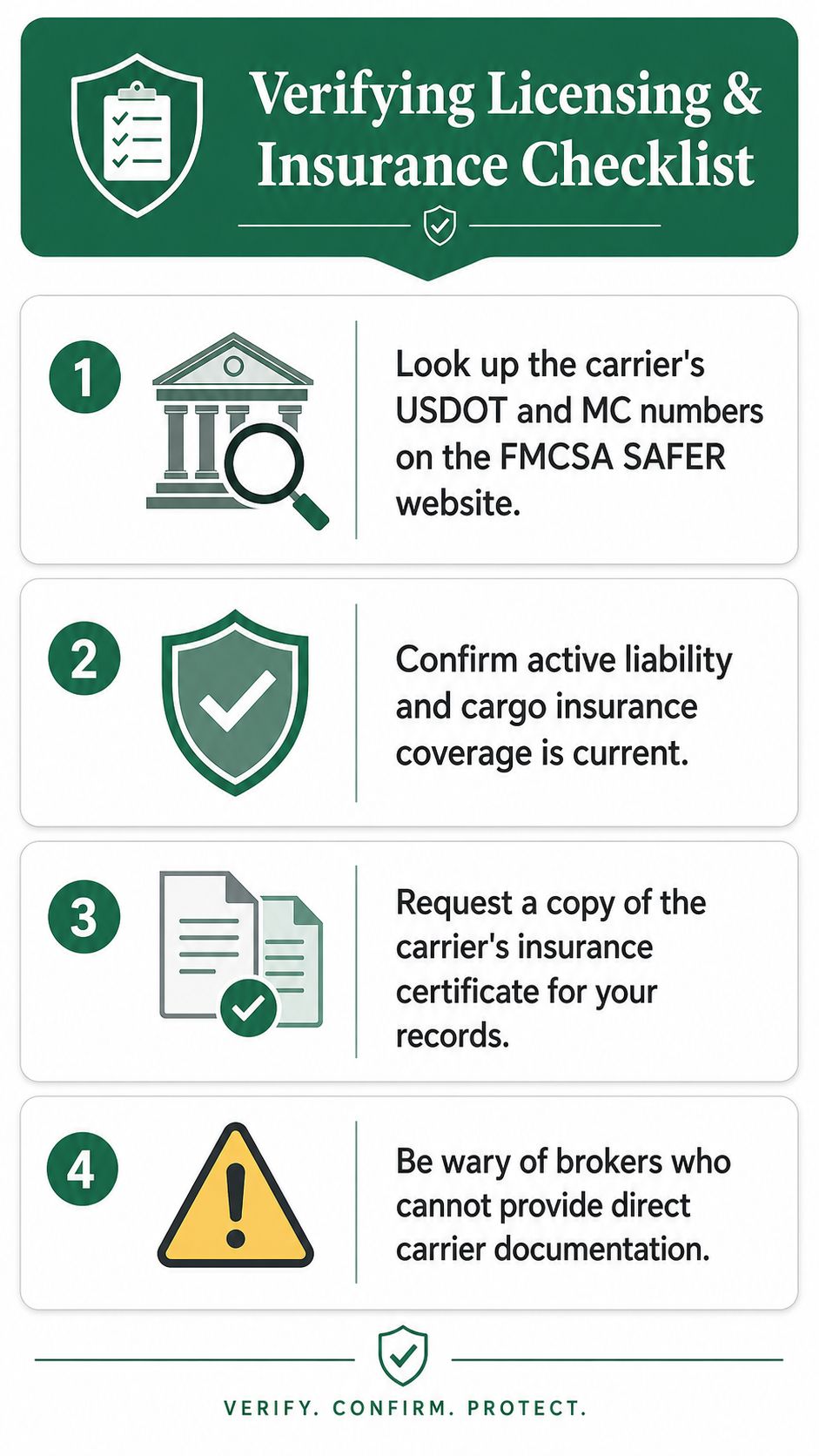
A cheap quote means nothing if the carrier cannot prove it is licensed, insured, and authorized to move your vehicle. Start there. In the U.S., legitimate interstate vehicle transport providers must show a USDOT number and often an MC number, and their FMCSA status should read Active before you even consider signing anything (FMCSA registration and authority guidance).
What to ask for right away
Ask for the USDOT number, the MC number, and a current insurance certificate. Do not accept vague reassurances like “we're covered” or “everything's on file.” A serious carrier can produce those documents quickly, and that is the first sign you are dealing with a real operation instead of a sales pitch.
Cargo insurance deserves close inspection. The coverage benchmarks you will see for transporters often range from $250,000 to $1,000,000, but the actual issue is the certificate itself and the deductible terms, not a loose promise that the company is “insured” (insurance and coverage benchmarks). If a company cannot produce that document promptly, walk away.
Read the documents like a risk manager
A written agreement should spell out who is responsible, what is covered, and what happens if there is a delay or claim. Put the paperwork ahead of the quote. That order exposes bait-and-switch tactics fast, because companies that hide the terms usually plan to change them later. For a basic overview of authority checks, see FMCSA registration and authority guidance.
A carrier that will not give you paperwork before payment is not simplifying the process, it is protecting itself at your expense.
Brokers deserve extra scrutiny, especially when they behave like carriers but cannot produce carrier-level documentation. If the company cannot clearly identify the actual transporter, or keeps deflecting when you ask who owns the truck, treat that as a warning sign. Real operators can explain the chain of responsibility without confusion.
The same standard applies when you are comparing quotes. Apples-to-apples pricing only works if each offer names the same pickup window, insurance terms, and payment conditions. A lower number that comes with vague coverage, a larger deposit, or a moving delivery promise is not a better deal, it is a weaker offer dressed up to look attractive. For an example of a carrier review process that should include written verification, see documentation and pressure red flags.
For customers shipping to or from Puerto Rico, this point often marks the beginning of many bad experiences. Ocean coordination, island logistics, and mainland pickup all require clean paperwork. The company should explain the route, the carrier role, and the documentation trail without improvising.
When the answer is no
Disqualify any company that will not share licensing details, will not provide insurance proof, or pushes for an immediate commitment. You are not being difficult by asking. You are doing the job they are supposed to do.
That rule keeps bad operators out. If the company cannot clear the compliance check, nothing else matters.
Choosing Between Open and Enclosed Transport Options
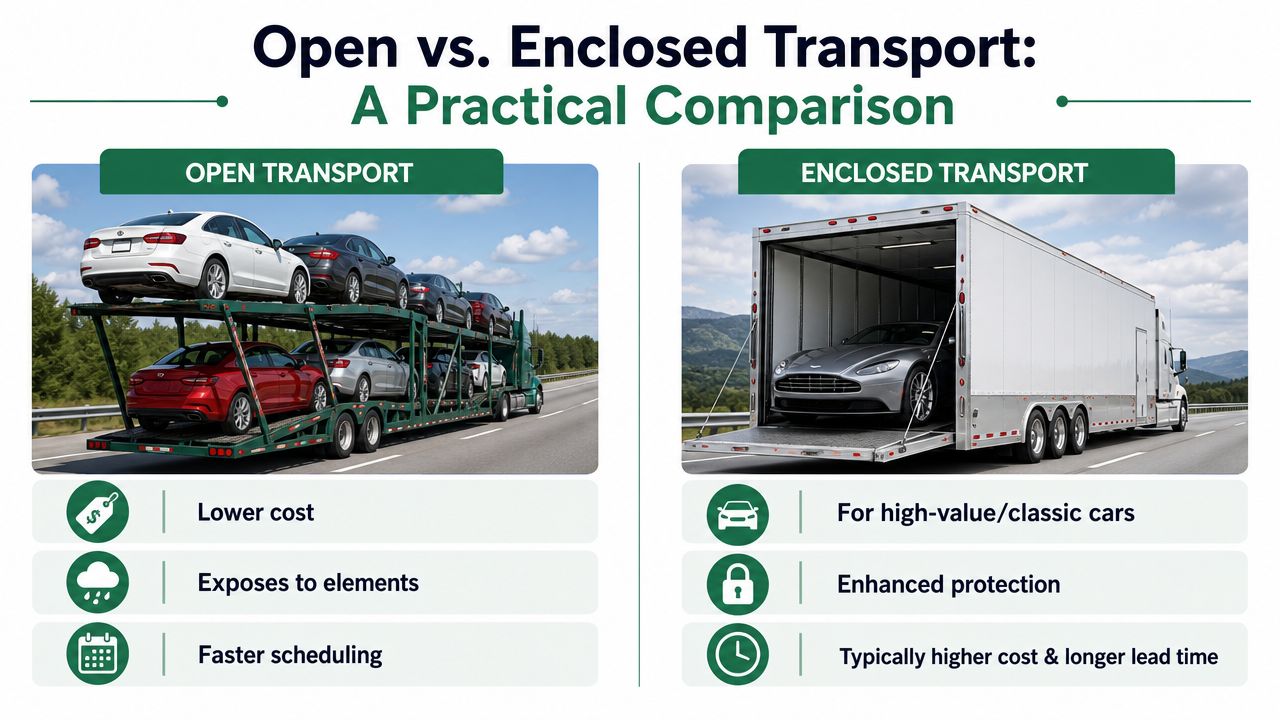
The right transport method depends on the vehicle, the route, and how much protection you need. Open carriers are the standard for most everyday vehicles because they're broadly available and usually the most affordable option. Enclosed transport is the better answer for luxury, exotic, classic, or collector vehicles, especially when the owner cares more about protection than speed or cost.
Open transport fits most standard moves
Open carriers make sense for sedans, crossovers, SUVs, dealer inventory, student moves, and most family vehicles. They're common because they're efficient, widely used, and easier to schedule. For many customers, that's enough.
If you're moving a normal daily driver from Dallas to Orlando, Phoenix to Atlanta, or Chicago to Charlotte, open transport is usually the practical answer. It gives you access to more carriers, which usually improves scheduling flexibility. For a general overview of that service type, see open car transport.
Enclosed transport earns its premium
Enclosed transport is the smarter choice when the vehicle itself justifies extra protection. That usually means higher-value cars, low-clearance models, custom paint, or vehicles that owners don't want exposed to road grime and weather during transit. The stronger the vehicle's value or sensitivity, the easier the decision gets.
Bottom line: if you'd be upset seeing dirt on the car, or if the car's resale and collector value is material, enclosed transport is the safer lane.
Route matters too. Local moves under roughly 200 miles can sometimes be handled more efficiently by a nearby provider, while Puerto Rico shipments need specialized ocean freight coordination rather than a simple mainland truck dispatch. The logistics are different enough that you should ask how the company handles island movement before you discuss price.
Door-to-door service is the convenience choice, terminal service is the tradeoff choice. Door-to-door saves time and hassle, which matters for military families, working professionals, and out-of-state buyers. Terminal pickup can make sense when access is tight, the route is unusual, or the lower friction is worth a bit less convenience.
If you're shipping to San Juan from the mainland, or sending a vehicle from Puerto Rico back to the U.S. mainland, ask the company how it coordinates pickup, transfer, and delivery timing. The right provider won't dodge that question. It'll explain the route in plain English.
Evaluating Quote Quality and Spotting Hidden Fees
A low quote means nothing if the offer is incomplete, hard to compare, or designed to change later. That is how buyers get trapped. They compare the number on the screen, then find out the final bill was never fixed in writing.
Compare the full offer, not the headline number
The first mistake is treating every quote as if it covers the same job. It rarely does. One carrier may quote open transport with a flexible pickup window, while another is pricing enclosed service, a tighter schedule, or different insurance treatment. Those are different offers, even if the totals look close.
Compare at least 3 quotes, but only after you verify that each one matches the same route, service level, and timing. If the offers are not apples-to-apples, the cheapest quote is usually the weakest one. three-quote comparison guidance
The quote should spell out the rate, fees, coverage limits, deductible, pickup window, and cancellation terms before you agree to anything. Missing details mean the quote is incomplete. Pushy answers mean the company is hiding risk, not solving it. A proper quote should read like a written offer, not a sales pitch. quote-documentation framework
| Quote Element | What to Verify | Red Flags |
|---|---|---|
| Base rate | The quoted price matches the route and service level | Vague total with no service description |
| Fees | Every surcharge is listed in writing | “We'll explain later” or shifting numbers |
| Coverage | Insurance limits and deductible terms are stated | “Fully insured” with no certificate |
| Pickup window | The timeframe is written, not casually promised | Pressure to accept a sudden dispatch |
| Cancellation terms | You know when and how you can walk away | No written policy or hostile responses |
| Payment terms | Deposit and balance timing are clear | Full payment demanded up front |
Watch the payment behavior, not just the price
A quote that looks too cheap usually is. It can signal hidden fees, a bait-and-switch setup, or a broker who is counting on adding charges after you have already committed. Pressure to book fast is another warning sign. If a company pushes urgency instead of documentation, walk away. bait-and-switch and payment risk guidance
Treat the quote as a contract preview. Ask whether the deposit is refundable, when the balance is due, and whether the rate changes if the carrier is delayed or the route shifts. If the answers stay vague, assume the final bill will not stay friendly either.
If the company will not put the rate and terms in writing, it is not a quote. It is a pitch.
For a clean benchmark on how pricing is usually structured, review car shipping cost details. Use it to judge whether the estimate fits the route, vehicle type, and service level. The goal is not the lowest number, it is the clearest documented offer.
Reading Reviews and Reputation Signals That Actually Matter
Star ratings are the least useful part of the review process if you don't read the patterns underneath them. A company can look strong on the surface and still fail on communication, claims handling, or delivery timing. The better move is to read recent feedback across multiple platforms and look for consistency, not applause.
Focus on recent patterns
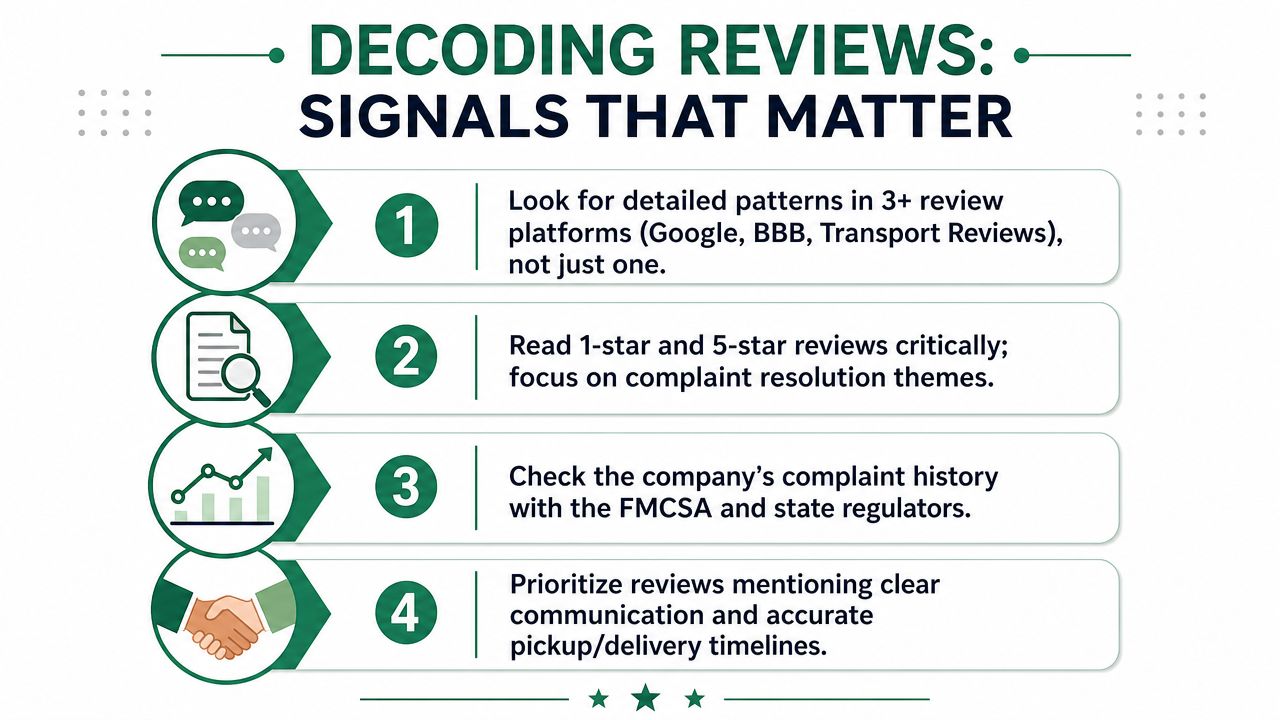
One useful rule is to review feedback across Google, BBB, and Trustpilot, then focus on recent reviews from the last 6 to 12 months (recent-review guidance). That time window matters because transport companies change fast. A good brand name from years ago doesn't protect you today.
Read the low ratings carefully. Complaints about missed timelines, ignored calls, sloppy inspection notes, or unclear claims handling are far more informative than generic praise. Also check how the company responds to negative feedback, because that often shows whether management solves problems or just argues online.
Look for evidence, not just enthusiasm
A strong reputation includes verifiable communication procedures and inspection habits at pickup and delivery. Customers should be able to see a pattern of clear updates, consistent condition reporting, and realistic delivery estimates. That's harder to fake than a polished homepage.
When companies talk about experience, take the claim seriously if the rest of the business supports it. An A+ BBB rating and 25+ years of experience can signal stability, but only when paired with documented process and a serious carrier network. National coverage also matters, because a company with a 25,000+ vetted carrier network has more room to match routes efficiently than a limited shop with a thin bench.
Good review signal: people describe exactly how the pickup, communication, and delivery unfolded. That's the kind of detail scammers hate.
Avoid relying on star averages alone. A profile can look clean while hiding weak complaint resolution, or it can look imperfect while still showing responsive management and solid delivery performance. The difference is in the story the reviews tell, not the score at the top.
For special routes like Puerto Rico, the review trail should show that the company understands island coordination, bilingual communication when needed, and shipment tracking across handoffs. If reviews never mention route complexity, ask more questions before booking.
Your Complete Auto Transport Decision Checklist
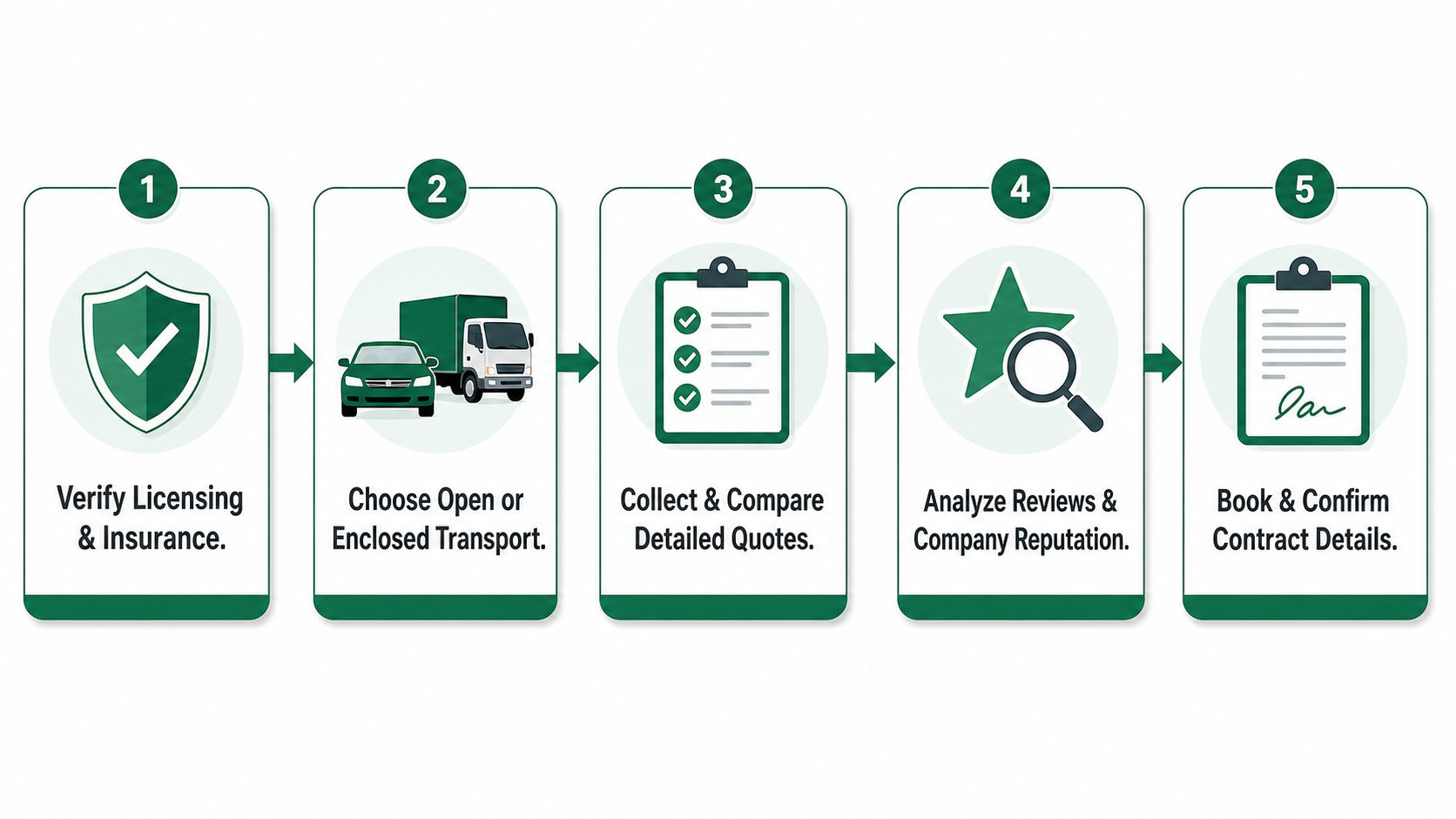
The decision should be boring by the end. Boring means safe. Verify the company, pick the right service, compare quotes in writing, and only then decide who gets your vehicle. That sequence keeps you out of trouble.
The checklist that actually works
- Verify licensing first. Ask for the USDOT and MC numbers, then confirm Active status and current operating authority in the FMCSA database. If that step fails, the conversation ends there.
- Confirm insurance in writing. Request the current insurance certificate, check the coverage terms, and read the deductible details.
- Choose the transport type that fits the vehicle. Open works for most standard shipments, enclosed makes sense for protected or high-value transport, and Puerto Rico shipments need a company that understands ocean coordination.
- Collect detailed quotes. Compare at least three written offers that show rate, fees, coverage, pickup window, and cancellation terms.
- Check reputation patterns. Read recent reviews across major platforms, pay attention to complaint handling, and look for consistent communication habits.
Ask these questions before you book
- Who is the actual carrier? You need to know who's moving the car, not just who answered the phone.
- What exactly is included in the quote? Every major cost driver should be written down.
- How do you handle claims? The company should explain the process without dodging.
- What happens if pickup slips? You want a real answer, not a sales line.
- How do you coordinate Puerto Rico shipments? Mainland and island moves should be described clearly, especially for San Juan routes.
That same discipline helps every audience, including snowbirds, students, dealerships, and military families. It also helps when you want a bilingual agent based in the U.S. who can keep the process simple, quick, and organized while the shipment is moving.
For door-to-door service details, see door-to-door auto transport. Use that option when convenience matters more than terminal logistics, and make sure the contract reflects the actual pickup and delivery plan.
Start your search early enough to compare properly, then book only after the paperwork is clean. The best companies make the process feel controlled because they've already done the hard work behind the scenes.
If you want a shipper that knows how to handle mainland routes, Puerto Rico logistics, and the paperwork that protects you, National Car Transport is built for that job. They offer 25+ years of experience, an A+ BBB rating, transparent flat-rate pricing, and a network of 25,000+ vetted carriers, with bilingual English and Spanish agents based in the U.S. ready to guide you from quote to delivery. Visit National Car Transport to get a clear, documented shipping plan without the usual runaround.