
The most popular advice about car shipping reviews is also the least useful: pick the company with the highest star rating. A 4.8-star average can still hide a quote that rises before pickup, a carrier that misses the agreed window, or a damage claim that sits unanswered after delivery.
Reliable car transport reviews need a closer reading. Look for evidence of price stability, scheduling dependability, communication, vehicle condition, and claims handling. Those details tell you how a company operates when a shipment becomes inconvenient, not just how it performs when everything goes smoothly.
That distinction matters whether you're moving between major cities in the 48 states, sending a vehicle to San Juan, relocating for military service, moving south for the winter, shipping a student's car, or coordinating vehicles for a dealership. A review isn't an endorsement to accept blindly. It's a record of what happened, and your job is to determine whether the same pattern is likely to affect your shipment.
Table of Contents
- Why Star Ratings Alone Won't Protect Your Car
- What Reliable Car Transport Reviews Measure
- Where to Find Trustworthy Auto Shipping Reviews
- Reading Complaint Data and Spotting Fake Reviews
- Sample Review Analyses From Real Customers
- A Practical Checklist for Choosing a Car Carrier
- How National Car Transport Meets the Reliability Bar
- Frequently Asked Questions About Car Transport Reviews
- How many reviews are enough to judge a company?
- Can a newer company with few reviews be trusted?
- How early should I read reviews before a seasonal move?
- What if my experience contradicts the reviews?
- Do reviews tell me whether open or enclosed transport is right?
- Are Puerto Rico reviews comparable to mainland reviews?
Why Star Ratings Alone Won't Protect Your Car
Star ratings measure sentiment, not operational control. A customer may leave five stars because the car arrived safely, even though the price changed before pickup or communication was poor. Another customer may post a low rating after a difficult experience that a carrier resolved responsibly. Treating both ratings as complete evidence leads to bad decisions.
Forbes' guidance on evaluating reliable car-transport providers points buyers toward verifiable contact information, responsive support, third-party reviews, and checks of FMCSA/USDOT and BBB records. That approach is more useful than counting stars because it tests whether the company can be audited before and after booking.
The three signals that matter most
Pricing clarity comes first. Read whether customers received a written quote, whether the company explained what could change it, and whether the final amount matched the booking terms. A complaint about a higher price before pickup deserves more attention than several vague comments saying “great service.”
Booking and pickup dependability reveal whether the provider can secure a carrier for your route. Look for realistic pickup windows, updates when plans change, and evidence that the driver arrived as promised.
Post-delivery support becomes critical when the vehicle has damage or the inspection paperwork is incomplete. Reviews should tell you whether the company helped document the issue, explained the insurance process, and stayed reachable after delivery.
Practical definition: Reliable transport means the provider gives you a clear financial commitment, coordinates a realistic pickup, documents the vehicle properly, and remains accountable after delivery.
A high-value vehicle, classic car, or custom-painted car may deserve enclosed auto transport, but the same review framework still applies. Protection during transit doesn't compensate for unclear terms or unreachable support.
What Reliable Car Transport Reviews Measure
A five-star average can hide unstable pricing, weak route coverage, or poor claims support. Reliable car transport reviews expose the operating details that determine whether a shipment stays predictable from quote to delivery. The 2025 Forbes Home survey of 1,600 car-shipping customers across 16 companies found that affordability and customer reviews were leading decision factors. Its findings also connect satisfaction with price transparency, booking ease, and pickup reliability. The survey data and customer-service findings are available through this BBB reference.
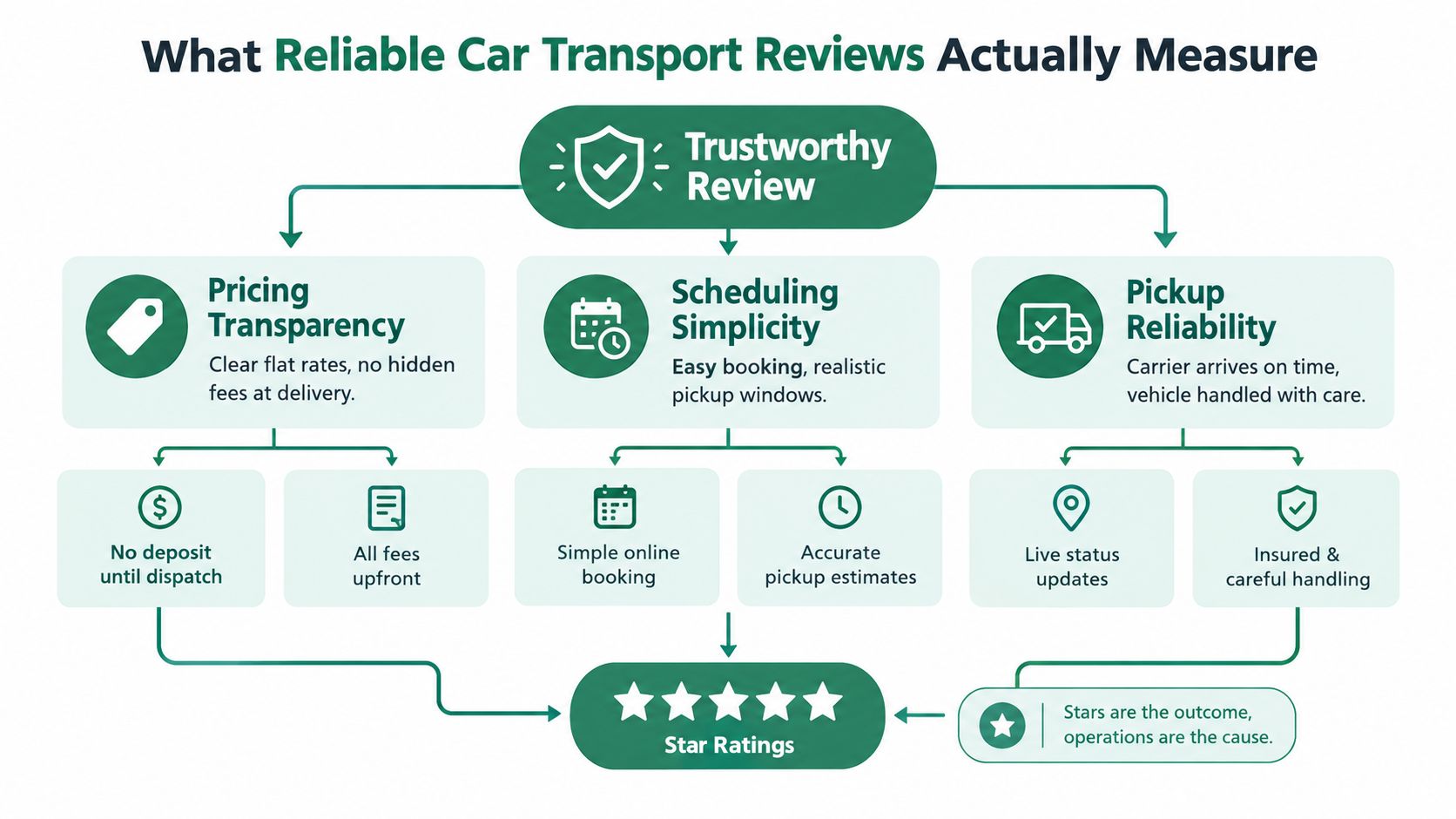
Read each review for answers to five practical questions:
- Quote accuracy: Did the price remain stable, and did the customer understand what the estimate covered?
- Communication: Could the customer reach a real person before pickup and during transit?
- Timing: Did the provider give a realistic pickup window and explain delays?
- Vehicle condition: Did the driver document the car carefully at pickup and delivery?
- Claims handling: Did the company respond constructively after reported damage?
According to the 2025 Forbes Home survey, 88% of A1 Auto Transport customers said they would recommend the company, 89% said scheduling was simple, and 96% said they received a pickup date within days of booking. The survey also reported 86% satisfaction with price transparency among A1 customers, compared with an 83% average across all companies, while 34% identified better pricing or estimate information as the biggest needed improvement. These figures are summarized in the Forbes Home car shipping survey.
Use those findings to test patterns, not praise. Repeated compliments about easy booking mean little if reviews also report quotes changing before pickup. Strong delivery feedback may coexist with poor escalation support. Route details matter too. A company can perform well on common mainland lanes yet provide less predictable service for island routes such as Puerto Rico.
For domestic shipments, check whether reviews mention access limits, alternate meeting points, and live updates. A provider that explains how it handles remote addresses gives you more useful evidence than a generic promise of door-to-door auto transport.
Where to Find Trustworthy Auto Shipping Reviews
Start with independent review platforms, but don't stop there. Third-party sites show customer experiences at scale, yet they can still contain incomplete or emotional accounts. Read several recent reviews and search for shipment details, such as origin, destination, vehicle type, pickup timing, delivery condition, and the company's response.
The Better Business Bureau offers a different kind of evidence. Its complaint records show how a business responds to problems, whether it answers complaints, and whether recurring issues appear in the record. A BBB rating matters, but the complaint narrative often matters more because it exposes the facts behind the score.
A simple verification sequence
- Confirm the company identity. Check that the business name, phone number, physical contact details, and website information match across its site, review profiles, and regulatory records.
- Verify FMCSA and USDOT information. Ask for the broker or carrier's registration details, then check the active status and operating authority through the official FMCSA database.
- Review external feedback. Search for repeated themes about quote changes, missed pickups, support responsiveness, vehicle damage, and claim resolution.
- Read company testimonials last. Testimonials can explain the services a company wants to highlight, but they're curated. Use them as supporting evidence rather than independent proof.
Forbes specifically recommends checking third-party reviews and cross-referencing FMCSA/USDOT and BBB records. That matters for every customer group. A military family needs dependable coordination around a move, a snowbird needs a predictable seasonal lane, a dealership needs repeatable fleet handling, and an individual buyer needs to know who is accountable if the shipment changes.
Rule of thumb: No single review source can establish reliability. Trust the provider only after the company identity, registration, complaint history, and customer patterns tell the same story.
This approach also helps distinguish a broker from a carrier. A broker may coordinate a network rather than own the truck, so verify how it selects carriers, confirms insurance, communicates dispatch details, and handles problems when the assigned driver changes.
Reading Complaint Data and Spotting Fake Reviews
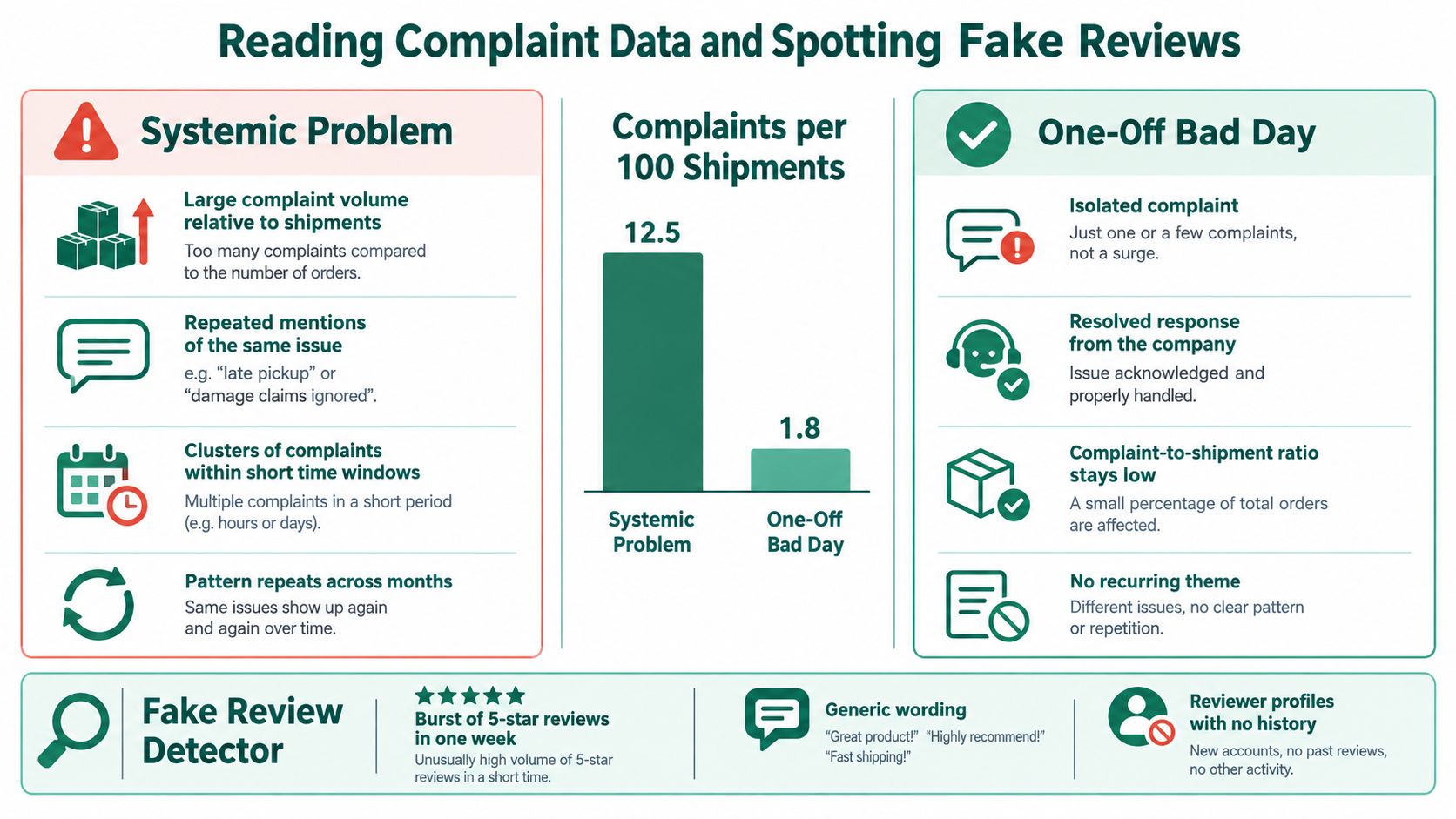
Complaint counts are useful only when you read them in context. A large company may receive more complaints because it handles more shipments, while a smaller company may show fewer complaints without proving stronger performance. Compare the recurring subjects, company responses, time periods, and, when available, the complaint volume relative to shipment activity.
BBB records provide a clear illustration. Montway Auto Transport had 279 total complaints in the last 3 years and 113 complaints closed in the last 12 months, while Sherpa Auto Transport had 17 total complaints in the last 3 years and 9 closed in the last 12 months. The same BBB records list 62 total complaints in the last 3 years for Navi Auto Transport and 155 total complaints in the last 3 years for Nexus Auto Transport. See the BBB complaint records used for this comparison.
Separate a pattern from an incident
A systemic problem usually appears as repeated complaints about the same failure, such as price increases, late pickups, poor communication, or ignored damage claims. A one-off complaint includes specific shipment details, a clear company response, and no evidence that the same issue keeps appearing.
Fake or weak reviews often lack practical information. Watch for:
- Generic wording: “Great company” without a route, vehicle, timing, or service detail.
- Unnatural clustering: Many similar five-star posts appearing close together.
- No shipment context: The reviewer doesn't identify what happened from booking through delivery.
- No response history: The company never addresses detailed complaints, or responses look copied and evasive.
A useful review-audit workflow can help you identify missing themes and repeated weaknesses. For teams comparing providers at scale, the review weakness miner tool can organize review language around recurring service failures, but it can't replace registration checks or human judgment.
Review complaint records alongside the provider's pricing process. For a practical reference on quote structure and cost variables, examine car shipping cost information from National Car Transport, then ask whether customer reviews describe the same pricing logic.
Sample Review Analyses From Real Customers
The fastest way to improve your judgment is to dissect the wording customers use. Consider three anonymized review styles that appear frequently in auto transport.
The glowing review with no evidence
“Five stars. Excellent service. My car arrived and everyone was nice.”
This review may be genuine, but it tells you almost nothing about route reliability. It doesn't say whether the quote changed, how long pickup took, whether the inspection was detailed, or how the company would respond to damage. Keep it in the positive column, but give it less weight than a review with verifiable operational detail.
You can compare that thin testimonial with more detailed customer accounts by browsing client testimonials, while still treating any company-selected testimonial page as supporting material rather than independent verification.
The detailed price complaint
“I booked at one amount. Before pickup, the company said no carrier would take the shipment unless I paid more. Support told me the market had changed.”
This complaint raises a serious question, but it doesn't automatically prove dishonesty. Recent industry reporting states that, in the first half of 2026, completed shipments finishing above the booked price rose 46%, cancellations rose 24.8%, and cancellations because the booked rate was too low to attract a carrier rose from 1.45% to 4.64%. Those figures come from SGT Auto Transport's State of Auto Transport 2026 release.
The review should therefore be tested against the provider's conduct. Did the company disclose that the quote was exposed to carrier acceptance? Did it offer choices, explain timing, and document the revised terms? A market-driven re-bid can happen, but a vague quote followed by pressure is a reliability problem.
The balanced inspection review
“The driver photographed the existing scratches at pickup, noted them on the bill of lading, called before delivery, and reviewed the vehicle with me when it arrived. One delay occurred because of weather, but the company updated me.”
This is stronger evidence because it documents process. It tells you how the provider handled condition records, communication, delay expectations, and delivery verification. Balanced reviews often deserve more trust than perfect praise because they show what happened when the shipment wasn't effortless.
A Practical Checklist for Choosing a Car Carrier
Use this checklist before you compare quotes. A strong candidate should make each item easy to verify in writing, not require you to infer the answer from marketing language.
| Checklist Item | Strong Candidate | Risky Candidate |
|---|---|---|
| FMCSA/USDOT registration | Provides active, traceable details | Avoids or obscures registration information |
| BBB record | Shows a clear rating and explainable complaint history | Relies only on a badge or ignores complaints |
| Third-party reviews | Includes route, timing, vehicle, and resolution details | Contains vague or repetitive praise |
| Pricing structure | Explains a flat rate and possible exceptions | Uses an unusually low quote without conditions |
| Cargo insurance | States coverage limits and claim procedures | Gives vague assurances |
| Inspection documentation | Uses pickup and delivery condition reports | Treats inspection paperwork as optional |
| Human support | Offers reachable agents throughout the shipment | Directs you only to automated forms |
Verify before you pay
Ask for the registration information and check it independently. Then request the written quote, cancellation terms, carrier-matching conditions, payment schedule, and the name or role of the person responsible for support.
Damage handling deserves special attention because the problem is uncommon but meaningful. One consumer review source estimates that 1 in 20 vehicles may be damaged during shipping and notes that many licensed carriers carry roughly $100,000 to $1 million in cargo insurance, as described in ConsumerAffairs' auto-transport review guidance. Don't treat those figures as a guarantee for your shipment. Ask what the selected carrier's actual policy covers, whether exclusions apply, and how quickly you must report damage.
Before pickup, photograph every side of the vehicle and record existing marks. At delivery, compare the vehicle with the inspection report before signing completion paperwork. If damage appears, document it immediately and ask for the claim procedure in writing.
How National Car Transport Meets the Reliability Bar
A five-star rating does not prove stable pricing, dependable route coordination, or effective claims support. National Car Transport offers a practical case for reading reviews against those specific standards. Company information supplied for this service lists 25+ years of experience, an A+ BBB rating, transparent flat-rate pricing, and payment only after a carrier is matched. Its network includes 25,000+ vetted, licensed, and bonded carriers, giving customers access to different carriers and routes rather than one truck or operating path.
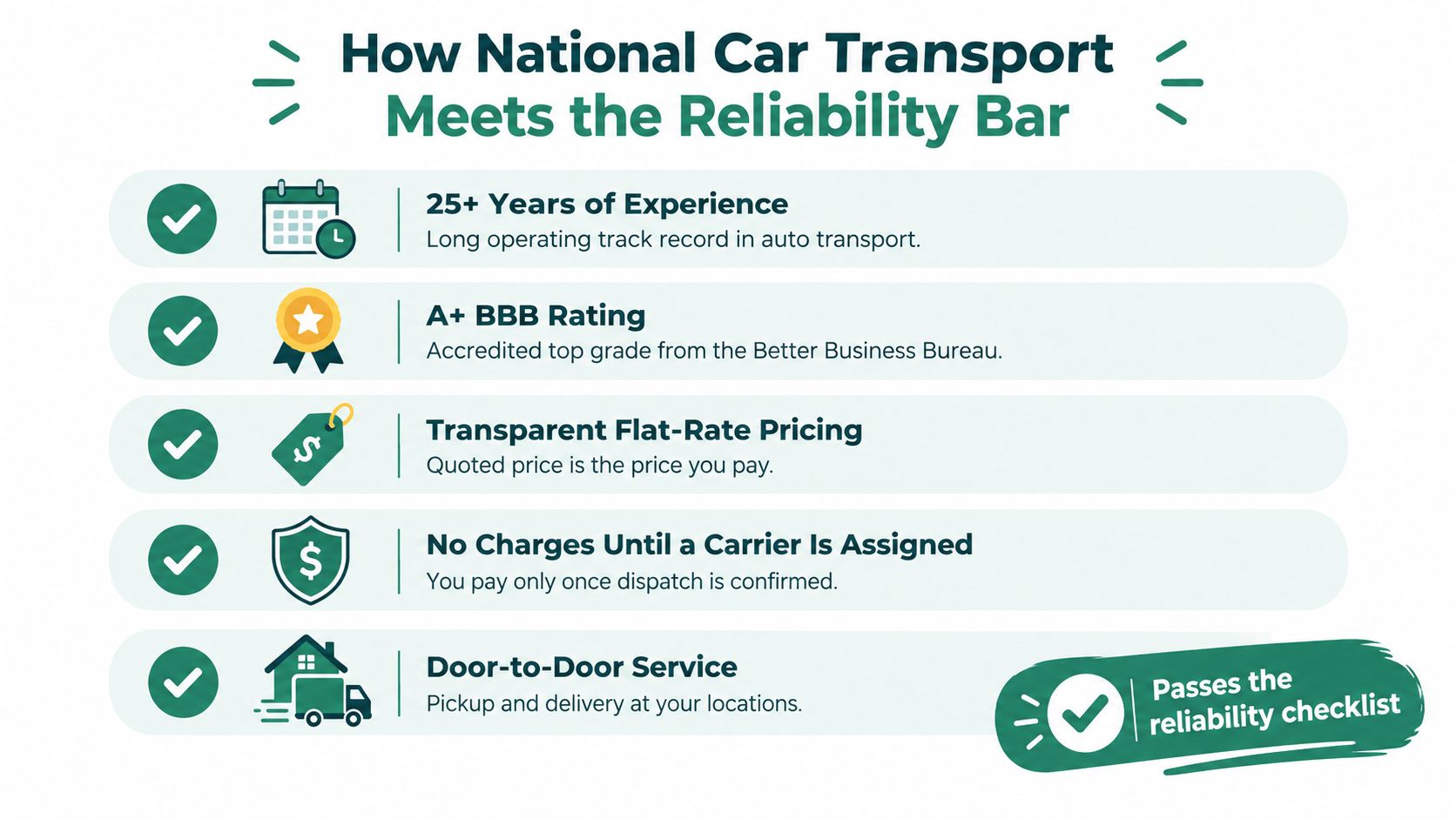
Reviews should show whether those stated policies hold up in actual shipments. Look for comments about quote changes before pickup, pickup reliability, communication during delays, and how clearly the company explains carrier matching. A low initial price means little if the final quote rises without a clear reason.
The support model also matters. National Car Transport has bilingual English and Spanish agents based in the United States, including agents with over 20 years of experience in auto transport logistics. They assist from scheduling and pickup inspection through delivery, with service available 365 days a year. That coverage matters because a major-city sedan shipment requires different coordination from a seasonal SUV move, enclosed transport for a classic car, or a dealership fleet shipment.
Puerto Rico requires a separate reliability test
Island shipping adds ocean logistics, port schedules, and paperwork. JAXPORT identifies Crowley, TOTE Maritime Puerto Rico, and Trailer Bridge as the three ocean carriers based in Jacksonville offering service to and from Puerto Rico, according to Puerto Rico car transport guidance. National Car Transport coordinates mainland-to-Puerto Rico shipping through Jacksonville to the Port of San Juan, with container options for eligible vehicles.
TOTE Maritime's Puerto Rico vehicle-shipping guidance advises making a reservation before delivering the vehicle because demand can be high and provides receiving hours at Isla Grande in San Juan. Reviews of this route should identify whether the company handled reservation timing, documents, port handoffs, and delivery coordination clearly.
Route distance also changes expected timing. Examples include Orlando to San Juan at 1,609 miles and 8–9 days, Miami to San Juan at about 1,812 miles and 9–11 days, and Los Angeles to San Juan at 3,877 miles and 13–15 days, as shown in mainland-to-San Juan shipping examples. These are examples, not promises. A positive Florida review cannot automatically predict a California shipment.
Frequently Asked Questions About Car Transport Reviews
How many reviews are enough to judge a company?
There isn't a magic review count that proves reliability. Look for consistent, specific experiences across independent sources, especially reviews that describe pricing, pickup, communication, inspections, and resolution. A smaller profile with detailed, credible accounts can be more useful than a large profile filled with generic praise.
Can a newer company with few reviews be trusted?
Possibly, but it must compensate for limited review history with strong documentation. Verify FMCSA/USDOT information, insurance, written terms, contact details, and the identity of the carrier or broker. Don't let an introductory price substitute for an operating record.
How early should I read reviews before a seasonal move?
Read them before requesting quotes, then check recent feedback again as your pickup date approaches. Seasonal routes, snowbird moves, military relocations, and college schedules can expose problems that don't appear in quieter periods. For Puerto Rico, review reservation and port-document requirements before the vehicle is delivered to the shipping facility.
What if my experience contradicts the reviews?
Document the shipment while events are fresh. Save the quote, contract, messages, inspection reports, photos, payment records, and delivery paperwork, then give the company a precise opportunity to respond. If the response doesn't resolve the issue, post a factual review that identifies the route, vehicle type, timeline, problem, and attempted resolution without exaggeration.
Do reviews tell me whether open or enclosed transport is right?
Reviews can reveal whether customers received the service they booked, but they can't decide your risk tolerance. Open transport generally suits ordinary daily drivers, while enclosed service may make more sense for a classic, exotic, luxury, or unusually valuable vehicle. Read for inspection quality and handling practices in either case.
Are Puerto Rico reviews comparable to mainland reviews?
Only in part. Mainland shipments depend heavily on carrier availability, route access, pickup coordination, and delivery communication. Puerto Rico shipments also involve ocean carriers, port appointments, paperwork, and San Juan receiving procedures, so give island-specific reviews greater weight when your destination is Puerto Rico.
Reliable car transport reviews won't eliminate every shipping variable. They will help you identify whether a provider explains those variables plainly, documents the vehicle properly, keeps its quote understandable, and stays available when plans change.
National Car Transport offers door-to-door open and enclosed shipping across the 48 states, plus container and ocean options for Puerto Rico routes, with transparent flat-rate pricing and bilingual U.S.-based support. Visit National Car Transport to request a shipment review and quote based on your vehicle, route, and timing.