
An auto transport broker is a regulated intermediary that arranges a vehicle's shipment with an authorized motor carrier for a fee, without owning the truck or driving it. That company must keep $75,000 in financial security on file, while a separate motor carrier picks up the car, loads it, and delivers it.
You're comparing quotes for a car that has to leave the mainland and show up in San Juan, or come back the other way. A snowbird in Philadelphia wants a sedan at the condo before winter. A service member is changing duty stations. A student is flying ahead of the car. A dealer in Jacksonville is moving auction inventory on the next sailing. The company that took your call may never put a hand on the steering wheel.
That split is the part people miss. Booking the move and driving the truck are two jobs, held by two kinds of businesses, even when both names appear on one shipment.
Table of Contents
- What an Auto Transport Broker Does
- How a Broker Matches Your Car With a Carrier
- Transit Times and What to Expect
- Broker Authority, Bonds and Insurance Explained
- Puerto Rico Costs, Taxes and Paperwork a Broker Handles
- Documents, Pickup Inspection and Common Mistakes
- Confirm Your Broker Before You Book
What an Auto Transport Broker Does
Think of the broker as a travel agent and the carrier as the airline. The agent books the seat, checks the route, and tells you when to be at the gate. The airline owns the plane and flies it. What is an auto transport broker comes down to that same split, applied to a car instead of a passenger.
The Federal Motor Carrier Safety Administration defines a broker as a person who, for compensation, arranges, or offers to arrange, the transportation of property by an authorized motor carrier. FMCSA calls the broker the "middle person" between a shipper and a motor carrier. Brokers arrange transportation without directly transporting the property themselves.
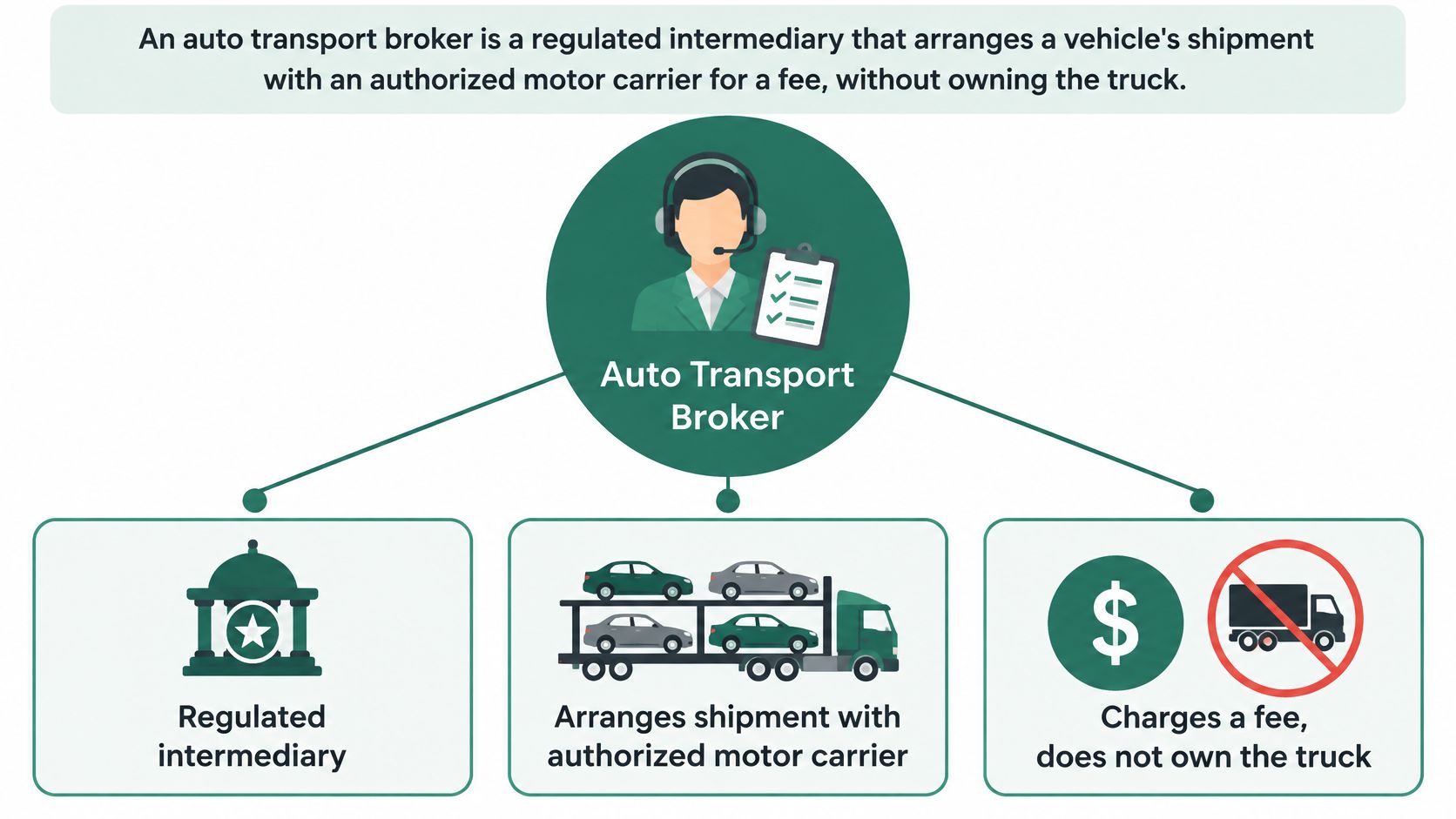
One shipment can involve both companies, and they stay separate businesses. The broker organizes the load, passes pickup and delivery requirements, and matches you with a carrier that can serve the lane. The carrier owns the equipment, employs the driver, and does the physical move. On routes into and out of Puerto Rico, trailer type and port timing change from week to week, so coordination is the broker's work, not driving.
How the jobs divide
| Responsibility | Auto transport broker | Motor carrier |
|---|---|---|
| Arranges the shipment and matches it to capacity | Yes | Receives the assignment |
| Owns the truck or employs the driver | Usually no | Yes |
| Physically picks up, loads and delivers the vehicle | No | Yes |
| Holds the $75,000 broker financial security | Yes | No, carriers carry their own insurance |
| Monitors timing and communicates status | Yes | Reports pickup and delivery |
Practical rule: On any quote, name which company is the broker and which is the carrier before you sign. If one legal entity holds both authorities, the paperwork should still say which role it is playing on your load.
How a Broker Matches Your Car With a Carrier
Say the car is in Miami and the owner lives in San Juan. It does not sail straight out of Miami. A truck hauls it north to Jacksonville, FL, the vessel loads there, and the ship sails to San Juan. Philadelphia, PA is the alternate mainland port, not the default for a South Florida pickup.
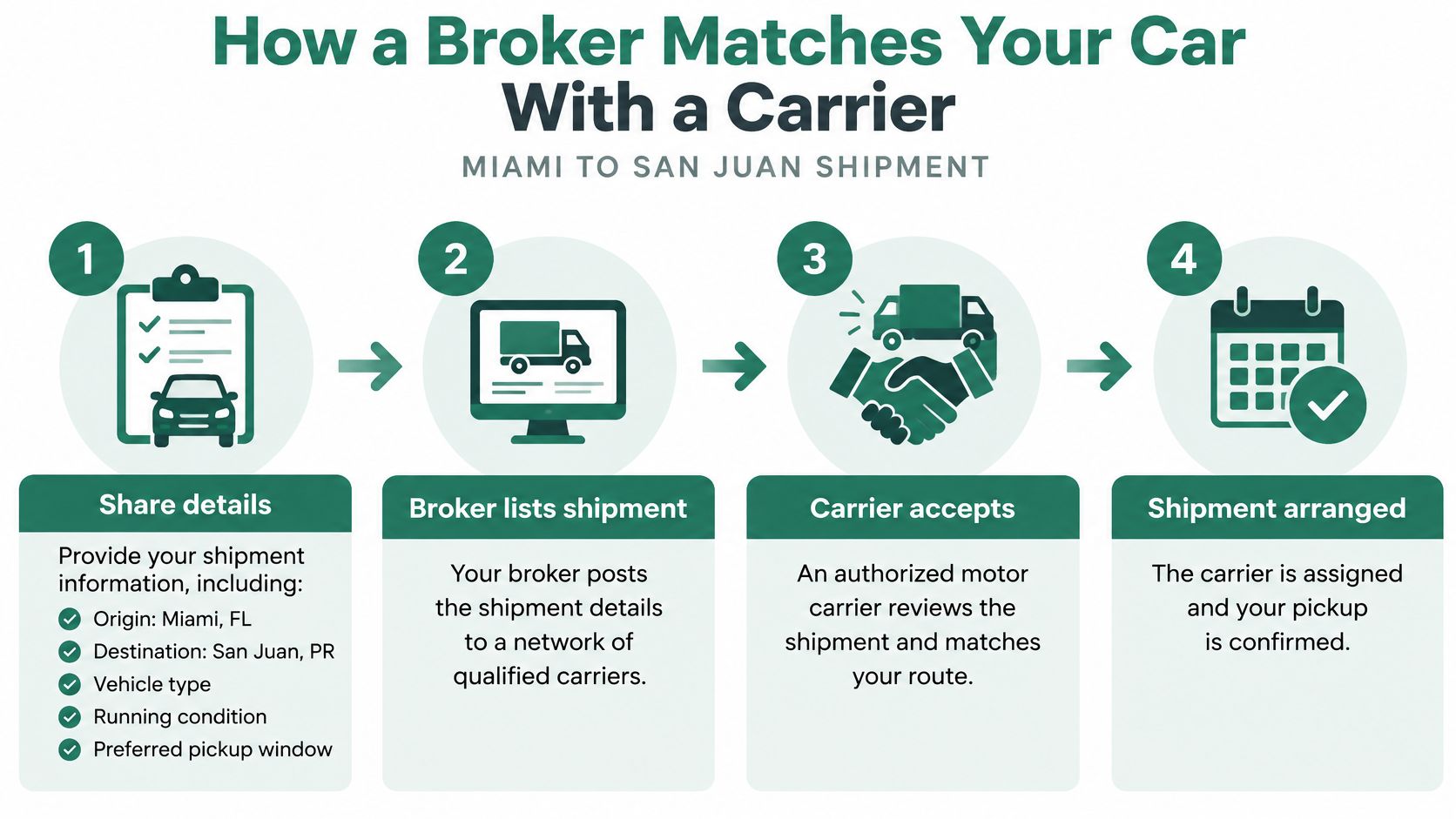
The match happens in order, and each step exists so a later dispute has a paper trail.
- You share origin, destination, vehicle type, running condition, and a preferred pickup window. The broker turns that into a shipment request. Vague details can leave you with a carrier who can't take the car.
- The broker checks lane capacity and equipment. A daily driver usually rides an open trailer. A high-value or classic car needs an enclosed trailer. Asking for the wrong equipment wastes the first week.
- The broker assigns a motor carrier with active authority and insurance, then confirms that carrier's identity in writing. A price without a named carrier is still a search, not a booking.
- The carrier sets the pickup, and the broker tracks whether that window holds. You should know who to call if the truck slips a day.
- At pickup the driver inspects the car, marks existing damage on the Bill of Lading, and photos should back that sheet. That report is what a later damage claim gets compared against.
- For this Miami car, the truck goes to Jacksonville, the vehicle is loaded on the vessel there, and it sails to San Juan. Philadelphia is only the alternate port if the booking is built that way. The sailing, not the highway miles, sets most of the wait.
- At delivery in San Juan you inspect the car against the pickup report and sign the release. New marks belong on that delivery sheet before you sign, not in an email the next morning.
A healthy shipment has three things in writing: a named carrier, a confirmed pickup window, and an inspection record at both ends.
This short walkthrough shows how a broker posts a load and a carrier accepts it.
Transit Times and What to Expect
A car leaving Miami for San Juan does not move on one clock. It works like a relay: the truck is one runner, the ship is the next, and the car advances only when that next runner is ready. Once a carrier is named, expect stages, not a single promised hour.
The pickup window is a span of days. A locked Tuesday at 10 a.m. is rarely how a multi-car trailer fills. The broker is accountable for the arrangement: the written window, the contract that names it, and the $75,000 bond behind that contract. The carrier is accountable for pickup, loading, and insurance on the car. If the truck slips, you call the person the broker named, because a moving window still has an owner.
The truck leg runs to Jacksonville, or to Philadelphia when that port is the one on your booking. The broker should watch the handoff so the car is not sitting in a yard with nobody assigned to it. The driver and the trailer do the miles. If you want to see how a trailer unit reports location, trailer GPS tracking explained is a plain look at what those devices report.
Most of the wait is the vessel. The car sits for a sailing to San Juan, and highway speed does not shrink a ship that has not left. Ask for that sailing date in writing. The broker arranges the booking. The ocean carrier moves the vehicle.
Port release comes after the paperwork clears, including the excise estimate. A car at the pier is not a car you can drive yet.
Delivery in San Juan goes to the address you agreed, and the carrier reports status when the truck rolls. The same stages run in reverse when the car leaves the island for a mainland city.
Total time follows the sailing calendar and port timing, so the broker should give a written estimated range for your lane. Days that are not confirmed stay unstated until the sailing is booked.
Before you pay the balance, get three items in writing and set them down on a Puerto Rico car shipping schedule for your booking: the pickup window, the sailing date, and the expected delivery window.
Broker Authority, Bonds and Insurance Explained
A sedan leaves Miami for San Juan. One company arranged the booking and the contracts. Another company picks the car up, loads it, and carries the insurance that applies if it is scratched. Those are two jobs. Sending a damage claim to the wrong one is a common mix-up.
The arranger is the broker. The mover is the carrier. A broker works like a booking desk at a port: it lines up the shipment and the paperwork, and it does not drive the trailer or sail the vessel. On a Miami-to-San-Juan move, the broker is accountable for arranging the shipment and the contracts that bind it, including the $75,000 financial security described below. The carrier is accountable for pickup, loading, and the cargo insurance on the car.
A U.S. property broker can't register until its financial security is active. Under 49 CFR 387.307, that security is $75,000, filed either as a surety bond on Form BMC-84 or a trust fund on Form BMC-85. Registration stays valid only while that security stays active. The broker also files Form BOC-3, which names an agent for service of legal process.
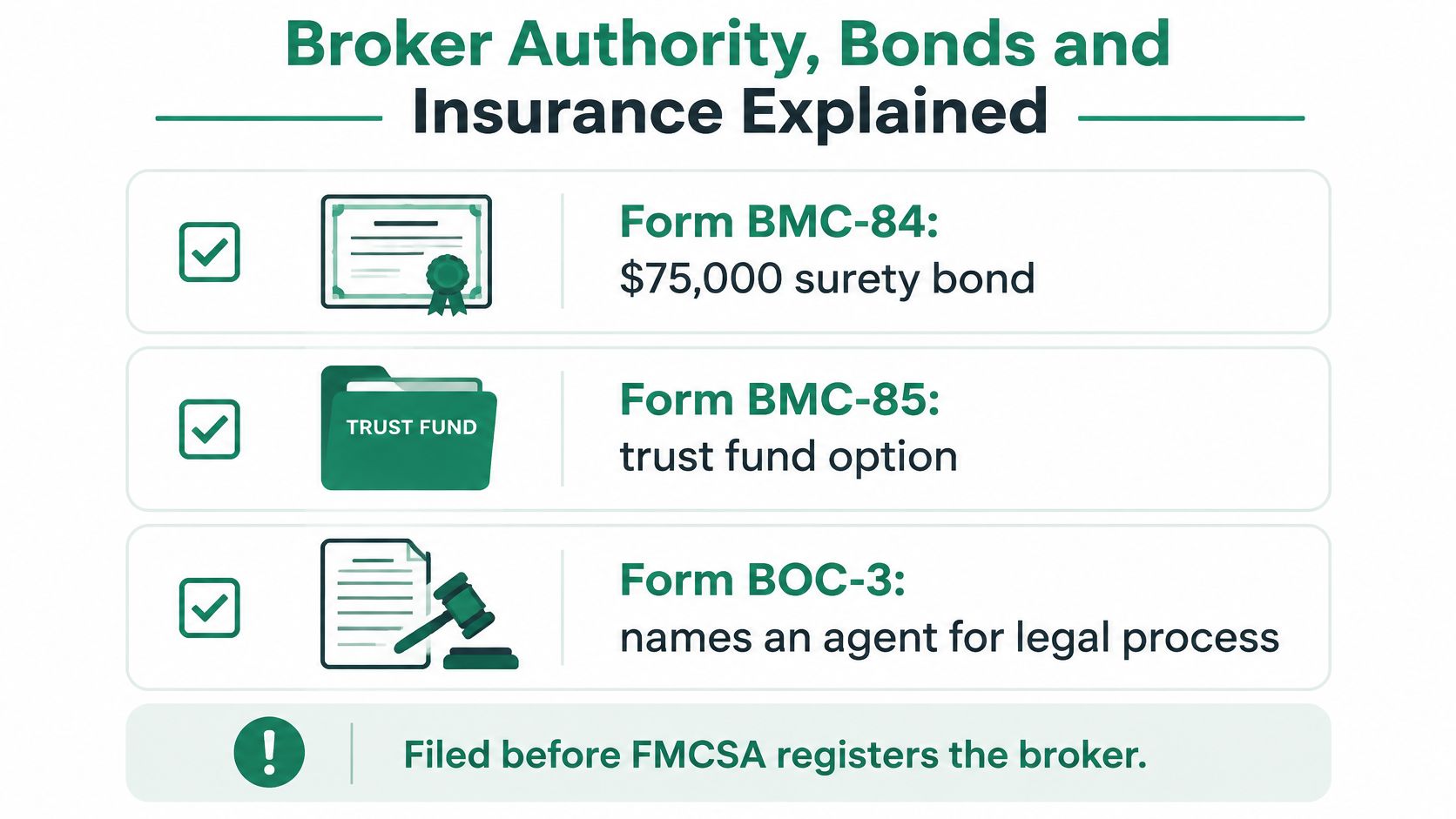
That bond or trust backs payments to shippers or motor carriers when a broker fails to carry out the transportation contracts it arranged. It is not cargo insurance on your car. A scratch, a dent, or a total loss is a carrier-insurance question. Treating the bond as a damage payout leaves the claim pointed at the wrong party.
Six checks before a deposit
- Look up the USDOT or MC number and confirm active broker authority.
- Match the legal name on the quote to the name in those federal records. A similar trade name is not the same company.
- Confirm BMC-84 or BMC-85 security is on file and still active.
- Ask whether the quote comes from a broker, a carrier, or both.
- Request the assigned carrier's name, USDOT number, and current insurance certificate before you treat that carrier as assigned. A plain insurance verification process shows what to read on the certificate, including whether the limits match your car's value.
- For a high-value car, you provide the appraised value and National Car Transport matches you with a carrier whose coverage fits that figure.
A bond can signal that a broker is allowed to arrange freight. It does not replace the carrier's cargo and liability coverage, and it does not automatically reimburse every damage dispute.
If you're pricing what cargo coverage should protect, budgeting freight coverage for DTC importers is a useful companion to the certificate you request in check five. Read the limits against your car's value, not against the bond amount.
Puerto Rico Costs, Taxes and Paperwork a Broker Handles
Arbitrios is the excise tax on a vehicle arriving in Puerto Rico. It is separate from the truck-and-vessel freight. Hacienda, the Puerto Rico Department of Treasury, calculates it from the make, model, and year, or from the 17-character VIN. Declarations and payments run through SURI, the island's Unified Internal Revenue System. A broker's job here is to help you estimate the tax before the car ships, so the port bill isn't the first time you see the number. Our bilingual agents help customers build that estimate before a Puerto Rico vehicle moves.
A $25,000 worked example
Take a vehicle with a Puerto Rico tax value of $25,000. On the Hacienda vehicle excise schedule, that value sits in the band above $21,380 and up to $31,780. The formula is $3,188.35 plus 23% of the amount above $21,380.
The amount above the floor is $3,620. Twenty-three percent of $3,620 is $832.60. Add the base: $3,188.35 + $832.60 = $4,020.95. That figure is tax, not freight, and it uses Hacienda's tax value, which may not match what you paid for the car.
Puerto Rico arbitrios bands by tax value
| Puerto Rico tax value | Arbitrios formula |
|---|---|
| Up to $10,690 | Confirm the amount directly with Hacienda |
| Above $10,690 up to $21,380 | $1,098 + 19.6% of the amount above $10,690 |
| Above $21,380 up to $31,780 | $3,188.35 + 23% of the amount above $21,380 |
| Above $31,780 up to $44,890 | $5,575.15 + 27.2% of the amount above $31,780 |
| Above $44,890 | $9,253.10 + 34% of the amount above $44,890 |
The published bands above start once the tax value is over $10,690, so a lower value needs a direct check with Hacienda rather than a guess from this table. Freight, port fees, and this tax should each appear as their own line. A single bundled number hides which piece you can question.
Two questions belong on every quote: who estimates the arbitrios, and is that estimate written into the quote? A walkthrough of the mainland-to-island path, including how the tax sits next to the freight, is in shipping to Puerto Rico from the U.S.. The same questions apply when the car leaves San Juan for any mainland state. You're still matching a broker to a carrier, and you're still separating freight from tax.
Documents, Pickup Inspection and Common Mistakes
People assume a signed quote is the paperwork. It isn't. Before pickup, gather the title, or a lienholder letter if the car is financed, a photo ID, the current registration, and the VIN. The carrier's insurance plus your inspection record are what a damage claim stands on. Empty personal items out. Carrier coverage is for the vehicle, not the suitcase in the trunk.
U.S. Customs and Border Protection says used vehicles shipped between the continental United States and Puerto Rico are not treated as exports under 19 CFR 192.2. Electronic Export Information must still be filed in the Automated Export System with the VIN or product identification number. CBP has said it will stop enforcing the ordinary rule that ownership documents be presented 72 hours before export on these Puerto Rico routes. Don't skip the EEI filing because someone called the move "domestic."
Cars tied to Pennsylvania have an extra wrinkle. The PennDOT imported and exported vehicle fact sheet treats Puerto Rico as a U.S. territory, so these shipments aren't foreign imports. Vehicles more than 25 model years old can still need an enhanced safety inspection and Form MV-426B when the applicable exemption requirements are met.
Four mistakes and the fix
Booking before the carrier is named. Require the carrier's name and USDOT number first. A deposit against "a truck we'll find" is how loads stall.
Skipping photos at pickup. Photograph all sides, the odometer, and the interior before the driver leaves. The Bill of Lading diagram is stronger with pictures behind it. What to expect at the curb is covered in truck pickup and delivery.
Leaving gear in the car. Personal items and unlisted accessories come out. Anything that stays, such as a roof rack, gets written on the Bill of Lading.
Treating a low quote as complete. Read the written terms for fees and for arbitrios. A cheap freight line with a blank tax line is not a finished price.
Note any damage on the delivery report at the moment you sign, and keep copies of the pickup and delivery paperwork until you've inspected the car in daylight.
Confirm Your Broker Before You Book
A sedan in Miami is booked for San Juan, and the quote ends with a deposit link. Stop before you pay. The company that arranged the move and the company that loads the car are often two different businesses, and that split is what you are confirming.
A broker works like a booking desk at the port. The desk arranges the shipment, writes the contract, and stands behind the $75,000 bond. The carrier picks the car up in Miami, loads it, hauls it, and carries the insurance to San Juan. Name both parties before any money moves.
Finish the checks in one week, before any deposit.
- Gather the VIN, year, make, model, running condition, and both cities.
- Request quotes from at least two providers. Ask each to state whether it is a broker, a carrier, or both.
- Run the six authority, bond, and insurance checks on every company named in those quotes.
- For a Puerto Rico shipment, ask for the arbitrios estimate in writing before you pay anything.
- Confirm the deposit amount, the pickup window, the expected delivery window, and the name of the person coordinating the load.
National Car Transport is one U.S.-based company you can test against that list. It has 25+ years of experience, an A+ BBB Accredited standing, transparent flat-rate pricing, and a network of 25,000+ vetted, licensed, and bonded drivers. Bilingual English and Spanish agents coordinate each shipment. Check the broker status and the assigned carrier's insurance with the same checklist. A fuller set of questions is in how to choose an auto transport company.
National Car Transport arranges open, enclosed, and ocean vehicle shipments between San Juan and the U.S. mainland, matching your car with an authorized carrier while a dedicated agent tracks the paperwork, the port, and the delivery window. If you're ready to separate the broker's job from the carrier's and get a flat-rate quote for your lane, visit National Car Transport and share the cities, the vehicle, and when it needs to move.