

You've booked a carrier, arranged time off work, and prepared your vehicle. Then, just before pickup, you discover the carrier's insurance certificate is outdated, the policy doesn't match the shipment, or a Puerto Rico document is missing. At that point, a problem that could've been caught during booking can affect scheduling, pickup, and your confidence in the entire move.
The insurance verification process isn't a box someone checks once. It's a continuing compliance workflow that connects carrier coverage, vehicle condition, shipment paperwork, and delivery records. That matters whether you're moving a daily driver between mainland cities, sending a second vehicle to San Juan, relocating for military orders, or coordinating dealership inventory.
Table of Contents
- Why Insurance Verification Matters in Auto Transport
- What Coverage Details to Verify Before Shipping
- Required Documents for Vehicle Transport Verification
- The Carrier Insurance Verification Process
- Common Verification Issues and Solutions
- Tips for Ensuring Adequate Protection
- Moving Forward with Confidence
Why Insurance Verification Matters in Auto Transport
A customer shipping a vehicle from Atlanta to Denver may assume the carrier's insurance is part of the booking. A snowbird sending a car from New York to San Juan may make the same assumption, especially after receiving a low quote and a quick pickup estimate. The trouble starts when nobody confirms what the policy covers, whether it's active, or whether the vehicle's value and route create additional requirements.
A responsible carrier verifies coverage before the vehicle is assigned, then keeps the records aligned through pickup and delivery. That includes reviewing the certificate of insurance, confirming the carrier and policy information, checking whether exclusions apply, and matching the protection to the type of transport. The process also works alongside the bill of lading and the inspection report, which document the vehicle's condition at handoff.
Practical rule: A carrier's statement that a shipment is insured isn't the same as reviewing current insurance evidence.
Third-party compliance provides a useful warning. A 2021 industry report on third-party insurance verification reported an average compliance rate of 25%, meaning 75% of third parties didn't meet the stated insurance requirements. That report described verification as continuous reverification rather than a single approval event.
What a coverage gap can mean
If a policy has lapsed, the claim process can become more complicated. If the limit is insufficient, the carrier's policy may not fully address the vehicle's value or the type of loss. If the paperwork lists a different carrier or an incorrect vehicle detail, the customer may spend valuable time resolving an administrative problem after damage has occurred.
This is especially important for high-value, classic, luxury, modified, and dealership vehicles. Open transport can be practical for ordinary daily drivers, but an enclosed carrier may be more suitable when exposure to road debris, weather, or public handling needs to be reduced. Neither choice removes the need to verify the actual policy.
Across the 48 mainland states, the same principle applies in cities such as Miami, Orlando, Atlanta, Dallas, Houston, Chicago, Detroit, New York, Boston, Philadelphia, Denver, Phoenix, Seattle, Los Angeles, and San Francisco. Puerto Rico shipments add ocean transit and destination documentation, so the verification record must stay accurate beyond the initial pickup.
What Coverage Details to Verify Before Shipping
Before booking, match the coverage to the shipment's actual risks. Liability coverage generally addresses the carrier's responsibility for covered damage caused during transport. Cargo or transport coverage applies more directly to vehicles in the carrier's care, subject to the policy's terms. Customs bond coverage is separate and may matter for international or island movements, where customs and export requirements can affect release and delivery.
Request a current certificate of insurance, then verify the named insured, policy period, insurer, coverage categories, and applicable limits. Confirm that the policy does not exclude personal property, mechanical failure, pre-existing damage, specialty equipment, or the transport method you selected. A certificate summarizes the policy, but it may not show every endorsement or limitation. Ask for clarification before pickup, not after a claim arises.
| Coverage Type | What It Protects | Typical Minimum Limit |
|---|---|---|
| Liability | Covered third-party responsibility connected with the carrier's operations | Confirm the carrier's active policy and applicable limit |
| Cargo or transport coverage | Covered loss or damage to vehicles in the carrier's care, subject to policy terms | Confirm the vehicle value, exclusions, and claim conditions |
| Customs bond coverage | Customs-related obligations and release requirements on applicable Puerto Rico movements | Confirm whether the shipment requires a bond or related addendum |
The table's “typical minimum limit” is a verification prompt, not a universal legal figure. Requirements can vary by carrier, vehicle, route, contract, and shipment method. A generic number in an advertisement does not confirm that the policy fits your shipment.
Puerto Rico moves require extra attention. Verify whether the policy applies through the ocean segment and confirm that the insured carrier, vehicle description, declared value, and destination information match the booking and customs paperwork. Treat verification as a continuing workflow. Recheck the policy if the carrier changes, the route is revised, or pickup is delayed beyond the policy period.
Open and enclosed transport
Open transport suits standard cars, SUVs, and dealership units. Enclosed service places the vehicle in a more controlled environment and is often chosen for collector, luxury, restored, or unusually valuable vehicles. Confirm that the same coverage terms and limits apply to the selected method rather than assuming one policy covers both in the same way.
| Transport Method | Practical Protection Question | Best Fit |
|---|---|---|
| Open carrier | Does the policy cover the vehicle while it's exposed to normal road and weather conditions? | Everyday vehicles and routine domestic moves |
| Enclosed carrier | Does the policy recognize the vehicle's declared value and specialty status? | Classic, luxury, restored, or high-value vehicles |
For a closer comparison of enclosed service considerations, review enclosed auto transport options. Clear answers about coverage are more useful than verbal reassurance alone. Get material exceptions and limits in writing before authorizing transport.
Required Documents for Vehicle Transport Verification
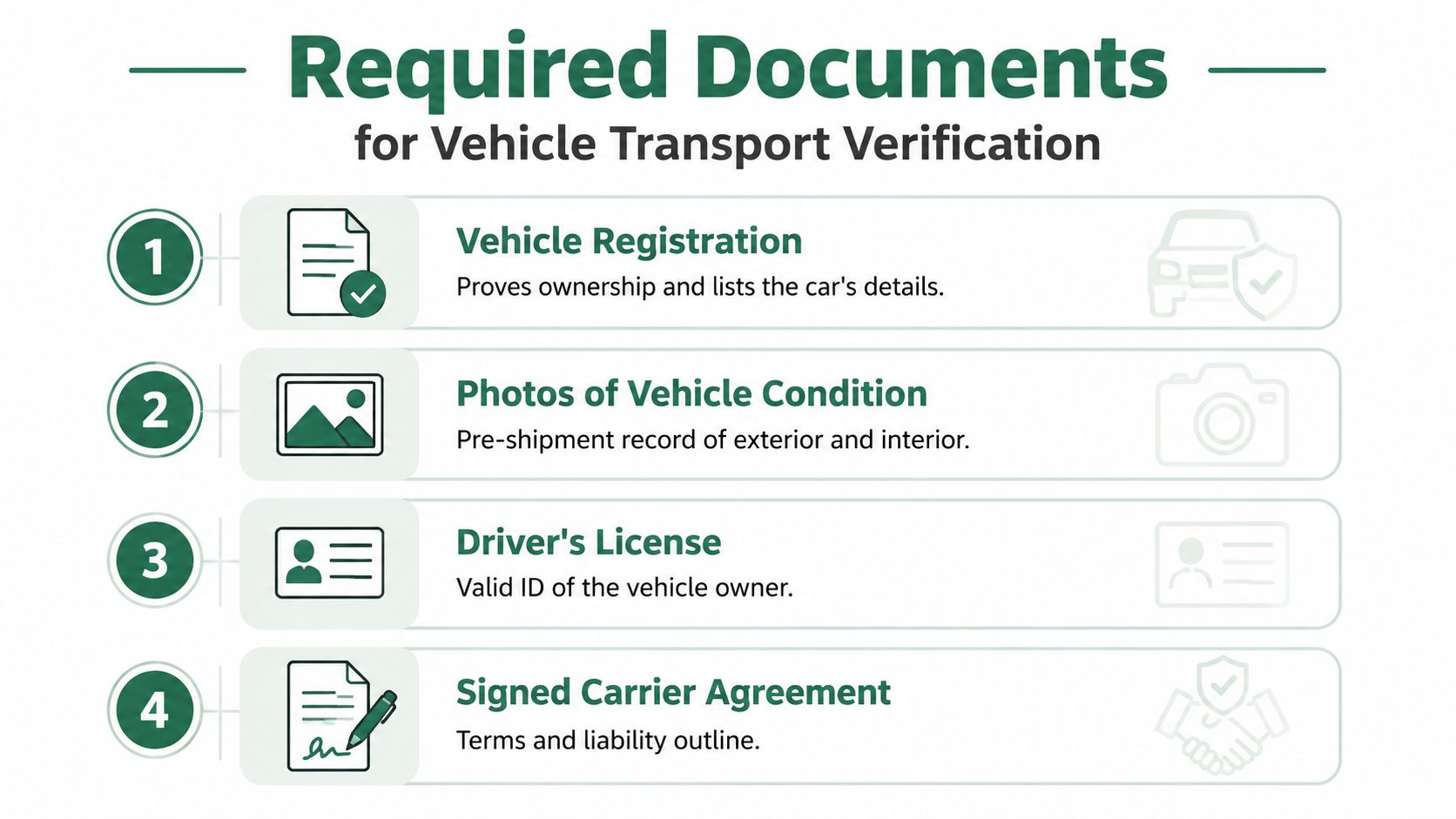
A vehicle can be ready for pickup while its paperwork still blocks the shipment. Prepare documents that let the dispatcher match the vehicle, owner, route, condition, and handling requirements before assigning the move. For a standard mainland shipment, keep the registration, government-issued identification, pickup and delivery details, signed transport agreement, payment information, and clear condition photos together.
Mainland shipment checklist
Use one digital or paper folder. Name each file so the dispatcher can identify it without opening several unrelated attachments.
- Vehicle registration: Confirms the vehicle's identity and registration details.
- Owner identification: Matches the shipper's name and identity to the booking.
- Condition photos: Record existing scratches, dents, chips, and interior condition before loading.
- Signed carrier agreement: Sets out transport terms, pickup details, and documented responsibilities.
- Special instructions: Identify an inoperable vehicle, oversized dimensions, alarms, modifications, or personal-property restrictions.
Take photos in good light and keep the original files. They do not replace the inspection report, but they provide an independent record for comparison with the pickup and delivery condition reports. If the vehicle changes hands, update the folder rather than relying on an old photo set.
Shipping from Puerto Rico to the mainland
Puerto Rico outbound shipments require original-document planning. Crowley's Puerto Rico vehicle shipping document guidance identifies a copy of the driver's license, the original vehicle registration from DTOP, and the original vehicle title free of loans or liens as required documents. Include records for replacement parts connected with accidents or repairs when they apply.
A clean-title requirement can delay a financed vehicle. Contact the lienholder early, then confirm with the carrier which release or authorization documents will be accepted before the port handoff. Copies support preliminary review, while the shipping instructions may still require originals at the required stage.
Dealerships and commercial shippers should maintain a unit-level folder for every vehicle. Dealer vehicle transport support can help organize recurring moves, but each unit still needs accurate title and registration documents. Recheck the folder if a vehicle, consignee, route, or carrier changes.
Shipping to Puerto Rico
A U.S. Coast Guard personal vehicle shipping checklist states that a vehicle bound for Puerto Rico cannot be accepted without travel orders authorizing shipment of the POV or a valid TAC code. It also requires no more than one-quarter tank of gas, no cracked glass, a thoroughly cleaned vehicle, and no oil leaks.
The export file may also require a “no fines due” certificate valid for only 3 days, a $10 auto export voucher from the Puerto Rico Internal Revenue Department, an export car wash receipt, a Motor Vehicle Export Certificate from the Puerto Rico Police Department, and an original affidavit authorizing shipment. Obtain the short-validity certificate close to the actual export process, then verify that every document remains current before the port handoff.
The Carrier Insurance Verification Process
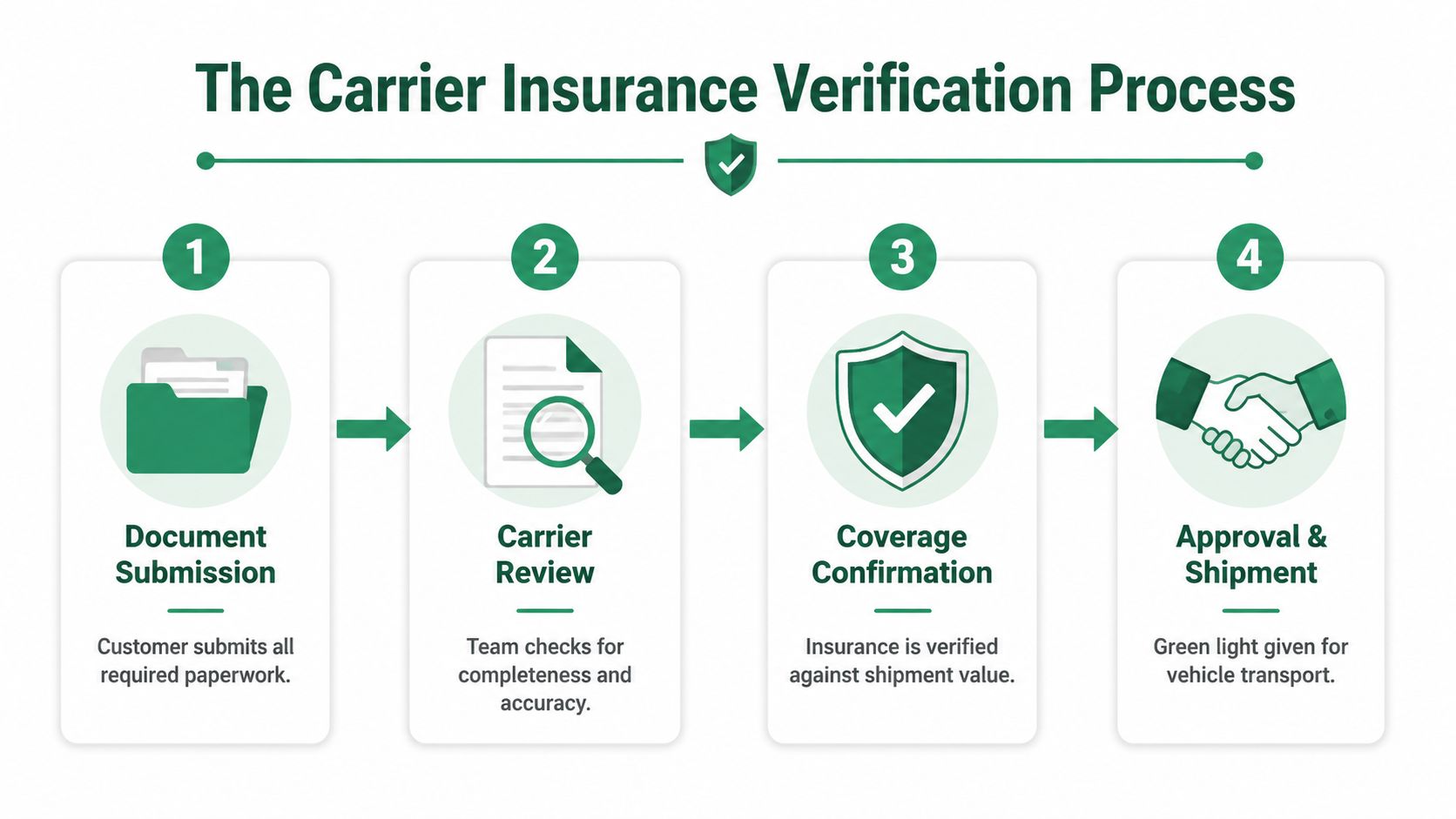
A professional workflow begins before a truck is assigned. The carrier or broker collects the shipment information, reviews the paperwork, confirms the vehicle's condition and route, and verifies that the transport provider's insurance is active and appropriate for the job.
Step 1, collect and match the records
The dispatcher first confirms the year, make, model, vehicle identification number, operating condition, pickup address, delivery address, and transport method. The insurance record must correspond with the carrier handling the vehicle, not with a company name shown on an old email or quote.
The team then reviews the certificate of insurance, policy dates, insurer details, applicable coverage, limits, and exclusions. For Puerto Rico shipments, the review also includes port, ocean, customs, and document requirements. If the vehicle is financed, titled to a business, or being moved under military orders, those details should be resolved before the booking becomes time-sensitive.
Step 2, identify and correct exceptions
A missing signature, mismatched vehicle identification number, expired policy, unclear coverage limit, or absent export document should stop the workflow until someone resolves it. The practical alternative to stopping is worse: allowing the vehicle to move while assuming the missing item will be fixed later.
A structured insurance verification process records what was checked, who checked it, when the check occurred, and what action remains open. That record gives the customer a clear answer instead of forcing them to reconstruct the conversation from text messages.
The same continuous principle applies to coverage reviews in other regulated workflows. The My Policy Quote coverage guide offers additional context for checking policy information and identifying gaps before relying on a certificate.
Step 3, reverify through the shipment lifecycle
Verification should continue after approval. A carrier's status can change, a policy can approach expiration, the assigned truck can change, or a port schedule can move. Reverification catches those changes before pickup, loading, ocean departure, or delivery.
At pickup, the driver and customer document existing damage, mileage, keys, accessories, and vehicle condition on the bill of lading. The customer should read the report carefully and keep a copy. At delivery, both parties compare the vehicle with the pickup record and document any new condition issue before the driver leaves.
For additional visual context on the workflow, review the following transport-focused video:
This approach takes more discipline than a one-time checkbox, but it prevents the common mistake of treating an old certificate as permanent proof. The 2021 third-party verification report described ongoing reverification because compliance can change after the original approval.
Common Verification Issues and Solutions
A shipment can be ready while its paperwork is not. A wrong vehicle identification number, incomplete title record, missing export certificate, or expired carrier policy can stop the move at pickup or the port. Treat each item as a live compliance check, not a box marked complete once.
Manual review creates avoidable errors. Industry guidance places manual verification error rates around 15% to 27%, and links those errors to roughly 8% to 12% of claim denials or eligibility-related denials, according to the insurance verification errors guide. Those figures are guidance rather than a universal auto transport benchmark. The practical point remains clear: incomplete records create delays, rework, and disputes.
The problem is often visible before pickup
| Warning Sign | Likely Cause | Practical Fix |
|---|---|---|
| Certificate shows an expired policy period | Old insurance evidence or delayed renewal | Request a current certificate directly from the carrier or insurer |
| Coverage limit doesn't match the vehicle or contract | Generic policy review | Ask for the applicable cargo terms, exclusions, and endorsements |
| Carrier name differs across documents | Broker, carrier, and insurer records weren't matched | Confirm the legal operating entity handling the vehicle |
| Title has a lien | Financing remains active | Obtain lienholder authorization or resolve title requirements before port delivery |
| Puerto Rico export record is missing | The shipper treated port paperwork as optional | Ask for the full port checklist and prepare each original document |
| No-fines certificate expires before use | Document obtained too early | Schedule the certificate close to export because its validity is limited |
Fix the root cause, not the symptom
If a policy appears lapsed, do not rely on a text message saying it is being renewed. Request current evidence and confirm the effective dates with the carrier or insurer. If the vehicle's value is higher than usual, verify that the policy recognizes its declared value. Check whether personal items, modifications, or specialized equipment fall under exclusions.
Puerto Rico shipments require their own document calendar. Track the driver's license, DTOP registration, lien-free original title, repair records, travel orders or TAC code, clean-vehicle requirements, export voucher, police certificate, affidavit, and port instructions as separate tasks. A single “paperwork complete” status hides gaps until the vehicle reaches the port.
The no-fines certificate also needs timing control. As noted earlier, obtain it close enough to export that it remains valid when the vehicle is processed. A document that was correct when requested may no longer support the shipment when the port appointment arrives.
A carrier should tell the affected parties which requirement failed, identify the missing document or coverage detail, and hold the shipment until the issue is resolved. That pause can cost time, but releasing a vehicle into an incomplete process can create a larger delay, storage exposure, or claim problem. Recheck the file whenever the carrier, vehicle, route, or export schedule changes.
Tips for Ensuring Adequate Protection
Good protection comes from matching the vehicle, route, documents, and policy instead of focusing only on the quoted price. A daily driver moving between mainland cities needs a different conversation from a restored classic traveling in an enclosed carrier or a dealership unit moving through a Puerto Rico port.
Ask focused questions before booking
Request the current certificate of insurance and ask who the named carrier is. Confirm policy dates, cargo coverage, applicable exclusions, claim reporting steps, and whether the coverage applies to the selected open, enclosed, container, or ocean movement.
For high-value vehicles, provide an honest description of condition and modifications. A low declared value or incomplete description can create friction if a claim reviewer later compares the vehicle with the booking record. Photograph the vehicle in good light, remove unapproved personal property, and retain the pickup inspection.
Build a route-specific document plan
A mainland relocation may need registration, identification, agreement, and condition records. A Puerto Rico move may also need original title documentation, port paperwork, travel orders or a TAC code, a cleaned vehicle, and export records. Military families should confirm their orders and shipment authorization early, while snowbirds should avoid obtaining short-validity documents before the schedule is settled.
Dealerships can use a unit-level checklist and assign one person to verify every vehicle. Individuals can use the same method with a simple folder and a written list of open items.
Cost should be evaluated alongside coverage and service details. A car shipping cost guide can help frame the quote, but a lower price isn't useful if it leaves questions about carrier assignment, protection, port handling, or required documents unanswered.
National Car Transport describes a U.S.-based service with 25+ years of experience, an A+ BBB rating, transparent flat-rate pricing, and a network of 25,000+ vetted carriers. Its bilingual English and Spanish agents are based in the USA, have more than 20 years of auto transport logistics experience, and can guide individuals, military families, students, snowbirds, dealerships, and businesses through route-specific requirements. Not one vehicle transport is alike, so having an experienced agent simplify the process can be more valuable than trying to interpret every requirement alone.
Moving Forward with Confidence
A reliable insurance verification process protects more than the vehicle. It keeps the carrier, shipper, paperwork, inspection record, and delivery expectations aligned from the first conversation through final handoff. Whether you're shipping to San Juan, moving between major cities in the 48 mainland states, or coordinating multiple dealership units, continuous verification reduces preventable surprises. National Car Transport brings 25+ years of experience, an A+ BBB rating, transparent flat-rate pricing, and a network of 25,000+ vetted carriers, supported by bilingual U.S.-based agents who can explain the logistics in English or Spanish.
If you're planning a mainland or Puerto Rico vehicle shipment, visit National Car Transport to discuss your route, transport method, documentation, and insurance verification needs. Their experienced bilingual agents can help organize the details and connect you with a suitable carrier at a transparent flat rate.