

Your family is moving from Orlando to San Juan, the new home is ready, and the vehicle is the last major piece of the relocation. A mainland shipment might seem simple, with a truck collecting the car and delivering it to a new address. Shipping a vehicle to Puerto Rico is different. The car must travel over land to a mainland port, move by ocean vessel, pass through Puerto Rico's release process, and then reach its final destination.
That route applies whether you're a snowbird moving between residences, a military family changing duty stations, a student taking a car to school, a dealership transferring inventory, or an individual relocating from any U.S. city. The phrase “domestic shipping” describes the trade relationship, but it doesn't eliminate the paperwork, tax planning, or port coordination that determine whether your vehicle moves smoothly.
Table of Contents
- Understanding the Mainland to Puerto Rico Vehicle Shipping Journey
- Choosing Between Roll-On and Container Ocean Shipping
- Documentation and Compliance Requirements You Cannot Skip
- Real Costs and Transit Timelines for Puerto Rico Auto Transport
- Managing Pickup Delivery and Port Handoff Logistics
- Your Pre-Booking Checklist for a Smooth Vehicle Shipment
Understanding the Mainland to Puerto Rico Vehicle Shipping Journey
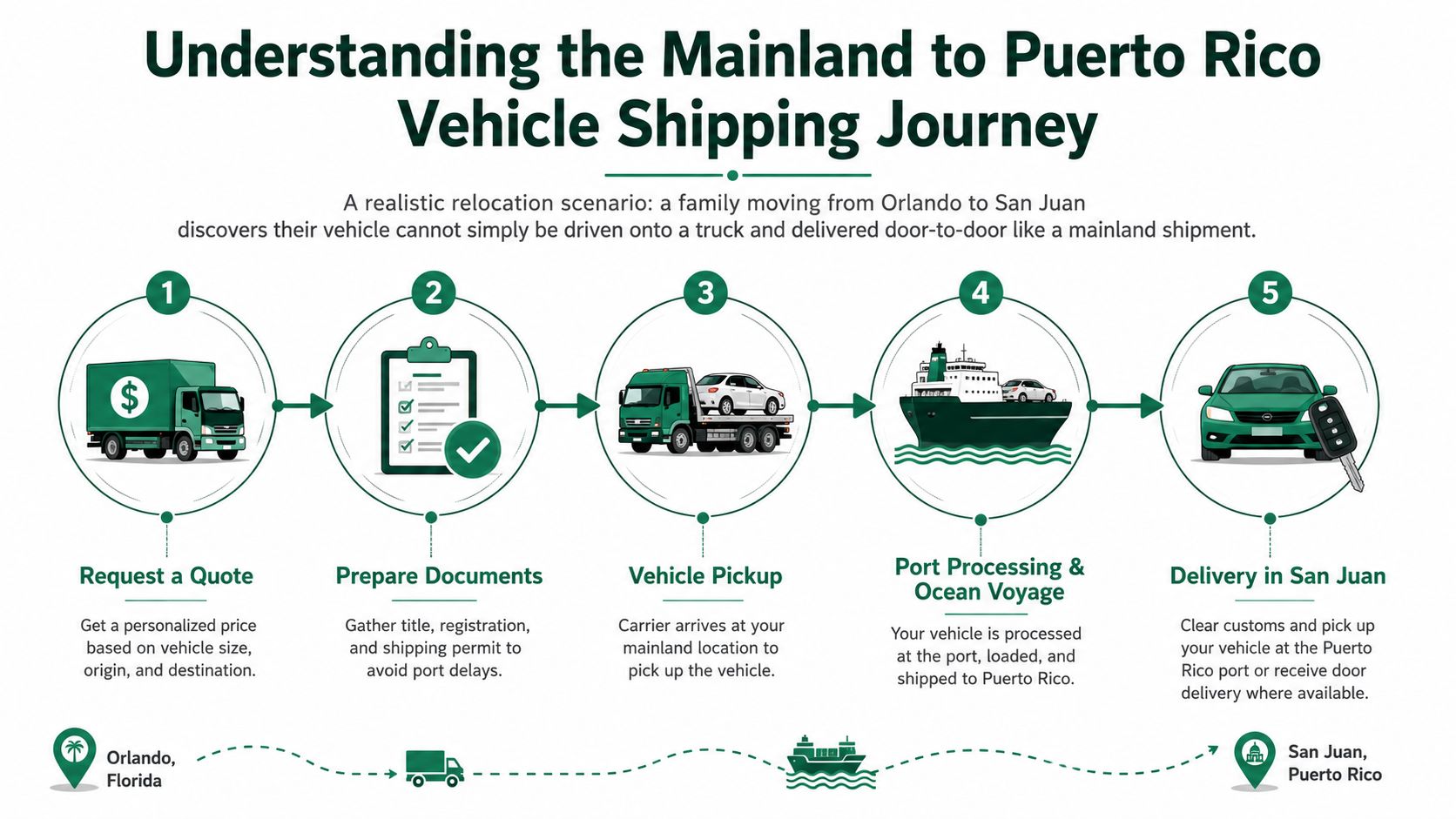
The Orlando family first needs a truck to collect the vehicle and move it to a mainland departure port. Jacksonville, Florida, is a common gateway for Puerto Rico service, although some shipments may be routed through another port, such as Newark, New Jersey, based on origin, sailing availability, vehicle type, and carrier planning. From there, the vehicle takes the ocean leg to the Port of San Juan.
That two-stage movement, overland transport followed by ocean freight, is the foundation of every mainland-to-island auto shipment. A door-to-door quote doesn't mean one truck drives continuously from Orlando to San Juan. It means the provider coordinates separate transport stages and the handoff between them.
Why the ocean leg is different
Puerto Rico is a U.S. territory, but its mainland shipping lane has distinct operational and tax requirements. The Jones Act, formally associated with the Merchant Marine Act of 1920, requires domestic waterborne cargo traveling between U.S. ports to use vessels that are U.S.-built, U.S.-owned, U.S.-flagged, and U.S.-crewed. A World Bank study on Puerto Rico's maritime trade identifies U.S.-flagged and U.S.-owned vessels as Jones Act ships and notes capacity limitations for non-containerized freight.
That requirement narrows the available vessel network and affects sailing schedules, capacity planning, and pricing. It also helps explain why containerized ocean transport remains important for island freight, even when a vehicle can move through a specialized rolling cargo service.
The timeline you should plan around
Published vehicle-shipping estimates vary. Some service guidance gives a total range of 6 to 16 days, while other estimates cite approximately 12 to 21 days, depending on origin, port processing, and transit conditions. You can review those published ranges in National Car Transport's Puerto Rico transit guidance.
For a practical planning window, many customers should allow roughly 10 to 21 days from pickup planning through port delivery, with the actual result depending on the mainland distance, terminal schedule, vessel availability, documentation, and San Juan release. A vehicle that arrives at the port quickly can still wait if its paperwork or local release arrangements aren't ready.
For routes, service details, and vehicle-specific planning, see Miami to Puerto Rico car shipping. The right question isn't only “How much does it cost?” It's also “Who handles each handoff, and what must be ready before the vessel arrives?”
Choosing Between Roll-On and Container Ocean Shipping
Most standard vehicles don't need a container. Roll-on/roll-off, or RoRo, uses a vessel designed for rolling cargo. The vehicle is driven or positioned onto the ship, secured on an interior deck, and moved off at San Juan. Crowley describes this type of vehicle movement as part of its specialized vehicle shipping service.
Container shipping places the vehicle inside a dedicated ocean container. This can provide additional separation from other cargo and may suit a classic car, luxury vehicle, non-running project vehicle, or a shipment where limited personal effects are permitted under the carrier's rules. Container loading requires more handling and careful dimensional planning, especially for large SUVs, trucks, and modified vehicles.
| Factor | Roll-On/Roll-Off (RoRo) | Container Shipping |
|---|---|---|
| Best fit | Running sedans, SUVs, and standard trucks | Classics, luxury vehicles, non-running cars, or approved combined cargo |
| Handling | Vehicle is driven or moved onto a vehicle deck | Vehicle is loaded and secured inside a container |
| Personal belongings | Generally prohibited inside the vehicle | Limited household goods may be allowed, subject to carrier rules |
| Protection | Suitable for ordinary transport with proper preparation | Adds enclosure and separation from weather and terminal activity |
| Cost position | Commonly the more economical option | Usually costs more because of container space and loading work |
| Schedule | Follows available vehicle-vessel sailings | Often follows similar ocean schedules, with container availability also relevant |
Matching the method to the vehicle
RoRo usually makes sense when the car runs, rolls, steers, and can be safely accessed by terminal personnel. It's often the practical choice for a daily driver, family SUV, or dealership vehicle where controlling cost matters more than enclosure.
Container service deserves consideration when the car has high sentimental or financial value, can't operate under its own power, or needs a specialized loading plan. It may also be appropriate for certain personal effects, but never assume the vehicle can be used as a suitcase. Carriers set their own rules, and prohibited items can create inspection and release problems.
A common mistake is choosing a method based only on a headline rate. The correct comparison includes mainland pickup, terminal charges, loading requirements, insurance, destination handling, taxes, and the cost of solving a delay if the method doesn't fit the vehicle.
Practical rule: Tell the coordinator whether the vehicle runs, whether it has modifications, and whether you plan to include belongings before receiving a quote. Those details can change the shipping method.
Documentation and Compliance Requirements You Cannot Skip
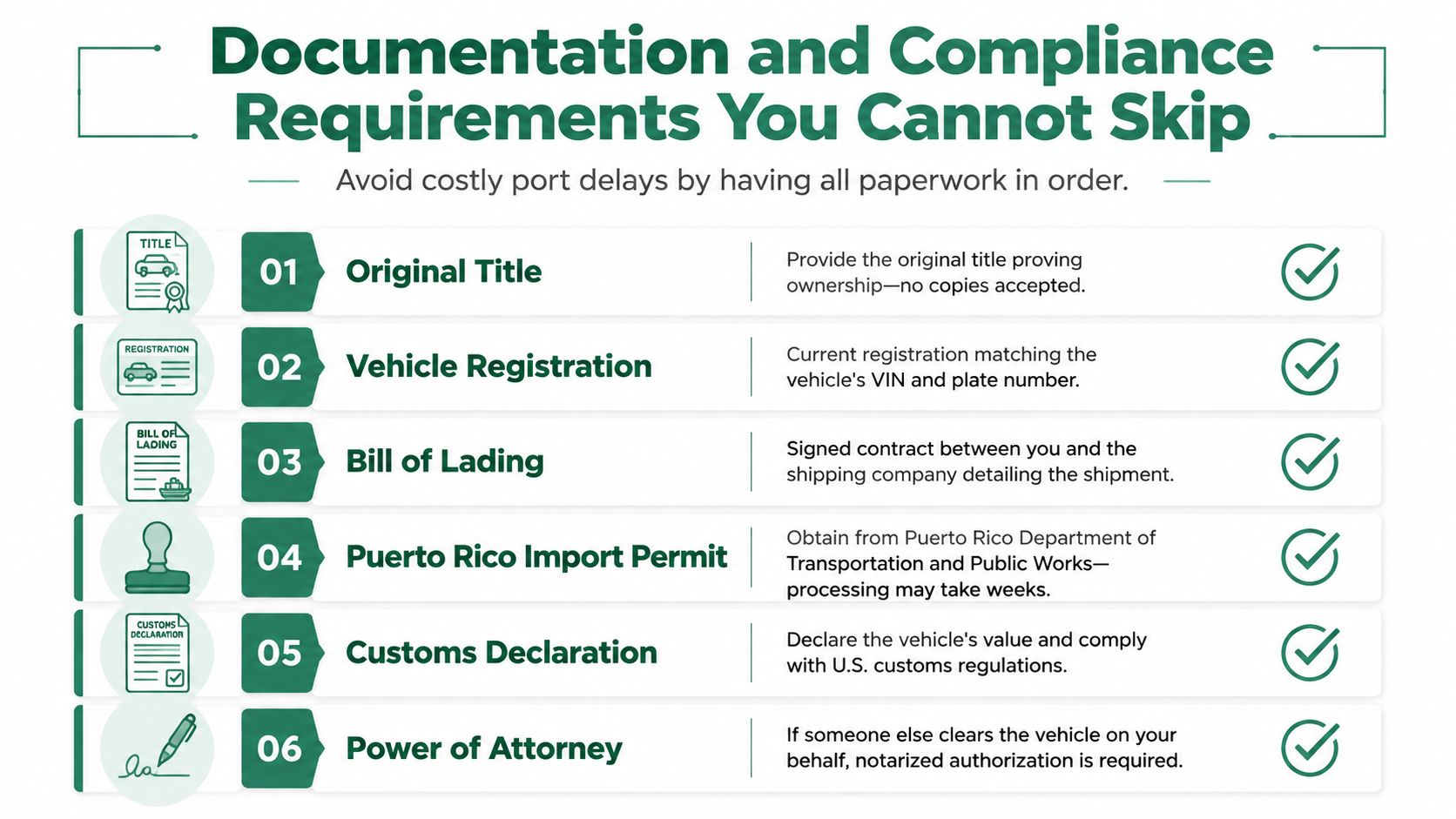
A clean title and a valid registration are the starting point, not the whole file. Port delays often begin when the shipper treats Puerto Rico like an ordinary 48-state delivery and waits until pickup day to ask about ownership, authorization, or export documentation.
Prepare the ownership file first
Gather these documents before the booking is finalized:
- Vehicle title. The original title is commonly requested. If a lien exists, obtain written authorization from the lender. Some providers accept a notarized copy with lienholder authorization, but the exact port and carrier requirements should be confirmed before pickup.
- Current registration. The registration should match the vehicle identification number and ownership records.
- Government-issued photo ID. Keep a clear copy available for the carrier and port file.
- Power of attorney. If a broker, agent, or another person will handle release paperwork, complete the required authorization in advance.
- Vehicle details. Provide the VIN, year, make, model, operating condition, and any modifications accurately.
- Shipping documents. The carrier will generate or provide the bill of lading, delivery order, and related movement records.
A bill of lading guide can help you understand why this document matters. It records the shipment terms and the vehicle's condition at handoff, so review it carefully before signing.
Don't overlook EEI
Shipments to Puerto Rico are generally treated as domestic freight rather than international imports, so the normal CBP import entry and duty process typically doesn't apply. However, the U.S. Census Bureau explains that Electronic Export Information filing can be required when a single Schedule B commodity classification exceeds $2,500 for shipments between the mainland and Puerto Rico. The Census Bureau guidance on exports between the United States and Puerto Rico also highlights the special issue of foreign-origin goods moving through a mainland port, which may require an in-bond process under 19 CFR 18.
That distinction matters for vehicles. A move can be domestic for customs purposes and still require EEI filing. Confirm who will prepare the filing, what value and classification will be used, and whether the vehicle's origin creates an additional in-bond requirement.
Plan local tax and release
Puerto Rico's local tax obligations are separate from federal customs duty. Guidance for Puerto Rico imports cites an 11.5% Hacienda excise tax on goods entering the territory, while other trade guidance discusses consumption taxes that can vary by item and municipal structure. Confirm the applicable treatment for your vehicle before sailing, and ask whether a carrier or broker will advance tax and charge a processing fee.
The release sequence usually looks like this:
- The vehicle is received at the mainland terminal.
- The carrier issues the ocean bill of lading and later provides a delivery order.
- The destination representative or customs broker coordinates the local file.
- Hacienda and other release requirements are addressed.
- The port authorizes pickup or final delivery after the file is complete.
The paperwork you prepare before pickup prevents more delays than paperwork created after arrival.
Real Costs and Transit Timelines for Puerto Rico Auto Transport
A base freight quote is only one part of the landed cost. Depending on the route and service, the final amount can include mainland trucking, ocean freight, terminal handling, wharfage, security or fuel-related charges, documentation, insurance, destination handling, broker services, and Puerto Rico taxes.
Published carrier guidance describes separate freight-related components such as bunker or fuel, security, terminal, handling, and export-declaration charges. TOTE Maritime's personal vehicle information is useful when reviewing how these charges may appear outside a simple line labeled “shipping.”
Build the estimate in layers
Start with the mainland leg from the vehicle's actual location to the selected departure port. A car in Atlanta, Dallas, Chicago, or Seattle may require a longer overland move than one near Jacksonville or Miami. Then add the ocean method, terminal handling, destination release costs, insurance, and any applicable Hacienda obligation.
Don't rely on generic price tables for a modified truck, an inoperable car, or a high-value classic. Vehicle dimensions, running condition, port access, and loading equipment can change the quote.
| Vehicle Class | RoRo Estimated Cost | Container Estimated Cost | Ocean Transit Days | Total Door-to-Port Timeline |
|---|---|---|---|---|
| Standard sedan | Request a route-specific quote | Request a container-specific quote | Schedule-dependent | Common published estimates range from 6 to 16 days or approximately 12 to 21 days total, depending on origin and processing |
| SUV | Request a route-specific quote | Request a container-specific quote | Schedule-dependent | Varies with vehicle size, mainland haul, sailing, and San Juan release |
| Oversized truck | Requires dimensions and operating details | Requires container fit and loading review | Schedule-dependent | May require additional coordination for equipment, terminal access, and vessel space |
Because verified public guidance doesn't provide a universal dollar range for each vehicle class, a responsible estimate must remain route-specific. A quote that promises one price for every sedan or truck is usually hiding assumptions.
Transit risk is part of the price
Ocean sailing is only one segment. Pickup scheduling, inland transport, terminal receiving, vessel loading, destination inspection, tax release, and final delivery all affect the clock. A real-time congestion tracker reports that 63% of shipments to the Puerto Rico region do not arrive on time, according to Puerto Rico port congestion data. Treat that as a planning warning, not a guarantee that your individual car will be late.
Weather, holiday closures, vessel changes, and port congestion can extend the schedule. Carriers have also issued 2026 notices involving holiday and weather-related interruptions, so customers moving during those periods should ask for a schedule with contingency room.
For broader budgeting context, see car shipping cost factors. Request a written quote that separates base transport from port charges, taxes, insurance, and optional services.
Managing Pickup Delivery and Port Handoff Logistics
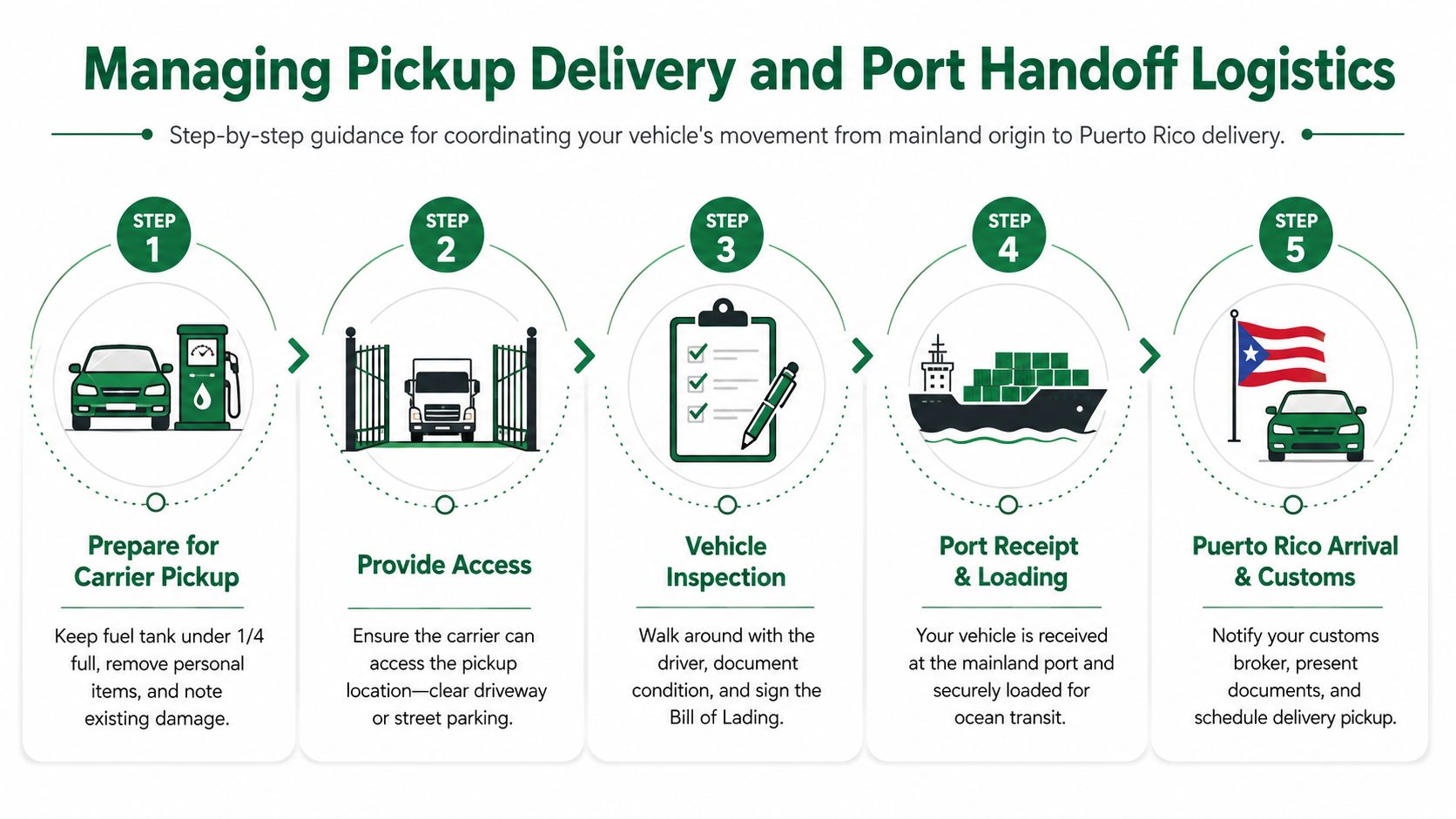
The smoothest shipments have a clear handoff plan. Start by cleaning the vehicle, removing personal property, checking for existing damage, and photographing every exterior panel, wheel, glass area, and interior surface. Use timestamped images and keep copies in cloud storage so the condition record remains available if a question arises later.
Keep the fuel level low enough for safe handling and follow the carrier's specific instruction. Many ocean vehicle services request a quarter tank or less, and personal items are often prohibited in RoRo vehicles. Do not place documents, valuables, medication, or loose equipment inside the car unless the carrier has approved the arrangement in writing.
Make the mainland handoff predictable
The pickup driver needs safe access, accurate vehicle information, and the correct contact person. If the car is at a dealership, auction, apartment complex, military installation, or storage facility, confirm gate procedures before dispatch.
At the origin terminal, keep the booking reference, title file, identification, and carrier instructions together. Terminal hours and receiving procedures can change, so confirm them directly rather than assuming the driver can arrive at any time. The terminal checks the vehicle record and condition before loading, and a VIN mismatch can stop the handoff even when every other document is ready.
The driver and shipper should review the condition report together. Don't sign a bill of lading without reading the noted damage, mileage, accessories, and operating condition.
Prepare for San Juan release
Track the vessel through the carrier or assigned agent, then contact the destination representative before arrival. A local customs broker or port agent can explain the required release sequence, Hacienda payment process, inspection expectations, and pickup appointment.
At arrival, keep digital and printed copies of the title, registration, ID, bill of lading, delivery order, authorization, EEI confirmation when applicable, and tax records. If port staff identify a discrepancy, a bilingual coordinator can reduce confusion and make sure the same information reaches the owner, broker, and carrier.
Service coordination matters more than a low introductory quote. National Car Transport offers door-to-port and port-to-door coordination, including mainland trucking, ocean shipping arrangements, and bilingual English/Spanish agents based in the United States. The company describes more than 25 years of experience, an A+ BBB rating, transparent flat-rate pricing, and a network of more than 25,000 vetted carriers on its company information page. One vehicle transport isn't identical to another, and having an experienced agent guide each handoff can make the process simpler and quicker at a sensible value.
The following video provides a visual overview of vehicle shipping coordination before you arrange your own handoff.
For customers who want the mainland carrier to manage the movement from the pickup address, compare the details of door-to-door auto transport, then verify which portion of the Puerto Rico route is included.
Your Pre-Booking Checklist for a Smooth Vehicle Shipment
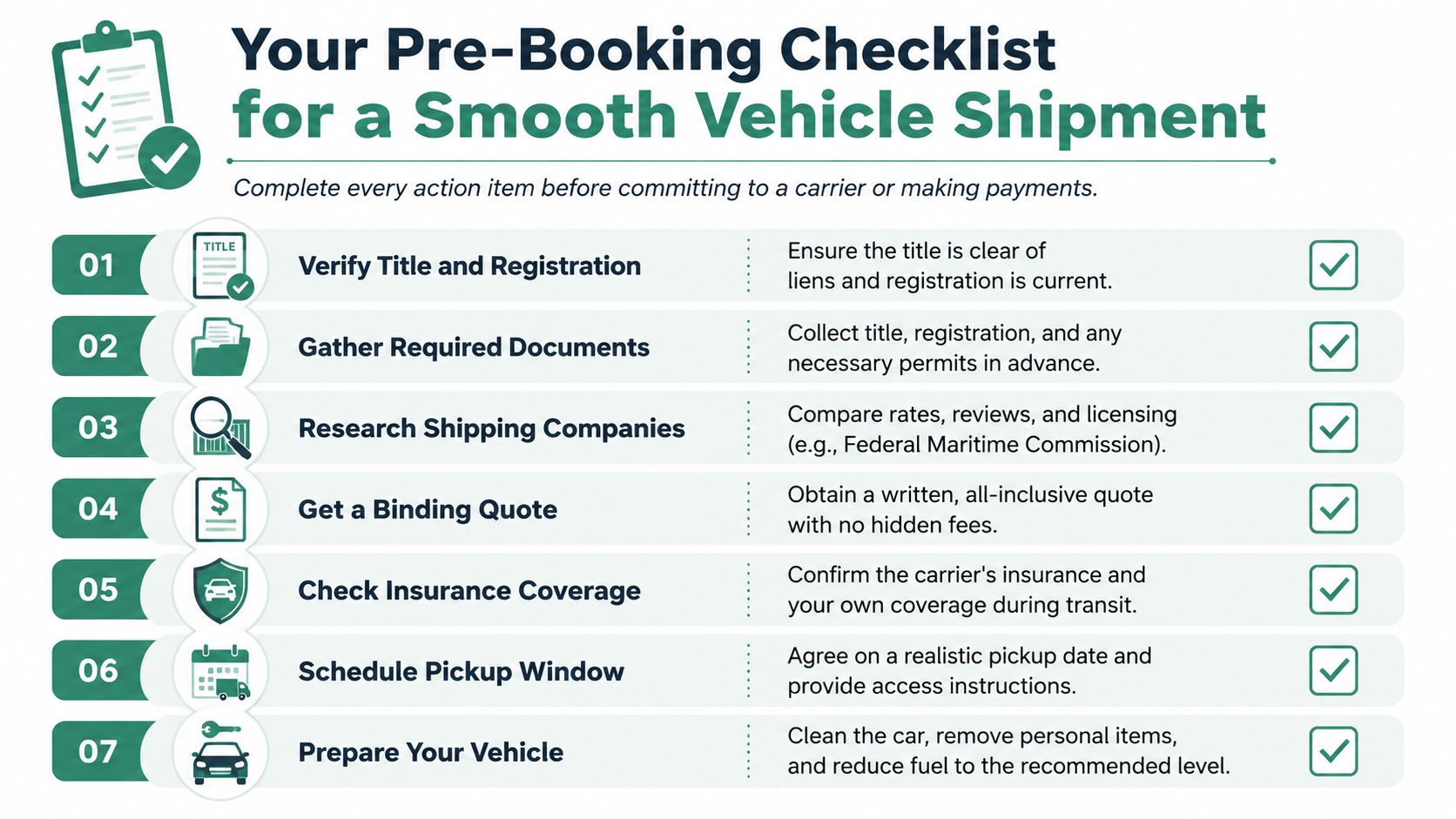
Before paying a deposit or accepting a dispatch date, use this sequence as a final control check:
- Verify title and registration. Confirm ownership, lienholder authorization, VIN accuracy, and current registration.
- Gather the complete document file. Include identification, authorization forms, vehicle details, and any port-specific paperwork.
- Confirm EEI responsibility. Ask whether the vehicle's value and Schedule B classification trigger filing above the $2,500 threshold, and get written confirmation of who will file.
- Review insurance. Check the carrier's cargo coverage, exclusions, deductible, and claims process. Ask whether your own policy remains active during ocean transport.
- Validate the provider. Confirm the broker or carrier's licensing, insurance, FMC-related authorization where applicable, and Puerto Rico port access.
- Prepare Hacienda funds. Ask how local tax is calculated, who pays it, whether the carrier advances it, and which processing fees may apply.
- Get an itemized quote. Separate mainland trucking, ocean freight, terminal handling, security or fuel charges, documentation, insurance, destination release, broker service, and taxes.
- Confirm both port procedures. Ask about origin terminal hours, booking references, San Juan release steps, inspection, and pickup appointments.
- Document the vehicle. Photograph existing damage, record the condition on the bill of lading, remove prohibited belongings, and follow fuel instructions.
- Set a communication backup. Save the coordinator's phone number, carrier contact, vessel reference, broker details, and copies of every signed document.
The best quote is the one that explains the full route, not merely the first truck pickup. If a provider can't identify who handles EEI, Hacienda requirements, port release, and damage documentation, the price is not yet a complete estimate.
National Car Transport can coordinate mainland pickup, Puerto Rico port shipping, door-to-port or port-to-door service, and bilingual English/Spanish support through U.S.-based agents with more than 20 years in auto transport logistics. Visit National Car Transport to request a vehicle-specific quote, review the required documents, and create a practical pickup and San Juan release plan before booking.