
You've got a sailing date circled, a flight booked, and a car in the driveway that still doesn't have a pickup time. The moving company already gave you a delivery window, which makes the silence around the car feel like a loose end. It isn't. On the Puerto Rico lane, truck pickup and delivery runs on its own clock, and that clock starts with a folder of paperwork you hold, not with the truck you're waiting for. San Juan will not release a vehicle to anyone until the import tax is settled and the documents match the shipment. Get the folder ready early and the handoff takes an afternoon. Leave it until the ship docks and you'll be the person calling from a rental car.
Table of Contents
- Pickup and Delivery Options Compared
- Documents Needed Before the Truck Arrives
- Arbitrios and Payment Before You Take the Car
- How Pickup Gets Scheduled From Booking to Collection
- How to Prepare Your Vehicle for Pickup
- What the Driver Inspects at Pickup and Delivery
- Book Your Pickup and Confirm the Window
Pickup and Delivery Options Compared
Two routes run between the mainland and the island, and they begin in different places. Toward Puerto Rico, the truck comes to you. Toward the mainland, you name the address where you want the car back.
Door-to-port, mainland to Puerto Rico. A carrier collects the vehicle at your home, office or the nearest safe landmark, trucks it to the port at Jacksonville, Florida, and the car sails from there to San Juan. Inspection is documented at pickup, so the condition record starts in your driveway instead of at a dock.
Port-to-door, Puerto Rico to mainland. The car leaves the San Juan port, crosses to Jacksonville, and is trucked to your mainland address. Same water, same Florida transfer point, different direction and a different person waiting at the end.
| Service | Pickup point | Delivery point | Route | Best fit |
|---|---|---|---|---|
| Door-to-port (mainland to Puerto Rico) | Owner's home, office or nearest safe landmark | Port of San Juan | Trucked to Jacksonville, FL port, then sailed to San Juan | Mainland owners who want collection at their address |
| Port-to-door (Puerto Rico to mainland) | Port of San Juan | Owner's mainland address | Sailed from San Juan to Jacksonville, FL, then trucked to the address | Owners leaving the island who need delivery on the mainland |
What the Port Changes About Your Schedule
The port is the only transfer point on this lane. There's no second terminal to reroute through and no alternate crossing to fall back on, so sailing dates and import paperwork set the calendar. Trucks carry the rest of the load: a Federal Highway Administration analysis published by the Bureau of Transportation Statistics puts trucks at about 64% of U.S. freight by weight and 69% by value. That dominance is why the land leg is where a schedule usually holds or slips.
Your car and your furniture don't have to travel together. FMCSA guidance on protecting your move notes that a shipment may be divided between multiple trucks, particularly when an automobile moves on a vehicle specially designed for automobile transport, and charges must remain the same as if the shipment traveled on one truck. Two arrival windows are normal on a relocation. If you want to see how a fixed collection point compares with home pickup, terminal-to-terminal car shipping lays out where a terminal sits in the chain and when it saves time.
Transit time depends on how far the vehicle sits from Jacksonville, and the agent confirms it at booking rather than estimating it at the curb.
Rule of thumb: Choose door-to-port when the car can be released from your address and the paperwork is ready. Choose port-to-door when you're leaving the island and need the car delivered on the mainland.
Documents Needed Before the Truck Arrives
Hacienda's process is built around the maritime shipment, so the documents it asks for are the ones tied to your bill of lading, not just the ones tied to your car. Assemble them before the truck is dispatched.
| Document | Purpose | Requirement |
|---|---|---|
| Commercial invoice | Shows the sale and price of the vehicle | Uploaded in SURI with the import declaration |
| Bill of lading | Ties the vehicle to the maritime shipment | Selected in SURI as the bill being declared |
| Motor Vehicle Inspection Document (tasación) | Establishes the vehicle's valuation | Required for every motor vehicle import |
| Title or registration | Proves ownership of the vehicle | Listed as a document the importer may need to provide |
| Photo ID | Confirms the identity of the person releasing the vehicle | Carried to pickup and release |
| Shipping papers and seller invoice | Records the shipment and the purchase | Listed as records the importer may need to provide |
Where the Documents Actually Go
Hacienda's import declaration process names the commercial invoice and the bill of lading as required documents for imported goods and requires a Motor Vehicle Inspection Document, the tasación, when the item is a motor vehicle. In SURI, you select the bill of lading being declared, enter the shipment information, and upload the commercial invoice plus anything else the system requests for that vehicle.
The tasación is the item owners skip. It carries the vehicle's valuation, and a declaration filed without it stalls at release.
The Same-Bill Rule
Vehicles listed on the same bill of lading belong in the same import declaration, together with the applicable arbitrios and special charges. Ship two cars on one bill and you file one declaration covering both, not two separate filings. Dealers importing inventory hit a tighter version of the same calendar: a merchant importing a motor vehicle must declare it in a single import declaration that includes arbitrios and special charges, and for certain distributor imports Hacienda's published regulation requires an excise declaration 15 days before authorization to release the shipment from the dock.
Owner checklist before you book
- Title or registration: Proves ownership and appears among the records the importer may need to provide.
- Seller's invoice: Needed when the car was bought recently rather than owned for years.
- Valuation document: The tasación that matches this specific vehicle.
- VIN match: Confirm the VIN agrees across title, invoice and bill of lading.
- Photo ID: Carried to pickup and to release in San Juan.
If the title is changing hands as part of the move, steps for signing over a title covers the signature and notarization sequence the import documents assume. The full shipping to Puerto Rico from the US walkthrough is a good second read once the folder is together.
A missing document is a booking problem, not a port problem. Call the agent before the booking is confirmed, while there's still time to request a duplicate title or a corrected invoice.
Arbitrios and Payment Before You Take the Car
Before the vehicle reaches San Juan, decide who will handle the declaration and payment. The port handoff puts those tasks on the owner's schedule, so waiting until the ship docks can delay collection.
Estimate It by VIN, Not by Guess
The Puerto Rico Department of Treasury's vehicle arbitrios page provides an official estimator. Search by VIN when possible. The amount depends on the specific vehicle, not a universal percentage. If the online system has no result for an older vehicle or a current-model-year vehicle, check the valuation process listed by Hacienda.
The Release Sequence
- Estimate before you book. Budget for arbitrios alongside the freight quote.
- Assemble the document folder described in the previous section.
- File the excise declaration when the vehicle is introduced. Include the make, model, VIN and date the shipment was received.
- Pay the full arbitrios amount before the car is released. Hacienda's official vehicle arbitrios page sets out the payment requirement.
- Collect the car after payment and release are complete.
Plan the filing and payment before the ship docks. The declaration date follows the vehicle's introduction, not the owner's arrival in Puerto Rico. If you fly down first and start the paperwork afterward, collection may have to wait.
Timing risk: The port release depends on completed paperwork and payment. Arrange both in time for collection rather than treating them as tasks to handle after arrival.
What the Tax Isn't
Arbitrios are separate from the transport contract. Household-goods moving has federal estimate rules, but those rules do not automatically apply to a vehicle-only shipment. Review the auto transport contract and ask which charges are confirmed in writing.
If you are still weighing transport against buying on the island, compare the costs of shipping your car with you.
How Pickup Gets Scheduled From Booking to Collection
Once the booking is in place, a dispatcher looks for the next carrier with room on a truck heading to Jacksonville. No charges apply until a carrier is matched to the vehicle. The pickup window needs to leave enough time for the truck to reach the port before the sailing.
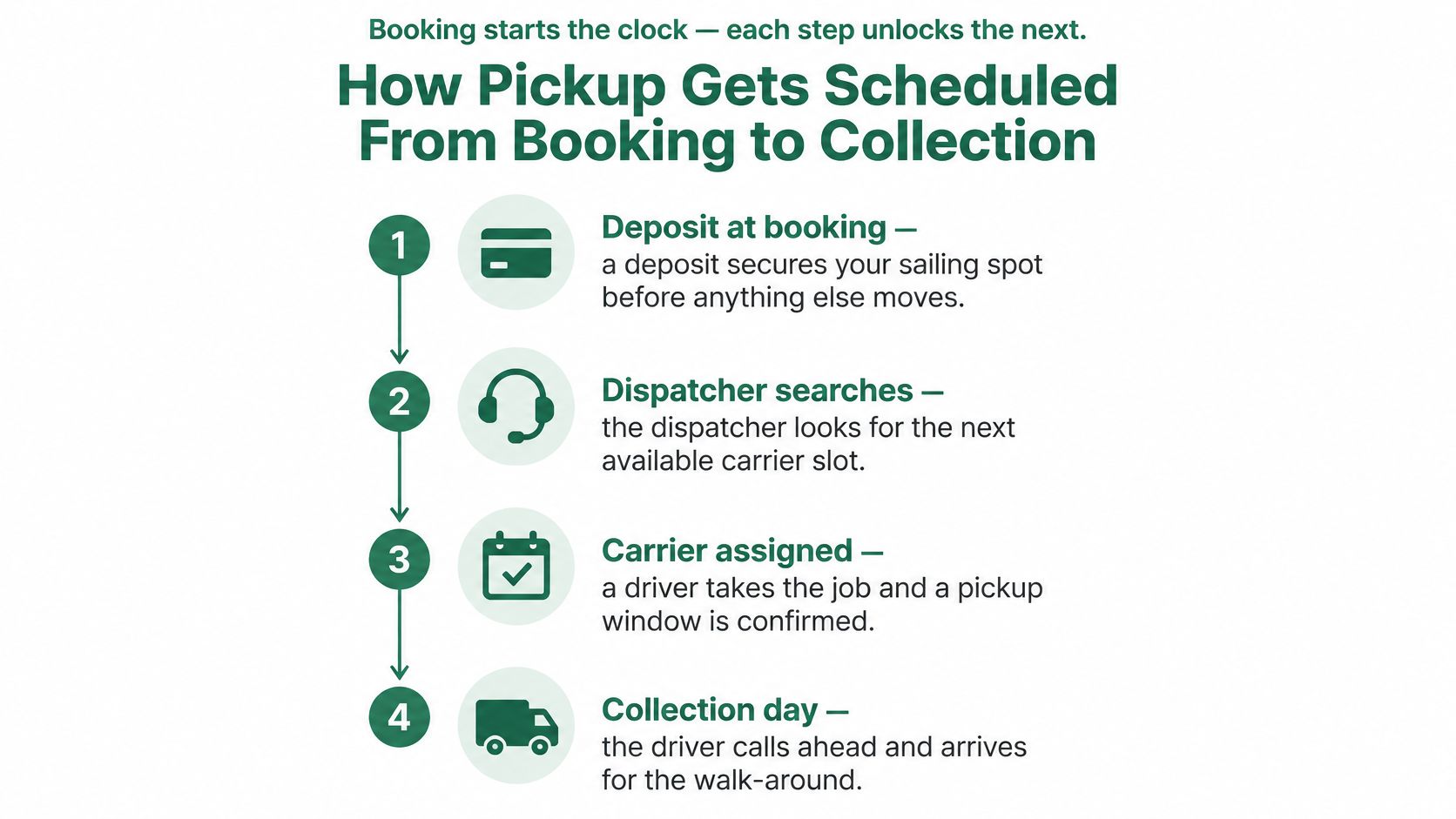
Six Steps From Quote to Collection
- Provide the vehicle and pickup details. Share the origin address, vehicle year, make and model, and whether it runs. An accurate quote depends on the actual pickup location and vehicle condition.
- Place the booking. Once it is in place, dispatch starts searching for a carrier. There is no charge until the vehicle is matched with one.
- Set a pickup window and backup date. The vehicle must reach Jacksonville in time for the sailing, so choose dates that allow for the truck's route and port handoff.
- Confirm the carrier and pickup date. After a carrier is matched, an agent confirms the date by phone or email.
- Keep your phone available. The driver calls ahead, so make sure the booking has a number someone will answer.
- Have the vehicle ready for collection. Keep the keys and required documents available for the driver.
Why the Window Is a Window
A carrier may have other stops on its route, so pickup timing is planned as a window rather than an exact hour. Driving limits also shape the route: property-carrying drivers are restricted to 11 hours of driving within the applicable duty period under FMCSA hours-of-service rules. Dispatchers plan the pickup around the sailing date and the time needed to get the vehicle to Jacksonville.
The driver calls ahead before pickup and completes a documented walk-around inspection on the Bill of Lading before loading. The port handoff follows collection, so keep the paperwork and tax arrangements in view while choosing a pickup window, not after the car reaches San Juan.
For example, a Philadelphia owner booking in early spring can choose a pickup window that gives the carrier time to reach Jacksonville before the sailing. A narrower window may limit which sailings fit. Check the Puerto Rico car shipping schedule when coordinating the pickup with a departure.
How to Prepare Your Vehicle for Pickup
Three problems cause almost every awkward pickup: personal items still in the car, damage nobody wrote down, and a vehicle the driver can't start or move. All three are preventable in the week before the truck arrives.
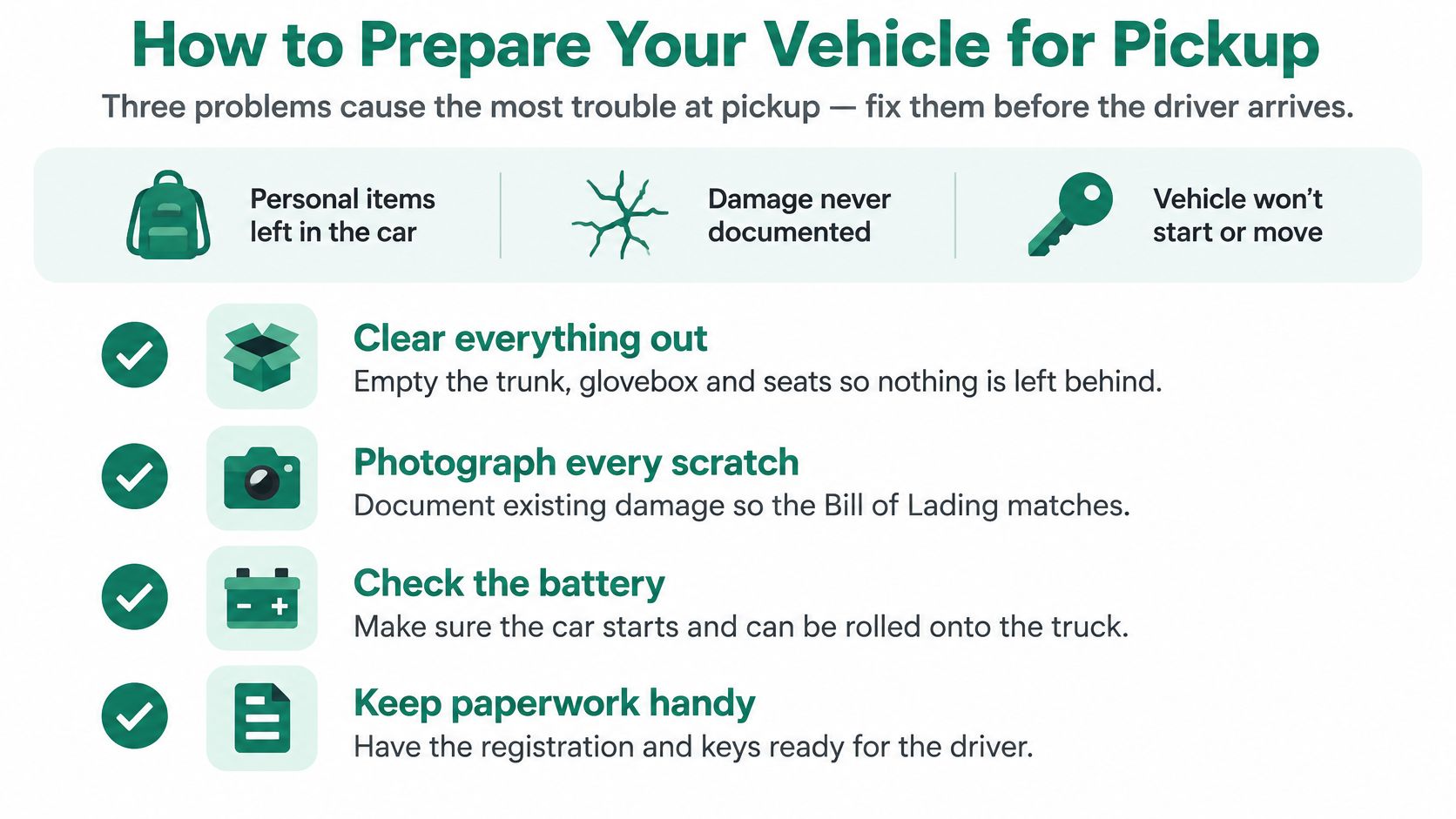
The Prep Sequence
- Empty the cabin and trunk. Carriers move vehicles, not cargo, and household goods left inside generally fall outside the carrier's cargo coverage. Check under the seats and inside the door pockets, where the small things hide.
- Wash the exterior. Road film hides chips and makes a scratch invisible in a photo. Clean paint is honest paint.
- Photograph all four sides, each wheel, the odometer and the dashboard with a time-stamped phone camera. Those images back up the Bill of Lading if a mark gets missed.
- Leave about a quarter tank of fuel. It keeps weight down for loading and means the car won't run dry if it idles in a queue at the port.
- Disable the alarm, label the keys and hand over a spare if the carrier asks. An alarm that arms itself in a holding yard is a flat battery and a delayed sailing.
- Remove toll transponders, roof racks, custom spoilers and loose accessories that can snag, disappear or break in transit.
- Check the battery, tires and any fluid leaks, and write down every warning light. A weak battery that fails on the ramp turns a routine pickup into a jump start and a wait.
- Keep the title or registration and booking paperwork in one folder, so the handoff moves at the curb instead of in the kitchen.
If the Car Won't Start
Tell the agent before booking, not on the morning of pickup. An inoperable vehicle needs different loading equipment and a different slot on the truck, and the sailing won't wait while a winch is arranged.
A clean, empty, well-photographed car turns pickup into a handshake and a signature.
What the Driver Inspects at Pickup and Delivery
The inspection is the part of the process that protects your money, and it happens twice.
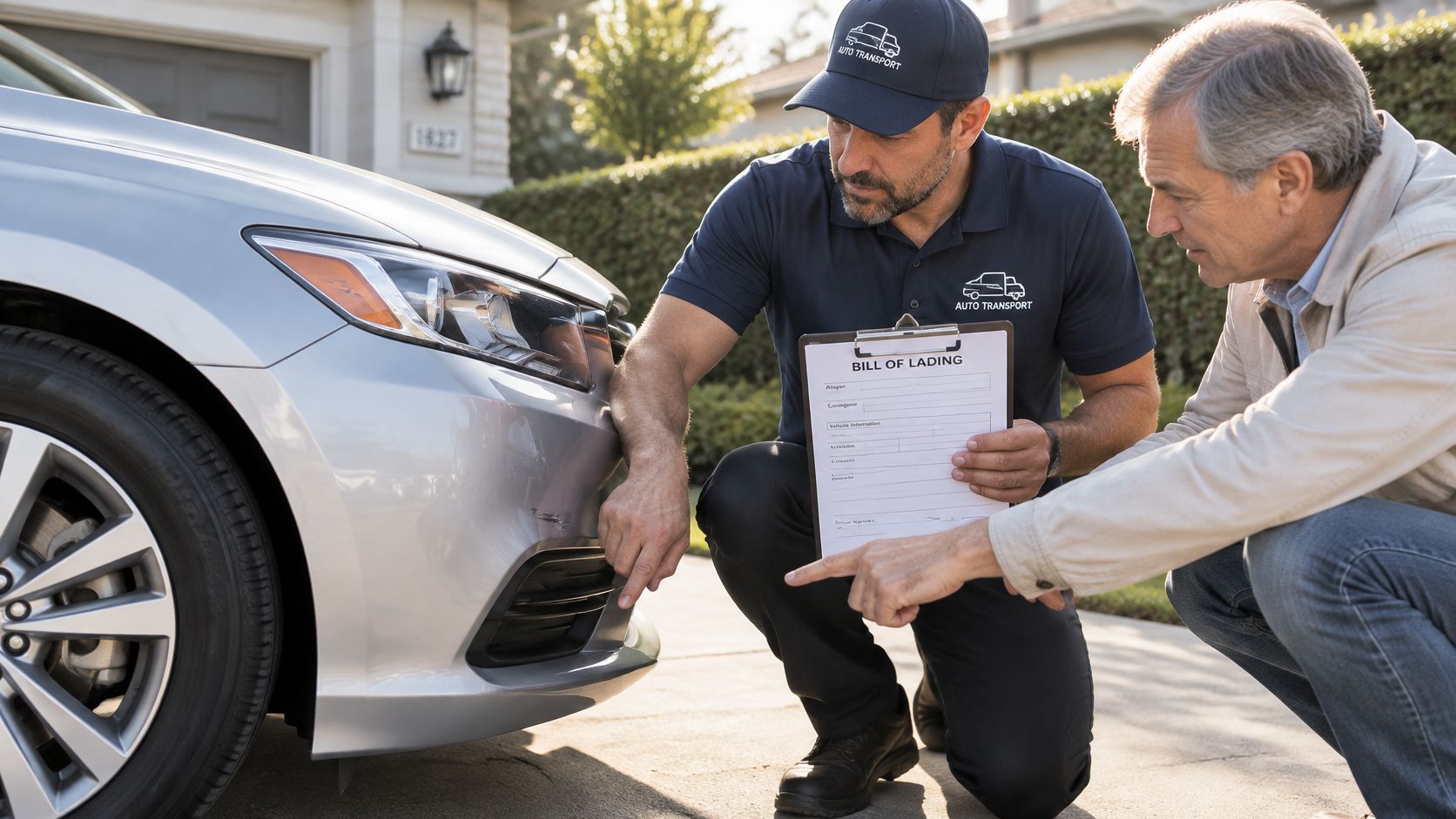
At Pickup
The driver calls ahead, then walks around the car with you and records its condition on the Bill of Lading. The walk follows a set order: front, sides, rear, roof, wheels and glass, with each existing dent, scratch or chip marked on the form. Read it before you sign. If a mark is missing, add it, photograph it, and note anything staying in the car.
At Delivery
The driver calls before arrival, completes the final inspection with you, compares the car against the pickup record and collects the balance. The note written at pickup is the comparison point, which is why an accurate first record does the work for you weeks later.
A small dent marked at pickup and photographed again at delivery shows the condition didn't change in transit. An unmarked dent shows up as a claim dispute.
Read the Bill of Lading before you sign it. After your signature, that pickup record is the only version of the car's condition that counts.
Where the Truck Stops
On door-to-door shipments, the driver comes as close to your address as is legal and safe. Clear a spot on the street or in the driveway, and if the residence can't be reached, agree on a meeting point before the day arrives. Open carriers handle most of this lane; open transport explains what the car is exposed to and why the price differs from enclosed.
The Port Handoff
Heading to Puerto Rico, your job is release documents and photo ID, and the car is collected at the San Juan port only after the arbitrios payment has cleared. Coming from the island, the car leaves the port and is trucked to your mainland address once it reaches Jacksonville, so confirm the delivery window with the agent as soon as the sailing date is set. Outbound paperwork the port wants gets confirmed before the car reaches the dock, not on the day of handoff.
Three checks before you sign
- The condition matches the record.
- The keys and documents are back in your hand.
- Any meeting point and time is confirmed in writing.
Book Your Pickup and Confirm the Window
Before you book, have the route, vehicle details and your preferred pickup dates ready. For Puerto Rico shipments, confirm the paperwork and tax arrangements before the truck arrives. The port handoff puts scheduling and document preparation on your side, and missing paperwork can delay release after the car reaches San Juan.
What to have ready
- Pickup address, plus a nearby alternative if a carrier truck cannot safely reach the street.
- Vehicle year, make, model and whether it runs.
- Earliest and latest dates the vehicle will be ready.
- Destination address or port.
- The documents you have gathered so far.
How booking runs
Request a flat-rate quote and book online. There is no upfront charge until your vehicle is matched with a carrier. A dedicated advisor coordinates the carrier and pickup window; confirm the port dates and document requirements with the advisor before collection. Same-day pickup may be available for an expedite fee, so ask when requesting your quote if timing is tight.
National Car Transport has more than 25 years of experience, an A+ BBB rating and a nationwide network of more than 25,000 vetted, licensed and bonded drivers. English- and Spanish-speaking agents can assist with questions about the shipment and paperwork.
Before you confirm
Check that your document folder is in order and that you have planned for the arbitrios payment. The vehicle's arrival at the port does not complete the release process: arrange the required documents and tax before the car reaches San Juan.
Confirm the pickup window with your advisor once the dates and paperwork are ready.
National Car Transport provides door-to-door vehicle pickup across the U.S. for Puerto Rico shipments, with the vehicle trucked to the Jacksonville port before sailing to the island. For a shipment in either direction, request a flat-rate quote through National Car Transport.