
The popular advice is simple: terminal-to-terminal car shipping is cheaper because the carrier doesn't have to come to your home. That advice is incomplete. A lower base quote can be offset by terminal trips, storage charges, lost time, and additional vehicle handling, so the decision should be based on total landed cost, not the first number you see.
Terminal service still has a legitimate place in U.S. auto transport. It can work well for flexible customers near major hubs, dealerships moving batches of vehicles, businesses managing inventory, and owners who can handle drop-off and pickup without disrupting their schedule. It can also be part of a Puerto Rico shipment, where port and terminal handling are unavoidable because vehicles must travel by sea.
For domestic car shipping, customers commonly compare routes involving cities such as Birmingham, Alabama; Anchorage, Alaska; Phoenix, Arizona; Little Rock, Arkansas; Los Angeles, California; Denver, Colorado; Hartford, Connecticut; Wilmington, Delaware; Miami, Florida; Atlanta, Georgia; Honolulu, Hawaii; Boise, Idaho; Chicago, Illinois; Indianapolis, Indiana; Des Moines, Iowa; Wichita, Kansas; Louisville, Kentucky; New Orleans, Louisiana; Portland, Maine; Baltimore, Maryland; Boston, Massachusetts; Detroit, Michigan; Minneapolis, Minnesota; Jackson, Mississippi; Kansas City, Missouri; Billings, Montana; Omaha, Nebraska; Las Vegas, Nevada; Manchester, New Hampshire; Newark, New Jersey; Albuquerque, New Mexico; New York, New York; Charlotte, North Carolina; Fargo, North Dakota; Columbus, Ohio; Oklahoma City, Oklahoma; Portland, Oregon; Philadelphia, Pennsylvania; Providence, Rhode Island; Charleston, South Carolina; Sioux Falls, South Dakota; Nashville, Tennessee; Houston, Texas; Salt Lake City, Utah; Burlington, Vermont; Richmond, Virginia; Seattle, Washington; Charleston, West Virginia; Milwaukee, Wisconsin; Cheyenne, Wyoming; and San Juan, Puerto Rico.
Table of Contents
- The Reality of Terminal to Terminal Car Shipping
- How Auto Transport Terminals Actually Operate
- Calculating the True Cost and Transit Time
- Comparing Terminal Service to Door-to-Door Delivery
- Navigating Puerto Rico Port and Ocean Freight Routes
- Preparing Your Vehicle for Terminal Drop-Off and Pickup
- Choosing a Reliable Auto Transport Partner
The Reality of Terminal to Terminal Car Shipping
Terminal-to-terminal car shipping requires you to deliver the vehicle to an origin facility and collect it at a destination facility. The carrier manages the long-haul movement between fixed hubs, while you arrange the first and last miles. That division may lower the carrier's operating cost, but it shifts travel, scheduling, and handling responsibility to you.
Retail customers increasingly choose door-to-door service for convenience. One industry source reports that terminal-to-terminal shipments represented 19% of U.S. shipments in 2023, compared with 81% for door-to-door service. It also lists a typical terminal shipment at $500 to $1,100 for 500 to 1,500-mile routes, with transit often taking 4 to 9 days. See the car shipping industry statistics for that market baseline.
The lower quote is only part of the calculation. Add fuel, parking, tolls, or a rental car for terminal access, then account for storage if the vehicle arrives before you can collect it. Every extra handoff also creates a chain-of-custody risk, so inspect the vehicle at release and keep the intake paperwork. Puerto Rico ocean freight adds port scheduling and terminal handling to the move. A missed pickup window can mean more storage and another trip, even when the base ocean rate looks attractive.
Terminal service fits customers who live near a busy hub, have another driver, and can accept an approximate schedule. It also supports commercial shippers consolidating inventory. For a family with a fixed move date, a student without a second driver, a snowbird arriving by air, or an owner shipping a valuable classic, the additional control of door-to-door delivery may justify the higher starting quote.
Practical rule: Compare the complete move, including travel, storage, port handling, and pickup risk, rather than terminal and door-to-door base rates alone.
How Auto Transport Terminals Actually Operate
A terminal is a working logistics facility, not a parking lot. It functions as a consolidation node with receiving staff, yard capacity, inspection procedures, loading areas, operating hours, and vehicle-release controls. The site can change by provider, route, or availability, so obtain the exact address, contact details, drop-off and pickup rules, and storage policy before booking. Those details affect both scheduling and the total cost.
The physical journey
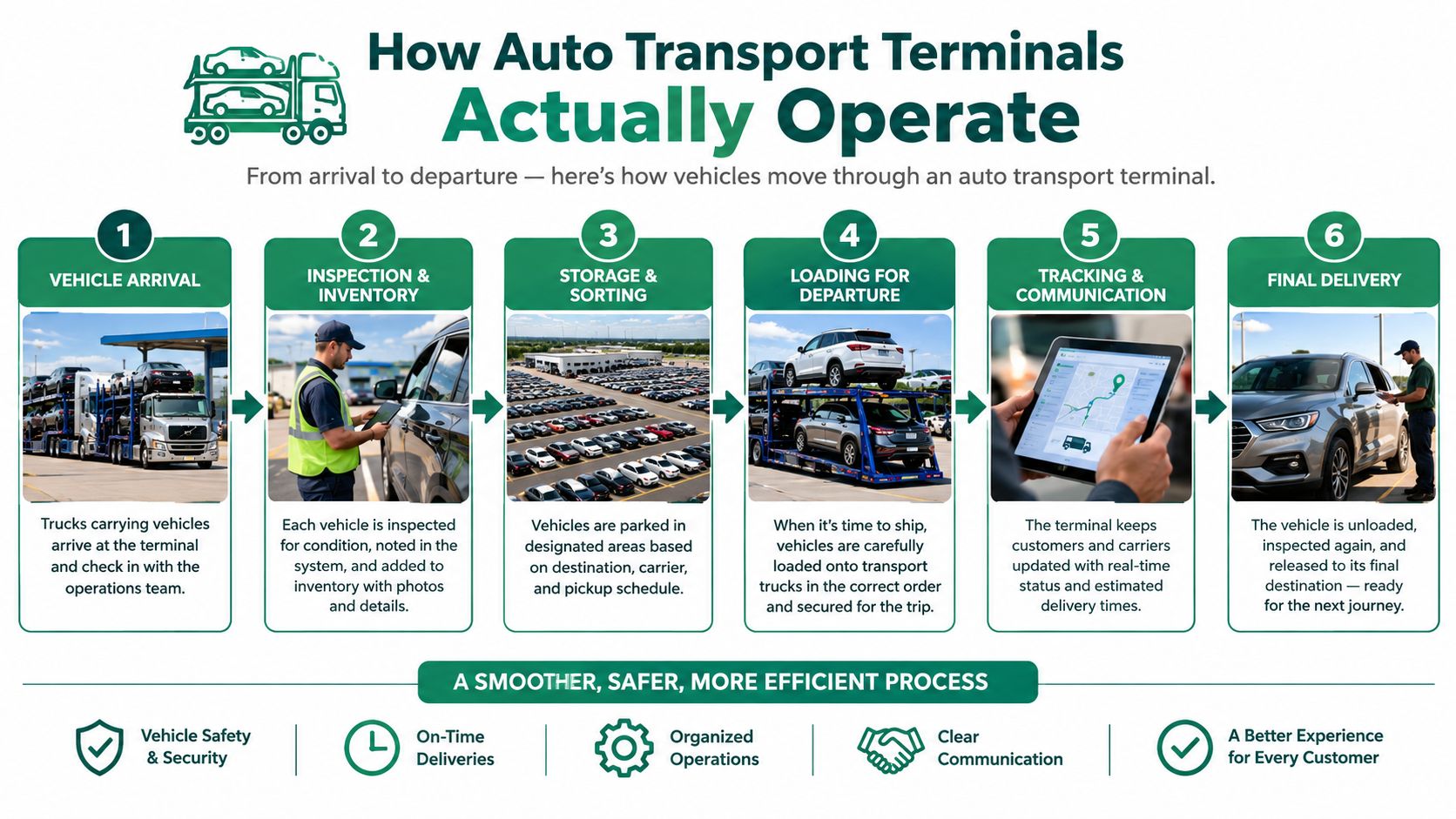
A vehicle normally moves through this sequence:
- Arrival and intake: You deliver the car to the origin facility within its accepted drop-off window. Staff verify the vehicle, keys, condition, and paperwork.
- Inspection: Existing dents, scratches, chips, and other visible damage are recorded on inspection documents, often with photographs.
- Yard staging: The vehicle waits in a designated area until a compatible carrier or transfer movement is available.
- Linehaul loading: A truck loads it with other vehicles traveling along a structured route. Consolidation lets carriers reduce residential detours, although waiting for a full or compatible load can add dwell time.
- Destination transfer: Depending on the route and operating plan, the car may be unloaded at an intermediate facility before reaching its destination terminal.
- Release and pickup: The terminal issues an arrival update or contacts you. You inspect the car, complete the release process, and drive it away.
For Puerto Rico ocean freight, the same handoff logic extends through port operations. The vehicle may pass from a local terminal to a port facility, then through vessel loading and destination handling. Each transfer creates another inspection and release point, so keep the intake record and compare it with the condition at pickup.
Why fixed hubs matter
High-volume terminals support domestic trucking and international vehicle logistics. A 2026 industry report describes Bremerhaven as Europe's largest seaport terminal, handling more than 1.3 million vehicles per year. Another 2026 logistics report lists Brunswick, Georgia at almost 779,000 finished vehicles in 2025, Baltimore at more than 728,000, and Vancouver at almost 480,000. The same snapshot lists Jacksonville at 416,721, New York and New Jersey at 361,283, Hueneme at 357,498, and San Diego at 346,415 vehicles. These figures appear in this overview of European auto terminals.
That volume explains the model. A carrier can gather several vehicles at one hub instead of making repeated residential detours, then feed them into another concentrated network. Resources explaining how trucking, rail, and ocean movements connect can help shippers plan shipments with Novocargo.
Fixed hubs improve routing density, but they do not guarantee immediate movement. Your car may wait for a matching load, staff may work limited hours, and the destination terminal may require advance notice. Those delays can become storage charges, extra travel, or missed port windows.
Calculating the True Cost and Transit Time
A terminal quote is only one line in the moving budget. The lower base rate can disappear after you add the drive to the origin facility, a ride home, travel from the destination terminal, fuel, time away from work, and storage if collection is delayed.
As noted earlier, base rates can cluster around $500 to $1,100, depending on route and vehicle. That figure does not cover every task assigned to the customer. One terminal shipping cost guide notes that terminal pricing may reduce the carrier's charge by $50 to $150, while storage may cost $15 to $35 per day at each end. A missed release window can consume that discount quickly.
For a practical estimate, budget the extra travel separately. Fuel, tolls, parking, rideshare fares, or a second driver can add roughly $180 to $250 across origin drop-off and destination pickup. Puerto Rico ocean freight requires particular care: a vehicle may involve a mainland terminal handoff, port processing, and destination release. A delay at any point can create storage or additional travel before the vehicle is ready.
A practical cost worksheet
Write down each charge before accepting a quote:
- Transport quote: Confirm that terminal intake, loading, linehaul movement, destination release, and administrative charges are included.
- Origin travel: Add fuel, tolls, parking, rideshare costs, or the cost of having someone follow you.
- Destination travel: Estimate the same expenses for collecting the vehicle.
- Storage exposure: Ask when the clock starts, how charges are calculated, and whether weekends or holidays count.
- Schedule cost: Include unpaid time, missed work, hotel needs, or a rental car if release slips.
- Custody preference: For a valuable or delicate vehicle, account for the practical value of fewer transfers and simpler condition checks.
| Cost Factor | Terminal to Terminal | Door-to-Door |
|---|---|---|
| Base transport rate | Often lower because the carrier uses fixed hubs | Often higher because residential or local access requires more work |
| First and last miles | Paid and arranged by the customer | Included in the transport arrangement |
| Storage exposure | Possible when pickup misses the terminal window | Usually outside the customer's normal workflow |
| Personal time | More coordination and travel | Less customer travel |
| Handling | Several custody changes may occur | Usually fewer handoffs |
| Best fit | Flexible shipments near suitable hubs | Time-sensitive or high-value moves |
Review car shipping cost information before comparing quotes. Ask each provider to list included services, storage rules, port charges, and pass-through costs in writing.
Transit time is a scheduling issue
Terminal transport depends on consolidation. A car can be ready for movement while the carrier waits for space on the correct route. Terminal hours, yard capacity, loading order, weather, truck availability, and port schedules can affect release.
Use the quoted transit window for planning, not as a guaranteed appointment. Ocean freight routes to Puerto Rico can add a separate port and vessel schedule to the trucking timeline. Confirm when the terminal will notify you, how long you have to collect the vehicle, and whether storage begins immediately after release. Arrange transportation before the arrival notice, especially when the destination terminal has limited hours.
Comparing Terminal Service to Door-to-Door Delivery
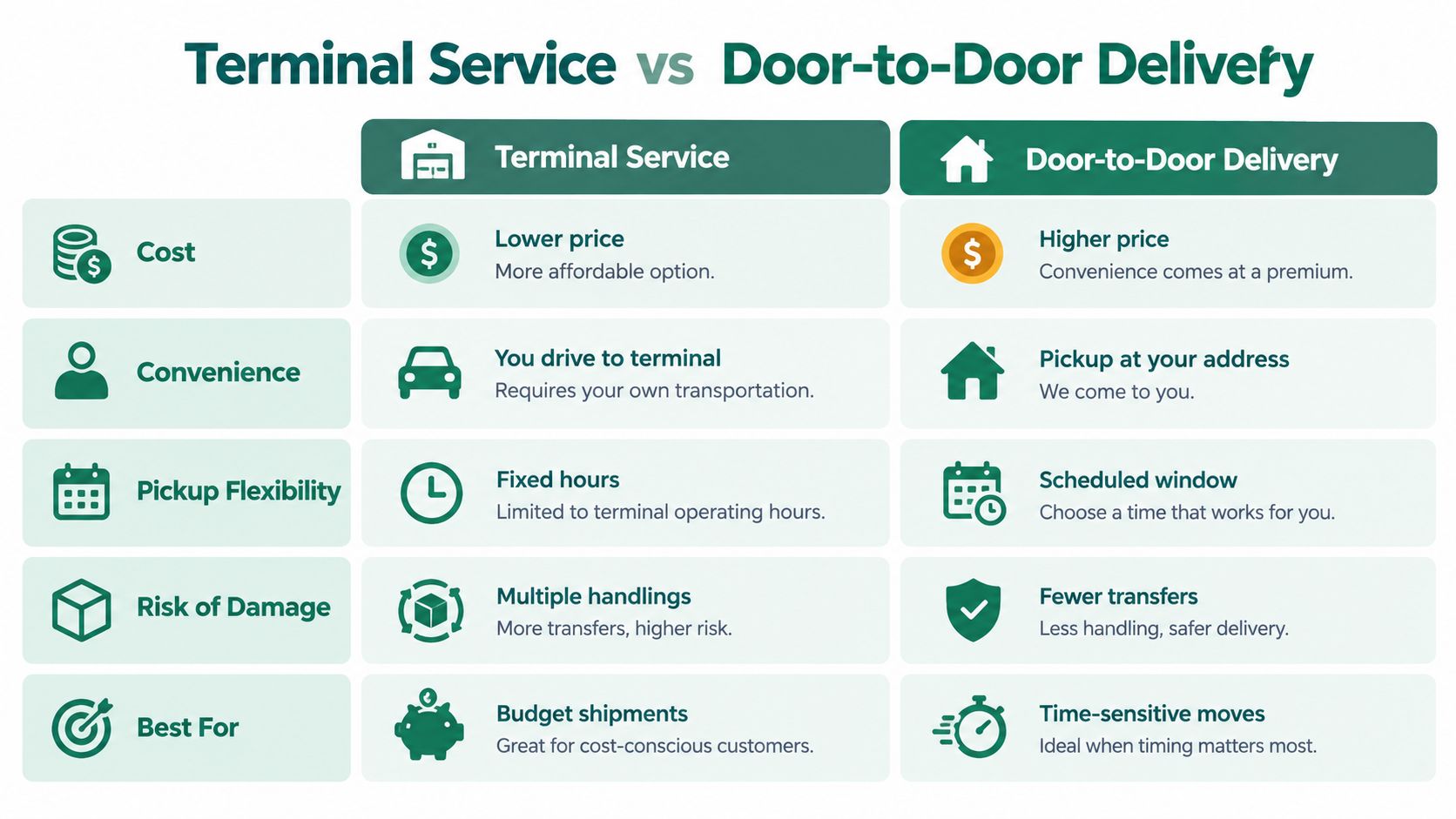
Terminal service saves the carrier from many residential pickups and deliveries. Door-to-door service saves the customer from making those trips. Neither option removes every logistical constraint. A large carrier may still need to meet you at a nearby accessible location if your street has low branches, tight turns, weight restrictions, or limited space.
The operational difference becomes clearer when you look at custody. At a terminal, staff may receive the vehicle, yard personnel may reposition it, a loading crew may place it on a trailer, and another team may unload it at the destination. Every movement creates another inspection point and another opportunity for a scrape, minor collision, or disagreement about when damage occurred. Industry guidance on terminal versus door-to-door transport highlights this chain-of-custody concern.
Which customers benefit from each model
Terminal-to-terminal can make sense when:
- Budget controls the decision: You can absorb the travel and still come out ahead after calculating the complete cost.
- Your schedule is flexible: A delayed loading or pickup won't create a serious problem.
- You live near a real hub: The terminal is reachable without an expensive or disruptive trip.
- You manage vehicle inventory: Dealerships, auctions, and businesses may benefit from batch handling and predictable facility access.
- You need temporary holding space: The terminal's storage arrangement fits your dates and you understand the charges.
Door-to-door is usually better when:
- You have a fixed move date: A relocation, military transfer, school start, or business opening leaves little room for terminal delays.
- The vehicle has high value: Luxury, classic, low-clearance, and specialty vehicles benefit from fewer handling events.
- You don't have a second driver: The first and last miles would require costly rides or complicated coordination.
- You live far from a hub: Driving a long distance to save on transport can defeat the purpose of shipping.
- You need a simpler handoff: Pickup and delivery near an accessible address reduce customer labor.
Door-to-door service doesn't mean a truck can enter every driveway. The practical solution may be a nearby wide road, shopping center, or commercial meeting point. That still differs from terminal shipping because the vehicle is handed directly to the carrier rather than being stored and managed by a separate yard. Customers can review the operational details of door-to-door auto transport before choosing.
A terminal is a good tool when the shipment profile matches it. It isn't a universal upgrade or a universal discount. The right choice depends on who can absorb the extra coordination and how much control the owner needs over timing and custody.
Navigating Puerto Rico Port and Ocean Freight Routes
Puerto Rico changes the transportation equation. There is no road connection between the mainland and Puerto Rico, so a vehicle moving between the mainland and the island must travel by sea. Port and terminal handling aren't optional add-ons on these routes. They are part of the physical process.

A typical mainland-to-island movement involves inland transport to a departure port, vehicle intake and documentation, ocean loading, arrival processing, and release near the destination port. A route may connect a mainland logistics network with San Juan, while the inland origin could be anywhere from a major city to a smaller community served by a carrier pickup. Puerto Rico vehicle shipping guidance explains why these moves can't be treated like ordinary interstate hauling.
Documents determine whether the vehicle moves
Documentation problems can delay an otherwise ready shipment. For a financed or leased vehicle, the owner generally needs a notarized lienholder authorization allowing the vehicle to leave the mainland. For an outright-owned vehicle, guidance calls for the original title and government identification. Confirm current requirements with the shipping provider and relevant authorities before delivering the car to the port.
Puerto Rico's Hacienda appraises arriving vehicles to calculate the applicable excise tax before registration can be completed. That means the shipping budget isn't the entire island-side cost. Owners should plan for clearance, tax assessment, registration steps, and any local transport after release. The Puerto Rico shipping documentation guide provides a neutral explanation of these mechanics.
Ocean routes also create schedule variables that don't appear in a simple mainland trucking quote. Port cutoffs, vessel schedules, documentation review, terminal release procedures, and weather can affect the timeline. Snowbirds should avoid booking a flight that assumes the vehicle will be available immediately upon arrival. Military families and students should coordinate the shipment with housing, reporting, and transportation needs rather than treating the vessel arrival as the final step.
For a route-specific explanation of container and ocean options, review Puerto Rico car shipping services. Ask whether the quote includes mainland pickup, port handling, ocean transport, destination terminal release, and any required local delivery. Those are separate operational stages, even when one company coordinates them.
Puerto Rico customers should also confirm how keys, personal items, alarms, disabled vehicles, and inspection records are handled at each handoff. A vehicle crossing by sea passes through more formal custody points than a standard overland move, so complete paperwork and clear condition records matter from the first terminal visit.
Preparing Your Vehicle for Terminal Drop-Off and Pickup
Preparation protects both the vehicle and the record of its condition. Start with a clean exterior so staff can see existing scratches, dents, paint damage, and glass issues. Remove personal belongings, including loose items in the trunk and cabin, because terminal staff and carriers generally aren't responsible for household property left inside the car.
Before you arrive
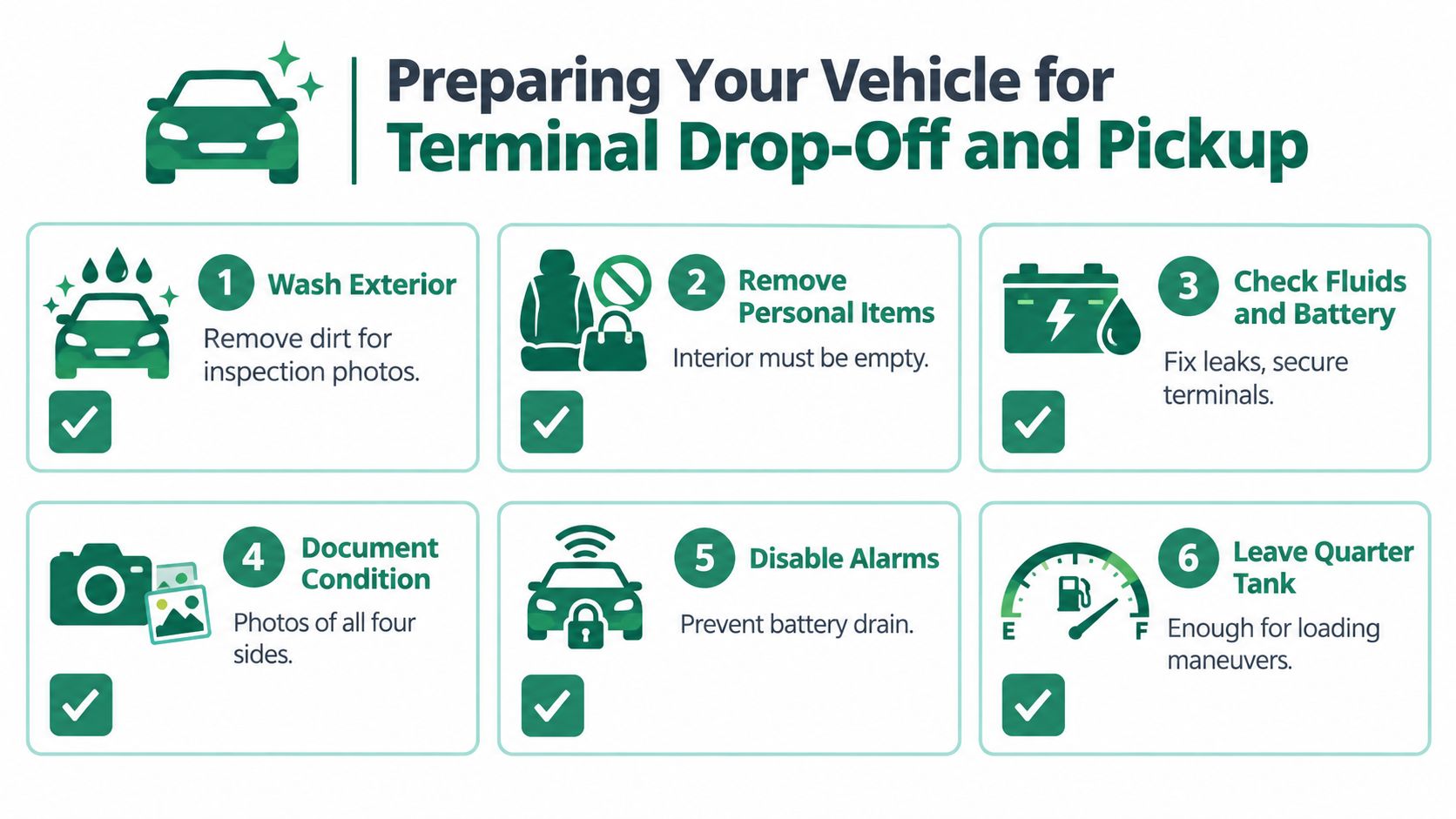
Use this checklist before driving to the origin facility:
- Wash the exterior: Clean surfaces make inspection photographs more useful.
- Remove personal items: Leave the cabin, trunk, and storage compartments empty.
- Check fluids and the battery: Address leaks and secure loose battery terminals.
- Document the condition: Photograph all four sides, the roof if possible, wheels, glass, interior, and existing damage.
- Disable alarms: Prevent battery drain and avoid activation during yard handling.
- Leave a quarter tank: Keep enough fuel for loading and repositioning without carrying an unnecessarily full tank.
Bring the requested keys and paperwork, and ask how the terminal handles vehicles that don't run, steer, or brake. A non-running car may require specialized equipment and may not fit a standard terminal process. That detail must be disclosed before drop-off, not when a carrier arrives.
At drop-off and pickup
During intake, walk around the vehicle with the terminal representative. Check that the bill of lading or inspection record describes existing damage accurately, and don't sign a blank or incomplete condition report. Keep copies of the signed documents and photographs in a cloud folder or on your phone.
At the destination, inspect the car before leaving the facility. Compare the body, wheels, glass, lights, interior, and odometer with the origin record. If you find a new issue, document it immediately on the delivery paperwork and notify the responsible provider before driving away.
Ask about the terminal's pickup window before you drop off the car. Storage terms vary, and a missed window can create charges that weren't included in the transport quote. A clear release process, correct contact number, and realistic arrival plan prevent many avoidable disputes.
Choosing a Reliable Auto Transport Partner
Terminal shipping requires more than a low quote. The provider should identify the actual terminal, explain who holds the vehicle at each stage, disclose storage terms, describe inspection procedures, and separate included transportation from customer responsibilities. If an agent can't answer those questions, the quote isn't complete.
Look for a company with experience coordinating both domestic trucking and port movements. That matters for customers in the 48 contiguous states, but it matters even more for Puerto Rico routes, where inland transport, ocean freight, port intake, customs-related documentation, excise-tax assessment, and destination release must fit together.
Questions to ask before booking
- Where is the origin terminal: Request the facility address, operating hours, and drop-off rules.
- Where will the vehicle be released: Confirm the destination terminal and the process for scheduling pickup.
- When does storage begin: Ask about the grace period, daily charges, weekends, holidays, and payment methods.
- Who records condition: Find out whether terminal staff or the carrier completes the inspection and how photographs are stored.
- What happens if the schedule changes: Ask about late arrival, delayed pickup, missed vessel cutoffs, and rerouting.
- Who coordinates the shipment: A dedicated agent can reduce confusion when several carriers, terminals, or ports are involved.
A provider such as National Car Transport brings 25+ years of experience, an A+ BBB rating, transparent flat-rate pricing, and a network of 25,000+ vetted carriers to the planning process. The company also offers bilingual English and Spanish agents based in the USA, with agents who have over 20 years of experience in auto transport logistics service. That kind of human guidance is useful because no vehicle transport is alike, and the right agent can make the process simple and quick at a great value.
For a customer, bilingual support isn't just a convenience. It can help an English- or Spanish-speaking individual understand terminal rules, lienholder paperwork, port instructions, inspection records, and storage exposure without relying on a relative or informal translation. Individuals, snowbirds, military families, students, dealerships, and businesses all benefit from an advisor who can explain what happens next and who is responsible for each handoff.
National Car Transport can arrange domestic and Puerto Rico vehicle transport with transparent flat-rate options, experienced bilingual agents, and access to vetted carriers. If you're comparing terminal-to-terminal car shipping with door-to-door or ocean service, visit National Car Transport for a route-specific evaluation and a quote that accounts for the complete logistics, not just the base rate.