
You've got the job, the orders, or the lease in Puerto Rico, and now you're staring at the car in your driveway wondering how it gets there with you. You can't pack it, you can't drive it across the water, and buying a replacement on arrival isn't a decision you want to make under pressure. Bringing your car with you is usually doable, but it works best when you price two things first. Check the arbitrios tax from your VIN, then get a freight quote from your actual mainland origin, because that truck leg to the sailing port drives most of the difference between cities.
Table of Contents
- Four Ways to Get a Car to Puerto Rico
- What Shipping Costs and How the Car Travels
- Documents and Car Prep Before the Sailing
- Puerto Rico Arbitrios Tax on Arriving Cars
- Moving a Car From San Juan to the Mainland
- Which Route Fits Your Situation
- Lock In Your Sailing and Request a Quote
Four Ways to Get a Car to Puerto Rico
A car can't be driven to Puerto Rico, so your real choice is how it crosses the water and who handles each leg. Many people picture only one option, handing the keys to a carrier, but there are four paths and the right one depends on the car's value and your timeline.
Door-to-port means a carrier collects the car at your address, trucks it to the sailing port, and ships it to the Port of San Juan for collection or onward delivery. Port-to-door flips the work. You drive the car to the port yourself, usually Jacksonville, Florida, and the carrier handles the sailing and the island end. That can suit Florida residents, but you still need a way home from the port.
Comparing the Options
| Option | Best for | Control over timing | Paperwork | Main risk |
|---|---|---|---|---|
| Door-to-port carrier | Owners who want the car collected at their address | Set by the sailing schedule | Title, registration, ID and shipping records | Sailing dates can move, so keep a flexible window |
| Port-to-door | Owners who live near Jacksonville and can drop the car off | You choose the drop-off day within port hours | Same records plus port drop-off paperwork | Travel cost to the port and back |
| Sell and rebuy | Owners with a low-value car or no need for it on the island | Full, on your own timetable | Bill of sale and title transfer | Island purchase prices and arbitrios on the new car |
| Leave it behind | Short stays or cars close to retirement | Not applicable | None for shipping | Cost of replacing the car on arrival |
Selling and rebuying avoids freight, but you're not avoiding cost. You still list the car, transfer title, and pay island prices plus tax on whatever you buy next. Leaving the car behind makes sense for short stays or a vehicle near the end of its useful life.
If you're weighing how the car travels once it reaches the port, our overview of container shipping to Puerto Rico explains that part of the process. For staying reachable during pickup, sailing, and delivery updates, many travelers sort mobile data in advance through options like Kimsim eSIM plans for Puerto Rico.
Practical rule: If the car is worth keeping and your move date is fixed, ship it. If it's old or inexpensive, price a replacement on the island before you book anything.
What Shipping Costs and How the Car Travels
You are two weeks from a San Juan move, and two carriers have sent totals that differ by several hundred dollars. One number ends at the dock. The other includes a Chicago pickup, the sailing, and delivery to your address. Until both quotes name the same pieces of work, you are not comparing the same job.
A Puerto Rico car shipment is four charges stacked together. Inland trucking is pickup at your address and the run to the sailing port. Ocean freight is the vessel crossing to San Juan. Port and ground charges cover terminal handling, administrative fees, and clearance at both ends. Island delivery is either release at the port or a truck to your Puerto Rico address. A driver collects the car, notes existing marks on a condition check, and the car is trucked to the mainland port, loaded for the crossing, then handled and cleared in San Juan before release to you or your designated recipient.
Jacksonville is a common sailing port for mainland shipments to San Juan. A U.S. Department of Transportation filing reports approximately 58 to 60 hours of vessel transit from Jacksonville to San Juan. That same filing lists Philadelphia, Pennsylvania and Pennsauken, New Jersey as an origin route to San Juan and gives a historical Puerto Rico Maritime Shipping Authority rate of $3,789 per trailer, plus a terminal charge of 43 cents per 100 pounds, administrative and licensing charges, container-availability charges, and San Juan handling and arrimo fees. Treat those dollars as a historical tariff, not a current consumer quote. They show the shape of the bill: ocean freight is one line, and port charges sit on top of it. The crossing is the fast part. Waiting for a sailing slot, then the truck leg before it, is why total transit runs well beyond those two and a half days on the water.
Present pricing moves with vehicle size, port handling, inland pickup or delivery, insurance, and sailing availability. I treat every figure as an estimate until it names your origin, the next sailing, and whether island delivery is included. The variable that changes most is the trucking leg. Your mainland city sets how far the car travels before it sees a vessel. A car collected in South Florida has a short run to port. A car collected in Chicago or Los Angeles does not, and that distance is in the quote whether or not you see it as its own line. SUVs, trucks, and enclosed transport are quoted on request rather than at a standard sedan rate. Open transport is the more economical method when the car does not need the extra protection of an enclosed trailer.
Price the Puerto Rico arbitrios from the VIN before you book. On a newer car that tax can rival the freight, so a lower ocean rate is not automatically the cheaper move. Then request the quote from your own origin. A rate built from someone else's city will not match the trucking leg you need.
| Mainland origin | Total transit time |
|---|---|
| Miami / South Florida | Short truck leg plus sailing wait and crossing |
| Orlando / Tampa / Jacksonville | Shortest inland leg for most Florida pickups |
| Atlanta | Regional truck leg plus sailing wait and crossing |
| New York / New Jersey / Philadelphia | Northeast truck leg or Philadelphia area routing plus crossing |
| Boston / Hartford | Longer Northeast truck leg plus sailing wait and crossing |
| Chicago | Midwest truck leg plus sailing wait and crossing |
| Houston / Dallas | Texas truck leg plus sailing wait and crossing |
| Los Angeles / West Coast | Longest inland leg plus sailing wait and crossing |
No fixed per-city price can be honest for your shipment. Vehicle type, exact addresses, and the next available sailing all move the number. Use our car shipping cost guide to see which inputs belong on the bill, then send your origin city, vehicle type, and target date for a current figure. Ask for the next sailing date, and check whether your pickup window can absorb the upper end of the transit range.
The car also has to sail empty, with a quarter tank of fuel or less. Personal items are discouraged because they are not covered by carrier insurance and they add weight. For Puerto Rico, the ocean carrier requires the vehicle to be empty of personal items. If you pull small engine or trim parts off the car and clean them while they stay behind, it helps to compare ultrasonic cleaners for automotive parts rather than guessing at size and settings.
A low quote that cannot secure a carrier or a sailing is not a saving. It is a delay you pay for in rental days.
Documents and Car Prep Before the Sailing
Before the car leaves your driveway, check that the ownership records agree and prepare the paperwork for the ocean carrier and Puerto Rico's vehicle tax process. A mismatch in names or missing documents can delay clearance.
Ownership and Sale Records
- Certificate of title: Shows ownership of the vehicle.
- Current registration: Identifies the registered vehicle and owner.
- Driver's license or photo ID: Should match the name on the vehicle records.
- Bill of sale: Include it if you recently bought the car and the title or registration has not yet been updated.
Check the names across the title, registration, ID, and bill of sale before booking. The same care with identity documents applies in other transactions, including proof of identity for car scrapping.
Shipping and Import Records
The Hacienda guidance for vehicle arbitrios covers the tax process for vehicles arriving in Puerto Rico. Keep the shipping and vehicle records together, including the commercial invoice, bill of lading, and Motor Vehicle Inspection Document, also called the vehicle assessment or tasación document.
Relocating shippers should register in SURI, Puerto Rico's Unified Internal Revenue System, before the vehicle arrives. Complete the filing steps in advance so the car is not waiting at the port while you sort out registration or documents.
Preparing the Car Itself
The ocean carrier requires the vehicle to be empty of personal items. Remove everything from the trunk and passenger area, including loose accessories and household goods. The car should have no more than a quarter tank of fuel at shipment.
Take photos of the car at pickup, including its sides, roof, and wheels. Record the odometer reading and note existing damage in writing at handoff. These records provide a clear baseline for checking the vehicle at delivery.
Prepare the file and the car before pickup. Missing ownership records or import paperwork can delay the shipment at the port.
Puerto Rico Arbitrios Tax on Arriving Cars
Arbitrios is Puerto Rico's excise tax on imported vehicles. You pay it when the car comes onto the island, and it's completely separate from your shipping charges. Freight gets the car to San Juan. Arbitrios is what lets it stay.
The visual below summarizes how that tax fits into the arrival process.
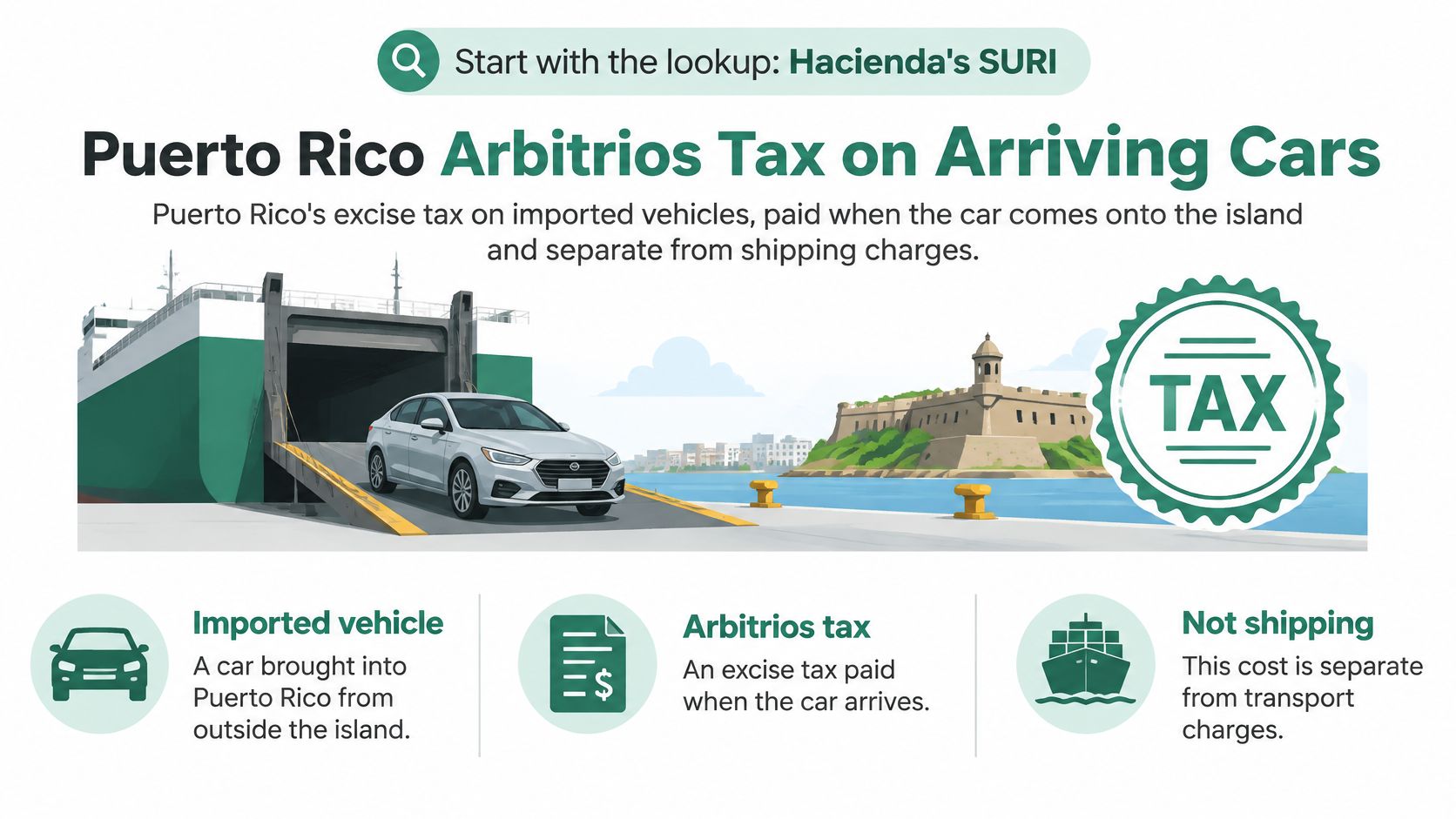
Start with the lookup, not a guess. The Hacienda vehicle arbitrios guidance explains that Puerto Rico's Department of Treasury provides an official estimator through SURI where importers can search by VIN, or by make, model, and year, and that the VIN method is generally the most effective.
| Vehicle value | Excise tax rule |
|---|---|
| Up to $6,170 | $637.50 minimum tax |
| $6,170 to $10,690 | $637.50 plus 10.2% of the amount over $6,170 |
| $10,690 to $21,380 | 19.6% of the amount over $10,690 |
| $21,380 to $31,780 | 23.0% of the amount over $21,380 |
| $31,780 to $44,890 | 27.2% of the amount over $31,780 |
| Above $44,890 | 34.0% of the amount over $44,890 |
Read those rows as progressive. The bands stack on the value above each threshold, so a single row doesn't give you the total for a higher-value car. That's exactly why the exact figure should come from the SURI estimator rather than a hand calculation at your kitchen table.
The video below walks through the broader shipping process so you can see where the tax step sits.
Here's the trap. On a newer car with a higher assessed value, arbitrios can rival or exceed the freight itself. The tax is calculated on the vehicle's assessed value under Hacienda's rules, which may differ from what you paid for it. If that number surprises you at the port, your budget is already broken.
Run your VIN before you book, write down the estimated tax, and add it to your freight quote. That combined figure is your true total. Our Puerto Rico car shipping FAQ answers the follow-up questions most owners ask at this stage.
Moving a Car From San Juan to the Mainland
The same sea route runs in reverse when you're leaving the island and taking your car with you to a mainland state. Don't assume the arrival rules flip automatically. Outbound shipments have their own checks, and confirming them early is what keeps the car moving.
What to Gather First
- Certificate of title: Your core proof of ownership.
- Current registration: Shows the car is registered in your name.
- Photo ID: Connects you to the vehicle records.
- Bill of sale or proof of ownership: Especially important for recently purchased vehicles.
Before you book, ask your carrier whether your vehicle needs an export certificate or any clearance before it leaves the port. Also confirm with the Puerto Rico Department of Treasury whether any charge applies on departure, since the arbitrios schedule covers imports only and won't answer that question for you.
The route itself mirrors the inbound journey. You drop the car at the port or have it collected from a San Juan address, it crosses by vessel, and you collect it at the mainland port or have it delivered onward. Your mainland destination city shapes the final truck leg the same way your origin city shaped the first one on the way in. Details for this direction are covered on our page for car shipping from Puerto Rico.
Once the car arrives, you'll need to register it in your new state, so check that state's registration requirements and timeline before the car lands. Confirm every required document in writing with your carrier before the vehicle is released from the island. A missing export paper can hold a car at the port just as effectively on the way out as on the way in.
Which Route Fits Your Situation
Different moves point to different answers, even when the destination is identical.
Relocating Families and Military Moves
If you're relocating with a family car worth keeping and a fixed move date, ship door-to-port. Replacing a dependable family vehicle on arrival costs time you won't have during a household move. Military members with orders to the island should take the same path when the car is owned and the date is set. Your main risk isn't the sailing, it's paperwork, so keep title and registration in order well before your report date.
Snowbirds and Students
Snowbirds should compare shipping both ways against selling and buying again each season. For a well-kept car you'll use for months at a time, shipping usually wins. For an older car used only briefly, selling can make more sense. Students on a one or two year program should usually leave the car behind or sell it, unless it's paid off and needed daily. Two sailings plus tax is a lot to spend on a short stay.
Dealers and Online Buyers
Dealers and remote buyers should ship with a complete file for each vehicle, every time. When the seller, transporter, and recipient are three different parties, condition photos, title paperwork, and a documented handoff are what protect everyone. One incomplete file can hold up an otherwise routine delivery.
Don't assume the cheapest quote wins. A late booking that misses a sailing can cost lodging nights and rental car days that erase any saving on freight. Price matters, but a quote is only useful if it holds until a carrier and sailing are secured.
Decision shortcut: Weigh the car's current value, the years of use it has left, and how flexible your move date is. Those three answers settle most cases.
Lock In Your Sailing and Request a Quote
A 2022 sedan sits in Ohio, and the move date in San Juan is six weeks out. Price the Puerto Rico arbitrios from the VIN before you treat any freight figure as the cost of the move. On a newer car that tax can rival the ocean freight. Then request the quote from your own origin, not from a generic East Coast port. The trucking leg to the sailing port is what changes the total the most. Every quote is an estimate until a carrier and a sailing are held.
What to Include in Your Request
Send year, make, model, and body type. SUVs, trucks, and enclosed transport to Puerto Rico are quoted on request rather than at the standard sedan rate. Provide the exact pickup and delivery addresses, not only the city names. Specify the day you need the car collected and the day you need it on the island.
The Booking Sequence
- Request a current quote with those addresses and your origin city.
- Choose your route, door-to-port or port-to-door, based on how much of the land journey you want to handle yourself.
- Book once a carrier is matched. There is no upfront charge until your vehicle is matched with a carrier. Check dates on the Puerto Rico car shipping schedule before you lock the sailing.
- Confirm in writing the pickup window and sailing date before the car is collected.
Have the title file and your arbitrios estimate ready at booking, so the reservation is not waiting on paperwork. National Car Transport is a US-based company with 25+ years of experience, an A+ BBB rating, transparent flat-rate pricing, and a network of 25,000+ vetted, licensed, and bonded drivers. A dedicated bilingual English and Spanish agent based in the USA guides pickup, the sea leg, and delivery.
Send the vehicle, the origin city, and the target date. You get a current estimate and the next sailing that fits the move.
Ready to bring your car with you to Puerto Rico or ship it back to the mainland without guessing at sailings, documents, or tax? National Car Transport will price your shipment from your exact origin, confirm your pickup window and sailing date in writing, and assign a dedicated bilingual agent to keep the process simple from collection to delivery. Visit us today with your vehicle details, origin city, and target date to request your quote.