

$845–$1,795 depending on origin, with a 7–14 day total transit window, is the practical starting point for shipping a vehicle from the mainland to Puerto Rico. The final figure depends less on mileage alone than on the sailing, port congestion, container choice, and island-side delivery.
You may be a snowbird sending a second car ahead of the winter season, a military family working through PCS orders, a student returning home, or a buyer who found the right vehicle online and now needs it delivered to San Juan. The process looks simple on a quote sheet, but the decisions behind that quote determine whether the move feels routine or turns into a week of calls.
Container shipping to Puerto Rico is a port-based ocean move. A vehicle travels inside a 20-foot or 40-foot steel container, either sharing space with other cargo or occupying the container alone. The container is loaded at a mainland port and discharged in San Juan or Ponce. Puerto Rico's container system is substantial by island standards, with 1.49 million 20-foot containers handled in 2021, equal to the 2020 level, while the long-run average from 2000 through 2021 was 1.52 million containers (port-traffic data for Puerto Rico).
The four choices that move your price and schedule are straightforward:
- Origin port: A vehicle closer to a regular Puerto Rico gateway usually costs less to position.
- Sailing frequency: Missing the cutoff can mean waiting for the next vessel rather than moving immediately.
- Container sharing: Shared space lowers the bill, while sole-use space offers more control and protection.
- Island delivery: San Juan pickup is different from delivery to a residence, warehouse, or municipality farther inland.
Dispatcher's view: Watching your car disappear into a steel container is unsettling. That feeling is normal. The useful question is not whether the process looks dramatic, but whether the loading record, documents, and handoffs are controlled.
Puerto Rico has been involved in containerized maritime freight for decades. One historical account places the island's cargo-containerization practice in 1954, with Sea-Land introducing containerized service in 1958 (historical account of Puerto Rico containerization). For broader planning and international-market preparation, the Translators USA foreign market guide is a useful reference, especially for businesses coordinating documents and receiving arrangements across jurisdictions.
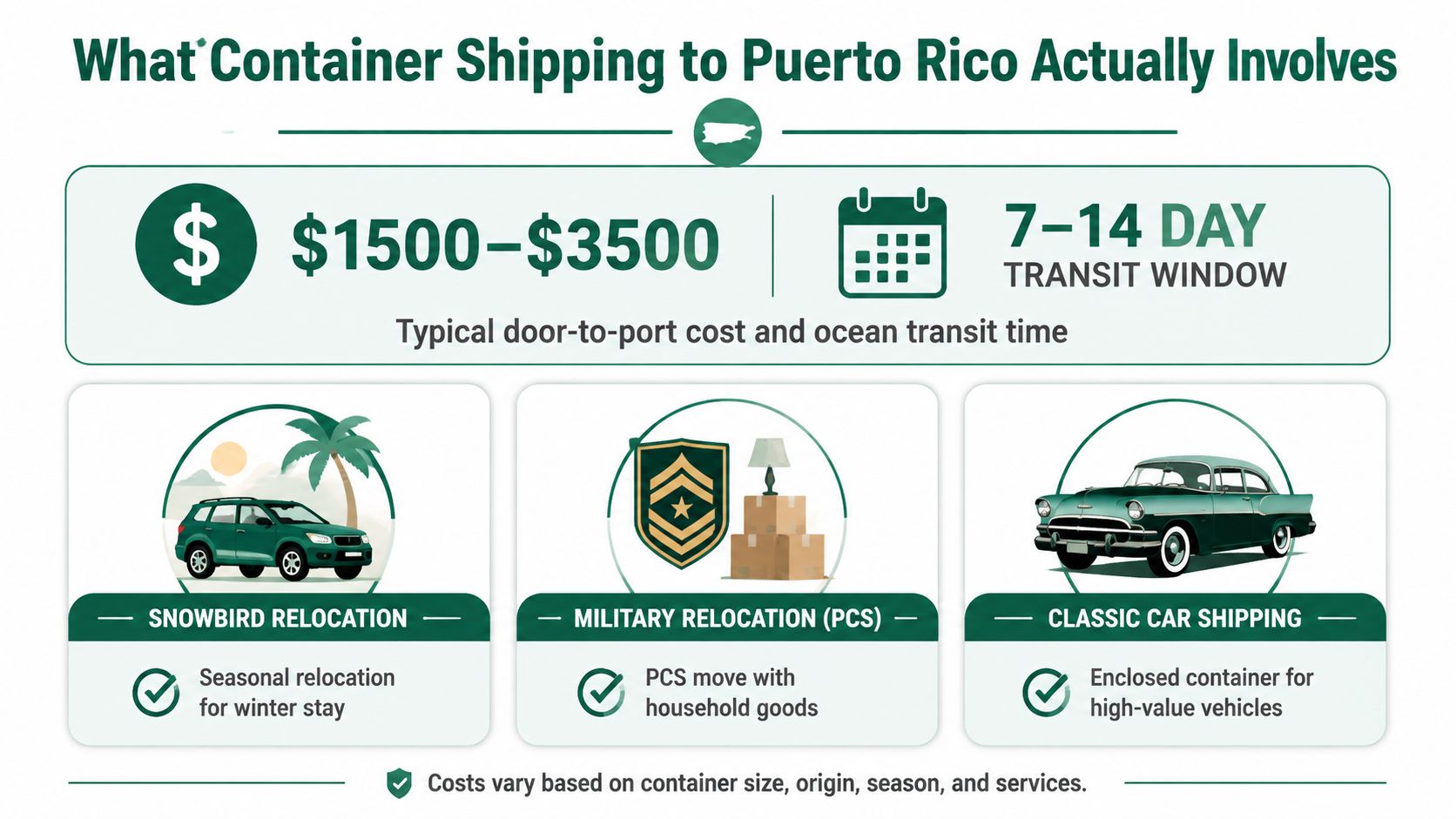
Table of Contents
- Container vs RoRo for Shipping a Car to Puerto Rico
- How the Mainland-to-Island Journey Works
- Preparing Your Vehicle for Container Loading
- Documents, Title, and Puerto Rico Excise Tax
- The Jones Act Effect Most Guides Skip
- Timing, Sailing Schedules, and Working With an Advisor
Container vs RoRo for Shipping a Car to Puerto Rico
The choice between container shipping and RoRo, or roll-on/roll-off, should start with the vehicle, not the sales pitch. Container service places the car inside a steel box, either in shared space or in a sole-use container. RoRo service drives the vehicle onto a purpose-built vessel, where it remains in the vessel's vehicle deck rather than inside a container.
For many ordinary vehicles, RoRo can be less expensive, often by $150–$300 according to the provided route guidance. The trade-off is control. RoRo doesn't allow personal items, and the vehicle is more exposed to salt spray and repeated handling. Container service can allow roughly 200–500 pounds of personal items depending on the carrier, but you must follow that carrier's written rules, and loose cargo can create liability problems.
| Factor | Container Shipping | RoRo |
|---|---|---|
| Protection | Vehicle travels inside a steel container | Vehicle travels on a vehicle deck |
| Personal items | May be allowed within carrier limits | Not allowed |
| Cost position | Typical range is $845–$1,795 from common origins | Often $150–$300 less than container service |
| Best fit | Classics, financed vehicles, low-clearance cars, valuable vehicles | Operable daily drivers where budget matters |
| Main concern | Container availability and loading fees | Exposure to salt spray and handling |
Choose a container when the vehicle is a classic, leased, financed with GPS equipment, or unusually low to the ground. A vintage Porsche, a restored truck, or a car with fragile trim deserves the added enclosure. Sole-use space makes sense when you need tighter control over what shares the container or when the vehicle's dimensions make shared loading difficult.
RoRo is reasonable for a reliable daily driver, particularly when the budget is tight and the delivery date has flexibility. It's less attractive for a vehicle that you'd be upset to see exposed to marine conditions or handled alongside other rolling cargo.
For a plain-language comparison of open vehicle transport before the ocean portion, review open car transport options. My default recommendation is container service for higher-value, delicate, financed, or low-clearance vehicles, and RoRo only when the vehicle is ordinary, operable, and cost is the main priority.
How the Mainland-to-Island Journey Works
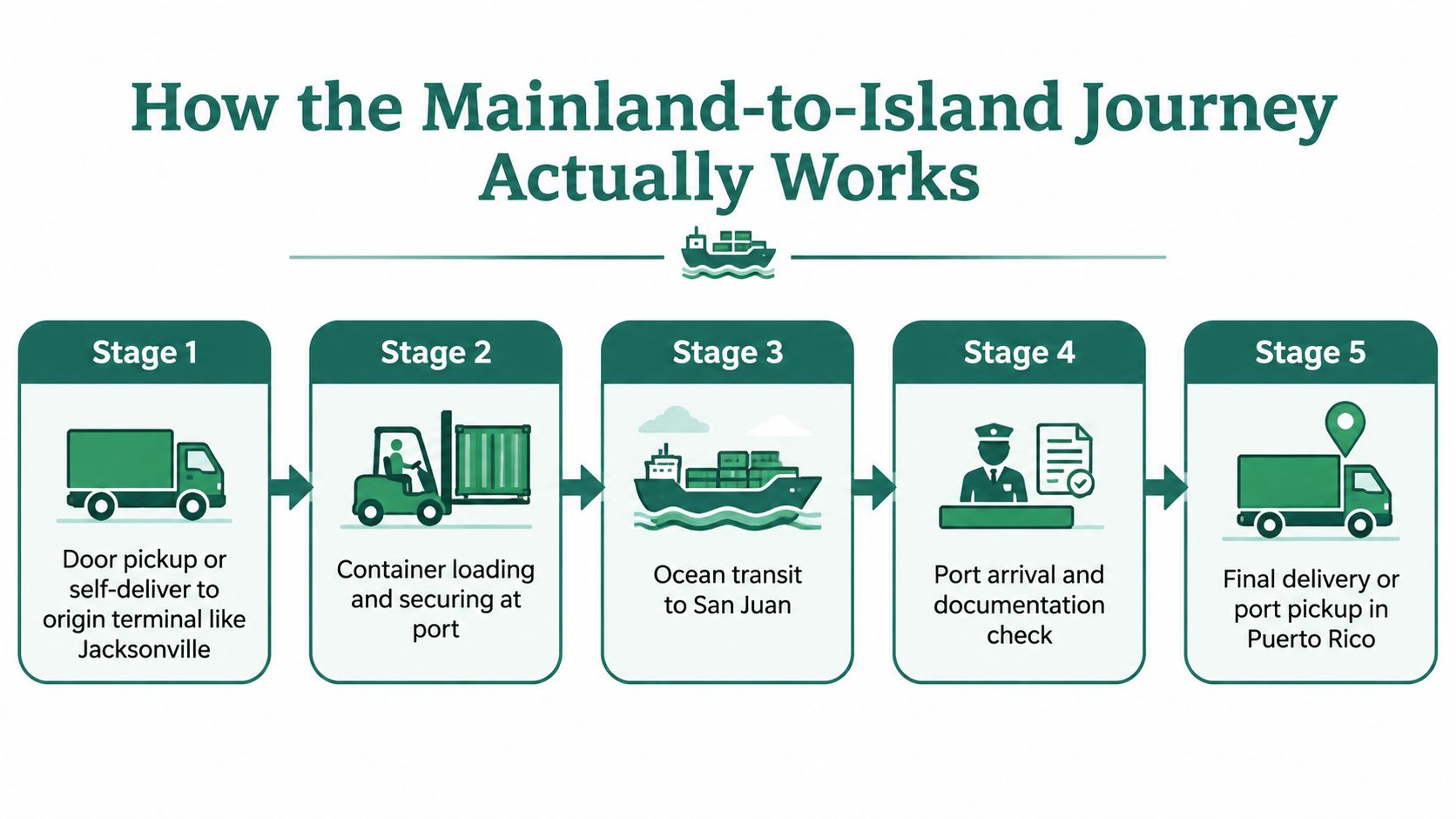
The shipment starts with a choice that affects both price and timing: who moves the car to the port. A contracted drayage truck can collect it at your door, or you can deliver it to the origin terminal yourself. Jacksonville, Port Everglades, and Galveston are common gateways. The right one depends on the vehicle's location and the sailing schedule, not on a generic “nearest port” rule.
At the terminal, staff inspect the vehicle, verify the paperwork, and place it into the loading queue. The ocean carrier or its terminal partner secures the car inside the container and assigns the container to a vessel departure. A port-to-port quote covers the ocean movement, not every mile before loading or after arrival.
The handoffs that cause delays
The first handoff is origin trucking versus terminal delivery. With port-to-port service, you must get the vehicle to the terminal before the receiving cutoff. Door service removes that task, but it introduces inland scheduling and the possibility of waiting for a truck in your area. Ask for both options in writing. The cheaper quote can lose its advantage if the terminal deadline forces an urgent delivery.
The second handoff is the customs and local processing window. Puerto Rico is a U.S. territory, yet vehicle release still depends on complete documents, local inspection, and the receiving process. Vessel arrival does not mean the car is ready for pickup.
The third distinction is between household goods and a private vehicle. Household goods may move through a relocation program with its own inventory and consignee instructions. A private vehicle requires title or registration records, condition documentation, release authorization, and a clear receiving plan. Missing one item can leave the car waiting after the ship has cleared the berth.
The physical route
After loading, the vessel heads to San Juan as the primary gateway or Ponce as a secondary option. The ocean portion of a Jacksonville to San Juan movement is roughly 3–5 sailing days. After arrival, the broker or receiving agent checks the documents and handles any required Hacienda-related vehicle inspection, including ISV or ARV procedures described in the operating plan. An island drayman then takes the car to your residence, a port pickup point, or a receiving warehouse near the airport.
Book San Juan first unless the sailing and final delivery plan make Ponce clearly better. Independent port data show San Juan recorded 18,504 TEU imports, 6,498 TEU exports, and 18 vessel calls in July 2026, while Ponce recorded 232 total containers in the sampled manifest dataset (San Juan port activity data). That difference does not eliminate Ponce, but San Juan generally offers more sailing depth and receiving infrastructure. Port congestion can still change the practical timeline, so confirm the cutoff and expected vessel before booking.
This video provides another visual explanation of the mainland-to-island movement:
For a lane-specific example, review Miami to Puerto Rico car shipping. Before signing, ask who owns every handoff, from your driveway through island delivery, and what happens if the planned sailing or terminal cutoff changes.
Preparing Your Vehicle for Container Loading
A clean, operable vehicle is easier to inspect, load, and release. The terminal team isn't preparing the car for you, so the condition at drop-off matters.
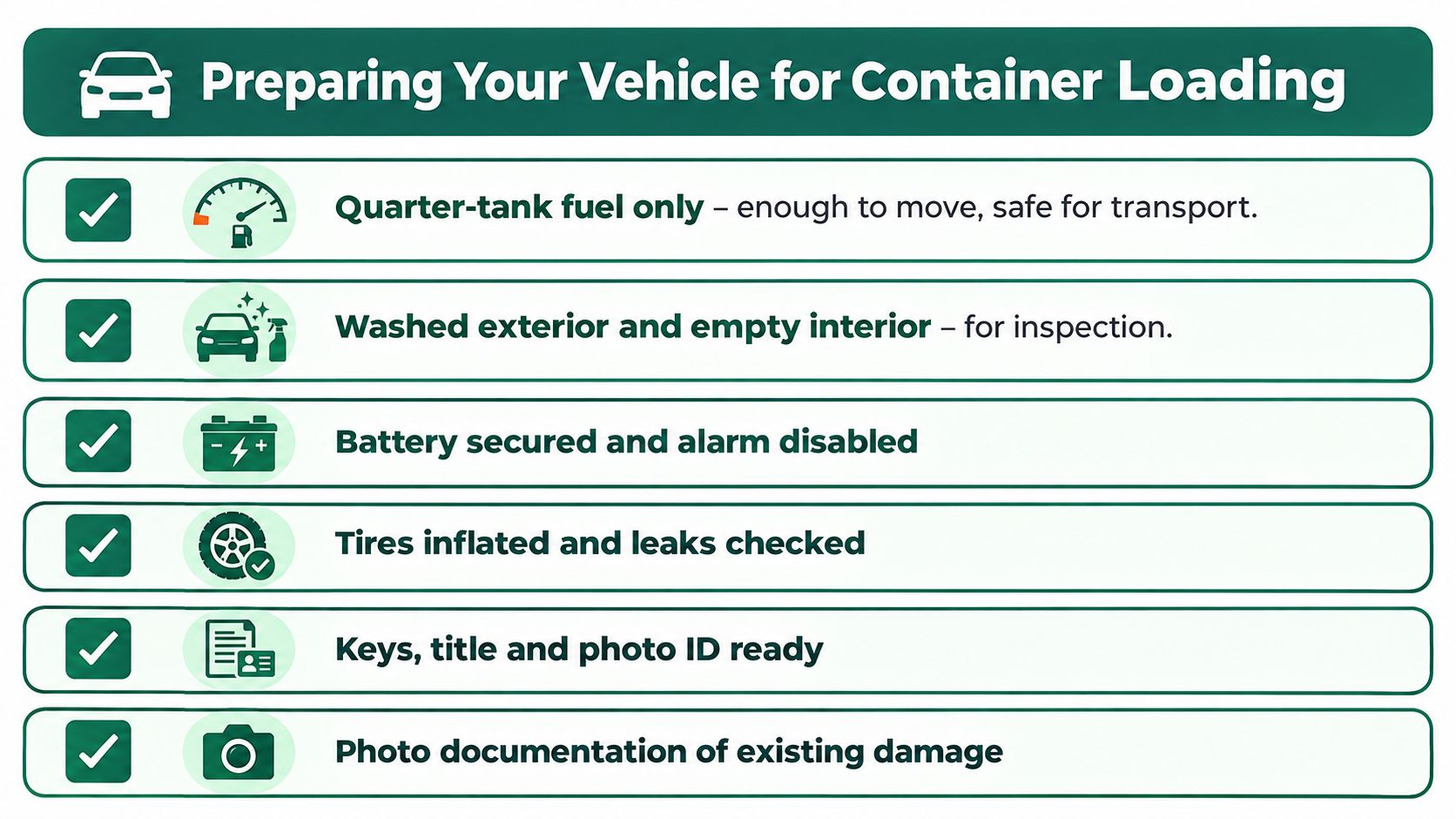
Start with fuel. The carrier guidance commonly requires no more than a quarter tank of gas, enough for loading and unloading without creating an unnecessary hazardous-materials issue. Don't arrive with a full tank because you want to avoid stopping after delivery. That creates a compliance problem, not a convenience.
Top off the vehicle's operating fluids before pickup. Washer fluid, brake fluid, and coolant should be at appropriate levels, and you should address visible leaks before the car reaches the dock. A small leak that seems harmless in your driveway can become a documentation or handling issue inside a sealed container.
Remove anything the carrier didn't approve
Personal items are the most misunderstood part of vehicle shipping. Some container carriers permit a limited amount in the trunk, but policies vary, and the provided carrier guidance notes a common limit of under 100 pounds. Treat that as a planning ceiling, not a universal entitlement.
Keep the cabin and cargo area empty unless the carrier has approved the contents in writing. Don't pack valuables, medication, passports, electronics, tools, or anything you can't afford to lose. Never place paint, propane, fuel cans, aerosols, extra tires, or other flammable or pressurized items in the vehicle.
Use this loading checklist:
- Fuel: Leave the tank at roughly a quarter full or less, following the carrier's written rule.
- Interior: Remove personal belongings, loose paperwork, and anything visible through the windows.
- Exterior: Fold in mirrors, retract antennas, and remove detachable racks or accessories.
- Security: Disable alarms that can drain the battery during the ocean move.
- Mechanical condition: Report leaks, non-running conditions, warning lights, and low ground clearance before booking.
- Tires and battery: Check tire inflation and make sure the battery is secured.
- Keys: Provide the required keys, including a working ignition key and any key needed to open locked compartments.
Wash the exterior before the inspection. Dirt hides scratches, dents, and paint transfer, while a clean surface gives the driver and terminal team a better baseline. Take two printed condition photos, one front three-quarter view and one rear three-quarter view, then keep copies with your shipping documents. The bill of lading inspection happens quickly, and your own dated record helps resolve disagreements about pre-existing damage.
Know what the flat rate includes
A “flat rate” isn't one mysterious number. It generally combines four billable legs:
- Origin trucking or port drop-off: Origin port delivery commonly runs $150–$300, depending on location and service arrangement.
- Ocean freight: The vessel portion averages $600–$1,100, with seasonal and capacity changes affecting the quote.
- Terminal handling: Origin and San Juan terminal fees commonly add $75–$150 per port.
- Island delivery: Delivery from San Juan to a Puerto Rico address commonly runs $200–$450, depending on the final municipality.
These figures come from the provided 2024–2025 planning guidance. Confirm each line with the quoting agent because a low ocean figure can be offset by terminal or destination handling.
Fuel adjustments can change the total, as can July through October peak-season premiums, full-size SUV or lifted-truck surcharges, and an enclosed-container upcharge for weather-tight transport. Quotes can change weekly because bunker fuel indexes and container availability change. A Jacksonville-to-San Juan lane is usually $150–$300 cheaper than West Coast origins such as Long Beach or Houston when the western move requires transshipment.
Loading rule: If an item isn't listed on the booking confirmation, assume it shouldn't travel inside the vehicle.
Before the driver arrives, stage the title, registration, photo ID, keys, lien information, and condition photos together. That small amount of preparation prevents the most avoidable pickup delays.
Documents, Title, and Puerto Rico Excise Tax
Vehicle release depends on documents that identify the car, establish ownership, and authorize the person collecting it. Prepare the following before the container is booked:
- Original title or lien release: The carrier or broker needs evidence that the registered owner can move the vehicle.
- Current registration: This supports the vehicle identity and ownership record.
- Ocean bill of lading: The shipping line issues this transport document.
- Government photo ID: The registered owner's valid identification should match the shipment records.
- Power of attorney: Provide one if someone other than the owner will collect the vehicle.
A bill of lading records the vehicle, route, parties, and transport terms. For a practical explanation of how to review one, use the Doczen bill of lading guide before signing the shipping paperwork.
What happens after arrival
The broker prepares the vehicle declaration and coordinates the local release process. Mainland-to-Puerto Rico movement is treated differently from a foreign import, but that doesn't mean the car skips every administrative step. The receiving side still needs the correct documents, vehicle information, and inspection or tax processing before release.
The cost issue many mainland guides understate is Puerto Rico's excise tax, commonly called arbitrios. Puerto Rico law applies an excise tax to vehicles introduced from abroad or manufactured locally, and a vehicle arriving from the mainland is generally assessed under local rules based on value and vehicle category (Puerto Rico vehicle relocation and excise-tax guidance).
Don't assume the ocean quote includes arbitrios. Ask the broker to identify the tax separately, explain the valuation method, and confirm whether prepayment is available. Paying a local tax obligation is different from paying ocean freight, terminal handling, or island delivery, and the person booking the shipment should know which party handles each item.
For vehicle-specific service, review Puerto Rico car shipping and ask for a written breakdown of transportation, documents, destination charges, and any local tax responsibility.
The Jones Act Effect Most Guides Skip
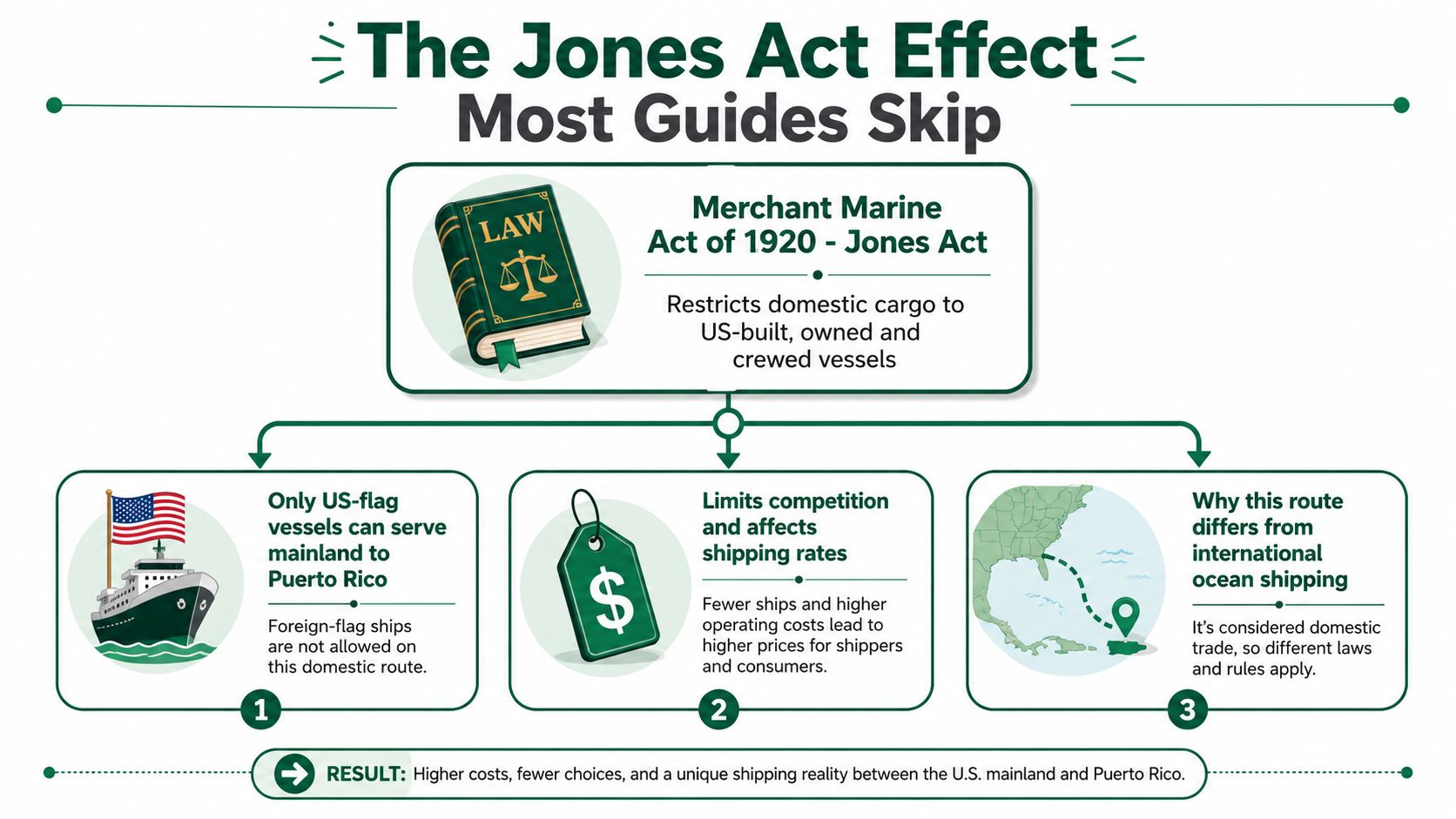
Mainland-to-Puerto Rico vehicle shipping isn't priced like a normal international ocean route. The Merchant Marine Act of 1920, commonly called the Jones Act, restricts domestic waterborne transportation to vessels that meet U.S. requirements for construction, ownership, and crew. The provided policy reference describes those requirements as U.S.-built, U.S.-owned, and U.S.-crewed vessels (background on Jones Act restrictions).
That rule narrows the pool of eligible ships. A smaller carrier pool affects space, sailing frequency, equipment availability, and the balance between shared and sole-use containers. When an eligible vessel enters dry dock or carriers prepare for hurricane conditions, shippers can see tighter space and higher quotes because the schedule has fewer alternatives.
What the rule changes for your booking
The Jones Act doesn't add a line called “Jones Act fee.” Its effect appears through limited competition and constrained capacity. Carriers such as Crowley, TOTE Maritime, and Trailer Bridge operate in this lane, and a dispatcher needs to know which service has space for your vehicle rather than treating every ocean carrier as interchangeable.
It also explains why a route can cost more than its geographic distance suggests. A foreign-flag vessel that could serve a pure international route may not be eligible for domestic cargo movement between the mainland and Puerto Rico. The law doesn't cover a foreign-origin shipment in the same way, and it doesn't govern driving the vehicle on the island after release.
Practical consequence: Book the sailing, not just the truck. A cheap pickup that misses the vessel cutoff can cost more in storage and delay than a properly timed origin move.
The sensible response is operational, not political. Work with a dispatcher who books Puerto Rico lanes regularly, confirms the vessel cutoff, checks container availability, and explains what happens if the selected sailing fills or slips.
Timing, Sailing Schedules, and Working With an Advisor
A vehicle can reach San Juan quickly once it is on the ship, yet the full booking still depends on pickup, port cutoff, container space, and island release. Plan around the sailing date, not the ocean crossing alone. The 7–14 day total transit window covers the core movement, but delivery to every address will not follow the same calendar.
A dispatcher tracks four working stages:
| Shipment Phase | Typical Duration | Slip Risk |
|---|---|---|
| Inland truck pickup | 1–4 days | Truck availability, distance, vehicle condition |
| Port staging and consolidation | 1–3 days | Cutoff timing, container space, paperwork |
| Ocean sailing | 3–5 days on Jacksonville to San Juan | Weather, vessel schedule, inspections |
| Puerto Rico drayage and last mile | 1–3 days | Customs or local release, destination access |
Carrier schedules control the timetable. The operating guidance gives weekly examples such as Crowley sailing Tuesdays and Fridays from Jacksonville, with TOTE following a similar cadence. Miss the cutoff and the vehicle may wait 3–7 days for the next sailing. That delay usually costs more than choosing a mainland pickup that arrives in time for the booked vessel.
The variables that move the date
Weather in the Caribbean, U.S. Coast Guard inspections, holiday backlogs around Thanksgiving and Memorial Day, and hurricane-season rebookings from August through October can shift a clean plan. Ask whether the advisor has secured a firm vessel assignment or is offering only a target week. That distinction tells you how much schedule certainty you have.
Customs timing depends on the shipment and document status. Review this customs clearance time guide, then ask one practical question: which document or approval must arrive before the vehicle can be released?
Give the advisor your origin ZIP code, vehicle year and model, operability, dimensions, target delivery date, destination municipality, and lien status. State whether you need door pickup, port delivery, island delivery, or a receiving yard. The advisor should then compare container and RoRo suitability, check carrier space, confirm the cutoff, and identify title, lien, or excise-tax issues before booking.
Service requirements vary by shipment. A snowbird's seasonal sedan may need schedule flexibility, while a military family's second vehicle, a dealership shipment, or a classic car may require different protection and handling. National Car Transport coordinates mainland and Puerto Rico vehicle moves through door-to-port and port-to-door options. The company lists flat-rate pricing, more than 25 years of experience, an A+ BBB rating, and a network of 25,000+ vetted carriers. Its U.S.-based bilingual English and Spanish agents report more than 20 years of auto-transport logistics experience, giving customers a direct point of contact for the handoffs.
If you are planning container shipping to Puerto Rico, send National Car Transport your origin ZIP code, vehicle details, preferred sailing window, and island destination. Ask for a quote that separates mainland pickup, ocean freight, port handling, and Puerto Rico delivery before you commit. Visit the National Car Transport website to request that breakdown and confirm which sailing the quote assumes.