
Open transport is the standard U.S. car-shipping method that moves vehicles on uncovered, multi-car trailers, usually 7 to 10 cars per load, which is why it costs less and is the easiest carrier to schedule for everyday sedans, SUVs, and trucks. In the U.S., roughly 85% to 90% of interstate vehicle shipments move this way, with some industry sources putting the share even higher.
If you're looking at car shipping for the first time, you're probably comparing two things at once. You want a fair price, but you also want to know what your car will experience on the road. That's where many first-time shippers get stuck. They understand that open transport is cheaper, but they don't yet have a clear picture of what they're buying.
That picture matters whether you're moving from Miami to Dallas, shipping a student car from Chicago to Phoenix, relocating after military orders, sending inventory between dealerships, or arranging a move to or from San Juan, Puerto Rico. Open transport isn't a mystery product. It's a very specific kind of logistics service with a clear loading method, a predictable exposure profile, and a standard paperwork trail.
Table of Contents
- What Open Transport Means in Plain English
- How Open Carriers Actually Move Your Vehicle
- Pricing, Transit Times, and What Drives Both
- Open vs Enclosed Transport and Who Should Pick Each
- What Happens at Pickup, in Transit, and at Delivery
- Shipping to and from Puerto Rico on Open Carriers
- Who Open Transport Is Right For and When to Choose Otherwise
What Open Transport Means in Plain English
When people ask what is open transport, the simplest answer is this: your vehicle rides on an uncovered, two-level trailer with several other vehicles, instead of inside a fully enclosed trailer.
You've already seen these trucks on the highway. They're the long haulers carrying rows of new or used vehicles on upper and lower decks. That's open transport. It's the everyday working format of auto logistics across the country, and industry guidance describes it as the standard, most economical form of car shipping used for mass-market relocation and dealership movement alike, including many moves of new inventory on the same basic carrier style (Viceroy Auto Transport on open carriers).
What the setup looks like
A standard open carrier typically moves 7 to 10 vehicles per load on a two-level trailer, and that higher capacity is a major reason the price per vehicle stays lower (Jack Cooper's open transport guide). The cars aren't boxed in. They're visible, strapped in place, and exposed to normal outdoor conditions during transport.
That exposure is the part many focus on first, and for good reason. Your car can pick up:
- Road dust
- Rain residue
- Pollen or grime
- Occasional road spray
That doesn't automatically mean damage. Most of the time, it means your vehicle may need a wash when it arrives.
Practical rule: Open transport usually involves cosmetic exposure, not automatic harm. Dirt is common. New transport damage is what the inspection paperwork is designed to catch.
Why most people choose it
Open transport dominates U.S. auto shipping because it balances availability, efficiency, and cost. Industry summaries commonly estimate that about 85% to 90% of interstate shipments move on open carriers, with some sources placing the share at over 90%, and the same summaries note that long-distance open shipping of 1,000 to 2,500+ miles is commonly cited around $1,100 to $1,600, with many cross-country moves clustering near $1,300 to $1,500 (A-1 Auto Transport interstate car shipping statistics).
For a family sedan going from Atlanta to Denver, a leased SUV headed from Los Angeles to Seattle, or a pickup moving between Dallas and Orlando, open transport is usually the default choice because it's broadly available and designed for ordinary vehicles on ordinary routes.
Enclosed transport exists for a different reason. It's meant for owners who want more shielding from weather and road debris, often because the vehicle is rare, collectible, freshly painted, or unusually sensitive.
How Open Carriers Actually Move Your Vehicle
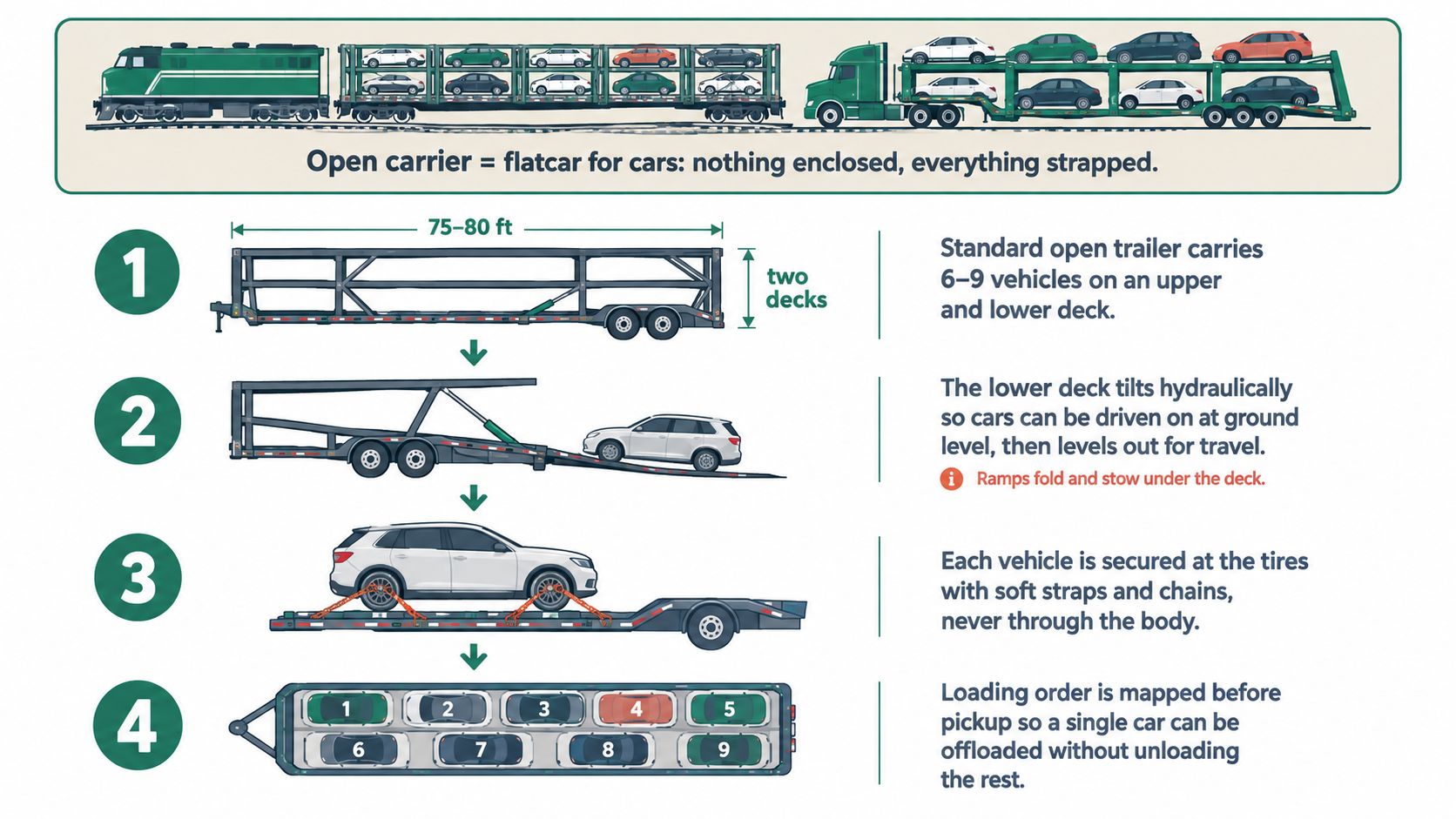
Open carriers make more sense once you stop thinking of them as “just a truck” and start thinking of them like a freight train for cars. Each vehicle has a slot. The driver plans the order carefully. The whole load has to stay balanced and unload in a practical sequence.
How the trailer is built
Most open auto haulers use a two-level open-air trailer. The lower level can tilt and shift to create loading angles, and the upper level is reached by ramps. Industry explainers consistently describe this setup as carrying about 7 to 10 vehicles per trip, depending on the mix of sedans, SUVs, and pickups, with the open design leaving each vehicle exposed to weather, dust, and road debris during transit (Extra Space comparison of open and enclosed car transport).
A load with compact sedans may fit more units than a load filled with taller SUVs or longer trucks. The trailer isn't packed by simple counting. It's packed by height, length, weight, turning clearance, and delivery order.
What loading day usually looks like
At pickup, the driver doesn't just line up cars randomly.
A typical sequence looks like this:
- Route order comes first. The driver loads vehicles in an order that makes later drop-offs possible without constantly unloading the whole trailer.
- Lower deck vehicles often go on first. The rear section tilts so the driver can drive or winch vehicles onto the trailer.
- Upper deck vehicles are placed after that. Ramps raise the car into position on the second level.
- Each vehicle is secured at the tires. The goal is to hold the vehicle firmly without stressing body panels.
A non-running car may still ship, but it usually needs special handling because the driver may need a winch and a favorable deck position.
A good loading plan protects both your car and everyone else's. The safest load is the one the driver can secure tightly and unload in the right order.
Why paperwork matters before the wheels roll
The physical loading process is only part of the job. The other part is matching the vehicle to the right carrier and documenting its condition. That's why many experienced shippers check VIN details and title status before pickup, especially on recently purchased used trucks or SUVs. If you bought a Toyota pickup online, it can help to verify a Tacoma's title before the truck is dispatched so there aren't ownership or record surprises at handoff.
That's especially useful for online purchases, auction buys, and dealer trades where the person releasing the vehicle may not be the eventual registered owner.
Pricing, Transit Times, and What Drives Both
The best way to read an open transport quote is to compare it against route length, not against a single national average. A short move and a coast-to-coast move don't behave the same way in dispatch.
Published pricing comparisons describe many short open moves around $400 to $800, longer routes around $1,000 to $1,500, and many cross-country shipments in the roughly $550 to $1,200 range depending on lane conditions, while also noting that open service is commonly 30% to 60% less expensive than enclosed transport (Sakaem Logistics on open vs enclosed auto transport).
A practical benchmark table
| Route Length | Typical Total Cost | Transit Time | Price Per Mile |
|---|---|---|---|
| 0 to 500 miles | $400 to $800 | 1 to 3 days | Varies by route |
| 1,000 to 2,500+ miles | $1,100 to $1,600 | 6 to 9 days | Varies by route |
| Cross-country routes | Often near $1,300 to $1,500 | Commonly within long-route windows | Varies by route |
Transit timing for open transport is commonly described this way under normal conditions: 0 to 500 miles in 1 to 3 days, 500 to 1,000 miles in 3 to 5 days, and 1,000 to 2,500+ miles in 6 to 9 days (route and timing guidance for open transport).
Why one quote is higher than another
Two routes can be the same mileage and still price differently.
Common reasons include:
- Route popularity. Major metro lanes usually attract more carrier traffic.
- Vehicle size. A full-size pickup takes more room than a compact sedan.
- Seasonality. Busy relocation periods can tighten truck space.
- Pickup difficulty. Rural detours can cost more than meeting near a standard corridor.
- Scheduling urgency. A flexible pickup window usually gives dispatch more options.
Industry summaries also note that open transport is broadly available nationwide and easier to schedule than enclosed because it handles roughly 90% of shipments and has much wider carrier coverage (Car Shipping Explained on open car transport).
How to judge a quote calmly
If your quote falls inside a normal published range, that doesn't guarantee it's the right booking. You still want to ask what's included, how pickup timing works, and whether the route is a common corridor or a more difficult assignment.
For people who want a managed option instead of calling around, National Car Transport is one example of a U.S.-based provider that coordinates open shipping across the mainland and Puerto Rico through a network of 25,000+ vetted carriers, with 25+ years of experience, an A+ BBB rating, bilingual U.S.-based agents, and transparent flat-rate pricing. That kind of support can matter because no two shipments are exactly alike, especially for military moves, student relocations, snowbird schedules, dealership transfers, or mixed truck-and-port routes.
Open vs Enclosed Transport and Who Should Pick Each
Most people don't need a luxury-level shipping method. They need the right method for the vehicle they own.
That's where the choice gets simpler. Open and enclosed transport solve different problems.
Side-by-side comparison
| Factor | Open Transport | Enclosed Transport |
|---|---|---|
| Exposure | Vehicle is exposed to weather, dust, and road grime | Vehicle rides inside a covered trailer |
| Capacity | Usually 7 to 10 vehicles per load | Usually fewer vehicles per load |
| Price | Lower-cost option in most lanes | Commonly costs more |
| Availability | Easier to schedule on many routes | Fewer trailers available |
| Best fit | Daily drivers, leased cars, SUVs, pickups | Classics, exotics, fresh paint, specialty vehicles |
When open makes sense
Open transport is usually the rational choice when the vehicle is a normal-use car and the owner wants a practical balance of cost and convenience.
That includes:
- Daily-driver sedans: Commuter cars and family vehicles usually fit open transport well.
- SUVs and pickups: These are common freight for open carriers.
- Leased vehicles: Most lessees care about documented condition and cost control.
- Student and relocation moves: Budget often matters more than premium shielding.
- Dealer and fleet units: Open hauling matches the way mainstream inventory commonly moves.
When enclosed is worth paying for
Some vehicles justify a more protective setup.
Choose enclosed if any of these sound like you:
- Collector ownership: The vehicle is rare, show-ready, or irreplaceable.
- Fresh cosmetic work: New paint, bodywork, or wrap protection matters more than price.
- Low-clearance concerns: A specialty car may need gentler loading angles.
- You don't want surface exposure: Some owners would rather pay more than accept weather or road grime.
If you're weighing that upgrade, it helps to review an actual enclosed-service option such as enclosed auto transport so you can compare service style, not just price.
If road dust would annoy you but not truly upset you, open transport is usually fine. If even minor cosmetic exposure feels unacceptable, enclosed is the safer fit for your peace of mind.
What Happens at Pickup, in Transit, and at Delivery
Most stress in car shipping comes from not knowing what the handoffs look like. The process becomes much easier once you know where your job is to pay attention.
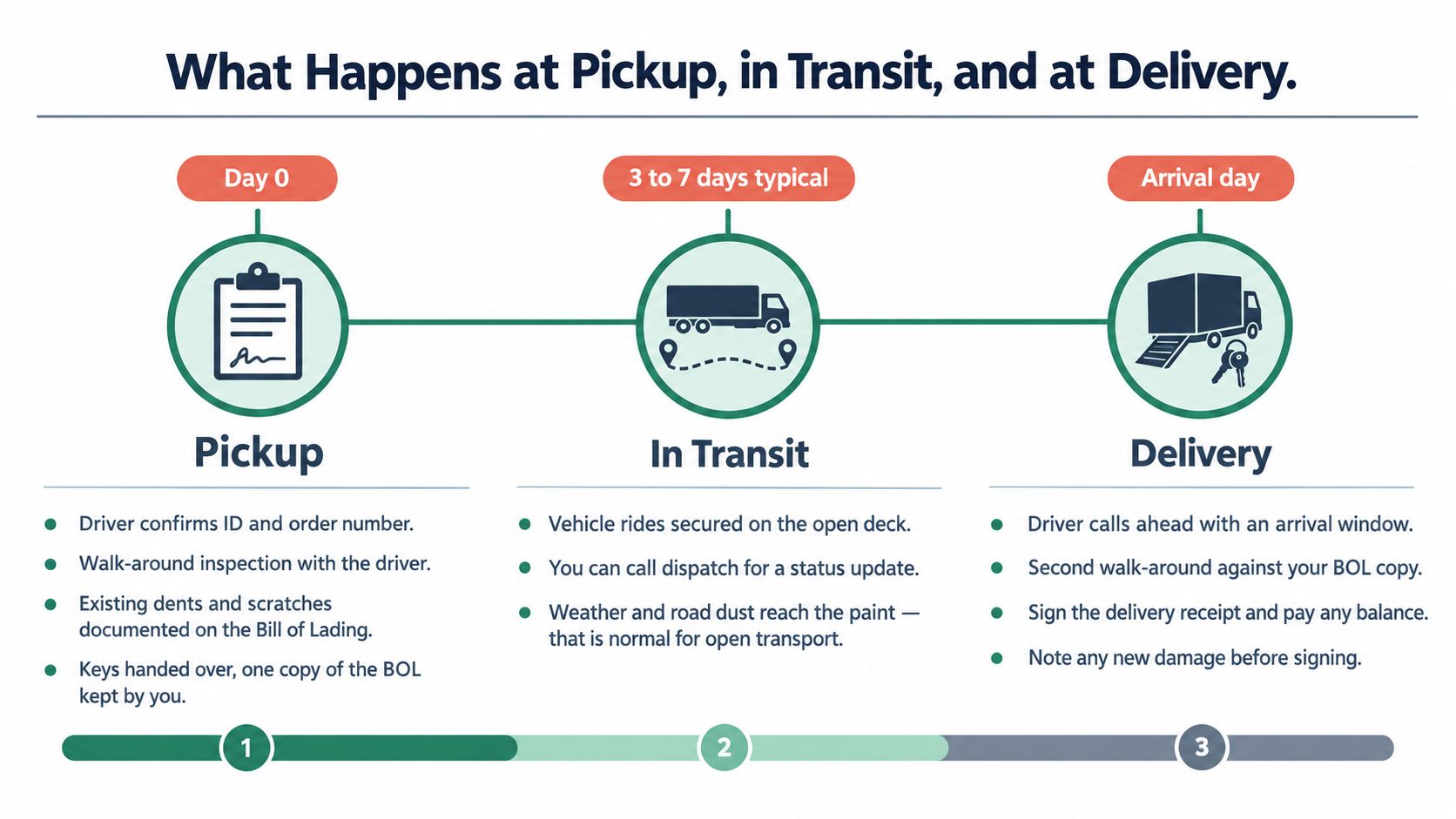
Pickup day
The most important part of pickup is the inspection.
You and the driver walk the vehicle together and note visible condition on the Bill of Lading. That includes scratches, dings, cracked trim, or existing bumper scuffs. Then you hand over the keys and keep your copy of the signed paperwork.
Use a wide, safe location if your street is tight or crowded. A shopping center edge, large parking lot, or broad side street is often easier for a long hauler than a narrow residential block.
What transit really feels like
In transit, open transport is less like parcel tracking and more like scheduled freight. You may not get live map-based tracking, and that's normal.
Instead, communication usually happens through dispatch and driver check-ins. Routes can shift because of weather, traffic, legal driving-hour limits, and the order of pickups and deliveries. If your shipment uses door-to-door auto transport, that usually means as close to your address as a full-size carrier can safely and legally reach, not always directly in front of the house.
A small delay doesn't always mean a problem. It often means the carrier is adjusting the route to complete the load safely.
Delivery and final inspection
Delivery works best when you treat it like pickup in reverse.
Before signing off:
- Inspect in daylight if possible: Dirt can hide marks at night.
- Use your Bill of Lading copy: Compare the vehicle against the original notations.
- Look before washing: You want to distinguish fresh condition issues from removable grime.
- Note concerns immediately: If something appears new, write it on the delivery paperwork before signing.
Consumer-oriented guides often miss this distinction, but it matters. In open transport, cosmetic exposure such as dust or rain spotting is different from actual transport damage, and that's one reason documentation matters so much in claims conversations (Car Haul Direct on open transport and the consumer information gap).
Shipping to and from Puerto Rico on Open Carriers
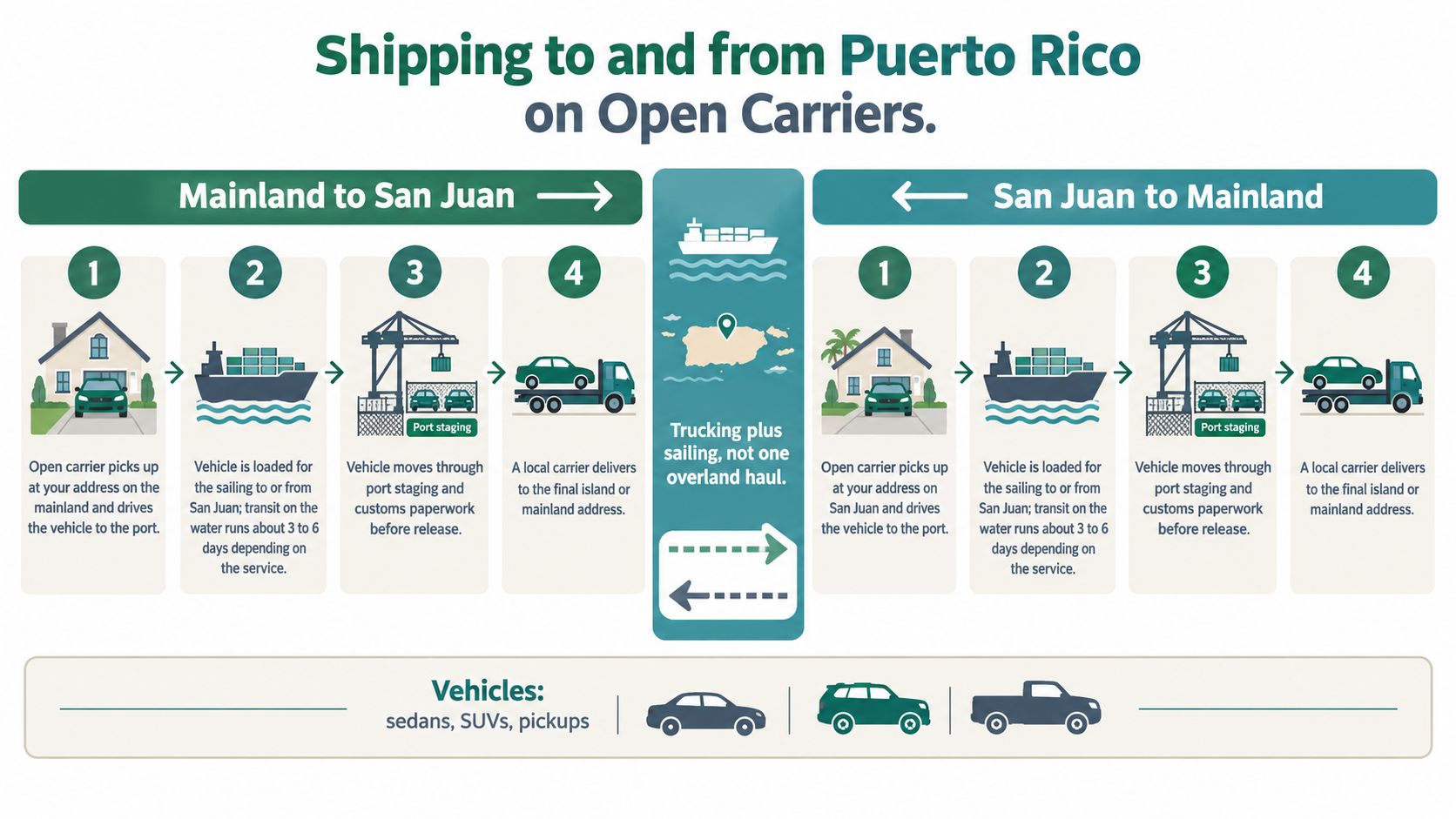
Puerto Rico moves are where many people assume auto transport works just like any other domestic route. It doesn't. A shipment to or from San Juan is not one continuous overland trip. It's a combined truck-plus-ocean move with separate paperwork and separate handoff points.
How the mainland-to-island route works
For a Puerto Rico shipment, the open-carrier part usually handles the mainland side pickup or delivery. The vehicle then moves through an ocean leg before final release or onward delivery.
That means your route has separate stages:
- Mainland pickup by truck
- Port processing and staging
- Ocean transport to or from San Juan
- Final release or local delivery
Published Puerto Rico guidance stresses that these shipments involve mainland-to-island ocean logistics and specific documents including the vehicle title and registration, and that the route requires distinct planning rather than being treated like a standard overland move (Puerto Rico car shipping guidance).
What paperwork usually matters
Island routes are document-sensitive. Small mistakes can slow release.
You should expect to confirm items such as:
- Ownership records: Title and registration need to match the shipment details.
- Lienholder approval if applicable: Financed vehicles may need added authorization.
- Bill of Lading: This tracks the truck handoff condition and movement.
- Ocean documents: The water segment uses separate port paperwork.
If you're moving from Orlando, Houston, Atlanta, Charlotte, Philadelphia, Los Angeles, Phoenix, Chicago, or another mainland market into San Juan, ask early who is handling each leg and which documents must be ready before the port accepts the vehicle.
What surprises first-time Puerto Rico shippers
The biggest surprise is usually that shipping quotes don't cover every government charge connected to the island side.
Puerto Rico shipping guidance notes a separate excise tax paid to Puerto Rican authorities that is not included in shipping quotes. That's one reason buyers and relocating families should ask for a full breakdown before booking, especially when comparing mainland quotes with island-route quotes (National Car Transport Puerto Rico car shipping information).
Salt air and humidity are also real factors in any ocean-linked movement. For standard-use sedans, SUVs, and pickups, that's usually a manageable exposure issue rather than a reason to avoid the route. Still, it's wise to remove personal items, keep the vehicle clean enough for inspection, and document condition thoroughly before the mainland handoff.
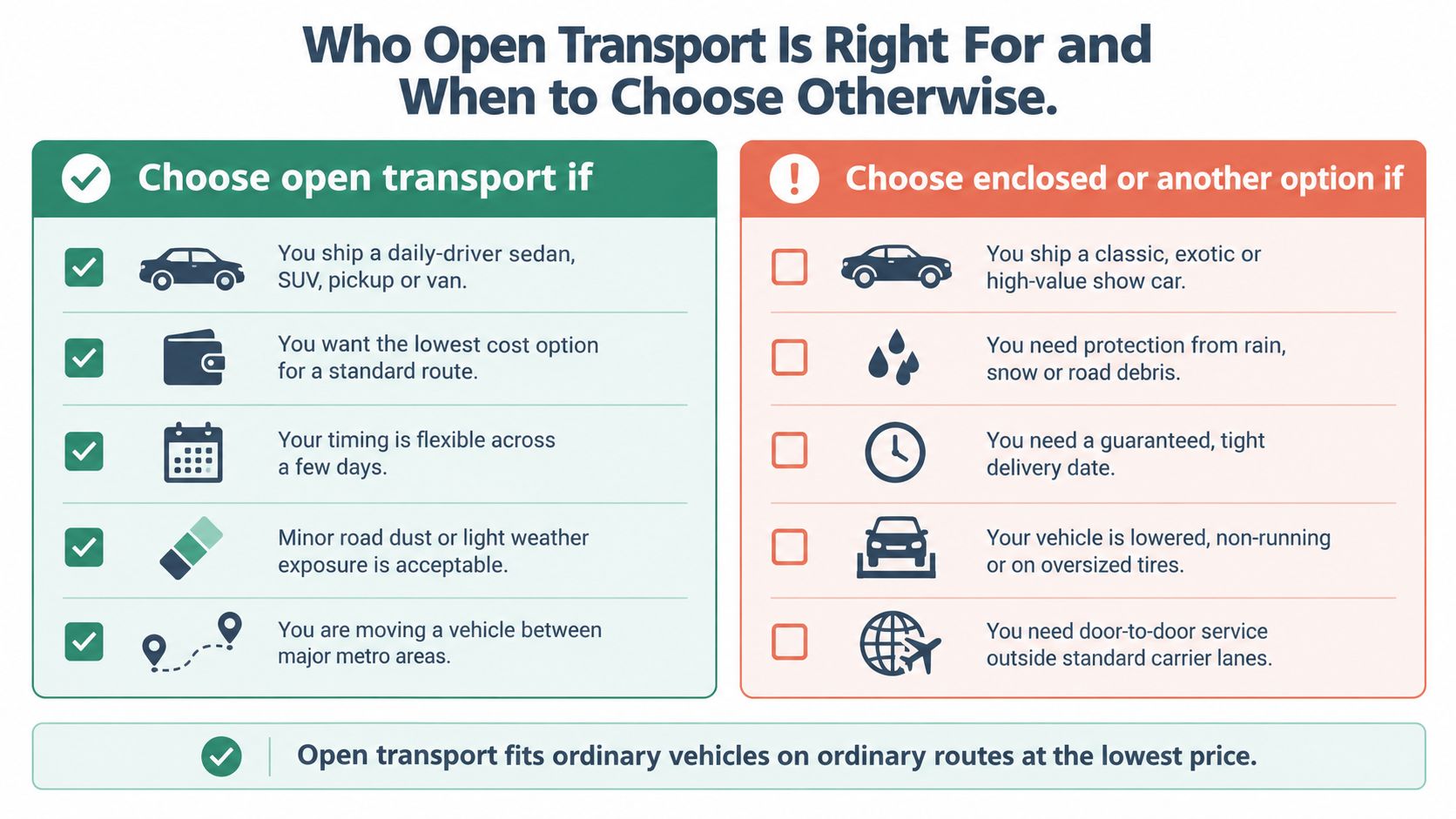
Who Open Transport Is Right For and When to Choose Otherwise
By the time most finish comparing options, the right answer is usually clearer than they expected.
Open transport is usually right for
Open transport fits people shipping normal vehicles on common routes. That includes everyday sedans, family SUVs, pickup trucks, leased vehicles, fleet units, student cars, and most relocation moves between major cities in the lower 48 states.
It's also the format many snowbirds, military families, and businesses choose because the network is broad and scheduling tends to be more practical than with specialty trailers.
Choose another option if these triggers apply
You should pause on open transport if your situation involves one of these concerns:
- The vehicle has unusual value: Classics, exotics, and collector cars often justify enclosed service.
- The finish is unusually sensitive: Fresh paint, custom bodywork, and wraps deserve extra caution.
- The car sits very low: Loading angle becomes more important with low-clearance setups.
- Your tolerance for cosmetic exposure is near zero: If rain, dust, or road film will bother you, enclosed may save stress.
Booking checklist
Before you commit, slow down and check the basics:
- Carrier authority: Confirm the transporter or broker is properly registered.
- Insurance clarity: Ask what the cargo policy covers and what inspection steps support a claim.
- Recent reviews: Look for patterns in communication, not just star ratings.
- Payment terms: Be cautious with any company demanding unusual upfront wire payments.
- Human support: If your route is unusual, especially to or from Puerto Rico, it helps to work with a U.S.-based bilingual agent who can explain the sequence in English or Spanish and keep the process simple.
A calm booking process is often a sign of a competent one.
If you want help matching your vehicle and route to the right shipping method, National Car Transport handles open car shipping across the mainland U.S. and Puerto Rico with bilingual U.S.-based agents, transparent flat-rate pricing, and guidance from pickup inspection through final delivery. For first-time shippers, that kind of support can make open transport much easier to understand, especially when the move involves San Juan, a military relocation, a student vehicle, or a dealership transfer.