

Nearly one in three shippers, 29%, reported experiencing transportation fraud during the past three years. The two most common patterns were ghost carriers and double brokering, so the safest approach is to verify the company, payment process, and assigned carrier before you release money or your vehicle.
Car transport scams aren't isolated deposit tricks anymore. They exploit the way vehicle shipments are quoted, assigned, paid for, and handed between companies. That affects a family relocating across the country, a snowbird moving between homes, a military household changing duty stations, a student shipping a car to campus, and businesses moving inventory between dealerships, auctions, ports, and customers.
The practical rule is simple: don't judge a shipper by its website or quote alone. Confirm who you're hiring, who will physically move the vehicle, what the paperwork says, and how you can recover funds if the transaction turns fraudulent.
Table of Contents
- Car Transport Scam Rates and Structural Risk in the US
- Common Types of Auto Shipping Fraud
- Red Flags and Warning Signs to Watch For
- Low Quotes Scam or Market Pressure
- What to Do If You Become a Victim
- How to Choose a Trusted Auto Transport Provider
- Frequently Asked Questions About Vehicle Shipping Fraud
Car Transport Scam Rates and Structural Risk in the US
A 2026 vehicle transportation industry report found that 29% of shippers reported transportation fraud in the past three years. Fraud is therefore an operating risk for dealerships, auctions, OEMs, and individual consumers. The same report identified ghost carriers at 53% and double brokering at 47% as the most common patterns. Shippers using brokers or load boards were 72% more likely to report fraud than those working directly with carriers or through direct-to-carrier marketplaces, according to the vehicle transportation fraud report.
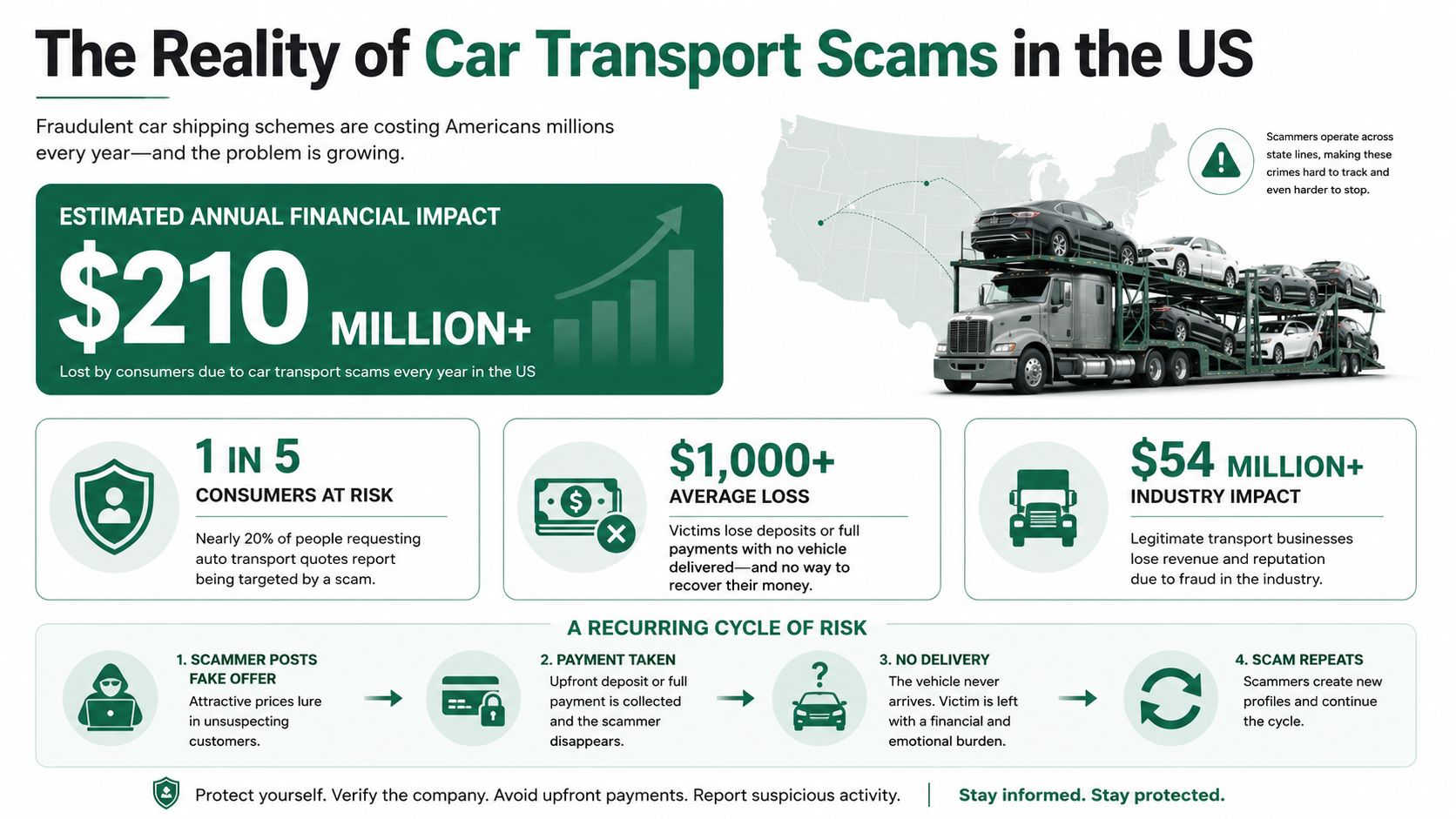
These figures expose a structural weakness in vehicle logistics: every undisclosed handoff reduces the customer's control. A ghost carrier can collect a deposit and disappear before dispatch. A double broker can accept the order, pass it to another broker or carrier, and leave the original shipper unsure about insurance, payment responsibility, pickup details, and liability.
Why the risk has expanded
Vehicle shipping operates within a broader theft and cargo-fraud problem. Confirmed cargo theft incidents rose 18% in 2025, while estimated losses increased 60% to nearly $725 million. Vehicle theft in the United States exceeded 1 million incidents in 2023, according to the vehicle transit theft and cargo fraud analysis. That environment gives criminals more ways to disguise a fraudulent shipment as routine transportation.
Scammers copy company identities, take over accounts, create fake carrier credentials, and send convincing tracking updates. A vehicle may be collected, yet the party arranging the move may have no authority over delivery. Payment diversion, vehicle misrouting, false damage claims, and extortion can follow.
Practical rule: Treat every handoff as a verification event. A familiar company name does not prove that the person calling, invoicing, or dispatching your vehicle represents that company.
Established providers reduce this exposure by confirming carrier authority, checking insurance, documenting each assignment, and keeping the customer informed when responsibility changes. Before release, require the legal company name, contact details, carrier information, payment recipient, and written pickup instructions. After a suspected scam, preserve contracts, messages, invoices, payment records, tracking data, and photographs. Notify your bank or payment service immediately, report the conduct to the relevant authorities and platforms, and contact the insurer and every company named in the paperwork. Do not send additional money to recover the vehicle without independent verification.
This applies across the 48 contiguous states, including major routes between New York, Chicago, Los Angeles, Houston, Miami, Denver, and Seattle. It also applies to mainland shipments to San Juan, Puerto Rico, where port schedules, export documents, ocean transport, and local delivery create more handoff points. Know which company controls the shipment at every stage.
Common Types of Auto Shipping Fraud
The two dominant schemes look different, but both depend on a customer losing visibility.
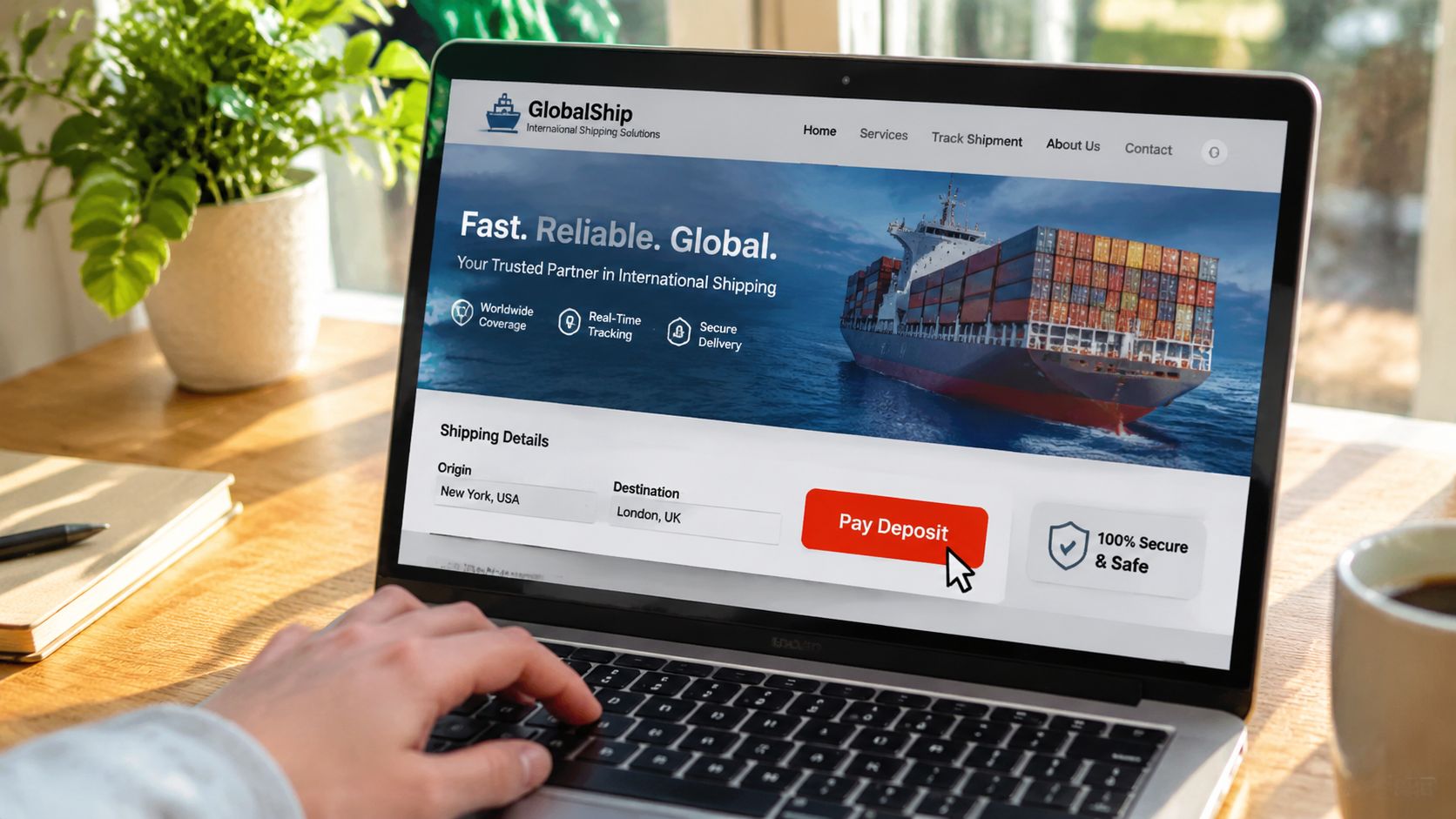
A ghost carrier presents itself as a legitimate transporter or shipping company. It may provide a quote, request a deposit, send a confirmation, and then stop responding. No truck may ever be assigned. In other cases, the operator uses a real company's name or branding to appear established, collects payment, and vanishes before the vehicle enters legitimate transportation operations.
Double brokering is more complicated. A broker accepts the shipment, then passes it to another broker or carrier without clearly telling the customer. Passing a shipment to a properly authorized carrier isn't automatically fraudulent, but undisclosed reassignment becomes dangerous when the customer can't verify the new party, the payment recipient, insurance coverage, or the person holding the vehicle.
How the schemes differ
| Scheme | What the customer sees | Main danger |
|---|---|---|
| Ghost carrier | A polished quote and booking confirmation | The operator takes money without arranging real transport |
| Double brokering | A booking that moves to an unfamiliar company | The customer loses control over assignment, payment, and liability |
| Bait and switch | An unusually attractive price followed by new charges | The scammer gains leverage after the customer is committed |
| Identity impersonation | A real company's name, logo, or contact details | Payment goes to an impostor rather than the legitimate business |
Consider a common warning scenario. You book a company that looks reliable, receive a dispatch message, and then an unknown driver arrives in a truck connected to a different entity. That driver might be legitimate, but you shouldn't assume so. Compare the driver's company name, insurance information, vehicle details, and bill of lading with your booking records before releasing the car.
For additional industry perspective, Mai & Associates coverage insights can help readers understand how vehicle transportation businesses and related disputes are discussed. If your car needs extra protection, review the differences between standard and enclosed auto transport, especially for classic, luxury, collector, or high-value vehicles.
A legitimate assignment should leave a paper trail. You should know the carrier's legal name, the broker's role if a broker is involved, the pickup contact, the delivery contact, the agreed payment terms, and the inspection process. If the explanation changes every time you ask, stop the shipment until the facts match.
Red Flags and Warning Signs to Watch For
The most useful warning signs appear before payment, but you need to interpret them together. A low quote alone doesn't prove fraud. A low quote combined with pressure, vague credentials, changing payment instructions, and unclear carrier identity is a different matter.
Check identity before you pay
FMCSA requires brokers and carriers operating interstate to register. The agency also advises consumers to be suspicious when a website doesn't clearly identify whether it represents a broker or a transporter. Verify the company's FMCSA registration and MC docket number before paying by using the agency's consumer advisory on automobile transporters.
Use this checklist:
- Confirm the legal identity: The business name on the quote, contract, payment request, and website should align. Ask whether the company is acting as a broker, carrier, or both.
- Verify the MC docket number: Don't accept a number copied into an email without checking that it belongs to the company contacting you.
- Match contact details: Call a phone number obtained independently, and compare the address and company information with official records.
- Inspect the assignment: Before pickup, ask for the carrier's legal name and verify that the driver and truck correspond to the dispatch information.
- Review complaints: A complaint history deserves context, not automatic dismissal. Look at the nature of complaints and whether the company responded.
Listen for pressure tactics
Scammers want you to make a decision before you investigate. They may claim that a truck is leaving immediately, demand payment through an unusual channel, refuse to send a written contract, or say the price will disappear if you don't pay during the call.
A legitimate provider can explain the route, pickup window, payment schedule, cancellation terms, inspection process, and carrier assignment without becoming hostile. You should also be cautious when a company won't answer basic questions about insurance, its role in the shipment, or who will receive your payment.
If the company makes verification difficult before booking, the shipment won't become safer after booking.
Keep records of every quote, text, email, invoice, and phone number. A professional company should also explain what happens if the vehicle can't reach the exact address, if the pickup location has access restrictions, or if the shipment involves a port or ocean leg. Clarity is a security feature, not a luxury.
Low Quotes Scam or Market Pressure
A low quote can reflect legitimate market pressure. Route availability, seasonal demand, vehicle size, pickup flexibility, open or enclosed equipment, and the distance from the carrier's existing route all affect a genuine price. A truck already traveling through your area may cost less than a provider arranging a special dispatch.
The danger begins when the quote is bait. A ghost carrier may pose as a real transporter, collect your deposit, then disappear. In another common setup, a broker accepts the job at an impossible price and double-brokers it to a carrier that was never identified in your agreement. Once pickup is scheduled, the customer faces a higher demand, a different carrier, or a vehicle held until more money is paid.
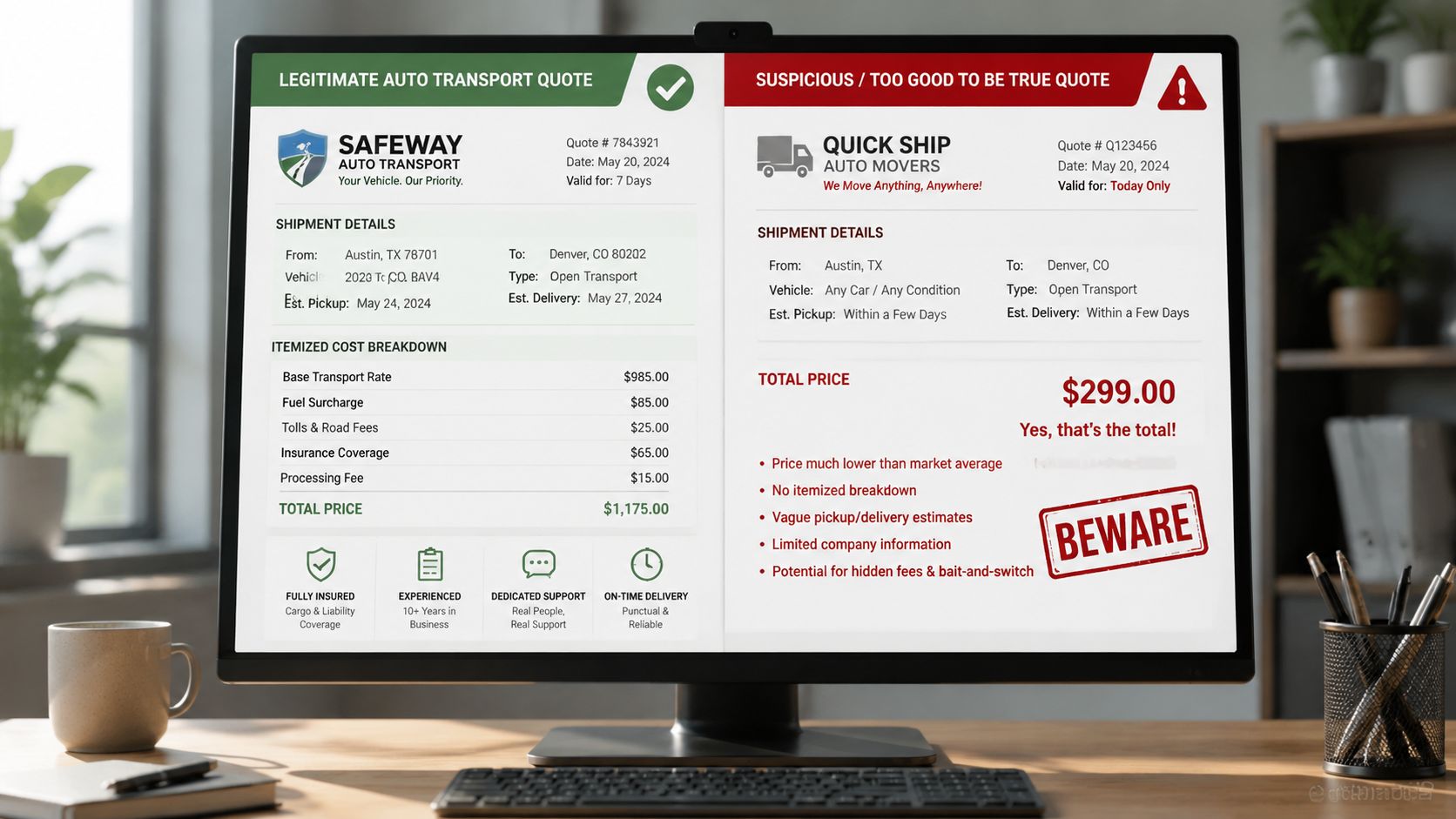
Treat an unexplained increase as a control failure, not a normal adjustment. Established providers reduce this risk by identifying the contracted business, disclosing their broker or carrier role, confirming the assigned carrier, and keeping payment terms tied to written conditions.
Use a transparency test
Ask four questions before accepting a low quote:
- What does the price include? Get the transport type, vehicle condition, route, pickup terms, delivery terms, and known access or port charges in writing.
- Who receives payment? The recipient should match the contracted business or be clearly identified in the agreement.
- When can the price change? Require specific written conditions. “Market adjustment” is not a blank check.
- Who controls the shipment after pickup? Obtain the carrier's legal identity and a direct contact before the vehicle leaves.
Compare the structure, not only the total. An itemized quote with clear responsibilities is safer than a low figure with missing terms. Use this car shipping cost guide to understand ordinary pricing factors, then ask each provider to explain its difference.
If a scam has already begun, stop negotiating by phone alone. Save the quote, contract, payment records, messages, carrier details, and revised invoices. Contact the legitimate broker or carrier through independently verified information, then dispute unauthorized charges with your payment provider and report the conduct to the relevant authorities. Do not pay an escalating demand just because the vehicle is being held.
What to Do If You Become a Victim
Act quickly and preserve evidence. A transport scam can begin with a deposit, emerge through a fake carrier assignment, or become extortion after pickup. FMCSA and the FBI direct victims toward immediate reporting because fast action can preserve records and interrupt fraudulent payment flows. BBB has also warned that internet vehicle-shipping schemes may use third-party handling stories to make a transaction appear legitimate, as described in the FBI warning about moving extortion fraud.
First, secure the shipment and evidence
Don't send additional money because the caller threatens delay, storage, cancellation, or abandonment. Save the original quote, contract, bill of lading, payment confirmation, bank details, emails, text messages, call logs, voicemail, website screenshots, driver information, license plate details, and every revised invoice.
If the car has been picked up, contact the legitimate broker or carrier through contact information you found independently, not through the suspicious message. Ask for the vehicle's current location, driver identity, insurance information, delivery plan, and any active bill of lading. Notify your insurer if the vehicle is missing, damaged, or being held for an unexplained payment.
Then notify payment providers
Contact your credit card issuer, bank, or wire service immediately. Explain that the transaction involves suspected fraud, provide the contract and communications, and ask about a dispute, chargeback, recall, or payment freeze. Use traceable payment records, and don't delete or alter anything while the financial institution investigates.
Your bank may not reverse every payment, but waiting reduces your options. Ask for a case number and written instructions for submitting evidence. If your account or card details may have been exposed, ask whether you need replacement credentials or additional monitoring.
Report through the right channels
File reports with:
- The FBI: Use the FBI's reporting channels when the conduct involves interstate fraud, identity impersonation, extortion, or a missing vehicle.
- FMCSA: Report suspected unauthorized interstate transportation activity, false carrier identity, or broker misconduct.
- BBB: Submit a complaint and preserve the company's public record for future customers.
- Local law enforcement: File a police report if the vehicle, funds, title documents, or personal information were taken.
- Your insurer: Notify the insurer promptly when the vehicle is missing, damaged, or involved in a disputed transport event.
Write a concise timeline with dates, names, amounts, promised services, pickup events, and payment instructions. Don't exaggerate or speculate. Clear documentation helps investigators, banks, insurers, and legitimate transportation companies separate a service failure from deliberate fraud.
How to Choose a Trusted Auto Transport Provider
Choose the provider that makes its process easy to verify. A credible company should clearly explain whether it is a broker or carrier, provide registration information, identify the party moving the vehicle, document pickup and delivery, and disclose payment terms before you commit.
Experience matters because auto transport is route-specific. A move from Boston to Phoenix differs from a shipment between Dallas and Miami, and both differ from a mainland route to San Juan, Puerto Rico. The same is true for a dealership transfer, military relocation, student move, snowbird shipment, auction purchase, classic car, or business fleet. No two vehicle transports are alike.
Look for these operating markers:
- A verifiable history: Check the company's BBB profile, complaint responses, reviews, registration, and contact details.
- Transparent pricing: The quote should state what the price includes and explain any circumstances that could change it.
- Carrier visibility: You should receive the assigned carrier's identity before pickup, not after the vehicle disappears into the network.
- Practical support: A dedicated advisor should answer questions about access, documents, inspection, payment, and delivery.
- Suitable equipment: Open transport may suit ordinary vehicles, while enclosed equipment can make sense for valuable or delicate cars.
One BBB listing for an auto transport company documents 4 total complaints in the last 3 years and includes a customer statement alleging it was a scam, illustrating why consumers should review public dispute records before paying. See the BBB complaint record and evaluate the actual responses rather than relying on a badge alone.
For interstate brokers, FMCSA registration requirements include Unified Registration System authority, a $300 non-refundable application fee, a $75,000 surety bond or trust fund agreement, and Form BOC-3 process-agent filing, as outlined by FMCSA broker registration requirements. Those requirements don't replace your own checks, but they give you concrete legitimacy markers to verify.
For Puerto Rico, a provider should also explain port and document requirements. Shipping instructions may involve the title and registration, proof of ownership, lien release if financed, a Puerto Rico DMV certificate showing no fines due, a $10 export voucher, car-wash receipt, police motor-vehicle export certificate, ACAA no-debt certificate, and an original affidavit authorizing shipment, according to the Puerto Rico vehicle shipping instructions.
Frequently Asked Questions About Vehicle Shipping Fraud
What documents may Puerto Rico shipping require? Expect vehicle ownership documents, registration, lien release when applicable, Puerto Rico DMV clearance, the export voucher, car-wash receipt, police export certificate, ACAA certificate, and an original shipment affidavit. Confirm the current list with your provider.
Are mainland shipments to Puerto Rico treated like international exports? Customs inspections aren't required for shipments to the U.S. mainland, while international destinations such as the U.S. Virgin Islands require inspection in Guaynabo, Puerto Rico, according to Crowley's document guidance.
How do I verify the pickup driver? Match the driver's identity, truck, company name, carrier details, and bill of lading against your booking before handing over the keys.
What should I do with a suspiciously high quote? Request an itemized explanation in writing. Don't authorize extra payment after pickup unless the change is documented, legitimate, and independently verified.
National Car Transport provides door-to-door auto shipping across the United States and Puerto Rico, including open, enclosed, container, and ocean transport options. Visit National Car Transport to request transparent flat-rate pricing and speak with a U.S.-based bilingual English/Spanish agent with more than 20 years of auto transport logistics experience, backed by 25+ years in the industry, an A+ BBB rating, and a network of 25,000+ vetted carriers.