
Shipping a car between the U.S. mainland and Puerto Rico is safe when three conditions hold at the same time: the carrier has active federal operating authority and cargo insurance, the vehicle's condition is documented with dated photos and a signed condition report, and the title, ID and arbitrios paperwork are complete before the ship loads. Miss any one of those and the exposure isn't the Atlantic, it's the hole in your own file. The ship, the salt air and the San Juan terminal are routine freight work that carriers handle every week. The failures that happen on this lane are quieter and entirely preventable: a broker who never names the actual carrier, a walkaround nobody photographed, a tax bill discovered at release.
Table of Contents
- Is It Safe to Ship a Car to or From Puerto Rico?
- The Five Safety Layers of Island Car Shipping
- How to Vet a Car Shipping Company
- Insurance, Inspections and Proof of Condition
- Choosing Open, Enclosed or Container Transport
- Documents, Hacienda and the Arbitrios Tax
- Special Cases That Change the Safety Checklist
- Book Your Puerto Rico Car Shipment With Confidence
Is It Safe to Ship a Car to or From Puerto Rico?
The clearest way to size the risk is to compare it with the one you'd take by driving. NHTSA recorded 22,713 passenger-vehicle occupants killed in U.S. traffic crashes in 2024, down 5% from 24,017 in 2023, according to NHTSA's 2024 fatal crash data. That is the risk pool a long relocation puts you in when you put those highway miles under your own right foot. Hand the car to a licensed hauler and those miles belong to a commercial driver with a medical card, an hours-of-service log, an inspection file and a policy behind the load.
The route itself is simple. A truck collects the car in any of the 50 states, runs it to a mainland port, Jacksonville most often with Philadelphia also serving the lane, and the vessel delivers to the Port of San Juan. A local driver then brings it to your address in San Juan, Bayamón, Caguas, Ponce or wherever you're landing. Two handoffs, one ocean leg, one document set.
The ocean leg is the part customers worry about and the part that rarely fails. The handoffs are where cars actually get hurt.
Four things cause nearly every bad outcome on this lane: an unvetted carrier whose authority or insurance has lapsed, missing photos that make a damage claim unwinnable, personal items left in the car that the ocean carrier refuses at the gate, and unpaid arbitrios that leave the vehicle sitting at release while the tax gets sorted out.
It doesn't matter whether you're relocating for a job, heading south for the winter, moving on PCS orders, shipping a car home from college or sending dealer inventory to the island. The five layers below, followed by vetting, inspection, transport choice and tax, are the entire process.
The Five Safety Layers of Island Car Shipping
Every mainland-to-island shipment runs through five layers, and a car is only as safe as the weakest one. See them side by side before you book anything.
| Safety layer | What it protects against | What you should verify |
|---|---|---|
| Licensed, insured carrier | Unvetted or underinsured operators | Active MC/DOT number and a certificate of cargo insurance |
| Cargo securement | Shifting under braking, cornering and bumps | Front-and-rear restraint with at least two tiedowns |
| Condition documentation | Unprovable damage disputes | Dated photos and a signed condition report at pickup and delivery |
| Port-ready vehicle | Port rejection and clearance delays | Empty car, low fuel, working keys, no leaks |
| Tax and import paperwork | Hacienda holds and surprise costs | SURI arbitrios estimate, title, ID and invoice |
Where the chain breaks
Layer two deserves the technical detail because it's the one you can inspect with your own eyes at the load. Under 49 CFR §393.128, automobiles, light trucks and vans weighing 10,000 lb (4,536 kg) or less must be restrained at both the front and the rear with at least two tiedowns, holding the vehicle against lateral, forward, rearward and vertical movement. Those four directions aren't abstract. Braking pushes the car forward, cornering slides it sideways, road undulations lift it, acceleration drags it back.
Rated wheel nets and factory-approved mounting points do that work. Hooks improvised around a control arm, a tie rod or an exhaust hanger do not, and that shortcut is the one to look for before you sign. Vehicles above 10,000 lb, meaning heavy SUVs, commercial trucks and specialty builds, fall under the heavier-vehicle securement provisions, so the light-vehicle rule isn't a pass for everything on the deck.
Layer four trips up more customers than any other. The car has to be empty of personal items when it sails to Puerto Rico, as required by the ocean carrier, so a trunk full of housewares becomes a problem at the gate rather than at delivery. Low fuel, working keys, no active leaks and no warning lights on arrival round it out.
Layer five is the one nobody researches until the car is already floating. Get a SURI arbitrios estimate in hand before the ship leaves, because the tax is calculated separately from freight and surprises people at release.
Weakest link: A fully insured carrier with sloppy documentation can still leave you losing a damage dispute. Safety lives in the paperwork as much as in the straps.
How to Vet a Car Shipping Company
The name on a Puerto Rico quote and the name on the bill of lading can split once the car is booked toward a vessel. An hour of checking, done before you pay, is what ties the company you called to the carrier who will have the keys.
Work the five checks in this order. Later ones are easy to fake if the first ones are skipped.
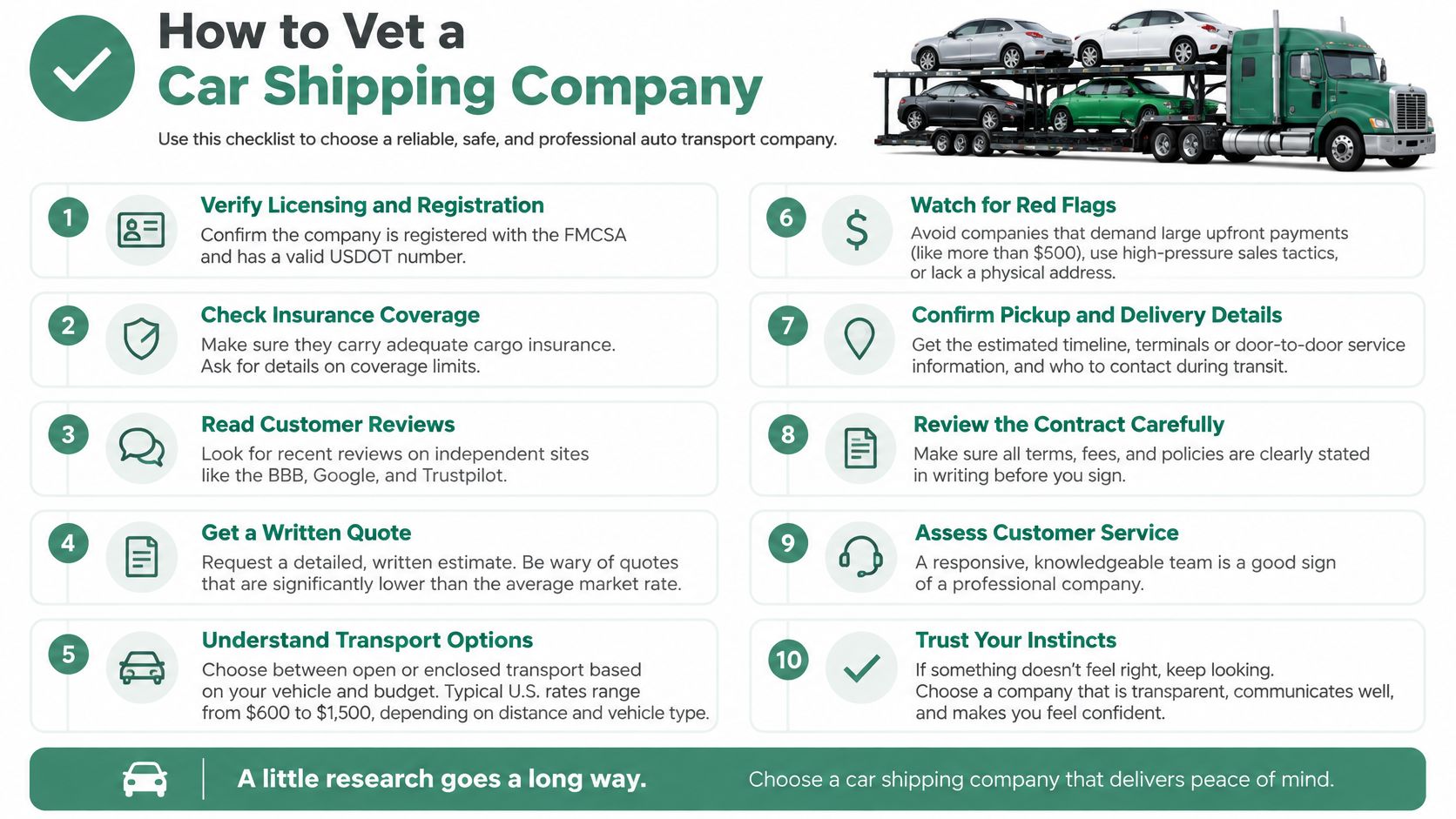
- Pull the MC/DOT number and confirm active authority. Every for-hire interstate carrier holds a motor carrier number and a DOT number, and both are searchable in FMCSA's public licensing systems. No number, no booking. The ocean leg still depends on a motor carrier with active authority for the U.S. move into the port.
- Verify insurance, then compare the limit to your car's value. For-hire property carriers moving non-hazardous cargo in vehicles rated under 10,001 pounds GVWR generally carry at least $300,000 in financial responsibility, and heavier or specialized operations face higher requirements, under the FMCSA insurance filing requirements. Ask for the certificate and read the limits yourself. That floor is comfortable for a ten-year-old sedan and thin for a restored muscle car or a late-model luxury SUV. I would not book a high-value car against only the minimum.
- Read the safety record, not the testimonial page. FMCSA's Safety Measurement System screens roadside inspection and state-reported crash data alongside recent investigation results. That history predicts how a carrier behaves better than any review carousel.
- Check reputation on your lane. A company with glowing reviews on Texas-to-Florida moves may never have booked a San Juan sailing. Ask how many island shipments they run in a month, and which departure port those cars use.
- Compare quotes for realism. The cheapest number usually means a carrier that gets replaced at the last minute, a fuel surcharge added later, or a terminal fee nobody mentioned. An island quote has vessel cost in it, so a price that looks like a short domestic haul is a warning, not a bargain.
The full sequence, condensed into a checklist you can work through while you're on the phone:
Red flags that should end the conversation
- A large cash deposit demanded before anything is scheduled. A deposit holds a slot. It should never be most of the bill, and it should never be cash.
- No DOT number, or a number that doesn't match the company name. Mismatches mean a broker fronting for an unknown hauler.
- A quote far below every competitor. On an island lane with real vessel costs, an outlier price is a signal, not a deal.
- Refusal to name the actual carrier. You're entitled to know who holds the keys.
- Vague answers about cargo coverage. "Fully insured" without a certificate and a claims procedure means nothing.
Authority, a certificate you have read, and a named carrier still have to line up before pickup. If you want the longer version of this process, read how to choose an auto transport company before you compare prices.
Insurance, Inspections and Proof of Condition
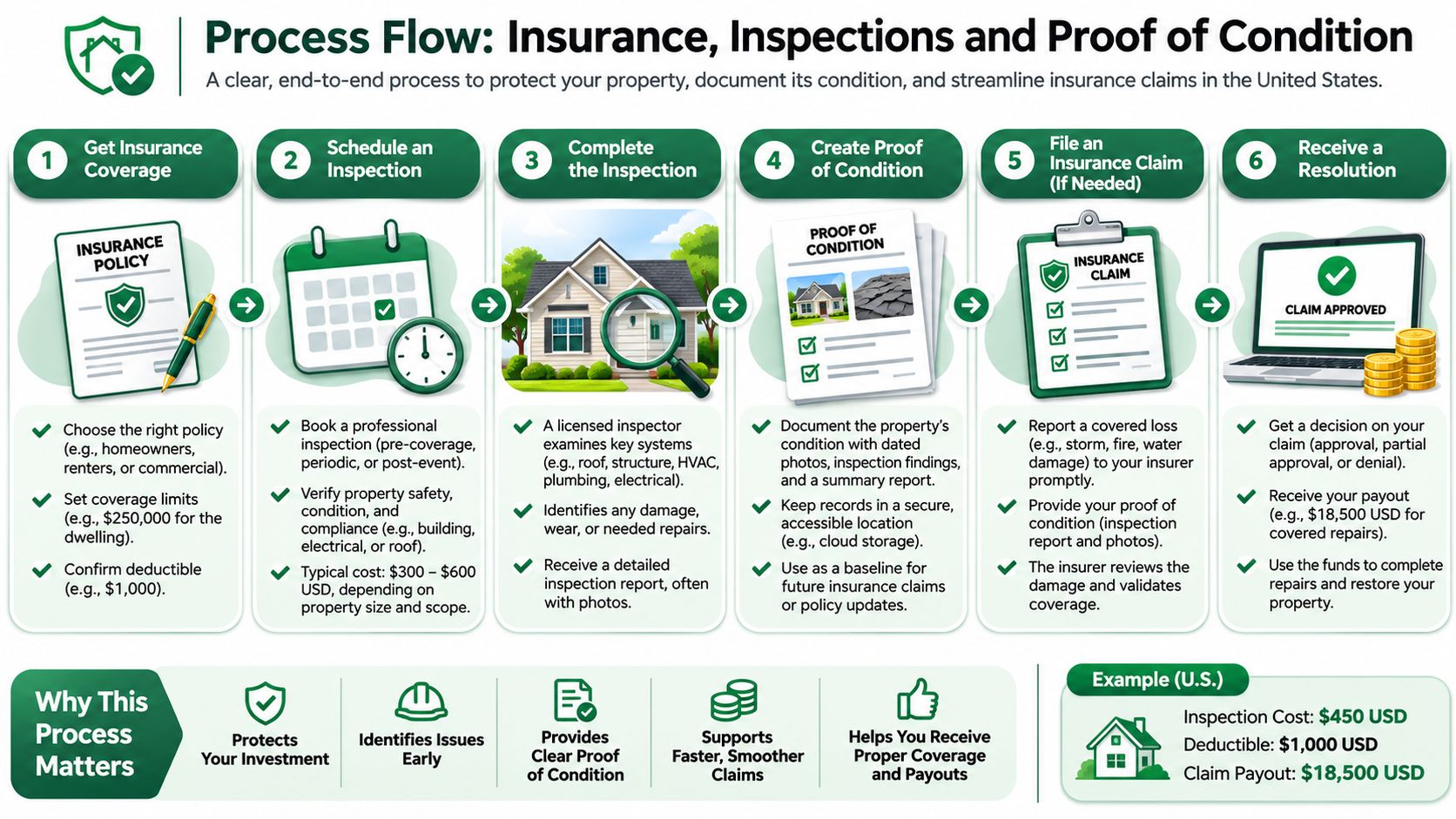
Cargo coverage on a Jacksonville to San Juan shipment pays only what the condition record can prove. The policy is the financial backstop. Dated photos and a signed bill of lading are what make that backstop usable after the ocean leg.
The carrier's cargo insurance is the primary coverage on the vehicle while it is in transit. A flat-rate quote includes that coverage rather than adding it after booking. Get the exclusion list in writing before pickup. Standard carve-outs are personal belongings left in the car, mechanical or electrical failure, pre-existing damage, flood damage, and battery defects. In the same conversation, ask for the claims procedure: who you call, and how many days you have to file.
Federal rules give you a second set of papers to request. Carriers must keep a motor-vehicle record for each driver, request an updated record at least every 12 months and retain it for three years, and commercial vehicles need a qualified inspection at least once every 12 months, as outlined in FMCSA's safety audit guidance. A carrier that cannot say when its equipment was last inspected is telling you the inspection layer is weak.
The walkaround that wins claims
- Wash the car the day before. Scratches and dents hide under road film, and a dirty car photographs badly.
- Shoot dated, high-resolution photos of all four sides, the wheels, glass, bumpers, roof and odometer.
- Strip the interior. Remove every personal item and loose accessory. The ocean carrier requires a Puerto Rico shipment to be empty of personal items, and leave the fuel low.
- Record existing damage on the bill of lading or condition report, and get the driver's signature at pickup.
- Repeat the identical walkaround at delivery, photographing the car again before you sign anything.
- Note new damage on the spot and file within the carrier's claim window, sending the dated photos and the signed bill of lading together.
I would not sign a clean delivery receipt if a new scrape is visible. A signature with no note says the car arrived as it left.
Non-running cars change the loading plan, not whether they can ship. Non-running classic cars can ship on winch-equipped enclosed trailers, but they must roll, steer and brake, and their condition must be declared at booking so the right equipment shows up. For how cargo coverage is written and how a claim is filed, see car shipping insurance.
Choosing Open, Enclosed or Container Transport
Every mainland-to-Puerto Rico shipment is multimodal, and that shapes the choice more than any brochure does. A truck carries the car between your address and the mainland port. The ocean leg runs between Jacksonville, FL (with Philadelphia, PA also serving the route) and the Port of San Juan. An island truck then delivers locally. You are buying three services stitched into one quote.
| Option | Protection level | Best for | Trade-off |
|---|---|---|---|
| Open carrier (road legs) | Exposed to weather and road debris | Daily drivers, SUVs, dealership inventory | Lowest cost and widest availability |
| Enclosed carrier (road legs) | Full cover from weather, debris and eyes | Classic, luxury, modified or low-clearance cars | Higher price and fewer carriers |
| Roll-on/roll-off ocean | Standard vessel deck securement | Most vehicles on the Jacksonville to San Juan route | Standard handling for the island leg |
| Ocean container | Vehicle blocked and braced inside a container | High-value cars wanting an extra layer | Extra handling, scheduling and cost |
Open transport is the method dealerships use to move new vehicles. It is the sensible default for a daily driver, a family SUV, or a batch of inventory. Enclosed adds full cover from weather, road debris, and prying eyes, usually with soft tie-downs and hydraulic loading. That is what a fresh paint job, a low-clearance build, or a collector car needs on the road legs. Roll-on/roll-off is the standard way cars cross to the island: the vehicle is driven on, secured to the deck, and driven off in San Juan. A container suits a high-value car when you want it blocked and braced inside its own steel box. You pay for the extra crane handling and a tighter sailing window.
The trailer type changes exposure. Securement holds the car. FMCSA cargo securement guidance requires the aggregate working load limit of the system to be at least one-half the weight of the cargo, so a 4,000 lb car needs 2,000 lb of aggregate working load limit before the vehicle-specific front-and-rear rule is even satisfied, per the FMCSA cargo securement rules. A tight-looking strap with the wrong rating fails under emergency braking, on an open trailer or inside a container.
The one-line version: A daily driver on a budget books open. A collector car, a modified build, or anything with fresh paint books enclosed. Either way, ask what the wheel straps are rated for.
For a closer side-by-side of the road options, read enclosed vs open car shipping.
Documents, Hacienda and the Arbitrios Tax
For a Puerto Rico vehicle shipment, the title, importer details, bill of lading and tax declaration need to identify the same vehicle and shipment. Prepare these documents before the car reaches the port:
- Certificate of title: The seller or owner must be named, and the title must be signed over correctly.
- Government photo ID: It should match the importer named on the declaration.
- Bill of lading: This identifies the shipment the vehicle arrived under.
- Commercial invoice: Include the make, model year, model, color, quantity and VIN, along with unit value, transaction currency, sale terms such as FOB or CIF, freight or insurance charges, discounts or commissions, and country of origin. See Hacienda's commercial invoice requirements.
- Hacienda excise declaration: The Puerto Rico Department of the Treasury import declaration is required for goods arriving by sea, must reference the bill of lading, and is used to assess the vehicle excise tax, called the arbitrio.
What the arbitrios actually cost
Hacienda's published schedule applies to vehicles introduced from outside Puerto Rico, or manufactured on the island after October 31, 2014. The vehicle arbitrios schedule sets the tax by contributory value:
| Vehicle contributory value | Arbitrio due |
|---|---|
| Up to $6,170 | $637.50 minimum |
| $6,170 to $10,690 | $637.50 plus 10.2% of the amount over $6,170 |
| $10,690 to $21,380 | $1,098 plus 19.6% of the amount over $10,690 |
| $21,380 to $44,890 | $3,193.24 plus 23.0% of the amount over $21,380, up to $26,790; then $4,436.54 plus 27.2% of the amount over $26,790, up to $44,890 |
| Above $44,890 | $9,359.74 plus 34.0% of the amount over $44,890 |
For an estimate, use Hacienda's SURI arbitrios estimator, which accepts a VIN or the vehicle's make, model and year. Older vehicles and current-model-year vehicles may require valuation through the official cost provider. Keep ocean freight and arbitrios as separate budget items; a shipping quote does not include the tax.
A car leaving Puerto Rico for the mainland is an export, so it does not pay the import arbitrio. Keep the title and ID ready, confirm any export certificate requirement with your agent, and coordinate truck pickup and delivery timing with port cutoffs. Bonded importers generally file a monthly importer return by the 10th day of the following month, as described in Hacienda's importer return guidance.
Special Cases That Change the Safety Checklist
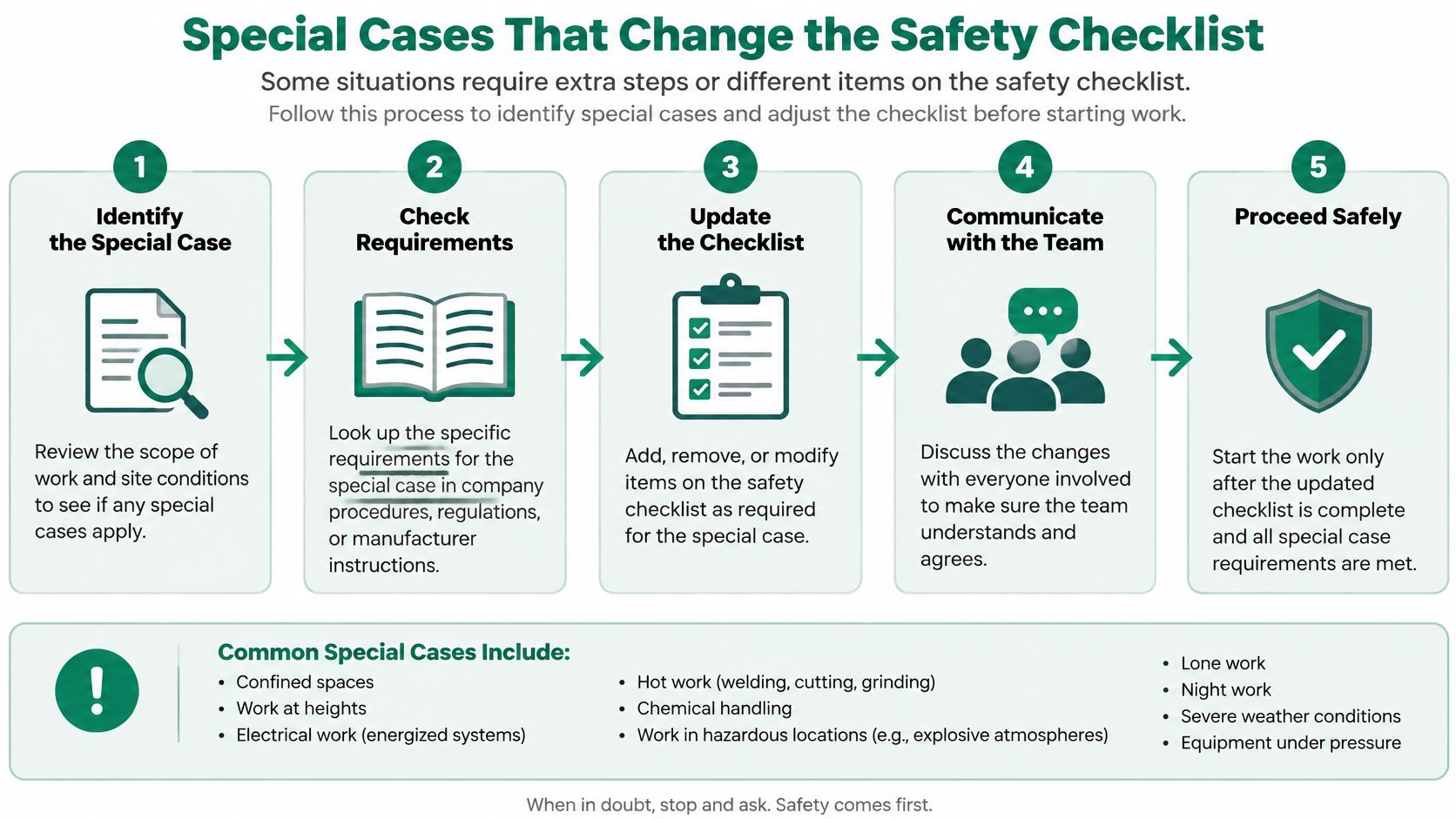
Four situations rewrite parts of the checklist. The documents stay the same. Disclosure, timing, and equipment change, and each one still has to clear the same five layers: carrier authority, securement, condition evidence, port readiness, and Hacienda paperwork.
Electric vehicles
Disclose everything before booking: a prior crash, flood exposure, an open recall, a battery repair, or a replacement pack. European Maritime Safety Agency guidance says a vehicle with a damaged lithium-ion battery should generally not be accepted for transport unless the battery is removed and handled under dangerous-goods rules, because a damaged pack can enter thermal runaway and reignite after the visible fire is out. That re-ignition and toxic-material profile is what makes the condition file the safety measure on a Jacksonville–San Juan sailing. A carrier with clean authority still cannot load a car the port will refuse. Our guide to electric vehicle transport covers the pre-shipment questions to answer.
Military moves
Align the pickup window and the delivery window with your PCS orders rather than with a guessed moving date, and keep copies of the orders in the same folder as the bill of lading. A flexible window near the port absorbs a sailing delay without turning the shipment into a second move. Orders do not replace the authority check or the signed condition report.
Snowbirds
Book the spring and fall shoulder-season sailings early, because capacity tightens when seasonal residents move in both directions at once. After delivery, set the car up for months of island parking: correct tire pressure, a battery maintainer, a cover, and low fuel. Leave those extras out of the cabin for the ocean leg. The vehicle has to be empty of personal items before the carrier will accept it. A declared delivery date and a realistic one often differ by a sailing.
Dealers and online buyers
Puerto Rico shipping covers cars, trucks, SUVs, motorcycles, and inoperable auction units. Inoperable units move on this lane only when the condition is declared at booking so winch loading can be arranged. Non-running classics need a winch-equipped enclosed trailer, and they still must roll, steer, and brake. Every unit needs its own dated photo record, front to back, because auction-condition claims are won or lost on what you shot before the truck pulled away. A batch of ten cars needs ten files, not one shared file.
The rule that holds across all four: special cases change the disclosure and the timing, never the documentation discipline.
Book Your Puerto Rico Car Shipment With Confidence
On a Jacksonville to San Juan move, I book only when five checks are closed: carrier authority, securement, condition evidence, port readiness, and Hacienda paperwork. A quote with a date on it is not the same thing.
Match the carrier's FMCSA authority and cargo insurance to a certificate you can read. Ask in writing how the car will be secured on the truck and for the sailing. Schedule the pickup walkaround so photos and a signed condition report are on file before the driver leaves. Port readiness is concrete: the car empty of personal items, fuel low, keys that work, on the day the truck arrives. Print the SURI arbitrios estimate and keep it with that packet.
Request one flat-rate quote for the exact route and vehicle, with insurance included. Confirm the pickup window and the sailing out of Jacksonville, Philadelphia, or San Juan. National Car Transport does not collect a deposit to hold a slot. Charges stay at zero until the vehicle is matched with a carrier. Get that payment timing in the same written reply, along with what the rate covers and which exclusions apply. If an exclusion is vague, the booking is not finished.
National Car Transport is U.S.-based, with 25+ years in auto transport, an A+ BBB rating, and a network of 25,000+ vetted carriers. Bilingual English and Spanish agents work from the USA. One dedicated agent stays with the file from the pickup inspection through delivery. Have that agent review your vehicle and your dates before you commit.
At National Car Transport, that same agent quotes the flat rate with insurance included and walks through port routing, sailing, and the arbitrios step. Send the vehicle, the origin, and the timing, and you get those answers before you commit to the move.