

You've just bought an EV in another state, scheduled a relocation, or need to move a vehicle to Puerto Rico. The pickup date is close, but one question keeps creating uncertainty: can the car ship like any other vehicle? Usually, yes, but electric vehicle transport depends on battery condition, charge level, ground clearance, weight, and route. A carrier that handles ordinary sedans may not be prepared for a damaged battery pack or an ocean shipment.
The safest process starts before a truck arrives. You'll need accurate vehicle details, a documented battery condition, the right loading equipment, and a carrier that understands mainland and island logistics. The same preparation works for private owners, snowbirds, military families, students, dealerships, and businesses, but the transport method changes with the vehicle and destination.
Table of Contents
- Why Electric Vehicle Transport Requires a Different Approach
- Preparing Your EV Battery and Vehicle for Shipping
- Choosing Between Open Enclosed and Container Transport
- Handling Damaged or Recalled EV Batteries Safely
- Pricing Timelines and Route Expectations Across All 50 States
- Frequently Asked Questions About EV Shipping
Why Electric Vehicle Transport Requires a Different Approach
A Seattle-to-Miami relocation can look routine until the carrier reviews the vehicle information. A Tesla Model Y, Ford Mustang Mach-E, Rivian, or another EV may require different loading equipment, a more careful charge-level plan, or a hazmat review if the battery shows damage. The problem usually isn't the vehicle's exterior. It's the condition and handling requirements of the battery system underneath it.
EVs have concentrated weight in the battery pack, and many models have low clearance. That combination affects ramp angles, tie-down placement, axle loading, and the carrier's ability to load the vehicle without scraping the underside. A driver who accepts the vehicle without checking those details can arrive at pickup and reject the load, or create avoidable damage during loading.
The battery condition changes the shipment
A healthy, undamaged EV is generally handled as a vehicle. A vehicle with collision damage, a battery warning, a recall issue, or uncertain battery condition may fall under hazardous-material requirements. U.S. federal guidance says lithium batteries installed in vehicles must be securely fastened in their holders and protected against short circuits. It also says damaged, defective, or recalled lithium batteries can move by highway, rail, or vessel, but not by commercial aircraft. PHMSA safety guidance for transporting EVs and lithium batteries provides the governing details.
That distinction matters on every route, especially Puerto Rico. A carrier needs to know whether the vehicle starts, rolls, steers, and brakes normally. If it doesn't, the dispatcher must arrange winch equipment, a flatbed, or another suitable method instead of assuming a standard drive-on process will work.
Practical rule: Describe battery warnings and collision history before booking. Hiding a warning light doesn't make the shipment simpler. It makes the pickup less predictable.
EV adoption has also moved beyond a specialist market. Global electric car sales exceeded 20 million in 2025, rose about 20% from 2024, and represented 25% of new cars sold worldwide, according to the International Energy Agency's Global EV Outlook 2025. More vehicles mean more transport requests, but carrier procedures and port processes still vary. A useful background resource for buyers moving an imported vehicle is DreamBid's guide to how to import an EV from the US safely.
Preparing Your EV Battery and Vehicle for Shipping
Battery preparation should begin when you request a quote, not when the driver calls from the curb. Give the transporter the exact year, make, model, trim, drive configuration, condition, and battery status. A heavy long-range model, a non-running vehicle, and a compact hatchback may need entirely different equipment.
Set a manageable charge level
For a healthy vehicle, many logistics teams prefer a 30% to 50% state of charge before pickup. That leaves enough power for loading, unloading, and short repositioning without sending the vehicle across the country with an unnecessarily high charge. Maritime guidance also emphasizes battery state and recommends controls that vary with voyage conditions, so the carrier or ocean operator should confirm its own requirement before sailing.
Record the displayed charge level and photograph the dashboard. Save any diagnostic message, battery warning, or service notification. If the car has recently suffered a collision, flooding, overheating event, or recall-related repair, tell the transporter immediately. A normal-looking dashboard doesn't override a known battery problem.
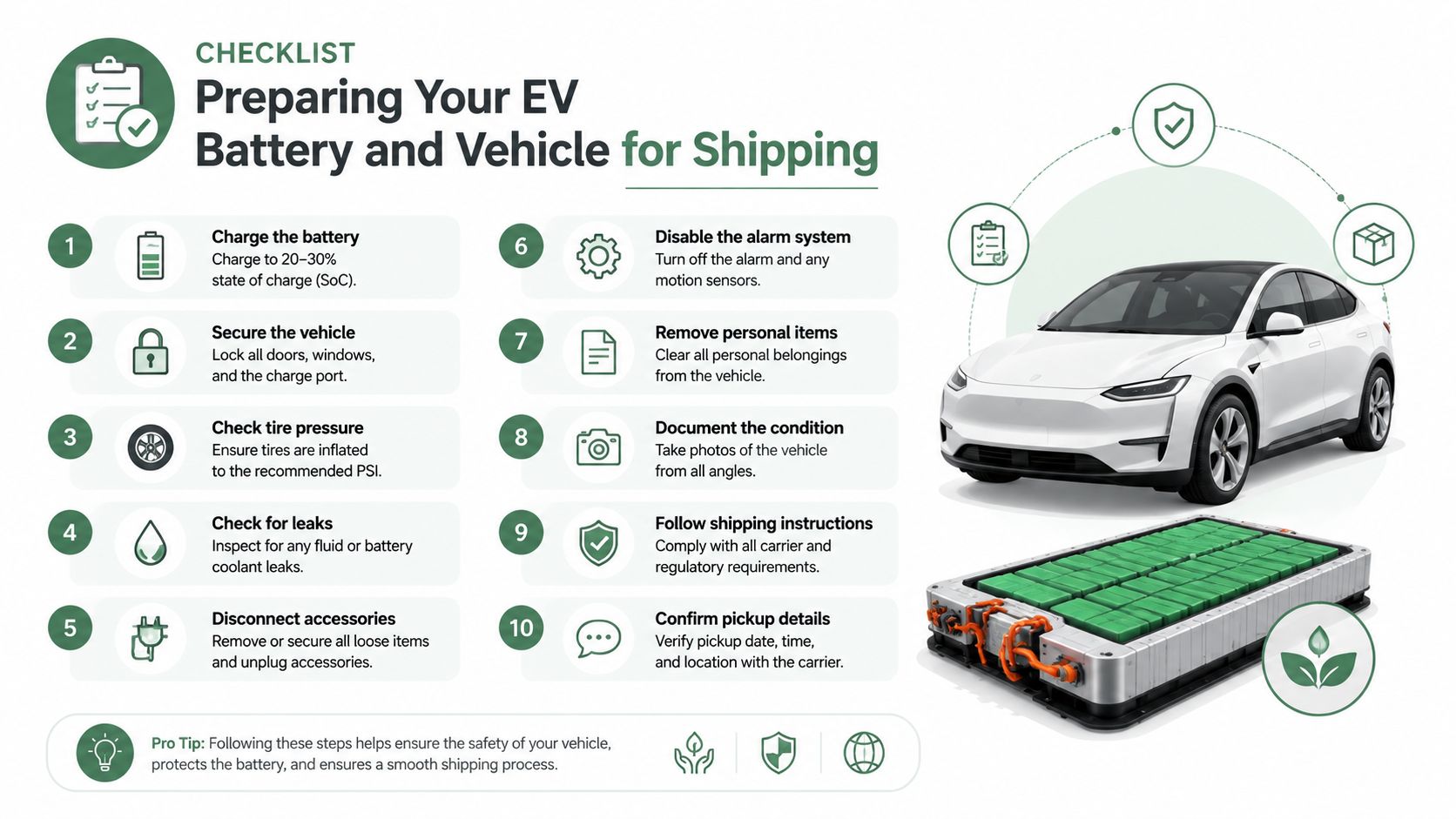
Complete the physical handoff checklist
- Turn off power-draining features: Disable Sentry Mode, remote climate control, scheduled preconditioning, and other functions that could consume energy during transit. Follow the owner's manual for Transport Mode or its equivalent.
- Remove charging equipment: Take out charging cables, adapters, and removable accessories unless the carrier specifically approves them for separate packing.
- Check tires: Inflate tires to the manufacturer's recommended pressure. Correct inflation reduces loading problems and helps avoid unnecessary flat-spotting.
- Measure clearance: Note the lowest point of the vehicle and tell the carrier if it has a lowered suspension, aftermarket wheels, or a steep approach angle.
- Photograph the vehicle: Capture every panel, wheel, glass surface, roof, interior, and accessible underside before loading. Include the odometer and dashboard warnings.
- Record the correct weight: Use the vehicle's door-jamb label or documented curb information rather than relying on a generic base-model specification.
- Remove personal property: Do not leave luggage, tools, child seats, loose cables, or boxes inside the vehicle. Follow the destination port's rules for documents and contents.
- Secure keys and access devices: Provide the required key fob, card, or digital access method, and explain how to place the vehicle in neutral and release the parking brake.
Battery disposal and end-of-life handling are separate issues from shipping, but owners replacing a damaged pack should understand the recycling path. Beyond Surplus offers a useful lithium battery recycling guide for that decision.
Keep your inspection photos and paperwork in one folder. The National Car Transport blog can also help you review broader vehicle shipping preparation topics before scheduling pickup.
Choosing Between Open Enclosed and Container Transport
The cheapest method isn't automatically the right method for an EV. Choose based on battery exposure, clearance, vehicle value, operating condition, and route. Open transport is often practical for a healthy Nissan Leaf or Chevrolet Bolt traveling between mainland cities. Enclosed transport makes more sense for a high-value Porsche Taycan, Lucid Air, Rivian, restored vehicle, or a car with a vulnerable finish and low underbody clearance.
Container shipping is the normal choice for ocean-connected routes such as Puerto Rico, Hawaii, and some Alaska movements. The vehicle travels through a port process rather than staying on a highway carrier for the entire journey. Container availability, port schedules, vehicle dimensions, and documentation become just as important as the truck leg.
Match protection to the route
Open carriers offer broad availability and efficient pricing for standard mainland shipments. They also expose the vehicle to road debris, weather, and road salt. Enclosed equipment provides more protection, but capacity is tighter and the loading process may require additional clearance checks.
For Puerto Rico, the mainland truck leg and ocean leg must be coordinated. Vehicles moving between the U.S. mainland and Puerto Rico commonly route through Jacksonville, Florida and the Port of San Juan. San Juan is the Puerto Rico port identified for these vehicle shipments in the vehicle shipping packet from Tote Maritime. That makes port appointment timing, paperwork, and vehicle readiness central to the booking.
| Transport Type | Best For | Cost Range | Protection Level | Route Availability |
|---|---|---|---|---|
| Open carrier | Healthy standard EVs on mainland routes | Varies by mileage, vehicle, and market | Basic exterior protection | Broad mainland availability |
| Enclosed carrier | Luxury, collectible, lowered, or highly finished EVs | Higher than open service | Stronger weather and debris protection | More limited, scheduled capacity |
| Container or ocean service | Puerto Rico, Hawaii, and selected Alaska routes | Route-specific quote | Protected ocean movement, subject to port handling | Port-dependent |
A damaged undercarriage isn't just cosmetic on an EV. Impact near the battery enclosure can create a safety concern, delay acceptance, or require a specialist inspection. For higher-value vehicles, review the options for enclosed auto transport before selecting the lowest quote.
Handling Damaged or Recalled EV Batteries Safely
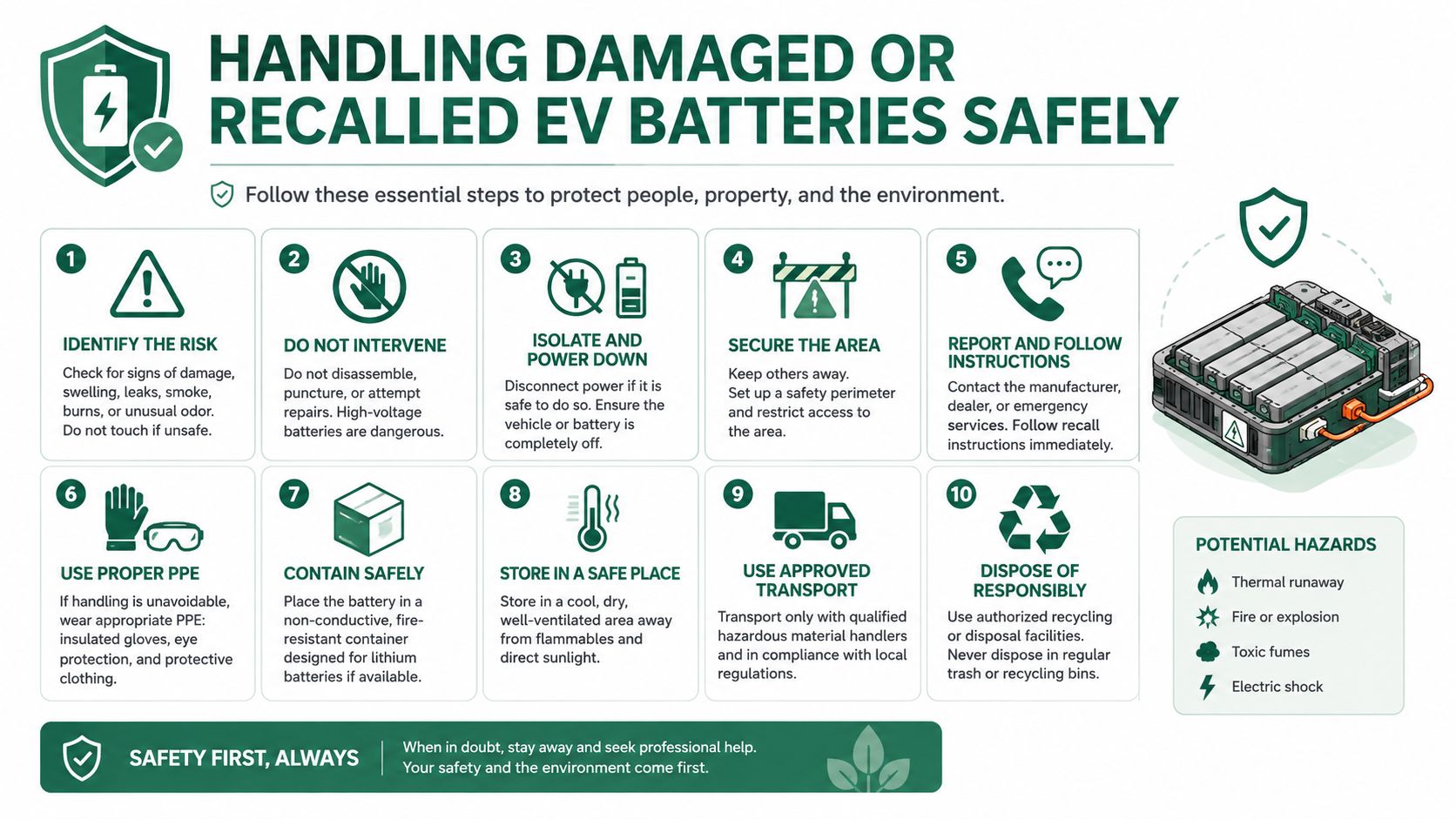
The most dangerous assumption in EV shipping is that a damaged vehicle remains ordinary freight. It doesn't. A collision, visible battery casing damage, a battery warning, a thermal event, or an active recall can change the shipment from routine auto transport to hazardous-material logistics.
Start with disclosure. Tell the carrier about collision damage, water exposure, smoke, unusual heat, charging failure, warning messages, and any manufacturer or dealer instruction. Don't rely on a generic vehicle description such as “runs and drives.” The battery can require special handling even when the wheels turn.
What the federal guidance requires
For damaged or defective lithium batteries, U.S. guidance requires transport by highway, rail, or vessel, and prohibits commercial aircraft. The packing method for a removed damaged or defective battery is specific: one battery per non-metallic inner package, one inner package per specification outer package, with the outer package marked “Damaged/defective lithium-ion battery” or “Damaged/defective lithium metal battery” in 12 mm characters. These requirements come from the PHMSA safety advisory on EV transportation.
That packaging rule applies to battery shipments, not a casual instruction for placing an entire damaged car in a box. The carrier, shipper, battery specialist, and port operator must determine the correct method for the vehicle and battery configuration. A damaged pack may also affect carrier acceptance, insurance terms, port storage, and vessel documentation.
Why ocean routes need early review
Ocean transport adds another layer of coordination. Guidance for maritime EV movement continues to emphasize fire prevention, early detection, thermal monitoring, and state-of-charge controls. Yet the industry guidance cited in the available European transport discussion notes that there are no statutory fire-safety requirements specific to EVs at sea and no regulations governing Li-ion battery state of charge at sea, even though recommended SOC levels may be around 30% to 50%, depending on voyage length. The European Alternative Fuels Observatory's June 2026 update describes that operational gap.
Ask for written acceptance before moving a damaged or recalled vehicle toward a port. A carrier that discovers the issue at the terminal may have no legal or operational way to load it. For general fire-response context, Knight Tek's EV fire extinguisher guide can help owners understand why ordinary fire assumptions don't transfer neatly to battery incidents.
Pricing Timelines and Route Expectations Across All 50 States
EV shipping quotes depend on distance, vehicle weight, operating condition, equipment, pickup access, season, and destination. A compact operational EV traveling from Boston to Atlanta may fit a standard mainland process. A non-running Rivian moving from Denver to San Juan requires different planning, port coordination, and possibly specialized loading equipment.
Across the 48 contiguous states, common origin and destination markets include Seattle, Portland, San Francisco, Los Angeles, Phoenix, Denver, Dallas, Houston, Chicago, Detroit, Minneapolis, Atlanta, Miami, New York, Boston, Philadelphia, Washington, D.C., and San Juan for Puerto Rico service. A quote should identify whether the price covers door-to-port, port-to-door, or door-to-door coordination, because island shipments include separate inland and ocean stages.
Route variables that change the quote
Heavier EVs can reduce the number of vehicles a carrier can place on a load. Low clearance can require a different ramp setup. A vehicle that doesn't roll may need a winch or flatbed. Battery concerns can narrow carrier availability, while peak relocation periods can make scheduling less flexible.
For Puerto Rico, the most commonly cited pattern is mainland door-to-port or port-to-door service connected with San Juan. One published estimate places Puerto Rico vehicle shipping at about $895 to $1,795, with transit of 7 to 14 days, while another source describes ocean transit itself as about 3 to 4 days at sea. These figures come from National Car Transport's Puerto Rico shipping information, and the final quote can change with vehicle condition, pickup location, port handling, and service level.
| Route | Transport Type | Estimated Cost | Transit Time | Booking Lead Time |
|---|---|---|---|---|
| Mainland, 48 contiguous states | Open or enclosed carrier | Mileage and equipment based | Route and carrier based | Earlier booking improves flexibility |
| Alaska | Highway, barge, or combined service | Route and seasonal conditions based | Weather and routing based | Arrange before seasonal capacity tightens |
| Hawaii | Mainland truck plus ocean service | Port, vehicle, and ocean charges based | Sailing schedule based | Coordinate with port cutoff |
| Puerto Rico | Mainland truck plus vessel service | About $895 to $1,795 in the cited estimate | 7 to 14 days in the cited estimate | Confirm vessel and terminal availability early |
Alaska may involve the Alcan Highway or barge connections from Tacoma. Hawaii commonly requires West Coast port coordination. Don't assume a mainland quote includes ocean handling, terminal fees, customs paperwork, or delivery from San Juan.
For a broader explanation of quote variables, use the car shipping cost guide. Ask the broker or carrier to separate each leg, state the vehicle's charge requirement, and confirm whether the quote changes if the car arrives with a warning light or fails to roll.
Frequently Asked Questions About EV Shipping
Does standard transport insurance cover battery damage?
Request the carrier's insurance certificate and review its exclusions. A policy may cover damage caused during loading or transit, while pre-existing defects, recalls, thermal events, or undisclosed collision damage may be excluded. Photograph warning messages, the exterior, wheels, and underbody at pickup, then compare them at delivery. If damage appears, record it on the delivery inspection before signing.
What happens if the EV arrives below the carrier's charge requirement?
The carrier may delay loading, arrange local charging, or apply an additional service charge, depending on the equipment and route. A low state of charge can also prevent the vehicle from entering neutral or rolling onto a trailer. Confirm the required charge before pickup and tell the carrier immediately if the vehicle cannot meet it.
How do shipping claims affect the vehicle warranty?
A transport claim and a manufacturer warranty claim address different issues. The carrier handles documented damage caused during transport, while the automaker decides whether a failed component qualifies under warranty. Keep the inspection report, photographs, tow records, warning codes, and repair diagnosis. Do not authorize battery repairs before the carrier and manufacturer have had an opportunity to inspect the vehicle.
Can a carrier move a damaged or recalled EV?
Not automatically. A damaged or recalled battery may require special handling, isolation, or refusal by the carrier, especially if it shows heat, smoke, swelling, leakage, or collision damage. Disclose the condition before booking. Ocean operators and terminals may impose separate hazardous-material requirements, so Puerto Rico shipments need confirmation for every leg.
What should Puerto Rico customers prepare?
Keep identification, title or registration documents, shipping paperwork, and required tax documents available. Confirm who handles Hacienda-related forms and which documents the San Juan receiving process requires before arrival. Ask whether the quote includes terminal handling and final delivery, rather than assuming mainland service covers ocean costs.
National Car Transport coordinates open, enclosed, container, and ocean vehicle shipping across the mainland, Puerto Rico, Alaska, and Hawaii, with transparent flat-rate pricing and a network of 25,000+ vetted carriers. Its U.S.-based bilingual English and Spanish agents have more than 20 years of auto transport logistics experience. Visit National Car Transport to request a route-specific quote.