

You're standing in a Phoenix driveway watching your sedan climb onto a carrier, and the driver has just handed you a condition report. At that moment, “Is my car insured?” stops being a casual question. You need to know which policy applies, what it covers, what it excludes, and which document proves your position if the vehicle arrives with damage.
That answer matters whether you're moving between major cities in the 48 contiguous states, sending a car from New York to Florida for the winter, transferring a military vehicle between duty stations, delivering dealership inventory, or shipping a vehicle between the mainland and San Juan, Puerto Rico. Car shipping insurance isn't one universal product. It's a layered system, and the layer that protects you depends on where the vehicle is, who has custody, and how the damage occurred.
Table of Contents
- What Car Shipping Insurance Actually Means
- Carrier Liability and Broker Contingent Coverage
- How to Verify a Carrier's Insurance Before Pickup
- Supplemental and Marine Coverage for High-Value and Island Shipments
- Filing a Car Shipping Insurance Claim Step by Step
- What Car Shipping Insurance Costs in 2026
- Car Shipping Insurance Questions Customers Ask Most
What Car Shipping Insurance Actually Means
Once the carrier accepts the vehicle, the Bill of Lading records the car's condition and documents the handoff of custody. From that point, the carrier's insurance is the primary protection for damage caused during the transport operation. The same principle applies whether the pickup is in Phoenix, Atlanta, Denver, Miami, or Seattle.
Federal motor carrier rules connect interstate vehicle transport with registration, safety requirements, and financial responsibility standards. A commonly cited federal minimum under 49 CFR Part 387 is $5,000 per vehicle and $10,000 per occurrence for cargo coverage in the situations where cargo insurance is required, according to this overview of transportation insurance requirements. That doesn't mean every vehicle shipment has a separate full-value policy. It means you must identify the actual coverage carried by the assigned carrier.
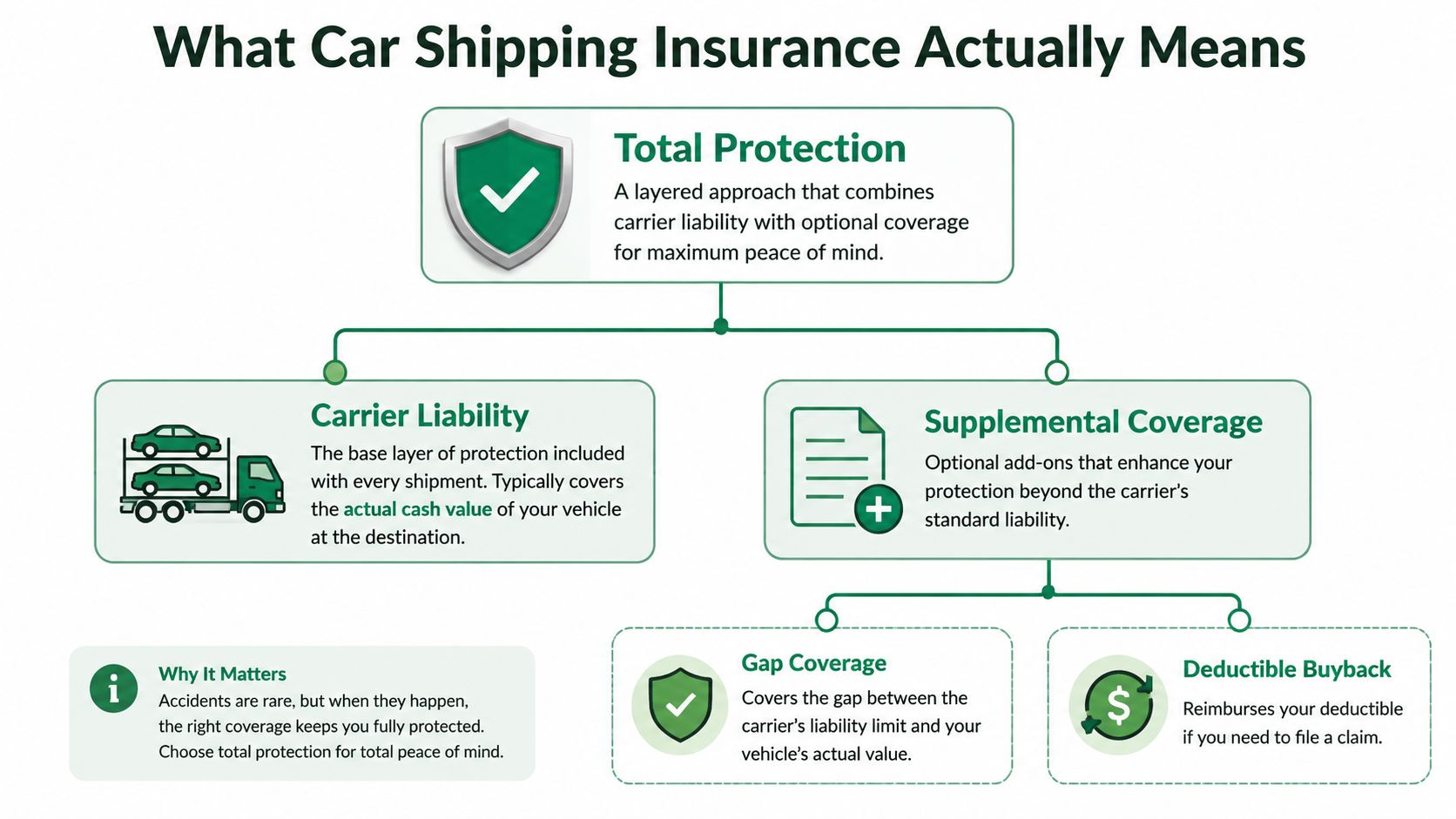
The terms you'll see on a quote
Carrier liability is the carrier's legal responsibility for covered loss or damage while it has custody. It may respond to physical damage caused by a collision, handling incident, fire, theft, or vandalism during transit, subject to the policy's terms.
Cargo coverage limit is the maximum amount the carrier's policy may pay for covered vehicle damage. A deductible is the amount assigned to you or the carrier before the insurer pays an approved claim. Exclusions are situations the policy specifically leaves out, such as personal belongings, mechanical failure, or certain weather-related damage.
A Certificate of Insurance, often called a COI, summarizes the carrier's policies, limits, effective dates, and named insured. It's useful, but it isn't a substitute for reading the actual policy or confirming that the policy is active for your shipment.
Practical rule: Treat the Bill of Lading as your starting evidence, not a routine delivery form.
The four layers are straightforward once separated: carrier liability for the assigned truck, broker-contingent coverage in limited backup situations, marine or container coverage for ocean legs, and personal supplemental or gap coverage for vehicles whose value or risk exceeds the carrier's protection.
Carrier Liability and Broker Contingent Coverage
Customers often assume that a broker's insurance replaces the carrier's policy. It doesn't. The carrier's policy is the primary layer while the vehicle is in the carrier's possession, while broker-contingent coverage is generally a secondary protection that may respond only under defined circumstances.
FMCSA materials distinguish between public liability and cargo requirements. For general property carriers, the stated minimum auto liability is $750,000, while household-goods movers must carry cargo insurance of $5,000 per vehicle and $10,000 per occurrence, as explained in this FMCSA insurance requirements guide. A carrier can therefore satisfy public-liability rules and still leave questions about vehicle cargo protection unanswered.
What each layer actually does
Carrier liability may address covered physical damage during custody, including damage connected to a collision, fire, theft, or vandalism. The policy may impose a deductible, a per-vehicle limit, valuation restrictions, and exclusions. You need the assigned carrier's documents, not a generic promise from a booking website.
Broker-contingent coverage usually doesn't become the first payer because a claim is inconvenient. It may apply if the carrier's insurance is unavailable or the carrier fails to resolve a covered loss, but the contingent policy's terms control. It also won't automatically turn a limited cargo policy into full replacement-value protection for a $40,000 SUV.
Neither layer should be treated as a substitute for your own preparation. Weather events, road debris, pre-existing damage, personal items left inside the car, and mechanical or electrical failure may fall outside the policy, depending on the wording and cause of loss. Your strongest position comes from matching the vehicle's documented condition at pickup with its condition at delivery.
| Feature | Carrier Liability | Broker Contingent |
|---|---|---|
| Primary role | Responds to covered loss while the carrier has custody | Secondary protection under the broker's policy terms |
| Who carries it | The assigned motor carrier | The broker or dispatching company |
| Typical trigger | Covered physical damage during transport | A defined failure or gap involving the carrier's coverage |
| Main limit | The carrier's stated cargo limit and valuation terms | The contingent policy's separate limits and conditions |
| What it doesn't guarantee | Full replacement value for every vehicle | Automatic payment for every carrier dispute |
| First verification | Carrier COI and active authority | Broker contract and contingent policy terms |
Check the carrier's authority before pickup through the FMCSA SAFER Company Snapshot. Confirm that the MC or USDOT information identifies the same company shown on the COI and booking paperwork. If those names don't match, stop and ask who has custody of the vehicle.
How to Verify a Carrier's Insurance Before Pickup
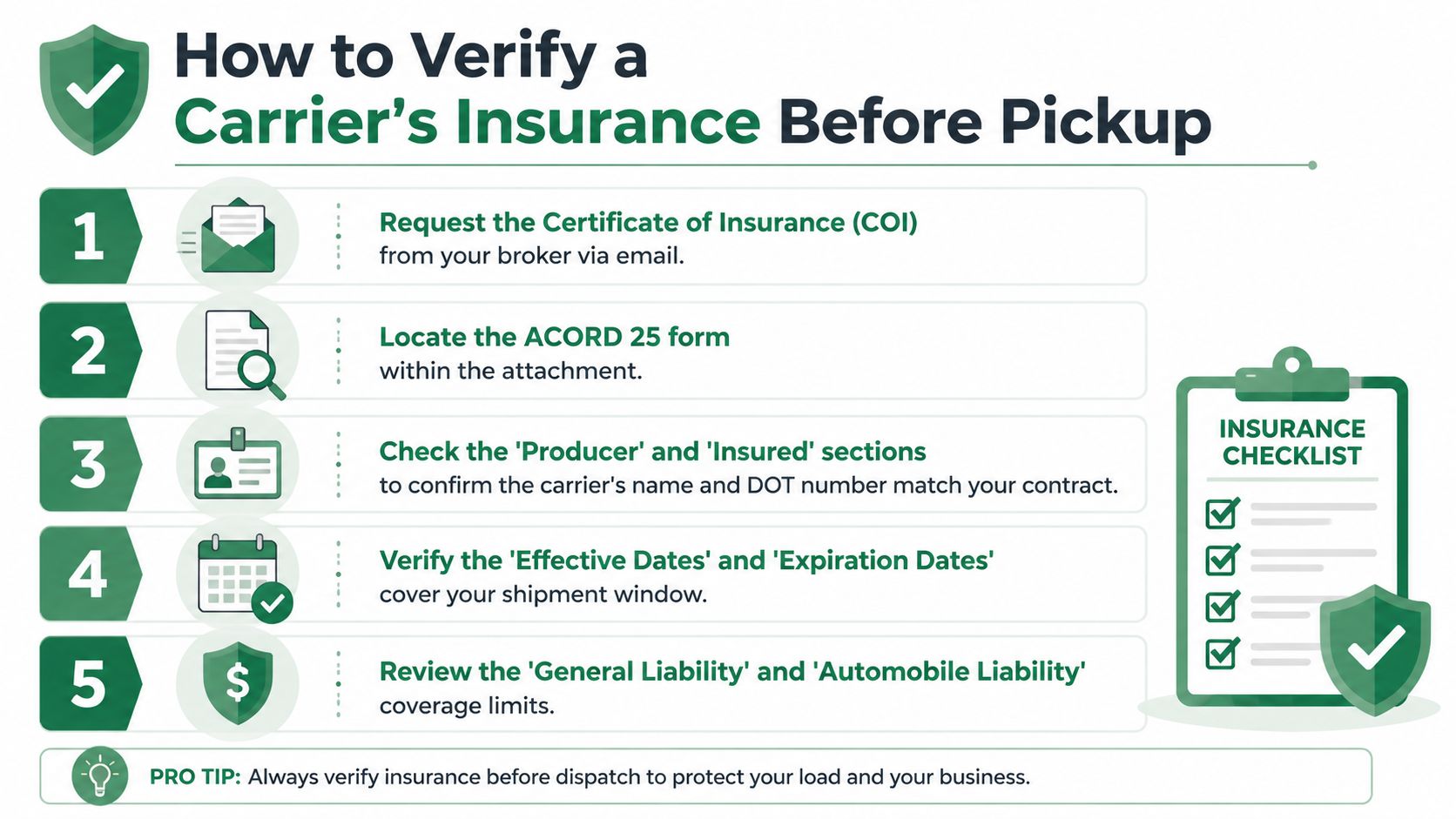
Don't wait until the driver is in your driveway. Ask for the assigned carrier's Certificate of Insurance before pickup, then compare it with the carrier details on your booking confirmation.
Read the COI in the right order
Many brokers send an ACORD 25 form in an email attachment. Start with the Producer and Insured sections. The insured name should match the motor carrier assigned to your shipment, and the company identity should align with the MC or USDOT number in your paperwork.
Next, check the policy number, effective date, expiration date, cargo limit, automobile liability limit, and deductible. The certificate may also show whether another party has additional-insured status, but that wording doesn't automatically expand the coverage for your vehicle.
Make the verification call
Use the insurance company's verification number, not only the phone number supplied by the driver. Give the representative the policy number and ask:
- Is the policy active on the pickup date?
- Is this carrier the named insured?
- What cargo limit applies per vehicle?
Write down the representative's name, the date of the call, and the answers. A screenshot may be altered, outdated, or missing pages, so treat it as a lead rather than proof.
Then check the company in SAFER. The authority should be active, and the insurance information on file should be consistent with the carrier's identity. This basic check won't interpret every exclusion, but it can expose a mismatched or inactive operation before you release the keys.
Use this door-to-door auto transport service information to understand what information a coordinator should provide before pickup.
Watch for these red flags:
- No COI: The broker or carrier refuses to provide current insurance documentation.
- Screenshot only: You receive an image but no verifiable insurer contact or policy details.
- Name mismatch: The carrier shown on the COI doesn't match the MC or USDOT information.
- Unclear custody: The booking party can't tell you which motor carrier will physically transport the vehicle.
For additional context on the verification sequence, watch the following walkthrough:
Supplemental and Marine Coverage for High-Value and Island Shipments
A standard carrier policy may be adequate for an ordinary sedan moving between Dallas and Chicago, but it deserves closer scrutiny for a classic, exotic, modified, or unusually expensive vehicle. The carrier's cargo limit may not match the vehicle's market value, and the truck's coverage doesn't automatically continue once the vehicle leaves the mainland on a vessel.
Supplemental third-party coverage is designed to fill a value gap or provide protection that the carrier's policy doesn't offer. Ask whether the policy uses agreed value or stated value. Agreed value establishes the amount accepted before the loss, while stated value can leave the settlement tied to policy language, valuation evidence, or the lower applicable amount.
Marine or container coverage applies to the ocean portion of an island shipment. Puerto Rico law defines marine and transportation insurance broadly to include cars and other vehicles exposed to transit, navigation, storage, transshipment, or reshipment risks, as described in the Puerto Rico insurance code. That's a different exposure from the highway segment between a mainland residence and the port.
Crowley publishes optional Puerto Rico cargo insurance at $250 for up to $25,000 of coverage and $500 for up to $50,000, with zero deductible, in its vehicle shipping requirements. If a customer declines that option, Crowley says its liability is limited to $500 per vehicle under federal law, as stated in its Puerto Rico vehicle-shipping FAQ.
TOTE Maritime's guidance is narrower in a different way. Its policy describes broad physical-loss protection for qualifying vehicles owned by manufacturers, dealers, distributors, and rental agencies, while excluding marring, denting, chipping, scratching, gouging, and atmospheric fallout, according to its vehicle insurance liability document.
| Feature | Supplemental, Third-Party | Marine or Container, Crowley and TOTE |
|---|---|---|
| Best use | Closing a value or coverage gap on a mainland shipment | Protecting the ocean leg to Puerto Rico, Hawaii, or another island route |
| Valuation | Often based on agreed or stated value | Based on the marine policy and declared shipment value |
| Main question | Does the policy cover the full vehicle value? | Does it cover the exact vessel, port, storage, and handling exposure? |
| Personal belongings | Commonly excluded | Commonly excluded unless specifically accepted |
| Condition evidence | Required for underwriting and claims | Required at port, loading, and delivery |
| Space choice | Not a shipping method | May involve RoRo, deck space, or container placement |
For logistics professionals comparing cargo-specific protection, PTL Insurance Associates inland marine coverage offers useful background on how inland marine products address transported property. Owners of restored cars should also review classic car shipping options before choosing open, enclosed, port, or container service.
A restored Mustang headed to Honolulu and a Porsche 911 leaving Galveston need a written answer about value, port handling, exclusions, storage, and container or RoRo placement. Don't buy a policy because its name sounds broad. Buy it only after confirming the exact transit segment and loss scenarios it covers.
Filing a Car Shipping Insurance Claim Step by Step
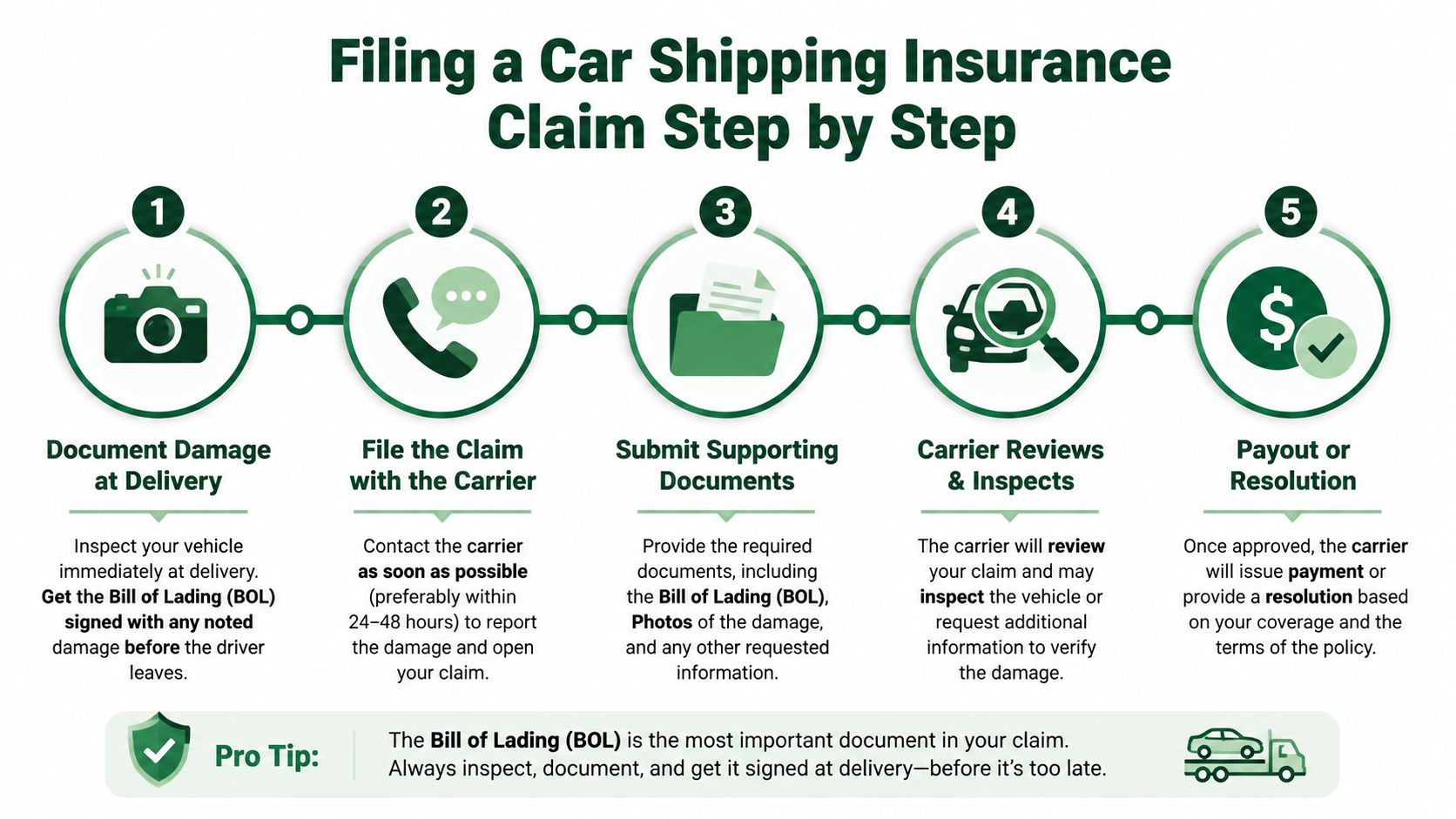
The claim usually succeeds or fails at delivery, not weeks later in an adjuster's office. A customer who spots a new scrape should keep the driver present, compare the vehicle with the pickup condition report, and write the damage on the delivery receipt before signing it.
Start with the pickup record
The Bill of Lading and condition report should describe existing scratches, dents, wheel damage, glass issues, mirrors, and custom parts. Take photographs from multiple angles, including wide shots that establish where the damage appears on the vehicle and close shots that show the detail. This evidence chain matters because the customer generally must prove that the damage occurred during transit rather than before pickup, as explained in this car transport insurance guide.
At delivery, photograph the car before removing it from the carrier if the location allows. Note the damage clearly on the BOL, ask the driver to acknowledge the notation, and keep a copy. Don't rely on a verbal promise that the carrier will “take care of it later.”
Build the file the adjuster can use
Submit the carrier's claim form promptly, following the deadline in the contract. Some transport providers ask customers to report damage within 7 days, while other instructions may use a shorter window, so follow the specific paperwork you received. Include:
- Signed BOL: Pickup and delivery condition records with damage noted.
- Time-stamped photographs: Wide reference images and close-ups of every affected area.
- Repair estimate: A written estimate from a qualified repair facility.
- Prior records: Earlier photographs, inspection reports, or repair invoices showing the pre-shipment condition.
- Communication log: Emails, claim numbers, and the names of carrier or broker contacts.
The carrier's insurance desk assigns the claim for review. An adjuster may inspect the vehicle, compare the BOL with the images, request an estimate, and determine whether the loss falls within the policy. The settlement, if approved, follows the applicable valuation and deductible terms.
A disputed island claim may involve a vessel operator, port handler, inland carrier, or multiple policies. Resources such as this discussion of an insurance claim dispute in Hawaii can help explain why responsibility becomes more complicated when transportation crosses water.
At delivery, documentation beats argument. A calm notation, clear photos, and a retained copy of the BOL are more useful than a heated conversation on the curb.
What Car Shipping Insurance Costs in 2026
Insurance pricing follows the broader commercial transportation market, so carrier economics affect the rate attached to a shipment even when the customer never sees a separate insurance line. One industry index reported commercial auto premiums rising an average of 8.9% in a recent quarter, while another reported a 9.4% annual increase; transportation insurance costs were also reported at 10.2 cents per mile in 2024, up 3% from the prior year after a 12.5% increase in 2023, according to this transportation insurance market analysis.
Those figures don't create a universal quote. Route, vehicle value, carrier type, enclosed or open equipment, port handling, declared value, and policy exclusions all change the price. A high-value vehicle also deserves a review of limits, because a low premium can reflect narrow protection.
The following examples use illustrative ranges, not guaranteed quotes:
| Shipment Type | Vehicle | Lane | Supplemental Premium | Notes |
|---|---|---|---|---|
| Snowbird move | 2022 Honda CR-V | New York to Florida | Qualitatively, standard supplemental coverage is usually the lower-cost option | Confirm the carrier limit and whether your personal policy already responds |
| Military household | 2021 Ford F-150 | Fort Hood to Lejeune | Qualitatively, price depends on declared value and carrier terms | Review the BOL carefully during a duty-station move |
| Collector shipment | 1969 Mustang | California to Maui | Qualitatively, marine or container protection generally costs more than a routine mainland add-on | Obtain valuation documentation and confirm exclusions before port delivery |
For context, carrier insurance costs remain under pressure. A transportation market report cited average premium increases of around 4.9% in Q2 2025, while some 2025 outlooks projected physical-damage premiums rising 20% to 25% and auto-liability premiums 10% to 20%, as reported in this transportation insurance outlook. Those outlook figures are projections, not a promise about every 2026 shipment.
Get a written quote that identifies the transport method and insurance assumptions. The car shipping cost information can help you separate the transport price from optional protection instead of treating them as one unexplained total.
Car Shipping Insurance Questions Customers Ask Most
Does my personal auto policy cover the shipment?
Maybe, but don't assume it does. Ask your insurer whether your policy covers physical damage while a third-party carrier has custody, whether the carrier's policy must pay first, and whether your deductible applies. Your personal policy may protect you in some situations, but it doesn't replace verification of the carrier's coverage.
What does carrier insurance usually exclude?
Common exclusions include personal belongings left inside the vehicle, mechanical or electrical failure unrelated to handling, pre-existing damage, weather, and road debris, depending on the policy and cause of loss. A vehicle that won't start because of an unrelated mechanical problem usually isn't a cargo-damage claim. A scratch that existed at pickup won't become new covered damage because the shipment took place.
How much is the deductible?
Deductibles vary by policy. Crowley's published optional Puerto Rico cargo coverage has zero deductible, while other carrier or supplemental policies may assign a deductible. Ask for the exact amount in writing rather than relying on a general range or verbal assurance.
What does broker-contingent coverage guarantee?
It doesn't guarantee that every claim gets paid or that you receive the vehicle's full replacement value. It's a secondary layer controlled by its own conditions, and it may apply only when the carrier's insurance is unavailable or fails in a defined way. The assigned carrier's active policy and the BOL remain central to the claim.
Why do Puerto Rico and Hawaii shipments need special attention?
The mainland truck is only one part of the route. Once the vehicle enters port handling, vessel transport, storage, or transshipment, marine coverage terms become relevant. Puerto Rico's insurance code expressly includes vehicles connected with navigation, transit, storage, and related transportation risks, so ask which policy applies to each segment rather than accepting the phrase “fully insured” without details.
What should I do before handing over the keys?
Remove personal items, photograph every side of the vehicle, record existing damage on the pickup condition report, and request the carrier's COI. Verify the carrier identity through SAFER, keep copies of the BOL and quote, and ask whether the coverage limit matches the vehicle's value.
National Car Transport works with mainland and island shipments using open, enclosed, container, and ocean options, and it has 25+ years of experience, an A+ BBB rating, transparent flat-rate pricing, and a network of 25,000+ vetted carriers, as described by the company. Its U.S.-based bilingual English and Spanish agents have over 20 years of experience in auto transport logistics, and they guide individuals, snowbirds, military families, students, dealerships, and businesses through the details because no two vehicle transports are alike.
Before booking, ask National Car Transport to identify the assigned carrier, explain the applicable coverage layer, and document any value gap or marine exposure. Visit National Car Transport for a quote and speak with an agent who can make the insurance and shipping process clear, simple, and quick at a fair value.