You found the car on a Tuesday: a 2016 sedan listed two states away, priced under everything else you've looked at, and the seller answers every message within minutes. The photos look clean. The title photo is legible. What you still don't have is any proof that the car is what the ad says, or a plan for getting it from that driveway to yours, and if yours happens to be in San Juan, the second question can change the budget more than the first.
Buying used isn't an edge case. The Bureau of Labor Statistics Consumer Expenditure Survey found that used-vehicle purchases represented 70.4% of all vehicle acquisitions in 1991 and still 67.2% in 2000; among households reporting a recent acquisition in the 1999-2000 survey, 66% bought used, 26% bought new and 8% leased. Those figures describe vehicle acquisitions generally rather than private-party sales alone, but they explain why the private market is so deep and why so many buyers end up doing exactly what you're about to do.
When you buy a car privately, you're working in the version of that market with the fewest guardrails. The seller owes you an honest answer in most states and not much more. So the work that protects you happens before money moves, in a fixed order, and it starts with one assumption: nobody at the other end is required to volunteer anything.
Table of Contents
- What a Private Sale Leaves Out
- Verify the Car in Seven Steps Before Paying
- Documents to Check and What Each One Proves
- Puerto Rico Import Tax and Hacienda Paperwork
- Pay, Hand Over and Confirm Before You Drive Away
- Arranging Transport and What It Costs
What a Private Sale Leaves Out
The transmission starts slipping nine days after you hand over the cashier's check. The seller has stopped answering and the ad is already deleted. Buy the same car from a dealership and you'd have somewhere to go: a posted disclosure, possibly an implied warranty, and a business with a license on the line. In a private sale, the trail usually ends at the seller's front door.
The rule behind that is federal. The FTC's guide to buying a used car states that private sellers generally aren't covered by the Used Car Rule, so they don't have to provide the standardized Buyers Guide that dealers must display. The same guide explains that private sales usually aren't covered by implied warranties under state law, which makes the car "as is" unless the written purchase agreement promises otherwise.
Here's the gap in three lines:
- Warranty: a dealer can still sell a car as is, but the Buyers Guide has to say so on the vehicle, and some states add protections a dealer can't sign away. A private seller starts and ends at as is.
- Disclosure form: the window document listing warranty terms, inspection status and known problems comes from dealers. Private sellers skip it entirely.
- Recourse: after a dealer sale you can escalate to a state dealer licensing agency or an attorney general's office. After a private sale, you're down to a small claims filing and whatever the contract says.
That leaves three jobs that are yours alone: verify the vehicle history, title and registration, recall status, odometer disclosure and any lien; arrange an independent mechanic inspection; and put every promise in writing. The FTC recommends asking for that inspection outright and notes that a written contract requires the seller to honor the promises stated in it.
When buyer and seller live in different states, those jobs get harder. Title, registration, sales tax and inspection requirements vary by jurisdiction, so a process that looks clean in one state can leave you with a car your own DMV won't register. A sale that ends with the car sailing to Puerto Rico adds another layer of documents on top of that.
Protection has to come from checks you run yourself, in order, before money moves.
Verify the Car in Seven Steps Before Paying
Seven checks stand between a promising listing and a car you can register. Run them in this order, because each one can end the deal before you've spent anything beyond fuel money.
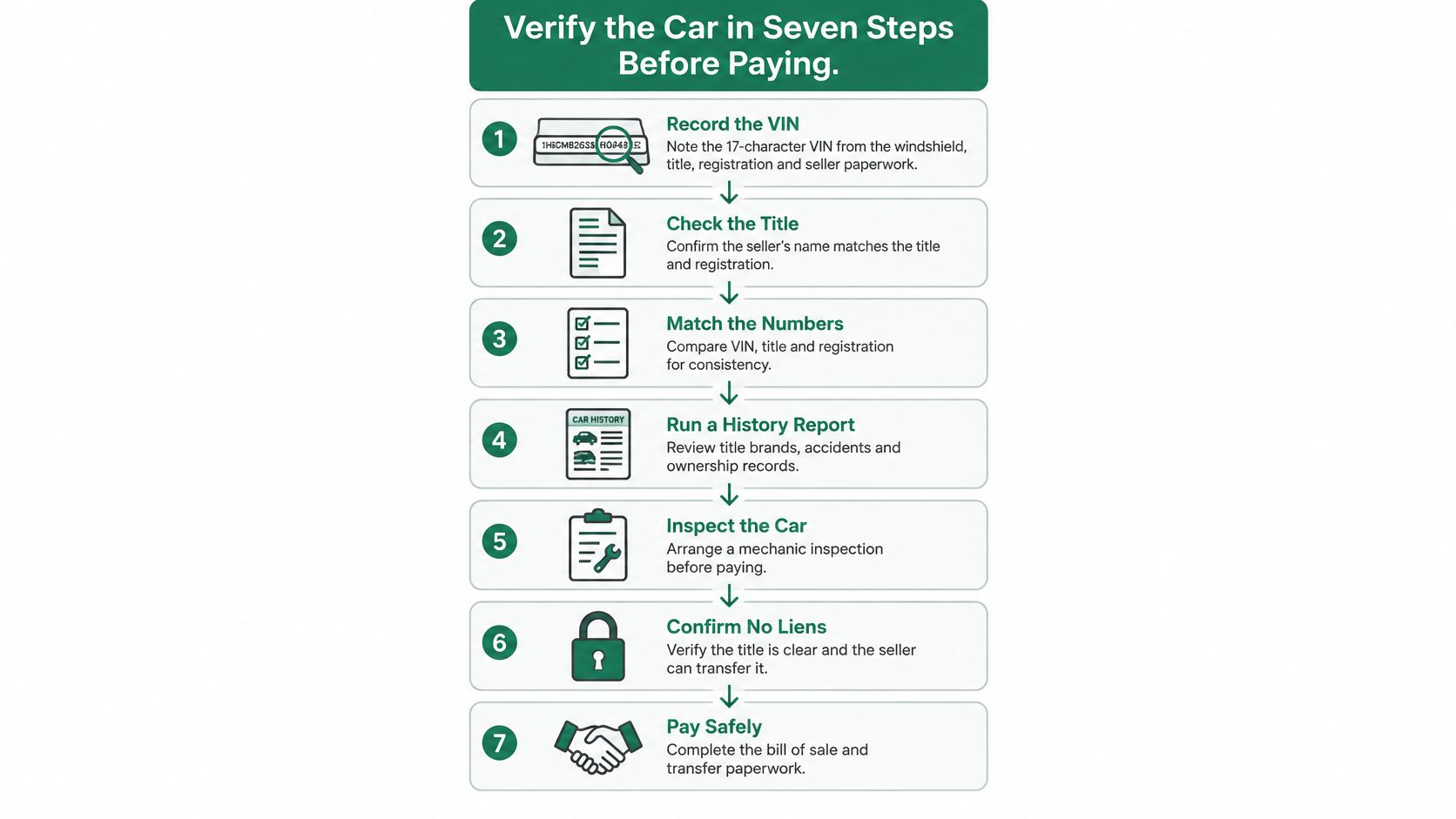
Write down the VIN, all 17 characters. Pull it from the windshield plate, the title, the registration and anything the seller emails you. If one copy disagrees with another, stop; a mismatched VIN is the most reliable single sign of a stolen car or a forged title.
Match the seller to the title. Ask for photo ID and check that the name matches the title and registration. If the seller isn't the registered owner, ask for a notarized authorization from whoever is. Someone selling a car they don't legally control can't transfer it to you.
Run the VIN through NICB VINCheck. It's free and screens for theft, salvage and flood records. A hit ends the conversation; a clean result moves you to step four.
Order a state DMV title search. The DMV record shows lienholders and title brands the ad didn't mention. A lien means a lender has to be paid before the title can move anywhere.
Compare the history report to the paper. Maintenance invoices, mileage readings and reported accidents should agree with each other. Then look for physical shortcuts: damp carpets, paint that doesn't match across panels, panel gaps that widen on one side, fresh undercoating sprayed over rust.
Pay for an independent pre-purchase inspection. Choose a mobile inspector or a local shop, never the seller's cousin. A seller who won't allow it is telling you something useful. A proper pre-purchase inspection should cover compression and leak-down checks, as well as frame and flood evidence.
Sign the bill of sale last. Only after the title has been correctly assigned to you, with the seller's signature in the right place. A bill of sale written before the title is signed isn't proof of anything.
If the person across the table is selling for someone else, an estate, a deployed spouse, a relative abroad, confirm that person exists before you drive three hours. A reverse-lookup service such as find a person by photo can match a name to a face in a few minutes.
Why a Clean VIN Check Isn't Proof of Clear Title
NICB is explicit that VINCheck has limitations: a stolen, seriously damaged or encumbered vehicle may have no matching record at all, especially when an uninsured loss was never reported. A clean result is a screening signal, not proof.
Title washing is the practice of moving a salvage or flood vehicle between states until the paperwork comes back looking clean. Say a Texas seller hands you a title branded in a state three time zones away and the ad never mentions damage. That's a DMV title search before a test drive, not after one.
Walk away when the VIN differs across documents, the seller refuses an independent inspection, the title carries a brand the ad didn't disclose, or nobody can produce a lien release for a loan the seller admits is still open.
Documents to Check and What Each One Proves
A private sale is a paper transaction with a car attached. The test drive tells you how it drives; the documents tell you whether you can own it, register it, insure it and ship it.
| Document | What to Verify | When It Applies |
|---|---|---|
| Certificate of title | Seller name matches photo ID; no salvage, flood or lien brands the seller didn't disclose | Every sale |
| Registration | Current, and matches the VIN on the windshield and the plate on the car | Every sale |
| Bill of sale | Buyer, seller, price, date, VIN, odometer reading and as-is wording | Every sale, signed after the title is assigned |
| Lien release letter | Original payoff letter from the lender itself | When the title shows a lien |
| Odometer disclosure | Reading matches the dashboard and the service records | Every title transfer |
| Photo ID | Name matches the seller name printed on the title | Every sale |
| Hacienda excise declaration | Vehicle details and VIN as Hacienda requires | Vehicles going to Puerto Rico |
| Motor-vehicle inspection or appraisal | Document presented together with the Hacienda declaration | Vehicles going to Puerto Rico |
Start with the title, because it decides who owns the car. The name on it has to match the ID of the person in front of you, character for character. A middle initial or a maiden name that doesn't line up is a question, not a detail. If the seller is the second owner and the title is still in the first owner's name, the seller never completed the transfer and neither can you.
If the title shows a lien, the lender still has a claim on the car. Ask for the lender's original payoff letter, not a bank statement and not a note on letterhead saying the loan was satisfied years ago.
The payoff rule: a letter from a bank that no longer holds the loan proves nothing about the balance on the day you pay. Get the current payoff figure in writing first.
Registration should be current and match both the VIN plate and the bumper plate. The odometer reading on any disclosure form, the dashboard and the service records should agree; a car whose dashboard reading sits below the mileage on last year's invoice has been tampered with or misrepresented.
The bill of sale gets signed only after the title has been assigned, and it should carry buyer, seller, price, date, VIN, odometer reading and any as-is wording. Keep the original and photograph it the same day. Knowing how bills of sale for private sellers are laid out helps, because this is the document that proves the transaction years later.
Practical test: if a document can't be matched to the car parked in front of you, don't sign until it can.
A car with no title at all is a different problem, and what to do when there's no vehicle title lays out the bonded-title route. That has to be finished before the car can ship anywhere.
Puerto Rico Import Tax and Hacienda Paperwork
The tax that surprises people on a move to Puerto Rico isn't sales tax and it isn't the freight bill. It's the arbitrios, an excise tax assessed on the island's own valuation of the vehicle, called the contributory price, not on what you paid the seller and not on what the carrier charges to move it.
The Puerto Rico Department of the Treasury's arbitrios schedule applies to vehicles introduced from abroad or manufactured in Puerto Rico after October 31, 2014, and sets a minimum tax of $637.50 for a contributory price up to $6,170. Above that, the tax rises progressively by band, with the base amounts carried forward at each tier.
| Contributory Price Band | Tax Rate or Minimum |
|---|---|
| Up to $6,170 | $637.50 minimum tax |
| $6,170 to $10,690 | 10.2% of the amount above $6,170 |
| $10,690 to $21,380 | 19.6% of the amount above $10,690 |
| $21,380 to $31,780 | 23.0% of the amount above $21,380 |
| $31,780 to $44,890 | 27.2% of the amount above $31,780 |
| Above $44,890 | 34.0% of the amount above $44,890 |
Say Hacienda values the car inside the $10,690 to $21,380 band. Only the portion of that valuation above $10,690 is taxed at 19.6%, and the base amounts carried up from the lower bands are added on top. Push the valuation one band higher and that slice is taxed at 23.0% instead. That's why you get the estimate before you agree on a price, not after the carrier is booked. Hacienda's estimator runs on the make, model, year or VIN, so you can price the tax before the car is even yours.
Two separate clearances: Hacienda clears the tax; the carrier's bill of lading moves the car. Neither document replaces the other.
Paperwork runs alongside the money. Hacienda's informative bulletin on vehicle imports requires an excise-tax declaration for vehicles imported into Puerto Rico, and the documentation has to identify the make, model year, model, color, quantity and VIN, with the motor-vehicle inspection or appraisal document presented when the declaration is filed.
To ship a car out of Puerto Rico you need the title or a lienholder authorization, photo ID and registration, and any Hacienda lien has to be cleared before the port will accept the vehicle. The port side of the move has its own sequence, and shipping to Puerto Rico from the U.S. walks through it step by step.
Pay, Hand Over and Confirm Before You Drive Away
Payment is where a private sale goes wrong in ways paperwork can't fix. Meet at the seller's bank during business hours and complete a verified transfer or a cashier's check drawn in front of a teller. Sign the title there, with a notary or bank stamp if your state requires one. Skip the envelope of cash, and skip any wire to an account you haven't confirmed belongs to the person named on the title.
Online purchases borrow the same logic as payment terms for online stores: money moves only once the thing you're buying has been checked and the terms are written down. Here the thing you're buying is a car plus a clean title, and the terms are the bill of sale.
Then walk the handover in this order:
- Confirm the title signature. The registered owner signs in the exact space your state's title specifies. A signature in the wrong box gets rejected at the counter.
- Sign the bill of sale and keep a copy. Both parties initial the odometer figure.
- Photograph the odometer and VIN at handover. Time-stamped photos settle arguments later.
- Check the plate and registration against the documents. Plate on the car, VIN on the plate, name on the title.
- Get the transport quote's inclusions in writing. What's covered, what's extra, and where the car is inspected before loading.
- Insure the car before you drive it. The seller's policy stops covering the vehicle once it's sold; yours has to start before the wheels move.
- Register or transfer it with your state DMV by the deadline. A late transfer can cost you a penalty and a re-inspection.
The title is the sale. A handshake, a receipt or a promise to mail the paperwork later doesn't transfer ownership. Only a correctly assigned title does.
An unsigned or missing title means the sale isn't finished, no matter how much money has changed hands. For a car heading to San Juan, book transport only after the arbitrios estimate and the Hacienda documents are in hand, since the port process runs on the tax declaration rather than the sailing date.
When the car does need to move, National Car Transport is A+ BBB Accredited, and customers can book online 24/7 by filling out the free quote form and choosing to book at the end of it; a dispatcher then starts working the next available spot for the car.
Buying remotely adds a category of risk that has nothing to do with the vehicle itself, and car transport scams covers the red flags to check before you send a deposit to anyone.
Arranging Transport and What It Costs
You've agreed to buy a car in another state, but getting it home is a separate transaction. The same applies when you're relocating, heading south for a snowbird season, shipping a household to Puerto Rico, or selling to a distant buyer. Before booking, separate the vehicle's purchase price from the cost of moving it and, for Puerto Rico, the tax and port paperwork.
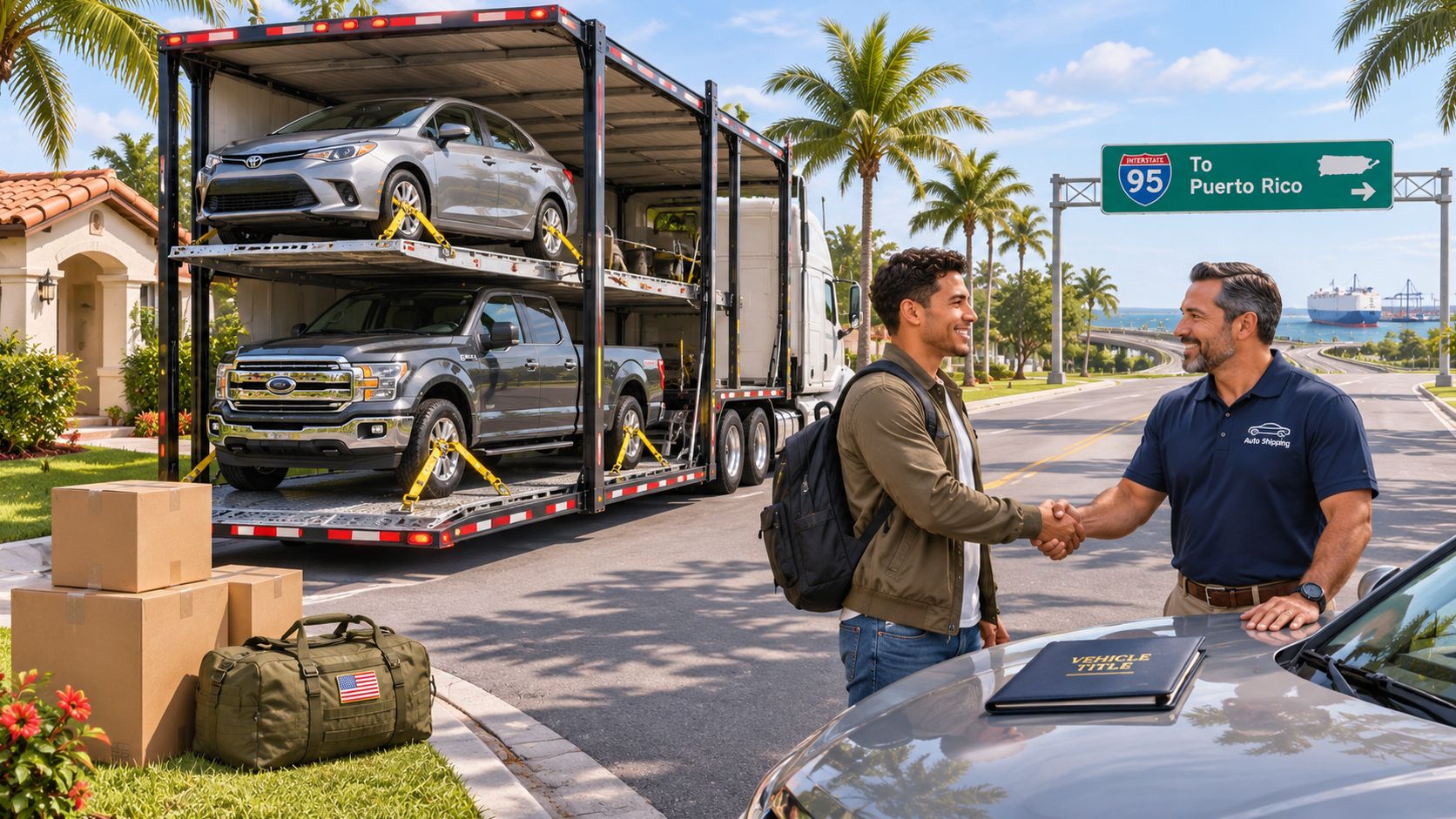
Open transport is the most economical option and the same method dealerships use for new vehicles. It's a sensible default for a daily driver. Enclosed transport costs more and adds protection for paint and glass. On National Car Transport's mainland routes, nothing is charged until the car is assigned to a truck; that zero-upfront arrangement applies to mainland shipments.
Published rates are estimates for a standard running sedan on open transport, not guaranteed prices. Season, fuel prices and route demand affect them. SUVs, trucks and enclosed transport to Puerto Rico need vehicle-specific quotes rather than the standard sedan rate.
For an island shipment, compare the whole journey:
| Route | Transit Time | What Sets the Price |
|---|---|---|
| Florida to San Juan via Jacksonville | Truck leg plus available sailing, confirmed at booking | Distance to Jacksonville, sailing availability and vehicle type |
| Philadelphia to San Juan via mainland port | Inland haul plus scheduled ocean leg | Distance to the eligible port, terminal handling and vehicle type |
| Northeast to San Juan via mainland port | Inland pickup and sailing schedule determine the window | Pickup location, inland distance and delivery arrangements |
| Texas or Midwest to San Juan via mainland port | Long inland haul followed by available sailing | Inland trucking distance, sailing availability and vehicle type |
| San Juan to a mainland city, reverse route | Export clearance, ocean leg and mainland delivery | Port processing, sailing schedule and distance to the destination |
The Puerto Rico Ports Authority describes Jacksonville as the leading U.S. port for island trade, handling almost 90% of maritime cargo moving between Puerto Rico and the mainland. That makes Jacksonville an important routing point, but your eligible port, sailing availability and delivery arrangements still determine the journey.
The truck leg is only part of the move.
Puerto Rico's official foreign-trade statistics track goods shipments between the island and the United States. For your car, that journey involves inland trucking, terminal handling, ocean freight and clearance. A port-to-port quote therefore isn't interchangeable with a quote starting at the seller's driveway in Philadelphia. Ask where the quoted service begins and ends, and whether island taxes are handled separately.
Paperwork determines whether the car can proceed. The bill of lading and shipping documents should identify the same vehicle by VIN. To ship from Puerto Rico, you need the title or lienholder authorization, photo ID and registration. Any Hacienda liens must be cleared before the port accepts the vehicle. A return move needs its own document check; don't assume both directions have identical requirements.
Dealers use this pipeline too. National Car Transport handles auction inventory from Copart, IAAI and Manheim with dealer rate sheets and a dedicated account rep. For Copart and IAAI vehicles, the service includes auction pickup and gate release, trucking to port and ocean freight to San Juan. Military families and seasonal residents can also arrange the reverse journey, with clearance and delivery planned for that direction.
Questions to Ask Before You Book
- What's the total, itemized? Identify trucking, ocean freight, terminal fees and documentation charges. Keep separately handled island taxes visible in your budget.
- What does the insurance cover? For a high-value car, provide the appraised value so National Car Transport can match it with a carrier whose coverage fits.
- Which sailing dates are real? Request a transit window that includes inland pickup and sailing availability, rather than treating ocean transit as the entire trip.
- What does the pickup inspection record? Ask what is photographed and entered on the bill of lading at pickup and delivery. Classic car shipping includes photo-supported inspections at both.
- What's excluded? Ask specifically about terminal storage, waiting for a sailing and any service left outside the quoted price.
For a closer look at the components, how flat-rate shipping is priced explains what goes into the quote.
National Car Transport is U.S.-based and offers bilingual English/Spanish support, open and enclosed transport, and shipping to and from Puerto Rico. Its flat rate includes insurance. Use the free quote at National Car Transport to establish the transport budget before committing to the move. Keep title completion, port clearance and transport scheduling aligned: a reserved journey cannot substitute for paperwork that makes the vehicle ready to ship.