
$845–$1,795 is the estimated 2026 flat rate for shipping a vehicle between the U.S. mainland and Puerto Rico, ocean freight included, with an estimated door-to-door window of 7–18 days. But does that transportation price cover everything you'll pay before you can drive the car away?
That's the distinction that matters when you're budgeting a move. The transportation rate and the landed cost aren't the same number. A useful quote tells you what the carrier will move, where responsibility starts and ends, and which destination expenses remain yours.
Table of Contents
- How Much Flat Rate Shipping to Puerto Rico Costs
- What the Flat Rate Covers and What It Leaves Out
- What Moves Your Quote Up or Down
- How the Car Travels From Your Door to San Juan
- Documents and Hacienda Paperwork Before the Car Sails
- Island-to-Mainland Shipments and Export Papers
- Special Moves From Snowbirds to Dealerships
- Confirm These Details Before You Book
How Much Flat Rate Shipping to Puerto Rico Costs
The mainland pickup or delivery region gives you a starting point, not a finished booking price. The estimated regional ranges below apply in both directions, between the mainland and San Juan, Puerto Rico, with ocean freight included. They show the transportation number, not every landed cost tied to port release, paperwork or local delivery.
Estimated flat rate by mainland region
| Mainland origin or destination | Estimated flat rate | Total transit time |
|---|---|---|
| South Florida (Miami, Orlando, Tampa, Jacksonville) | $845–$1,195 | Pickup window plus confirmed vessel and release schedule |
| Southeast (Atlanta, Charlotte, Nashville) | $1,095–$1,545 | Inland dispatch plus confirmed vessel and release schedule |
| Northeast (New York, New Jersey, Philadelphia, Boston) | $1,095–$1,545 | Port routing and confirmed sailing determine the window |
| Texas and Midwest (Dallas, Houston, Chicago) | $1,195–$1,595 | Longer inland leg plus confirmed sailing and release |
| West Coast (California, Oregon, Washington) | $1,395–$1,795 | Cross-country trucking plus confirmed sailing and release |
| SUV, pickup, van or enclosed transport | $1,195–$1,795 | Exact quote depends on vehicle details, with sailing time as scheduled |
Those ranges are practical planning bands, with ocean freight included. Exact quotes still depend on the vehicle details and the transport method. A sedan on open transport sits inside the standard regional range. SUVs, pickups, vans and enclosed transport use the higher estimated band above, with the exact price quoted once vehicle size, condition and handling needs are clear.
A car collected near a mainland port needs less inland coordination than one collected far from the coast. That inland leg affects the number before the vehicle ever reaches the vessel. The quote also needs to state whether it covers terminal collection or delivery to your address. Keep those separate, because the transportation price and the final delivery plan are different parts of the move.
What makes the price fixed
A fixed vehicle shipping price works like a standardized shipping box. The carrier can hold the number because the service boundaries are defined. For a vehicle shipment, those boundaries are the route, vehicle class, running condition and transport method.
The estimate assumes a running sedan, open mainland transport, and standard pickup and delivery arrangements. Change the vehicle class, add enclosed transport, or create special handling needs, and the price has to be recalculated. That avoids a sedan price followed by a later adjustment.
Transport preparation is a separate budget item from optional spending. The car needs to be clean enough for a useful condition inspection, but it does not need detailing. If you maintain a seasonal vehicle, you can compare unlimited monthly wash plans through VIP Car Wash as a separate ownership expense, not part of the shipping budget.
Read the booking terms before paying
Get the origin and destination addresses onto the written quote. Confirm whether the destination means the San Juan terminal, an accessible meeting point, or your home. That wording controls the delivery leg you are buying.
Then read the payment and reservation terms. A booking payment should not be treated as proof of a confirmed vessel reservation unless the booking documents say so. Ask for the sailing status, payment milestones, and cancellation conditions in writing before arranging flights around the car's arrival.
What the Flat Rate Covers and What It Leaves Out
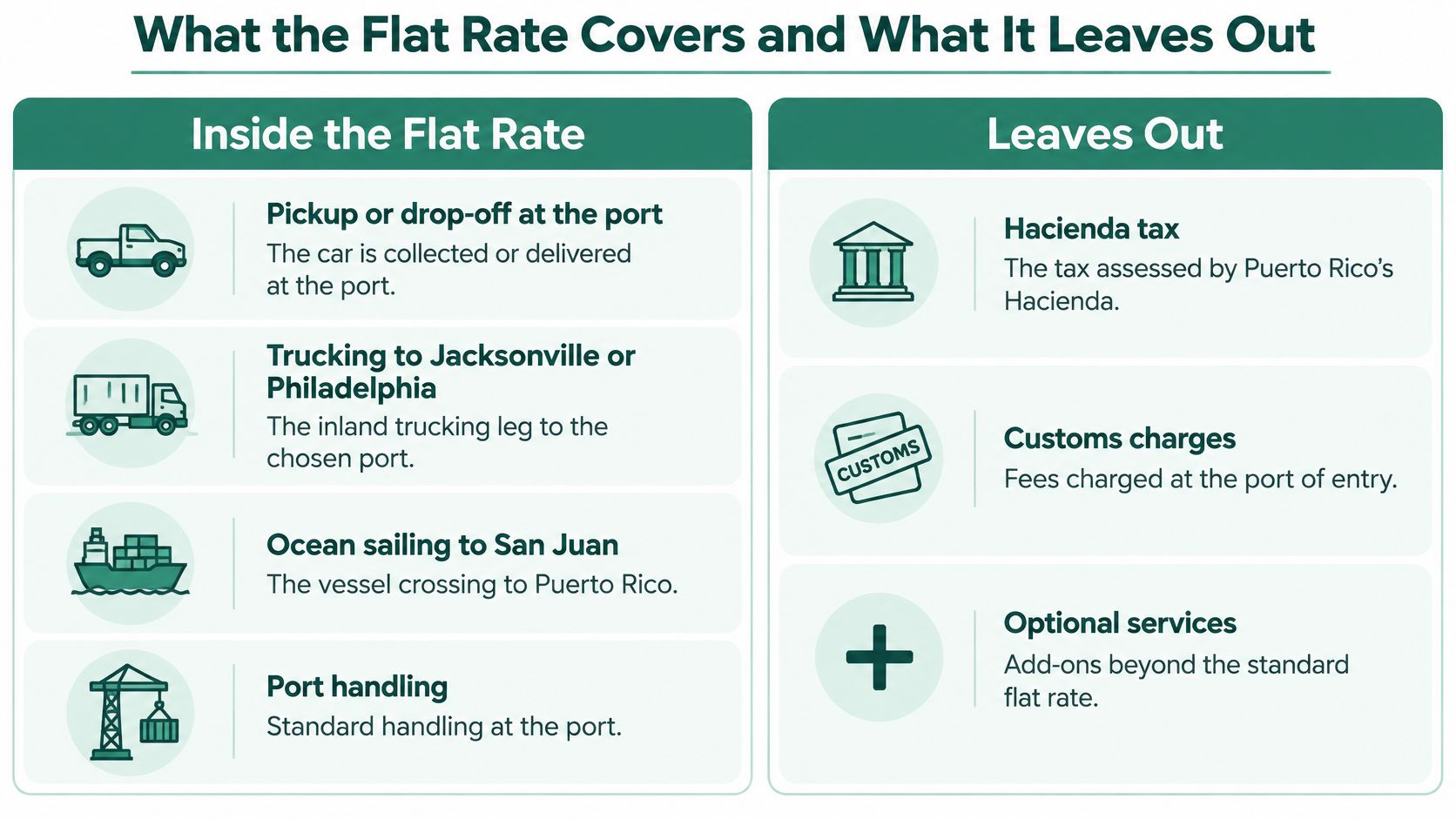
Inside the transportation price should be a clearly defined chain of services: collection or terminal drop-off, the agreed inland trucking leg to Jacksonville or Philadelphia, the ocean movement to San Juan, standard port handling, and the stated carrier insurance.
The distinction is service scope. The USPS explanation of flat-rate products illustrates the underlying principle: a fixed price works within specified packaging and service limits. Vehicle transport needs equally clear boundaries, even though the shipment isn't a parcel.
A flat rate is fixed within an agreed service description. It isn't permission to change the vehicle, destination or handling requirements without changing the booking.
Carriers can spread transportation and handling costs across compatible shipments. That works only when the booking accurately describes what they're collecting.
The visual below separates the transportation services from potential additional obligations. Any reference to customs charges should be checked against the actual shipment, not treated as an automatic fee on every mainland–Puerto Rico move.
Transportation price versus landed cost
Outside the transportation price, unless expressly included, are the vehicle's Puerto Rico excise tax, tax-preparation services, storage after the terminal's free period, and delivery beyond the agreed service area. Non-running handling and oversized dimensions also need advance disclosure.
Insurance included in transport doesn't mean every possible loss has the same coverage. Review the applicable policy, exclusions, deductible and claims procedure, including how coverage applies across trucking and ocean legs.
An all-inclusive transportation quote should cover the transportation it promises. It shouldn't imply that Hacienda has waived a separate tax obligation.
The expenses most likely to disrupt a tight arrival budget are arbitrios, port storage, and delivery to a town outside the contracted route. Have a written answer for each before accepting the transportation total.
What Moves Your Quote Up or Down
A map can tell you the distance, but it can't tell you the equipment or handling the vehicle needs. Two cars leaving the same city can require different arrangements because one runs normally and the other can't steer or brake.
The Bureau of Labor Statistics truck transportation industry page tracks producer pricing for trucking services. Fuel, labor, equipment utilization and available capacity all affect the inland leg; mileage alone doesn't explain the price.
What changes a Puerto Rico flat rate
| Factor | Why it changes the price | Effect on your quote |
|---|---|---|
| Distance from your city to the port | Inland trucking reflects mileage and lane demand | Longer haul generally raises the rate |
| Vehicle size and weight | Trailer space and load capacity are limited | SUVs, pickups and vans need an individual quote |
| Running or inoperable | Loading may require a winch and additional handling | Adds handling costs when accepted |
| Open, enclosed or container | Equipment, protection and loading arrangements differ | Enclosed or container service can add a premium |
| Door-to-port or port-to-door | Address collection or final delivery adds trucking | More service than port-to-port |
| Season | Seasonal relocations can compete for available space | Busy departures can cost more |
| Fuel and carrier capacity | Operating costs and truck availability change | Rate moves with booking conditions |
| Expedited or guaranteed sailing | A restricted schedule reduces routing flexibility | Can add a scheduling premium |
Change the choices you control
Start with your pickup window. Flexible dates can let an agent match your car to available equipment instead of arranging the shipment around a narrow deadline. Fall snowbird departures and summer military relocations deserve early planning, though an off-season departure is not automatically cheaper.
Port-to-port service can remove an address-delivery leg if you can safely and practically handle the terminal visit yourself. Compare the saving with your own travel, parking and time costs before choosing it.
For multiple vehicles, request coordinated pricing rather than assuming a discount. Atticus Goods on order consolidation is a retail example of the broader consolidation idea; vehicle bookings still need separate loading, identification and handling checks.
Use an auto shipping cost estimator to organize your route and vehicle details before comparing written proposals.
Practical rule: A quote that never asks whether the car runs, or whether it has oversized modifications, hasn't established enough detail to be reliable.
Disclose roof racks, lift kits, oversized tires and mechanical faults before dispatch. A photograph and accurate measurements are more useful than describing a modified truck as standard.
How the Car Travels From Your Door to San Juan
Say you're moving a running sedan from an inland mainland city to San Juan. The shipment has separate handoffs, and each handoff needs a responsible contact.
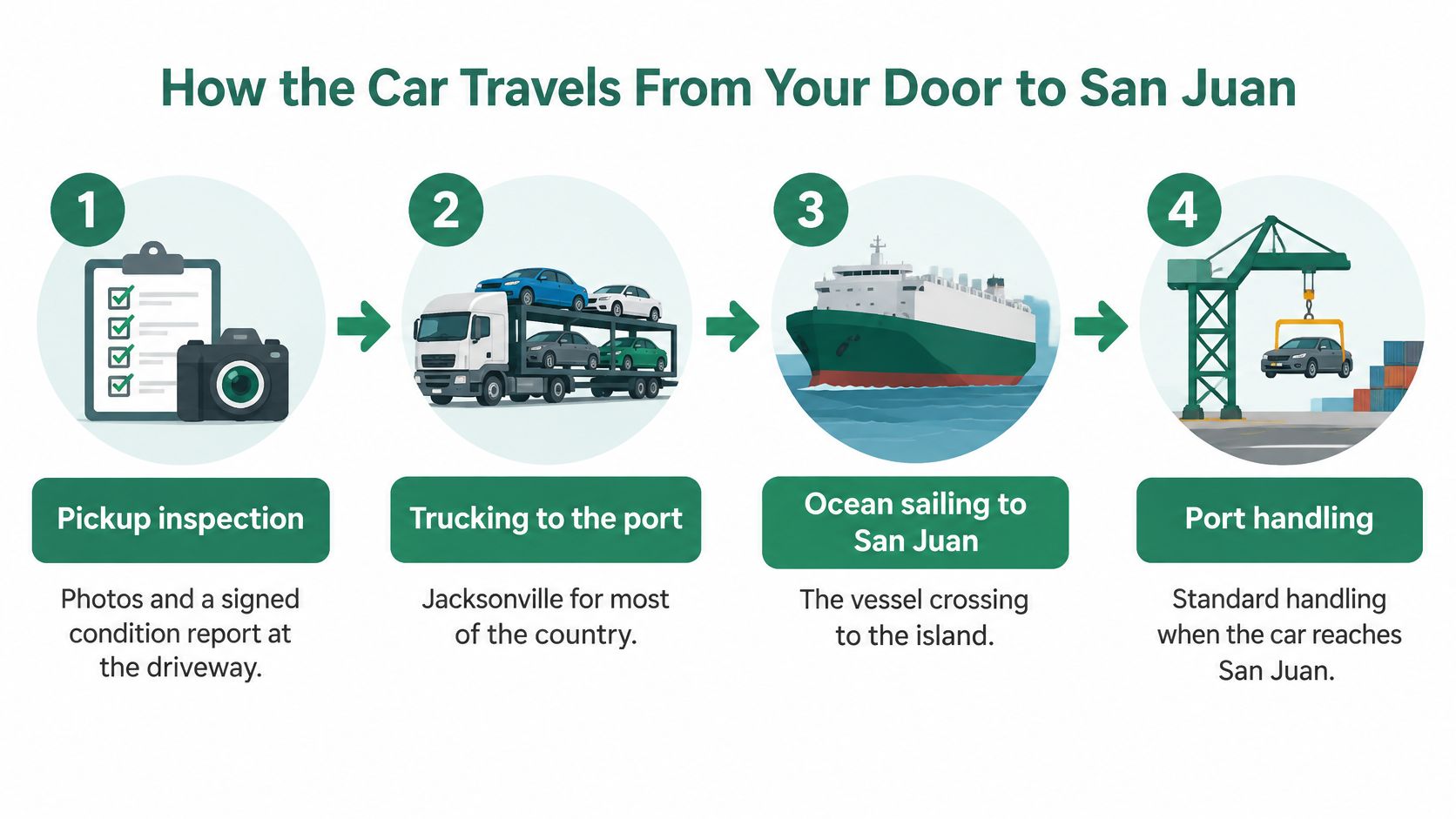
This visual shows the physical sequence from inspection through arrival.
Inspection and mainland trucking
At collection, photograph the vehicle and review the signed condition report before the driver leaves. Record existing damage, mileage and any handling instructions, then retain your copy.
The truck takes the car to the booked gateway. Jacksonville is a major routing option; Philadelphia can be relevant for Northeast shipments when the selected service supports that gateway. Confirm the actual departure terminal rather than assuming the nearest coastal city is the right one.
Receiving, sailing and release
Port receiving isn't the same event as vessel departure. The vehicle must reach the terminal within its receiving requirements, with the documentation accepted before loading.
According to the Puerto Rico Ports Authority, Jacksonville handles almost 90% of maritime cargo between Puerto Rico and the U.S. mainland, making it an important gateway for this trade.
After the crossing, the vehicle must be unloaded and released through the applicable terminal and Hacienda processes. Local delivery can then be arranged for the contracted address in San Juan, Bayamón, Carolina, Guaynabo, Caguas, Ponce, Mayagüez or Arecibo.
The following video provides additional context for planning the transport.
Don't count the booking date as the sailing date. Obtain separate expectations for pickup, terminal receiving, departure, arrival and release, especially if you need the car for work immediately after relocating.
For address service, review how door-to-door vehicle transport works when a large truck can't safely enter your street. A nearby accessible meeting point may be necessary.
Documents and Hacienda Paperwork Before the Car Sails
The flat rate answers only the transport question; ownership, arbitrios and terminal acceptance sit outside that number. Keep two folders: one for carrier acceptance, one for Puerto Rico tax assessment. Sending a title photo does not complete the tax filing, and paying freight does not establish ownership.
Prepare the port folder
Use this checklist with your agent and the receiving terminal:
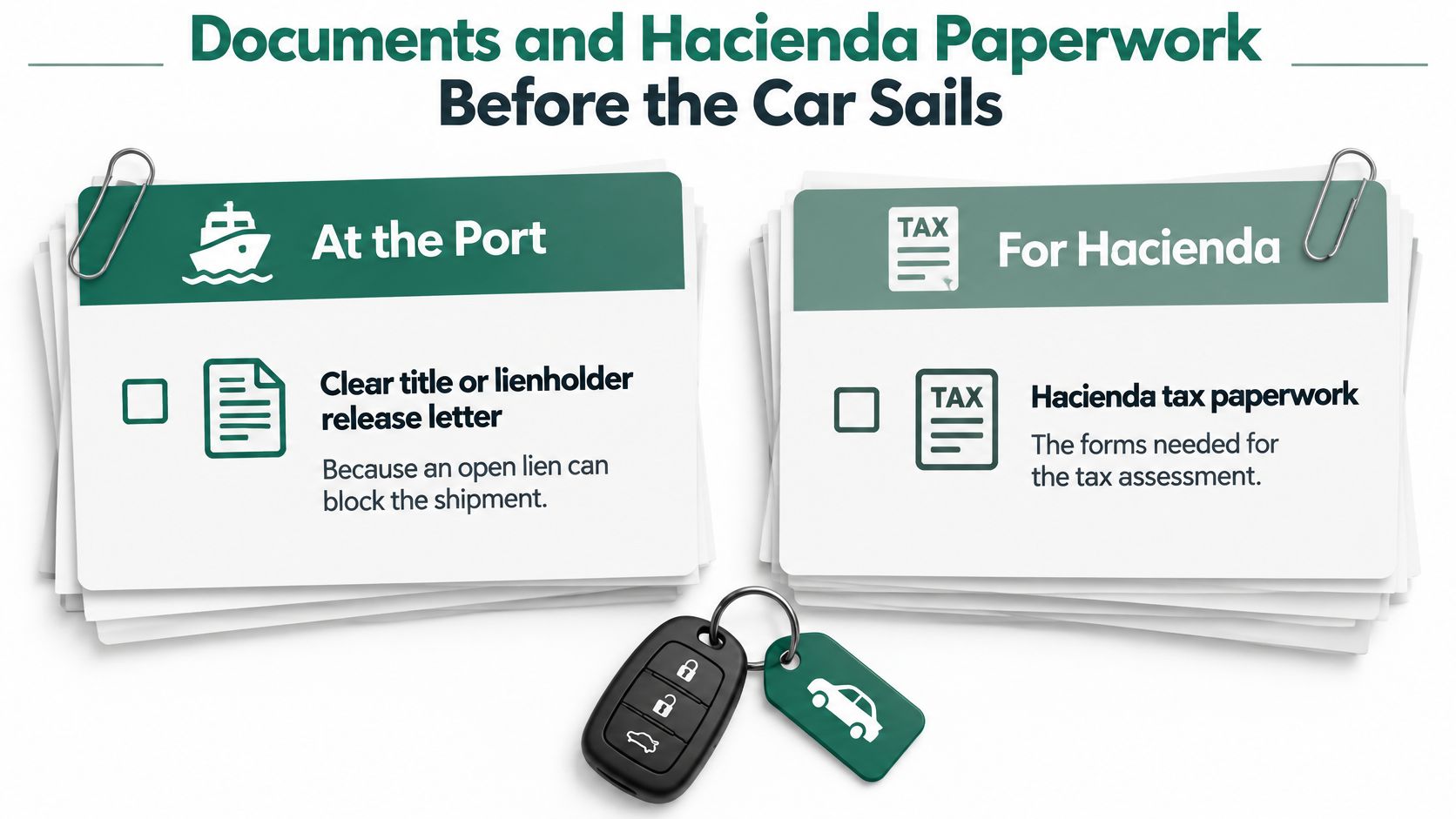
- Ownership: Clear title, or the lienholder's required release or shipping authorization.
- Identity: Government photo ID matching the booking.
- Representation: Signed authorization or power of attorney when another person handles the vehicle.
- Vehicle records: Current registration and requested proof of insurance.
- Transport record: The carrier-issued bill of lading.
Empty personal belongings, provide the keys, clean the car for inspection, and confirm the collection address in writing. Resolve a lien before delivery to the terminal rather than assuming possession of the car is sufficient. A clean flat rate can still leave a car waiting if one signature is missing.
Prepare the Hacienda folder
Hacienda's excise-tax bulletin specifies vehicle invoice and bill-of-lading information and requires carriers to provide cargo documents within 24 hours after arrival. Hacienda's declaration guidance also identifies the Motor Vehicle Inspection Document used for assessment.
| Document | Who provides it | What must appear on it |
|---|---|---|
| Commercial invoice | Seller, dealer or vehicle owner | Make, model year, model, color, quantity, VIN, shipping terms, freight and insurance charges, discounts, country of origin |
| Bill of lading | Ocean carrier | Import date, cargo details, origin port, destination port |
| Motor Vehicle Inspection Document | Inspection or valuation provider | Vehicle assessment used for excise-tax calculation |
| Title and photo ID | Vehicle owner | Ownership and identity records consistent with the vehicle's VIN |
Arbitrios is separate from freight. Budget for Hacienda's vehicle assessment rather than calculating tax from the shipping charge.
If the vehicle is leaving the island rather than arriving, confirm the required motor-vehicle steps before scheduling terminal delivery and fold the dates into your Puerto Rico moving preparations.
Resolve missing ownership paperwork before scheduling terminal delivery. A booked sailing will not cure a title problem.
Island-to-Mainland Shipments and Export Papers
For a departure from Puerto Rico, start with the vehicle's legal readiness to leave, not the mainland delivery date. Have the agent verify which export certificate, registry documentation and ownership authorizations the receiving terminal requires for your particular vehicle.
The export notation, title status and plate-handling process need to agree with the booking. Keep copies of submitted documents and written confirmation of acceptance; an appointment to obtain a document isn't the same as having the accepted document in hand.
Arrange the departure in the right order
- Verify the record: Resolve ownership discrepancies, liens and export-document requirements before committing to terminal delivery.
- Confirm island collection: Specify whether you'll deliver the car to the terminal or need pickup from your municipality.
- Name the mainland gateway: Establish Jacksonville or an available Philadelphia service before arranging onward delivery.
- Check the final address: Confirm truck access and the person authorized to inspect and receive the vehicle.
A car collected in Ponce or Mayagüez needs an island-side trucking arrangement to reach the departure terminal. Don't treat collection anywhere on the island as automatically included in a terminal-based quote.
Plan for the mainland handoff
After ocean arrival and terminal release, the mainland truck still needs to collect the vehicle. A vessel's arrival notice isn't a promise that the car will reach your driveway that afternoon.
For car shipping from Puerto Rico, we coordinate service to all U.S. states. The destination determines the onward routing, so provide the actual delivery ZIP code rather than only the state.
Give your receiving contact the condition report and inspection photographs before delivery. If someone else accepts the car, make sure they understand how to record any new damage before signing.
Special Moves From Snowbirds to Dealerships
The most useful way to organize a special move is by the constraint that changes the booking. A seasonal resident and a student may need similar transportation, but their availability to receive the car can be very different.
When the return date matters
Snowbirds should plan both directions early, while keeping the return leg's confirmation terms clear. If your accommodation ends before the car can sail, arrange lawful parking or storage rather than leaving that gap unresolved.
A snowbird car transport plan should identify who can release and receive the vehicle if your travel dates change. An early request helps coordination, but it doesn't automatically lock a future return price.
Students heading to mainland universities need a receiving arrangement that works with campus access. An August departure or May return should account for exams, housing handovers and whether the student will be present at delivery.
When availability or handling matters
Military families moving on PCS orders should distinguish their required reporting date from their vehicle's acceptable delivery window. Provide the orders-related timing constraints, but confirm separately what transportation expenses are authorized or reimbursable.
Returning residents bringing a household vehicle to the island should resolve ownership and Hacienda preparation before household-moving deadlines take over. Having owned the car for years doesn't eliminate the need to establish the correct import process.
For dealers and auction buyers, the vehicle list should include VINs, dimensions and operational status. Coordinate multiple units under compatible documentation where the carrier permits it, without assuming every vehicle belongs on the same bill of lading.
Booking priority: Disclose what the vehicle can't do. A car that starts but won't brake or steer isn't ready for ordinary drive-on handling.
Classic or high-value vehicles may justify enclosed mainland transport or a suitable container arrangement. Identify the required protection for each leg rather than treating those services as interchangeable.
No two shipments are alike. A running sedan and a lifted truck can require different equipment on the same route in the same month.
Confirm These Details Before You Book
A flat rate is useful only when the written total matches the whole job. Before authorizing a mainland to Puerto Rico shipment, pin down what the price includes, what sits outside the transportation number, and who handles each handoff. Ask for the ocean freight, trucking, port handling, departure terminal and arrival terminal in the same service description.
Check these points before payment:
- Total and ports: Ocean freight, handling, departure terminal and arrival terminal.
- Addresses and vehicle: Pickup, delivery, vehicle class, modifications and running condition.
- Schedule: Pickup window, sailing expectations and delay procedures.
- Protection: Insurance scope, deductible and claims process.
- Payment: Due dates, reservation status and cancellation terms.
- Paperwork: Who prepares Hacienda documents and who handles terminal release.
For a repaired auction vehicle, settle safety-system concerns before presenting it as road-ready. Safety Restore's common airbag module reset questions can help you frame repair questions, but don't replace a qualified vehicle inspection.
National Car Transport has 25+ years of experience, an A+ BBB rating, and a network of 25,000+ vetted carriers. Our USA-based bilingual English and Spanish agents support each customer with a dedicated advisor who keeps the process simple and informed from pickup to delivery.
Provide the year, make, model, running condition, and exact origin and destination. Confirm the assumptions in writing before authorizing the sailing. A free, no-obligation flat-rate quote can give you the number in minutes, but the booking decision should come after the taxes, service boundaries and sailing arrangements match your move. Our transportation price includes the agreed trucking, ocean freight, port handling and insurance, with no hidden fees.