A door-to-door quote is a flat rate set at booking, with the amount varying by origin, vehicle, and season. It covers freight, not Puerto Rico's vehicle tax, which is billed separately.
If your car must leave a driveway, dealership lot, or base housing street and reach San Juan, choose the handoff pattern around who can meet it. A PCS report date, snowbird flight, semester start, or buyer's schedule may shape the timing. Door-to-door is a choice among three handoff patterns, not a guarantee that a truck can reach every curb. The carrier comes as close to the address as legally and safely possible. For a Puerto Rico shipment, the mainland pickup and island handoff are separate parts of the plan. The quote covers freight only until Puerto Rico's excise tax is added.
Table of Contents
- What Door-to-Door Car Shipping Means for Puerto Rico
- Estimated Costs and Transit Times by Origin
- How Pickup and Delivery Locations Work
- Documents and Vehicle Prep Before the Driver Arrives
- Puerto Rico Arbitrios and the $750 Tax Floor
- Ports Sailings and the Jones Act
- Military Snowbird Student and Dealer Moves
- Book the Door-to-Door Pickup
What Door-to-Door Car Shipping Means for Puerto Rico
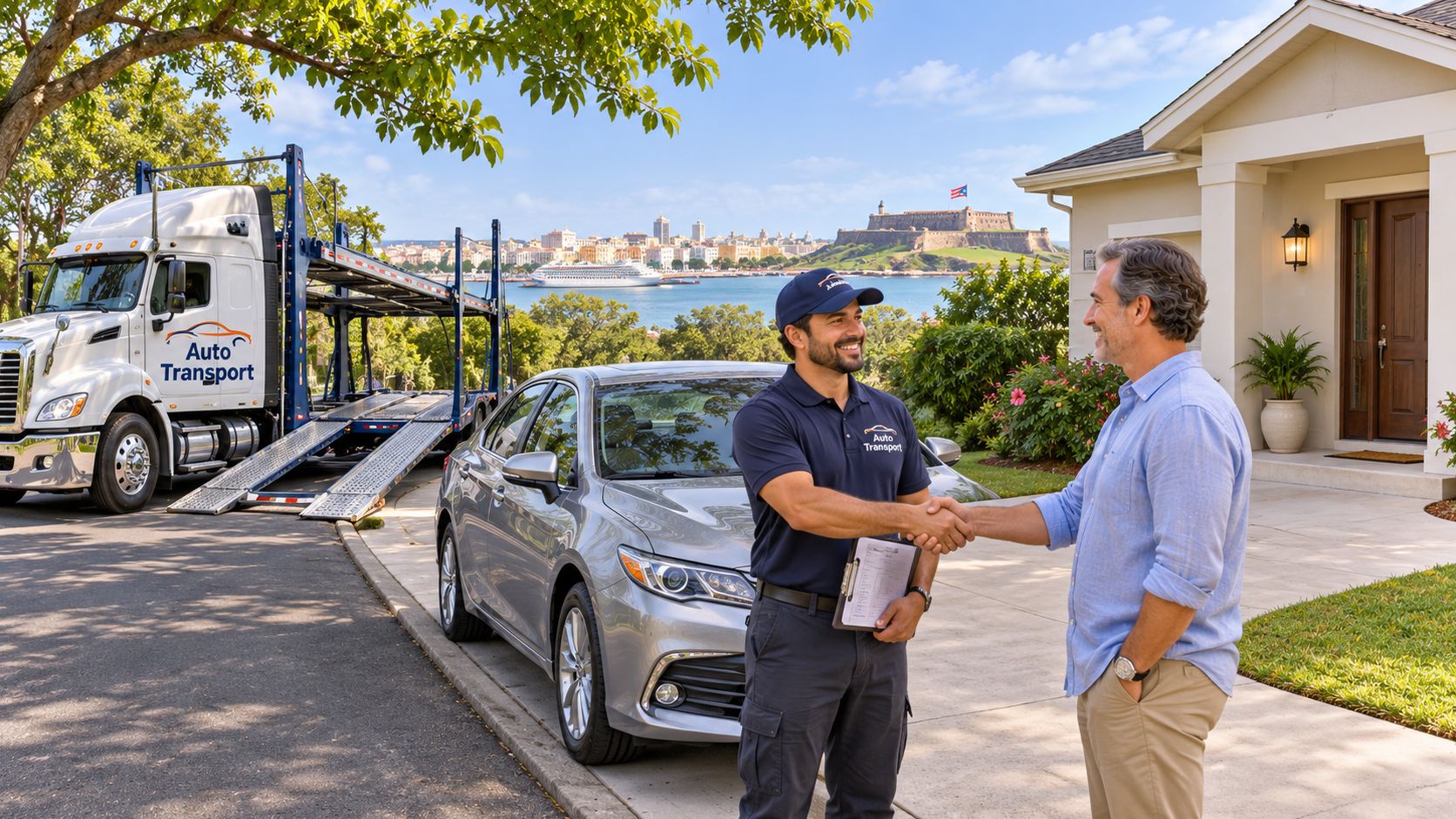
Shipping a car between any U.S. state or city and San Juan is a coordinated chain. On the mainland, a carrier picks the vehicle up at a home, an office, a dealership, or the nearest safe landmark, then trucks it to the sailing port. The island end is not the same product for every address. Match the pattern to who can meet the car.
| Pattern | Handoff | Best when |
|---|---|---|
| Door-to-port | Owner takes the car to the San Juan port | Someone can reach the island port |
| Port-to-door | Pickup at San Juan and delivery to a mainland address | The car is leaving Puerto Rico for a U.S. address |
| Mainland door-to-door | Truck at a home, office, or safe landmark, then ocean to San Juan | Pickup is at a mainland home or workplace |
Which fact picks the pattern
Two facts decide the booking. Can someone reach the Port of San Juan on the day the ship releases the car? Is the mainland stop a home or a workplace?
Door-to-port fits when a relative, a dealer, or you can drive to the island terminal and sign. You skip an island truck leg. You also accept port hours, parking, and a wait if release slips.
Port-to-door fits a car leaving Puerto Rico for a U.S. address. The car is turned in at San Juan. After the sailing, we deliver it to a mainland home, office, dealership, or auction lot. That is the return half of a snowbird year and the inbound half of a move back to the States.
Mainland door-to-door fits when the truck should come to a U.S. address and the ocean leg finishes at San Juan, either as a port handoff or as an island address after release. Offshore moves work as door-to-port or port-to-door: we pick up or deliver at the mainland door, and on the island you drop off or collect at the Port of San Juan.
The service runs both ways. Weight limits, gates, and narrow streets can still move the meeting point a few blocks. That is a site check inside the pickup sequence, not a different product. I would lock the pattern before you ask for a price, because a San Juan port drop and a gated mainland apartment are not the same job.
Estimated Costs and Transit Times by Origin
The origin sets both the inland truck distance and the likely transit window. The figures below show total time to or from Puerto Rico, not just the sailing. Freight costs depend on the vehicle and route, so use the quote for the shipment rather than treating a transit row as a price estimate.
| Mainland origin | Estimated freight cost | Total transit |
|---|---|---|
| Miami / South Florida | Quote required | 7–10 days |
| Orlando / Tampa / Jacksonville | Quote required | 7–10 days |
| Atlanta | Quote required | 8–12 days |
| New York / New Jersey / Philadelphia | Quote required | 10–14 days |
| Boston / Hartford | Quote required | 11–15 days |
| Chicago | Quote required | 12–16 days |
| Houston / Dallas | Quote required | 10–14 days |
| Los Angeles / West Coast | Quote required | 14–18 days |
What the flat rate covers
The carrier quote covers the booked transport, including mainland trucking, ocean freight to San Juan, and the port handling included in that booking. It is freight, not the full cost of importing a vehicle: Puerto Rico's arbitrios are billed separately. The carrier figure and island tax should therefore be budgeted on separate lines.
All published rates are estimates for a standard running sedan on open transport. They are not guaranteed and can change with season, fuel prices, and route demand. A non-running vehicle, enclosed trailer, lifted truck, or dealer unit with aftermarket parts may cost more than that standard shipment. Open transport is the more economical option and the same method dealerships use for new vehicles. Choose it when an open trailer suits the vehicle; enclosed transport is the alternative when added protection is needed.
For ways to reduce the freight portion of the bill, compare options in this guide to the cheapest way to ship a car to Puerto Rico. The quote still does not include the island tax.
How the days add up
Transit includes four stages: mainland pickup, the sailing, port processing, and the island handoff. South Florida, Orlando, Tampa, and Jacksonville are nearer the Florida load port, so their listed windows are shorter. Atlanta adds inland trucking. Northeast origins may use a different mainland terminal, while Boston and Hartford sit farther up the coast. Chicago and Texas are inland routes; from the West Coast, the long truck leg to the ship places the estimate at the upper end of the listed range.
Practical rule: Match the origin row to your required arrival date, then budget the freight quote and Puerto Rico's separate tax as distinct costs. The three handoff patterns affect where the vehicle changes hands, but a door-to-door quote is not a curb-access guarantee.
How Pickup and Delivery Locations Work
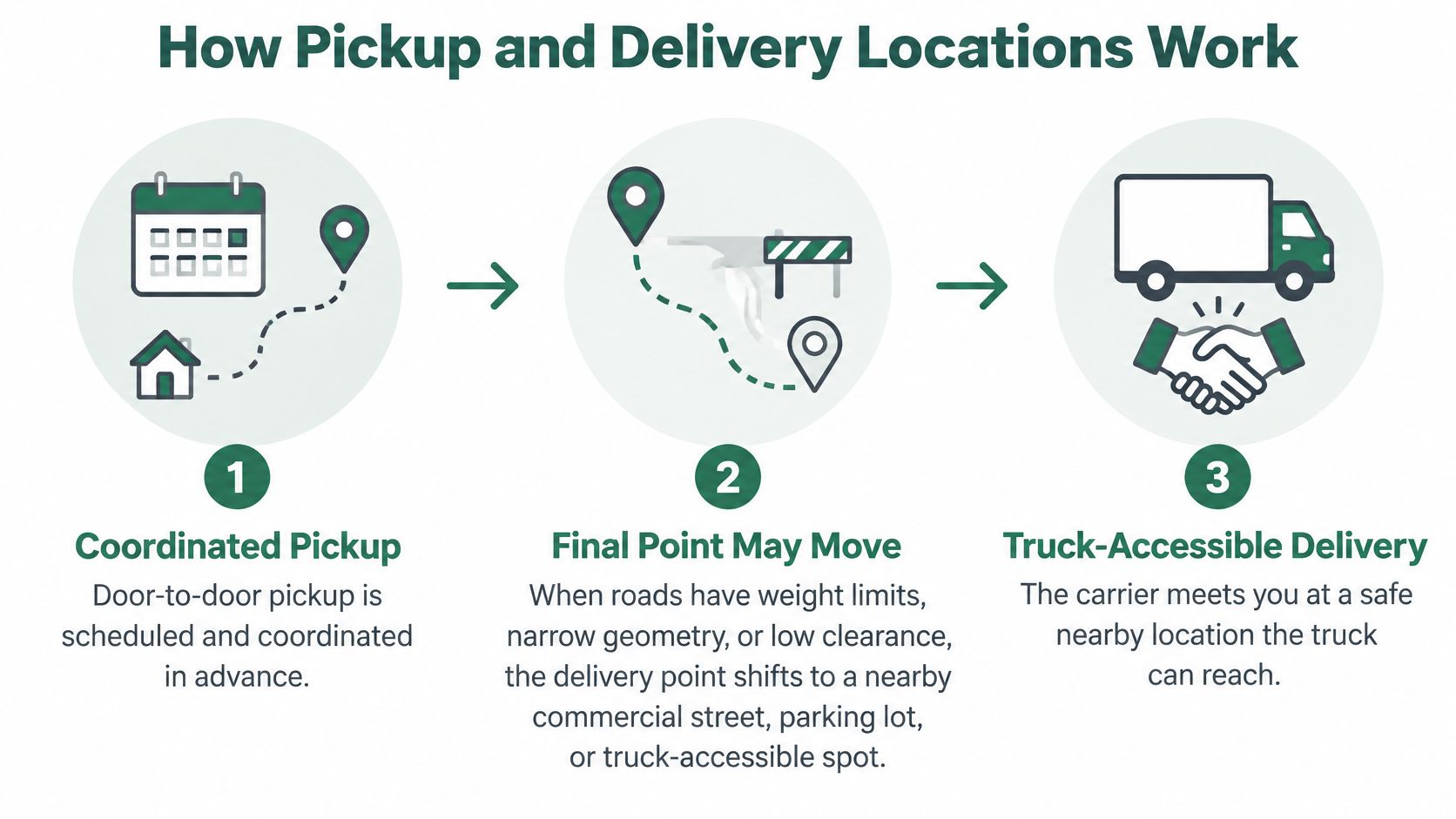
Door-to-door is a handoff arrangement, not a guarantee that a carrier can stop at your curb. The driver comes as close to your address as legally and safely possible. A narrow road, weight limit, low clearance, gate, dead end, or unpaved surface may require meeting at a nearby commercial street or parking lot. These access limits can affect apartment complexes, dense urban blocks, military housing, rural roads, and gated communities.
The Federal Highway Administration identifies loading space and the final stretch to a destination as recurring freight constraints. A map pin alone cannot confirm that a large carrier can stop there. For a practical overview of how truck pickup and delivery works, remember that the address, truck access, and handoff point all matter.
The sequence we actually run
- Share the exact address and access details. Mention low bridges, steep grades, gate codes, and visitor hours. A ZIP code can hide a clearance problem that determines whether the assigned truck can reach the address.
- Choose an accessible alternate before dispatch if needed. A nearby grocery lot or wide commercial street can prevent a failed attempt on sail day. You, a representative, or the receiving contact can meet the driver there.
- The driver calls ahead before pickup. This gives you an arrival window, rather than leaving you to wait at the curb without an update.
- The driver records a walk-around inspection on the bill of lading before loading. Existing chips and dents are documented while both parties can see them. For Puerto Rico shipments, the carrier picks up at the customer's door anywhere in the U.S. and trucks the vehicle to the Jacksonville, Florida, port, with the inspection documented at pickup.
- The truck takes the vehicle to Jacksonville. This is the mainland port used for the Puerto Rico shipment after the road leg.
- At the island end, the handoff is at the Port of San Juan. For a door-to-port shipment, you drop off the vehicle at the port. For a port-to-door shipment from Puerto Rico, you collect it there. There is no island-address pickup or delivery.
- At mainland delivery, the driver calls before arrival, completes the final inspection with you, and collects any balance. Review the condition report before signing.
If the carrier cannot stop safely, the vehicle will not be left in a travel lane. The meeting point must change, or the stop must be rescheduled. You can authorize a representative to sign by naming that adult in advance. If your address changes after the truck is assigned, tell the company before dispatch because the route may need to change.
For example, a car in a gated complex in northern New Jersey bound for a family address in San Juan may need a mainland meeting point outside the gate. The island-side handoff remains at the Port of San Juan. For a vehicle coming from Puerto Rico to a mainland address, the driver comes as close to that address as the law and safe truck access allow.
Before booking, settle two practical details: whether you can meet at an alternate point, and who can receive the vehicle if you are unavailable. The driver needs a safe stopping place and an authorized person for the handoff.
This short walk-through shows how a coordinated stop is arranged when a truck cannot use the driveway.
Documents and Vehicle Prep Before the Driver Arrives
Paperwork and the car's condition decide whether San Juan releases the vehicle on time. A ship can dock on schedule and the car can still sit, because inspection or a missing title stops the handoff. Vehicles generally need the original title and must be clean, including the undercarriage, because agricultural inspection applies in both directions, according to shipping guidance for cars bound for Puerto Rico.
Prep in the order that prevents a hold
- Gather the title, or a bank letter if the car is financed. The port and the carrier need proof you can ship it. A lienholder letter should name the vehicle and say export or transport is allowed.
- Bring photo ID and current registration. The person at the truck should match the booking, or be the adult you already authorized.
- Say whether the car runs when you book. A dead battery or a no-start changes the trailer. Guessing "it runs" and finding out at the curb misses the sailing.
- Empty the cabin and trunk. Carriers don't cover personal items under the vehicle insurance. Leave the spare tire and jack. Take documents, child seats, and anything you'd claim on a home policy.
- Leave a quarter tank of fuel or less. A full tank adds weight and isn't needed for loading. Enough fuel to start and move onto the trailer is the point.
- Clean the undercarriage and the exterior. Mud and plant debris are what agricultural inspection is looking for. A wash the night before is cheaper than a failed inspection after the ship arrives. Do this for mainland-to-island and island-to-mainland.
- Keep the car accessible and the keys ready. A car blocked in a garage, or keys still with a spouse at work, turns a 20-minute load into a missed cutoff.
- Note existing damage, then walk the car with the driver and sign the inspection on the bill of lading. Undocumented scratches become an argument at delivery. Photos on your phone, taken in daylight before the driver arrives, back up that form.
A dirty undercarriage can hold the car at inspection even when the ocean leg was on time. A full tank doesn't help the ship and can push a marginal weight situation. Personal goods in the trunk aren't a free extra container.
Who signs, who pays, who receives
Who signs: the owner or one authorized adult at pickup, and the same kind of person at delivery. Dealers should name one employee for the walk-around.
Who pays port charges: agree this before the car sails. If a terminal or documentation fee sits outside the flat rate, the person meeting the car in San Juan needs authority to pay it. Don't leave that to a student who only has the keys.
Who receives the car on the island: name them on the booking, with a phone that works at the port. If you're leaving Puerto Rico, prepare an export certificate or lender clearance when the island requires it or when the lienholder wants it before export. Keep a copy with the title, the bill of lading, and the San Juan inspection record so release isn't waiting on a form that's still in a desk.
Puerto Rico Arbitrios and the $750 Tax Floor
The number that surprises people isn't the freight. Hacienda identifies a minimum automobile excise tax of $750. That category covers vehicles with any means of self-propulsion designed to transport people, including hearses and flower-delivery carriages. The minimum is a Puerto Rico tax floor for qualifying automobiles. It isn't a shipping price, and it sits apart from ocean transport, terminal, documentation, inspection, and inland delivery charges.
Arbitrios is the island's vehicle excise tax on cars brought into Puerto Rico. You pay it to the government, not to the truck.
| Cost item | Who sets the amount | When it applies |
|---|---|---|
| Carrier freight, flat rate | Carrier quote at booking | Before pickup |
| Arbitrios excise tax | Hacienda estimate by VIN | Before release at San Juan |
| Minimum automobile excise | Hacienda floor of $750 | For qualifying automobiles |
| Port handling and documentation | Included in the carrier flat rate when contracted; any terminal fee outside that quote is confirmed before sailing | At the Port of San Juan |
How to estimate the tax
Hacienda's online vehicle excise estimator lets you search by make, model, and year or, more accurately, by the VIN, which may contain up to 17 characters. You'll usually find it on the dashboard plate, the vehicle license, or the title. The final amount may depend on Hacienda's official assessment, so treat the screen as a planning figure, not a receipt. Payment methods listed there are ACH debit, credit card, and qualifying ACH credit.
Filings and payments go through SURI, the Unified Internal Revenue System. Hacienda states that this requirement has applied since December 10, 2018. The excise-tax declaration is the document used to report and pay taxes on goods introduced into Puerto Rico. For imported vehicles, the supporting record is the vehicle inspection document or valuation assessment, the Documento de Inspección de Vehículos de Motor, also called tasación. General import filings may also require a commercial invoice and a bill of lading. Those papers matter when the car arrives in San Juan from Jacksonville, Philadelphia, or another mainland port.
Get both numbers before you sail. A carrier quote without the Hacienda estimate understates what it costs to put the car on the island. Households planning the wider move can line the car up with the rest of the timeline in our guide to moving to Puerto Rico.
Do these three things in order. Run the Hacienda estimate by VIN. Get the carrier quote for the same vehicle. Confirm who pays the tax and any port charges at San Juan before the car leaves the mainland.
Ports Sailings and the Jones Act
For a Puerto Rico shipment, the ocean handoff runs through Jacksonville, FL and San Juan. After pickup anywhere in the U.S., the carrier trucks the vehicle to Jacksonville for loading. San Juan is the island port for mainland arrivals and departures. Door-to-door describes the mainland truck leg, not a promise that a carrier can drive onto a vessel or deliver at a Puerto Rico residence. Offshore shipments use a door-to-port or port-to-door handoff, with vehicle drop-off or collection at the Port of San Juan.
The Jones Act and U.S. cabotage rules affect maritime transport between the mainland and Puerto Rico. Puerto Rico government materials on cabotage explain that these rules restrict which vessels may carry goods on that route. For a vehicle shipment, the practical effects include vessel availability, sailing schedules, port handling, and pricing. Sailings follow vessel schedules, not the availability of a highway truck.
Missing the cutoff can leave a car waiting for the next sailing. The same applies when required title or inspection papers are missing. That delay affects the schedule, not the freight price.
Four checks before you lock a date
- Confirm Jacksonville as the mainland load port. For Puerto Rico shipments, the vehicle travels there by truck before loading.
- Ask which sailing the booking is tied to. A broad month-long window does not identify the cutoff. Check the Puerto Rico car shipping schedule against the assigned sailing.
- Leave spare days around fixed arrival dates. A sailing schedule may not align with a military report date or a planned arrival on the island.
- Confirm the handoff in both directions. Mainland-to-island shipments go to the Port of San Juan, while return shipments require collection there. On the mainland, the carrier handles pickup or delivery at the customer's address as legally and safely possible.
Treat the carrier quote as freight, not the full cost of receiving the vehicle in Puerto Rico. Hacienda's arbitrios and any port charges are separate items to plan for.
Military Snowbird Student and Dealer Moves
The mainland-to-San Juan chain is the same. The person meeting the car is not.
Households moving onto or off the island need a home or office pickup and one named receiver. If the car is entering Puerto Rico, leave time for the Hacienda estimate before anyone plans to drive it off the port. A lease end on the mainland and a school start on the island rarely land on the same day as a ship.
Snowbirds who split the year between a mainland state and Puerto Rico often ship twice. Each direction needs its own sailing and a clean undercarriage for agricultural inspection. Don't assume the return booking is a copy of the inbound one. The season, the port, and who is on the island to sign will differ. I would book the return when you book the outbound if both dates are already fixed.
Military families should say whether the address sits behind a base gate or on a military-housing street. Those roads often can't take the carrier, so the handoff moves to a commercial point outside the gate. Tell us that before the truck is assigned, and name a receiver who can leave the installation during the arrival window. Orders and a report date belong in the first call so spare days sit in front of that date, not after it. Families comparing duty-station timing can use our page on car transport for military moves.
Students should name who holds the title and who can meet the driver during class hours. A parent on the mainland and a student in San Juan is a normal split. The student still needs ID, the keys plan, and authority to sign if they're the one at the port.
Dealers and other businesses should send the commercial invoice, the bill of lading details, and one person who can sign the inspection. Each vehicle gets its own walk-around, even when five units share a week. Inoperable auction units and motorcycles can move on these routes, but they have to be declared as what they are. Open or enclosed, mainland or island, a personal car or dealer inventory: say which, because vehicle condition changes the trailer.
Tell the agent why the car is moving when you book. The port, the receiver, and the tax steps follow that reason. A dealer buy and a PCS move don't fail in the same place.
Book the Door-to-Door Pickup
Before booking, decide where each handoff will happen. Door-to-door service brings the vehicle to the customer's home, office, or nearest safe landmark, as close to the address as legally and safely possible. For Puerto Rico shipments, the mainland handoff is at the customer's door; on the island, the vehicle is collected from or dropped off at the Port of San Juan.
- Request a quote with the exact origin and destination addresses or ZIP codes. A city name alone may not identify the right pickup point or port. The quote is an estimate, and the carrier's freight charge is separate from Puerto Rico's arbitrios.
- Describe access limits such as gates, low bridges, or restricted streets. Give the dispatcher an alternate truck-accessible meeting point if needed.
- Book online by completing the free quote form and choosing to book at the end. Online booking is available 24/7. After the order comes in, the dispatcher works on the next available spot for the vehicle. There is no upfront charge until the vehicle is matched with a carrier.
- Call or text (800) 320-1050, or call Puerto Rico at (787) 777-1028. Miami is (305) 884-2253. Bilingual agents are available 365 days a year.
- For a vehicle going to Puerto Rico, estimate the Hacienda arbitrios and prepare the title, photo ID, registration, and any required export certificate before pickup.
National Car Transport offers door-to-door vehicle shipping, transparent flat-rate pricing, and a nationwide carrier network. Confirm the vehicle's condition, the pickup and delivery handoff points, and who will receive it. For Puerto Rico shipments, the carrier picks up the vehicle at the customer's door anywhere in the U.S. and trucks it to the Jacksonville, Florida, port.
Confirm the handoff pattern and tax estimate before reserving the shipment. Request a quote from National Car Transport.