
A standard sedan shipped port-to-port from Jacksonville, Florida, to San Juan is the most realistic low-cost scenario, with ocean freight around $1,210. That rate is only the starting line, because Puerto Rico's excise tax, registration, inspection, and handling charges can push the total landed cost several times higher than the freight quote.
You may be relocating for work, sending a vehicle to family, returning from a military assignment, or moving between the mainland and the island for the season. The quote that looks cheapest in an online form often covers only the vessel movement. Your actual budget must account for getting the car to the port, releasing it in San Juan, paying island-side taxes and fees, and completing registration.
The cheapest way to ship a car to Puerto Rico is therefore a total-cost decision, not a race to find the smallest ocean-freight number. For most running, standard-size cars, that means choosing a frequent Florida sailing, dropping the vehicle at the terminal when practical, submitting documents before cutoff, and asking for every charge in writing.
Table of Contents
- What the Cheapest Quote Really Buys You
- RoRo vs Container vs Door-to-Door Compared
- Port-to-Port vs Door-to-Door Pricing
- The Hidden Cost Layer Most Shippers Miss
- Paperwork, Cutoffs, and Prep That Protect Your Savings
- Choosing a Carrier That Actually Delivers Value
- Your Cheapest-Car-to-Puerto-Rico Checklist
What the Cheapest Quote Really Buys You
The lowest realistic booking scenario is straightforward: a standard sedan, delivered by the customer to the Jacksonville port, shipped by Roll-on/Roll-off, or RoRo, to San Juan. TOTE Maritime lists $1,210 for vehicles up to 82 inches wide and 76 inches high, and $1,310 for vehicles up to 82 inches wide and 100 inches high. Its separate Puerto Rico-to-Jacksonville return rates are $845 to $945. These published figures are documented in TOTE Maritime's Puerto Rico vehicle shipping information.
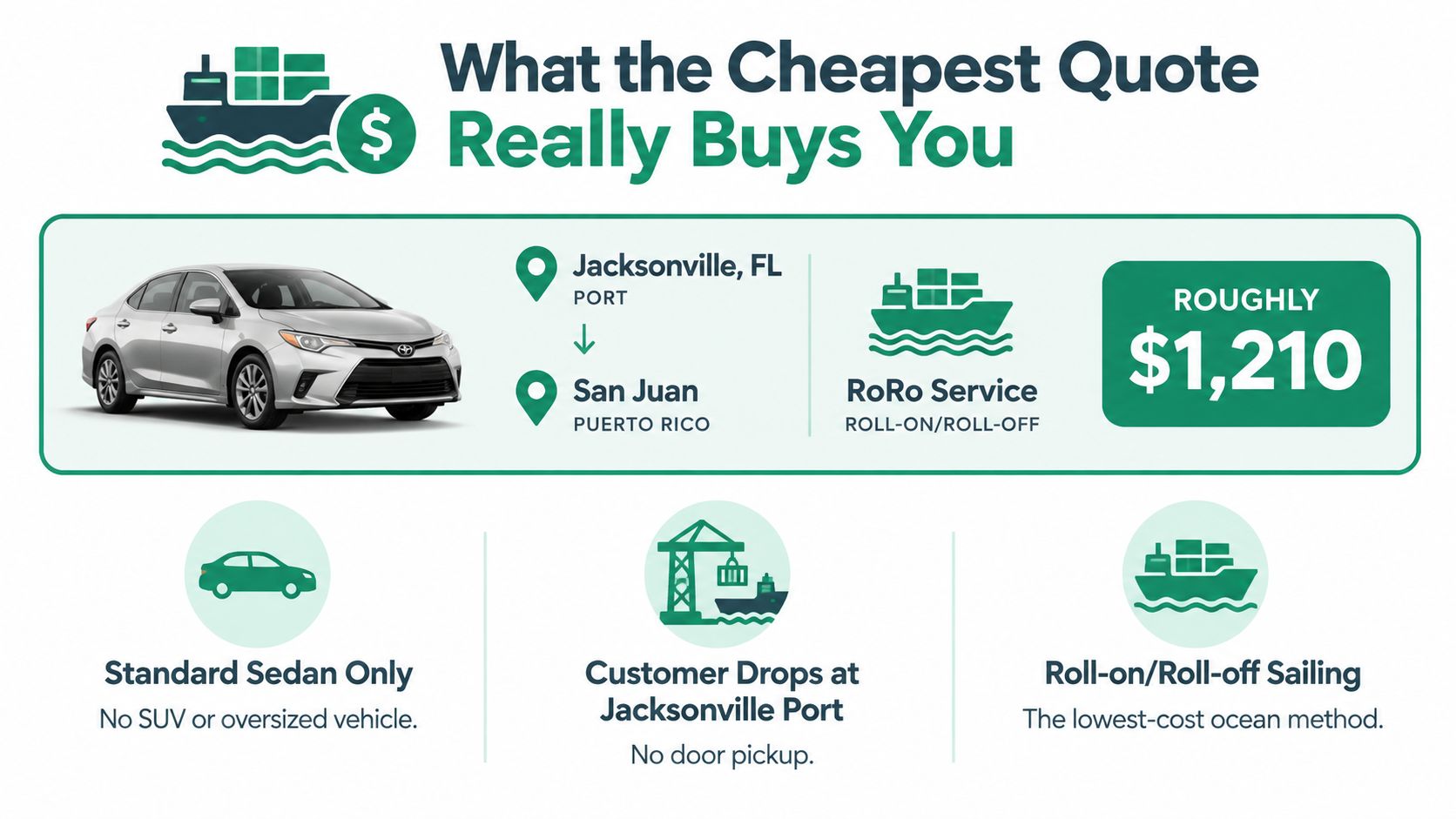
That $1,210 buys ocean freight under specific conditions. It doesn't automatically include inland pickup from another state, private container space, oversized-vehicle handling, or delivery from San Juan to an address elsewhere on the island. TOTE says its listed prices already include bunker, environmental, TAC security, and port-related fees, which is important because a quote that separates those surcharges can look cheaper at first glance.
Dispatcher's rule: Compare the same service level, vehicle dimensions, port, destination, and included fees. A lower headline price isn't a lower landed cost if the carrier adds charges later.
Puerto Rico's tax layer can be more important than the vessel rate. One industry summary cites an 11.5% excise tax on vehicle value, plus $200 to $500 in registration fees and $50 to $100 for inspection. Another comparison shows shipping-related costs rising from approximately $1,295 to $1,895 in ocean freight to $4,600 to $15,000 or more after taxes and fees are included. See the Puerto Rico vehicle shipping cost breakdown before treating any quote as final.
For a fair comparison, write down four totals:
- Mainland transport: What will it cost to reach Jacksonville?
- Ocean freight: Is the quote port-to-port or door-to-port?
- Island charges: Which taxes, inspection, registration, broker, and terminal fees are excluded?
- Release and delivery: Who handles San Juan pickup and final delivery?
If you're also arranging household equipment or temporary storage during a relocation, it may help to compare container rental sizes separately. Don't assume a vehicle container and a household storage container are interchangeable services.
RoRo vs Container vs Door-to-Door Compared
RoRo is the budget default for an operable sedan or SUV. The vehicle is driven onto the vessel, secured on a vehicle deck, and unloaded at the destination. You aren't paying for a dedicated box, crating, or the extra loading work associated with container service. The car must be operable, and personal belongings generally aren't part of the low-cost RoRo calculation.
A container makes sense when the vehicle is valuable, non-running, modified, or unusually vulnerable to handling exposure. Shared container space can spread the container cost across multiple vehicles, while an exclusive container provides more control but commands a higher charge. Container service may also accommodate approved spare parts or boxes, subject to the carrier's rules and insurance terms.
Door-to-door service adds mainland pickup and Puerto Rico delivery to the ocean movement. It can be convenient for a student, military family, dealership, or customer living far from a port, but convenience creates additional trucking and handling legs. If you can safely drive the car to Jacksonville, port delivery usually deserves the first comparison.
| Mode | Typical Price Range (sedan) | Best For | Main Cost Driver |
|---|---|---|---|
| RoRo | Ask for a route-specific quote | Running sedans and ordinary SUVs | Vessel space, vehicle dimensions, and port handling |
| Container | Ask for a route-specific quote | Classics, exotics, non-runners, and approved contents | Shared or exclusive container space and loading labor |
| Door-to-door | Ask for a route-specific quote | Inland origins, limited mobility, and managed relocations | Mainland pickup, ocean freight, and Puerto Rico delivery |
The transport method used on the mainland also matters. Open car transport is generally the economical choice for ordinary vehicles moving within the 48 states before the ocean leg. Enclosed transport is more appropriate for a collector car or high-value vehicle, but its added protection doesn't belong in a budget calculation unless the car needs it.
My recommendation is direct: choose RoRo for a running standard sedan, container service for a non-running or high-value vehicle, and door-to-door only after comparing the cost of local driving or a short terminal transfer. A cheap method that can't accept your vehicle isn't cheap. It creates a rebooking problem.
Port-to-Port vs Door-to-Door Pricing
Port-to-port pricing gives you the cleanest view of ocean freight. You bring the vehicle to the mainland terminal, the carrier loads it, and the consignee or an appointed representative retrieves it in San Juan. The savings come from removing a mainland pickup leg and reducing the number of parties handling the car.
Door-to-door pricing combines several services into one managed move. Depending on the origin and destination, the bill may contain domestic pickup by a third-party hauler, inland drayage to the port, terminal handling, ocean freight, San Juan release coordination, and Puerto Rico ground delivery. Ask the provider to show each segment instead of accepting one blended total.
| Cost Segment | Port-to-Port | Door-to-Door |
|---|---|---|
| Mainland pickup | Customer delivers vehicle to terminal | Carrier or subcontracted hauler collects vehicle |
| Inland movement | Usually limited to the customer's own trip to port | Added transport from origin address to loading port |
| Ocean freight | Included as the primary transport charge | Included, often inside a bundled quote |
| Origin terminal | Confirm whether included | Confirm whether included |
| San Juan terminal | Confirm release and handling charges | Confirm whether the service includes release handling |
| Puerto Rico delivery | Customer or consignee collects vehicle | Carrier arranges delivery to the final address |
| Main savings opportunity | Avoids extra inland transport | Pays for convenience and coordination |
The cheapest route usually starts at the nearest high-frequency mainland port. Jacksonville, Florida, is a common origin, while Pennsauken or Eddystone, Pennsylvania, also serve Puerto Rico traffic, with San Juan as the principal destination port. Port documentation from Taylor International's Puerto Rico customs guidance reinforces the importance of preparing the original ocean bill of lading, title, registration, and any required customs or EPA-related forms before the vessel cutoff.
Don't drive halfway across the country just to chase a low ocean rate. A modest freight advantage can disappear once you add fuel, lodging, tolls, time away from work, or mainland transport to Jacksonville. For customers in Atlanta, Charlotte, Orlando, Tampa, Miami, New York, Philadelphia, Baltimore, Washington, Chicago, Dallas, Houston, Denver, Phoenix, Los Angeles, Seattle, or other major cities, the right comparison is the complete origin-to-port cost, not the port quote alone.
A terminal transfer can be worthwhile when the vehicle is near Jacksonville or another active port. Customers farther inland may save time with door-to-port service, especially when the provider has a reliable carrier already moving through the area. Ask whether the mainland pickup is direct or brokered through another hauler, and ask what happens if the vehicle misses the vessel cutoff.
The same discipline applies to timing. A cheap quote has little value if the carrier can't confirm space, the documents arrive late, or the vehicle rolls to a later sailing. Weather, terminal congestion, and vessel changes can affect schedules, so get the named sailing or booking reference in writing when available.
For general transport budgeting outside Puerto Rico, a neutral Ferried price guide can help you understand how vehicle size, distance, and service type influence domestic pricing. Use it as a comparison aid, not as a substitute for a Puerto Rico landed-cost quote.
The Hidden Cost Layer Most Shippers Miss
The ocean freight quote is only one line of the transaction. Puerto Rico assesses an excise tax based on vehicle value, and one guide cites an Arbitrios range of 6.6% to 17.5% of vehicle value including shipping. The rate that applies depends on the vehicle and the applicable assessment, so don't build your budget from freight alone. The supporting tax discussion is available in this Puerto Rico vehicle import tax and registration guide.
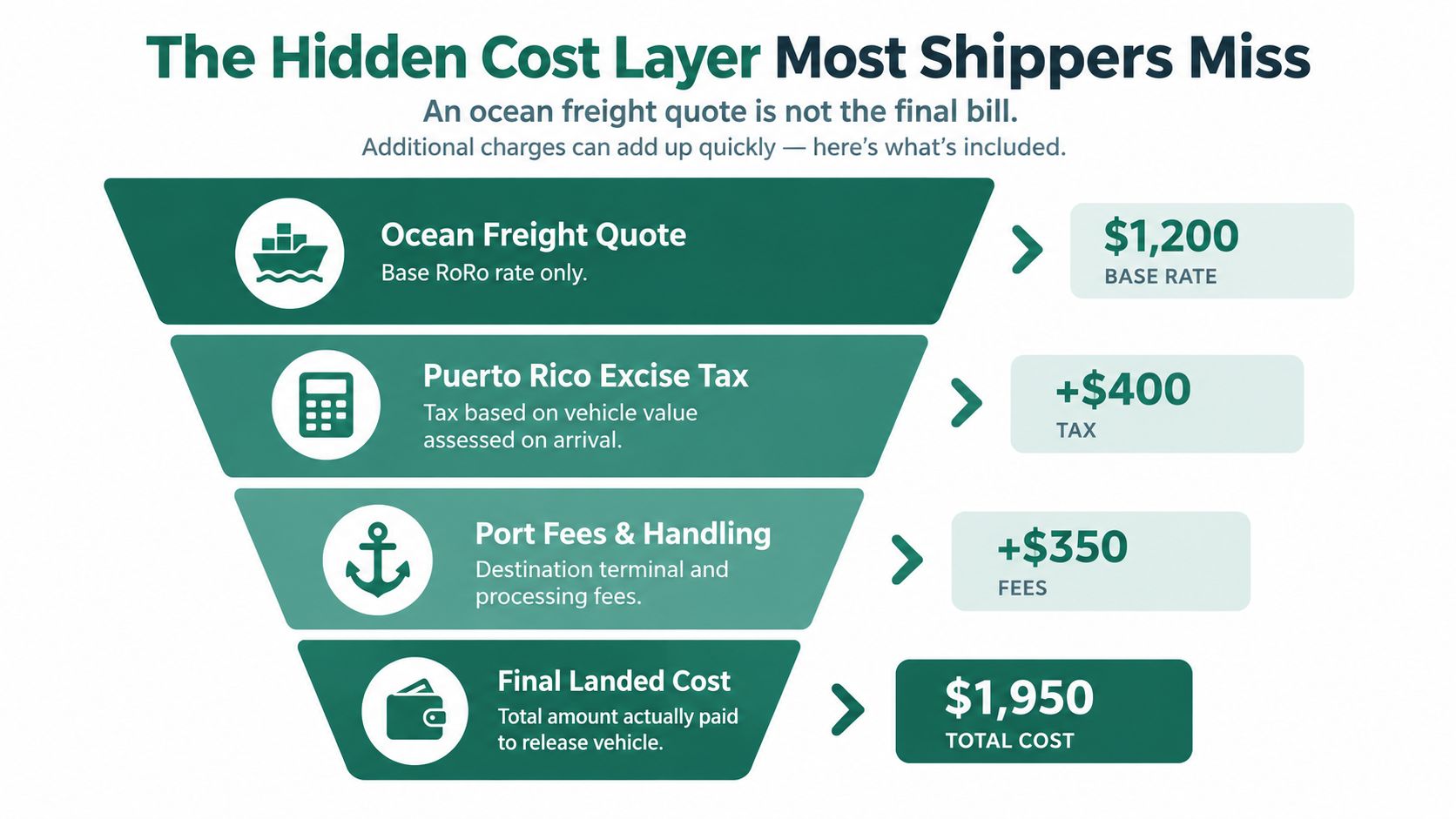
A low freight rate can therefore become an expensive total for a newer, luxury, or high-value vehicle. Registration, inspection, destination terminal processing, broker handling, and possible storage charges can follow the vessel movement. If the car sits because the consignee lacks paperwork or isn't ready to collect it, storage exposure can erase the saving you thought you secured.
The correct question isn't “What is the ocean rate?” It's “What amount must I pay before the vehicle is released and legally usable?”
Request an all-in estimate with separate lines for ocean freight, origin handling, destination handling, broker or processing charges, tax responsibility, inspection, registration, and final delivery. If the provider can't identify what it includes, treat the quote as incomplete.
Puerto Rico is a U.S. territory, so mainland-to-Puerto Rico vehicle movements are generally handled differently from foreign-country imports. Shipping guidance from Crowley's Puerto Rico vehicle service notes that these moves generally don't require the same U.S. Customs and Border Protection inspection or international customs clearance associated with foreign ports. That doesn't eliminate Puerto Rico's own tax, registration, inspection, or release requirements.
The practical budget choice is often a standard sedan with a lower assessed value, shipped port-to-port from a Florida lane. That won't remove the island charges, but it limits the freight and vehicle-size variables that commonly raise the starting bill.
Paperwork, Cutoffs, and Prep That Protect Your Savings
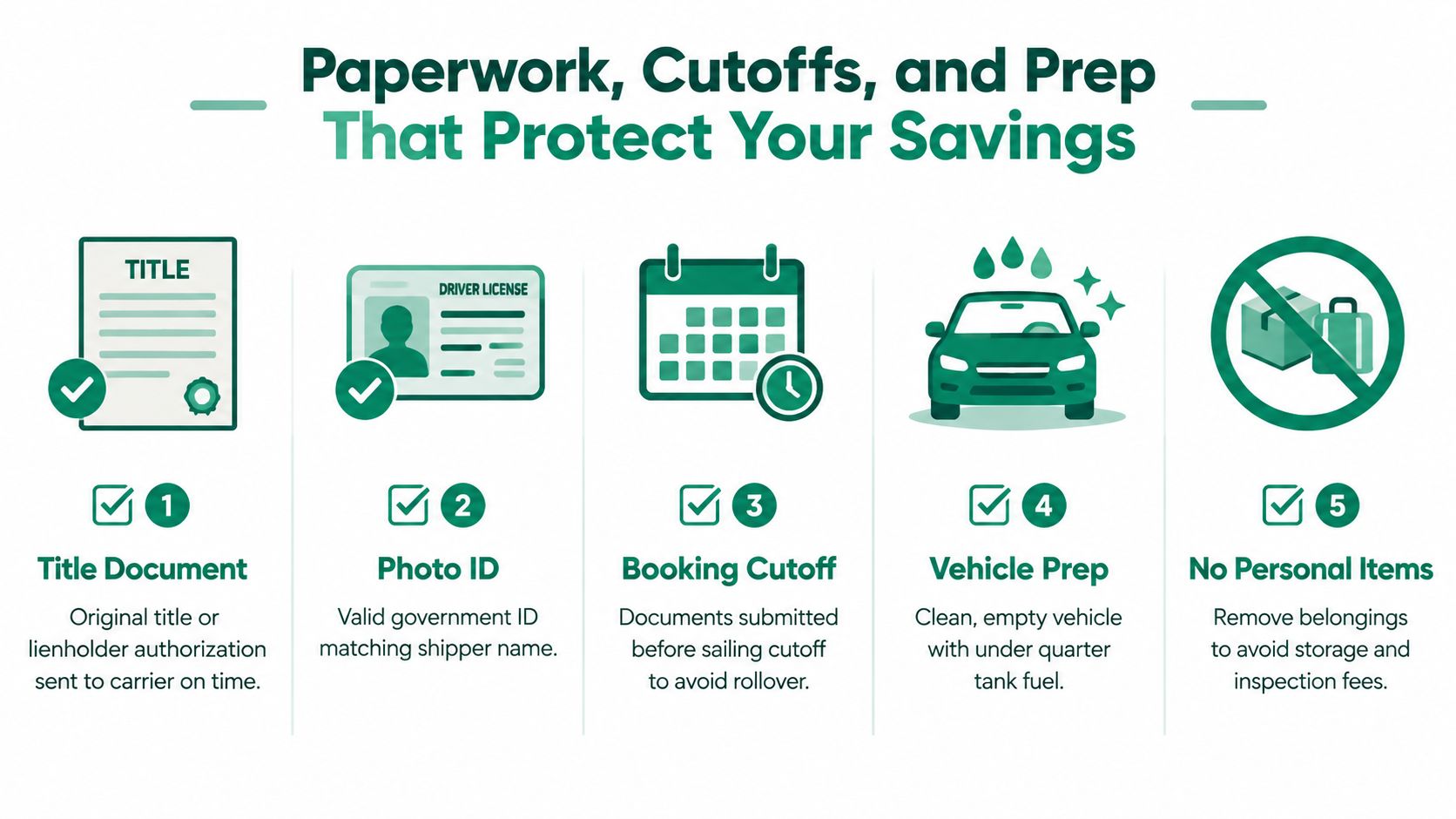
Documentation errors create avoidable costs. Before booking, assemble the original title, current registration, government-issued identification, and ocean bill of lading information. If the vehicle has a lien, obtain written authorization from the lienholder. Joint ownership may require notarized consent or additional authorization, as described in this Puerto Rico vehicle import documentation guide.
Use a simple sequence:
- Confirm ownership: Make sure the name on the booking matches the title and identification.
- Resolve lien issues: Send the lienholder letter or authorization before the carrier's cutoff.
- Review the bill of lading: Check the VIN, vehicle description, origin terminal, destination, and consignee.
- Prepare the car: Wash it, remove personal items, secure loose parts, check the battery and tires, and follow the carrier's fuel instructions.
- Photograph condition: Record every panel, wheel, glass surface, and existing mark before terminal delivery.
Puerto Rico tax law requires vehicle shipment notification 15 days before port release, according to the cited tax and registration guidance. Late notification or incomplete paperwork can expose the vehicle to storage or demurrage and can wipe out a freight saving before you ever collect the car.
Don't wait until the car is already at the port to ask who handles the declaration, inspection appointment, and release. Confirm the consignee, broker contact, payment method, and document deadline in one written email. That record gives you something concrete to use if the booking changes.
Choosing a Carrier That Actually Delivers Value
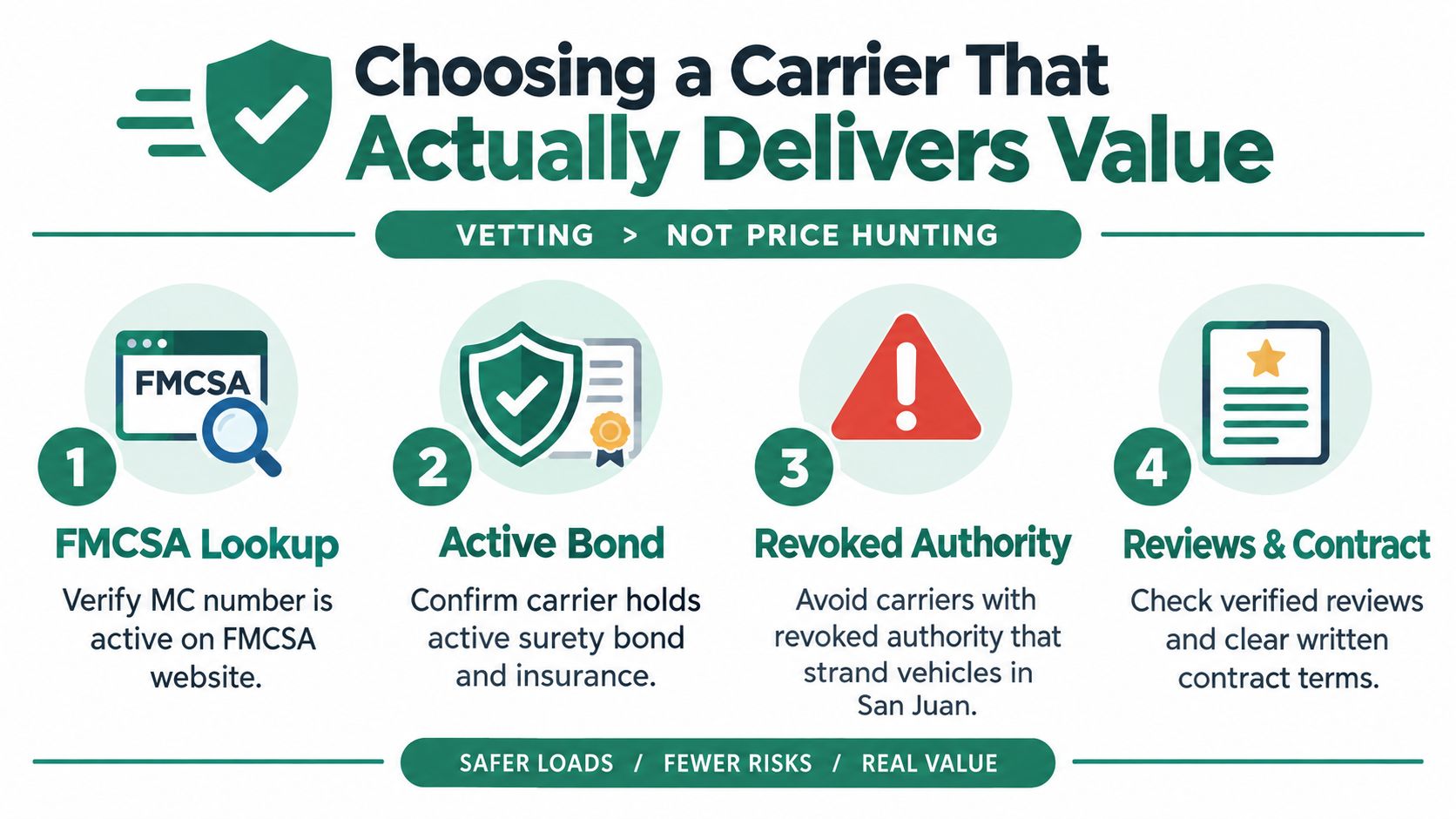
Carrier selection is a verification exercise, not a price contest. Start with the company's FMCSA and MC information, then confirm the authority is active. A company with revoked authority may leave a vehicle waiting at a terminal while the customer searches for a replacement arrangement.
Ask for the insurance certificate and read the actual policy terms. The certificate alone doesn't tell you every exclusion, and broker liability may not equal the ocean carrier's cargo coverage. Confirm who insures the car during mainland pickup, terminal storage, vessel movement, and San Juan delivery.
Look for practical warning signs:
- An implausibly low quote: A dramatically low number may exclude port handling, taxes, delivery, or required vehicle preparation.
- No physical terminal information: You should know where and how the car is accepted.
- An unnamed vessel line: The provider should identify the ocean carrier or explain why the sailing remains pending.
- Wire-payment pressure: Avoid sending full payment before you understand the contract, release conditions, and cancellation terms.
- No Spanish-language support: A bilingual dispatcher can clarify a San Juan hold or documentation question faster when Spanish is the working language.
National Car Transport is one U.S.-based option that coordinates mainland and Puerto Rico vehicle transport, including door-to-port and port-to-door arrangements. The company states that it has 25+ years of experience, an A+ BBB rating, transparent flat-rate pricing, and a network of 25,000+ vetted carriers. Its English and Spanish agents are based in the United States and have over 20 years of experience in auto transport logistics. Those details matter only if the written quote and service terms match the actual booking.
Complete three checks before paying:
- Verify the MC record through FMCSA's SAFER system.
- Request the insurance certificate directly and review the coverage.
- Call the named San Juan consignee or terminal contact to confirm the release process.
Your Cheapest-Car-to-Puerto-Rico Checklist
Run this list before you accept a quote. It keeps the decision focused on the vehicle, route, paperwork, and final release rather than the advertising headline.
Before booking
Choose the simplest service that fits the car. A running, standard-size sedan is the natural RoRo candidate. Decide whether you can deliver it to Jacksonville or another practical mainland port, or whether inland pickup is necessary. If the vehicle is non-running, valuable, modified, or oversized, ask for container or special-handling pricing instead of forcing it into a standard quote.
During quote week
Get several written quotes with identical details. Each should identify the vehicle, origin city, mainland port, San Juan destination, transport method, terminal charges, inland legs, and exclusions. Verify the provider's MC status, request the insurance certificate, and ask whether the price includes fuel, environmental, security, and port-related surcharges. TOTE's published Jacksonville figures show why the vehicle's height and width must appear on the quote, not just the make and model.
Before the vessel cutoff
Send the original title, current registration, identification, lienholder authorization when applicable, and bill of lading details. Confirm the required shipment notification, which Puerto Rico guidance places 15 days before port release. Keep digital copies, but ask whether the carrier requires originals at the terminal.
During sailing week
Monitor the booking reference and vessel schedule. Confirm who receives arrival notices, who pays destination charges, and who schedules inspection or release. Don't assume that the person who arranged mainland pickup is also handling Puerto Rico registration or final delivery.
After arrival
Budget for the 11.5% excise tax reference, $200 to $500 registration fees, and $50 to $100 inspection costs cited in the industry cost summary, while confirming the actual assessment for your vehicle with the responsible Puerto Rico office. Arrange customs or port processing, complete the required inspection, and schedule registration before storage begins. The freight bill is finished, but the vehicle isn't ready for use until the island-side steps are complete.
Paying more for freight can still produce the lower total in three situations. A non-running SUV may need container handling instead of a cheap RoRo booking. A financed vehicle may require a specific lienholder authorization window that makes the most flexible carrier worth the added charge. A peak seasonal booking may justify a higher confirmed sailing price if the cheaper option leaves you waiting for space and paying extra inland or storage costs.
One final filter keeps the decision simple: compare the amount required to make the car released, registered, and drivable, not merely the amount required to place it on a ship.
National Car Transport can coordinate mainland pickup, port-to-port or door-to-port service, ocean shipping, and San Juan paperwork for personal vehicles, dealership units, military moves, snowbirds, students, and business fleets. Visit National Car Transport for a route-specific quote and speak with a U.S.-based bilingual English/Spanish agent who can review the full landed-cost picture before you book.