
You've got a moving date, a car you know, and a shipping estimate that looks manageable. Then someone asks whether your lender has authorized the move, whether Hacienda has valued the vehicle, and who will collect it in San Juan if you're not there yet.
For anyone moving to Puerto Rico or sending a vehicle back to the mainland, the freight quote is only part of the decision. The practical job is to line up transportation, matching ownership papers, tax clearance where applicable, and a person who can receive the car. A vessel can arrive on schedule while the vehicle still waits for release.
Table of Contents
- How a Car Moves Between the Mainland and San Juan
- Papers That Must Match for Hacienda Release
- What the Arbitrio Adds to a Move
- How to Ship the Car From Pickup to Delivery
- Tips for Military Snowbird and Dealer Moves
- Confirm the Flat Rate Before You Book
How a Car Moves Between the Mainland and San Juan
A car moving from Tampa to Carolina and one moving from Guaynabo to Philadelphia follow the same ocean route in opposite directions. Mainland pickups go by truck to Jacksonville, Florida, then sail to San Juan. For the return trip, the car sails from San Juan to Jacksonville before trucking to its mainland destination.
At pickup, the carrier documents the vehicle's condition. From there, the shipment includes inland trucking, the ocean leg, and port handling. The return route reverses those steps, with port-to-door service delivering the vehicle from Puerto Rico to the customer's mainland address.
Vehicle route and timing both ways
| Direction | How the car moves | Total transit | Ocean gateway |
|---|---|---|---|
| Mainland to Puerto Rico | Door pickup, truck to Jacksonville, sail to San Juan | 7–14 days | Jacksonville to San Juan |
| Puerto Rico to the mainland | Sail from San Juan to Jacksonville, then port-to-door trucking | 7–14 days | San Juan to Jacksonville |
Count the whole trip
The inland leg depends on the vehicle's origin or destination. A car from Miami, Chicago, Houston, Dallas, New York, or Los Angeles has a different trucking route to Jacksonville than one already near the port. National Car Transport offers service between Puerto Rico and all 50 states, with multiple sailings each week.
Use the Puerto Rico car shipping schedule to coordinate pickup with a sailing. Total transit is typically 7–14 days, but the arrival date depends on the shipment's timing and route.
Scheduling rule: Ask for the pickup window and expected arrival window, then confirm how they align with the sailing.
The route gets the vehicle to the island or back to the mainland. For an arriving vehicle, the arbitrio and matching documents determine whether it can be released from the port.
Papers That Must Match for Hacienda Release
A car can reach San Juan on schedule and still wait at the port if the importer's name, vehicle details, or ownership records do not match. Check the paperwork before pickup, while there is time to resolve discrepancies.
The shipment file requires the vehicle title or lienholder authorization, government photo ID, and vehicle registration. If the car is financed or leased, obtain the lender's or lessor's written authorization before arranging collection.
Assemble the release file
For vehicles arriving in Puerto Rico, Hacienda's excise-tax declaration requirements list the commercial invoice, bill of lading, and Motor Vehicle Inspection Document, which serves as the appraisal or valuation document. The filing also addresses ownership in the importer's name, identification, vehicle descriptions, and Form SC 2005 for a non-bonded importer.
Papers for a Puerto Rico vehicle shipment
| Document | Who needs it | What it proves | If it is wrong |
|---|---|---|---|
| Title or lienholder authorization | Every shipper; lender letter if financed or leased | Ownership and permission to move the car | Port or carrier refusal |
| Government photo ID | Importer | Identity matches the title and declaration | Release delayed |
| Registration | Every shipper | Vehicle identity alongside the title | Declaration mismatch |
| Commercial invoice | Arriving vehicles | Seller, price, and description | Hacienda assessment cannot be completed |
| Bill of lading | Arriving vehicles | Consignee and shipment | Declaration cannot be reconciled |
| Motor Vehicle Inspection Document | Arriving vehicles | Appraisal or valuation | Tax file incomplete |
| Form SC 2005 | Non-bonded importer | Excise-tax declaration | Clearance filing incomplete |
| Export file, including title or lien release, outbound bill of lading, and Hacienda lien clearance | Vehicles leaving Puerto Rico | Ownership, shipment, and clearance to leave | Port or carrier refusal |
If you already own the car, confirm which purchase or ownership records Hacienda will accept for the file. Do not create a replacement invoice or use a vehicle advertisement as valuation paperwork.
Check names before sending originals
Compare the title, registration, importer's legal name, consignee, and VIN character by character. A dealership should use its legal business name consistently, rather than alternating between a trading name and an employee's name.
Send legible copies of the title and VIN details to the coordinator before pickup. Keep originals secure, and bring any required originals to the release appointment instead of leaving the only set inside the vehicle.
For a vehicle leaving Puerto Rico, clear any Hacienda liens before the port accepts it. Confirm the export and release requirements against the vehicle's actual file.
A vehicle purchased abroad may need EPA or DOT documentation in addition to the ordinary shipment file. General information on emissions and safety forms for exports can help explain those document categories, but does not establish Puerto Rico's release requirements.
Use the vehicle-shipping safety guide alongside the paperwork checks. Accurate condition records document the handoff; matching documents help prevent a release delay.
What the Arbitrio Adds to a Move
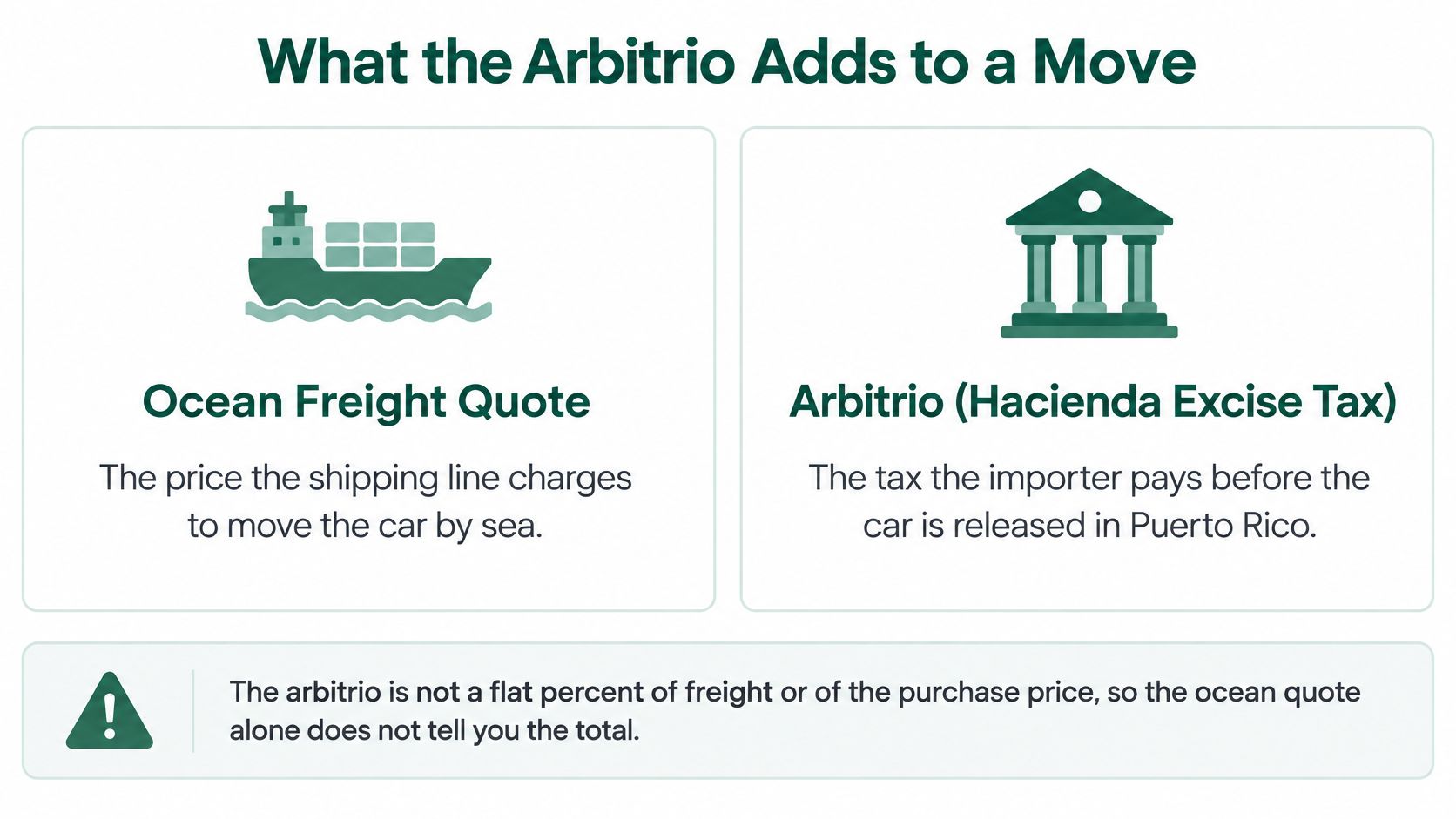
Hacienda lists a minimum automobile arbitrio of $750 in its schedule of taxable articles. A low purchase price doesn't establish a lower tax bill, and the automobile category broadly covers self-propelled vehicles designed to transport people.
The arbitrio is Puerto Rico's vehicle excise tax, not another name for ocean freight. Hacienda assesses arriving vehicles based on vehicle value, and payment is required before port release. Don't calculate it as a flat percentage of the transportation quote or assume your mainland purchase price settles the valuation.
Estimate the vehicle before committing to freight
Use Hacienda's SURI estimator with the make, model, and year, or preferably the 17-character VIN from the title or registration, following Hacienda's vehicle-excise guidance. For older vehicles or current-model-year vehicles that don't return a result, Hacienda directs importers toward a direct valuation through its designated source.
A blank estimator result isn't a zero-dollar assessment. Keep the VIN ready and resolve the valuation before treating the landed-cost budget as complete. Our bilingual agents can help estimate the obligation before shipping, but Hacienda determines the assessment.
Ship, buy locally, or replace
| Plan | Best when | Costs beyond freight | Main risk |
|---|---|---|---|
| Ship the current car | A longer stay, a reliable vehicle, and accessible replacement parts | Vehicle excise tax, insurance, inspection, and DTOP registration | Missing lender permission or delayed release payment |
| Buy on the island | A short assignment or a worn daily driver that isn't worth transporting | Local purchase, insurance, and purchase-related paperwork | A transportation gap while shopping |
| Sell and replace after arrival | A trial move with uncertain plans | Selling and buying costs, temporary transport, and a possible future return shipment | Replacing a known car with an unfamiliar one |
Make the decision against the stay
For a hypothetical stay longer than a year, I would lean toward shipping a dependable paid-off daily driver if parts and maintenance are realistic on the island. Its known service history has practical value. That advantage weakens when the car needs major repairs before it even reaches the departure port.
For a hypothetical six- to twelve-month trial, compare selling and replacing with the cost of shipping in both directions. Buying locally isn't automatically cheaper, either. Include the time spent finding, inspecting, insuring, and registering the replacement.
A classic car needs a different handling discussion, including enclosed inland transport and the ocean carrier's protection options. A financed car adds lender permission and continuing payments during any period when you can't use it.
Build a separate allowance for:
- Late collection: Port storage if clearance or pickup isn't completed promptly.
- Local compliance: DTOP/CESCO inspection and registration after delivery.
- Insurance: Written confirmation of island and ocean-transit coverage, rather than assumptions about a mainland policy.
- Vehicle condition: Existing corrosion, salt-air exposure, repairs, and parts availability.
The useful comparison is the cost of having a usable car at your destination, not the cost of putting it on a ship.
How to Ship the Car From Pickup to Delivery
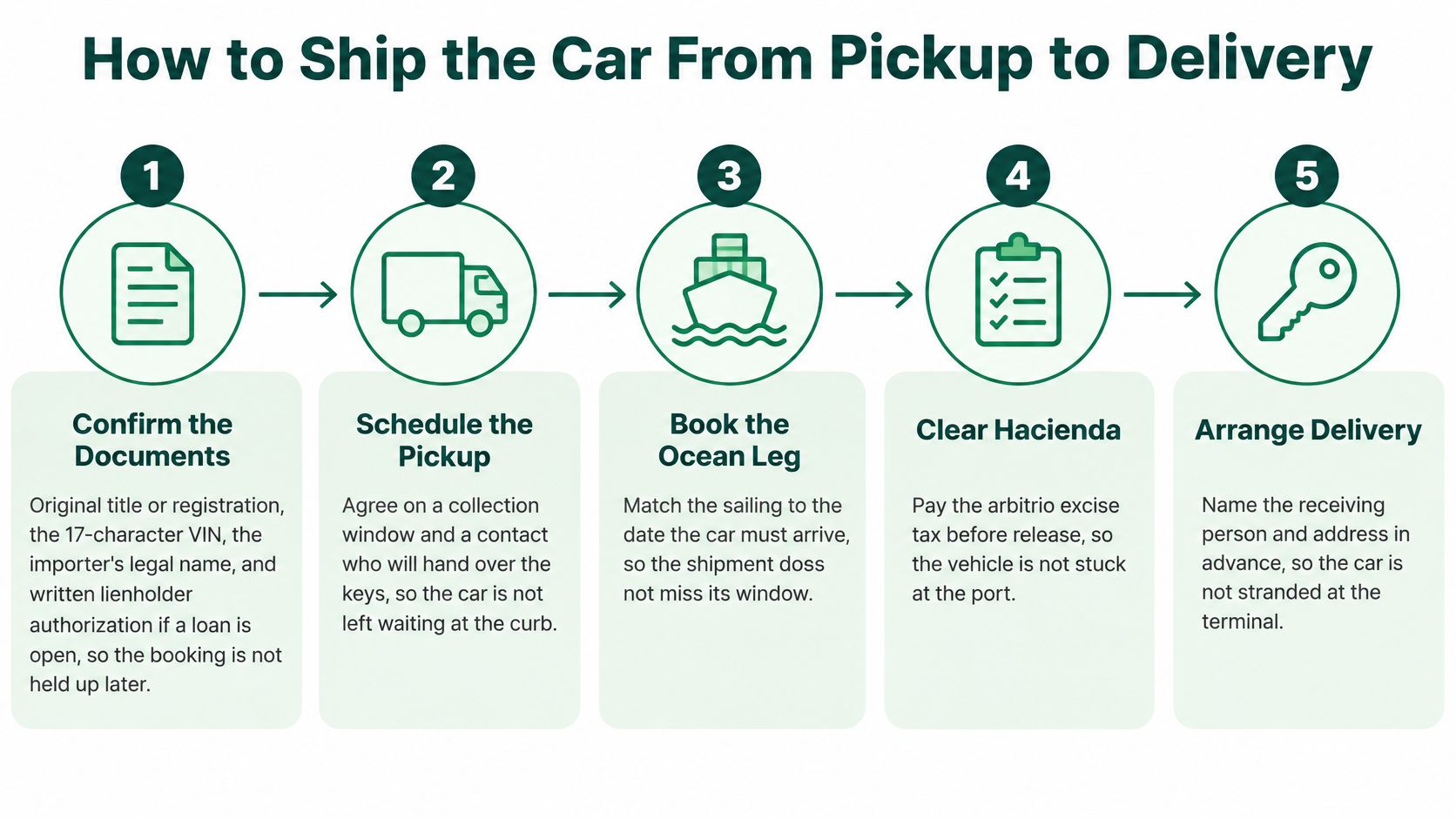
Work backward from the date someone needs the vehicle, then assign a person to each handoff. The truck driver, ocean terminal, importer, and receiving contact don't necessarily communicate directly with one another.
Keep one shipment file containing the booking confirmation, document copies, inspection photographs, payment records, and arrival notice. Use the same legal name and vehicle description throughout.
Control each handoff
Confirm ownership and permission before dispatch.
Verify the original title or registration against the VIN plate and the importer's legal name. Obtain written lienholder authorization for a financed or leased vehicle, with permission appropriate to the planned route. This prevents a truck from collecting a car whose ownership file can't support the ocean booking.Prepare the car and document pickup.
Agree on the collection window and identify who will hand over the keys. For our mainland pickups, the carrier records the vehicle's condition before trucking it toward Jacksonville. The car must be empty of personal items for shipment to Puerto Rico under the ocean carrier's requirements. Photograph every exterior panel, glass area, wheel, and dashboard reading, and complete the bill of lading with a readable condition report. Use the truck pickup and delivery guide to prepare the physical handoff.Reconcile the Hacienda submission with the ocean booking.
Check the bill of lading, vehicle identification, valuation, and tax declaration as a single file. Include the non-bonded importer's declaration where applicable. A corrected booking alone isn't enough if the old name or incorrect VIN remains on the tax paperwork. This check prevents conflicting records from reaching the release desk.Complete payment and arrange collection before arrival.
Have payment authority, the arrival notice, and a local pickup contact ready. Confirm that the release has been issued before sending someone to the terminal. This prevents a wasted collection trip and reduces the risk of avoidable storage charges while people search for payment approval or missing documents.Inspect at destination and finish local road requirements.
Compare the destination condition report with the origin photographs before signing acceptance. Record any discrepancy on the delivery paperwork and keep copies. For a Puerto Rico arrival, finish the applicable DTOP/CESCO inspection, insurance, and registration work before treating delivery as the end of the relocation.
Reverse the sequence for a mainland return
A return shipment starts with Puerto Rico lien clearance and the required export documents, followed by terminal acceptance in San Juan. After sailing and mainland release, port-to-door trucking takes the car to the receiving address.
A foreign-purchased vehicle may require EPA or DOT documentation beyond the ordinary shipment file. Identify that issue before booking rather than expecting the destination terminal to resolve it.
Don't sign a clean destination inspection without checking the car. If the receiving person isn't the owner, send that person the origin photographs and explain how to record a discrepancy.
Tips for Military Snowbird and Dealer Moves
The route may be familiar, but the right booking depends on who owns the vehicle, who can release it, and who needs it next. Adjust the file around those people rather than treating every shipment as a standard household move.

Match the schedule to the person receiving it
Military families should book against the report date, not the household-goods pack-out date. Identify an authorized receiving contact who can respond to the arrival notice if the service member is traveling or already reporting for duty. Our military car transport guidance helps organize the vehicle portion separately from the rest of the move.
Don't assume that orders settle a private vehicle's financing or port-release requirements. Put lender authorization and receiving arrangements on the same calendar as travel.
Snowbirds should price the return route before the outbound departure. Keep the return address, likely departure period, and San Juan handoff plan in the file. A seasonal resident who leaves before the car needs a properly authorized person to complete the remaining tasks.
Students should identify who owns the vehicle before deciding who signs the shipment papers. A parent-owned car traveling to a mainland campus needs a clear owner authorization and a receiving contact whose class schedule allows delivery.
Give commercial units their own handling instructions
Dealer and fleet shipments need more than a list of VINs:
- Dealerships and auction buyers: Send the invoice and correct legal business name early. Keep each vehicle's title, purchase record, and consignee assignment together.
- Inoperable units: Disclose whether the car rolls, steers, and brakes so the loading arrangement matches its condition.
- Leased fleets: Obtain the lessor's written permission before dispatch rather than relying on the employee assigned to drive the car.
- Business receiving teams: Name a person who can inspect the unit and retain delivery records, not just an unattended business address.
Our coverage reaches all 50 states in both directions. Island coordination includes San Juan, Río Piedras, Bayamón, Carolina, Guaynabo, Caguas, Trujillo Alto, Ponce, Mayagüez, Arecibo, and every municipio in between. Confirm whether the particular booking ends at the port or includes the additional island handoff.
No two vehicle shipments are alike. Sailing availability, lien status, and pickup windows differ, so a dedicated agent guides each customer and owns the file from the first call through delivery, keeping the process simple and quick.
Confirm the Flat Rate Before You Book
A quote for the ocean crossing alone does not show the full cost of getting a vehicle to Puerto Rico. Compare the complete transportation scope: mainland pickup, trucking to Jacksonville, ocean freight to San Juan, and port handling.
National Car Transport's Puerto Rico flat rate covers trucking, the ocean sailing to San Juan, and port handling, with no hidden fees. Service is available in both directions for cars, trucks, SUVs, and motorcycles. Have the written estimate identify the vehicle, origin, destination, and included handoffs.
Separate an estimate from a confirmed booking
Puerto Rico rates are estimates, not guarantees. Season, fuel prices, route demand, and vehicle specifics can change the price. A modified truck, motorcycle, and standard sedan may have different transport requirements.
Typical estimated ranges in both directions are $845–$1,195 from Florida, $1,095–$1,545 from the Northeast, $1,195–$1,595 from Texas and the Midwest, and $1,395–$1,795 from the West Coast. Ocean freight is included. Use the flat-rate shipping calculation guide to compare what the transportation price covers with separate costs, such as Puerto Rico's vehicle excise tax.
Send a complete booking request
Give the coordinator enough information to scope the move accurately:
- Vehicle details: VIN, make, model, running condition, and modifications that affect dimensions or loading.
- Ownership status: Paid off, financed, leased, recently purchased, or dealer-owned.
- Both locations: Pickup and receiving addresses, plus any access restrictions.
- Timing: Earliest release date, target sailing, and when the vehicle is needed.
- Contacts: The person releasing the vehicle and the person accepting it.
National Car Transport has 25+ years of experience, an A+ BBB rating, and a network of 25,000+ vetted, licensed, and bonded drivers. Bilingual English/Spanish agents support personal and commercial moves. A complete vehicle file and workable schedule still matter.
Before authorizing collection, compare the transportation estimate with the vehicle's tax valuation and your choice to ship, buy locally, or replace. Hacienda assesses the arbitrio on arriving vehicles based on value, and it must be paid before port release. Resolve any missing valuation information before the vehicle reaches the port.
Correct title discrepancies before pickup. Once the vehicle enters the terminal, fixing ownership paperwork can delay its release.
National Car Transport coordinates mainland trucking, ocean shipping, and San Juan port paperwork for vehicles moving to or from Puerto Rico. Visit National Car Transport with your VIN, title status, pickup and delivery addresses, and target dates to request a flat-rate estimate.