

You've got a moving date, a vehicle to ship, and quotes that don't seem to describe the same service. One includes pickup at your house. Another stops at a port. The cheapest number may not mention what happens if your SUV is taller than expected or your car won't start.
Learning how to calculate flat rate shipping starts with a simple distinction: a published price is an estimate, while a confirmed flat rate applies to a defined shipment. Build that shipment line by line, and you can compare offers without guessing what's missing.
Table of Contents
- What Goes Into a Flat-Rate Car Shipping Quote
- Puerto Rico Base Rates by Mainland Origin
- How to Calculate Your Flat Rate in Five Steps
- How Vehicle Type and Enclosed Service Change the Price
- Distance, Metro Coverage and Domestic Lanes
- Puerto Rico Port, Paperwork and Island Charges
- Confirm Your Flat Rate Before You Book
What Goes Into a Flat-Rate Car Shipping Quote
A corridor base rate is the starting price for a standard vehicle moving between defined origin and destination markets. Dispatchers price those markets, not mileage alone. Then they add only the adjustments the shipment requires. Two cars on the same route can cost different amounts if they need different trailer space or loading equipment.
The cost floor covers carrier line-haul, fuel, tolls, terminal handling, insurance or liability allocation, and payment and claims overhead. Treat the base rate as the route component of the quote, then check which conditional charges apply to your vehicle and service.
Separate the route from the vehicle
Prepare these details before requesting a firm quote:
- Route details: Origin and destination ZIP codes, residential or terminal service, and any sea leg to Puerto Rico. These stay fixed unless you change the itinerary.
- Vehicle details: Year, make, model, exact length and height, modifications, and running condition.
- Service choices: Open or enclosed equipment, pickup window, delivery arrangements, and expedited handling.
- Access conditions: Narrow streets, gated properties, steep driveways, or port appointments that affect loading.
These inputs help distinguish route costs from charges triggered by the vehicle, equipment, or access. Ask the dispatcher to list each adjustment separately, so you can see what changes the base rate and what is included in the quoted total.
Insurance needs a separate check. Duncan & Associates Insurance Brokers offers a coverage guide for auto transport businesses that explains carrier liability, cargo protection, and policy exclusions. Those terms are not interchangeable, so confirm what coverage applies to your shipment.
Practical rule: Your flat rate should state its inclusions and the conditions that trigger another charge before dispatch, not after loading.
Puerto Rico Base Rates by Mainland Origin
A quote from a mainland origin to San Juan combines a corridor base with any applicable charges. Check which legs the quoted amount covers: mainland trucking to the Jacksonville sailing, ocean freight, and San Juan port handling. Published figures are planning estimates, and season, fuel prices, route availability, and sailing schedules can change the amount before booking.
The table gives hypothetical planning ranges, not a published tariff or delivery promise. Use the nearest listed market as a starting point, then request a current quote for your specific route and vehicle.
Estimated mainland-to-San Juan base rates by origin market
| Origin Market | Hypothetical Base Rate | Estimated Total Transit Time |
|---|---|---|
| Miami / South Florida | $895–$1,195 | 7–10 days |
| Orlando | $895–$1,195 | 7–10 days |
| Tampa / Jacksonville | Similar to nearby Florida origins; request a current estimate | 7–10 days |
| Atlanta | $995–$1,295 | 8–12 days |
| New York / New Jersey / Philadelphia | Request a current estimate for the origin market | 9–13 days |
| Boston / Hartford | Request a current estimate for the origin market | 10–14 days |
| Chicago | Request a current estimate for the origin market | 10–14 days |
| Houston / Dallas | Request a current estimate for the origin market | 11–15 days |
| Los Angeles / West Coast | $1,395–$1,795 | 12–16 days |
The listed figures provide a line-by-line comparison: the longer mainland trucking leg can raise the bundled estimate. For South Florida route details, review the Miami-to-Puerto Rico car-shipping service. For markets without a stated rate range, use the transit time only as a planning estimate and ask the carrier to price that corridor directly.
Before paying, ask whether a deposit reserves a specific sailing or only opens an order, and get the refund terms. Confirm separately any shipment from San Juan to the mainland or delivery beyond the island terminal.
How to Calculate Your Flat Rate in Five Steps
Use a worksheet with a separate line for every adjustment. That keeps an equipment premium from concealing a vehicle-size charge and prevents you from paying twice for port handling already included in the base.
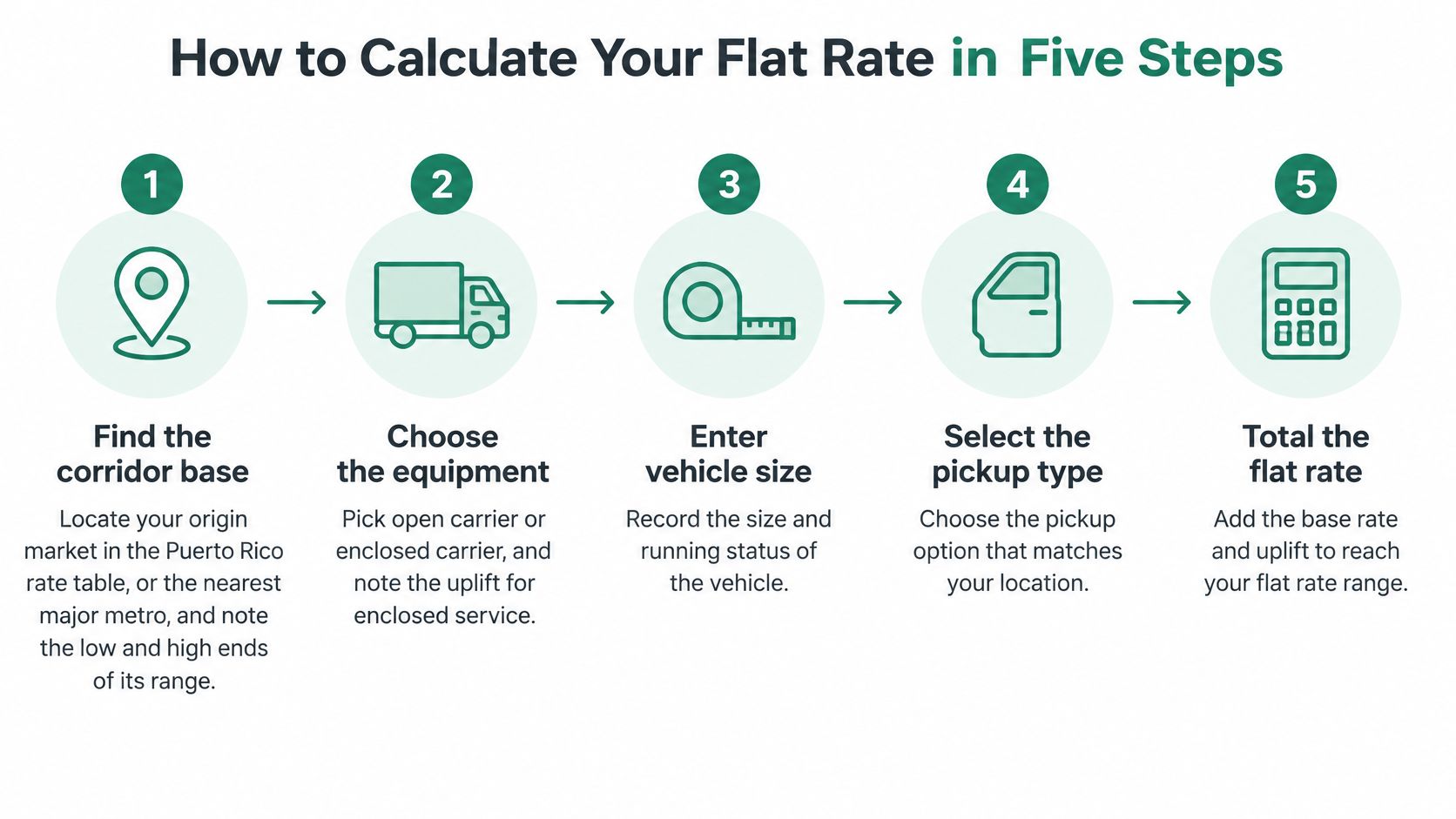
Build the quote in order
Find the corridor base. Request the current range for your origin market and destination terminal. Record the assumptions attached to it, including the standard vehicle profile and pickup window.
Choose the equipment. Ask for open and enclosed prices on the same itinerary. For island service, identify which mainland trucking segment receives enclosed protection and how the vehicle travels at sea.
Enter the actual vehicle. Supply measurements, running status, and modifications rather than relying on the model name alone. A roof rack, lift kit, or oversized tires can change the loading plan.
Add applicable conditional charges. List non-running handling, difficult access, expedited dispatch, and any port services excluded from the base. Mark included items explicitly so nobody adds them again.
Total and verify the service boundaries. Add the confirmed adjustments to the base, then identify whether the result is door-to-port, port-to-door, or another arrangement. Compare it with the same service from another provider, not a cheaper but shorter itinerary.
Worked example with hypothetical prices
Say you're shipping a running 2019 Honda CR-V from Atlanta to San Juan. For this example only, assume an open-carrier corridor range of $995 to $1,295 and an enclosed uplift of 40 to 60 percent applied to the $995 low base.
The enclosed calculation is $995 × 1.40 = $1,393 at the lower assumed uplift and $995 × 1.60 = $1,592 at the higher assumed uplift. This is arithmetic for a planning scenario, not a statement of current carrier pricing.
Worked example: Atlanta to San Juan for a running 2019 Honda CR-V
| Calculation Line | Open Carrier | Enclosed Carrier |
|---|---|---|
| Step 1: Corridor base, Atlanta to San Juan | Hypothetical $995–$1,295 | Hypothetical $995 low base used for illustration |
| Step 2: Equipment uplift | None | Assumed 40–60% of the low base |
| Step 3: Vehicle size or operability add-on | Pending, confirm by measurement | Pending, confirm by measurement |
| Estimated total before add-ons | Hypothetical $995–$1,295 | Hypothetical $1,393–$1,592 using the low base only |
The enclosed column doesn't represent every combination of the corridor range and equipment premium. Ask the dispatcher whether an actual uplift applies to the mainland trucking portion, the entire bundle, or a separately quoted enclosed service.
Until the CR-V's dimensions are accepted, use the high end of the open range as the provisional planning number, then leave room for any confirmed adjustment. Don't assume that choosing a crossover automatically qualifies you for a sedan base.
For a broader breakdown of the inputs, use the car-shipping cost guide alongside your written quote.
A useful total is one you can reconstruct. If the dispatcher can't explain a line item, ask for clarification before authorizing payment.
How Vehicle Type and Enclosed Service Change the Price
Open transport is the sensible starting point for a daily driver. Enclosed service costs more because the carrier supplies a different trailer, additional protection, and sometimes specialized loading equipment. Get the premium as a dollar amount for your actual route rather than treating a general percentage as a tariff.
An enclosed transit estimate also needs boundaries. Ask whether it covers mainland trucking only or includes the ocean connection; don't apply a domestic delivery estimate to the complete Puerto Rico move.
Vehicle and service adjustments that change the quote
| Factor | How It Changes the Quote | What to Confirm |
|---|---|---|
| Open carrier, standard | Base rate from the corridor table | Pickup window and carrier count per load |
| Enclosed carrier | Route-specific equipment premium | Low-clearance loading and whether a six-vehicle trailer limit applies |
| Sedan or coupe | Base rate, the most typical load | Standard length and height |
| SUV, crossover or pickup | Often priced above a sedan for size and weight | Exact height, length and weight |
| Classic, luxury or exotic | Usually enclosed; higher declared value | Ground clearance and insurance limits |
| Non-running vehicle | Conditional charge added before booking | Winch access at pickup and delivery |
| Oversized or modified vehicle | Conditional charge | Measured dimensions and lift or lowered status |
Don't assume every trailer has the same capacity. If an operator describes an enclosed trailer carrying six vehicles versus an open trailer carrying up to ten, verify that description against the assigned equipment rather than treating it as a universal limit.
When protection justifies the premium
Classic, luxury, and exotic vehicles often warrant enclosed auto transport, particularly when low clearance requires hydraulic loading. Confirm ramp angles, clearance, and cargo-policy limits, even when insurance is included in the price.
A non-running vehicle needs a more precise description than “doesn't start.” Tell the dispatcher whether it rolls, steers, and brakes, and whether the keys are available.
I would choose enclosed for a low-clearance collector vehicle or a high-value car whose owner wants protection from road debris and weather exposure. For an ordinary commuter car, open transport usually offers better value.
Distance, Metro Coverage and Domestic Lanes
A dispatcher prices a lane, not just an odometer reading. Balanced carrier demand, highway access, and available loading locations can make a metro-to-metro move easier to place than a shorter shipment between isolated addresses.
The U.S. Census Bureau's metropolitan-area guidance identifies a principal city as the largest city in its metropolitan or micropolitan area, with additional cities qualifying under population and employment criteria. That's useful geographic context, not a carrier service guarantee.
This map illustrates how major markets connect.

Mainland markets to use when requesting a lane
For contiguous-state service, use these city anchors when identifying the nearest dispatch market. Exact-address availability still needs confirmation.
| Region | State and major-city anchors |
|---|---|
| Northeast | Connecticut: Hartford; Maine: Portland; Massachusetts: Boston; New Hampshire: Manchester; Rhode Island: Providence; Vermont: Burlington; New Jersey: Newark; New York: New York City; Pennsylvania: Philadelphia |
| South Atlantic | Delaware: Wilmington; Florida: Miami; Georgia: Atlanta; Maryland: Baltimore; North Carolina: Charlotte; South Carolina: Charleston; Virginia: Richmond; West Virginia: Charleston; Washington, D.C. |
| South Central | Alabama: Birmingham; Arkansas: Little Rock; Kentucky: Louisville; Louisiana: New Orleans; Mississippi: Jackson; Oklahoma: Oklahoma City; Tennessee: Nashville; Texas: Dallas–Fort Worth and Houston |
| Midwest | Illinois: Chicago; Indiana: Indianapolis; Iowa: Des Moines; Kansas: Wichita; Michigan: Detroit; Minnesota: Minneapolis; Missouri: Kansas City; Nebraska: Omaha; North Dakota: Fargo; Ohio: Columbus; South Dakota: Sioux Falls; Wisconsin: Milwaukee |
| West | Arizona: Phoenix; California: Los Angeles; Colorado: Denver; Idaho: Boise; Montana: Billings; Nevada: Las Vegas; New Mexico: Albuquerque; Oregon: Portland; Utah: Salt Lake City; Washington: Seattle; Wyoming: Cheyenne |
Island and overseas distinctions
On Puerto Rico, specify San Juan, Bayamón, Carolina, Guaynabo, Caguas, Ponce, Mayagüez, or Arecibo rather than requesting island delivery. A destination farther from the terminal can require a separate trucking leg.
For genuinely overseas destinations, African Import Export Solution's guide to ship a car from the USA offers a separate planning reference; international export arrangements shouldn't be substituted for Puerto Rico procedures.
Ask whether service reaches your address, a terminal, or an agreed meeting point. Get any location adjustment in dollars.
Puerto Rico Port, Paperwork and Island Charges
The freight quote and the island-side budget aren't necessarily the same amount. Separate mainland trucking, ocean freight, terminal handling, inspection, documentation support, and final delivery, then identify which components the quoted bundle already covers.
Keep your paperwork together before the vehicle enters the port process.
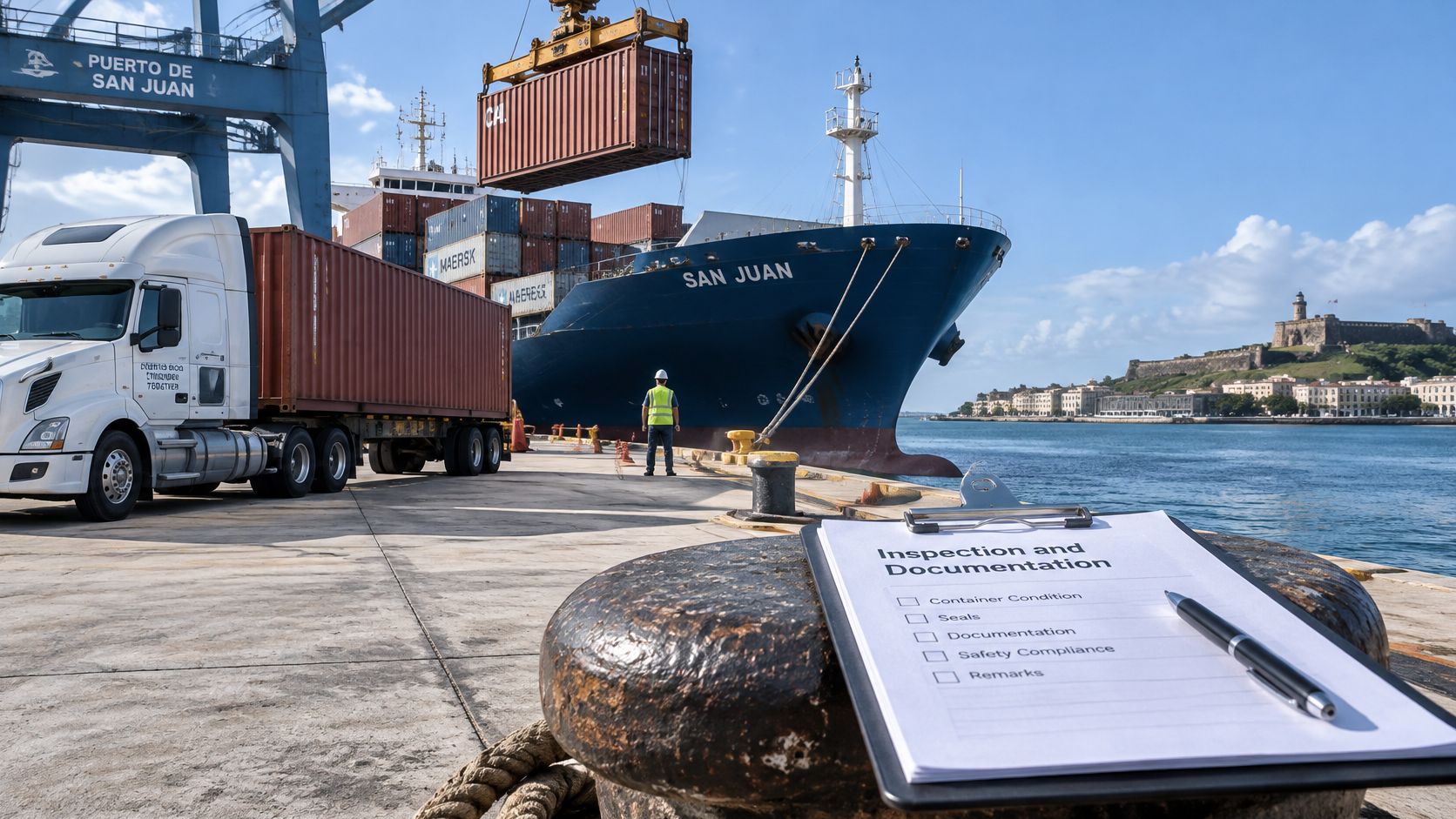
Prepare the documents before port arrival
According to CBP's Puerto Rico vehicle-shipment ruling, shipping a used, self-propelled vehicle from the mainland to Puerto Rico isn't an export under 19 CFR Part 192, so the usual 72-hour advance presentation of ownership documents doesn't apply. Electronic Export Information must still be filed through the Automated Export System with the VIN, and the vehicle remains subject to inspection.
- Ownership documents: Have the title and registration ready for the carrier's review.
- Identity and vehicle details: Supply photo identification and verify the VIN against the vehicle and paperwork.
- Carrier documents: Obtain the booking instructions, required authorizations, and terminal contact information.
- Filing responsibility: Identify who handles the electronic filing and whether assistance costs extra.
Budget separately for arbitrios, Puerto Rico's excise tax on arriving vehicles. Don't assume a freight quote includes this tax, and obtain the applicable assessment through the appropriate island process.
This video provides an additional visual reference for planning the shipment.
Check the island-side inclusions
Before paying, get written answers on port handling, documentation support, terminal release, and island delivery. Ask who pays storage or redelivery costs if paperwork or collection is delayed.
Budget check: Freight paid doesn't necessarily mean the vehicle is ready for release. Confirm the release requirements and collection arrangements separately.
Confirm Your Flat Rate Before You Book
A quote is only useful if it states what the price covers. Before booking, check the base corridor rate, equipment, vehicle condition, route, and any separate port or island costs. A higher quote with clear inclusions may cost less overall than a lower figure that leaves services unresolved.
Use this checklist to turn the estimate into an agreed shipment.
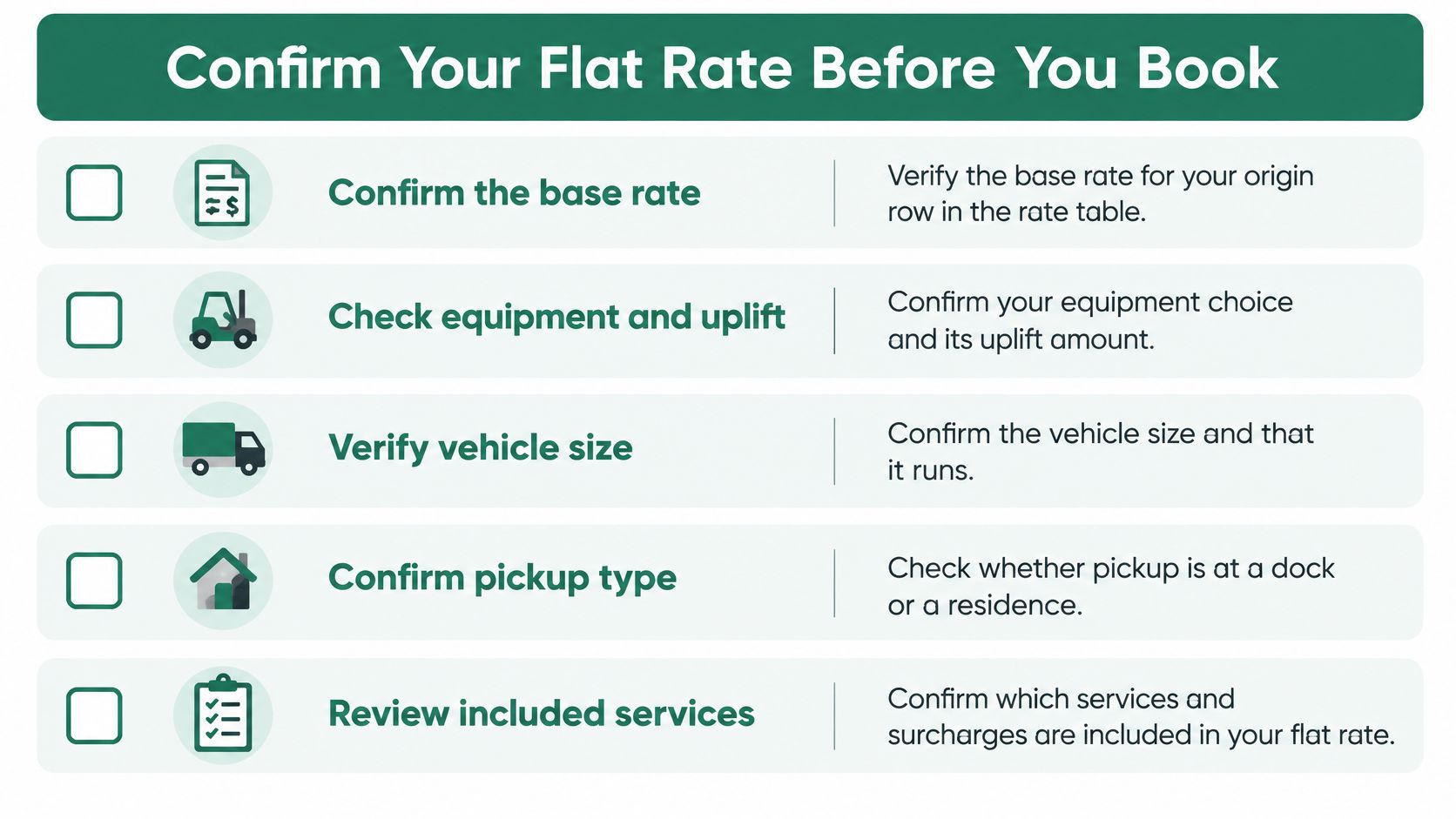
Get the final scope in writing
- Base and equipment: Confirm the origin-market rate and the charge for the selected transport equipment.
- Vehicle acceptance: Verify dimensions, modifications, running condition, and loading arrangements.
- Pickup and delivery: List the addresses or terminals, plus any agreed meeting points.
- Ocean and port services: Specify which transport legs, documentation assistance, and release arrangements are included.
- Separate obligations: Confirm the arbitrios budget, payment schedule, cancellation terms, and responsibility for delays.
For mainland–Puerto Rico shipments, CBP's Electronic Export Information guidance says the applicable ITN or exemption citation must reach the carrier by the time the shipment arrives at the port of unlading. For a return shipment, ask the carrier to confirm the direction, vehicle status, and current terminal requirements before you book.
Choose help that resolves the details
National Car Transport offers flat-rate quoting and has more than 25 years of company experience and an A+ BBB rating. Its bilingual English/Spanish agents can help you review quote details, and its nationwide network includes 25,000+ vetted, licensed, and bonded drivers.
A dedicated advisor can help clarify the base rate, equipment choice, and conditional charges for a snowbird, student, military family, dealership, business, or individual relocating. Make sure the final written quote matches the route and vehicle details you provide.
National Car Transport offers mainland vehicle transport and coordinated shipping to and from Puerto Rico. Visit National Car Transport with your route, vehicle details, and preferred dates to request a line-by-line quote before booking.