
A standard car shipped between the U.S. mainland and Puerto Rico is estimated at $895–$1,795 and 7–18 days, and a PCS order does not automatically pay that ocean bill. Treat the freight quote, any authorized PCS reimbursement, and Puerto Rico's vehicle excise tax as separate budget items.
That distinction matters when you're arranging car transport for military families on a report-date deadline. A carrier can reserve transportation, but it can't approve your entitlement or decide what Hacienda will assess when the vehicle enters Puerto Rico.
Start with the orders, not the sailing date. Then price the exact mainland city and San Juan route, verify the paperwork, and establish how much cash you'll need before reimbursement or vehicle release.
Table of Contents
- What Your PCS Orders Actually Authorize
- Estimated Rates and Transit Times by Mainland City
- When Shipping Costs More Than the Mileage Allowance
- How Arbitrios Sits on Top of the Freight Rate
- Port Papers, SURI Filings and Export Forms
- Two Duty-Station Moves Through the Port of San Juan
- Lock the Quote Before You Submit Leave
What Your PCS Orders Actually Authorize
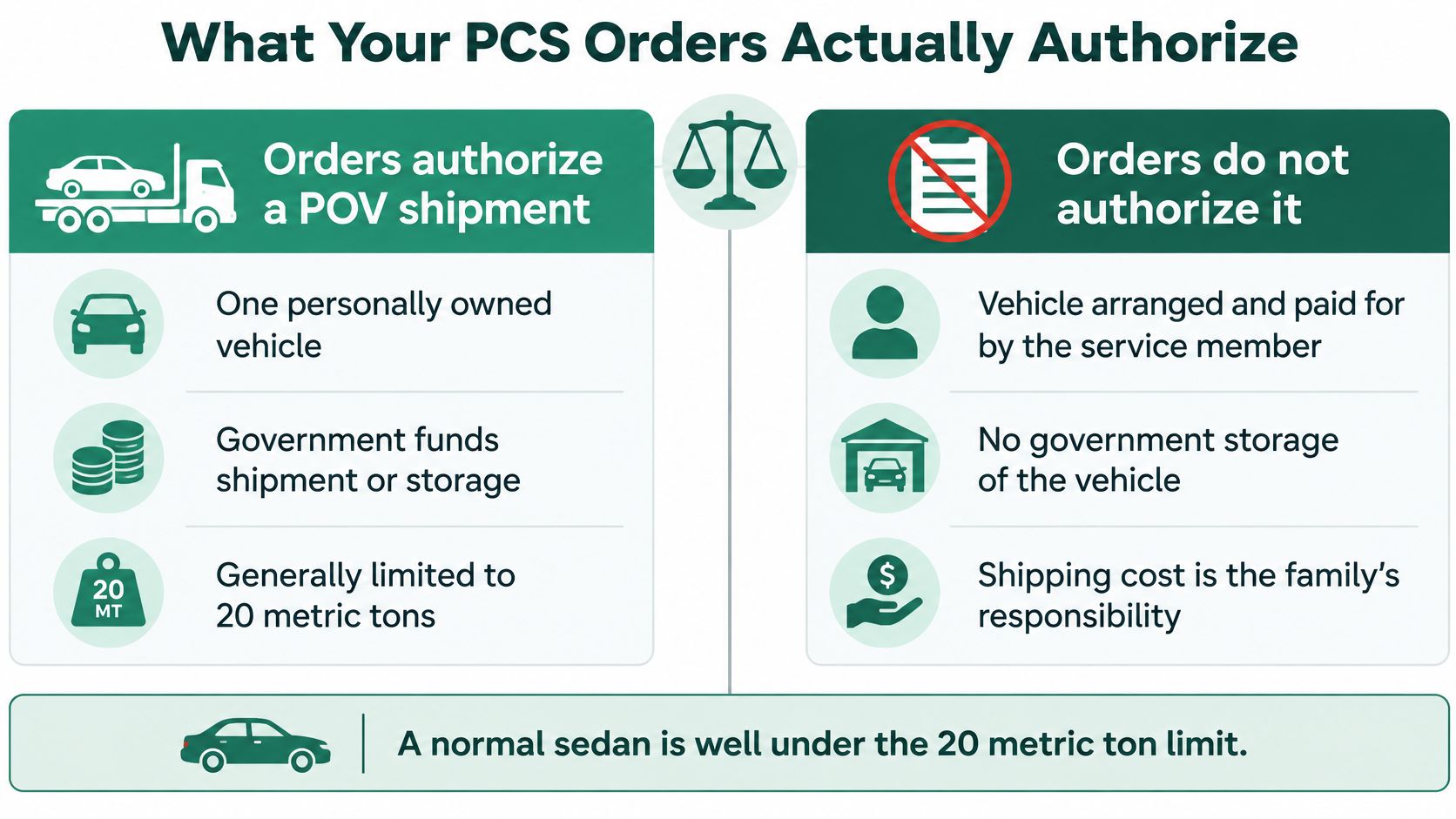
A family sedan and a large camper shouldn't enter the booking process with the same assumptions. Military OneSource's overseas shipment guidance generally describes government-funded shipment of one personally owned vehicle within a 20-metric-ton limit, with excess costs possible for oversized vehicles.
A normal sedan generally fits within the allowance. Large trucks, SUVs, campers, and recreational vehicles warrant a specific size review before anyone promises that the authorized shipment will cover the entire transportation charge.
An entitlement isn't a commercial reservation
A personally owned vehicle, or POV, entitlement establishes what the government authorizes. A commercial reservation establishes what a carrier will transport, between which locations, and at what price. Those aren't interchangeable approvals.
Puerto Rico is a U.S. territory, but the ocean crossing still requires a vehicle-shipping arrangement. For a privately arranged mainland-to-San Juan or San Juan-to-mainland move, confirm with your transportation office whether you should use an authorized government channel or book commercial door-to-port or port-to-door service.
Don't assume that booking a private sailing creates a reimbursement right. If the orders don't authorize the vehicle, or you're moving an additional vehicle outside the entitlement, plan to pay personally unless your transportation office approves another basis in writing.
This comparison helps separate the authorization decision from the booking decision.
Check the vehicle before reserving space
Read the actual POV sentence in your orders with the transportation counselor. Our explanation of whether the military will pay to move your car can help you prepare questions, but the office must resolve your individual authorization.
Bring the vehicle's specifications, not just its model name:
- Dimensions and configuration: Record length, height, width, shipping weight, roof racks, lift kits, and other modifications. Ask how the applicable shipping-size allowance is measured.
- Ownership approval: Have the title or registration available. For a financed vehicle, obtain the lienholder's written permission for the Puerto Rico shipment.
- Cabin contents: Remove personal belongings rather than treating the car as extra household-goods capacity.
Authorized operational and passenger items can include a jack, tire tools, jumper cables, spare tires, a first-aid kit, child seats, and a stroller. Confirm the acceptance list for the actual sailing before leaving anything inside.
Suitcases, packed boxes, and household supplies belong in the household-goods shipment. An empty cabin simplifies inspection and avoids disputes over cargo security, declared contents, and shipping weight.
Estimated Rates and Transit Times by Mainland City
For budgeting, use $895–$1,795 and approximately 7–18 days as a preliminary standard-car planning band between the mainland and San Juan, in either direction. These aren't guaranteed tariffs or vessel schedules, so replace the estimate with a written quote before committing your leave or flights.
The route bands below are intended to account for mainland trucking, ocean freight, and port handling. Ask the quote writer to identify those inclusions explicitly, particularly when comparing a port-only price with a price that includes pickup near your home or installation.
Find the closest mainland area
Estimated car shipping rates and transit to or from Puerto Rico
| Mainland area | Total transit | Usual port path |
|---|---|---|
| Miami / South Florida | 7–10 days | Jacksonville or nearby Florida port to San Juan |
| Orlando / Tampa / Jacksonville | 7–10 days | Jacksonville to San Juan |
| Atlanta | 8–12 days | Truck to Jacksonville, then San Juan |
| New York / New Jersey / Philadelphia | 9–14 days | Philadelphia or Jacksonville to San Juan |
| Boston / Hartford | 9–14 days | Truck south, then ocean to San Juan |
| Chicago | 10–14 days | Truck to Jacksonville, then San Juan |
| Houston / Dallas | 10–14 days | Truck to Jacksonville, then San Juan |
| Los Angeles / West Coast | 12–16 days | Cross-country truck, then San Juan |
The corresponding illustrative standard-car budget bands are:
- Florida: Miami, South Florida, Orlando, Tampa, and Jacksonville, $895–$1,195.
- Atlanta: $995–$1,295.
- Northeast: New York, New Jersey, and Philadelphia, $1,095–$1,495; Boston and Hartford, $1,145–$1,545.
- Chicago: $1,195–$1,545.
- Texas: Houston and Dallas, $1,195–$1,595.
- West Coast: Los Angeles and surrounding West Coast origins, $1,395–$1,795.
For a mainland city or state not listed, request a route-specific quote rather than extending a neighboring city's price by guesswork. Rural pickup, access restrictions, and the distance to the ocean terminal can change the inland portion.
Understand what the clock includes
Jacksonville, Florida, is the usual planning gateway for many mainland routings. Philadelphia, Pennsylvania, can serve some Northeast movements, while the island endpoint is the Port of San Juan. The booked itinerary, not the nearest port on a map, determines the actual path.
For South Florida planning, the Miami-to-Puerto Rico car-shipping guide helps distinguish local pickup from ocean-terminal delivery. Driving to a terminal yourself and requesting pickup at home are different service scopes.
Scheduling rule: Ask whether total transit starts at vehicle pickup, terminal acceptance, or vessel departure. Those dates aren't interchangeable.
Season, fuel costs, and carrier demand can move an estimate. SUVs, trucks, motorcycles, inoperable cars, and enclosed mainland transport need individual pricing rather than the sedan band.
Keep a separate calendar allowance for inspection, clearance, and collecting the car. Leave time and Puerto Rico excise tax belong on separate budget lines, not inside an assumed all-inclusive freight number.
When Shipping Costs More Than the Mileage Allowance
The Defense Travel Management Office's POV transportation examples include a $1,500 transportation cost with approximately $611 out of pocket, and another travel pattern leaving approximately $967 out of pocket. Those examples illustrate reimbursement limits, not Puerto Rico ocean tariffs or a promise about your claim.
PCS vehicle choices and what can stay out of pocket
| Choice | Freight example | What rules may repay | Still out of pocket |
|---|---|---|---|
| Ship one POV and drive another | $1,500 in the official example | Only the authorized difference versus concurrent travel in one POV | About $611 in that example |
| Alternate family travel pattern | Quoted separately | Limited by the applicable difference rule | About $967 in the second example |
| Drive only, no ship | $0 freight for the driving portion | Mileage allowance, not full operating cost | Fuel, lodging, tolls, wear, childcare, missed work |
| Commercial Puerto Rico sailing | $895–$1,795 preliminary planning estimate | Only when the orders and applicable rules authorize it | Full freight without an applicable entitlement |
The driving-only row applies to the mainland road portion. You can't drive the entire route between a mainland duty station and Puerto Rico, so a practical island-move comparison is often home pickup versus driving to an authorized terminal, not ocean shipping versus an uninterrupted road trip.
Why the family travel pattern matters
Under the applicable example rules, reimbursement may be capped at the difference between authorized travel costs using separate POVs and concurrent travel in a shared POV. Family size, official mileage, travel dates, per diem, and the wording of the orders affect that comparison.
That means the same freight bill can leave different personal balances for different households. Don't use another family's reimbursement as your approval, even if both families are transferring through San Juan.
The mileage allowance also isn't intended to repay every vehicle operating expense. A driving plan still needs its own fuel, lodging, toll, wear, childcare, and missed-work calculation.
Eligibility and cash flow are separate questions
An authorized expense can still require cash before repayment arrives. Confirm when the carrier expects payment, whether any deposit is required, what it reserves, and what happens if orders change before the vehicle reaches the terminal.
Use the guide to lower-cost Puerto Rico car shipping to evaluate the transportation arrangement, then take the resulting quote to your transportation office for the reimbursement decision.
An approved travel entitlement isn't the same as money available in your account on booking day.
Add freight, unreimbursed travel, temporary transportation, and the practical cost of lost leave. Then compare home pickup with driving the mainland leg to the port, while keeping the unavoidable ocean crossing in both options.
How Arbitrios Sits on Top of the Freight Rate
Puerto Rico vehicle excise tax brackets
The following planning table reflects the automobile schedule published by Puerto Rico's Department of the Treasury, Hacienda, including a $750 minimum excise tax and the listed progressive brackets.
| Taxable value | How the excise tax is figured |
|---|---|
| Schedule minimum | Minimum excise tax of $750 |
| Above $10,690 through $21,380 | $1,098 plus 19.6% of the amount above $10,690 |
| Above $21,380 through $31,780 | $3,188.35 plus 23% of the excess above $21,380 |
| Above $31,780 through $44,890 | $5,575.15 plus 27.2% of the excess above $31,780 |
| Above $44,890 | $9,253.10 plus 34% of the excess above $44,890 |
For a hypothetical taxable value of $15,000, use the listed bracket covering that value. Start with $1,098, then add 19.6% of $4,310, the amount above the bracket's threshold.
That calculation produces an illustrative tax of $1,942.76. It's separate from freight, and it isn't a prediction that Hacienda will assign that taxable value to your car.
Use the VIN, not a resale-price guess
Hacienda requires an import declaration for articles introduced into Puerto Rico, and the declaration supports payment of applicable excise tax, commonly called arbitrios. For estimating vehicle tax, use the agency's vehicle lookup and assessment process rather than assuming your purchase price or loan balance is the taxable value.
The VIN is the most useful starting point, though make, model, and year can also identify the vehicle. Enter the vehicle information carefully and save the resulting estimate with your shipping paperwork.
Don't assume PCS orders create a tax exemption. Military families, students, and snowbirds should confirm any claimed exemption directly with Hacienda before budgeting as though the tax disappears.
Keep the arrival tax separate from transportation
The ocean quote pays for a transportation scope. Hacienda's assessment concerns the vehicle entering Puerto Rico, so a paid freight invoice doesn't establish that the car is tax-cleared.
A dealership importing inventory also needs to address the Hacienda and SURI process, with commercial paperwork supporting the transaction and vehicle value. Business use doesn't turn the freight invoice into a substitute for the tax filing.
- Mainland to Puerto Rico: Obtain the current assessment and establish how payment and release will be handled.
- Puerto Rico to mainland: This particular Puerto Rico arrival tax isn't added merely because the car leaves the island, but export and release requirements still need attention.
- Any claimed exemption: Get confirmation for the actual owner and transaction rather than relying on general PCS advice.
Run the VIN through the current Hacienda assessment before paying for a mainland-to-island sailing. The table is a planning aid, not a complete substitute for the current schedule or a final tax bill.
Port Papers, SURI Filings and Export Forms
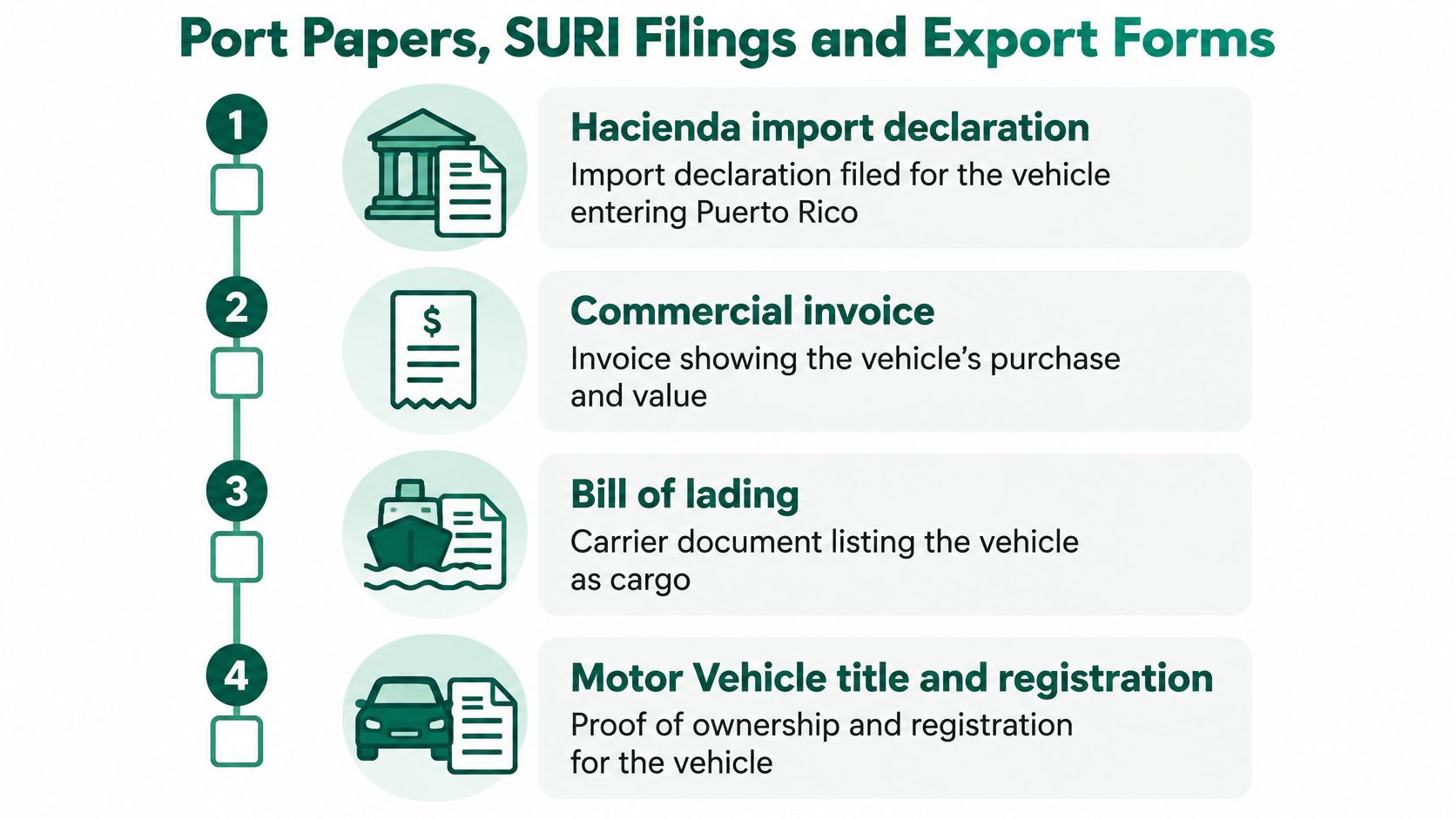
Build a vehicle-specific folder before scheduling pickup. For Puerto Rico excise-tax filings, Hacienda's arbitrios guidance lists a commercial invoice, bill of lading, and Motor Vehicle Inspection Document, and states that related filings and payments have gone through SURI since December 10, 2018.
SURI is Puerto Rico's Unified Internal Revenue System. The inspection and appraisal document is also called the tasación; it serves a different purpose from photographs documenting transport damage.
Use this checklist to organize the core import packet.
Match each document to its purpose
The import declaration identifies the entry for tax processing. The invoice and appraisal support the vehicle's value, while the bill of lading connects the vehicle to the ocean shipment.
Keep the title or registration, photo identification, VIN, lienholder permission, and PCS orders in the same folder. A privately funded move still needs ownership and carrier documentation, even when the orders aren't being used to claim transportation reimbursement.
For the outbound trip from San Juan, ask who handles the applicable export declaration and any requested export certificate. Don't treat those names as interchangeable, and don't assume a document accepted for a previous shipment is the current requirement.
The mainland-to-Puerto Rico shipping guide can help you organize the route questions alongside the paperwork. Resolve missing ownership papers or lender restrictions before presenting the vehicle for loading.
This video provides additional context for planning the vehicle shipment.
Prepare in a practical order
- Match the VIN: Compare the title, registration, booking, and vehicle identification plate. Correct mismatches before submitting the packet.
- Record condition: Photograph the odometer, exterior panels, glass, wheels, and existing damage. Keep your own copies.
- Gather ownership papers: Assemble the invoice, title or accepted ownership document, identification, and written lender permission when financed.
- Assign the shipping paperwork: Confirm who issues the bill of lading and how you'll receive the final copy.
- Assign export filing: Establish whether the carrier, an authorized filing agent, or you must submit the declaration and obtain any required certificate.
- Confirm acceptance milestones: Identify what must clear before loading and what completes after arrival through SURI or the applicable customs process.
Don't demand a final arrival assessment before a document can exist, but don't sail with an unresolved filing responsibility either. Each required document needs a named owner and a deadline.
Two Duty-Station Moves Through the Port of San Juan
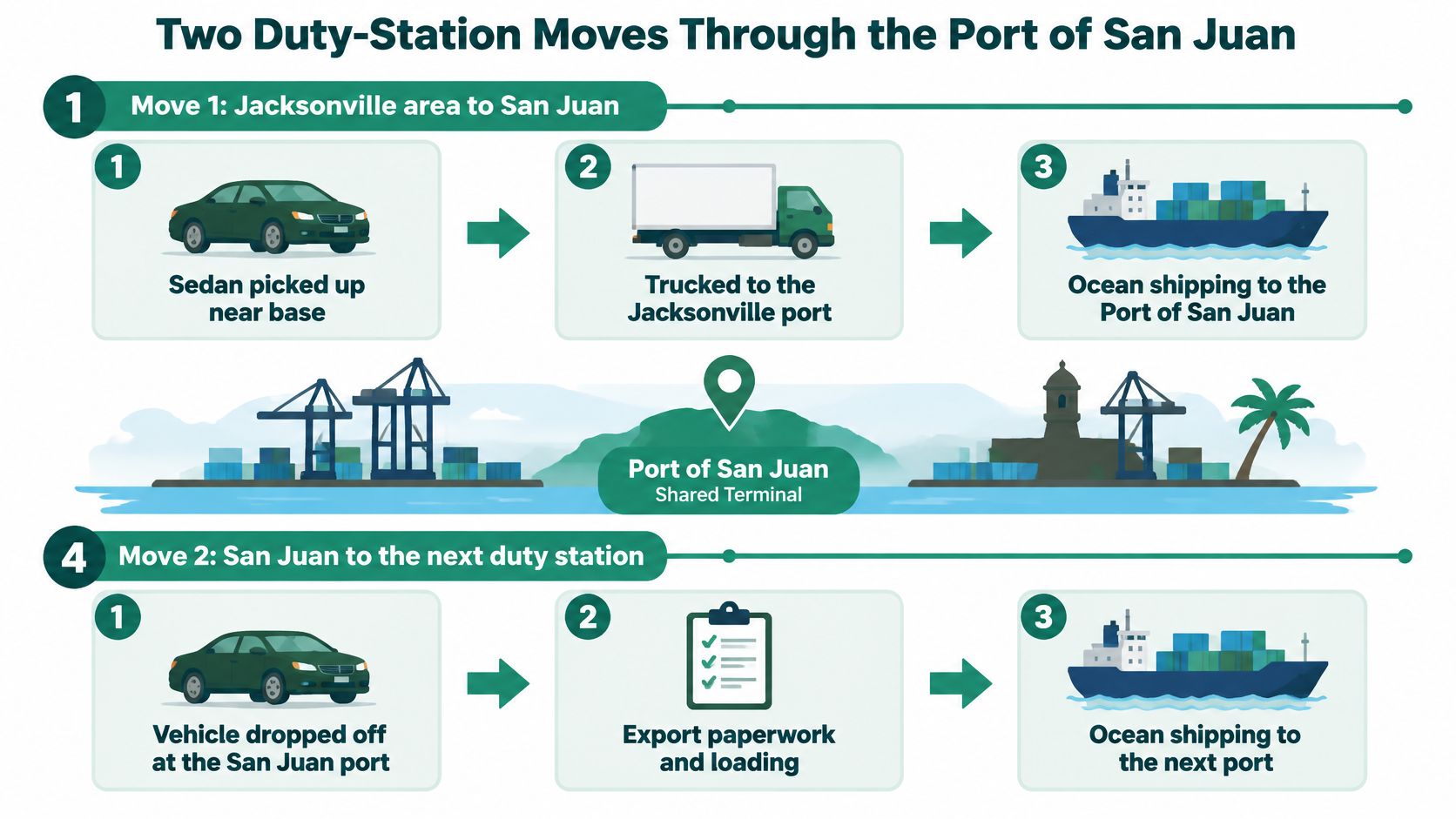
Jacksonville area to San Juan
Consider a family moving from the Jacksonville area to a Puerto Rico duty station. They first confirm the vehicle authorization, then obtain a written quote that names the pickup location, Jacksonville terminal, San Juan destination, and the party responsible for port collection.
They use the Florida planning band to build their calendar, but they don't schedule vehicle-dependent appointments around the earliest estimated arrival. The pickup window, terminal cutoff, vessel departure, and destination release are separate milestones.
Before collection, the family removes household belongings and keeps the original documents accessible rather than packing them with household goods. At pickup, they compare the condition report with their photographs and retain the signed record.
Their island contact prepares for the Hacienda filing and release process using the invoice, bill of lading, VIN, and inspection/appraisal paperwork. The family doesn't treat vessel arrival as permission to drive away from the terminal.
These routes share San Juan, but the document handoffs change with direction.
San Juan to the Philadelphia area
Now consider a family leaving Puerto Rico for the Philadelphia area. They deliver the vehicle to the Port of San Juan under the booked acceptance instructions, with the ownership packet and export-filing responsibility settled before cutoff.
Puerto Rico's official external-trade statistics publication describes a Shipper's Export Declaration submitted to U.S. Customs in San Juan, Ponce, or Mayagüez for shipments to the United States, and a similar form accompanying shipments in the opposite direction. Because that publication describes an established process rather than a current terminal checklist, the family verifies the present filing method and any export-certificate requirement with the responsible party.
Their itinerary may connect toward Philadelphia or use Jacksonville with onward mainland trucking. They use the Northeast planning band, then replace it with the actual booking window before arranging delivery access.
A snowbird can follow the same transport sequence without a military reimbursement claim. A dealership shipping inventory needs a commercial invoice and the appropriate business filing arrangement, while a student shipping an older car still needs valid ownership documents and the required port packet.
The shared checkpoints are straightforward:
- Quote and documents: Agree on scope and complete the vehicle-specific packet.
- Vehicle and cutoff: Prepare the car and meet terminal acceptance requirements.
- Sailing and release: Track the booked movement and satisfy destination requirements.
- Pickup: Bring the required identification, inspect the car, and record any discrepancy before signing.
Lock the Quote Before You Submit Leave
Before submitting leave, separate the decision into three bills: ocean freight, any PCS reimbursement, and Puerto Rico's excise tax. They are related to the move, but one does not automatically cover the others. Confirm the applicable POV entitlement with your transportation office, and budget for any freight or travel costs it does not reimburse, as well as the current Hacienda assessment.
Check that the vehicle's dimensions, modifications, condition, and cabin contents meet the booked service requirements. Have the title or accepted ownership papers ready, along with any required lienholder permission. If a requirement is not met, revise the sailing plan before it puts your report date at risk.
For a household leaving the Boston area, a moving cost guide for Boston renters can help organize the separate household-moving budget. Keep that figure apart from the vehicle's ocean-freight quote.
Get the shipment scope in writing
National Car Transport is U.S.-based, has 25+ years of experience, and is A+ BBB Accredited. Its bilingual English- and Spanish-speaking agents support shipments, and a dedicated agent can help coordinate the details.
Puerto Rico shipping covers cars, trucks, SUVs, motorcycles, and inoperable auction units. Ask for transparent flat-rate pricing based on the mainland city, San Juan endpoint, vehicle condition, and requested door-to-port or port-to-door arrangement. National Car Transport uses a network of 25,000+ vetted carriers.
Use the shipping-quote preparation guide to gather the shipment details. Before paying, ask what the estimate includes, which port path is booked, whether a deposit applies and what it covers, and who issues the bill of lading.
Before committing leave: Get the transportation scope and the reimbursement decision separately, in writing.
National Car Transport can coordinate a mainland-to-Puerto Rico vehicle shipment around the confirmed route, document requirements, and pickup window. Request a flat-rate quote with your vehicle details and city pair before reserving your sailing.