
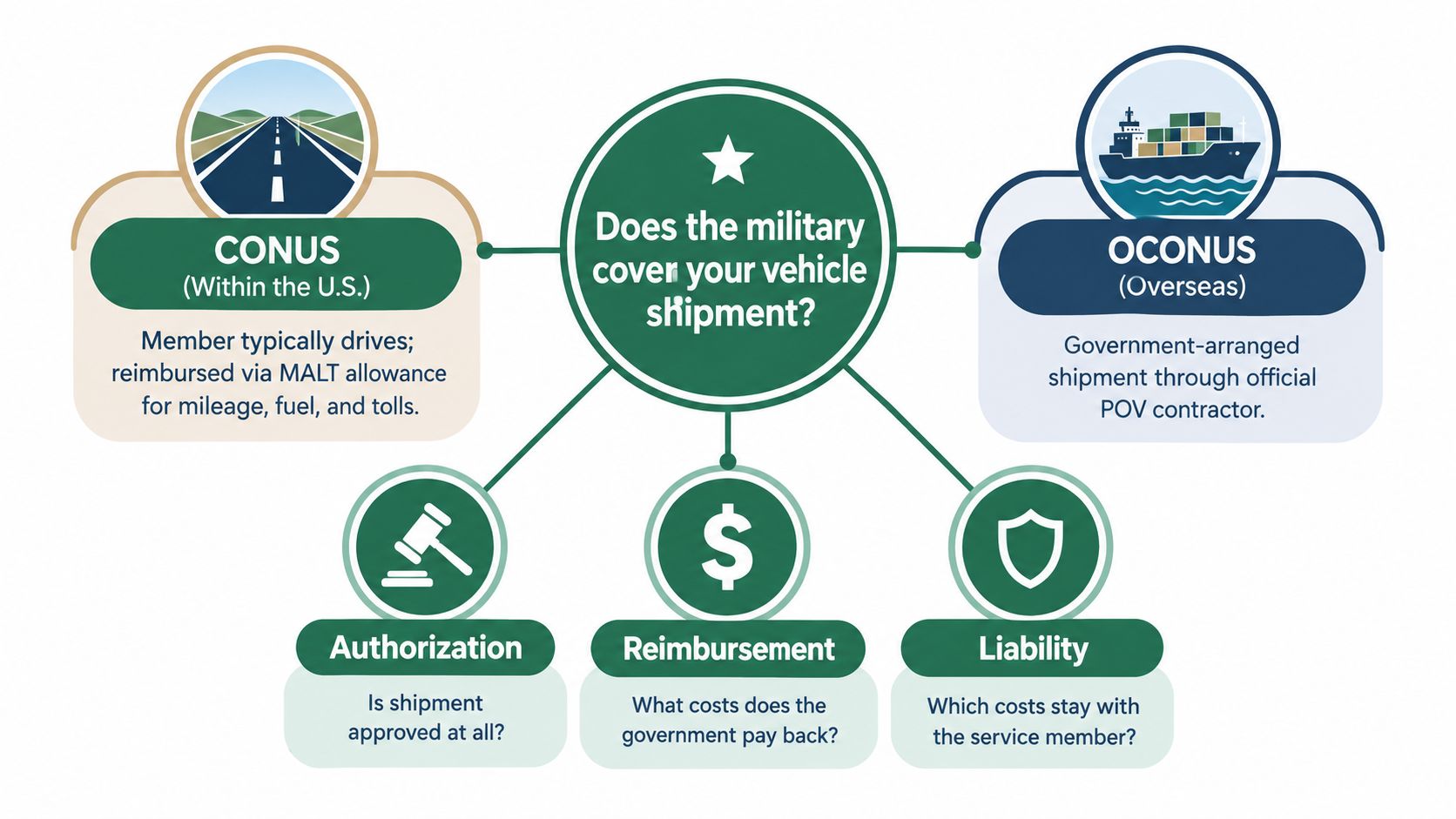
For most CONUS moves, no, the military provides a mileage allowance (MALT) rather than paying a commercial car carrier; for eligible OCONUS moves, the government may authorize shipment of one privately owned vehicle through its designated contractor, not any carrier you choose.
Your orders are in hand, your car's in the driveway, and your family wants to know when everything will arrive. Before you reserve transport, separate what the military has approved from what you'll have to pay yourself. That distinction matters more than the quote sitting in your inbox.
Table of Contents
- The Short Answer Every Service Member Wants First
- Three Questions the Military Is Actually Answering
- Moving Inside the Continental United States
- Shipping a Vehicle to an Overseas Duty Station
- Where Families Get Surprised by the Bill
- Island Routes and the Puerto Rico Layer
- Paperwork Worth Saving Before the Carrier Arrives
- What to Do Before You Book Anything
The Short Answer Every Service Member Wants First
A PCS order authorizes a relocation. It doesn't automatically authorize a commercial vehicle shipment. Treat those as separate decisions, especially when you're trying to coordinate flights, housing, school schedules, and another car.
Start with the location of your assignment. Military OneSource's PCS preparation guidance distinguishes moves within the 48 contiguous states, where members generally drive or pay for shipping themselves, from eligible overseas moves that may include government-arranged vehicle shipping or storage.
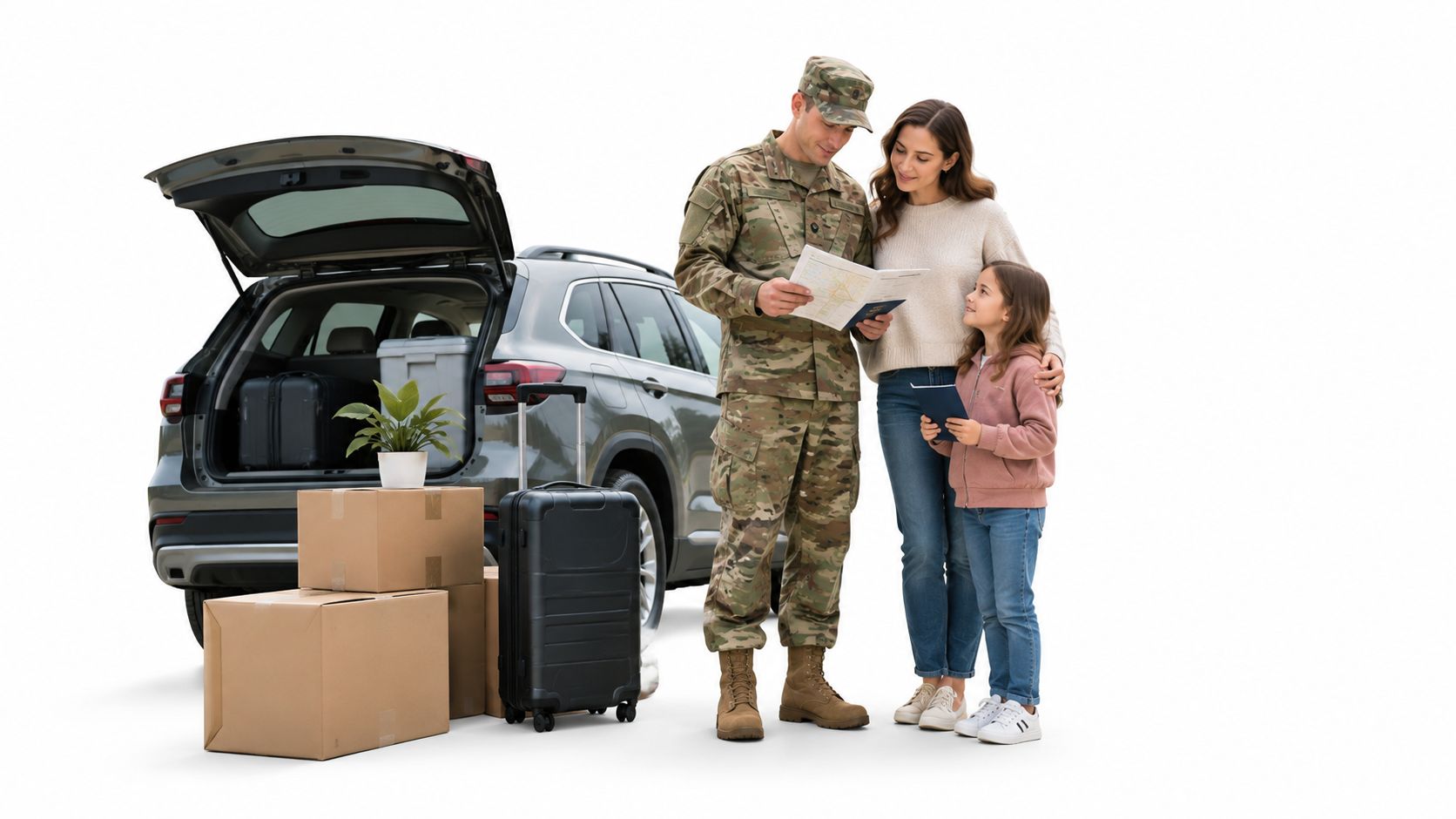
Identify your situation before requesting quotes
- Mainland assignment: Budget for driving unless your transportation office confirms a specific shipment authorization.
- Overseas or island assignment: Ask whether your orders authorize vehicle shipment, storage, or another arrangement. Don't infer eligibility from the destination alone.
- Additional family vehicle: Treat its transportation as a separate budget decision until the office confirms otherwise.
- Unusual circumstances: Request an individual determination rather than relying on another service member's experience.
When you ask, “Will the military pay to move my car?” you're really asking whether your particular vehicle, route, and arrangement qualify. A spouse's schedule, a tight reporting date, or an inconvenient drive may make private shipping sensible. Those considerations don't establish an entitlement.
Practical rule: Get the transportation office's written answer before you give a carrier permission to pick up your vehicle.
Keep that answer with your orders. If the office approves government transportation, follow its booking instructions. If it doesn't, compare private shipping against driving as a personal purchase, not an expense you expect someone to approve afterward.
Three Questions the Military Is Actually Answering
Authorization, reimbursement, and personal liability are different decisions. Confuse them, and you can book a perfectly legitimate transportation service that the government has no obligation to fund.
Authorization answers whether your shipment is approved under your circumstances. Reimbursement answers what eligible expenses the government will pay back, if that payment method applies. Personal liability answers what remains your responsibility.
| Decision | What you need to establish | What not to assume |
|---|---|---|
| Authorization | The approved vehicle, route, delivery point, and booking process | PCS orders approve every transportation choice |
| Reimbursement | Whether you pay first, what documentation applies, and any payment ceiling | A paid carrier invoice guarantees repayment |
| Personal liability | Who pays uncovered services, changes, and excess charges | An authorized shipment covers every related expense |
Government-arranged isn't the same as privately purchased
An authorized overseas shipment through the official contractor is not interchangeable with a commercial shipment you arrange independently. Likewise, the mainland mileage allowance isn't a general-purpose credit you can assume will settle a carrier invoice.
Consider a family that wants separate pickup dates for its vehicles. The useful question isn't whether the family is making an official move. It's whether each proposed service appears within the approved arrangement, and who pays if it doesn't.
Ask the transportation counselor to explain the payment mechanism in ordinary language: Does the government arrange and pay for the service directly? Are you expected to submit an eligible expense afterward? Or are you buying transportation yourself?
A carrier's willingness to move your car is not evidence that the military will pay for that move.
Apply the same discipline to a commercial quote. Ask what the quoted service includes, what changes require your approval, and whether port handling or final delivery is separate. Government authorization and the carrier contract should agree about the actual service, not merely name the same destination.
Moving Inside the Continental United States
For a typical mainland PCS, driving is the starting point. MALT supports authorized vehicle travel; it isn't normally a promise to pay a commercial shipping company in addition to that travel arrangement.
My recommendation is straightforward: compare the inconvenience of driving with the out-of-pocket cost of shipping. Include your availability, your family's travel plans, and whether someone can receive the vehicle. Don't spend your planning window trying to turn a personal preference into an entitlement.
Don't borrow a civilian entitlement
The 600-mile minimum sometimes cited online comes from eligible civilian PCS rules, not a blanket military car-shipping benefit. DFAS's civilian first-duty-station guidance says shipment may be authorized for up to two passenger vehicles when the authorized distance is at least that minimum, subject to a government-constructed cost ceiling.
That same DFAS guidance calls for applicable orders, a travel voucher, paid itemized receipts, and any required cost-construction documentation. It also identifies civilian CONUS vehicle shipment as taxable, while OCONUS shipment is generally non-taxable. Don't apply civilian reimbursement or tax rules to your military move without an individual determination.
Compare actual mainland routes
For a private quote, provide exact addresses rather than a general cross-country description. These major-city examples cover the contiguous-state planning footprint; they aren't promises of a particular pickup date or route availability.
| Region | Major-city origin and destination examples |
|---|---|
| Northeast | Portland, Maine; Manchester, New Hampshire; Burlington, Vermont; Boston, Massachusetts; Providence, Rhode Island; Hartford, Connecticut; New York City, New York; Newark, New Jersey; Philadelphia, Pennsylvania |
| South Atlantic | Wilmington, Delaware; Baltimore, Maryland; Virginia Beach, Virginia; Charleston, West Virginia; Charlotte, North Carolina; Charleston, South Carolina; Atlanta, Georgia; Miami, Florida |
| South Central | Louisville, Kentucky; Nashville, Tennessee; Birmingham, Alabama; Jackson, Mississippi; Little Rock, Arkansas; New Orleans, Louisiana; Oklahoma City, Oklahoma; Dallas, Texas |
| Midwest | Columbus, Ohio; Indianapolis, Indiana; Chicago, Illinois; Detroit, Michigan; Milwaukee, Wisconsin; Minneapolis, Minnesota; Des Moines, Iowa; Kansas City, Missouri; Fargo, North Dakota; Sioux Falls, South Dakota; Omaha, Nebraska; Wichita, Kansas |
| West | Billings, Montana; Cheyenne, Wyoming; Denver, Colorado; Albuquerque, New Mexico; Phoenix, Arizona; Salt Lake City, Utah; Las Vegas, Nevada; Boise, Idaho; Seattle, Washington; Portland, Oregon; Los Angeles, California |
If pets are traveling too, use Passpaw's pet travel paperwork help as a separate planning resource. Coordinate the family itinerary with vehicle availability rather than assuming every part of the relocation will line up automatically.
Shipping a Vehicle to an Overseas Duty Station
An authorized overseas shipment starts with the transportation office, not a commercial booking form. Follow the designated contractor's instructions and arrange delivery to the assigned Vehicle Processing Center, commonly called a VPC.
Military OneSource's overseas moving guidance says the government generally covers one personally owned or leased vehicle when the receiving installation permits it. That guidance also identifies a 20-metric-ton limit, with excess costs potentially payable by the member.

Follow the official handoff process
- Confirm destination acceptance. Ask the counselor to verify vehicle eligibility, approved routing, and the receiving location before scheduling.
- Schedule with the designated contractor. Get the VPC appointment instructions directly from the official booking channel.
- Request the document checklist. Ask which versions of your orders, title, registration, photo identification, and financing or lease permissions are required.
- Resolve ownership questions early. If you have a loan or lease, ask whether a lien release, lender authorization, or lessor permission applies. Don't assume those documents are interchangeable.
- Prepare for inspection. Follow the contractor's current vehicle-preparation requirements and retain the accepted inspection record.
- Confirm collection procedures. Establish how you'll receive arrival updates and what you'll need to collect the vehicle.
Don't show up with whatever paperwork happens to be in the glove compartment. Have the contractor review unresolved ownership or authorization issues before you make the trip to the processing center.
Plan household storage separately
Vehicle shipping and household storage are separate arrangements. If your housing dates don't align with your departure, Webster Moving Co.’s overview of storage options for cross-country moves can help you frame questions for a household-goods provider.
Don't assume an approved vehicle shipment approves a separate storage purchase. Ask the transportation office which storage arrangement, if any, belongs within your orders, and keep private household arrangements clearly separated from the vehicle file.
Where Families Get Surprised by the Bill
The expensive assumption is that approval for a family's move means approval for every family vehicle. It doesn't. Decide how you'll handle the additional car before arranging flights or committing to a pickup window.
Military OneSource's PCS entitlement guidance describes the normal government-funded vehicle limit, while the Hawaii installation guidance illustrates that an additional vehicle is the individual's responsibility. That Hawaii guidance also identifies a possible low-cost, space-available alternative when available, not a dependable substitute for a confirmed booking.
Separate the additional car from the covered shipment
For the privately funded vehicle, compare driving, shipping, storing, or selling based on your household's needs. If you want to drive a car while shipping another, have the counselor explain how that plan interacts with your authorized travel.
Use a car-shipping cost breakdown to frame the commercial comparison. Request an itemized written quote that identifies pickup, delivery, ocean transportation where applicable, and any separately billed services.
- Additional vehicle: Establish its funding independently of the approved government shipment.
- Oversized vehicle: Get an eligibility and excess-cost determination before drop-off, especially if the vehicle has unusual dimensions or modifications.
- Changed arrangements: Ask who pays if you change the destination, miss a handoff, or request storage.
- Temporary transportation: Don't assume a delay automatically makes every rental or substitute transportation expense reimbursable.
Delay compensation doesn't settle every expense
For shipments picked up on or after May 15, 2026, the entitlement guidance specifies a baseline inconvenience reimbursement without receipts, calculated using local meals-and-incidental-expense rates: 100% for the service member and 75% for authorized dependents, multiplied by qualifying delay days, as described in the linked PCS entitlement guidance.
That benefit addresses inconvenience. It doesn't establish that every storage fee, missed appointment, carrier charge, or substitute transportation expense will be paid. Ask the responsible claims office which costs qualify and which require a separate claim or determination.
Keep the evidence: Preserve orders, counseling records, inspection reports, receipts, promised delivery information, and written delay correspondence together.
Don't discard receipts merely because a baseline payment doesn't require them. Another expense or dispute may depend on proof of what you paid, why you paid it, and whether anyone authorized it.
Island Routes and the Puerto Rico Layer
A mainland-to-Puerto Rico shipment isn't a long highway move. A carrier can bring a car toward a mainland departure port, but someone must also coordinate the sailing, port handoff, documentation, and collection or onward delivery around San Juan, Puerto Rico.
Compare a Dallas-to-Miami move with a Dallas-to-San Juan move. The latter requires an ocean segment and island delivery planning. A route through Jacksonville may be proposed, but confirm the actual departure port rather than building your travel plans around an assumption.
Distinguish relocation paperwork from foreign import paperwork
CBP's vehicle import guidance says a vehicle entering the United States must be declared at the port of entry. Depending on the vehicle and basis for entry, documentation can include an original or certified title, EPA Form 3520-1, DOT Form HS-7, and evidence of processing such as CBP Form 7501.
Those are not instructions to treat every mainland-titled relocation as a foreign import. A car coming from the mainland and a vehicle purchased abroad can follow different procedures. Confirm what applies to your vehicle before paying for ocean or container arrangements.
For case-specific import questions, CBP's San Juan guidance identifies the Area Port contact at (787) 729-6980.
Assign responsibility for each handoff
- Mainland movement: Identify who collects the vehicle and delivers it to the confirmed departure terminal.
- Port processing: Establish who prepares and submits the applicable documents.
- Ocean segment: Confirm the booking arrangement and how schedule changes will be communicated.
- Island delivery: Specify terminal collection versus onward transport to the final address.
Review Puerto Rico car-shipping arrangements with the same questions for either direction of travel, including shipments connecting with mainland origins beyond coastal cities.
This video provides another way to review the service while you prepare questions for your advisor.
Port requirements don't, by themselves, determine military reimbursement. Ask the transportation office which steps belong within your authorized arrangement and which remain private expenses.
Paperwork Worth Saving Before the Carrier Arrives
Build a shipment file before pickup, not after a payment question arises. Keep readable digital copies and retain originals wherever the processing office requires them.
Before you release the vehicle
- Orders and amendments: Save the complete documents, including changes affecting the destination or travel arrangements.
- Written authorization and counseling: Preserve the transportation office's determination, approved routing, delivery point, and payment instructions.
- Ownership and identity documents: Gather title, registration, photo identification, and any required lender or lease permissions. Confirm whether originals, certified copies, or ordinary copies are acceptable.
- Booking and price documents: Keep the government booking confirmation or private contract, service scope, exclusions, and cancellation terms.
During transport and after delivery
- Condition evidence: Retain pickup and delivery inspection reports, your photographs, and written notes about any disagreement.
- Payment records: Keep paid itemized receipts and records showing what each charge covered.
- Changes and delays: Save revised dates, notification messages, storage instructions, and approval correspondence.
- Claim instructions: Record the responsible office, submission requirements, and applicable deadlines directly from that office.
Keep the authorization beside the invoice. You should be able to show what was approved and how the charge relates to it without reconstructing the move from memory.
Photograph the vehicle's condition before handoff and inspect it again before completing delivery paperwork. If something doesn't match, document the discrepancy and follow the applicable reporting process promptly.
A complete file doesn't create eligibility, but it makes an eligible claim easier to explain. Missing paperwork shouldn't be the reason you can't demonstrate what happened.
What to Do Before You Book Anything
Send your transportation office a precise request: identify the vehicle, origin, destination, proposed shipping arrangement, and whether you're asking about government booking or private reimbursement. Request the answer in writing.
Don't settle for a general statement that vehicle transportation is covered. Ask what applies to your car, what restrictions apply, and which costs remain yours. The vehicle-count and size restrictions discussed earlier still matter even when the destination qualifies.

Choose the service after confirming the funding
- Government-arranged move: Use the designated process and resolve exceptions through the transportation office.
- Privately funded mainland shipment: Compare open or enclosed transport, pickup arrangements, cancellation terms, and the complete written price.
- Puerto Rico shipment: Require a coordinated plan covering mainland transport, the ocean segment, port responsibilities, and island collection or delivery.
For a private move, review door-to-door auto transport and ask where the carrier can safely and legally load and unload. Don't assume the phrase guarantees access to every driveway or installation.
Military families aren't the only customers who need that clarity. Individuals, snowbirds, students, dealerships, and businesses should also get a named contact and a written explanation of the handoffs.
No vehicle shipment is identical to another. Give your advisor the actual addresses, vehicle details, operating condition, and timing constraints. A useful quote should reflect that information, not a generic route estimate.
For a privately funded PCS vehicle, an additional family car, or mainland-to-Puerto Rico transport, National Car Transport offers coordinated shipping with transparent flat-rate pricing, backed by 25+ years of experience, an A+ BBB rating, and a network of 25,000+ vetted carriers. Its U.S.-based bilingual English/Spanish agents have over 20 years of auto transport logistics experience and can help you compare arrangements, clarify handoffs, and simplify the booking process. Bring your confirmed authorization, route, and vehicle details so an advisor can help you plan the service you need.