

The most popular advice on how to get a shipping quote is simple. Get three quotes and pick the lowest. For a car, that advice can cost you more than it saves.
A low number isn't a plan. It's often just a lead form doing its job, collecting your contact details before anyone has checked whether a truck runs your route, whether your car can be loaded as described, or whether a sailing to San Juan is even in the price. A usable quote is a written lane spec, not a calculator total. It names the vehicle, the ZIP codes, the equipment, the pickup window, and every charge that could still appear later.
That distinction matters more when the move isn't alike to the last one. A running sedan going from Houston to Atlanta, a non-running auction purchase in Chicago, and a family SUV moving from Orlando to San Juan, Puerto Rico don't move the same way. They shouldn't be quoted the same way either.
Table of Contents
- What a Real Vehicle Shipping Quote Includes
- Details to Gather Before You Request a Quote
- How to Request a Quote Online or by Phone
- How Auto Transport Quotes Are Calculated
- Questions That Keep the Final Price Honest
- Book the Quote That Matches Your Move
What a Real Vehicle Shipping Quote Includes
A quote can look complete and still leave the most important question unanswered: what will you owe for the move described? A usable quote puts the route, vehicle, service, timing, and charges together in writing. Change one of those details and you may be comparing a different job.
Why headline prices move
Consumer complaint reports describe quotes rising from $700 to $1,300 and from $2,720 to roughly 20% more after driver contact, with loading, unloading, or delivery charges introduced later. Those increases show why the first number needs to be tied to the full service, not treated as a final price on its own.
Price still matters. In the 2024 shipper survey, 77% of surveyed shippers identified price as an important factor when choosing a motor carrier, according to Inbound Logistics' 2024 shipper survey. Compare the amount only after checking which services and fees it covers.
Practical rule: Ask for the charges that could still be added, as well as the ones already included.
Line items a usable car shipping quote should show
| Line item | What it should cover | Confirm in writing |
|---|---|---|
| Base transport | Trucking from pickup ZIP to delivery ZIP or port | Door-to-door, door-to-port, or terminal-to-terminal |
| Fuel or market adjustment | Diesel and route-cost changes after the quote date | Included, capped, or subject to revision |
| Open or enclosed | Trailer type and cargo-insurance level | Which equipment the price assumes |
| Inoperable or oversized | Winch, extra labor, or non-running loading | Whether the car runs, rolls, steers, and brakes |
| Access and storage | Residential, rural, garage, or terminal wait time | Any fee if the driver cannot reach the address |
| Puerto Rico ocean leg | Sailing, container or shared freight, and San Juan port handling | Whether the ocean leg and port charges are included or billed later |
| Insurance and claims | Carrier cargo limit and inspection process | Limit amount and how damage is recorded at pickup |
| Payment and cancellation | Deposit, balance timing, and conditions that void the rate | What is due at booking, pickup, or carrier assignment |
Use the rows to compare the same service, not just similar totals. A 48-state mileage quote does not include Puerto Rico's ocean leg or port paperwork unless those items are stated. For car transport options for interstate moves, the same basic test applies: match the route and service details to the charges listed.
Payment timing also belongs in the written quote. A deposit due at booking is different from payment due only after a carrier is assigned. And if the quote specifies door-to-door auto transport service, confirm that the price still applies if access at either address requires a different pickup or delivery arrangement.
For a military move, an online vehicle purchase, or a shipment from the mainland to San Juan, one missing line item can affect the schedule as well as the bill. Confirm that the quote accounts for the service and paperwork your route requires.
Details to Gather Before You Request a Quote
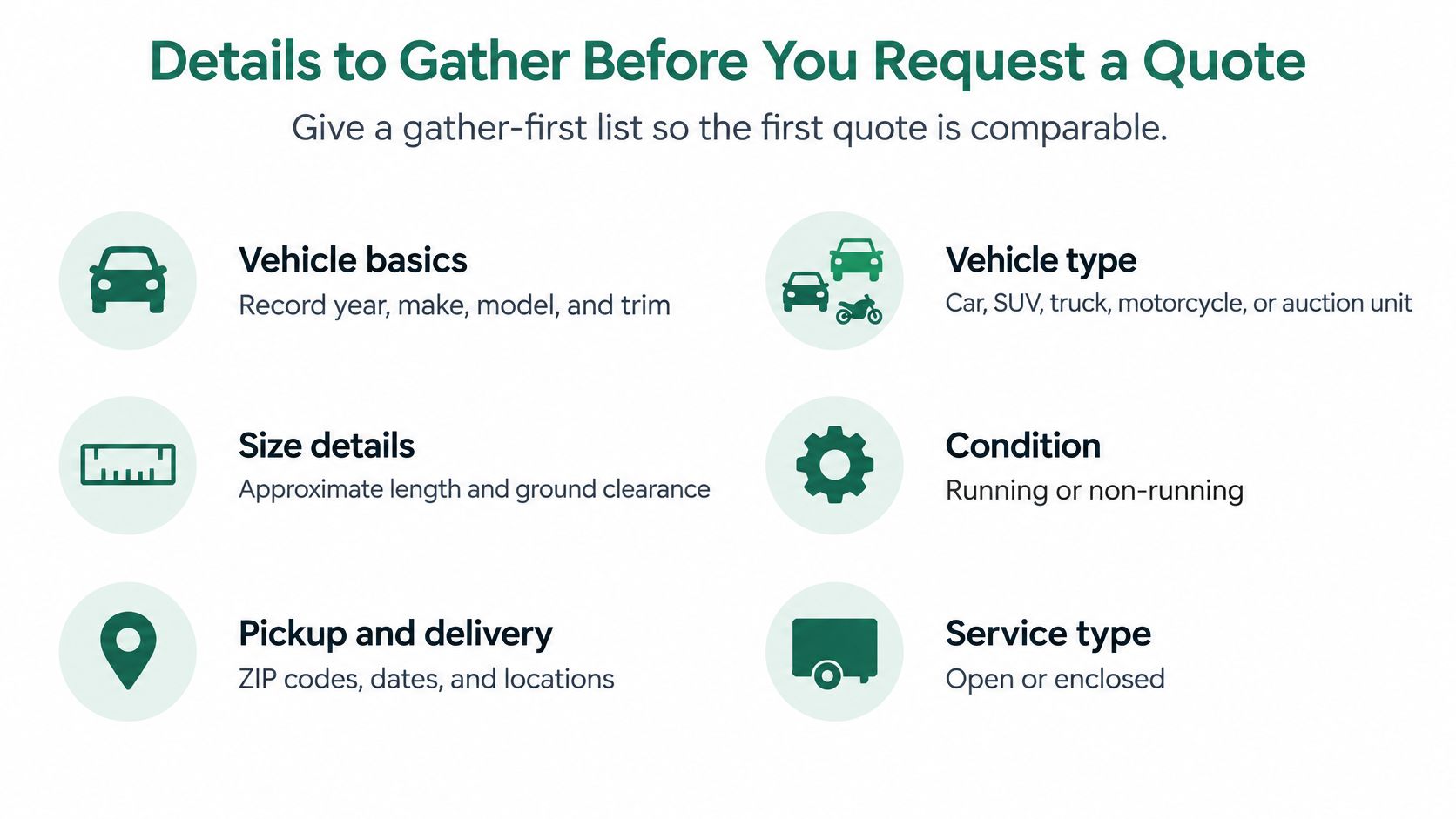
Don't open a quote form yet. Fill in the details first, on paper or in a note on your phone, so the first quote you get is one you can compare.
The vehicle, described precisely
Start with what the carrier has to load.
- Vehicle basics: Record year, make, model, and trim. A base sedan and a lifted trim of the same model don't take the same space.
- Vehicle type: Say whether it's a car, SUV, truck, motorcycle, or auction unit. Auction units often sit in lots with their own release rules.
- Size details: Note approximate length and ground clearance, especially for lowered cars, long-bed trucks, and anything with aftermarket parts.
- Condition: State whether it runs, rolls, steers, and brakes. "It ran last year" isn't the same as running, and a dispatcher needs the honest version.
- Service type: Decide open or enclosed now. A classic, luxury, or lowered car may need enclosed transport and a liftgate, and that choice changes equipment and price.
Personal items generally stay out of the vehicle. Don't assume a car quote includes household goods in the trunk or back seat. If you're planning to put anything in the car, say so and ask, don't discover the answer at pickup.
The lane, described precisely
Cities alone aren't enough. Provide pickup and delivery ZIP codes for places like Los Angeles, Houston, Chicago, Miami, Atlanta, and Seattle, and say whether the address sits in a metro core or a rural county. Carrier coverage and pickup timing vary by market, and a ZIP code tells a dispatcher things a city name can't.
Give a three-to-five-day pickup window and name any hard date behind it, such as a PCS report date, a semester start, or a snowbird departure. Then add access limits while you're at it.
- Apartment and condo rules: Gates, guard desks, and parking restrictions that keep a large truck out
- Clearance problems: Low garages and narrow streets where the driver will need a nearby meeting point
- Lot pickups: Dealership or auction locations with set hours and release paperwork
One missing condition is enough to make two quotes impossible to compare.
Extra paperwork for Puerto Rico
Puerto Rico confuses people because it's domestic, but not simple. For used, self-propelled vehicles shipped between the continental United States and Puerto Rico, U.S. Customs and Border Protection's Puerto Rico ruling states the movement is not an "export" under 19 CFR 192.2 because Puerto Rico is part of the U.S. customs territory, so the standard 72-hour advance ownership-document requirement under that rule doesn't apply.
That doesn't mean paperwork-free. Electronic Export Information must still be filed through the Automated Export System, the VIN or PIN must be entered, and vehicles remain subject to inspection. Have your title, photo ID, and VIN ready before you call.
Also say where delivery ends. The Port of San Juan is one answer. Bayamón, Carolina, Guaynabo, Ponce, or Mayagüez are different answers, with different final legs. State it up front so the quote prices the move you're really making.
How to Request a Quote Online or by Phone
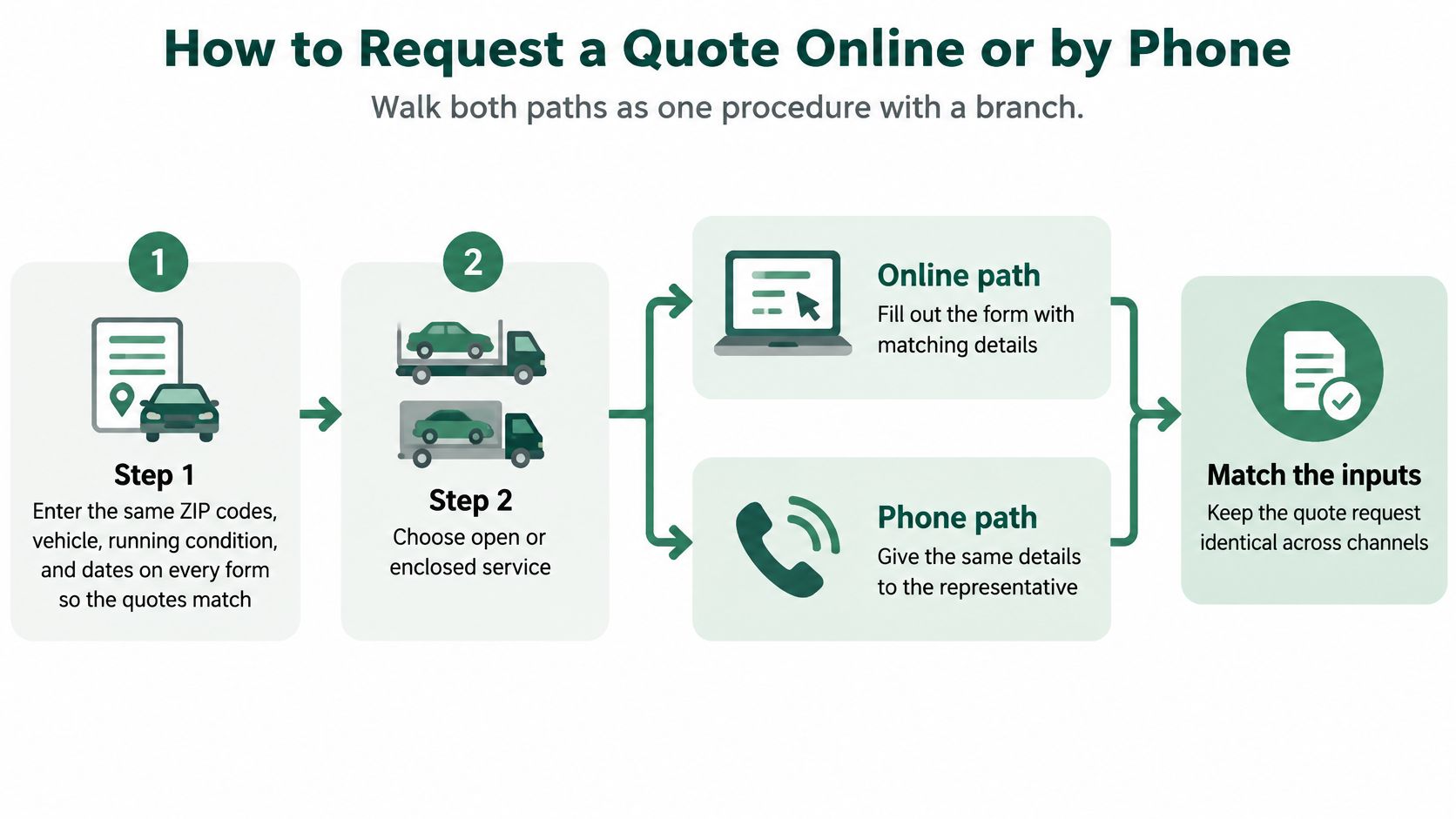
Online and phone aren't two different processes. They're one procedure with a branch in the middle, and both branches need identical inputs.
The shared steps
- Enter identical details everywhere. Use the same ZIP codes, vehicle, running condition, and dates on every form and every call, so the quotes describe the same job.
- Choose the service type. Pick open or enclosed service. For Puerto Rico, choose door-to-port or port-to-door rather than assuming driveway delivery on the island.
- Submit or call. A complete online form can be sent at any hour and may end with an option to book, after which a dispatcher looks for the next available truck or sailing. On the phone, read your checklist aloud.
- Ask for it in writing. Request the price with transport, fuel, accessorial charges, insurance limit, and cancellation terms split out, not folded into one unexplained total.
- Get two or three quotes in the same week. Prices built on identical inputs, close together in time, are the only ones worth comparing side by side.
- Reconfirm after any change. If the window, route, condition, or mode changes, the old quote no longer describes your move.
When the phone beats the form
Online is faster for a first number, and it works fine for a running car on a common route with easy access. Call or text when the details need explaining. If the car is inoperable, read the condition out plainly. If the street is tight or the garage is low, describe it before a truck is dispatched.
The phone also helps when paperwork is part of the job. Tell the agent the VIN and title status, and say whether the car sits at an auction or dealership with its own pickup rules. A move that combines a San Juan delivery with a mainland city far from Florida has more moving parts than a form can ask about, and a five-minute conversation prevents a mispriced quote.
Students shipping a first car to campus and dealers moving several units at once both benefit from that conversation, for opposite reasons. One needs each step explained. The other needs volume and lot logistics handled without repeating details vehicle by vehicle.
A calculator total or verbal rate is not a formal estimate until it matches the services on the written quote.
That last point protects you. A number spoken on a call or shown by a calculator is a starting point. The written quote, matched against your checklist, is the document you can rely on. When learning how to get a shipping quote that holds up, that written confirmation is the step people most often skip.
How Auto Transport Quotes Are Calculated
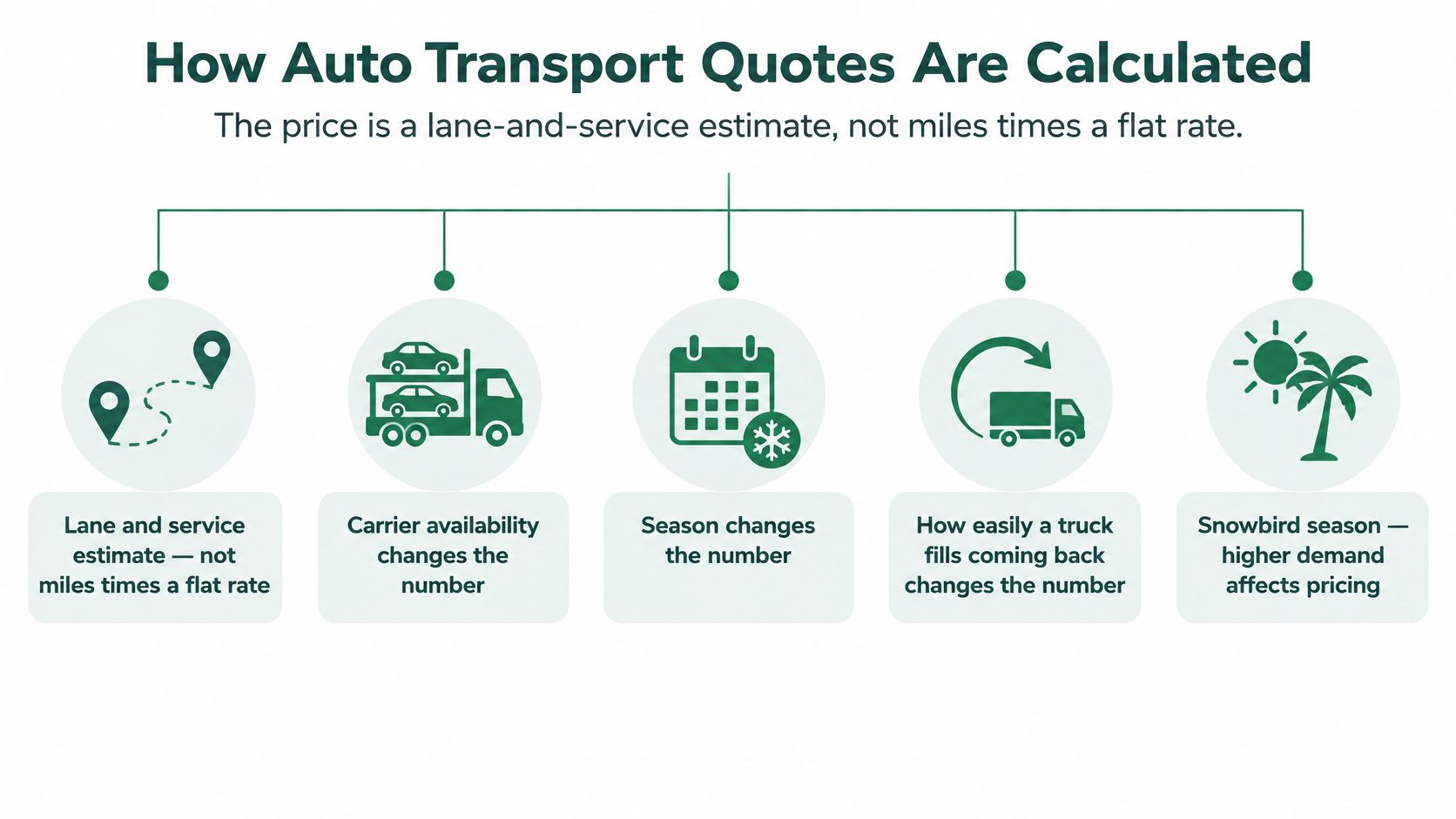
A low calculator number can be a poor quote if it leaves out a service or a leg of the trip. A usable quote is a written lane-and-service specification: it names the route, equipment, vehicle condition, and timing the price covers. No two vehicles move under exactly the same conditions.
Capacity, season, and the return trip
Carrier availability affects the price. A route with plenty of trucks and steady freight can cost less than a rural lane that requires a driver to detour. Season matters too: snowbird moves concentrate traffic to Florida and Arizona in the fall and back north in the spring, while military peak windows can put more moves into the same weeks. A flexible pickup window gives dispatchers more options than a fixed date during a busy period.
The return trip matters as well. A truck that can find another load near your destination has less empty running to account for than one headed toward an area with little outbound freight. This is why moving your car when relocating interstate can involve similar route-demand considerations, even though the transport market and pricing depend on the specific move.
Equipment changes the quote. Open transport is the budget default for everyday cars. Enclosed transport carries fewer vehicles and is often chosen for classics, exotics, or low cars that need a liftgate. A non-running car requires a winch and more labor, so its condition belongs in the quote.
Fuel is a live input
Fuel helps explain why a quote has a shelf life. Bureau of Transportation Statistics transportation cost data show U.S. on-highway diesel averaged $3.10 per gallon in 2025, down $0.10, or 2.7%, from 2024. The same source reports diesel reached a record annual-average level of $4.99 per gallon in 2022, and producer prices for trucking transportation increased 58.0% from 2010 through 2025.
BTS also notes that fuel prices vary by location and that trucking companies may raise shipping rates when fuel prices rise. Request a quote close to your planned shipping date, and ask whether fuel is included or could change the price. Comparing how car shipping costs are structured can help you distinguish transport charges from other items in a written quote.
Puerto Rico is not a mileage quote
A Puerto Rico move includes more than highway miles. The vehicle may travel by truck to a mainland port such as Jacksonville, by ocean to San Juan, then through port handling and any final island delivery. That ocean leg and its paperwork are not part of a 48-state mileage quote. Transit also depends on sailings, not driving days alone.
Sample mainland to Puerto Rico quote bands
| Origin or destination | Transit | Includes |
|---|---|---|
| Miami and South Florida | 7 to 10 days | Trucking, ocean freight, port handling |
| Orlando, Tampa, Jacksonville | 7 to 10 days | Trucking, ocean freight, port handling |
| Atlanta | 8 to 12 days | Trucking, ocean freight, port handling |
| New York, New Jersey, Philadelphia | 9 to 14 days | Trucking, ocean freight, port handling |
| Boston and Hartford | 9 to 14 days | Trucking, ocean freight, port handling |
| Chicago | 9 to 14 days | Trucking, ocean freight, port handling |
| All published lanes | 6 to 16 days | Broader band across lanes |
These transit windows are illustrative, not a promise for a particular vehicle or sailing. A 48-state move stays on the highway and is generally quoted by route and service instead.
Before accepting any figure, ask whether it is binding and what could change the final bill. A different vehicle condition at pickup, added storage, or extra services can affect the amount due.
Questions That Keep the Final Price Honest
Once a number arrives, switch from shopper to verifier. Use short, direct questions and write down the answers.

The call script
- Is this binding? Ask whether the price is binding and name every event that can change it, including a non-running discovery at pickup, a new address, storage, a missed sailing, or a port fee.
- What changes it? Requote whenever the pickup window, vehicle condition, route, or transport mode changes. An old quote for a different job protects nobody.
- Who hauls it? Ask for the assigned carrier's legal name, its FMCSA operating authority, the cargo insurance limit, the pickup inspection process, and the claims path.
- Is the low number all-in? If one quote sits far below the others, ask whether door service, carrier pay, tolls, taxes, port charges, storage, and inoperable-vehicle equipment are included.
Schedule promises deserve the same scrutiny. The FTC action against two Nevada automobile transport brokers documented that securing a requested date depends on the route, season, broker payment reputation, and whether trucks can quickly fill orders in the destination region, and it challenged precise pickup or delivery promises made without a reasonable supporting basis.
So give a pickup range rather than an exact appointment, disclose access constraints, and treat an exact-day guarantee with no route capacity behind it as a warning sign. If you're quoted for enclosed auto transport equipment, confirm the trailer and loading method are assigned, not just priced.
The short video below walks through how these questions sound on a real quote call.
For Puerto Rico, add one more question. Confirm how the arbitrios excise tax is billed, since it's a government charge outside the transport quote. Island arrivals shouldn't mistake it for a hidden carrier fee, and shouldn't be surprised by it either.
Book the Quote That Matches Your Move
The lowest quote is useful only if it describes the move you need. Compare two or three written quotes using the same ZIP codes, vehicle condition, and open or enclosed service.
Choose a quote that explains how carrier assignment works, what insurance applies, what inspections are required, and which details could change the price. A slightly higher all-in price is more useful than a low figure with no carrier ready to accept the shipment.
For a mainland-to-San Juan move, or the return trip, look for a quote that includes the ocean leg and port handling. A highway-only rate leaves those costs and port paperwork outside the price. On a 48-state move between major cities, compare pickup flexibility, carrier verification, and payment timing.
The right quote is a written lane specification a carrier can run with the dates and equipment you named.
National Car Transport is one option to compare. The company describes its pricing as transparent and flat-rate, holds an A+ BBB rating, and has more than 25 years of experience. Its nationwide network includes 25,000+ vetted, licensed, and bonded drivers. Bilingual English and Spanish agents can help with quote details.
Submit the quote form at nationalcartransport.com with your checklist in hand. Compare the written quote against your vehicle, route, dates, and included services. If the terms match, book and keep the quote with your vehicle paperwork until delivery is complete.
Ready to price your move with the details that determine the final bill? National Car Transport provides written quotes for car shipping, including Puerto Rico routes. Submit your ZIP codes and vehicle details to request a quote.