

You've booked the flights, arranged the house, and marked the departure date. Then you remember the second vehicle sitting in the driveway. Driving it from Minnesota to Florida means days on the road, fuel expenses, mileage, and the same trip in reverse when spring arrives. Flying while a carrier moves the car can be easier, but only if you plan around seasonal demand, route capacity, documentation, and the possibility that your dates will change.
Snowbird car transport is a recurring logistics decision, not a one-time shipment. The right plan considers both directions, the vehicle's value and condition, the corridor you're using, and whether shipping remains more practical than storage or driving. This guide covers domestic auto transport across the 48 contiguous states, major metropolitan areas, and vehicle shipping between the mainland United States and San Juan, Puerto Rico.
Table of Contents
- Why Snowbird Car Transport Needs a Seasonal Plan
- Understanding the Main Transport Options
- Timing Both Legs Around Peak Demand
- Choosing Between Shipping and Storage
- Verifying Registration and Insurance Requirements
- Preparing Puerto Rico Vehicle Shipments
- How Snowbird Transport Pricing Works
- Planning a Smooth Seasonal Move
Why Snowbird Car Transport Needs a Seasonal Plan
A couple leaving Minnesota for Florida in late October may think the main challenge is getting south before the first serious winter weather. They arrange flights, close up the northern home, and then realize the second vehicle needs to reach Florida too. A last-minute quote may still be available, but the preferred pickup window, neighborhood access, and delivery timing may not be.
That decision repeats every year. Snowbird households commonly ship south in fall and return north in spring, often using the same corridors. Industry sources describe southbound demand as strongest from September through November and northbound demand as strongest from March through May. One 2026 industry report says about 80% of customers book between September and November (industry seasonality data). The recurring nature of the move changes how you should plan.
Treat both shipments as one annual project
The first move usually gets attention because it marks the departure. The return trip feels less urgent, especially when spring plans remain flexible. That's a mistake. A household that books only the southbound leg may face tighter capacity and fewer date choices when it tries to arrange the northbound shipment.
Popular corridors include New York to Florida, Maryland to Florida, and Midwest-to-Florida lanes (seasonal route and market overview). Published route examples include New York to Tampa at about 1,130 miles, Chicago to Tampa at about 1,130 miles, and Chicago to Phoenix at about 1,750 miles (snowbird route examples). Those distances make a coordinated plan more useful than treating each shipment as an isolated errand.
Practical rule: Choose your seasonal travel windows first, then reserve transportation for both directions before the calendar becomes crowded.
Build around the route, not just the calendar
A snowbird move from Boston to Tampa has different capacity conditions from a move between a smaller northern community and Arizona. Pickup access, carrier positioning, destination density, and whether the driver already has a compatible return load can influence the practical quote and timing.
The snowbird communities in Florida for retirees can also help you compare destination areas before committing to a delivery address. That matters because a carrier may reach a nearby city more easily than a gated community, narrow residential street, or remote subdivision.
For a household that drives locally in both homes, shipping twice each year often makes more sense than driving the route twice. A route of 1,200 to 1,500 miles each way can create 2,400 to 3,000 miles of annual wear and tear, require 2 to 3 days of travel per direction, and involve about $200 to $400 in fuel per trip, according to a snowbird transport guide (snowbird travel burden and transport guidance). The best plan is the one that accounts for the whole year.
Understanding the Main Transport Options
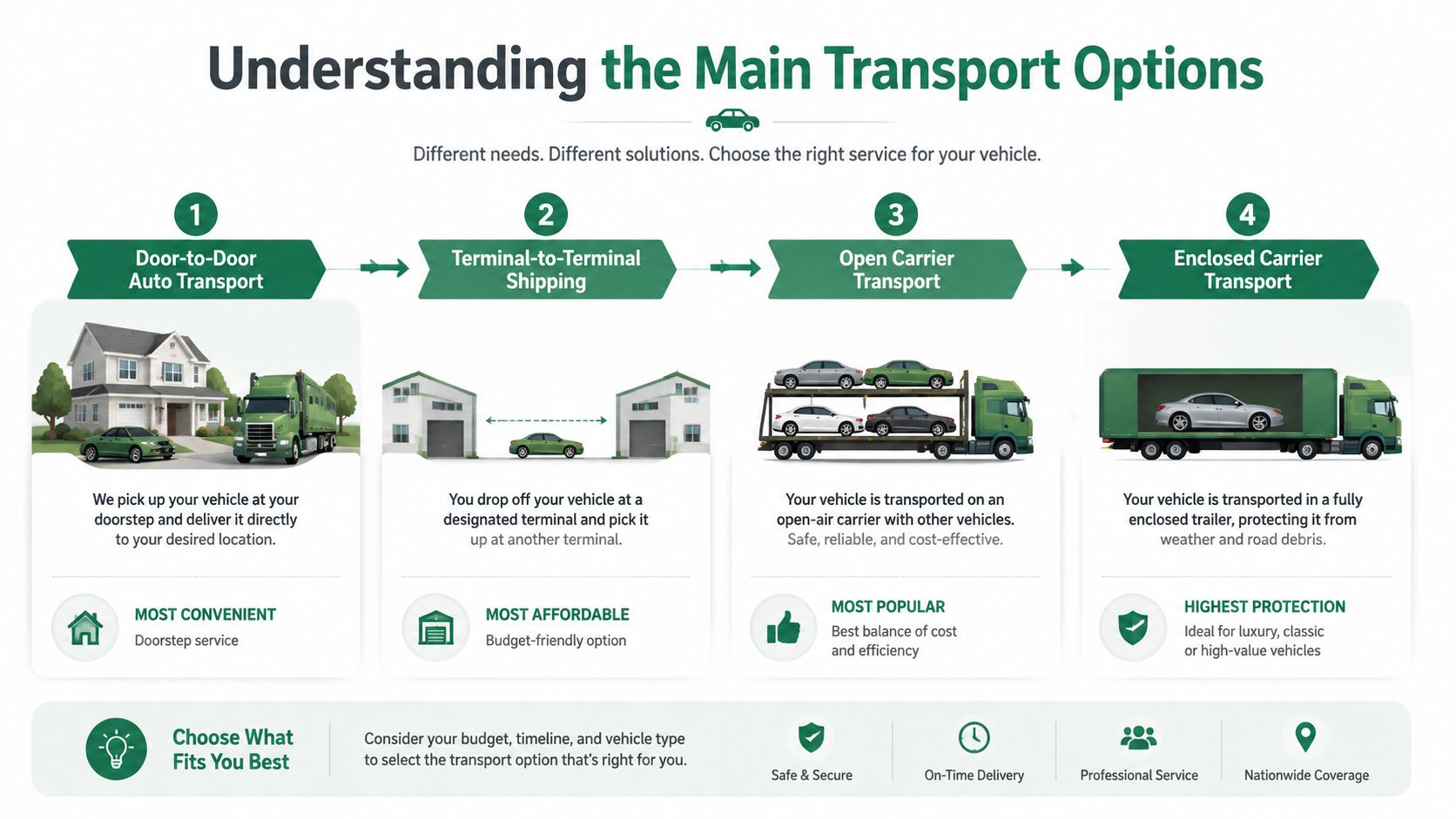
Choosing a service is similar to choosing how your household will move. Door-to-door service resembles hiring a moving crew to collect your belongings at home and bring them close to the new residence. Terminal service is more like taking your boxes to a warehouse and collecting them from another warehouse. Open and enclosed carriers describe the protection level during the trip.
Start with door-to-door transport
Door-to-door auto transport is the practical default for most snowbirds. The carrier picks up at or near the residence and delivers at or near the seasonal home. “Near” matters because large car haulers may not safely enter narrow streets, condominium lanes, gated communities, or roads with low branches.
Provide gate codes, community rules, and a backup meeting point when you book. A wide shopping center or service area can make the handoff easier than forcing a tractor-trailer into a residential street. You can review the service details for door-to-door auto transport before deciding whether the convenience fits your route.
Use terminal service when flexibility matters more than convenience
Terminal-to-terminal shipping can suit a snowbird who leaves the home before the vehicle is collected or arrives before the car is needed. The vehicle moves through designated facilities rather than directly between residences. That can simplify access, but you'll need to confirm terminal hours, storage policies, release requirements, and transportation to and from each facility.
This option works best for travelers with a dependable local contact. It's less attractive if you're trying to avoid extra driving at either end.
Match the carrier to the vehicle
Open carriers are the normal choice for daily drivers, family SUVs, and ordinary seasonal vehicles. The car is exposed to weather, road dust, and debris, but the service is widely available on major corridors.
Enclosed transport adds protection for classics, convertibles, luxury vehicles, low-clearance cars, and recently purchased vehicles whose owners want less exposure. It generally costs more, so don't pay for enclosed service just because the vehicle is used seasonally. Choose it when condition, value, or weather protection justifies the premium.
Treat Puerto Rico as a separate shipping mode
A vehicle moving between the U.S. mainland and Puerto Rico doesn't travel on a standard road carrier for the entire route. It must reach a port and load onto an ocean vessel, with separate documentation and island logistics. Port-to-port, door-to-port, and door-to-door arrangements can differ substantially.
Watch the service overview video after reviewing the basic options:
For Puerto Rico, ask specifically about sailing schedules, port handling, customs paperwork, and final delivery to San Juan or another destination. A mainland quote and an island quote aren't interchangeable.
Timing Both Legs Around Peak Demand
Seasonality affects more than the date printed on your travel calendar. Carriers reposition equipment toward the routes with the most demand, and snowbird lanes become harder to schedule when many customers want the same direction at once. Southbound shipments generally peak from September through November, while northbound returns are strongest from March through May (auto transport seasonality overview).
Peak-season snowbird shipping can cost 15% to 25% more than off-season rates, and delivery windows can expand from the usual 1 to 3 days to 5 to 10 days when carrier availability tightens (snowbird pricing and delivery guidance). Another market guide places seasonal route increases at about 10% to 25%, with some same-lane peak premiums of roughly $300 to $600 (seasonal snowbird pricing guidance).
Use the calendar as a pricing tool
You don't need to move during the busiest period if your travel plans are flexible. A January southbound shipment or a late-summer move can be easier to place than an October shipment. The same applies to a northbound return scheduled after the main spring rush.
For a typical household, reserve the southbound leg six to eight weeks ahead when possible. Broader guidance treats 2 to 3 weeks as a practical minimum, while dispatch-focused advice recommends reserving both legs 8 to 12 weeks early so a carrier already traveling the migration corridor can be assigned (snowbird booking guidance). The more specific your date and pickup location, the earlier you should act.
| Leg | Typical Months | Demand Level | Price Impact | Recommended Booking Lead Time |
|---|---|---|---|---|
| Southbound | September through November | High, especially during fall migration | Often above off-season rates | Six to eight weeks, with 8 to 12 weeks offering stronger planning control |
| Northbound | March through May | High, especially during spring return | Often above off-season rates | Reserve before spring capacity tightens |
| Flexible off-season move | January or late summer | Lower than migration peaks | Often more favorable | Still schedule ahead to protect the preferred week |
Ask about corridor exposure
A generic “book early” recommendation doesn't tell you how vulnerable your lane is. Reporting tied to the seasonal migration describes a roughly 30% surge in southbound demand during the November to December peak, while congested lanes include Boston to Tampa, Ontario to Florida, and Philadelphia to the Florida Keys (seasonal migration reporting). Ask the dispatcher whether your route has balanced northbound and southbound freight, where the carrier will be positioned, and what pickup window is realistic.
Mountain weather can also force rerouting. Dispatchers may adjust the route when mountain passes become unsafe, so leave buffer around flights and don't plan a same-day vehicle handoff immediately before departure.
For broader context on logistics pricing, this guide to container moving service costs illustrates why transport costs depend on more than distance alone. The same principle applies to snowbird lanes.
Choosing Between Shipping and Storage
The right comparison isn't just open versus enclosed transport. It's also shipping both directions, shipping one way and storing the vehicle, or driving each season. Each choice shifts the balance between convenience, mileage, storage obligations, and control over your schedule.
Open transport usually suits a standard daily driver. The vehicle travels on an exposed car hauler, so road dust and weather are part of the trade-off. Enclosed transport is more appropriate for a classic, convertible, luxury vehicle, or low-clearance car where road debris, weather, and ramp angles matter more than the lowest quote.
Compare the annual pattern
Storage can eliminate a return shipment, but it introduces its own work. You'll need to evaluate the facility's security, climate exposure, battery maintenance, tire condition, registration status, and insurance requirements. A car that sits for long periods may also create coverage questions, especially if the policy assumes regular use.
| Factor | Round-Trip Shipping Each Season | One-Way Ship + Storage | Drive Each Season |
|---|---|---|---|
| Convenience | Fly and use the same vehicle at both homes | Vehicle remains available at one destination | Requires driving time in both directions |
| Mileage | Minimizes long-distance wear | Minimizes one long trip, with storage inactivity | Adds the full road distance to the vehicle |
| Protection | Choose open or enclosed based on vehicle value | Storage quality determines exposure | Vehicle experiences ordinary road and weather conditions |
| Schedule | Requires two carrier bookings | Requires one booking plus storage coordination | Controlled by the owner, but affected by road conditions |
| Administrative work | Pickup, delivery, inspection, and seasonal booking | Storage contract, battery, tires, registration, and insurance | Fuel, lodging, maintenance, and travel planning |
| Best fit | Households that use the car in both locations | Owners who can leave the vehicle unused in one state | Travelers who enjoy or need the road trip |
A vehicle that stays in a Florida garage all summer may justify one-way shipping and storage. A vehicle used regularly in both locations usually favors repeated transport, particularly when driving would mean thousands of annual miles and multiple travel days. Storage is not automatically cheaper once facility fees, maintenance, insurance, and retrieval timing are included.
Advisor's view: Don't compare storage with a single shipping quote. Compare the full annual cost of each plan, including what you'll do when your dates change.
Verifying Registration and Insurance Requirements
A carrier can't solve a title problem at pickup. Verify the vehicle's paperwork before you request a firm schedule, especially when the car has a lien, recently changed owners, or is moving permanently between states.
Complete the document check first
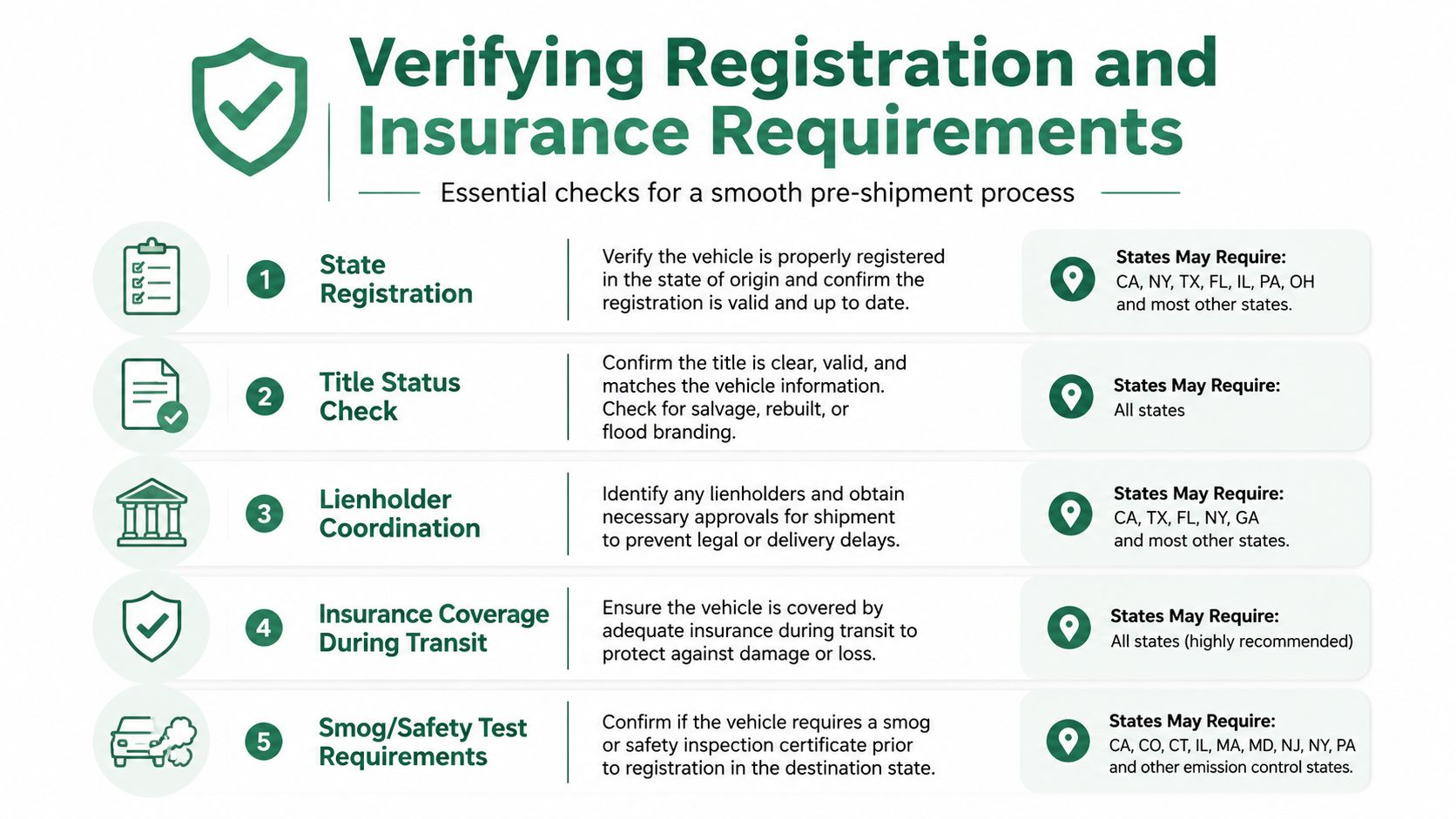
Start with the registration, title, VIN, and lien status. The names and identifying details should match across the records. Expired tags, a missing lien release, or mismatched VIN documents can delay release or create questions at pickup.
Some states require a smog or safety inspection before a vehicle can be re-titled. If you're changing the vehicle's registration state, check the receiving state's requirements before the car arrives. Registration timelines, local tax rules, and inspection appointments can affect how quickly you can use the vehicle after delivery.
Use this order:
- Confirm registration: Check that the registration is current and identify any state-specific inspection obligation.
- Review title status: Verify that the title is available and ownership information matches the shipping order.
- Contact the lienholder: Ask whether the lender requires written export or transport authorization, a lien release, or a specific clause in the shipping paperwork.
- Review insurance: Confirm whether your personal policy covers transport damage and ask for the carrier's cargo insurance details.
- Prepare the handoff file: Keep identification, registration, title copies, authorization letters, and contact information accessible.
Separate transport insurance from driving coverage
Your auto policy may cover some risks while the vehicle is being transported, but don't assume it does. Ask what the carrier's cargo policy covers, whether exclusions apply to personal items or pre-existing damage, and how a claim is filed.
At pickup, the driver records the vehicle's condition on the Bill of Lading. Review every notation before signing. At delivery, inspect the vehicle before accepting it, photograph any new damage, and record the issue on the delivery paperwork. Keep the documents and photos together.
Registration planning also matters for seasonal residents who establish a Florida address. These new to Florida car registration tips can provide useful background, but confirm the current requirements with the relevant state agency or your legal and insurance adviser.
Puerto Rico shipments require a separate document review. Common requirements include the original title and registration, a notarized authorization or affidavit when applicable, a certificate of no debt from ACAA, a pre-inspection certificate, and local fee stamps including the $11 code 5120 and $2 code 842 vouchers (Puerto Rico vehicle shipping documents). An active lien may require a notarized lender letter authorizing export, while an absent owner may need a notarized authorization letter for the person releasing or receiving the vehicle (Puerto Rico outbound shipping requirements).
Preparing Puerto Rico Vehicle Shipments
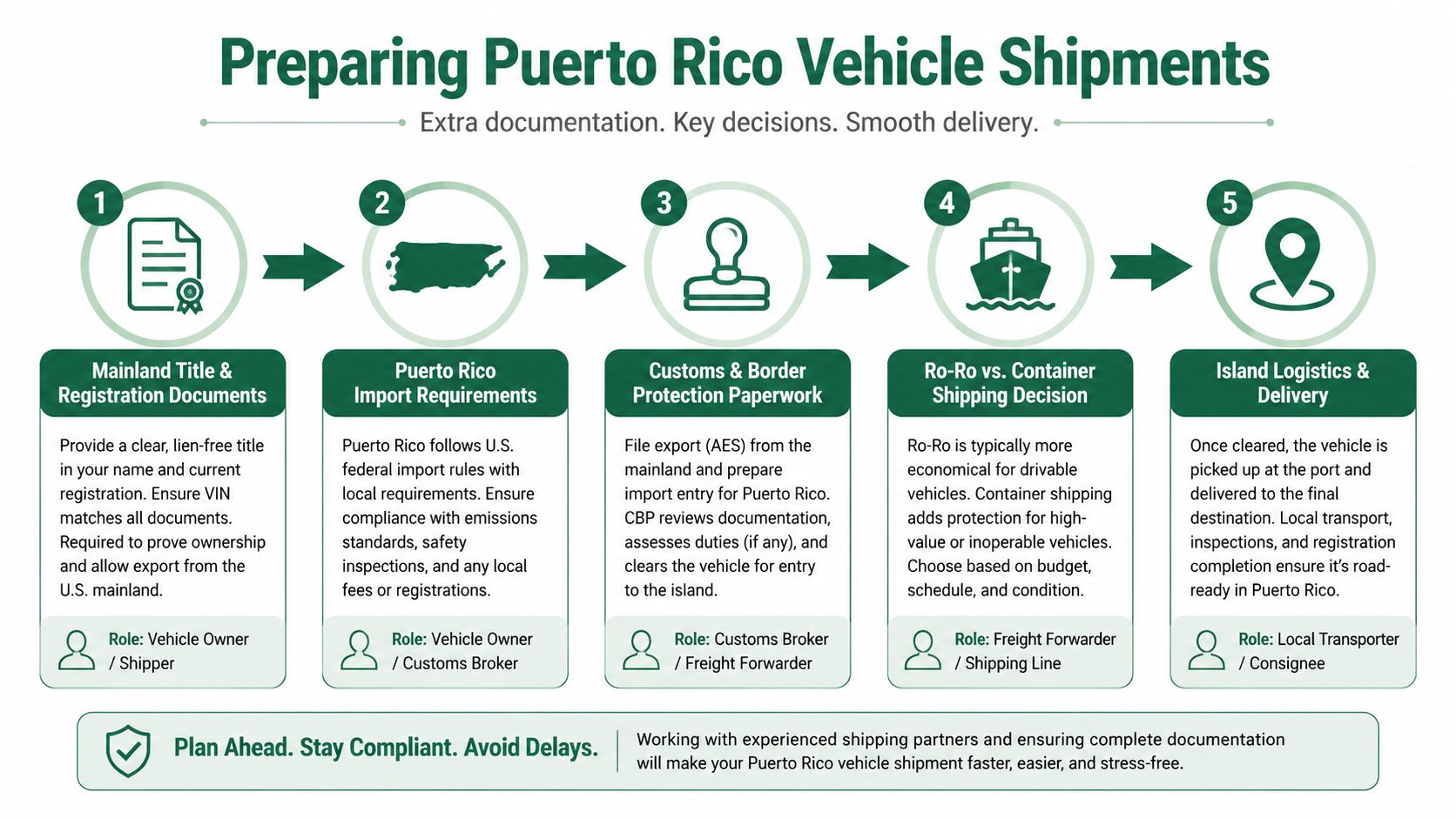
Puerto Rico vehicle shipping is an ocean move attached to a mainland pickup and delivery plan. The vehicle must reach the appropriate port, clear the required process, sail according to the available schedule, and then move through island delivery arrangements. A standard mainland auto transport quote won't capture every part of that chain.
Prepare the Puerto Rico file before booking
Gather the title, registration, owner identification, lienholder authorization when required, and any notarized letters before the mainland carrier is scheduled. If another person will release or receive the vehicle, the authorization should be prepared in advance rather than requested after the pickup appointment is set.
Puerto Rico paperwork can be time-sensitive. Government and logistics guidance states that a certificate of no fines may be valid for only 3 days, and shipping checklists require the vehicle to be washed with legible VIN or identification markings before acceptance (Puerto Rico shipping instructions). That means a document collected too early may expire before the port process is complete.
Clarify the ocean service
Ask whether the quote covers:
- Mainland pickup: Residential pickup, terminal delivery, or port delivery.
- Ocean movement: Ro-Ro or container service, sailing arrangements, and port handling.
- Puerto Rico processing: Customs broker coordination, local fees, inspection requirements, and release procedures.
- Island delivery: Port pickup, delivery to San Juan, or transport to another Puerto Rico location.
- Return planning: Available capacity and paperwork for the opposite direction.
A licensed customs broker can help coordinate import and export documentation, but confirm who hires the broker and whether the related charges are included. Ro-Ro service may suit an operable standard vehicle, while container shipping can be considered when the vehicle or cargo needs a different handling arrangement. Don't place personal belongings in the vehicle unless the carrier and shipping rules expressly allow them.
Review Puerto Rico car shipping as a starting point for the island-specific service questions you should ask. San Juan is a major destination, but delivery needs outside the port area can add another ground leg.
How Snowbird Transport Pricing Works
The lowest quote often looks attractive because it hides the decisions that create the final cost. A useful estimate starts with the lane and mileage, then accounts for demand, vehicle dimensions, operability, carrier type, pickup access, timing, and flexibility.
Peak-season pricing can be 15% to 25% higher than off-season pricing, and some guides report $300 to $600 premiums on the same lane during busy periods (seasonal snowbird pricing guidance). Those figures are market guidance, not a promise for a specific vehicle. Your quote may shift based on the exact origin, destination, vehicle, and pickup dates.
Read the quote by component
The base rate reflects the route and available capacity. A large SUV, lifted truck, heavy vehicle, or inoperable car may require different equipment or space. Enclosed service adds protection and cost. Door-to-door pickup may be more convenient than terminal service, but difficult residential access can require a meeting point.
Puerto Rico introduces port and ocean charges, customs coordination, island delivery, and potentially different handling fees. Expedited service and narrow pickup windows can also raise the quote because the dispatcher has fewer ways to match the vehicle with an existing route.
| Cost Component | Northeast to Florida | Midwest to San Juan, PR |
|---|---|---|
| Route base | Ground mileage, lane capacity, and pickup access | Mainland ground leg plus port and ocean routing |
| Seasonal demand | Fall southbound or spring northbound pressure | Seasonal timing plus sailing and port capacity |
| Vehicle factors | Size, weight, operability, and carrier space | Same factors, plus ocean acceptance requirements |
| Service type | Open, enclosed, door-to-door, or terminal | Port-to-port, door-to-port, container, or Ro-Ro options |
| Flexibility | Narrow dates and changes may affect placement | Missed sailing windows can affect the wider schedule |
| Extra charges | Access, storage, rebooking, or expedited handling | Port, customs, island delivery, storage, and handling fees |
The car shipping cost guide can help you organize the questions behind a quote. Ask whether the price is flat, what triggers a change, when payment is due, and whether a rescheduling fee applies after a carrier is assigned.
Price flexibility, not just the first number
Some providers allow free rescheduling only when the request is made more than 48 hours before pickup, then charge about $150 plus carrier costs after assignment (provider rescheduling policies). Confirm the policy in writing before booking. A low quote with harsh change terms may cost more than a slightly higher quote that tolerates uncertain travel dates.
If your household ships twice annually, ask whether both legs can be planned together. That doesn't guarantee a discount, but it gives the dispatcher more context about your recurring route and helps you avoid treating the spring return as an afterthought.
Planning a Smooth Seasonal Move
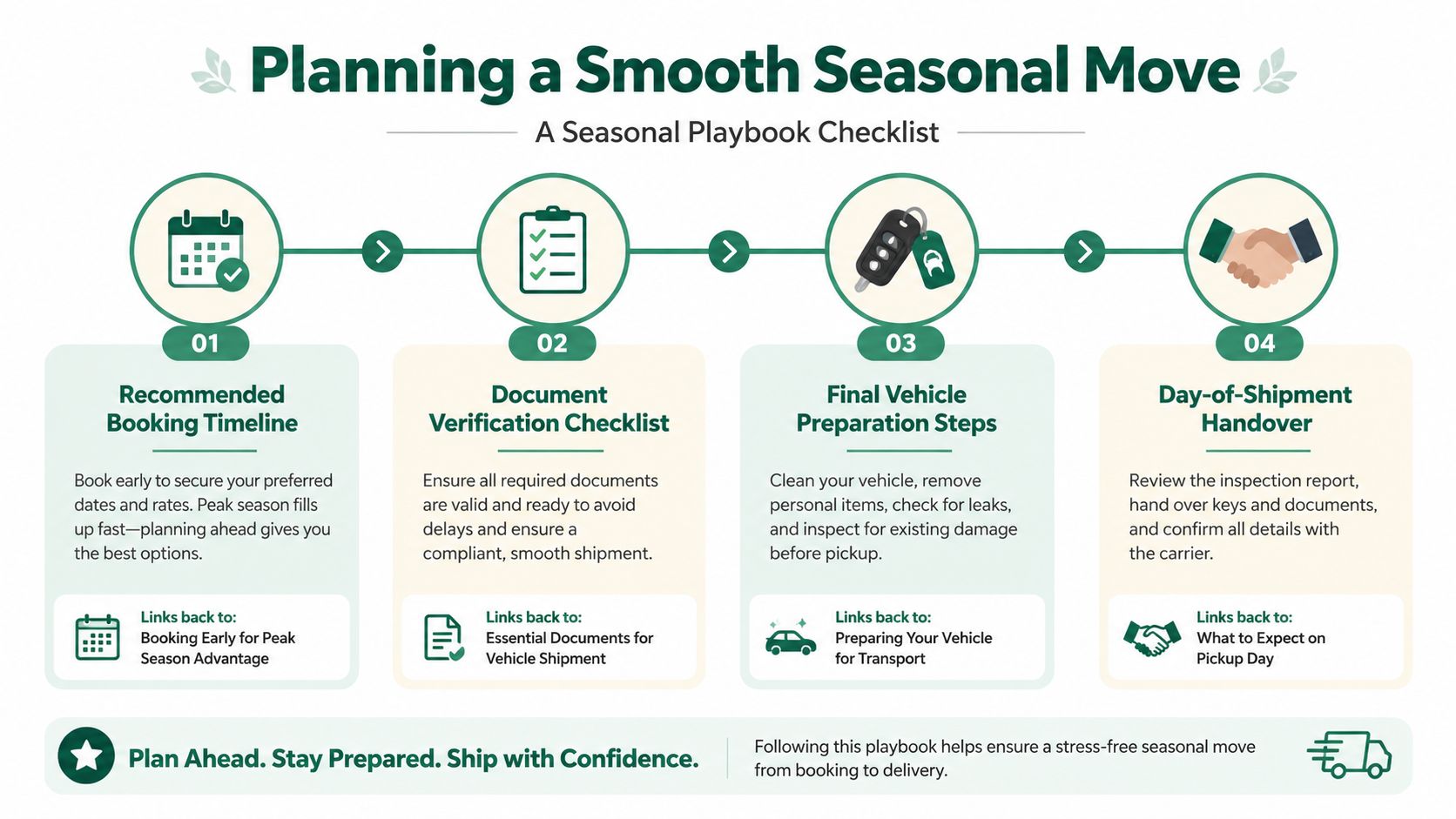
Use a simple sequence. Choose the southbound and northbound travel windows, then reserve both legs as early as your dates allow. Check route exposure, select open or enclosed service, and decide whether door-to-door pickup or a nearby meeting point will work at each address.
Before dispatch, verify registration, title, lienholder authorization, insurance, and any Puerto Rico documents. Keep a backup contact available if you'll be flying, and confirm the pickup window rather than assuming the truck will arrive at an exact hour.
Practical answers:
- Personal items: Ask before loading anything. Carriers may restrict or refuse personal cargo.
- Damage claims: Photograph the vehicle, note damage on the Bill of Lading at delivery, and follow the carrier's cargo-claim process.
- Payment: Confirm accepted payment methods and the amount due at delivery before dispatch.
- A second vehicle: Ask whether another vehicle can be placed on the same carrier. Availability depends on space, route, and equipment.
Before handoff, check tire pressure, battery health, and fuel level, then photograph every exterior side, the interior, wheels, glass, roof, and odometer. These records make the inspection clearer at both ends.
National Car Transport coordinates domestic and Puerto Rico vehicle shipping with open, enclosed, container, and ocean options, supported by 25+ years of experience, an A+ BBB rating, transparent flat-rate pricing, and a network of 25,000+ vetted carriers. Its U.S.-based bilingual English/Spanish agents have more than 20 years of auto transport logistics experience and can help snowbirds, families, students, military customers, dealerships, and businesses plan both seasonal legs. Visit National Car Transport to discuss your route, vehicle, dates, and the practical details that make your move simple and quick.