
You bought a car from a private seller, won one at auction, inherited a project vehicle, or you're trying to move before a deadline and just realized the paperwork isn't complete. The vehicle is sitting there. The keys may even be in your hand. But the title is missing, unsigned, inconsistent, or tied up in someone else's name.
That puts you in a real bind. A no vehicle title problem isn't just a paperwork annoyance. It affects ownership, registration, insurance questions, resale value, and, in many cases, whether a carrier will even agree to transport the car. The issue gets even tighter when the route crosses state lines or involves ocean shipping to or from Puerto Rico, where documentation mistakes can stall the move before the vehicle ever reaches the port.
The good news is that this is usually solvable if you approach it in the right order. Start with ownership verification. Then sort out whether you need a duplicate title, a bonded title, or a state-specific process. Only after that should you line up shipping or sale terms.
Table of Contents
- Why a Missing Vehicle Title Is a Serious Roadblock
- Your First Move Verifying Ownership with a VIN Check
- How to Get a Legal Title Replacement vs Bonded
- State-Specific Rules and Common Pitfalls to Avoid
- Shipping a Car with No Title A Guide for Movers and Buyers
- How to Sell Your Vehicle Legally Without a Title
Why a Missing Vehicle Title Is a Serious Roadblock
A missing title changes the transaction immediately. Without clear title paperwork, you can't safely assume the seller had the legal right to sell the vehicle, that an old lien has been released, or that the car wasn't branded in a way that affects value and insurability.
The risk isn't rare. Title fraud poses severe risks, with data revealing that 1 in 12 used vehicles, about 8.3%, has a significant title issue. The FTC's 2022 consumer reports documented over 250,000 complaints related to used car fraud, with 35% tied to title problems, leading to $2.1 billion in annual consumer losses, according to VinAudit's NMVTIS data overview.
What the title problem usually hides
Sometimes the problem is harmless. The owner lost the paper title during a move. The lender mailed a release and nobody filed it correctly. A family member sold a car they had a right to sell, but not the supporting documents.
Sometimes it isn't harmless at all.
- Unreleased liens: A paid-off loan may still appear unresolved until the proper release is filed.
- Brand history: The vehicle may carry salvage, rebuilt, flood, or other branding that changes what buyers, insurers, and DMVs will allow.
- Ownership breaks: Bills of sale alone often don't fix a missing chain of title.
- Theft exposure: If the VIN history doesn't line up, you're not just looking at delay. You're looking at a vehicle you should not ship, register, or sell.
Practical rule: If the title status is unclear, treat the car as unshippable and unsellable until the VIN history and ownership chain make sense on paper.
Why transport gets complicated fast
A lot of people assume shipping and title work are separate issues. In practice, they overlap. Carriers don't want documentation disputes at pickup. Port operators and receiving agents want names, VINs, and release paperwork to match. If they don't, the vehicle can sit while storage charges and scheduling problems pile up.
That matters even more for military families, snowbirds, students, online buyers, and Puerto Rico moves. Those customers usually work on a calendar. They need the car out of one place and available in another by a specific date. A no-title situation can break that schedule before the truck is dispatched.
The workable mindset
The best approach is simple:
- Verify the VIN and history first
- Choose the correct title path
- Match the shipping plan to the documents you have
People get into trouble when they reverse that order and book transport first.
Your First Move Verifying Ownership with a VIN Check
Before you call a DMV, sign a transport order, or try to resell the car, run the VIN. This is the first step because it tells you whether you're dealing with a fixable paperwork problem or a vehicle with deeper legal baggage.
Start with the VIN itself
Find the full Vehicle Identification Number exactly as it appears on the car. Check the dashboard plate at the windshield, the driver's door sticker, and any registration or prior paperwork you were given. If those don't match, stop there and resolve the discrepancy before doing anything else.
A clean process starts with one accurate VIN. One wrong character can pull the wrong record or cause a DMV rejection later.
Use NMVTIS, not guesswork
The National Motor Vehicle Title Information System, or NMVTIS, is the federal database that pulls title information from all 50 states, insurers, and salvage operators. By 2023, NMVTIS had processed over 1.2 billion records, enabling the detection of more than 500,000 salvage or flood-branded titles annually that could otherwise be sold illegally, as explained by the official NMVTIS consumer resource.
That matters because a no vehicle title problem often isn't visible from the car itself. A vehicle can look clean in the driveway and still carry title brands, theft records, or ownership issues in the database.
What to look for in the report
Don't just confirm that a record exists. Read the report like a file review.
Look for these items:
- Current and prior title brands: Salvage, rebuilt, flood, lemon, or similar brands affect registration and resale.
- Theft indicators: If theft records appear, don't move forward with transport or sale.
- Lien data: An active lien can block title transfer even if the seller insists the loan was paid.
- Odometer history: Inconsistencies can trigger DMV scrutiny.
- State history: Multiple state transfers aren't automatically a problem, but they do increase the need for matching paperwork.
A VIN report doesn't create ownership. It tells you whether the story you're being told matches the record.
How to interpret what you find
If the report shows a straightforward ownership path and the car was missing its paper title, you're usually looking at a duplicate-title situation.
If the report shows no clean transfer into your name, but your bill of sale and supporting documents are legitimate, you may be looking at a bonded-title route.
If the report shows theft flags, unresolved liens, or branding that conflicts with what the seller represented, don't try to solve it with better wording on a bill of sale. Pause the deal.
A quick field checklist
When I review a file like this from a logistics standpoint, I want the owner to gather these documents before anyone talks transport:
- VIN photo from the vehicle
- Bill of sale
- Any prior registration
- Seller identification, if available
- Any lien release or payoff proof
- The NMVTIS report
That packet won't solve every state issue, but it gives you a real starting point. Without it, every later step gets harder.
How to Get a Legal Title Replacement vs Bonded
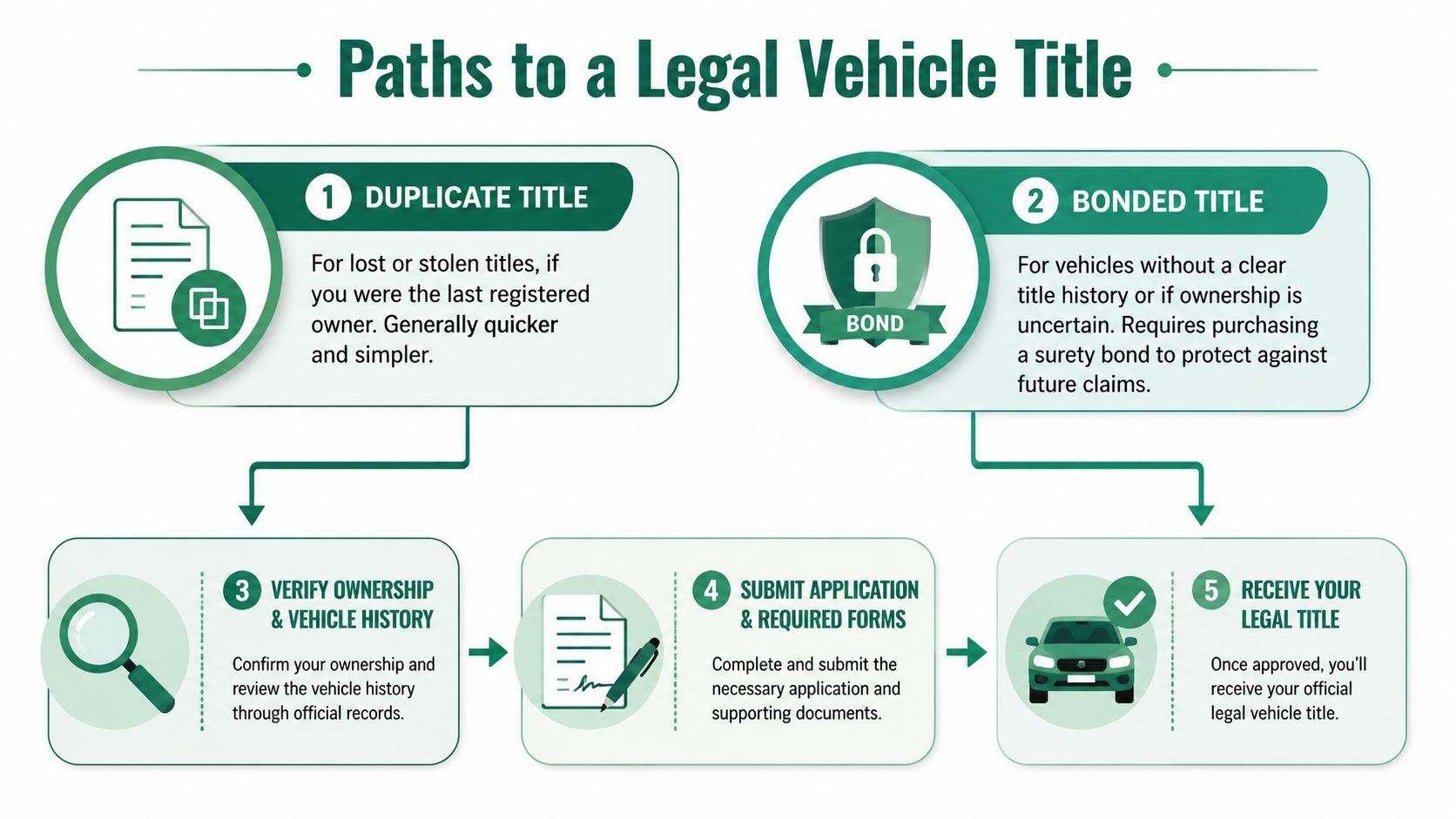
Once the VIN history checks out, the next question is whether you need a duplicate title or a bonded title. These are not interchangeable. People waste time when they apply for the wrong one.
When a duplicate title is the right answer
A duplicate title usually fits when you were the last legal owner and the original paper was lost, damaged, or never reached you. This is the cleaner route because you're not trying to prove a new ownership claim from scratch. You're replacing a document that should already exist in your name.
That route tends to work best when the registration history, your ID, and the DMV record all line up. If the vehicle is still titled to someone else, a duplicate title usually isn't your fix.
When a bonded title makes sense
A bonded title is the usual path when you bought a vehicle without a title and need a legal way to establish claim while protecting prior owners or lienholders if a valid claim surfaces later.
According to the bonded title process described in this surety-focused explainer, you must purchase a Lost Title Bond, typically for 1.5x the vehicle's value, with premiums averaging a $100 one-time fee. The process is available in over 45 states and generally requires the bond, a Statement of Fact, and a VIN inspection submitted to the DMV.
Side-by-side decision points
| Issue | Duplicate title | Bonded title |
|---|---|---|
| Last titled owner is you | Usually yes | Usually no |
| You bought vehicle with no title | Usually no | Often yes |
| Need surety bond | No | Yes |
| VIN inspection may be required | Sometimes | Common |
| Ownership chain matters | Yes | Yes, even more |
What works in the real world
The bonded route works best when your paperwork tells a consistent story. A clean bill of sale, matching seller information, VIN verification, and any old registration documents help. What doesn't work is trying to replace missing ownership evidence with a handwritten note and hope.
Common supporting items include:
- A bill of sale with matching VIN
- A signed affidavit explaining how you got the vehicle
- Photos of VIN plates and vehicle condition
- Prior registration or loan payoff paperwork
- A completed DMV inspection, if required
Worth remembering: A bond doesn't prove ownership by itself. It backs your ownership claim while the state evaluates the application.
One useful comparison from outside the U.S.
If you've dealt with vehicles in the UK, the paperwork logic may feel familiar. The forms are different, but the principle is similar. Replace a document if ownership is already established. Use a more formal corrective process when the paper trail is incomplete. For that reason, the CarForms.co.uk guide for lost logbooks is a useful comparison point, even though U.S. title law is state-based and not the same as the V5C system.
State-Specific Rules and Common Pitfalls to Avoid
A no vehicle title case is never purely national. The DMV that matters is the one with authority over the vehicle's current status, prior title state, or intended registration state. That's why advice that sounds right in one state can fail completely in another.

Alabama shows how different the rules can be
Some vehicles don't fit neatly into duplicate-title or bonded-title categories. Towed vehicles, abandoned vehicles, and certain possession-based situations can fall under a separate legal track.
In Alabama, the Unclaimed/Abandoned Motor Vehicle law creates a path from possession to title. The process requires reporting the vehicle within 5 days, notifying owners by certified mail after an NMVTIS check, and using a public auction if the vehicle remains unclaimed after 35 days to generate a bill of sale for title application, according to the Alabama Department of Revenue procedure page.
That isn't a loophole. It's a formal statutory process with deadlines. Miss the reporting window and your advantage can disappear.
Mistakes that cause the most damage
The most expensive errors are usually procedural, not mechanical.
- Using the wrong state process: A bonded-title path that works in one state may not exist or may work differently elsewhere.
- Skipping notice requirements: Certified mail, affidavit language, and waiting periods matter.
- Assuming a bill of sale is enough: It often isn't, especially across state lines.
- Trying internet shortcuts: If a workaround depends on weak documentation or a state with no real connection to the vehicle, expect problems later.
Questions to ask your DMV before filing anything
A short, focused call can save weeks. Ask:
- Does this state issue bonded titles for this kind of vehicle?
- What proof of ownership is acceptable in my situation?
- Is a VIN inspection required?
- Do I need certified mail notices to prior owners or lienholders?
- Can I register or transport the car while the title issue is pending?
Write down the answer, the date, and the office you spoke with. If your case later touches shipping, port release, or resale, those details help.
Don't rely on what a seller says their state "always does." Rely on what the current DMV process actually requires.
The trap with cross-state assumptions
People often get burned after buying from auctions, estate sales, or private sellers in another state. They assume their home state will accept whatever that seller handed over. Sometimes it will. Sometimes it won't.
The practical lesson is simple. Don't spend money on repairs, detailing, or transport until the title path is identified in the state where you need the car registered.
Shipping a Car with No Title A Guide for Movers and Buyers
Shipping a vehicle with title issues is possible in some cases, but it requires more discipline than a normal move. A carrier isn't just hauling metal. The carrier is taking custody of a vehicle that may cross checkpoints, state lines, terminals, and, for Puerto Rico, a port system with additional release requirements.
Why carriers hesitate
The problem isn't only legal ownership. It's risk allocation. If the names on the booking file, bill of sale, VIN record, and release paperwork don't line up, the carrier can get dragged into a dispute they didn't create.
That hesitation is backed by documentation risk data. Shipping a vehicle with no title across state lines is risky, as carriers may refuse the load due to liability and insurance voids. FMCSA data shows 15% of auto transport disputes involve documentation, with no-title vehicles being 3x more likely to be rejected. A temporary transit permit, available in 42 states, can be a solution, as summarized by RateGenius.
What usually gets a file approved
A no-title shipment is much easier when the customer sends a complete document package before dispatch. In practice, these shipments are won or lost before the truck arrives.
| Document | Domestic U.S. Shipping (48 States) | Shipping to/from Puerto Rico |
|---|---|---|
| Government-issued ID | Commonly required to match shipper or release party | Commonly required and should match port and booking records |
| Bill of sale | Often used to support possession and explain why no title is present | Important, especially if title replacement is pending |
| VIN photo | Strongly recommended to confirm the unit being moved | Strongly recommended before port intake |
| Registration or expired registration | Helpful when available | Helpful and often part of a cleaner file |
| Lien release | Important if any prior loan is involved | Important because unresolved ownership questions can stall release |
| Temporary transit permit | Useful where available | May help on mainland leg, but port-side requirements still govern |
| Title application receipt or DMV correspondence | Helps show that the owner is actively curing the title issue | Very helpful when coordinating with port agents and receiving parties |
What works and what doesn't
Here's the blunt version from a logistics standpoint.
What works:
- A verifiable VIN
- A bill of sale with complete buyer and seller details
- A duplicate-title or bonded-title application already in progress
- A temporary transit permit where the state allows one
- Clear pickup and delivery contact information with matching names
What doesn't:
- "The seller said it's fine"
- Photos of partial paperwork
- A title signed by the wrong person
- Open lien questions
- Last-minute disclosure to the carrier that the vehicle has no title
Interstate transport with pending title work
For a mainland move, some carriers will consider the shipment if the ownership story is clear and the route doesn't trigger additional restrictions. Others won't touch it at all. Both positions are reasonable.
The practical move is to disclose the issue early and ask whether the carrier wants a temporary permit, bill of sale, registration copy, or DMV filing receipt. If you hide the problem until pickup, expect cancellation fees, missed loading windows, or a driver who refuses the car.
Puerto Rico requires tighter coordination
Puerto Rico moves are a different animal. You're not just dealing with one truck and a driveway handoff. You're coordinating inland transport, port handling, vessel timing, release procedures, and local paperwork review on arrival or departure.
For a vehicle with no standard title, that means every document has to tell the same story. The VIN on the vehicle, booking file, bill of sale, and any pending title paperwork must align. If there is a lien release, it needs to be included. If a temporary permit exists, it should be supplied early, not after the vehicle reaches staging.
Experienced guidance is of utmost importance. Puerto Rico shipments often involve handoffs between parties who need names, identification, VINs, and authority to release or receive the vehicle. A weak paperwork file that might squeak through on a short domestic route can stop cold in a port environment.
A practical shipping sequence for difficult files
If you're moving a no-title vehicle from Chicago, Miami, Houston, Orlando, Jacksonville, Los Angeles, Phoenix, Dallas, Atlanta, New York, or another major mainland market to San Juan, or making the reverse move back to the mainland, the safest sequence looks like this:
- Run the VIN and review ownership history
- Identify the title path in the registration state
- Collect supporting documents into one file
- Ask the shipper or coordinator what the carrier and port will require
- Only then schedule pickup
A no-title shipment can still move smoothly, but only when the paperwork is treated like cargo. If one piece is missing, the whole load can stop.
Who needs to be most careful
These cases come up all the time with specific groups:
- Military families: Tight relocation dates don't leave room for rejected pickups.
- Snowbirds: Seasonal timing makes delays expensive and disruptive.
- Students: Family-purchased vehicles often come with incomplete document transfers.
- Dealerships and auction buyers: Volume buying can hide a bad paper trail until dispatch.
- Puerto Rico customers: Port timing magnifies every documentation mistake.
For those customers, experienced coordination matters more than speed promises. Every shipment is different. That is especially true when the route includes Puerto Rico, when the vehicle came from an online sale, or when the title issue is still being cured.
How to Sell Your Vehicle Legally Without a Title
Selling a car without a title can be done, but you need to decide whether you're selling a problem at a discount or solving the paperwork first to preserve value. In many cases, getting the title sorted before the sale brings better buyers and fewer disputes. In some cases, especially with older project cars or parts vehicles, a disclosed as-is sale may be the more realistic path.

Two legal ways to approach the sale
The first option is to get legal title first, then sell normally. That route usually attracts stronger buyers because they can register, finance, insure, and transport the vehicle more easily.
The second option is to sell with full written disclosure that the vehicle does not currently have title. That can work for buyers who understand bonded-title processes, restorers, dismantlers, or buyers in states that allow a later cure. It also limits surprises if your paperwork is honest and complete.
What full disclosure should include
Don't rely on a text message thread or a verbal explanation in the driveway. Put the facts in writing.
A proper no-title bill of sale should state:
- The full VIN
- Buyer and seller names and addresses
- Vehicle year, make, and model
- Date of sale
- Purchase price
- That the vehicle is being sold without current title
- Any documents included, such as registration copy or lien release
- That the sale is as-is, where permitted
- Signatures from both parties
If you want a formatting reference, a professional car sale receipt can help you structure the document cleanly, even though you'll still need to tailor it to your state and title situation.
Sample Bill of Sale for No-Title Vehicle
| Field | Description |
|---|---|
| Seller full name | Legal name of person transferring possession |
| Seller address | Current mailing address |
| Buyer full name | Legal name of person receiving possession |
| Buyer address | Current mailing address |
| Vehicle year, make, model | Basic vehicle identification |
| VIN | Full Vehicle Identification Number exactly as shown on vehicle |
| Odometer reading | Current reading, if available |
| Sale date | Date possession changes hands |
| Sale price | Agreed purchase amount |
| Title disclosure statement | State clearly that the vehicle is sold without current title |
| Supporting documents included | Bill of sale attachments, old registration, lien release, affidavits |
| Condition statement | As-is language, where legally permitted |
| Signatures | Buyer and seller signatures, plus notary if desired or required |
A simple disclosure line can read like this:
Seller transfers possession of the vehicle identified above to Buyer. Seller discloses that no current negotiable title is being transferred with this sale. Buyer understands that additional DMV procedures may be required before registration or title issuance.
That sentence won't fix a bad transaction, but it makes the facts plain.
Add supporting proof, not just signatures
A stronger file includes photocopies or scans of the seller's ID, prior registration if available, and any lien release or affidavit tied to the car. This matters later if the buyer applies for a bonded title or needs to explain the chain of possession.
Here is a helpful walkthrough on the subject:
When not to sell yet
Hold the sale if any of these are true:
- The VIN record raises theft concerns
- The person selling the car cannot explain the ownership chain
- A lien appears unresolved
- The buyer believes a bill of sale alone guarantees registration
Those are the deals that turn into chargebacks, civil disputes, or stranded vehicles that can't be shipped or registered.
A candid seller usually gets farther than a slick one. If the car has a no vehicle title issue, say that plainly, price accordingly, and document the transaction like it may be reviewed later by a DMV clerk, transport coordinator, or attorney.
If you're dealing with a no-title vehicle and need help moving it across the mainland or on a Puerto Rico route, National Car Transport is worth contacting. They handle shipping across all 50 states and Puerto Rico, have 25+ years of experience, an A+ BBB rating, transparent flat-rate pricing, and a network of 25,000+ vetted carriers. Their U.S.-based bilingual English and Spanish agents have deep auto transport logistics experience and can help you sort through the practical side of a difficult file, especially when the route, timing, or paperwork isn't straightforward.