

You just found a used car in another state, the photos look clean, and the seller says it's ready to go. The problem is that a glossy listing can hide the exact issues that turn a good deal into an expensive lesson, especially when the vehicle is going to be shipped before you ever touch it. A solid car inspection before purchase is the difference between buying with confidence and signing up for a problem that shows up on the truck, at the port, or after delivery.
Table of Contents
- Why a Thorough Inspection Protects Your Investment
- Visual and Mechanical Checks You Can Do Yourself
- Test Drive Procedures That Reveal Hidden Problems
- Vehicle History and VIN Verification Essentials
- Red Flags That Should Make You Walk Away
- When and How to Get a Professional Pre-Purchase Inspection
- Your Complete Pre-Purchase and Transport Checklist
Why a Thorough Inspection Protects Your Investment
A buyer calls about a sedan in Florida, another is bidding on an SUV in Texas, and a third is arranging shipment to San Juan, Puerto Rico. In each case, the pressure is the same, trust the photos, trust the seller, and assume the car will still be right when it reaches the driveway or the delivery yard. That's where people get burned, especially when the vehicle changes hands before anyone has documented its real condition.
The RAC's survey of more than 2,300 motorists found that 70% of used-car buyers had bought a second-hand car without any vehicle-history checks, while only 30% had paid for some kind of history report and just 8% of private buyers had paid for a professional inspection before handing over money. The same study found 34% relied on a friend or relative to inspect the car, 24% were worried about buying a stolen vehicle, 13% feared a write-off, and 45% later felt deceived by the seller. Those figures matter because they show how often buyers rely on guesswork instead of a structured check, even when the risk is plain. RAC survey findings
Practical rule: If you're buying sight-unseen, inspection isn't a courtesy step. It is the filter that decides whether the car is worth loading onto the carrier at all.
For remote purchases, the inspection has to do two jobs. It has to tell you whether the car is mechanically sound, and it has to create a condition record you can use before shipping, at pickup, and at delivery. That means starting with a cold visual check on level ground, then verifying identity and history, then confirming how the car behaves once it is driven under load. The Edmunds used-car inspection guide points buyers toward body-panel alignment, paint consistency, chassis levelness, fluid levels, hoses, belts, warning lights, and a drive that includes low-speed and highway conditions so you can judge drivetrain behavior and temperature stability.
That same discipline protects the transport side of the deal. Once a carrier is involved, every scratch, dent, scrape, and trim issue needs to be logged before handoff, because the conversation after delivery is always harder than the one before pickup. For buyers who want another layer of protection on premium or classic vehicles, enclosed auto transport can reduce exposure during the move, but it does not replace a proper inspection or condition photos before loading.
For buyers who want a practical reminder of what tends to get missed, essential vehicle inspection tips from Speedy Smog is a useful companion because it keeps attention on the basics that matter before the vehicle leaves the seller's hands.
Visual and Mechanical Checks You Can Do Yourself
Start with the car cold, parked on flat ground, and look at it from a distance before you touch anything. A vehicle that sits level, shows consistent panel spacing, and has paint that matches from panel to panel gives you a baseline. Uneven gaps, ripples in the bodywork, or a hood that does not sit flush often point to past repair, and the key question is whether the work was done cleanly or rushed to hide damage.
What the outside tells you
Body-panel alignment is one of the easiest clues to read if you slow down and look at the whole car, not just the shiny parts. Mismatched tire wear, rust in rocker panels or wheel arches, overspray on rubber trim, and panels that look slightly off all deserve attention. Bumper's inspection checklist also calls out fluid leaks, OBD2 fault-code checks, and obvious wear patterns as high-yield screening points, which is exactly why a walkaround should never be treated like a formality. Bumper inspection checklist
What I look for first: one panel that looks newer than the rest, because that is often where the seller's story starts to bend.
If you are buying remotely, this is also the point where shipping logistics start to matter. Before a carrier is booked, make sure the photos show each corner, the roof, the lower body, and any chip, dent, or scrape the seller mentions. That record protects you when the car is handed off for transport, and it helps if you later need to compare the condition at pickup with what arrived at delivery. For older cars or specialty buys, classic car shipping usually starts with tighter condition documentation than a routine local purchase, because small flaws can become disputed once the car changes hands.
What to check under the hood and underneath
Open the hood and look at fluid levels, hoses, belts, and warning lights before you start the engine. A clean bay is fine, but a bay that looks freshly washed can also be a way to hide leaks. New York State's buyer guidance says to inspect for rusted metal, oil leaks, and excessive dirt, then feel rubber parts like belts and hoses for cracking or hardening. New York DMV buyer guidance
If you can get low enough to see the underside, look for fresh undercoating, damp spots, and rust in the wheel arches or rocker panels. A milky-looking oil cap, wet spots around seals, or fluid on the ground are all warning signs, but do not stop there. Compare the underside to the seller's description and to the photos you plan to keep for transport, because a car can look decent from ten feet away and still be hiding repair work underneath.
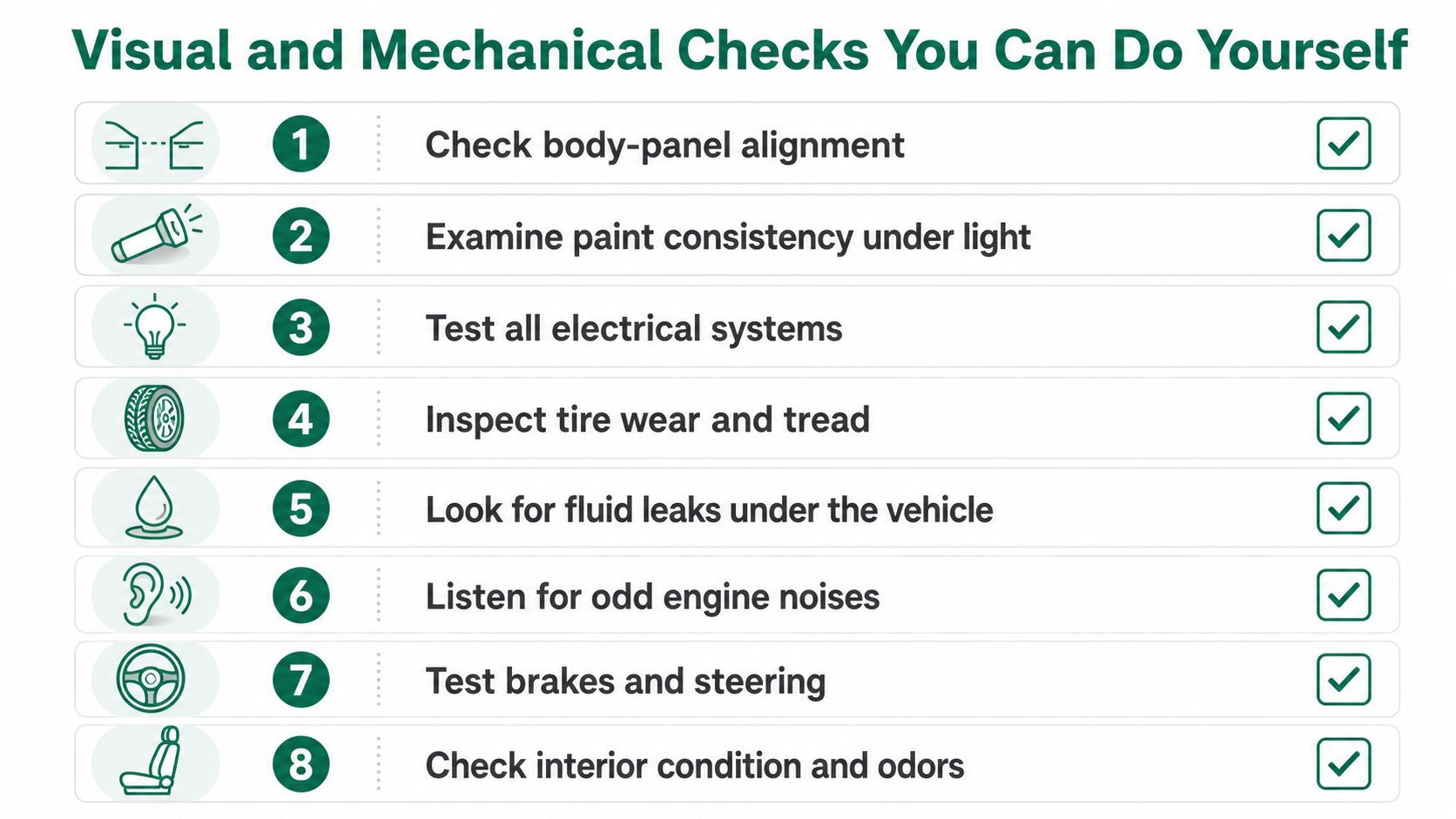
A professional detail can make a car look cared for while leaving mechanical clues untouched. The pre sale detailing tips from The Mobile Buff are useful for separating real cleanliness from a cosmetic cover-up, which matters when you are deciding whether the car is ready to buy, ready to ship, or needs another set of eyes before it goes anywhere.
Test Drive Procedures That Reveal Hidden Problems
A quick lap around the block hides too much. Start with a cold engine, let it idle for a few minutes, then move through slow turns, highway speeds, and a firm brake check. Different faults show up under different conditions, and a seller who only wants a short drive on familiar streets is controlling what you can notice. That matters even more if the car is being bought remotely and sent to a carrier, because the test drive is also part of your condition record before pickup.
Cold start and low-speed behavior
Start the vehicle cold and listen for a smooth idle, or for stumbling, shaking, and knocking right away. Watch the gauges and warning lights as the engine warms, because temperature changes and warning lamps can reveal issues a parked inspection will miss. Check how the transmission, steering, braking, and temperature behave under load, not just whether the car moves. The same approach helps you decide whether the car is ready for shipment or whether it needs another inspection before it leaves the seller's hands. Edmunds used-car inspection guide
At low speed, listen for steering response, clunks over bumps, and any whining or hesitation from the transmission. Tight parking-lot turns help because suspension and steering noises are easier to hear when road noise is low. If the wheel pulls, the brakes feel uneven, or the transmission hesitates between gears, do not explain it away as normal old-car behavior.
Highway speed and braking
Once you get onto faster roads, check for vibration in the wheel, drift in the lane, and whether the engine temperature stays steady. Highway speed exposes balance issues and alignment problems that a slow drive can hide. Then apply the brakes firmly. A pedal that sinks during a steady hold can point to hydraulic brake faults, and that is the kind of problem you want to catch before purchase, not after the car is on the carrier.
Use the drive to compare what you feel with what the seller claimed, and keep notes the same way you would document pre-shipping condition. If a car wanders, shudders, or pulls under braking, those symptoms belong in your records before anyone loads it. For older vehicles, especially if you are buying something unusual, decoding pre-1981 classic cars can also matter because identity and documentation issues often show up alongside mechanical ones.
If the seller refuses the test drive, treat that as a major warning sign. Autotrader's guidance is direct on this point, a refusal to allow an inspection should be seen as a red flag, and that applies just as strongly to a drive as it does to a mechanic's visit. Autotrader pre-purchase inspection guidance
A seller who won't let you drive the car is often telling you more than the ad ever did.
Vehicle History and VIN Verification Essentials
A car can look solid and still fail the identity check. That's why the VIN and paperwork matter just as much as the bodywork, especially if the vehicle is being shipped across state lines or to Puerto Rico, where you don't want surprises after the deposit is paid. The point isn't paperwork for its own sake. It's confirming that the machine, the title, and the story all belong to the same vehicle.
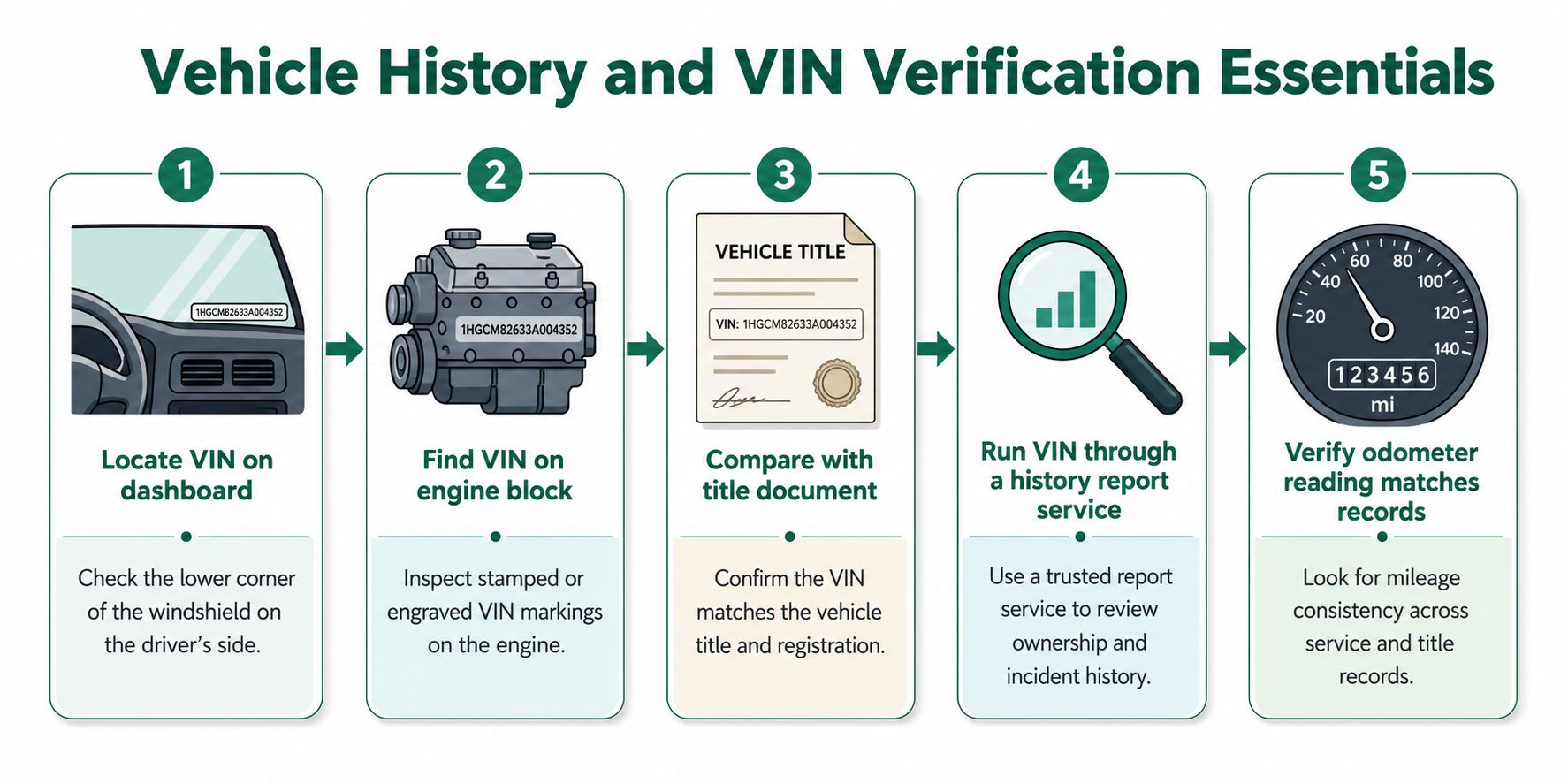
Match the identity first
Verify the VIN on the dashboard, engine block, and title. Houston Toyota Center's checklist also calls for reviewing title status, ownership history, accident reports, maintenance records, and odometer consistency, all of which help confirm that what you're buying is what the seller says it is. Vehicle history and VIN checklist
If the VIN plates don't match, or the title details feel thin, stop there and dig deeper. A clean body with weak paperwork is still a risk, because the paperwork is what helps reveal cloned vehicles, odometer issues, or title branding.
Read the paperwork like a contract
Look for salvage, rebuilt, or flood branding. Then compare ownership gaps, maintenance records, and mileage progression. A gap in records isn't always a dealbreaker, but it does mean you have less proof that the car was maintained the way the seller claims.
For older vehicles, especially classics that may not follow modern VIN formats, decoding pre-1981 classic cars can help you make sense of identification differences that don't fit the modern pattern. That kind of context matters for buyers, dealers, and shippers handling older inventory.
Why this matters before shipping
When a car is heading to a carrier, the inspection record becomes part of the handoff. The condition at pickup should match the paperwork, the photos, and the bill of lading, because once the vehicle has moved, you need a clean baseline to compare against. If you're buying remotely, that baseline is what keeps shipping from turning a small issue into a dispute.
Red Flags That Should Make You Walk Away
Some issues are negotiable. Others mean the car should leave the conversation immediately. The difference is whether the defect is cosmetic, routine, or the kind of problem that points to structural, electrical, or safety risk.
Hidden water, smoke, and tampered repairs
Flood damage doesn't always announce itself with visible mud. It can show up as musty smells, damp carpets, water under mats, corrosion in electrical connectors, or trim that doesn't quite match. Consumer Reports advises checking for musty smells, wet carpets, misaligned panels, inconsistent paint, and signs of water intrusion or poor repairs, which is exactly the kind of evidence a seller can't explain away with a quick detail. Consumer Reports used-car inspection advice
Smoke damage is similar. Heavy detailing can mask odor for a while, but the smell tends to linger in upholstery, vents, and headliners. Structural repairs can also hide under fresh undercoating or newer seam sealer, so if the underside looks too clean in one area and rough everywhere else, that contrast deserves a hard look.
Mechanical clues that aren't small
Milky engine oil is a serious warning because it can point to coolant mixing with oil, which often means a head-gasket issue or similar internal failure. A brake pedal that sinks during a firm hold is another dealbreaker-level sign, because hydraulic faults can get expensive fast and they're not something you want to discover after the vehicle is on the road or on a ship. Mismatched trim, overspray on seals, and panels that fit poorly after a supposed repaint all suggest the car may have had work done to hide damage rather than fix it well.
If you've reached this point, the most useful question is not “Can I live with it?” It's “Do I want to own the risk that caused it?”
Walk-away rule: if the seller can't explain the problem clearly, with paperwork or a credible inspection report, keep shopping.
When and How to Get a Professional Pre-Purchase Inspection
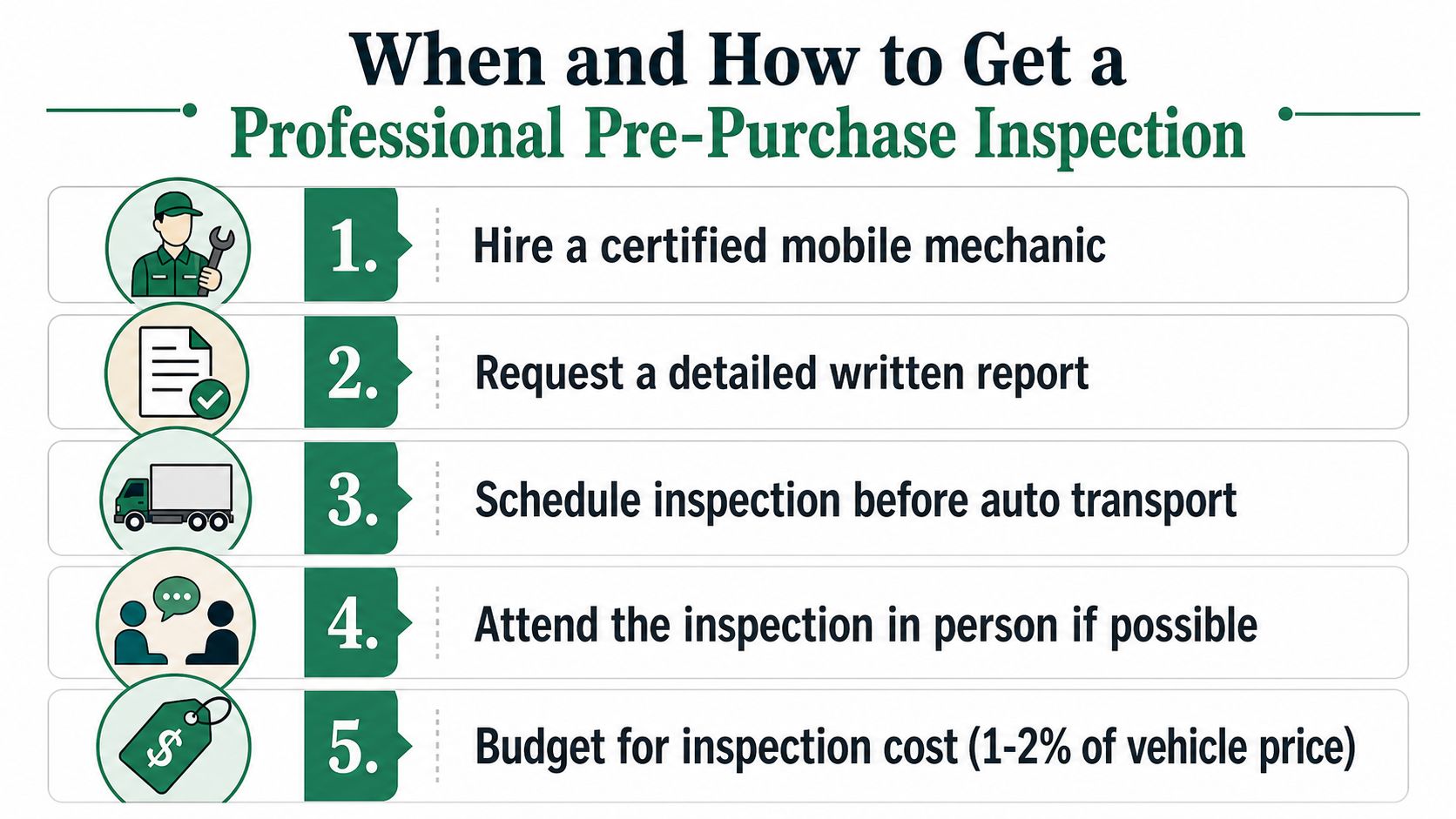
A solid DIY review can still miss the problems that matter most, especially on a remote purchase or a higher-value vehicle. Classic cars, cross-country buys, and any deal where you will hand the car to a carrier soon after purchase deserve a professional look before money changes hands or transport gets booked. A mobile inspector is often the cleanest option because the mechanic can meet the seller where the vehicle sits, which cuts out one of the easiest excuses for avoiding a proper inspection. Autotrader pre-purchase inspection guidance
What to ask for
Ask for a written report that separates urgent defects from normal wear. Request photos of the underside, tires, fluids, and any signs of recent repair, then line them up against your own notes. The report has real value only if you can use it in negotiation, either to press for a lower price or to walk away with a clear reason.
If the car is being shipped through National Car Transport, the pickup inspection should be recorded carefully on the bill of lading, and the carrier's notes should line up with your photos and written observations. That matters even more when the buyer and seller are in different states or when the vehicle is going to Puerto Rico, because the handoff needs to stay clear from inspection to delivery. The condition record at pickup becomes your reference point later, so keep it organized and easy to compare. If you are still planning the move, car shipping cost information can help you weigh transport against inspection and any repairs the report uncovers.
Why timing matters
Schedule the inspection before transport, not after. Once the vehicle is loaded, any new problem turns into a delay, extra cost, or a dispute that is harder to sort out at a distance. For a classic car, a student move, a snowbird transfer, or military shipping, the inspection should be part of the purchase decision itself.
For buyers who want the car to present well before pickup, The Mobile Buff's pre sale detailing tips are useful because a clean car makes condition issues easier to see and document. A tidy exterior and interior do not fix mechanical trouble, but they make it easier to spot new damage at the handoff and reduce confusion when the carrier arrives.
Your Complete Pre-Purchase and Transport Checklist
A smart purchase process stays simple when the steps are ordered the right way. Check the car cold, verify the paperwork, drive it long enough to see how it really behaves, and record its condition before it moves. If the vehicle is shipping across the mainland or to San Juan, Puerto Rico, the inspection notes and the transport handoff need to match cleanly.
| Inspection Stage | Key Actions | Transport Documentation |
|---|---|---|
| Exterior and under-hood check | Confirm panel alignment, paint consistency, fluid levels, belts, hoses, and visible leaks | Photograph all four sides, close-ups of damage, and the engine bay |
| Test drive | Start cold, drive at low speed and highway speed, test braking and steering | Note warning lights, noises, or pull on the bill of lading notes |
| VIN and history verification | Match VIN, title, odometer, ownership records, and accident history | Keep title copies, history report, and seller contact details |
| Professional inspection | Use a mobile mechanic if the car is remote or high value | Save the written report before release to the carrier |
| Pickup and delivery | Confirm the condition again when the carrier arrives and at drop-off | Compare delivery condition to your pre-shipment photos and notes |
Remote buyers need a clean record, not just a clean car. If you are comparing transport options while reviewing the inspection, car shipping cost estimates help you weigh delivery against any repairs the report turns up. Keep your photos dated, label them by side and area, and make sure the notes are detailed enough to stand up if the condition is questioned at pickup or delivery.
For buyers preparing a vehicle for shipping, simple presentation still matters. The Mobile Buff's pre sale detailing tips are useful because a clean car makes scratches, dents, and trim damage easier to document accurately before pickup. Remove personal items, keep the vehicle accessible, and make sure your photos show every angle before the carrier arrives.
National Car Transport's network of 25,000+ vetted carriers and transparent flat-rate pricing make the logistics side easier to plan around the inspection side, especially for relocations, dealership moves, and island routes. If you are comparing vehicles in multiple states or coordinating a move to Puerto Rico, use the inspection report, the transport quote, and the delivery checklist together so nothing slips through.