

A car shipped coast to coast between two major cities usually spends 7 to 10 days in transit, and the planning range for a 2,500 to 3,000-mile move runs 1 to 2 weeks. Anything shorter than that is a road-time estimate wearing a transit-time label.
That gap is the whole subject. Hours behind the wheel and elapsed days on the calendar are different clocks, and the space between them is where a shipping timeline lives. Federal hours-of-service rules cap how long a driver can be on duty each day, so mandatory rest, fuel stops, loading and inspections all stack on top of pure road miles. What looks like a few days of driving on a map becomes more than a week on a regulated carrier's schedule, and the 1 to 2 week window is the honest reflection of that math.
Three clocks run during any shipment.
Road time is the hours a truck physically moves. Carrier transit time is pickup to delivery, including rest, loading, fuel and inspections. Pickup and delivery windows are the scheduling on either end. Quote the first clock and you've promised something no one can deliver. Quote the third and you've got a date a customer can book a flight around.
Table of Contents
- Typical Transit Times by Route Distance
- Why a Cross-Country Car Needs Days, Not Hours
- Factors That Stretch or Shorten Your Transit Window
- Island Routes to Puerto Rico and Their Timelines
- Milestones That Show Where Your Car Is
- Planning Your Buffer and Booking a Realistic Date
Typical Transit Times by Route Distance
Find your mileage band, then read across for the range. That single move answers most of the question before a quote ever lands in your inbox.
| Route | Approximate distance | Typical door-to-door transit |
|---|---|---|
| Regional move within one state or nearby states | Under 500 miles | 1-3 days |
| New York to Miami | About 1,300 miles | 3-5 days |
| Chicago to Miami | About 1,400 miles | 3-5 days |
| Coast-to-coast, major cities at both ends | 2,500-3,000 miles | 7-10 days |
| Coast-to-coast, remote or rural origin or destination | 2,500-3,000 miles | Up to 14 days |
Short lanes behave the way you'd expect. A regional run inside one state or across a neighboring border usually closes in 1 to 3 days, because the driver can load and deliver inside one or two duty cycles. New York to Miami takes 3 to 5 days door to door, and Chicago to Miami sits in the same 3 to 5 day window: long enough for two solid driving days, short enough that a carrier can often run it direct.
Coast-to-coast is where the calendar stretches. Coast-to-coast shipments take 7 to 10 days when both ends sit in major metros on regular freight lanes, and most other routes take 5 days or less. Point one end at a rural address, a small-town terminal or a mountain community, and the same mileage can run to 14 days.
What the table deliberately leaves out
The clock starts at pickup, not at booking. Between the day you reserve and the day a driver hooks up your car, there's carrier matching, rate confirmation and scheduling, and none of that counts as transit time. Treat the table as the length of the shipping leg, then budget the front-end wait separately. Same on the back end: a receiver who only accepts cars between 9 and 11 a.m. on weekdays can add a day on their own.
Every figure here is an estimate, not a guaranteed arrival date.
How to use it: find your band, add two or three days if either end is rural, and add more if your delivery appointment is narrow. What you end up with is the range to plan around, and it's the same range the rest of this guide works from.
Long single lanes deserve their own look because nothing about them is symmetrical. A move like California to North Carolina auto shipping crosses two-thirds of the country on one carrier, and the driver's rest hours plus the pickup appointment do most of the calendar work.
Why a Cross-Country Car Needs Days, Not Hours
A car carrier doesn't run a marathon. It runs a relay with a rulebook, and the rulebook decides when the baton stops moving.
Picture what happens between Los Angeles and New York. One driver moves the load through a shift, parks, sleeps ten hours straight, then continues. Around that spine you have loading, unloading, fuel, inspections, scale checks, weather systems and appointment windows at both ends. The interstate network makes coast-to-coast movement possible; it doesn't make it continuous.
Federal rules set the ceiling. The summary of hours-of-service regulations states that a property-carrying driver may drive a maximum of 11 hours after 10 consecutive hours off duty, may not continue driving beyond the 14th consecutive hour after starting duty, and must take a 30-minute break after 8 cumulative hours of driving without a qualifying break.
Run the arithmetic on a 2,500 to 3,000-mile route at a 55 mph benchmark and you get roughly 45 to 55 hours of wheel time. At 11 hours per duty period, that's four to six driving days before a single minute of loading, fuel or inspection time is counted. Add the pickup appointment, the delivery appointment and one weather delay, and 7 to 10 calendar days for a major-city move stops sounding conservative.
The constraints stack in a predictable order, and the calendar absorbs them all.

Loading and unloading consume the same 14-hour duty window even while the truck stands still. A carrier that spends two hours at a terminal in the morning has two fewer hours of legal driving that day, which is exactly how a shared truck making one extra stop loses a full day without ever leaving the route.
Adverse weather isn't a scheduling tool. FMCSA permits up to a two-hour extension of the driving limit and driving window when drivers meet adverse conditions, and that's a narrow exception, not a buffer you build a delivery date on.
So compare any promised transit time against the mileage. Ask for a defined pickup window, an estimated delivery range and a contingency plan. A provider who answers all three in specifics is telling you how they operate.
Factors That Stretch or Shorten Your Transit Window
The range from the route table is a starting point. Six factors decide where inside it, or beyond it, your shipment lands. Each one hits a different part of the calendar: hours of wheel time, days of carrier transit, or the pickup and delivery windows bracketing both.
| Factor | Effect on timeline | Question to ask |
|---|---|---|
| Distance and route | Adds driving and rest days as mileage grows | Is my origin-to-destination route direct? |
| Metro congestion | Slows truck progress near large cities | Are pickup or delivery in a major metro area? |
| Season and weather | Winter storms and peak moving months add days | What seasonal buffer applies to my dates? |
| Pickup type | Terminal drop-off often schedules faster than door pickup | Is pickup door-to-door or at a terminal? |
| Carrier load and stops | Shared trucks may make extra pickups and drop-offs | Is the trip direct or multi-stop? |
| Delivery appointment | A fixed receiver window can force a wait | Can I get a delivery window instead of one date? |
Congestion near big cities costs real days
Federal data show how much truck speed varies by metro. In 2025, average truck speeds came in below 55 mph on 24 of the 25 metropolitan Interstate facilities measured, with averages of 30.9 mph in Los Angeles–Long Beach–Anaheim, 35.1 mph in Seattle–Tacoma–Bellevue and 35.3 mph in New York–Newark–Jersey City, according to the Bureau of Transportation Statistics freight performance data. A carrier crawling out of the New York metro at about 35 mph, well under the 55 mph benchmark, burns hours before it reaches open highway.
Rural routes cut the other way and land in the same place. Carriers build along primary freight corridors, so a remote pickup means a deviation, and deviations get scheduled when they fit the truck's route rather than when you would prefer.
Season compounds both. Winter corridors slow trucks on mountain passes, and peak relocation months tighten carrier supply at the same time demand rises, which pushes pickup dates out. Snowbird departures are the clearest example, and the snowbird car transport guide covers how those seasonal lanes behave.
Terminal drop-off is the lever people forget: a car delivered to a terminal the carrier already serves often gets matched faster than one waiting on a residential street with low clearance. The delivery end works the same way. A receiver who can accept the car on only one afternoon forces the driver to hold it, while a delivery window of two or three days lets the carrier hand it off at first arrival.
Identify the two or three factors that touch your move. Then place your estimate at the high or low end of your band rather than the middle. I'd rather quote a customer the cautious end of a range than apologize for the optimistic end.
Island Routes to Puerto Rico and Their Timelines
A Puerto Rico shipment is two shipments stacked. The vehicle rides by truck to Jacksonville, Florida, sails to San Juan, then clears port processing before anyone drives it off the dock. Sailings run several times each week, so the vessel is rarely the bottleneck. The drive to the vessel usually is.
| Mainland origin | Total transit to San Juan |
|---|---|
| Miami, Orlando, Tampa or Jacksonville | 7-10 days |
| Atlanta | 8-12 days |
| New York, New Jersey or Philadelphia | 9-14 days |
| Chicago | 10-14 days |
| Houston or Dallas | 10-14 days |
| Los Angeles or the West Coast | 12-16 days |
Why the origin city changes the total
Every mainland mile between your driveway and Jacksonville is truck time added in front of the sailing. Florida origins sit at the low end because the drive is a day or less. Chicago, Houston and Dallas add a multi-day haul to the port. The West Coast adds the most, and that extra trucking is what pushes a Los Angeles shipment toward the top of the range.
The paperwork that decides your release date
Puerto Rico's Department of the Treasury (Hacienda) publishes an online estimator for the excise tax, or arbitrios, due on an imported vehicle. You can search by make, model and year or by the 17-character VIN from your title or registration.
For the ocean import, Hacienda requires the importer to select and declare the applicable bill of lading in its SURI system and upload the commercial invoice, per Hacienda's import declaration guidance. The invoice should identify make, year, model, color, quantity and VIN, and the declared amounts must match both the invoice and the bill of lading.
Filing timing matters just as much. Hacienda's importer bulletin states that a non-bonded importer must file the excise-tax declaration before or when the merchandise is released. Documents that arrive after the ship does turn straight into storage days.
Ocean moves are often consolidated with other vehicles, and the container shipping to Puerto Rico guide explains how a shared container changes the plan on the island end. Find your origin row, then add clearance days for document review.
Milestones That Show Where Your Car Is
A carrier can cover 1,800 miles and still need three more days. Line-haul progress and appointment completion are separate events, and the FMCSA hours-of-service regulations govern maximum on-duty and driving time without granting a general allowance for loading and unloading delays.
That's why a milestone view beats a single promised date.
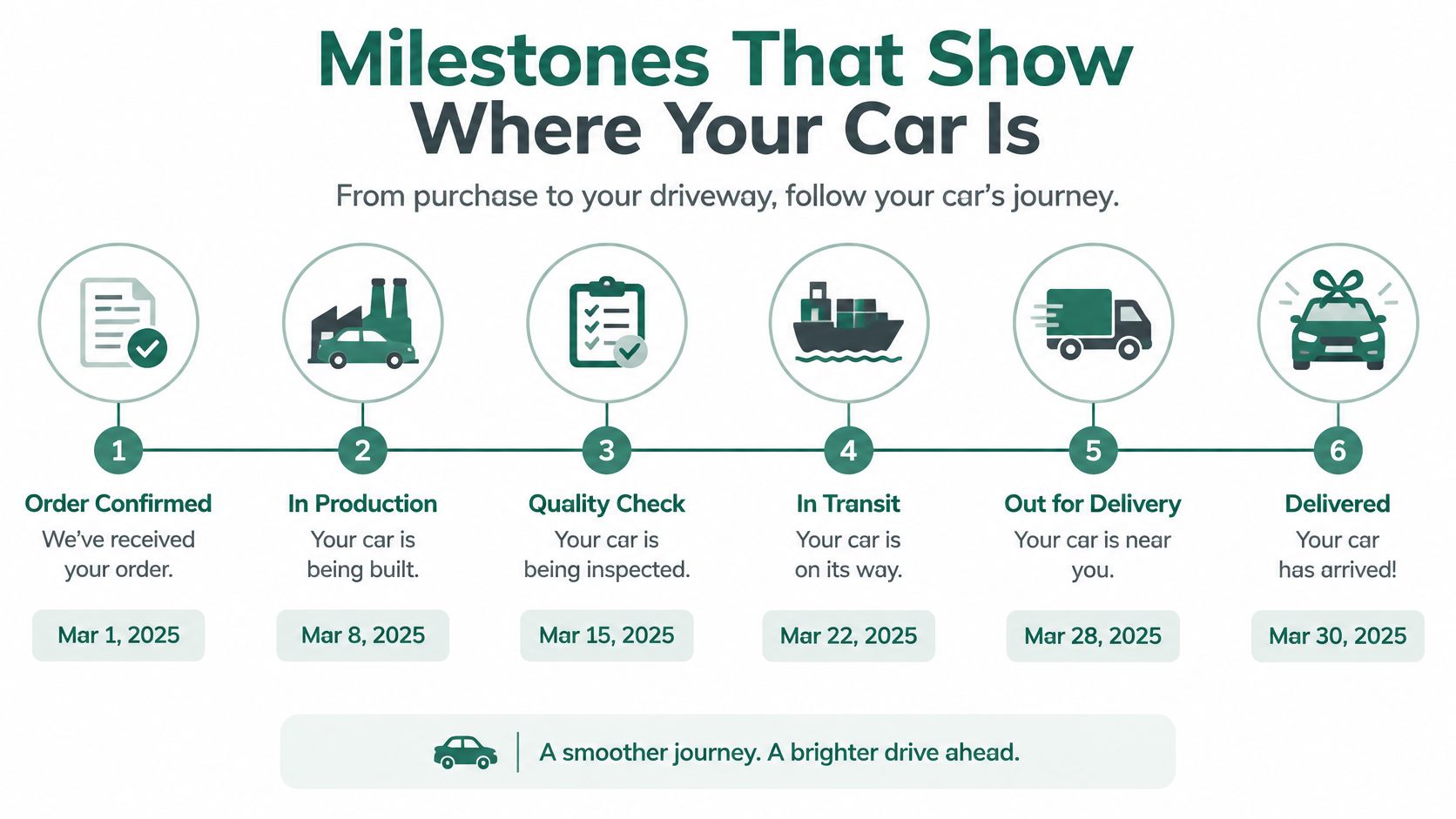
- Pickup confirmed. Ask for the carrier name, the driver's contact and the confirmed pickup date, not a range.
- Vehicle loaded and inspected. Ask for the condition report and photos taken at loading, because that's your baseline if anything is disputed later.
- Line-haul departure. Ask which route the truck is running and whether it has other stops before yours.
- Arrival in the destination region. Ask for the terminal or staging location and the expected delivery window, not a clock time.
- Delivery appointment set. Ask who calls you, when, and what happens if you can't be reachable that day.
- Final inspection and release. Compare the car against the loading report before you sign, and photograph anything new.
An ETA can move without the car being lost or parked for days. A receiver who shifts an appointment, an inspection that runs long or an access restriction at a gated community all consume the duty window a driver has left.
Build a buffer before anything that can't move: a flight, a move-in date, a first day at work or a dealership deadline. Two or three days of slack costs far less than rebooking a ticket.
For a live view of the middle of that sequence, this real-time car tracking guide covers what each status means.
Planning Your Buffer and Booking a Realistic Date
The highway network sets the outer limit on what's physically possible. The Federal Highway Administration's history of the Interstate System records that the Federal-Aid Highway Act of 1956 authorized 41,000 miles of controlled-access highways, and the network later grew to about 46,876 miles. That pavement is why a car can cover several hundred miles a day. It isn't why the calendar looks the way it does: a practical planning baseline for many long-distance U.S. moves is roughly 5 to 14 days from pickup to delivery, with longer timing for remote origins, rural destinations or routes with multiple operational stops.
Work backward from the date the car has to be there, not forward from the day you feel ready to book.

Buffers by customer type
A relocating family with a fixed start date should aim for the car to arrive at least two weeks before the household needs it, which usually means booking pickup three to four weeks out. If the car is the only vehicle, plan a rental for the gap rather than hoping the estimate holds.
A snowbird shipping in winter faces the widest spread of any customer type. Winter corridors, holiday freight volumes and weather delays all land in the same window, so take the top of your mileage band and add days rather than trimming.
A student with a campus move-in date has the least flexibility and the most to lose. Target arrival a week ahead, and if the car can't be there, ship early rather than late: a car waiting at a terminal for two days is a minor cost, a car arriving after orientation is a real problem.
A dealer moving inventory should think in batches. Multiple units on one lane let a carrier plan a full load, which usually shortens the pickup wait even when each individual unit's transit time doesn't change.
Never book a flight to meet the car on its delivery day. Arrange a rental or rideshare for arrival day and treat the car's arrival as a separate event.
Three steps to a bookable date
- Give the provider four things: origin, destination, vehicle type and a pickup window with at least a few days of flexibility. Narrow windows cost money and days.
- Ask for an estimated delivery range rather than a single date. If a provider won't give a range, that's information about how they handle delay.
- Confirm the milestones you'll be told about and what happens if the schedule shifts. Get the answer in writing before you pay.
National Car Transport runs this process with transparent flat-rate pricing, a network of 25,000+ vetted carriers, 25+ years of experience and an A+ BBB rating. Our bilingual English and Spanish agents are based in the USA with two decades in auto transport logistics, and a dedicated agent stays with each shipment from pickup inspection to final delivery. No two vehicle shipments are alike, so the timeline you get should be built around your route, your dates and your vehicle rather than pulled off a chart.
Before you commit, get a quote with your route and two possible pickup dates. The guide to getting a shipping quote walks through what a provider should ask you before pricing anything. A provider who can price both windows and explain the difference is one you can plan a month around.
Shipments between the mainland and San Juan, or across the country between two major metros, follow the same rule: the range is real and the single date is marketing. National Car Transport handles door-to-door auto transport in open or enclosed carriers, plus container and ocean shipping for island routes, with a dedicated agent coordinating scheduling and keeping you updated from pickup inspection through delivery. Tell us your route, your vehicle and two pickup dates, and we'll give you an honest transit range to plan around. Visit National Car Transport to get your flat-rate quote.