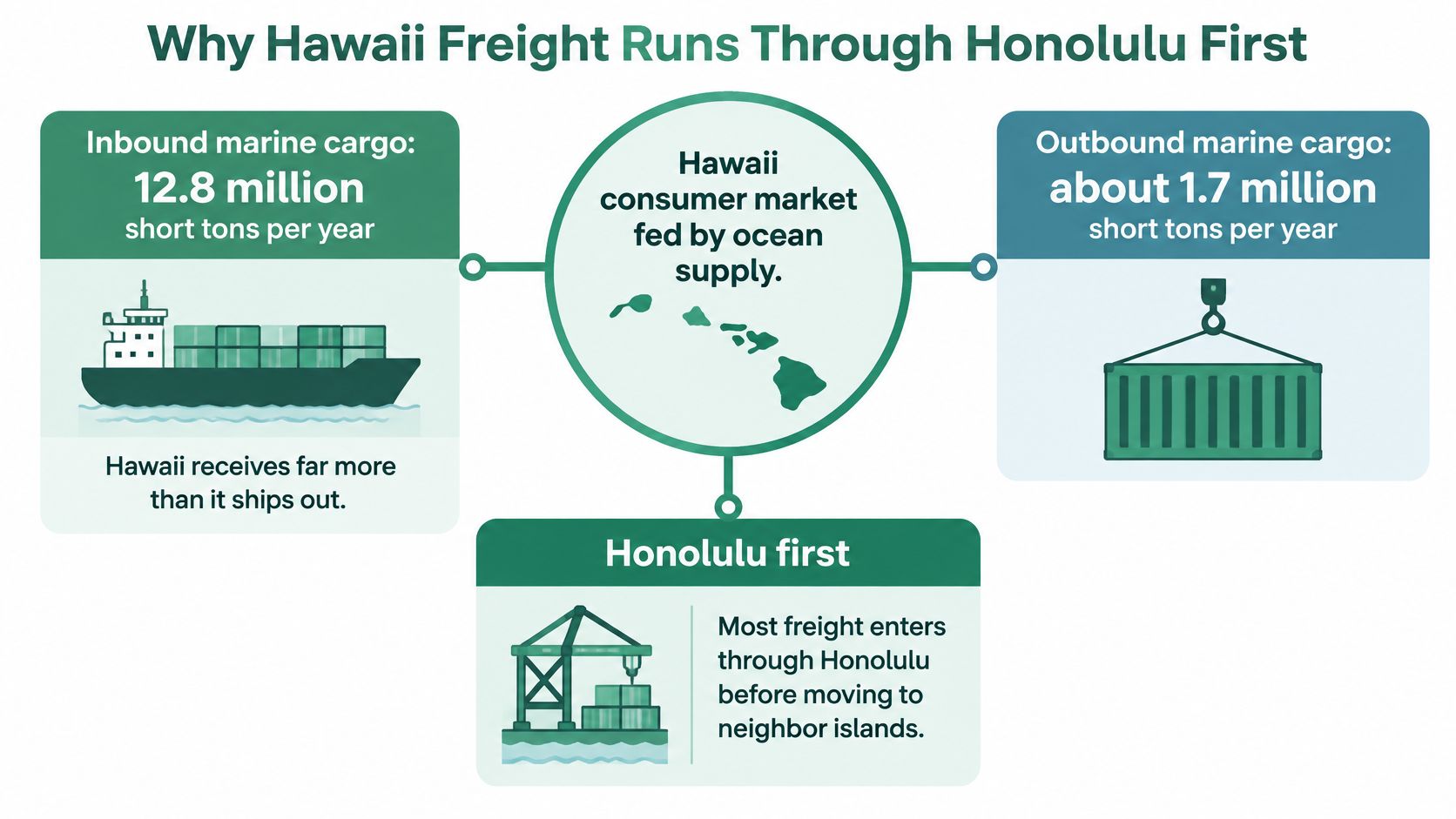
Hawaii takes in far more freight than it sends out. A Hawaii Department of Business, Economic Development & Tourism marine cargo study found the state received an annual average of 12.8 million short tons of marine cargo, while only 1.7 million short tons left the state. Inbound volume ran about 7.5 times outbound. That gap is why a car, a household load, or a dealer unit can't be treated like a mainland truck move.
Freight forwarders to Hawaii exist to close that gap. Most of what people use here arrives by sea: food, building materials, fuel, household goods, and vehicles. Your car joins that same inbound stream. It is trucked to a West Coast port, loaded for an ocean sailing, handled at an island terminal, and only then released or delivered.
The number on a quote is rarely the full delivered cost. A neighbor-island barge, a day of storage, or a missed cutoff can change both the date and the bill. The sections below walk a mainland customer through ports, days, and the charges that show up after the ocean rate.
Table of Contents
- Hawaii Shipping Costs and Transit Times by Route
- Why Hawaii Freight Runs Through Honolulu First
- Ports, Neighbor Islands and Where Delays Start
- What You Can and Cannot Leave in Your Vehicle
- How to Ship a Vehicle to Hawaii Step by Step
- What Drives the Delivered Cost Beyond the Quote
- Criteria for Choosing a Hawaii Freight Forwarder
- Confirm the Island Route and Book Your Shipment
Hawaii Shipping Costs and Transit Times by Route
Read the table by pairing your origin with the island where the car needs to arrive. The transit column is a planning window for a standard sedan, not a promise for every vehicle. Confirm it against your car's size, condition, and the sailing you book.
| Origin | Destination | Transit Time |
|---|---|---|
| California | Honolulu, Oahu | 10 to 18 days door to port |
| Inland U.S. state | Honolulu, Oahu | Longer than 10 to 18 days, because the car first travels by truck to a West Coast port |
| Any U.S. origin | Hilo, Kahului, Nawiliwili | 10 to 18 days plus a few days for the onward island leg |
California to Honolulu is the shortest ocean pattern in this set. The window runs 10 to 18 days door to port. That range breaks into three parts: trucking to the West Coast port, about a week at sea, and port processing on arrival. A car already near the terminal spends less of the window on the highway. An inland car does not.
Inland origins add a truck leg before the ship ever enters the picture. If your buyer, landlord, or duty station has a fixed date, plan on the longer end of the range that matches your row. A Wednesday arrival target is not a Wednesday sailing.
Hilo, Kahului, and Nawiliwili sit on a different clock. The car reaches Honolulu inside the same 10-to-18-day window, then an onward move to the neighbor island adds a few days. Quoting "Hawaii" hides that second move. Quote the island and the port.
Practical rule: If the date is fixed, book against the long end of your row, then ask whether the rate is door-to-port or includes island delivery.
A published lane sheet is what turns a transit window into a dollar figure. Shipping a sedan from California to Honolulu typically costs $1,500 to $2,300, and inland origins run higher because the vehicle first travels by truck to the coast. Our guide to what it costs to ship to Hawaii is the place to line up a sedan quote before you compare neighbors. One flat rate can cover trucking, ocean freight, and port handling, but only if the quote says so in writing and names the final island. That written scope is the difference between the advertised rate and the delivered cost.
Why Hawaii Freight Runs Through Honolulu First
Hawaii is a consumer market fed by the ocean. Goods land, then fan out. The pattern is hub-and-spoke: most inbound freight reaches Honolulu Harbor on Oahu first, then moves to the Neighbor Islands by short-sea barge, air cargo, or island trucking.
Honolulu Harbor processed approximately 10 million short tons of cargo in fiscal year 2024, according to the Hawaii Department of Transportation cargo overview. That volume is why a delay on Oahu doesn't stay on Oahu. Missed cutoffs and paperwork errors there travel with the cargo to the next island.
Hawaii's statewide freight plan, summarized by the Hawaii Department of Transportation, puts marine and truck freight at about 40% of mode distribution each. Marine transport accounts for 97% of international freight. A vehicle forwarder is working inside that constraint, not around it. Weekly sailings connect the islands to the mainland West Coast, but the ship still has to hit Honolulu's receiving window first.
A car booked to Maui
Say the car is going to Kahului, not Honolulu. It still needs a mainland-to-Oahu ocean leg. Then it needs a second interisland movement. Each handoff adds terminal time, another inspection point, and a schedule that can slip if the first ship is late.
Before you tender the car, get five details in writing:
- Receiving cutoff: the last time the mainland terminal will take the vehicle for that sailing.
- Interisland plan: whether a barge is already booked, and which day it leaves Oahu.
- Destination terminal: the exact port, not the island name alone.
- Free time: how long the car can sit before storage starts.
- Final mile: who drays it if you want it at a driveway instead of a gate.
Quote the final island, not "Hawaii," and confirm whether coverage is port-to-port, terminal-to-door, or full inland delivery.
Congestion on Oahu can push a Maui, Kauai, or Big Island delivery even when the mainland truck was on time. That's a planning risk you price in, not a surprise you discover at the pier.
Ports, Neighbor Islands and Where Delays Start
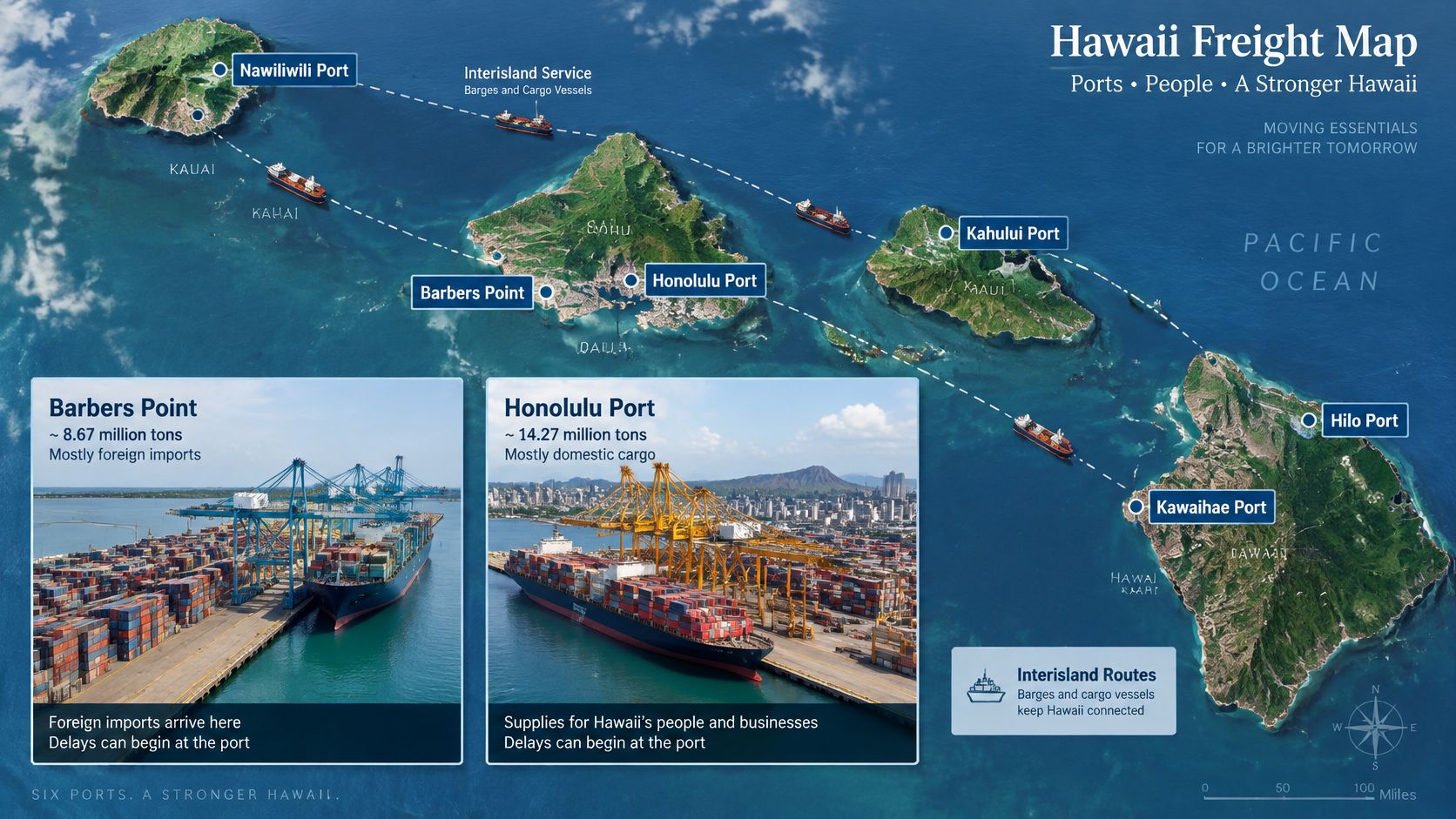
Six ports carry almost all of the state's listed cargo. U.S. Department of Transportation freight-network data ranks them by tonnage, and the split shows why Oahu sets the pace.
| Port | Total Tons | Notes |
|---|---|---|
| Honolulu | 14,274,405 | 12,903,023 domestic; 1,181,665 foreign imports; 189,717 foreign exports |
| Barbers Point | 8,670,956 | 6,575,240 foreign-import tons |
| Kahului | 3,668,583 | Maui's main freight harbor |
| Hilo | 2,061,692 | Hawaii Island east side |
| Kawaihae Harbor | 1,886,943 | Hawaii Island west side |
| Nawiliwili | 1,709,919 | Kauai |
Together these six ports represented roughly 32.3 million tons. Honolulu and Barbers Point account for about 71% of that total. Honolulu's cargo is mostly domestic. Barbers Point's is weighted toward foreign imports, including 6,575,240 foreign-import tons. Your car is a domestic vehicle move, so it follows the Honolulu-centered path, not the fuel-and-import path at Barbers Point.
Where the clock slips
An Oahu-bound car has the simplest path: West Coast truck, one sailing, Honolulu processing. Door-to-port shipments take 10 to 18 days total, and neighbor islands can add a few days on top of that ocean leg.
Delay usually starts in one of three places.
- Missed receiving cutoffs. The truck makes the port a day late, and the car waits for the next weekly sailing.
- Documentation errors at Oahu. A title mismatch or an undeclared condition holds the car before it can transfer.
- Congestion that carries downstream. A late Honolulu discharge pushes the barge to Kahului, Hilo, or Nawiliwili. Treat that as a planning risk, not as a measured delay you can put on a calendar.
Match the island to its port before you book. Honolulu for Oahu. Kahului for Maui. Hilo or Kawaihae for Hawaii Island, depending on which side you need. Nawiliwili for Kauai. Then ask which leg the forwarder owns. A Seattle-origin example of that mainland-to-port handoff is covered in our note on shipping a car to Hawaii from Seattle.
What You Can and Cannot Leave in Your Vehicle
Port staff have to roll, steer, and inspect the car without a workaround. That's the logic behind every row below.
| Item or Condition | Accepted | What to Do |
|---|---|---|
| Factory-installed items | Yes, may stay inside | Leave in place |
| Child car seats | Yes, may stay inside | Leave in place |
| Non-factory accessories | No | Remove before the port drop-off |
| Vehicle that rolls, steers and brakes | Yes | Declare the small fee at booking |
| Inoperable vehicle (cannot roll, steer or brake) | No | Cannot ship to or from Hawaii |
Do these checks before you book, not in the terminal lot. Pull personal items and any accessory that didn't come from the factory. Confirm the car starts, rolls, steers, and stops. If it doesn't, say so at booking.
Factory-installed items stay because they're part of the car the port agreed to move. Child car seats are the one add-on that can remain. Roof racks, aftermarket stereos, and loose cargo come out. If the port won't accept the car as it sits, you lose the sailing you already planned around.
A car that rolls, steers, and brakes can still move even if it isn't fully operable, but only with a small fee declared at booking. A car that cannot roll, steer, or brake cannot ship to or from Hawaii at all. There is no tow-on exception for this lane. Terminal crews won't drag a dead vehicle onto a ship or a barge.
If the car fails these rules at the port, it can lose its sailing slot. Check condition before you pay the deposit, not after the truck arrives.
How to Ship a Vehicle to Hawaii Step by Step
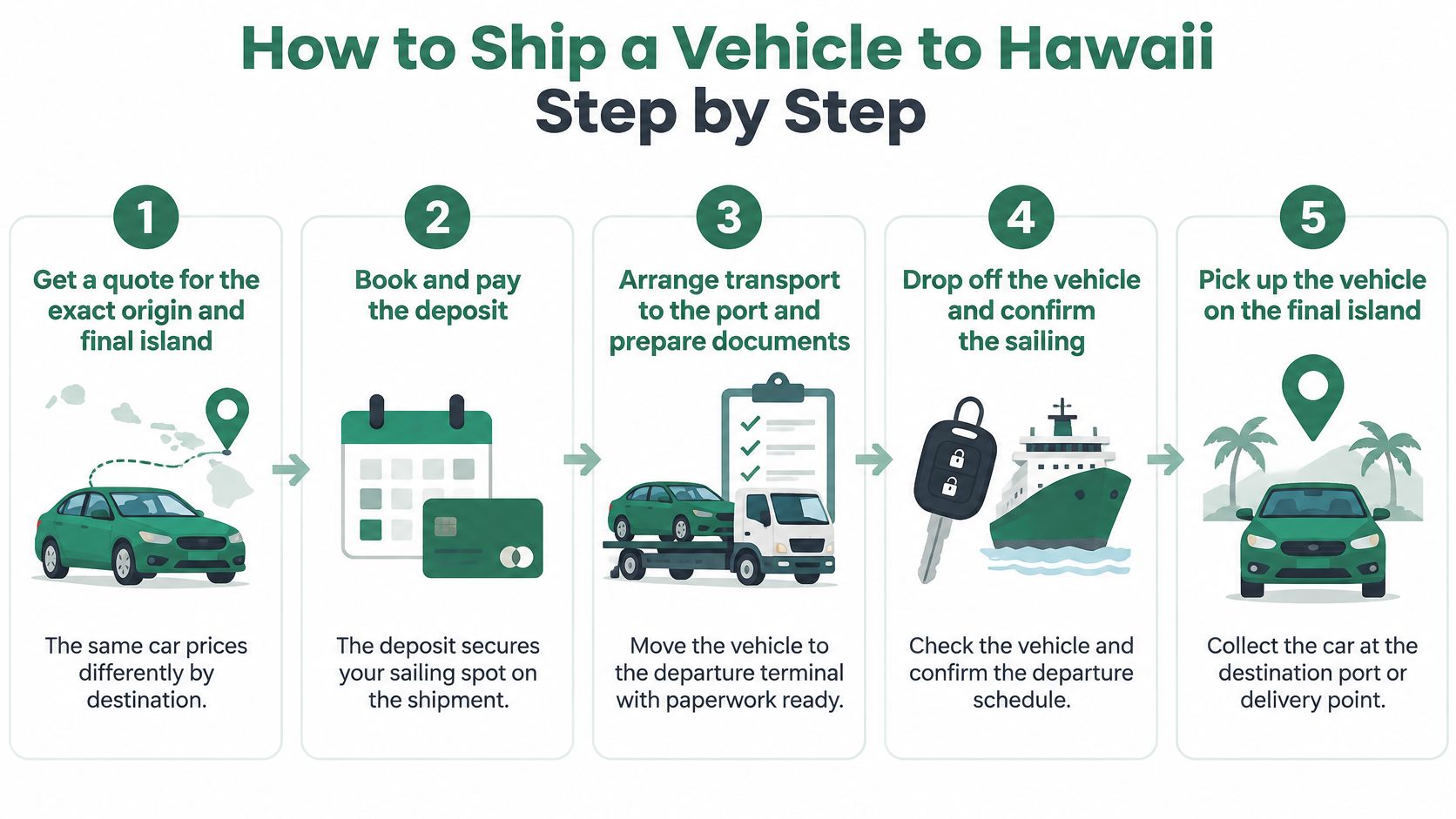
The same sedan prices differently for Honolulu than it does for Hilo or Kahului. Start with the island, not a statewide average.
- Get a quote for the exact origin and the final island. A California driveway and an inland driveway are different jobs, and so are Oahu and a neighbor island. The quote should name the port.
- Book and pay the deposit. The deposit secures your sailing. Without it, you're on a wish list, not a vessel.
- Arrange the mainland handover. We pick up at your door, or you drop the car at the mainland port. Either way, the car has to meet the receiving cutoff for that week.
- Complete the pickup inspection. It's documented at origin so later damage isn't a guessing game.
- Clear the port inspection before sailing. Vehicles are inspected at the port before they load, and that inspection is documented too.
- Plan transit from your lookup row. Count trucking, the sailing, and port processing. Don't treat the ocean day as the whole trip.
- Take the arrival inspection. The car is inspected again as soon as it lands, and that record is your protection if something changed at sea.
- Collect at the port or take delivery. Add time if the car still has an interisland leg. Door delivery on the island is a separate commitment from "the ship has docked."
Why the paperwork is the product
The deposit matters because weekly sailings fill. Inspections matter because a dispute without photos becomes a story. You should finish with three things in hand: a confirmed booking, a dated pickup, and inspection records from both ends.
Container and roll-on choices change how the car is handled on the ocean leg. Our overview of car containers for shipping walks through that choice if the vehicle is a classic or you want it boxed rather than driven on.
Watch the handover and inspection sequence before you book, so the steps above match what you'll see at the terminal.
What Drives the Delivered Cost Beyond the Quote
The cheapest ocean quote is often not the cheapest car on the island. The advertised sailing rate skips the layers that hit the invoice: origin pickup, mainland terminal handling, ocean freight, destination port fees, an interisland transfer, final delivery, and storage if nobody is there to take the car.
The line people forget
Storage is the quiet one. Published estimates put daily port storage at roughly $20 to $50 after the free period, and missed sailings can trigger rebooking charges and extra handling, according to carrier guidance in the Matson FAQ on shipping your car. A car that waits a week for its owner can cost more in storage than the gap between two "cheap" quotes.
Three cases push the bill up.
- The shipment misses a sailing. Rebooking plus another round of handling. Ask who pays before you choose the later truck.
- The car fails inspection. It sits while you fix the problem, and free time keeps running.
- The car arrives before you can collect it. Common for relocating households, snowbirds, military families, dealers, and online buyers who need a delivery-date range, not a single nominal transit day.
Build the estimate as line items. Then get a written answer on who pays storage and rebooking if the sailing is missed, the car fails inspection, or it lands early.
A quote that itemizes those layers is easier to compare than a single blended number. Our notes on container shipping quotes show the kind of split worth asking for: ocean, port, and the inland piece kept visible. If a provider won't say who pays in the three cases above, the low rate isn't a rate yet.
Criteria for Choosing a Hawaii Freight Forwarder
Score every company on the same five points before you compare prices. A low rate with a blank exception policy is how a sedan grows a storage bill.
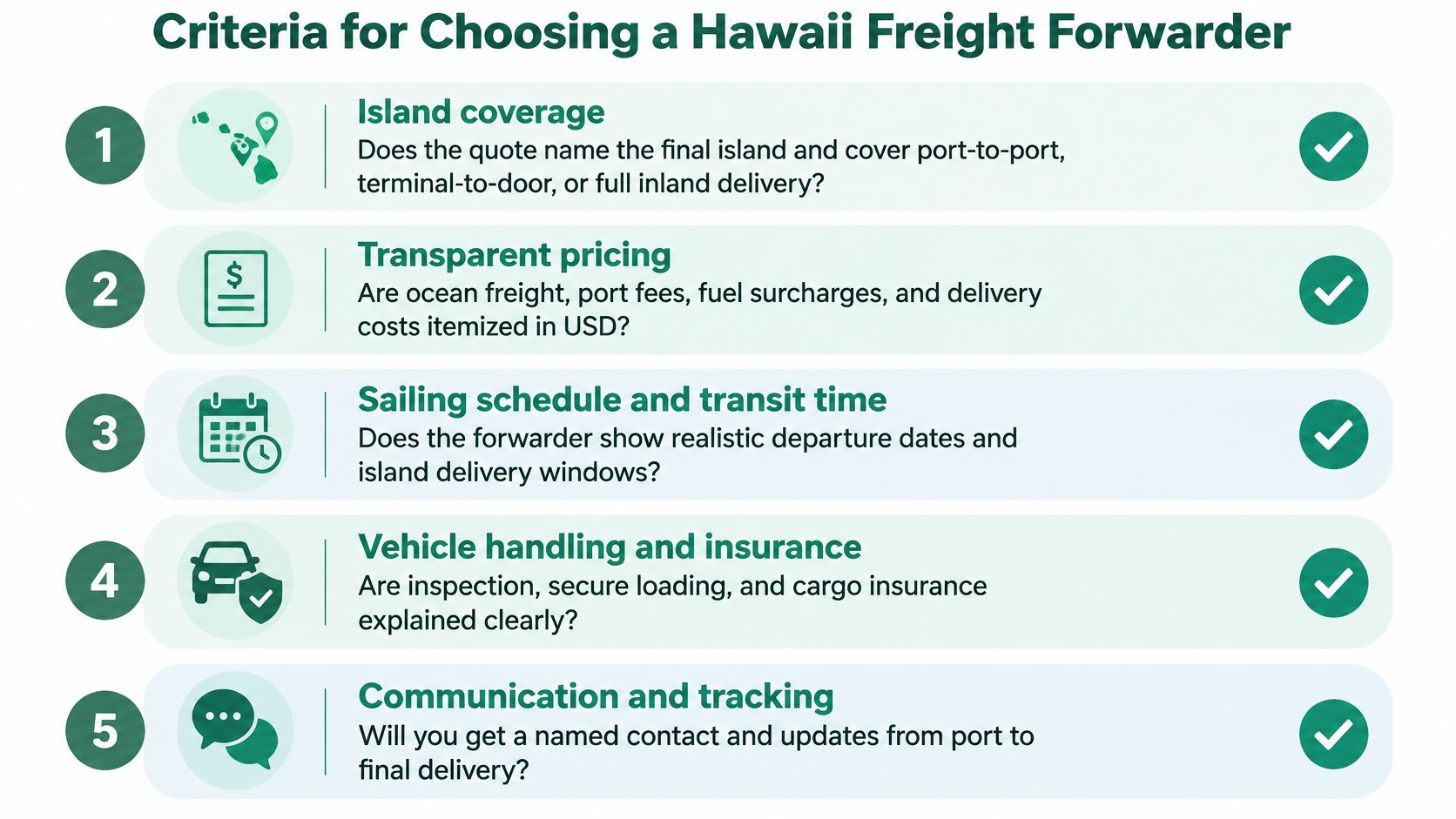
Island coverage. The quote names Honolulu, Hilo, Kona, Nawiliwili, or Kahului, and it says whether you get port-to-port, terminal-to-door, or full inland delivery. A quote that stops at "Hawaii" leaves the barge unpaid.
Ocean details. You can see the receiving cutoff, the interisland plan, the destination terminal, free time, and who handles final-mile drayage. Missing any one of those is how a car sits between two companies that each thought the other had it.
Inspection and documentation. Pickup and both port inspections are written down. Without that paper, damage becomes an argument.
Exception policy. You have a written answer on storage, rebooking, and who pays when a sailing is missed, the car fails inspection, or it arrives before you can collect it. This is the criterion that protects a tight quote from turning into a pier invoice.
A named agent. One person follows the car from quote to delivery and already handles your vehicle type and origin. Military families, snowbirds, students, and dealers all need that continuity. No two shipments are alike, and a dedicated agent is what keeps the steps short.
If you want a wider look at how forwarders structure island work, logistics solutions from Matil are a useful reference point while you score coverage and handoffs. For what customers report on this lane, read our Hawaii car shipping reviews and match the complaints to the five criteria above. Price is the last column, not the first.
Confirm the Island Route and Book Your Shipment
A Hawaii booking works like a flight with a connection: the mainland truck leg and the ocean leg have to line up on one ticket, or you pay for the gap between them. Three checks close the loop before any money moves.
- Name the origin and the final island. Find that row in the route table, and use the longer transit figure as your planning date. A car headed to a neighbor island can add a few days beyond the Honolulu arrival.
- Request a delivered-cost quote in writing. It should cover trucking, ocean freight, and port handling. Ask whether one flat rate includes all three, because a quote that prices only the ocean leg leaves the trucking and port fees to surface later.
- Confirm the sailing. Ask which weekly sailing fits your date, and what the deposit secures. For Hawaii shipments, the deposit at booking holds your spot on that sailing. Sailings run via Honolulu, Hilo, Kona, Nawiliwili, and Kahului, with inspections before and after every voyage.
Two practical questions belong in that same conversation. Ask what may stay inside the car, since only factory-installed items and child car seats can remain in the vehicle when the port accepts it. And if the car does not run, say so before you book, because inoperable vehicles cannot ship to or from Hawaii at all.
National Car Transport is one option for that quote. The company uses transparent flat-rate pricing, a network of 25,000+ vetted, licensed, and bonded drivers, a 25+ year record, and an A+ BBB rating. Bilingual English and Spanish agents, with some Portuguese support, guide each shipment. You leave with a written quote that names the island, the sailing, and the exception terms.
National Car Transport coordinates mainland trucking, ocean freight, and port handling for vehicles bound to Honolulu and the neighbor islands, with a dedicated agent from booking through delivery. If you're comparing a door pickup on the mainland with collection at an island port, start with a quote that names the island and the sailing. Visit National Car Transport to line up that shipment.