

If you're reading this, you probably have a real move on your calendar, not a theoretical one. Maybe you're heading to Puerto Rico for military orders, sending a vehicle to San Juan for school, moving a seasonal car south, or trying to bring home a car you bought online from another state. The hard part isn't just moving the car. It's figuring out which shipping method protects it, what paperwork matters, and where delays usually happen.
That confusion is normal. Vehicle transport is a $10.5 billion U.S. industry as of 2025, and container shipping has become a preferred option for high-value vehicles, island destinations, and shipments that need better protection from weather and security risks, according to IBISWorld's vehicle shipping services industry report. For Puerto Rico routes in particular, container service often makes sense because it gives the vehicle a sealed environment during ocean transit.
Car containers shipping isn't the right answer for every move. But when the route includes an ocean leg, a port handoff, or a vehicle you really don't want exposed, it deserves a serious look. The details matter, especially on mainland-to-Puerto Rico shipments where the smooth jobs are the ones planned correctly from the start.
Table of Contents
- Your Guide to Shipping a Car in a Container
- What Exactly Is Container Car Shipping
- Container Shipping Compared to Other Methods
- Your Step-by-Step Container Shipping Guide
- Understanding Documents and Insurance
- Typical Costs and Transit Times for Container Shipping
- Why an Experienced Partner Matters
- Frequently Asked Questions about Car Container Shipping
Your Guide to Shipping a Car in a Container
A lot of customers arrive at container shipping after a bad near-miss. They started with open transport because it sounded simpler, then realized the route ended at a port, the car was headed to Puerto Rico, or the vehicle was worth too much to leave exposed during an ocean leg.
That pattern shows up with military families, snowbirds, dealerships, and private owners alike. One customer type cares about timing. Another cares about condition. A third cares about keeping the process understandable because they're already juggling housing, travel, and registration deadlines. The shipping method has to match the move.
For island routes, container service usually enters the conversation for one reason first. Protection. A sealed container gives the vehicle a controlled space from loading through port handling and sea transit. That's a different experience from methods that leave the vehicle more exposed to marine air, terminal traffic, and repeated handling.
Practical rule: If the route includes Puerto Rico and the vehicle is high-value, sentimental, modified, or difficult to replace, container shipping deserves a quote before you decide on price alone.
The customers who benefit most tend to fall into a few groups:
- Military households: PCS moves often come with fixed reporting dates and little patience for avoidable paperwork mistakes.
- Snowbirds and seasonal residents: They usually want predictability and a clear arrival window more than they want the cheapest option.
- Students and relocating families: They need someone to explain port steps in plain language.
- Collectors and luxury owners: They want the vehicle enclosed and handled with the right loading equipment.
- Dealerships and businesses: They care about repeatable process, documentation, and fewer condition surprises at delivery.
Puerto Rico adds a layer that mainland shipping doesn't have. The car isn't just going from one truck to another. It may move from inland pickup to port staging, then into ocean transport, then through arrival procedures before final handoff. Good coordination matters more than flashy promises.
What Exactly Is Container Car Shipping
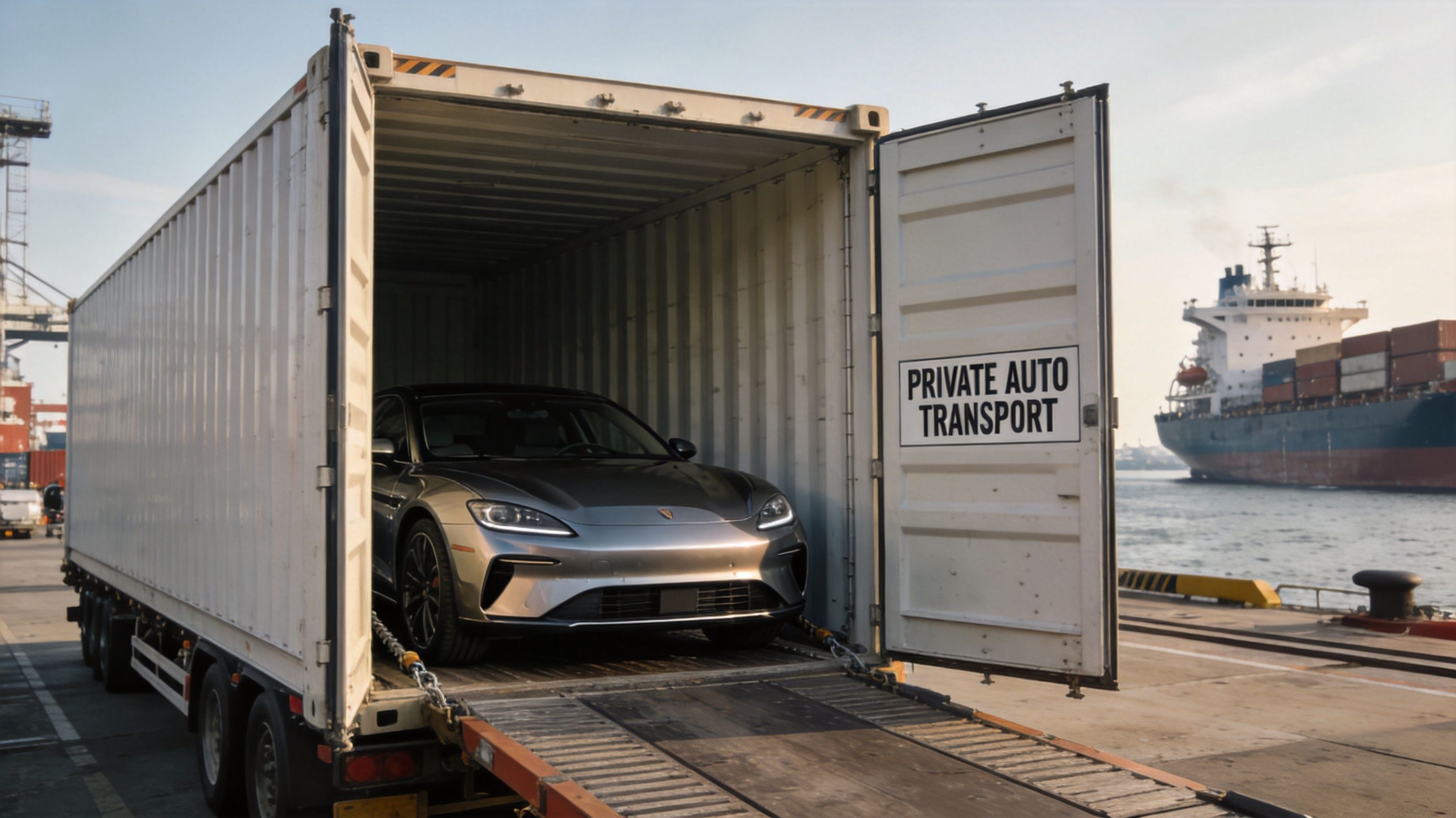
Container car shipping means your vehicle travels inside a sealed steel shipping container instead of riding exposed on an open trailer or being driven onto a vessel deck. The simplest way to think about it is this: it's a temporary steel garage for transit.
That matters most when the route includes water. Ocean shipping introduces salt air, terminal handling, and longer periods where the vehicle sits between checkpoints. A container reduces that exposure and gives the loading crew a fixed environment for securing the car.
Two ways to book container space
Most customers choose between sole-use and shared container service.
Sole-use means one customer books the container. This is often the cleaner choice for an exotic, classic, show car, or a move where schedule control matters more than squeezing the lowest possible price out of the shipment. There are fewer coordination variables because the load doesn't depend on matching multiple customers into the same box.
Shared service means multiple vehicles or cargo positions are consolidated into one container. That's common on Puerto Rico lanes because it can lower the cost per vehicle. The trade-off is timing. Shared loads often need more coordination before departure because the container has to be built correctly and documented correctly.
A shared container can be smart value. It just isn't the service to choose if you're in a rush and need every handoff simplified.
Common container sizes and capacity
For planning, customers usually hear about 20-foot and 40-foot containers. If you want a plain-language reference for physical sizing, this guide to 20ft shipping container dimensions helps visualize how tight the fit can be before tie-down space is added.
A 40-foot high-cube container can accommodate two standard SUVs or, with advanced racking, up to 4-6 sedans, according to Direct Express container specifications. The same source notes that sealed steel containers cut weather-related damage by over 95% compared to open-air methods like RoRo.
That doesn't mean every 40-foot container should be packed to its theoretical maximum. Real loading depends on vehicle length, ride height, weight distribution, and whether the shipment needs space for dunnage and safe access during loading.
In practice, effective solutions are:
- One vehicle in a container: Best for premium protection and simpler handling.
- Two vehicles in a 40-foot container: Common for paired household moves, dealer transfers, or shared bookings.
- Higher-density loading with racking: Useful in commercial settings, but it requires proper equipment and experienced loaders.
What doesn't work is assuming every sedan fits every setup the same way. A lowered front bumper, wide mirrors, roof accessories, or a long wheelbase can change the loading plan fast.
Container Shipping Compared to Other Methods
Container shipping is one tool. It isn't the whole toolbox. Customers usually compare it against RoRo, open carrier, and traditional enclosed carrier, and each one solves a different problem.
For Puerto Rico moves, the comparison usually comes down to four questions. How much protection do you want? How much flexibility do you need on timing? Is the vehicle standard or specialty? And how much risk are you comfortable accepting during the ocean portion?
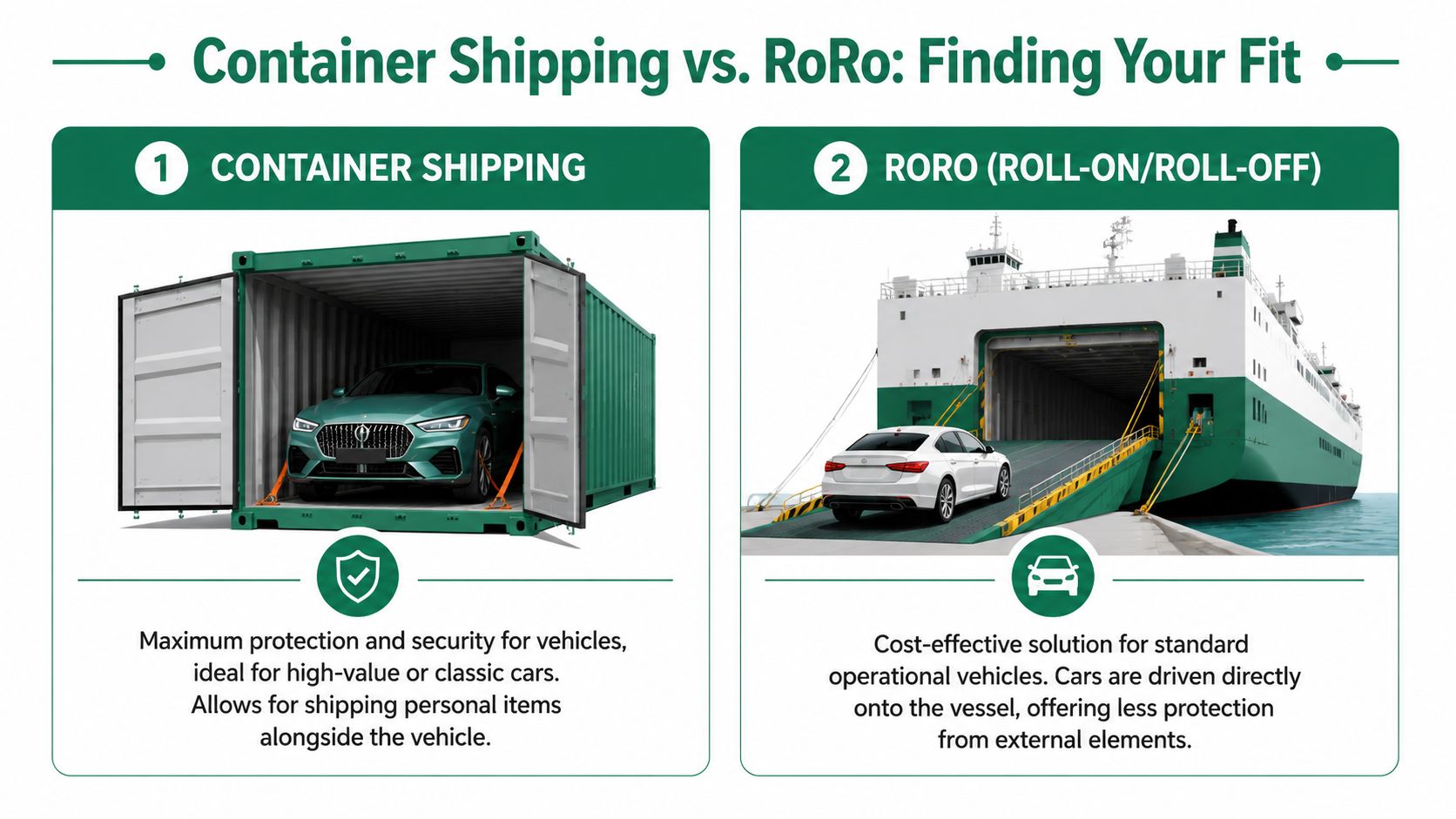
If you want a plain explainer that helps compare RoRo vs container, that resource gives a useful baseline before you start asking for quotes.
Where each method fits
Container shipping is strongest when protection comes first. It's a good fit for classics, luxury cars, modified vehicles, auction purchases, and Puerto Rico moves where you want the vehicle sealed through the sea leg. It's also useful when a customer wants a more controlled loading environment.
RoRo works for operational vehicles that can be driven onto and off the vessel. It's often chosen when the vehicle is standard, the owner is cost-conscious, and maximum enclosure isn't necessary. The trade-off is exposure. The car isn't inside a sealed box.
Open carrier is usually the everyday mainland solution. It's practical for domestic routes across the lower 48 when price matters and the vehicle is a regular driver. It's not the first choice for an ocean route where the customer wants the highest level of enclosure.
Enclosed carrier protects a vehicle on the road portion of the trip. For some mainland shipments, it's the right answer by itself. For Puerto Rico, though, enclosed truck service only covers the ground legs. The ocean piece still needs its own method.
The mistake I see most often is customers comparing only the first truck they see, not the full route. Puerto Rico moves have at least two environments to plan for: inland transport and ocean transport.
Vehicle Shipping Methods at a Glance
| Method | Protection Level | Typical Cost | Best For |
|---|---|---|---|
| Container shipping | Highest enclosure and security during ocean transit | Premium compared with more exposed methods | Puerto Rico and other island routes, luxury cars, classics, modified vehicles |
| RoRo | Moderate | Usually more budget-oriented for operable vehicles | Standard cars on ocean routes where enclosure isn't the priority |
| Open carrier | Lowest enclosure | Budget-friendly on mainland routes | Everyday domestic shipping for standard vehicles |
| Enclosed carrier | High on road legs | Premium on domestic trucking | High-value vehicles moving overland |
A few trade-offs are worth saying plainly:
- Best weather isolation: Container
- Best for a routine daily driver on a mainland move: Often open carrier
- Best for a high-end car staying on the mainland: Usually enclosed carrier
- Best value on some island routes for a standard operable car: Often RoRo
The right choice depends on the vehicle and the route together. Not separately.
Your Step-by-Step Container Shipping Guide
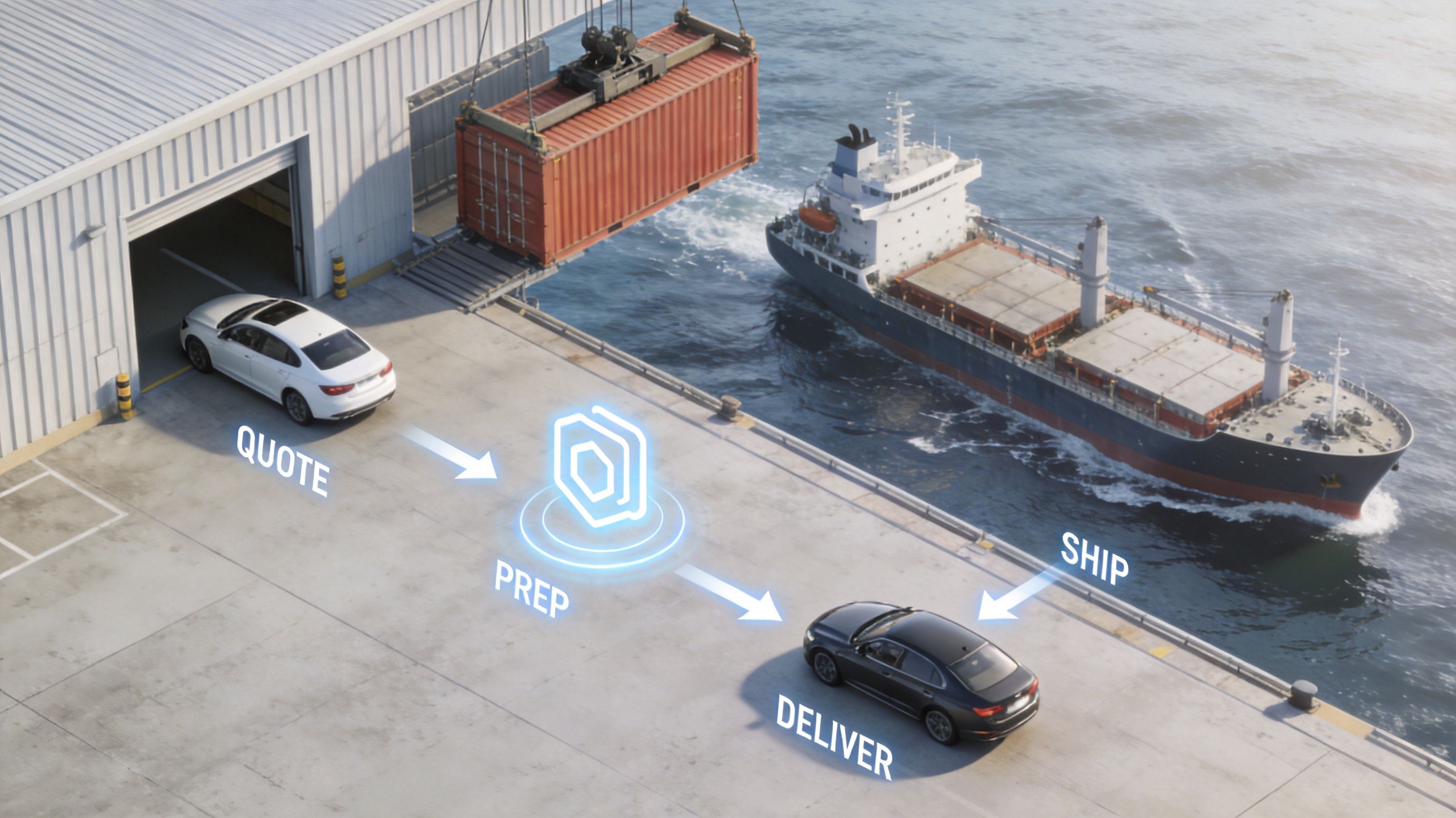
A Puerto Rico shipment usually goes smoothly when the sequence is handled correctly. Trouble starts when customers rush the booking, show up at the port with incomplete details, or assume arrival in San Juan means immediate release the same day.
Before pickup or port delivery
Start with accurate vehicle information. The year, make, model, running condition, and any modifications should be disclosed before the booking is finalized. That matters even more for Puerto Rico container moves, because a problem discovered at the terminal can push the shipment to a later sailing.
Low-clearance cars need extra attention. For low-clearance luxury and classic cars, standard ramps can have 20° inclines, while specialized carriers use hydraulic liftgates with gentler 6° to 10° angles, which helps prevent underbody damage, as noted by Navia Auto Transport's low-clearance car shipping guide.
Clean the vehicle before handoff. A clean exterior makes the inspection record more accurate and gives both sides a clear view of any existing chips, scratches, or dents.
Then take care of the practical items:
- Fuel level: Leave only a small amount, enough for loading and unloading.
- Loose items: Remove toll tags, chargers, paperwork, tools, and personal belongings.
- Keys: Provide the requested set and confirm they work properly.
- Battery and alarm status: Follow the carrier's instructions before delivery to the port or pickup point.
If the car does not run, say it early. The same applies to air suspension, oversized tires, front splitters, lowered suspension, and custom exhaust components. Terminal crews plan around that information. If they learn about it late, loading often slows down or gets rescheduled.
Loading and ocean transit
Container loading is straightforward in principle, but it has to be done carefully. The vehicle must enter the container without scraping, sit in the correct position, and be secured so it does not shift during the ocean leg. Clearance around the car matters, especially for wider vehicles, longer trucks, and modified cars.
A short visual overview helps if this is your first container shipment:
A coordinator's value becomes clear at this stage. Someone has to line up inland pickup if needed, confirm the port cutoff, pass loading instructions to the terminal, and keep the release contacts accurate on both the mainland and Puerto Rico side. On Puerto Rico moves, bilingual communication often prevents avoidable confusion, especially when one family member is coordinating in English and the receiving contact is handling pickup in Spanish.
Timing matters here. Missing a cutoff can mean waiting for the next vessel, and that can affect storage, delivery scheduling, and customer expectations on the island.
Arrival in Puerto Rico or another island port
Once the container reaches Puerto Rico, the job enters its final handling stage. The car may still need release processing, ID checks, and pickup coordination before it can leave the port.
That catches customers off guard all the time.
For San Juan deliveries in particular, confirm in advance who is listed as the release party, what identification will be required, and whether the vehicle will be picked up at the port or moved inland after release. Customers shipping from Miami, Houston, New York City, Dallas, or Los Angeles often focus on the departure side and give too little attention to the receiving side. In practice, the final handoff is often the part that determines whether the experience feels organized or frustrating.
The best results come from treating the shipment as one connected process. Mainland pickup, port handling, ocean loading, arrival, and release all have to line up.
Understanding Documents and Insurance
Paperwork causes more delays than loading does. The good news is that the core document set is usually straightforward if you gather it early and check the names carefully.

The paperwork that usually matters most
For most car containers shipping jobs, customers should be prepared to provide a small group of essential documents.
- Vehicle title or acceptable ownership proof: This shows you have the right to ship the vehicle.
- Lienholder authorization if applicable: If a lender has an interest in the car, written approval may be required.
- Photo identification: Ports and carriers need to confirm who is releasing and receiving the vehicle.
- Bill of sale for recent purchases: This helps when the car was just bought from a dealer, auction, or private seller.
- Booking and contact details: Small errors in names, phone numbers, or destination contact information can slow release.
For Puerto Rico shipments, document matching matters. If the ID, ownership record, and booking file don't align, expect questions before release.
Why the Bill of Lading matters
The Bill of Lading, usually called the BOL, is one of the most important documents in the entire shipment. It's the condition record used at pickup and delivery.
This matters due to:
- It notes visible condition at handoff: Existing marks should be listed before transit begins.
- It confirms custody transfer: The BOL records when the carrier took possession.
- It supports claim review if needed: Without a clear inspection record, disputes get harder fast.
Check the inspection notes before signing. A rushed signature is how small pre-existing marks become later arguments.
Insurance needs the same practical mindset. The carrier's cargo liability coverage and your own optional supplemental protection are not the same thing. Ask what the carrier covers, what exclusions apply, and what documentation would be required if a claim ever had to be filed. The clearest shippers ask these questions before pickup, not after a problem.
Typical Costs and Transit Times for Container Shipping
Customers usually ask two questions first. What will it cost, and how long will it take. The honest answer is that both depend on the route design, not just the mileage.
For baseline context, cross-country open transport can cost $550 to $1,200, while container shipping to islands like Puerto Rico often ranges from $1,500 to $3,000 per car in a shared container, according to Best Guy Moving's overview of overseas vehicle shipping. That premium pays for more protection from salt corrosion and security risks.
What drives the price
Container pricing changes based on the actual job, not a generic national chart.
A few factors have the biggest effect:
- Route origin: A vehicle leaving from Florida may move differently than one starting in California or the Midwest because inland trucking to the port changes the job.
- Shared versus sole-use container space: Shared service spreads cost. Sole-use buys simplicity and space control.
- Vehicle size and shape: Large SUVs, lifted trucks, and modified vehicles can limit loading options.
- Season and lane pressure: Snowbird periods and heavy relocation seasons can tighten scheduling.
- Operable versus inoperable condition: Non-running vehicles require more planning and equipment.
For Puerto Rico, customers should think in two price layers. First is the mainland leg. Second is the ocean leg. Sometimes the quote looks higher because both are bundled clearly instead of being broken into separate surprise charges later.
Why timing varies more than customers expect
Transit time has the same two-part logic. There's the domestic move to the port, then the port and ocean process, then the destination release and final handoff.
Shared containers can take longer to depart because the shipment may wait for consolidation. Sole-use service can remove some of that waiting, but the port still works on its own schedule. Weather, vessel cutoff times, and document corrections can all change the actual timeline.
What customers should ask for is not just "How many days?" Ask these instead:
- When does the vehicle need to be at the port?
- Is the container shared or sole-use?
- What happens after arrival in San Juan or the destination port?
- Is final delivery included, or is this a port pickup?
Those questions usually reveal more than a headline transit estimate.
Why an Experienced Partner Matters
Container shipping looks simple from a distance. In practice, it's a chain of handoffs. Inland pickup, inspection, port acceptance, loading, sailing, release, and final delivery all have to line up. One weak handoff is enough to create a delay or a condition dispute.
That matters even more on Puerto Rico routes because the customer often needs help with both logistics and communication. Some want updates in English. Some prefer Spanish. Some are coordinating with family on the island while they're still on the mainland. The shipment itself may be standard, but the customer's situation usually isn't.
A seasoned coordinator does three things that save real headaches. They catch bad assumptions early, they explain trade-offs transparently, and they keep the paperwork and scheduling aligned across the full route.
Experience is evident in practical ways:
- Route judgment: Knowing when container service is worth the premium and when another method is enough.
- Vehicle judgment: Recognizing when a low-clearance or modified car needs a different loading plan.
- Puerto Rico judgment: Understanding port flow, release timing, and what customers need to have ready before arrival.
The strongest support teams don't just book transport. They guide the shipment from first quote through final release, keep the process clear, and answer questions before they turn into delays. That's especially valuable when the move involves San Juan, a time-sensitive relocation, or a vehicle you can't afford to have mishandled.
Frequently Asked Questions about Car Container Shipping
Some of the most important container questions come up after the quote, not before. These are the ones customers usually should ask earlier.
Can I pack personal belongings in the car
Sometimes, but you should never assume it's allowed just because the vehicle is inside a container. Port rules, carrier rules, weight limits, and customs requirements can all affect what may stay inside the car.
The practical answer is to ask for written guidance for your exact route. On Puerto Rico shipments, undeclared items can create delays or issues at inspection. Even when limited personal items are allowed, they should be secured properly and kept within the rules given for that booking.
How do you load an inoperable or classic vehicle
A non-running car should be disclosed from the first conversation. That changes equipment planning. The crew may need a winch, a specific loading angle, soft-strap handling, or extra time at the terminal.
Classic and exotic vehicles need the same level of honesty from the owner. If the car sits low, has fragile trim, wide tires, or a custom body kit, the loader needs to know before the truck arrives. Specialty moves go well when the equipment matches the car. They go badly when everyone assumes it will "probably fit."
Don't describe a modified car as standard just to speed up quoting. That almost always slows the actual shipment.
How is the car secured inside the container
The securement method is specific, not improvised. For ocean transit, vehicles are loaded centerline and secured with a four-point tie-down system using ratchet straps with a minimum 5,000kg breaking strength, and the tires are blocked front, back, and outside to resist the forces common at sea, according to WC Shipping's vehicle container transport guide. That setup reduces damage claims by over 40%.
In plain terms, the car shouldn't be free to walk, roll, or lean inside the box. Good crews also pay attention to where straps contact the vehicle. The goal is restraint without creating avoidable cosmetic damage.
A sensible customer checklist before release looks like this:
- Ask how the vehicle will be secured: You want a real answer, not "it's standard."
- Confirm operable status and modifications: These affect equipment and loading sequence.
- Take clear photos before handoff: Good records protect you.
- Review the inspection record carefully: Make sure visible condition is noted.
If you're planning a mainland-to-Puerto Rico move, shipping a vehicle to or from San Juan, or trying to decide whether car containers shipping makes sense for your route, National Car Transport can help you review the options, explain the trade-offs in plain English or Spanish, and coordinate a flat-rate quote based on the actual vehicle and route.