
You're moving a vehicle from the mainland to Puerto Rico, comparing a household container quote, or arranging several cars for a dealership. The first price you receive looks straightforward, then someone mentions terminal handling, inland pickup, documentation, insurance, or island delivery. Suddenly, the “container shipping quote” isn't the final cost at all.
That's normal, but it isn't a reason to accept vague pricing. A useful quote should tell you what moves, from where, to where, by which method, under which conditions, and for how long the price remains valid. The same discipline applies to domestic car shipping across the 48 states, whether you're moving a sedan from Atlanta to Phoenix, a truck from Dallas to Seattle, or a vehicle from New York to San Juan.
Table of Contents
- What Container Shipping Quotes Actually Cover
- The Three Layers Behind Every Quote
- Key Cost Factors That Move the Price
- Why Container Quotes Move Week to Week
- How to Compare Quotes the Right Way
- Shipping to and from Puerto Rico
- Getting an Accurate Estimate from a Carrier
What Container Shipping Quotes Actually Cover
A customer in Florida may have a running vehicle, personal belongings, and a firm move date. They ask for a container shipping quote from Jacksonville to San Juan and receive a single figure. Another customer is moving a household container from Los Angeles to an international destination and sees a different figure that appears cheaper. Neither number means much until the scope is clear.
A container shipping quote is an estimate, and sometimes a binding rate, for moving cargo from an agreed origin to an agreed destination. It may cover only port-to-port ocean freight, or it may include pickup, terminal handling, customs support, destination delivery, and other services. The number on the first page is rarely the number you pay unless the inclusions and exclusions are written down.
The equipment changes the quote
The container type matters before anyone discusses price. FCL, or full-container load, gives one shipper use of a dedicated container. LCL, or less-than-container load, combines cargo from multiple shippers and is usually priced around space or volume. Reefer containers serve temperature-sensitive cargo, while flat racks handle oversized freight. Roll-on/roll-off service moves a running vehicle onto a vessel or barge rather than enclosing it in a standard box.
Auto customers commonly encounter a dedicated or shared 20-foot or 40-foot container. A vehicle may travel alone, or several vehicles may be consolidated if their dimensions, loading sequence, and documentation allow it. A courier estimate, air-freight estimate, and RoRo estimate aren't interchangeable because they use different equipment, handling systems, schedules, and liability rules.
Puerto Rico adds a separate planning problem
A domestic U.S. car transport quote usually focuses on pickup, linehaul trucking, and delivery. A mainland-to-Puerto Rico move adds ocean routing, port operations, customs and compliance paperwork, and an island delivery leg. A vehicle shipment may also be handled by a freight forwarder, an ocean carrier, an auto transport broker, or several parties coordinating together.
For Puerto Rico imports, required documents can include EPA Form 3520-21 when applicable, DOT Form HS-7, and proof of conformity, such as a U.S. title or registration, a manufacturer letter of conformity, or an exemption for a vehicle that is 25 model years old. The Puerto Rico country guide from the International Association of Movers outlines these requirements.
Practical rule: Treat the first quote as a scope document, not just a price. If it doesn't identify the service boundaries, you can't compare it fairly.
The Three Layers Behind Every Quote
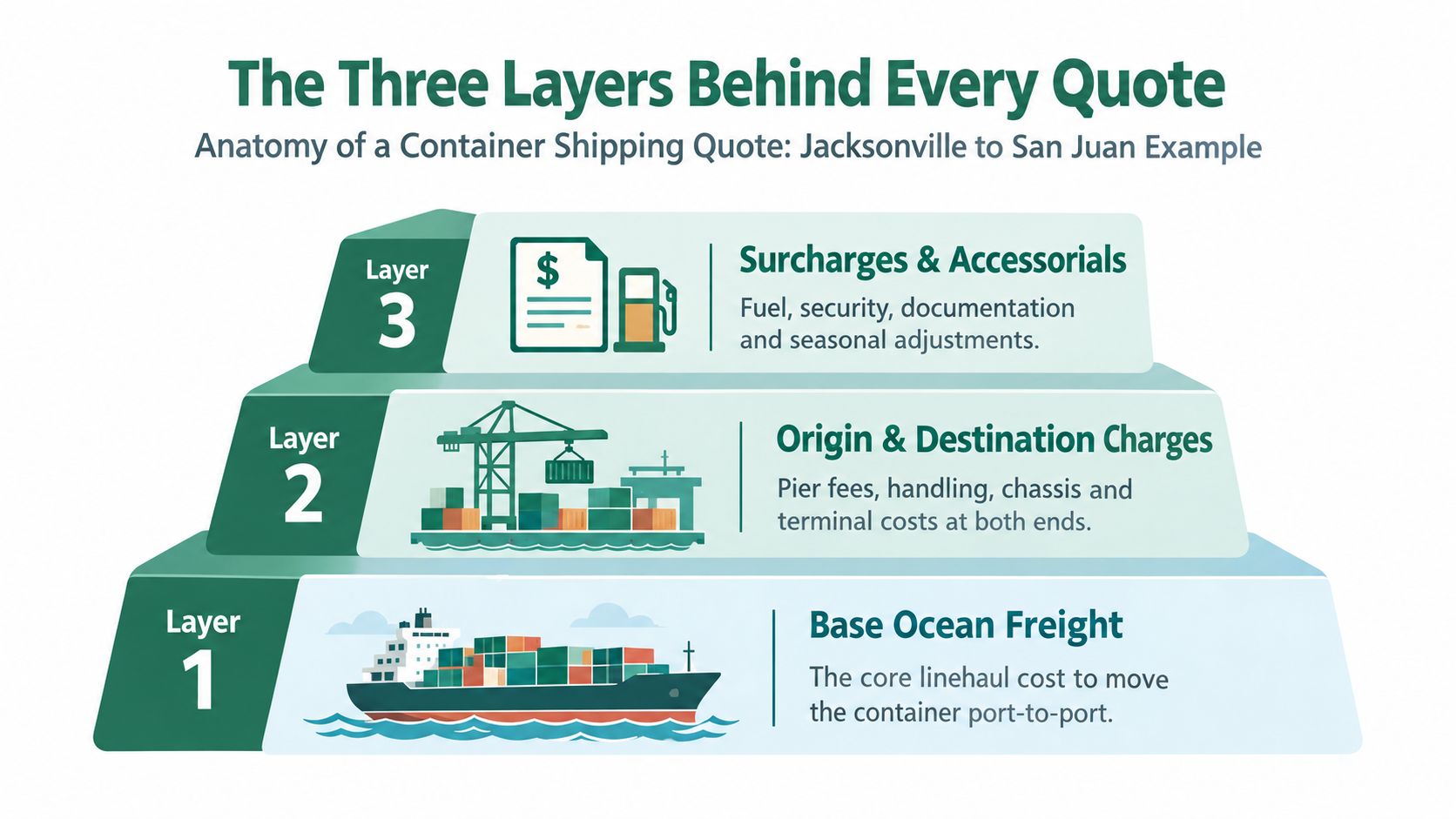
Take a Jacksonville-to-San Juan vehicle move. The cleanest way to read the quote is to separate it into base ocean freight, surcharges, and value-added services. This structure reflects the way liner-shipping research describes quote construction, with the base rate tied mainly to the origin-destination pair and additional charges influenced by fuel, terminals, and customer-specific services, as explained in this independent analysis of liner shipping rates.
Layer one is the ocean linehaul
The base ocean freight is the core charge for moving the container between designated port terminals. A carrier may quote it per container, while an LCL provider may use volume or weight-based calculations. On the Jacksonville-to-San Juan example, this is the amount that gets the loaded equipment onto the ocean service. It doesn't automatically include the driveway pickup in Jacksonville or delivery to a residence in Puerto Rico.
Start here when comparing providers, but don't stop here. A low base rate can mean that other charges appear elsewhere in the document.
Layer two is the surcharge stack
Surcharges respond to market and operating conditions. They can include bunker or fuel adjustments, general rate increases, congestion charges, currency adjustments, security fees, peak-season charges, and equipment repositioning costs. The route may remain Jacksonville to San Juan while the total changes because the carrier's fuel expense, available equipment, or operating conditions changed.
Ask whether each surcharge is fixed, estimated, or subject to revision before loading. A quote with a lower base freight figure may become more expensive once these items are added.
Layer three is the service package
Value-added services cover everything outside the core port-to-port movement. Common examples include origin pickup, destination delivery, customs clearance, documentation, cargo insurance, chassis use, port storage, and demurrage. For a vehicle, the pickup location and access conditions matter. A narrow residential street, an inoperable car, or a location far from the terminal can change the inland portion.
National Car Transport is not part of the comparison discussion here, but any competent auto transport provider should be able to explain these layers when you ask. Two quotes only represent the same move when they cover the same origin, destination, equipment, services, and liability terms.
Key Cost Factors That Move the Price
Distance matters, but it isn't the strongest predictor by itself. World Bank and UNCTAD material identifies cargo type, voyage distance, port infrastructure, shipping connectivity, trade facilitation, equipment shortages, geopolitical disruption, and capacity imbalance as important influences on liner freight pricing, including the World Bank analysis of maritime transport conditions.
| Cost Factor | Typical Impact on Quote |
|---|---|
| Container size and utilization | A larger container can provide more usable capacity, while inefficiently filled space raises the cost per vehicle or item |
| Route and sailing pattern | Direct service is generally simpler, while transshipment can add handling and schedule exposure |
| Origin and destination charges | Terminal handling, documentation, chassis, and local port costs can materially change the total |
| Door versus terminal service | Door service adds inland drayage and trucking on one or both ends |
| Vehicle condition and loading needs | A non-running vehicle may require special loading equipment or additional handling |
| Cargo type, weight, and dimensions | Oversized, dense, restricted, or unusual cargo can require different equipment or review |
| Insurance and liability | Cargo coverage, all-risk coverage, and carrier liability protect against different risks |
| Fuel, congestion, and capacity | Operating conditions can move surcharges even when the lane stays the same |
Equipment and utilization
A 20-foot container, 40-foot container, and high-cube container don't offer the same usable space or loading flexibility. For vehicles, the question isn't whether the car fits. The provider must consider vehicle dimensions, access for loading, tie-down requirements, and whether additional cargo is permitted.
A dedicated container may suit a household move or multiple vehicles. Shared space can make sense when the shipment is smaller, but consolidation introduces scheduling and handling considerations. Never choose equipment based only on the largest container available. Choose the smallest practical option that safely accommodates the cargo.
Routing and the two ends of the move
A quote from a mainland city includes more than the ocean leg. A car collected in Chicago may first travel by truck to a coastal port. A car delivered to a location outside San Juan still needs island-side transportation after discharge. Port infrastructure, vessel connectivity, and local trucking availability all influence the final bill.
Door-to-door service bundles these inland movements. Terminal-to-terminal service leaves more responsibility with you, and the lower headline price may disappear once you arrange pickup, port access, and destination delivery.
Coverage and accessorial exposure
Insurance needs careful reading. Carrier liability isn't the same as all-risk cargo coverage, and neither automatically covers every personal item left inside a vehicle. Ask who provides the coverage, what exclusions apply, and whether the policy covers the full declared value.
For a useful explanation of domestic vehicle pricing factors before adding an ocean leg, review this car shipping cost guide. The principle is simple: a quote should reflect the actual vehicle, actual addresses, actual service level, and actual loading conditions.
Why Container Quotes Move Week to Week
Container shipping quotes are market snapshots. UNCTAD documented the volatility clearly: the Shanghai Containerized Freight Index stood at 898 points in December 2019, rose to 2,455 in December 2020, and reached nearly 5,000 by December 2021. UNCTAD also noted that spot container freight rates peaked in January 2022 and stayed above pre-2019 levels after falling, as shown in its review of maritime transport and freight markets.
The later reset was just as instructive. UNCTAD reported that the unweighted average container freight rate fell 39% from 2022 to 2023, moving from $4,716 to $2,857 per FEU, while remaining above pre-pandemic norms in the 2024 Review of Maritime Transport. On the Shanghai-to-New York lane, the cost of a large container rose from $2,325 per FEU in September 2019 to more than $20,000 by September 2021.
What creates the movement
Carriers adjust pricing when demand exceeds available vessel or equipment capacity. Fuel costs, terminal congestion, blank sailings, seasonal demand, and geopolitical disruptions all affect the number attached to a lane. When carriers reroute around the Cape of Good Hope because of Red Sea disruption, the longer voyage can increase cost and absorb capacity.
A car shipment to San Juan feels these changes indirectly. The carrier may revise the ocean component, change the available sailing, or alter the validity window while the inland pickup remains unchanged. A quote issued early in the week may not be available when you authorize booking later.
Use indices as context, not as your invoice
Published indices are useful for understanding direction, but they don't replace a lane-specific quote. Recent 2026 market reporting showed wide dispersion, with Shanghai-to-Los Angeles around US$7,185 to US$7,352 per 40-foot container, Shanghai-to-New York around US$9,587 to US$9,726, and a global index that continued moving week to week, according to this 2026 ocean freight rate review.
Booking advice: Ask for the quote date, expiry date, confirmed sailing, and charges that remain subject to change. A quote without those details is a planning guess.
How to Compare Quotes the Right Way
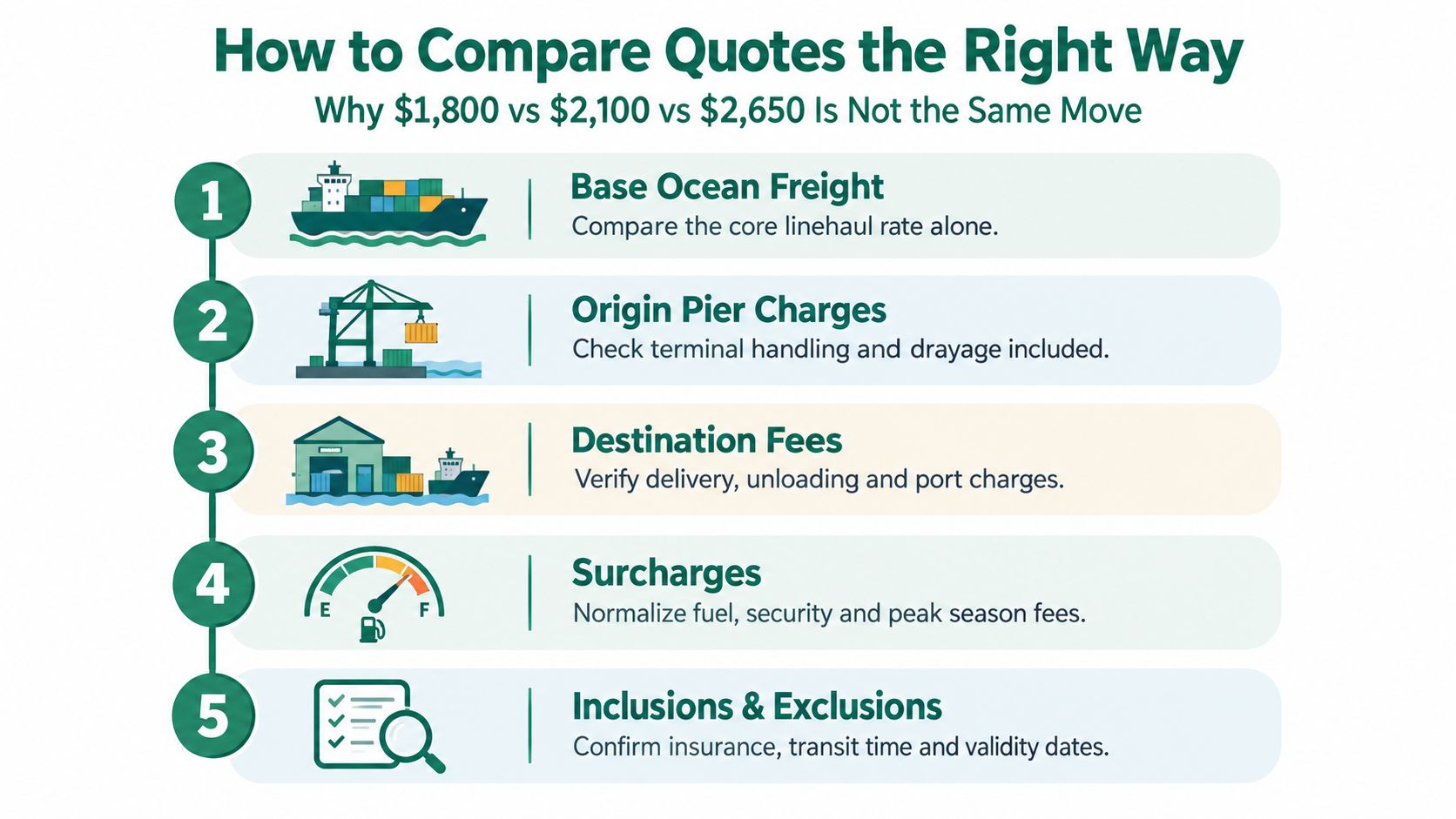
Three providers may quote $1,800, $2,100, and $2,650 for what appears to be the same shipment. Those totals can represent different scopes. One may cover terminal-to-terminal movement, another may include pickup and delivery, while the highest may add insurance, customs support, or a better sailing.
Put every quote into the same order before judging the price. Confirm these seven items line by line:
- Base ocean freight: Check the port pair, equipment type, and whether the rate is per container or based on volume.
- Origin charges: Identify pickup, drayage, terminal handling, documentation, and loading services.
- Destination charges: Verify discharge, terminal handling, port fees, unloading, and local delivery.
- Fuel and market surcharges: Look for bunker, congestion, security, peak-season, currency, and general rate adjustments.
- Customs and documentation: Ask whether brokerage, filing, inspections, and compliance review are included.
- Insurance and liability: Confirm coverage limits, exclusions, deductibles, and whether only carrier liability applies.
- Validity and operating terms: Record the rate expiry, sailing, transit window, free time, storage terms, and demurrage exposure.
Normalize the service before judging the price
If one quote ends at the terminal and another reaches your home, add the missing inland leg before comparing totals. Apply the same rule to insurance. Price equivalent coverage, or state clearly that one shipment carries more financial risk.
Vehicle moves require the same discipline in the domestic 48-state market. An open carrier from Miami to Denver is not the same service as an enclosed carrier on that lane. Terminal pickup and address-level delivery also require different scopes and prices.
For a vehicle headed to or from Puerto Rico, separate the mainland pickup, port handoff, ocean movement, island discharge, and final delivery. A low ocean rate can still produce an expensive invoice if drayage, port handling, or island delivery is missing. Ask who controls each handoff and which party can add charges.
Watch the video below for another visual way to review international quote components.
Red flag: If a provider refuses to itemize the quote, treat the total as incomplete and expect charges to appear after booking.
Shipping to and from Puerto Rico
Puerto Rico is where mainland auto transport and container shipping mechanics meet. A customer may be moving a single running vehicle, sending a household car during a seasonal relocation, or coordinating vehicles for a dealership. The choice between container service and RoRo depends on the vehicle, whether extra cargo is involved, and how much control the shipper needs over loading.
The Jones Act framework shapes this lane. U.S. cabotage rules restrict foreign-flagged vessels from carrying cargo between U.S. ports, which affects mainland-to-Puerto Rico routing, carrier availability, port operations, and pricing. For vehicles, Trailer Bridge describes service between Jacksonville and San Juan, including vehicle shipping to and from the island.
A running vehicle may move by roll-on/roll-off barge, while a vehicle with household goods may need a shared or dedicated container. The mainland handoff is only one part of the transaction. San Juan-area discharge, compliance review, island transportation, and final delivery all need to appear in the written scope.
Select the method around the cargo
| Method | Typical Price Range (Single Vehicle) | Transit Time | Best For |
|---|---|---|---|
| Shared container | Varies by vehicle, space, and sailing | Varies by booking and consolidation | A customer seeking container efficiency with limited additional cargo |
| Exclusive 20-foot or 40-foot container | Varies by equipment and service scope | Varies by sailing and handling | Households, multiple vehicles, or shippers needing dedicated loading space |
| RoRo barge | Varies by vehicle condition and route | Varies by vessel schedule | A single running vehicle with no personal cargo inside |
The table intentionally avoids invented “typical” prices. Puerto Rico quotes are too sensitive to vehicle size, condition, pickup location, port, service method, and current carrier conditions for a generic figure to be reliable.
Paperwork and island delivery
Puerto Rico vehicle imports can require EPA Form 3520-21 when applicable, DOT Form HS-7, and proof of conformity. A title or registration, a manufacturer conformity letter, or an applicable exemption may satisfy the conformity requirement, but you should confirm the exact documents for the vehicle before booking.
A vehicle collected anywhere in the mainland United States still needs a practical delivery plan after the ocean movement. Someone in San Juan may need local delivery from the port. A customer in Ponce, Mayagüez, or another part of the island needs the final inland leg priced and scheduled separately or included clearly in the door-to-door quote. Review the Puerto Rico car shipping service details while comparing methods, but insist on a written breakdown from the provider you choose.
Getting an Accurate Estimate from a Carrier
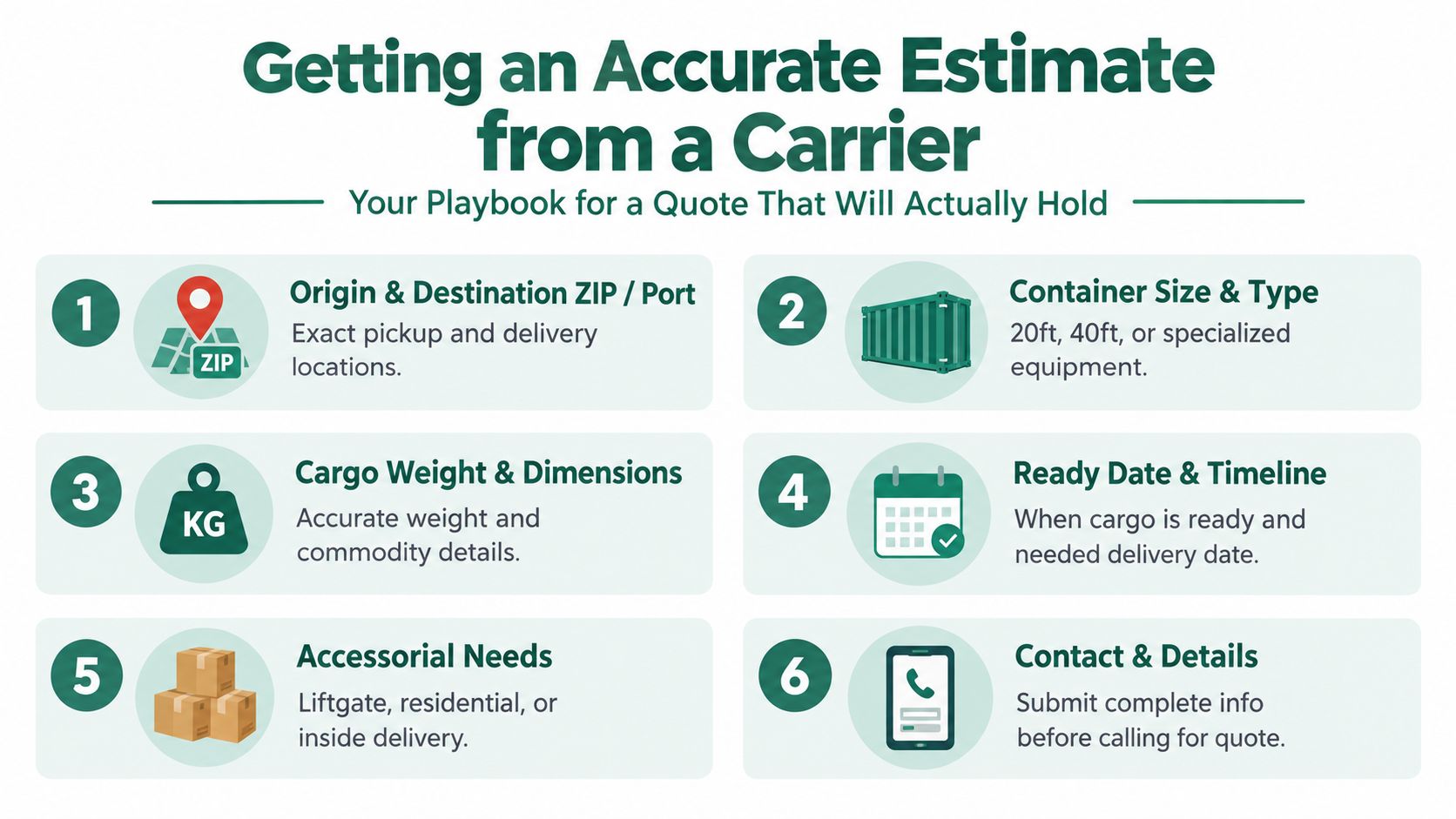
A carrier cannot price this move accurately from a vehicle model alone. Before calling, gather the origin ZIP code, destination ZIP code or port, vehicle make and model, container size if known, cargo type and weight, preferred pickup window, and access details at both ends. State whether the vehicle runs, rolls, steers, and brakes. A non-running vehicle may require different loading equipment and handling.
For a domestic move across the 48 states, give exact addresses whenever possible. For Puerto Rico, specify whether you need port pickup, delivery in San Juan, or delivery elsewhere on the island. The mainland pickup, ocean leg, Puerto Rico port handling, and final island delivery can each affect the bill. A city-to-city estimate starts the conversation, but it does not give the carrier enough detail for a firm operational quote.
Questions that reveal the final number
Ask whether the base rate includes bunker or fuel charges, chassis use, terminal handling, documentation, and destination delivery. Confirm whether insurance is included or separate, which carrier or vessel line will handle the ocean leg, whether equipment and space are guaranteed, and how long the rate remains valid.
Request a rate sheet or written booking confirmation. It should list exclusions, payment terms, cancellation rules, pickup conditions, delivery assumptions, and charges that may arise from storage, demurrage, detention, inspections, or access problems. For Puerto Rico, require the quote to identify where the mainland handoff ends and island delivery begins.
Walk away from weak documentation
Be cautious when a provider gives you a suspiciously round number without asking about the vehicle, cargo, or addresses. Other warning signs include no line-item breakdown, a verbal-only rate, refusal to identify the vessel line, unclear insurance, or pressure to send a large upfront wire payment.
A good provider asks questions before quoting because not one vehicle transport is alike. The strongest estimate comes from a carrier or logistics advisor who reviews the full move, explains every handoff, and identifies which charges can still change. For a door-to-door vehicle move, compare the door-to-door transport option against the exact pickup and delivery conditions, not just the headline number.
National Car Transport provides domestic vehicle shipping across the 48 states and service to and from Puerto Rico. Its U.S.-based bilingual English and Spanish agents can review your vehicle, route, paperwork, and delivery needs, so visit National Car Transport for an estimate and practical guidance.