
Shipping a sedan from California to Honolulu typically costs $1,500 to $2,300, a figure that already bundles trucking to the West Coast port, the ocean crossing, and port handling. Ship from an inland state and the number climbs, because the car first travels by truck just to reach the coast. That's the number to anchor on. Confusion about how much to ship to Hawaii usually starts when a headline ocean rate gets treated like a final bill.
Two quotes can both say Hawaii and still land hundreds of dollars apart for good reasons. One may end at a West Coast port while another includes pickup at your home. One may finish in Honolulu while another reaches a neighbor island port such as Kahului, Nawiliwili, Hilo, or Kona. One may assume you'll collect the car the moment free time starts, while the other leaves storage risk sitting with you.
You'll get a usable budget if you price the move in pieces. Start with the ocean leg, add inland trucking, check whether the car runs and fits the standard size, then keep Hawaii's use tax on a separate line. Door service and the tax sit outside the ocean figure, so the cheapest advertised sailing can stop looking cheap once the full route is priced. The trade-offs show up in dollars and days rather than vague promises.
Table of Contents
- Ocean Rates to Honolulu and the Neighbor Islands
- Build the Landed Cost Not Just the Ocean Rate
- What Changes the Price Off That Baseline
- How the Days Add Up on a Hawaii Sailing
- Port Fees and Cars That Are Not Running
- Hawaii Use Tax After the Car Arrives
- When a Military Order Pays for the Car
- Get a Hawaii Quote With the Port Named
Ocean Rates to Honolulu and the Neighbor Islands
Two cars can leave the same California dock on the same vessel and still land hundreds of dollars apart. The Matson car shipping rates and payment schedule lists Long Beach or Oakland to Honolulu from $1,790, and the same mainland ports to Hilo, Kahului, or Nawiliwili at $2,600 for a standard passenger vehicle.
That gap is $810, or about 45%, before inland pickup, delivery, storage, an oversized vehicle, or optional protection enters the quote. Honolulu is a direct ocean destination. A neighbor island usually takes another handling step after the main crossing, and the published schedule prices that step in rather than hiding it at checkout.
The Four Lanes Worth Comparing
Direction matters just as much as destination. The same schedule prices the return trip lower, starting at $1,020 from Honolulu to Long Beach or Oakland and $1,990.01 from a neighbor island to those ports. If you're moving back to the mainland, budgeting with the outbound number will misread the lane by a wide margin.
| Lane | Listed ocean rate | Typical total timing |
|---|---|---|
| Long Beach or Oakland to Honolulu | From $1,790 | 10–18 days |
| Long Beach or Oakland to Hilo, Kahului, or Nawiliwili | $2,600 | 10–18 days, plus a few days |
| Honolulu to Long Beach or Oakland | From $1,020 | 10–18 days |
| Neighbor island to Long Beach or Oakland | From $1,990.01 | 10–18 days, plus a few days |
Read the rate column as port to port only. It doesn't move a car from Phoenix, Dallas, Chicago, or New York to California. It also doesn't drive the car from a Hawaiian terminal to a house, condo, base, or dealership lot.
Why Timing Belongs Next to Price
The 10–18 day window is door-to-port time, and it breaks into three pieces: trucking to the West Coast port, about a week at sea, and port processing. Sailings run weekly to Honolulu, Hilo, Kona, Nawiliwili, and Kahului, so the calendar is predictable even when it isn't short. Neighbor-island deliveries can add a few days because the vehicle makes a second water movement after reaching Oahu, with its own schedule and dock handling.
Say you're relocating for work and your car must be usable during your first week on Oahu. A Honolulu arrival gives you a planning window you can work around. A neighbor-island arrival asks for a rental car, rides from family, or a longer stretch without your own vehicle, and that rental cost belongs in your real comparison even though no carrier puts it on the freight invoice.
Practical rule: Treat roughly $1,800 as the Honolulu ocean benchmark and about $2,600 as the neighbor-island benchmark, then add the cost of getting the car between your address and the port.
An ocean-only quote is where budgeting starts; the amount that leaves your bank account comes later. Once you know the lane, the port, and the direction, you can judge whether a higher quote is padded or more complete.
Build the Landed Cost Not Just the Ocean Rate
A headline rate looks clean because it leaves work out. The Matson Hawaii car shipping service page frames the final amount around mainland transport to the departure port, Hawaii port handling, terminal or storage charges, vehicle operability and size, and delivery from the destination port, with a published difference of $810 between Honolulu and several neighbor-island destinations before inland transport is added.
The illustration below shows why two Hawaii quotes can disagree even when both carriers are describing the same car.
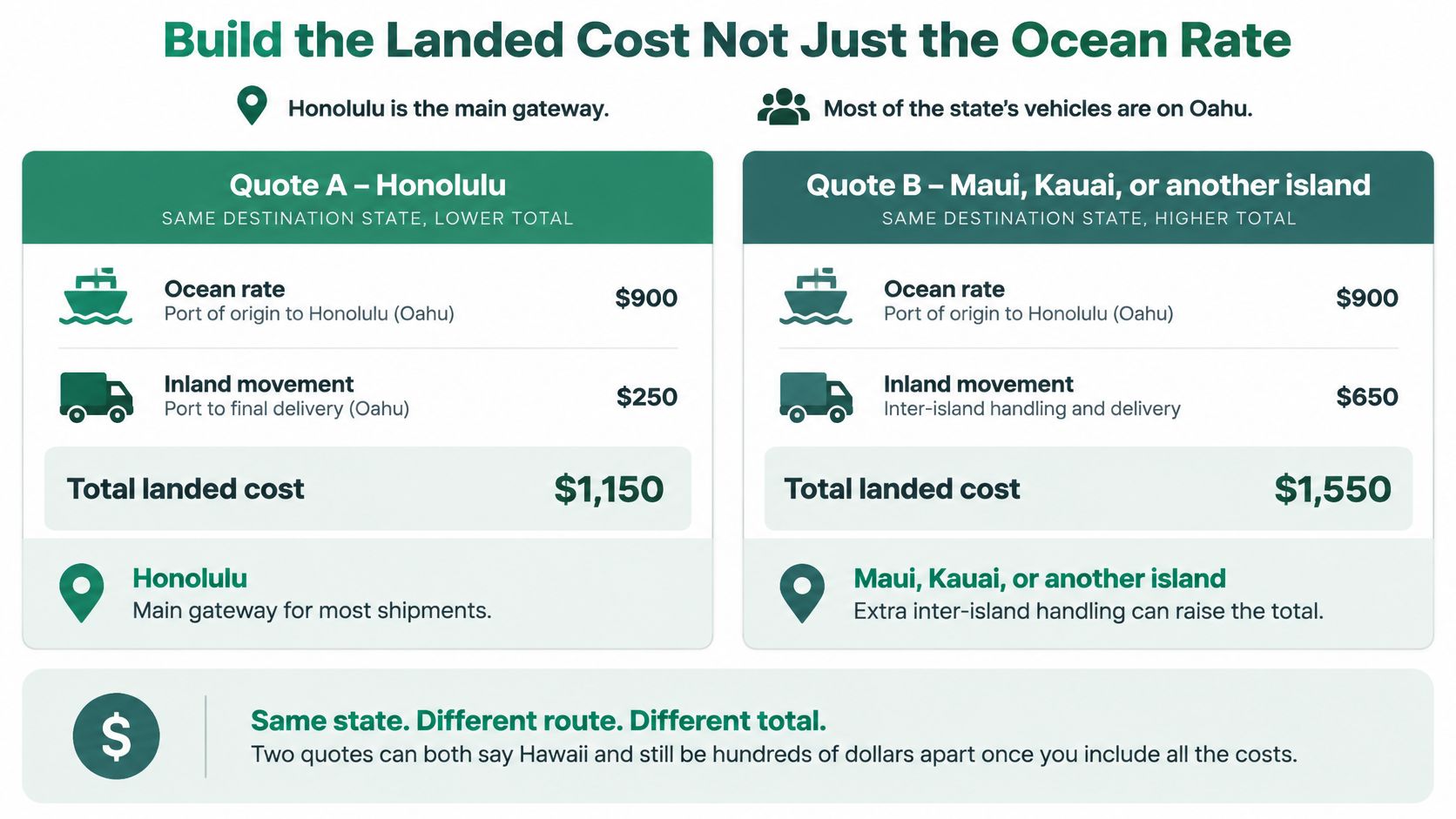
Honolulu is the main gateway because most of the state's vehicles are on Oahu. A car headed to Maui, Kauai, or Hawaii Island may need another maritime leg after it reaches Oahu, plus another round of terminal handling. That extra leg isn't a surcharge invented at checkout. It's a second movement with its own schedule, labor, and dock space.
A Landed Cost Worksheet You Can Reuse
Price these six lines in order, even if some of them come back as zero because you'll handle them yourself:
- Mainland pickup or self-delivery: A truck collects the car, or you drive it to Long Beach or Oakland and pay your own fuel, tolls, and time.
- Ocean freight: The port-to-port sailing to Honolulu or onward service to Hilo, Kahului, or Nawiliwili.
- Destination port handling: The terminal work that gets the car off the vessel, inspected, staged, and released.
- Interisland or local delivery: A barge connection, a local truck, or your own trip to collect the car at the terminal.
- Storage risk: Extra days if the car sits past the terminal's free window while flights, housing, or paperwork catch up.
- Optional protection or container service: Enclosed or containerized handling for a vehicle that needs more than standard open ocean transport.
A California owner near the port feels mostly the ocean line, so a low sailing rate can produce a low total. A Chicago or New York owner pays for cross-country trucking first, and that inland leg can wipe out the savings from an apparently cheap sailing before the car ever sees water. If you want a broader baseline for the trucking piece, review how car shipping costs are built before you compare ocean quotes side by side.
This short video is useful for seeing how the handoffs fit together, from mainland pickup through port release.
The contrarian point is simple. The lowest ocean rate doesn't always produce the lowest delivered price, especially when the car isn't ending on Oahu or when you miss the terminal free window and storage starts. Port storage is a real cost variable, not minor paperwork.
Ask every carrier one direct question. Which of those six lines are already inside the quoted number, and which will arrive later as separate charges?
What Changes the Price Off That Baseline
Treat the ocean table as a standard running sedan on a normal schedule. Anything that makes your car harder to load, larger to carry, or later to book can move the price.
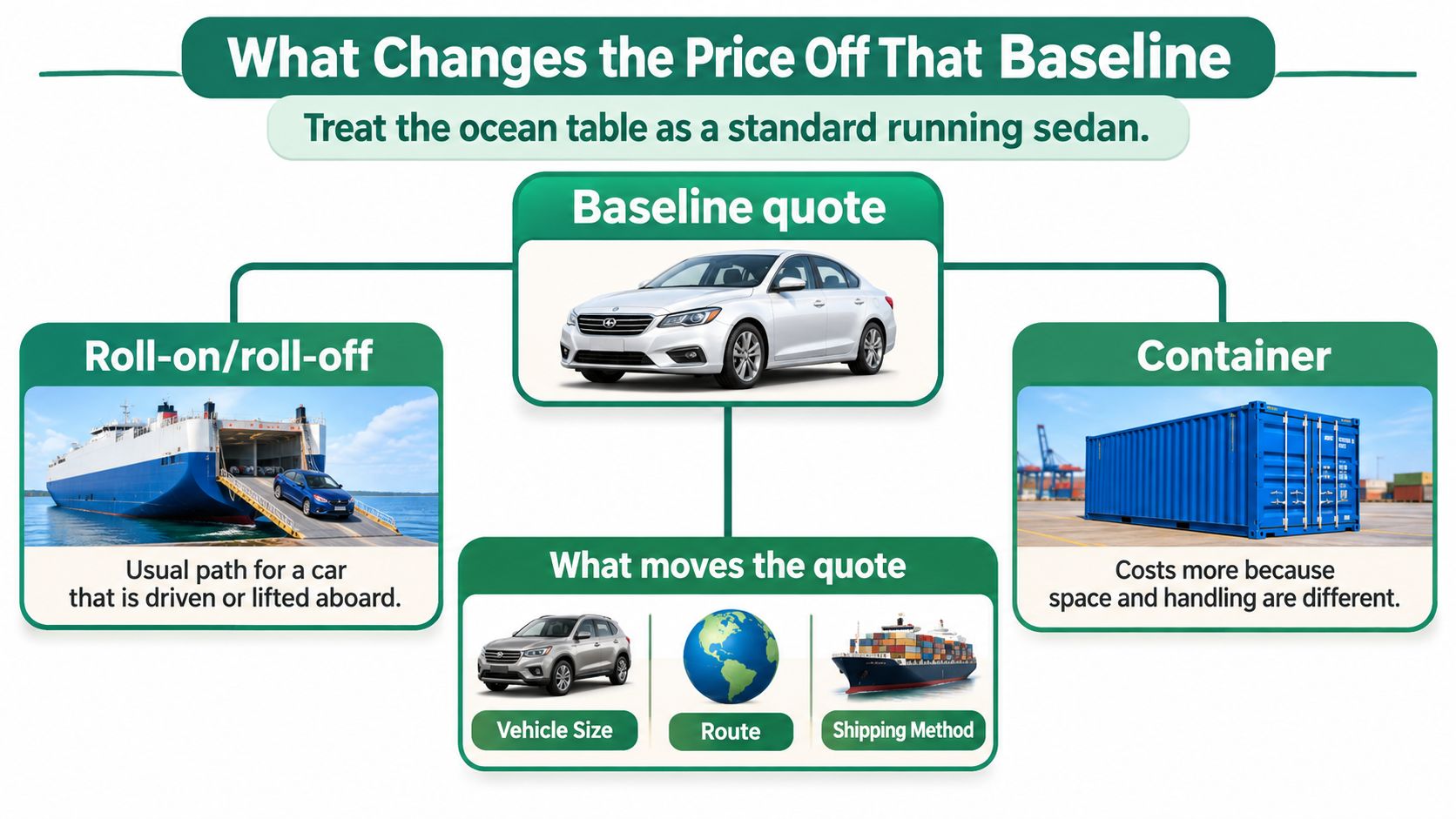
Roll-on/roll-off is the usual path for a car that can be driven or lifted aboard in the standard terminal flow. A container costs more because space and handling work differently, and it fits a nonstandard vehicle, a very high-value car, or a move where you specifically want the vehicle sealed in its own box. Don't pay for a container out of habit if a clean, running daily driver doesn't need it.
Size, Season, and Starting Point
A compact sedan is the baseline. A full-size SUV or pickup takes more deck space and usually costs more, while a lifted truck, a dually, or oversized tires can be repriced or refused if the dimensions don't fit the equipment. There's no published size surcharge for trucks, SUVs, or modified vehicles in the sources used here, so request a size-specific price from the carrier rather than applying a guessed percentage.
Season matters because summer relocations and military move windows fill West Coast sailings. Book earlier in those periods. Winter demand can be softer, but weather can still delay ports, so a lower quote doesn't guarantee a shorter trip.
Origin matters just as much as the vehicle. A car already in California, Oregon, or Washington pays mostly for the ocean leg. A car in Texas, the Midwest, or the Northeast first trucks to the departure port, and that inland leg is often the surprise that makes door-to-door auto transport planning worth pricing as one coordinated move instead of two separate purchases.
The Jones Act in Plain Terms
The Maritime Administration domestic shipping guidance explains that the Jones Act, formally the Merchant Marine Act of 1920 and codified at 46 U.S.C. § 55102, generally prohibits transporting merchandise between U.S. points by water unless the vessel is U.S.-built, U.S.-owned, and coastwise endorsed. That's why a Hawaii quote follows eligible ships and sailing days rather than simple highway miles. You can't shop your way around the eligible fleet the way you might compare dozens of trucks on an interstate lane.
Give the quote desk four facts up front. Tell them whether the car runs, name the exact island port, provide dimensions if the vehicle is modified, and state the date it must arrive. Vague inputs produce vague prices.
How the Days Add Up on a Hawaii Sailing
A Honolulu move is three clocks added together. Trucking to the West Coast port runs first, the ocean crossing runs second, and port processing wraps around the sailing on both ends.
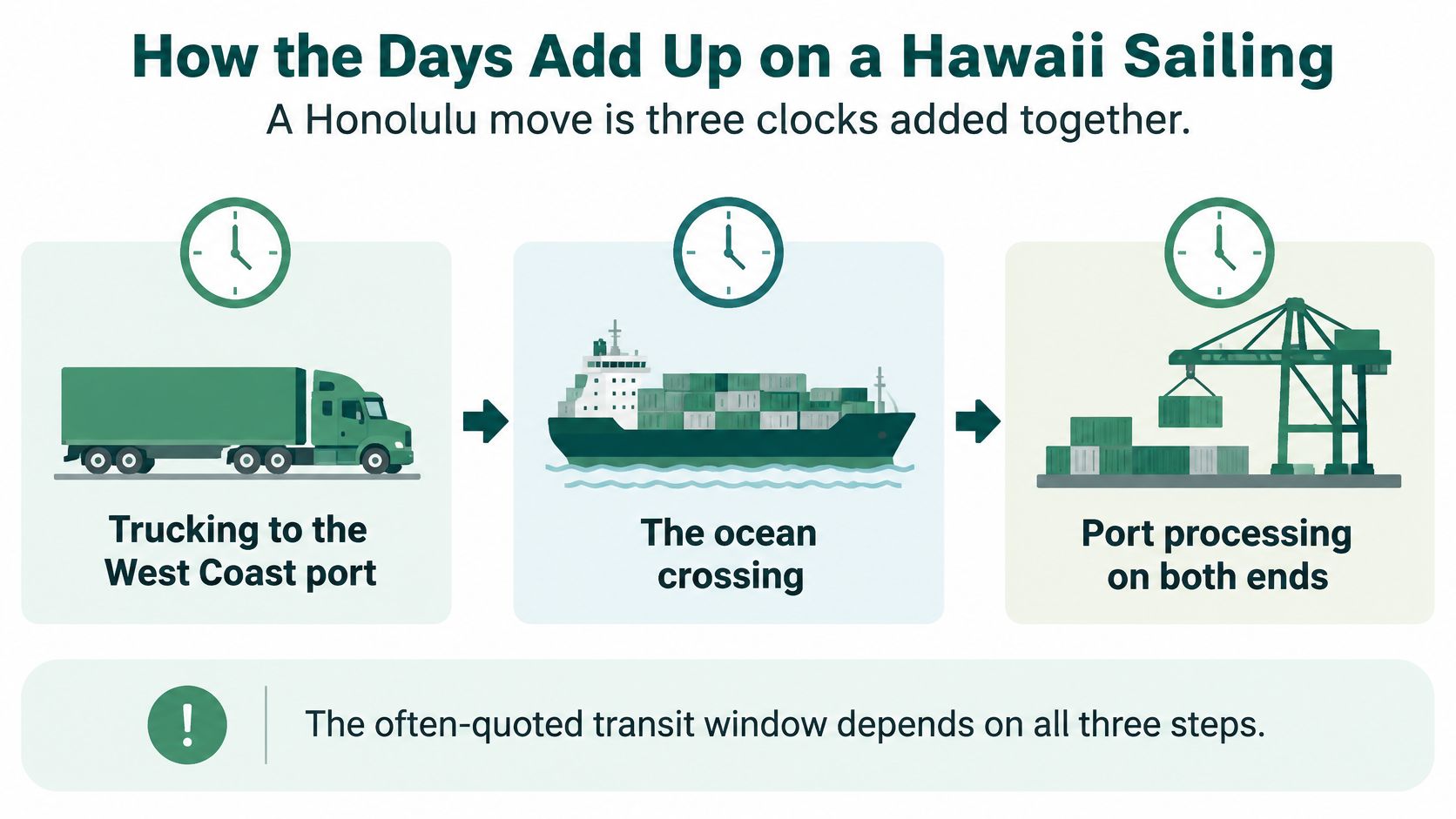
A realistic door-to-port window for Hawaii is 10–18 days total, and about one week of that is the sailing itself. The rest is land work: the truck leg to the departure port, terminal intake, the documented inspections before and after the voyage, and release processing once the vessel arrives. That is why a seven-day crossing never lands as a seven-day delivery, and any quote that promises only the ocean leg is quoting you one clock out of three.
Where Neighbor Islands Lose Time
Cars bound for Hilo, Kona, Kahului, or Nawiliwili typically connect through the same weekly sailings, then continue to their own port. That connection is why a neighbor-island move can add a few days on top of the Oahu window. Ask whether the island leg is included in both the price and the date range, because a quote that ends in Honolulu tells a Maui or Kauai owner only half the story.
Weekly departures also make cutoffs unforgiving. Miss the cutoff and you don't lose a day. You usually lose about a week, plus whatever new port processing time comes with the next sailing.
A blended transit promise hides the delay you can actually control, which is usually the truck pickup and the port cutoff.
Say a sedan leaves Dallas for Honolulu. It may wait for a truck, cross the country, make or miss a Friday cutoff in California, then sail. Each handoff has its own queue, and a late truck can push the car to the next vessel even if the ocean leg runs on schedule.
Door-to-port service means you collect the car at the Hawaiian terminal. Fuller door service adds a local truck after the port and more days, especially off Oahu. The same stacked-clock logic applies to other island routes, including cars moving through Puerto Rico car shipping services, where the mainland truck and the ocean sailing also have to line up.
Before you accept one blended promise, ask for three separate numbers in writing: truck days to the West Coast, the scheduled sailing, and port days on both ends. When the date moves, you will know which clock slipped.
Port Fees and Cars That Are Not Running
The ocean rate you agree to covers the sailing. The terminal clock is a separate bill. The Matson frequently asked questions for shipping your car states that port storage is charged once a vehicle remains beyond the terminal's allotted free period, and that the charge goes directly to the port rather than being absorbed by the ocean carrier.
That distinction costs real money on a Hawaii move, because sailings leave weekly. A car that misses a cutoff does not wait hours at the dock. It waits days, and the storage meter starts the moment free time expires.
| Charge | How it is billed | When it applies |
|---|---|---|
| Excess port storage | Per day, paid to the port | The vehicle sits past the terminal's free time at origin or destination |
| Inoperable-vehicle handling | Not offered for Hawaii | The car cannot roll, steer, and brake under its own power |
Inoperable cars need their own warning. On some mainland lanes, a vehicle that still rolls, steers, and brakes can ship, with a small fee declared at booking. Hawaii does not work that way. Inoperable vehicles cannot ship to or from the islands, so a winching or special-handling charge is not a fallback you can budget for. Test the car before the truck is dispatched. If it won't start and move, the repair happens at home, not in the terminal lane.
Loose Cargo Can Stop the Shipment
Loose cargo is a separate rejection risk, and it behaves like a storage bill waiting to happen. For Hawaii shipments, only factory-installed items and a child car seat may remain inside the vehicle, and non-factory accessories must come out before the port accepts the car.
Household goods stuffed into the trunk or back seat can stall acceptance, and a stalled car loses the sailing. Clean the vehicle out before pickup. Keep the child seat only if your service allows it, and don't treat the car as a moving box for the small stuff you forgot to pack.
Four Steps That Control These Fees
- Confirm the car starts, stops, rolls, and steers. Check it the day before pickup, not in the terminal lane.
- Get both free-time deadlines in writing. Storage can begin at the origin terminal and again at the destination terminal, so ask for each date.
- Schedule delivery with a buffer before cutoff. Traffic, weather, or missing paperwork that delays the truck converts directly into per-day storage.
- Ask for port handling and storage terms as separate lines. Pickup, ocean freight, destination handling, and any storage exposure should each appear on the written quote.
A quote that names only the ocean leg leaves three of those lines blank, and the blank ones are the ones billed at the counter.
Hawaii Use Tax After the Car Arrives
Freight tables usually skip the tax question, and that's where budgets break after arrival. The State of Hawaii use tax brochure says the tax applies to the vehicle's landed value, which includes the vehicle price, shipping and handling, insurance, customs duty, and related import costs, at a stated rate of 4.5% for a vehicle imported for the owner's use.
Sales or use tax already paid to another state may generally be credited, subject to Hawaii's limits. A prior tax payment is therefore a credit question, not an automatic exemption. If you paid tax in a low-rate state years ago, don't assume the credit erases the Hawaii calculation.
One Worked Example
| Line | Amount |
|---|---|
| Vehicle price | $30,000 |
| Shipping and related taxable costs | $2,000 |
| Landed value | $32,000 |
| Use tax at 4.5% before any credit | $1,440 |
The math is plain. A $30,000 vehicle plus $2,000 in shipping and related taxable costs creates a $32,000 landed value, and 4.5% of that is $1,440 before any allowable credit. Label that $1,440 correctly. It's a State of Hawaii charge, not a carrier fee, and it won't disappear because you negotiated a better freight rate.
This is also why a cheaper car isn't automatically a cheaper move. If the out-of-state credit is small and port charges are high, a lower-priced vehicle can still produce an uncomfortable total once tax, storage risk, and registration paperwork are counted. Price the car, the freight, and the tax as three separate decisions.
Documents to Keep in One Folder
Registration may require proof that the use tax was paid or that no tax is due. Keep the bill of sale, the shipping invoice, the insurance record, and any out-of-state tax receipt together from the day you book. Digging for a tax receipt after the car reaches Honolulu wastes time you may not have inside a free-time window.
Check the current state brochure before you file. Credits and vehicle facts change the result, and your car's purchase history matters more than a generic example.
When a Military Order Pays for the Car
The first question isn't the price. It's who's paying. On PCS orders to Hawaii, the government may cover one vehicle, and every car beyond that gets priced like a civilian move.
Military OneSource guidance on preparing to move or PCS states that when a service member travels overseas or outside the contiguous United States, the government may generally pay to ship one privately owned vehicle to the new duty station or store one vehicle during the overseas tour. That shipment runs through International Auto Logistics, the military's global POV contractor, and the car is delivered to a vehicle processing center for transportation or storage.
One Car on Orders, Every Other Car on You
Military vehicle allowances are limited, and Hawaii sits outside the contiguous United States, so the allowance that applied on a mainland move may not transfer. Read the orders first, then confirm with your service's transportation office exactly how many vehicles the government will move. A two-car household should decide early which car rides on the orders and which one needs a commercial quote.
Some members hear about space-available programs, sometimes called opportune lift, that can move a second vehicle on a government sailing when room exists. These options are limited and the eligibility rules are strict, so ask the transportation office whether one applies to your situation before you count on a second movement.
The government benefit covers a vehicle, not a household fleet.
Snowbirds, students, dealerships, online buyers, and other households don't use these channels at all. They budget the full private landed cost instead. The same applies to a service member's second car, a spouse's car that isn't on the orders, or a vehicle bought after arrival and shipped later.
Before you compare commercial quotes, confirm three things. Check the PCS order. Ask the transportation office which vehicles the government will move. Decide which car gets booked privately if a second one is going. Pricing the wrong car through the wrong channel wastes weeks.
Get a Hawaii Quote With the Port Named
A Hawaii quote is only as specific as its endpoints. Have the title or lienholder details, photo ID, vehicle identification number, exact pickup city, and destination port ready. A number that says only “Hawaii” leaves too much room for error. Honolulu, Hilo, Kona, Nawiliwili, and Kahului are different destinations, and the port affects the terminal work and delivery steps after arrival.
California to Honolulu provides the clearest baseline: an estimated $1,500–$2,300 with 10–18 days of transit. Weekly sailings serve Honolulu, Hilo, Kona, Nawiliwili, and Kahului, with documented port inspections before and after every voyage. Starting farther inland adds the truck trip to a West Coast port. Door-to-port service means collecting the car at the terminal, while delivery beyond the terminal adds local trucking and time, especially off Oahu.
Ask the written quote to identify West Coast pickup trucking, ocean freight, port handling, any delivery after the terminal, and the storage or free-time terms. An advertised ocean figure can leave out the first or last leg, and missed free time can erase the savings from a cheap sailing.
Vehicle condition and contents also affect whether the port accepts the car. Only factory-installed items and child car seats may remain inside, and non-factory accessories must be removed before acceptance. An inoperable vehicle cannot ship to or from Hawaii. On qualifying mainland routes, an inoperable vehicle that rolls, steers, and brakes may ship for a small fee declared at booking.
National Car Transport quotes personal and commercial Hawaii shipments. The company brings 25+ years in business, an A+ BBB rating, transparent flat-rate pricing, a network of 25,000+ vetted, licensed, and bonded drivers, and bilingual English and Spanish agents. At booking, the deposit secures the vehicle's sailing spot.
Request the quote with the destination port named, and confirm the free-time deadline before booking. That keeps the price tied to Honolulu or your specific neighbor island from the start.
Tell us the pickup city, the VIN, and whether your car lands in Honolulu, Hilo, Kona, Nawiliwili, or Kahului, and we'll price the truck, ocean freight, and port handling as one clear flat rate with the sailing and free-time deadline confirmed in writing. Visit National Car Transport to request your Hawaii quote with the port named, so the number you approve matches the island where your car needs to be.