
For a sedan shipped within the continental U.S., open-transport estimates range from $600 to $1,500, depending on distance, vehicle, transport type, and season. Enclosed transport for a covered shipment is quoted on request, so compare it with the open rate for the same route and trip length.
For a mainland-to-San Juan shipment, ask for a line-by-line quote that separates the mainland truck leg, ocean movement, and port handling. Confirm where enclosed protection starts and ends, and whether the vehicle travels in an enclosed trailer for each leg. The enclosed premium is easier to assess against inland distance and trip length when each part of the route is priced separately.
Table of Contents
- What a Covered Car Transport Quote Should Cost
- Information to Gather Before You Request a Quote
- How to Request and Verify a Covered Quote Step by Step
- Comparing Covered Quotes Line by Line
- Protecting Your Quote with Condition Reports and Insurance
- Port, Tax and Export Paperwork
- Confirm the Quote Before You Book
What a Covered Car Transport Quote Should Cost
A covered quote should be compared with an open quote for the same route and vehicle. Check the inland distance first. For a move involving San Juan, keep the mainland truck leg separate from ocean freight and port handling.
The mainland prices below are reference cases, not Puerto Rico package prices. They can help assess the trucking portion, but they do not include an assumed ocean charge.
Covered and open transport reference prices
| Route or Case | Open Transport | Enclosed Transport |
|---|---|---|
| Sedan, New York to Miami | $700–$900 | Obtain a vehicle-specific enclosed quote |
| SUV or crossover, New York to Miami | $800–$1,000 | Quoted on request |
| Pickup or van, New York to Miami | $850–$1,150 | Quoted on request |
| Texas to California, 4–6 days | $800–$1,100 | Obtain a route-specific enclosed quote |
| Chicago to Miami | Compare with the current open rate | 40–60% above the open rate |
| All shipments, median customer price | $1,100 | $1,500, with the middle half at $1,200–$1,950 |
| Enclosed premium by trip length | Use the same-route open quote as the baseline | Compare the premium against inland distance and equipment availability |
Standard running-sedan open-transport estimates fluctuate with season, fuel prices, and route demand. SUVs, trucks, and enclosed Puerto Rico shipments require individual pricing. These mainland estimates are not guaranteed Puerto Rico rates.
For a separate trucking benchmark, Automoblog's 2024 secret-shopper study found an average of $1.25 per mile for a 1,500-mile enclosed shipment, approximately $1,877 total. Use that as a comparison for trucking, not as a per-mile rate to apply to the combined land-and-sea distance to San Juan.
Test the premium against the inland leg
Compare enclosed and open quotes for the same route. The difference may reflect specialized loading, limited enclosed capacity, a fixed pickup date, or a longer mainland collection route. Ask the carrier to identify what the quoted premium covers.
Pricing rule: Apply the enclosed premium only to the service it buys. Keep trucking, ocean freight, and port handling distinct when reviewing a Puerto Rico shipment.
You can also request a quote from Hamptons Leisure Limo for a separate mainland cost comparison. Keep that comparison distinct from the port-to-port ocean service required for a Puerto Rico move.
Information to Gather Before You Request a Quote
Build a single shipment description you can send without rewriting it for each estimate. For mainland-to-San Juan moves, distinguish the collection address from the departure port. For San Juan-to-mainland moves, include the final delivery address, not just the arrival port.
Use this checklist to organize the vehicle and scheduling details.
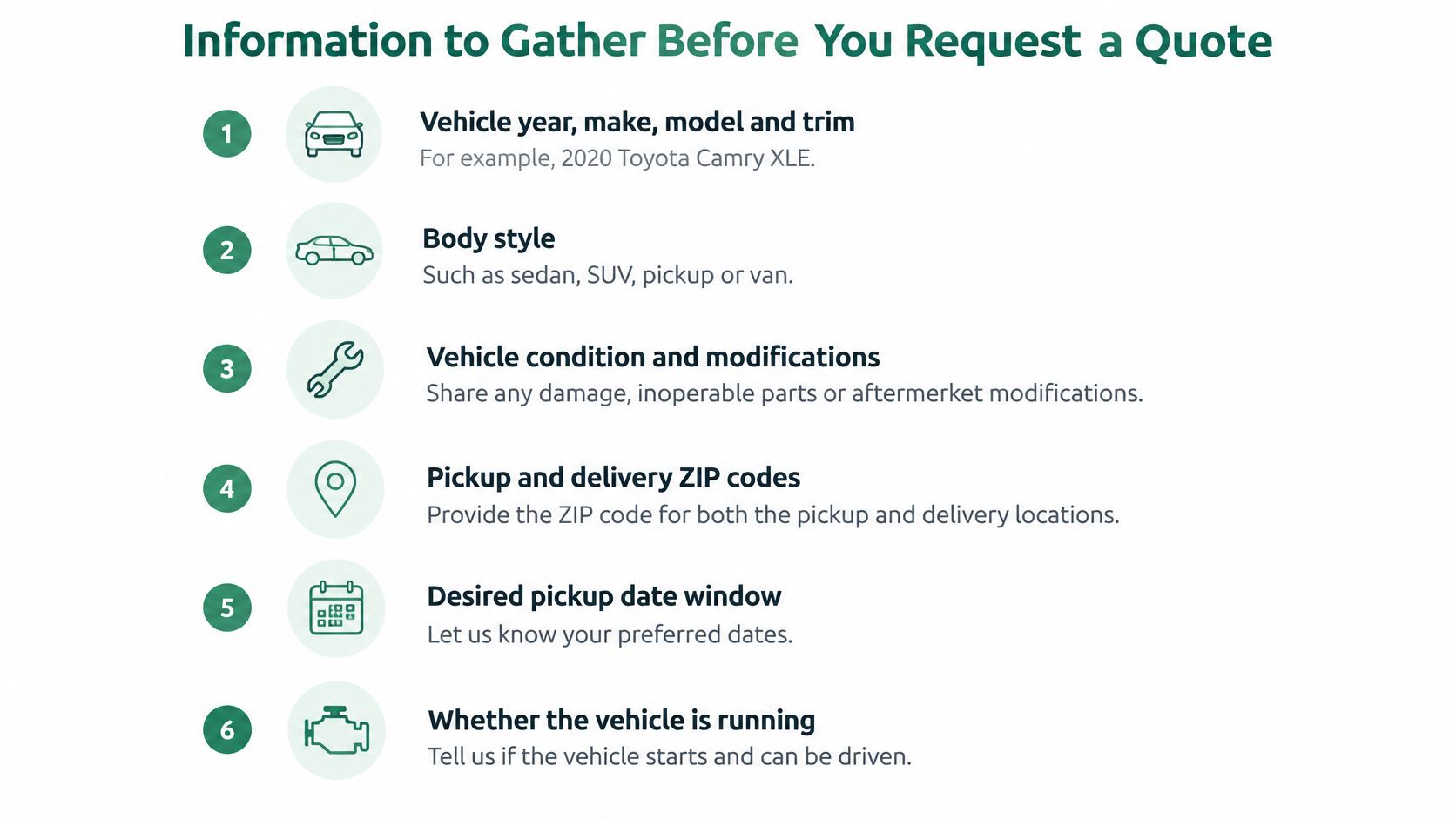
- Vehicle identity: Provide the year, make, model, trim, body style, and VIN. Include the declared value when arranging transport for a collector or high-value vehicle.
- Actual operating condition: State whether the vehicle starts, steers, rolls, and brakes. A car that starts but can't move under its own power shouldn't be described as running.
- Modifications and clearance: List lowered suspension, lift kits, oversized tires, roof racks, and body kits. Add photographs when dimensions or loading clearance could be misunderstood.
- Route and service boundaries: Supply pickup and delivery ZIP codes and specify door-to-port, port-to-door, or coordinated door-to-door service.
- Access limitations: Identify gated entrances, narrow streets, steep driveways, low garages, and locations without room for a transport truck.
- Availability and ownership: Give the earliest release date, pickup flexibility, title status, and any lender involvement. For a vehicle leaving Puerto Rico, flag export-document questions before dispatch.
Explain why you want covered transport
A restored finish, low-clearance bodywork, or valuable glass roof gives the planner useful information about equipment and handling. Our enclosed auto transport service can be matched to the vehicle rather than selected by the word covered alone.
For military families, students, and seasonal residents, identify the date you need the car available, not just your flight date. Dealers should also specify who can release inventory and sign the inspection paperwork.
Missing information doesn't automatically make a quote nonbinding. It does make it essential to check whether the written terms permit repricing when the actual shipment differs.
How to Request and Verify a Covered Quote Step by Step
A Puerto Rico booking can involve a broker, mainland motor carrier, ocean operator, terminal, and local delivery provider. You need to know which company arranges the shipment and who physically holds the vehicle at each stage.
The FMCSA consumer advisory on automobile transporters distinguishes brokers from transporters and states that interstate brokers and transporters must be registered. Use that check for the mainland motor-transport portion, rather than treating it as verification of every ocean-service arrangement.
Build a documented booking
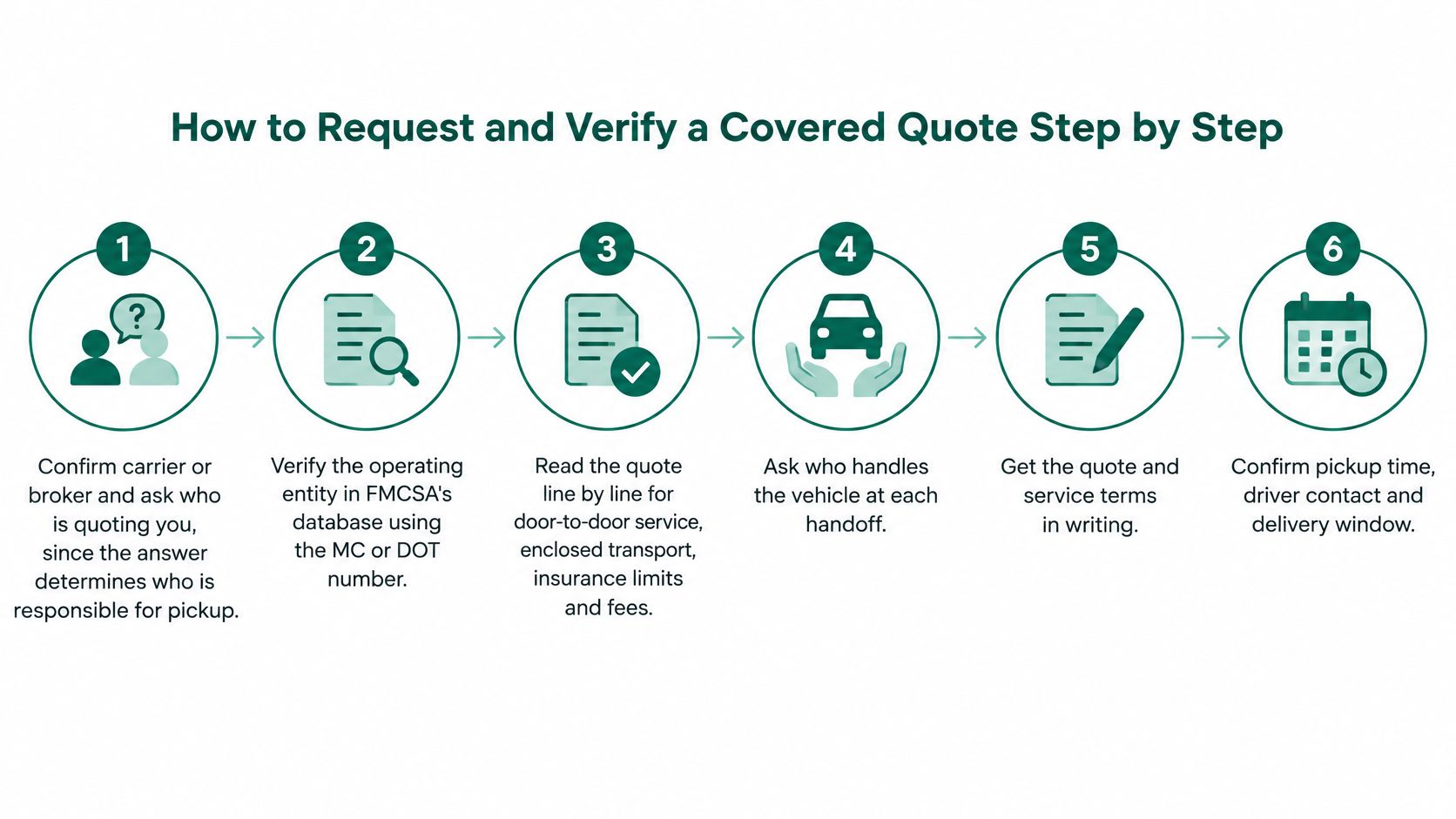
Identify the quoting entity. Ask whether you're dealing with a carrier or broker and record its legal business name. Establish who arranges pickup and who will identify the actual transporting carrier after assignment.
Verify the motor carrier or broker. Check the applicable MC or USDOT identifiers through FMCSA's registration resources. Match the legal name to the written quote rather than relying on a logo, text message, or trading name.
Send one complete shipment specification. Include the vehicle checklist, route, access restrictions, pickup window, and enclosed-service requirement in one message. Add whether you're moving toward San Juan or away from it, because the port handoffs and document sequence won't be interchangeable.
Request a written price breakdown. Separate base trucking, enclosed equipment, ocean freight, fuel or market adjustments, tolls, storage, expedited pickup, and terminal or port charges. If the provider offers a package price, have it identify which of those items are included and which remain payable separately.
Confirm the commercial terms. Ask whether the amount is binding, what permits repricing, when payments become due, and which party assumes custody at each handoff. Have the planner distinguish the pickup window, port receiving deadline, sailing estimate, and final delivery window.
Check insurance before accepting. Verify the applicable insurance filing for the motor carrier's authority and obtain the actual cargo-coverage terms. FMCSA cautions that insurance requirements differ by entity, cargo, and vehicle type, so a registration result alone isn't a complete coverage review.
Use the process below as a booking checklist, not a substitute for written terms.
Separate dispatch from arrival
A quick mainland pickup doesn't guarantee an equally quick arrival in San Juan. Ask what happens if the truck misses the intended port receiving window, and who pays any resulting storage or rescheduling charge.
For the return trip, don't schedule essential mainland driving around an unconfirmed vessel arrival. Allow the planner to confirm release and onward carrier availability.
At National Car Transport, our car-shipping pricing uses one flat rate with insurance included. Get the covered service boundaries and applicable policy terms recorded with that rate.
A finished quote names the charges, states the repricing triggers, and identifies a motor carrier whose registration checks out.
Comparing Covered Quotes Line by Line
Quote line items to compare
| Quote Line Item | What It Covers | What to Confirm in Writing |
|---|---|---|
| Base transportation | Trucking and freight for the route | Whether the amount is binding and what triggers repricing |
| Enclosed premium | Extra cost for a fully enclosed trailer | Trailer type, loading method, and whether it's in the headline price |
| Fuel or market adjustment | Seasonal and fuel-driven changes | The adjustment trigger or a stated cap |
| Tolls | Road and bridge charges on the mainland route | Who pays and whether they're included |
| Storage | Holding the vehicle at a terminal | Included storage allowance and the fee afterward |
| Expedited pickup | Faster dispatch or collection on a specified date | Extra cost and whether the delivery window changes |
| Terminal or port charges | Handling at Jacksonville, Philadelphia, or San Juan | Whether they're included in the base price |
Compare proposals with the same mainland endpoints, vehicle condition, and service boundaries. A port-to-port quote shouldn't compete directly against a package that collects your car at home and delivers it beyond the arrival port.
Our flat-price auto shipping explanation is useful when deciding how to record inclusions. A flat total should still make clear whether ocean freight, port handling, and the requested enclosed truck leg are included.
Decide what the premium buys
For a restored classic heading from a mainland garage to San Juan, enclosed mainland trucking may justify its cost because the finish and loading requirements matter. That choice doesn't establish how the vehicle travels aboard the vessel or where it waits at the terminal.
For an ordinary daily driver returning from Puerto Rico, open trucking after mainland release may be the more economical choice. Open transport is the method dealerships use for new vehicles, and paying for covered trucking isn't automatically the best use of a relocation budget.
We offer enclosed transport for luxury and classic cars by individual quote, rather than assigning a standard rate without vehicle details. Compare the actual open and enclosed offers for the same inland segment; national premium ranges aren't enough to establish that a particular Puerto Rico package is overpriced.
The comparison discipline is similar to choosing between auto and health quotes: compare obligations and exclusions, not just the headline total. That's a method for reading contracts, not a substitute for the transport policy.
Selection test: Choose the quote with named, written service commitments, not merely the smallest number.
A long mainland collection route, difficult loading, or limited equipment can explain a higher premium. If the explanation is just premium service, ask for the equipment and handling details that make it different.
Protecting Your Quote with Condition Reports and Insurance
Enclosure is an equipment choice, not an all-risk insurance promise. A Puerto Rico shipment also has handoffs between truck, terminal, and ocean service, so documenting custody matters as much as documenting the vehicle.
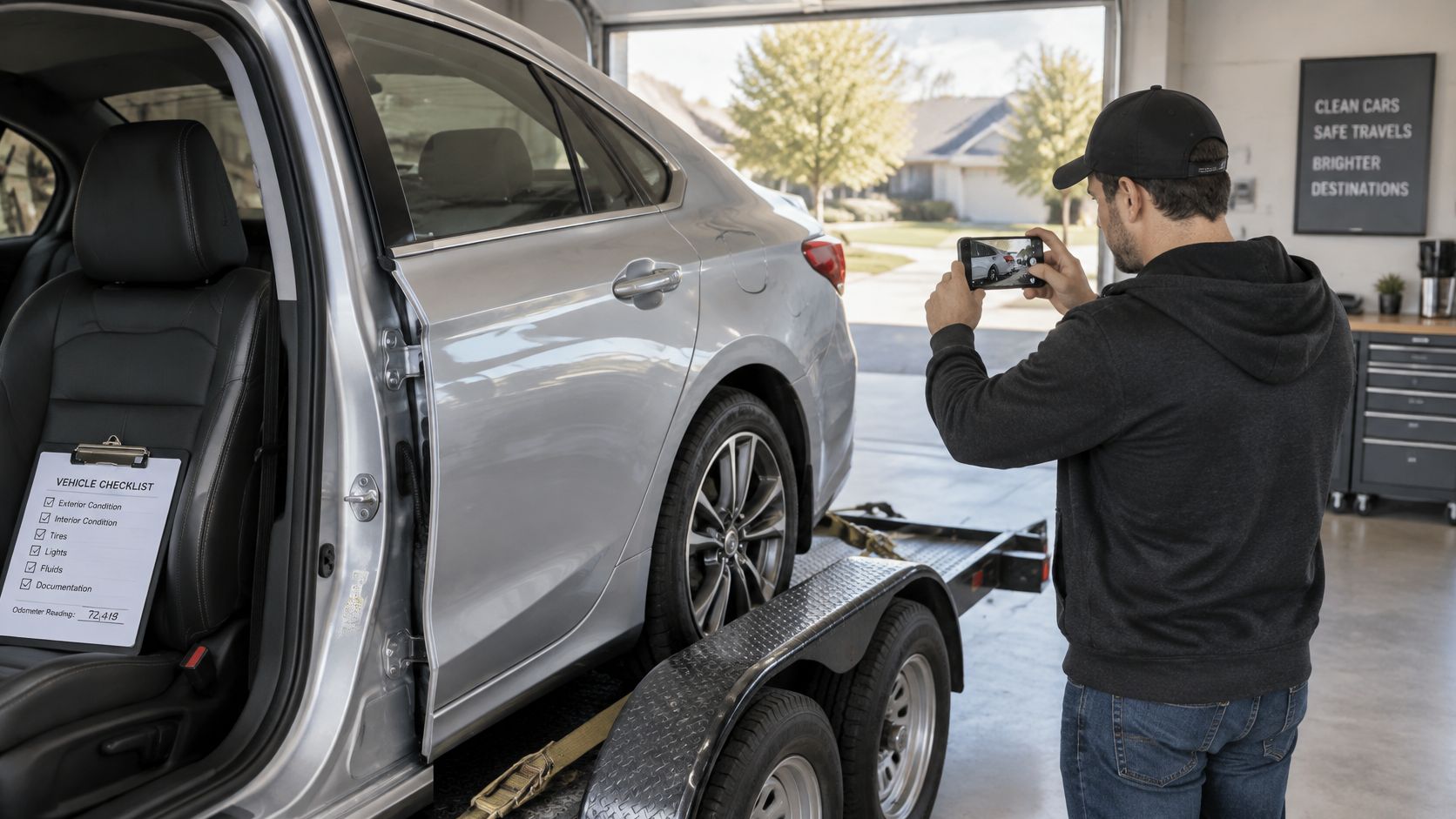
Use photographs to establish condition before anyone loads the car.
Before pickup and at release
Photograph every exterior panel, glass surface, wheel, and the roof with timestamps. Record visible underside damage where safely accessible, plus the odometer, fuel level, accessories, and whether the car starts, steers, rolls, and brakes.
Remove loose personal belongings rather than assuming the vehicle policy covers them. Request the transporting carrier's certificate of insurance, cargo limit, deductible, exclusions, and claims procedure; use our insurance verification process to organize that review.
- At collection: Compare the driver's condition report with your photographs and resolve inaccurate descriptions before signing.
- At port handoffs: Retain receiving and release records so you can identify the vehicle's custodian if damage is discovered.
- At final delivery: Inspect in daylight where possible, photograph discrepancies, and record new damage on the delivery paperwork before accepting an inaccurate clean-condition statement.
Know who handles a discrepancy
Publicly documented BBB transport complaints include a windshield claim unresolved for more than six weeks and a reported denial because repairs fell below a $5,000 deductible. Those individual complaints don't establish an industry-wide damage rate, but they show why a deductible and named claims contact belong in your booking file.
Ask which party receives the initial notice, what evidence it requires, and whether separate terms apply during ocean carriage or terminal storage. Don't assume the broker, driver, and insurer share the same role.
Keep the inspection process accessible when reviewing transport arrangements.
Covered trucking can reduce weather and road-debris exposure on the mainland leg. Your recovery after a loss still rests on the applicable contract, policy, evidence, and claims process.
Port, Tax and Export Paperwork
Transportation charges and Puerto Rico import taxes belong in separate budget lines. For mainland-to-San Juan shipments, Hacienda requires excise-tax filings and payments through SURI. Ocean freight does not complete that tax step.
Hacienda's vehicle excise-tax guidance explains its estimator and VIN-based lookup. Some vehicles require additional valuation checks, so get a vehicle-specific assessment rather than treating the shipping quote as an arbitrios estimate.
Match the route to the documents
- Name the ports: Identify Jacksonville, Florida, or Philadelphia, Pennsylvania, and San Juan on the proposal. Confirm the routing, receiving deadline, sailing estimate, and whether port handling is included.
- Prepare import records: Hacienda's import declaration guidance lists the commercial invoice, bill of lading, and motor-vehicle inspection or valuation document. Check that the VIN matches across ownership, shipping, and tax records.
- Confirm outbound requirements: For vehicles leaving Puerto Rico, the Puerto Rico insurance regulation ties exported status to transfer outside the territory and an exported title designation. Confirm the applicable export certificate, title notation, and release requirements before booking.
The mainland-to-Puerto Rico shipping guide covers the transportation side. SUVs, trucks, and enclosed transport to Puerto Rico are quoted on request, rather than at a standard sedan rate.
For a short seasonal stay, compare shipping and taxes with the cost of keeping a vehicle available locally. Why renting beats importing offers a general budgeting perspective, not Puerto Rico tax guidance.
A complete island quote identifies port charges, tax responsibility, and applicable outbound documents.
Confirm the Quote Before You Book
Accept a covered car transport quote only when the written offer is ready to operate, not merely ready to collect a booking. Apply these acceptance conditions to the full mainland–San Juan itinerary:
- Complete scope: Every applicable charge is named, including the boundary between covered trucking and ocean service.
- Verified operator: The mainland carrier's registration and applicable insurance records check out.
- Usable claims information: You have the deductible, coverage terms, and a named claims contact in writing.
- Defined price commitment: The amount is binding or the permitted repricing events are stated clearly.
If something's missing, request the written correction before accepting the total. Military orders, a dealership release deadline, or a seasonal flight can make scheduling urgent, but urgency doesn't resolve an incomplete contract.
Put the shipment in one agent's hands
National Car Transport is A+ BBB Accredited, with 25+ years of experience and a network of 25,000+ vetted carriers. Our USA-based bilingual English/Spanish agents bring 20+ years in auto transport logistics, and a dedicated agent guides each customer through the shipment.
No two vehicle shipments are alike. Gather your vehicle and route details, request the itemized written offer, check it against the acceptance conditions, and book when the terms match the service you need.
National Car Transport offers flat-rate vehicle shipping coordination between the U.S. mainland and Puerto Rico, including enclosed trucking options and dedicated-agent guidance. Visit National Car Transport with your vehicle details, mainland ZIP code, San Juan pickup or delivery information, and preferred dates to request a route-specific covered quote.