

Flat price auto shipping is a single all-inclusive price for a defined route, vehicle and service scope, valid for a stated period, with any allowed changes listed in the quote. You're probably looking at two or three numbers right now, and they don't match. One looks attractively low, another looks firm but higher, and neither explains what happens if your car won't start on pickup day or your street is too narrow for a carrier.
That confusion is normal, because no two vehicle transports are alike. A family sedan going from Atlanta to Dallas, a lifted truck leaving a rural address, and a car bound for San Juan, Puerto Rico all create different work for a carrier. The useful question isn't which number is lowest. It's what each number promises, for how long, and under what conditions it can change.
Table of Contents
- What Flat-Price Auto Shipping Covers
- Flat Rate Compared With Other Pricing Models
- What Your Flat Price Includes and What Can Change It
- Benefits and Limits of a Flat Rate
- Who Gets the Most From a Flat Rate
- Mainland Hubs and Island Service Areas
- How National Car Transport's Flat Rate Works in Practice
- Confirm the Flat Price Before You Book
What Flat-Price Auto Shipping Covers
Think of a flat price like a prix fixe dinner. The set price covers the courses printed on the menu. It doesn't cover a different dish you add later. Ordering a la carte, by contrast, prices every item separately as you go.

Flat price auto shipping works the same way. It's one price for a defined scope, not a universal tariff for every car on every route. A carrier's costs move with distance, diesel exposure, vehicle dimensions and weight, equipment type, pickup accessibility, and seasonality. Specialized handling changes the cost base again.
Fuel shows why a quote needs boundaries. Crude oil represented about 51% of the monthly average U.S. retail on-highway diesel price from 2004 to 2025, according to U.S. Energy Information Administration data on diesel price factors. When crude moves, operating a multi-vehicle tractor-trailer costs more or less, so a price quoted today can't sensibly stay open forever.
A concrete example
Picture a standard sedan, open carrier, door-to-door, Atlanta to Dallas, quoted with a 14-day validity window. That quote is flat for that sedan, that route, that equipment, and those pickup conditions during those 14 days. Swap in an oversized truck or an enclosed trailer and you're no longer describing the same shipment.
Every flat quote should spell out three parts:
- The scope: route, vehicle, equipment, and pickup and delivery conditions
- The validity period: how long the price stays in force
- The repricing triggers: the specific events that can change it
Before you compare numbers from different providers, check each quote for those three parts. A number without them isn't really comparable to anything.
Flat Rate Compared With Other Pricing Models
A quoted price can look settled while leaving the final total open. The difference lies in what the quote commits to, and what conditions could change it.
| Pricing model | How the price is set | What the quote includes | How the total may change | Best fit |
|---|---|---|---|---|
| Flat rate | One price for a defined route, vehicle, and service scope | The services listed in the quote | Changes only under stated conditions | Relocations, dealers, and buyers who need a predictable budget |
| Per-mile rate | Distance multiplied by a rate that may vary | Usually the distance charge; check how other costs are handled | Changes with the mileage or rate used to calculate the total | Long-distance shippers comfortable with a variable total |
| Base rate plus add-ons | A starting price, with separate charges for listed extras | The services included in the base price | Add-ons may increase the total if they apply | Shoppers who want to compare itemized charges |
| Lowest advertised estimate | A displayed estimate whose scope and terms may vary | Depends on the provider and the quote details | The final price may differ if the estimate is conditional or incomplete | Shoppers willing to confirm details and compare revised quotes |
A flat rate works like a ticket for a specific trip: the price is set for the service described, not for every possible change to the shipment. A per-mile quote works more like a taxi meter. Distance helps determine the cost, but the rate and any extra charges still matter.
A base rate with add-ons can be clear if each charge is listed. The risk is comparing its starting figure with another provider's more complete quote. A low advertised estimate also deserves a closer look: if it is conditional or leaves out services, the amount you ultimately pay may be less predictable.
Why credible prices account for operating costs
Carrier quotes have to account for driver pay, equipment, insurance, maintenance, dispatch, and compliance. These costs help explain why a price that seems unusually low may not be a firm commitment to move your vehicle under the stated conditions.
Compare the factors that affect car shipping costs alongside the quote itself. Ask what the price covers, which specific conditions can change it, and how long the quote remains valid.
What Your Flat Price Includes and What Can Change It
The clearest way to read a quote is to sort every line into three groups.
| Group | What it covers |
|---|---|
| Included in typical scope | Door-to-door or terminal pickup as stated; carrier transport; carrier insurance for the shipment; dispatch and tracking as offered |
| Excluded unless written in | Storage; failed pickup attempt; port or ferry handling on island routes |
| Customer-authorized change | Inoperable vehicle needing a winch; oversized or lifted truck; remote address needing a meeting point; requested date change; added storage; different delivery condition |
This visual checklist shows the same three groups at a glance.
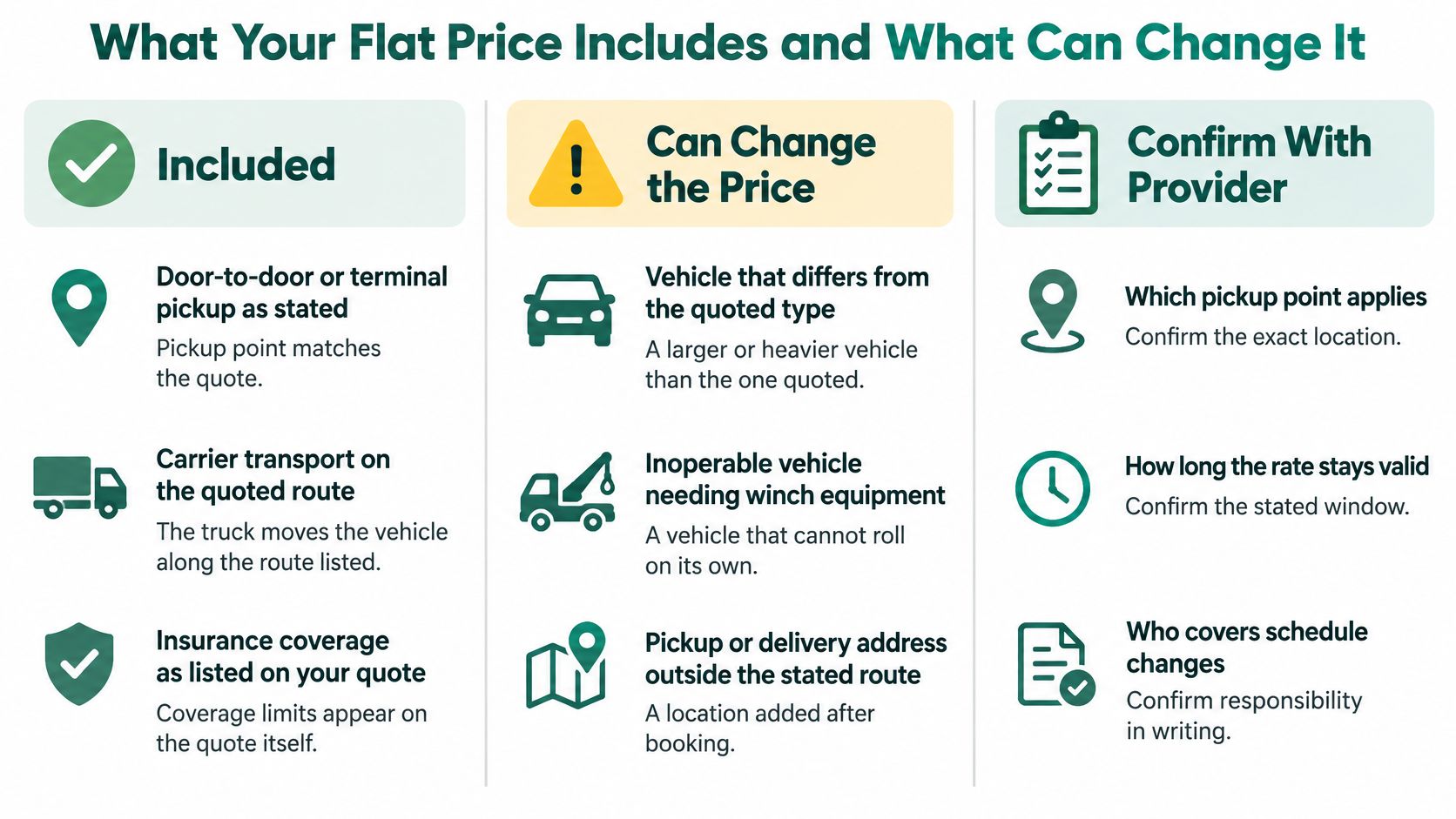
Included items are the core job you bought, such as door-to-door auto transport when that's the stated service. Excluded items, like storage after a missed delivery window, aren't part of that core job unless the quote says so in writing.
Customer-authorized changes are where most surprises live. Say your sedan doesn't run and sits at a rural address a large carrier can't reach. That shipment now needs winch equipment and probably a meeting point on a wider road. That's a legitimate adjustment, but it should appear as a written trigger before you book, not as a surprise at the curb.
This short video walks through how pickup and delivery terms work in practice.
Written terms matter for a reason. The Federal Trade Commission has previously taken action against auto transport brokers for allegedly misleading consumers about prices and shipping arrangements, as described in the FTC press release on automobile transport broker redress.
Practical rule: Ask the provider to mark every item on your written quote as included, excluded, or change-triggering before you book.
Benefits and Limits of a Flat Rate
A flat price can make budgeting easier, but it sets a boundary around the cost, not a guarantee of every detail. You can compare it to a hotel booking: the room rate applies to the dates and terms listed, and changes outside those terms may affect the price.
Within the written scope, a flat rate gives you:
- A budget you can plan around: one price for the stated service.
- Fewer surprises at delivery: the price should stay the same at drop-off if the shipment remains within scope and no listed repricing trigger applies.
- Easier comparisons: quotes with the same route, equipment, and service terms can be compared side by side.
- Less negotiation: the agreed price replaces bargaining over the same stated job.
- Simpler bookkeeping: dealers and fleets can record one transport charge per vehicle.
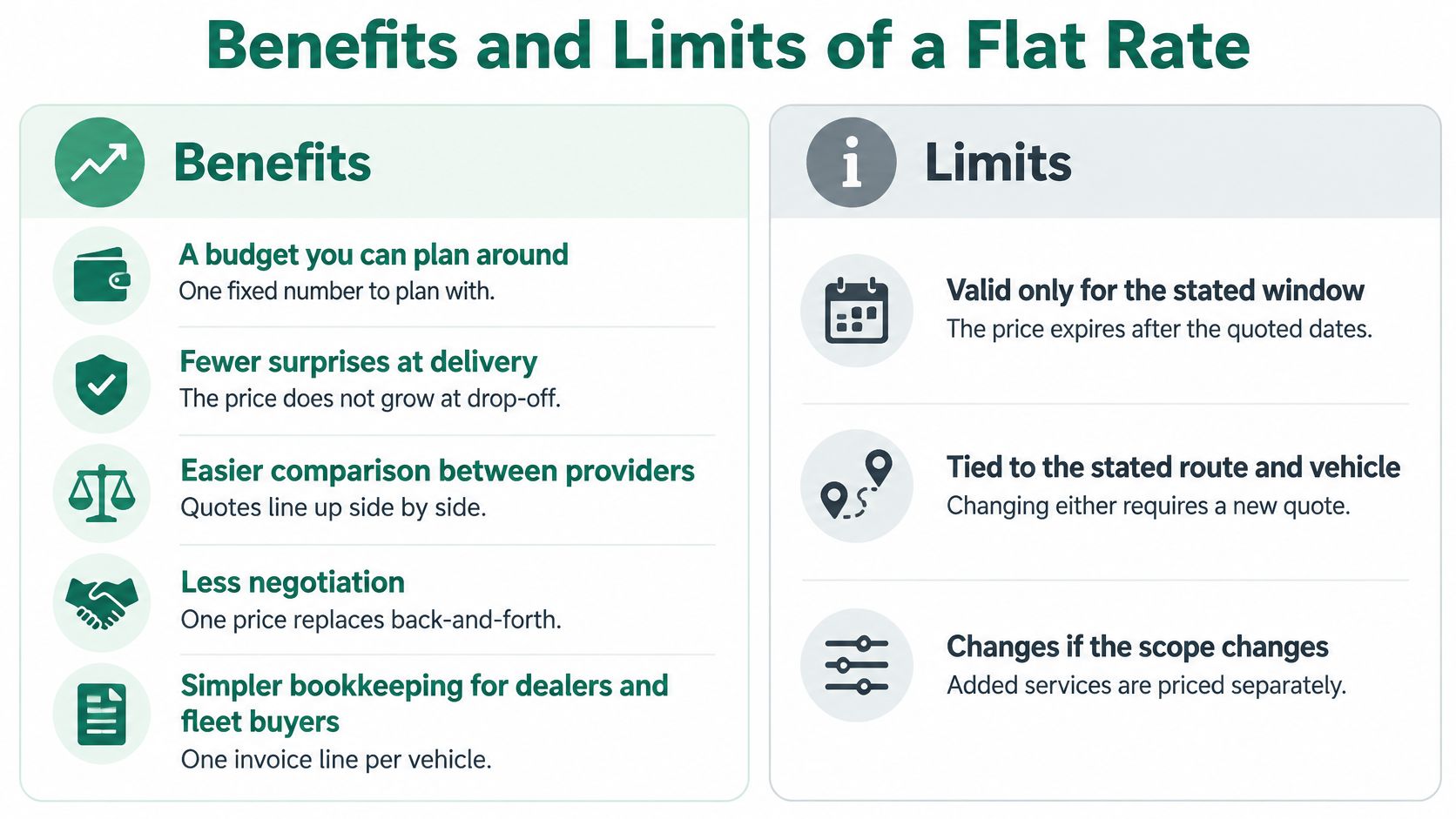
Three limits matter. First, a flat price usually does not guarantee an exact pickup day. Carrier schedules depend on route availability, season, location, vehicle condition, and equipment. A pickup window is an estimate; if a carrier cancels and the shipment needs to be matched with another, timing may shift.
Second, the price can change if a written repricing trigger applies. For example, a change to the vehicle, pickup location, or requested service may alter the job. Check which changes affect the price before booking.
Third, the quote is valid only for the period stated. If it expires before you book, ask for an updated price rather than assuming the original amount still applies.
A flat rate works best when a stable budget matters more than a fixed pickup day. If timing is your priority, confirm the pickup window and what happens if the carrier arrangement changes.
Who Gets the Most From a Flat Rate
Snowbirds make seasonal round trips, often between northern homes and Florida or Arizona. A flat quote gives them a fixed budget for each leg, though they still need some date flexibility in busy seasonal weeks.
Military families move on orders with set report dates. A defined price helps them plan the household budget, and the quote should state the transit window clearly so the car isn't the loose end in a tight move.
A student usually ships once, from home to campus. One price keeps it simple, but confirm the exact drop-off address, since campus streets may require a nearby meeting point.
Dealerships and auction buyers ship repeat routes and think in landed cost per unit. Predictable pricing per vehicle makes their margins easier to calculate before a sale closes.
Online car buyers should agree the transport price before completing a purchase. Confirm the pickup location with the seller too, because a car sitting somewhere different from the listing address changes the job.
Classic and luxury owners usually choose enclosed transport, which costs more than open transport on the same route. Their flat quote should name the equipment type and price the enclosed option on its own line.
A flat rate is less useful if your vehicle has unusual dimensions, you have no date flexibility, and you want the lowest possible open rate. In that case, an itemized quote may fit better.
Mainland Hubs and Island Service Areas
A pickup at a downtown address and a pickup at a remote rural property can fall under the same route quote, but the quote needs to define where the carrier will collect and deliver the car. A metro-area shipment may allow door-to-door service. Narrow streets, low clearances, or limited truck access can require a nearby meeting point. A rural address may involve extra distance from the carrier's route, so confirm whether that location is included or could change the price.
For mainland routes, the flat price should name the pickup and delivery locations, transport type, and any conditions that could trigger a revised quote. A change from an accessible metro address to a distant or hard-to-reach location can alter the job's scope. The city name alone does not settle what the price covers.
Island shipments add a separate leg. For Hawaii, the quote should clarify which mainland services are included, where the vehicle is handed off for ocean transport, and whether port handling and delivery on the island are part of the price. Hawaii car shipping options and service details can help clarify those boundaries.
Puerto Rico shipments also require coordination between mainland vehicle transport and ocean freight. Check which port, handling charges, and San Juan delivery arrangements the quoted price covers, and ask what location or schedule changes could affect it. The Puerto Rico estimates table in the next process section lists sample mainland origins and San Juan prices.
How National Car Transport's Flat Rate Works in Practice
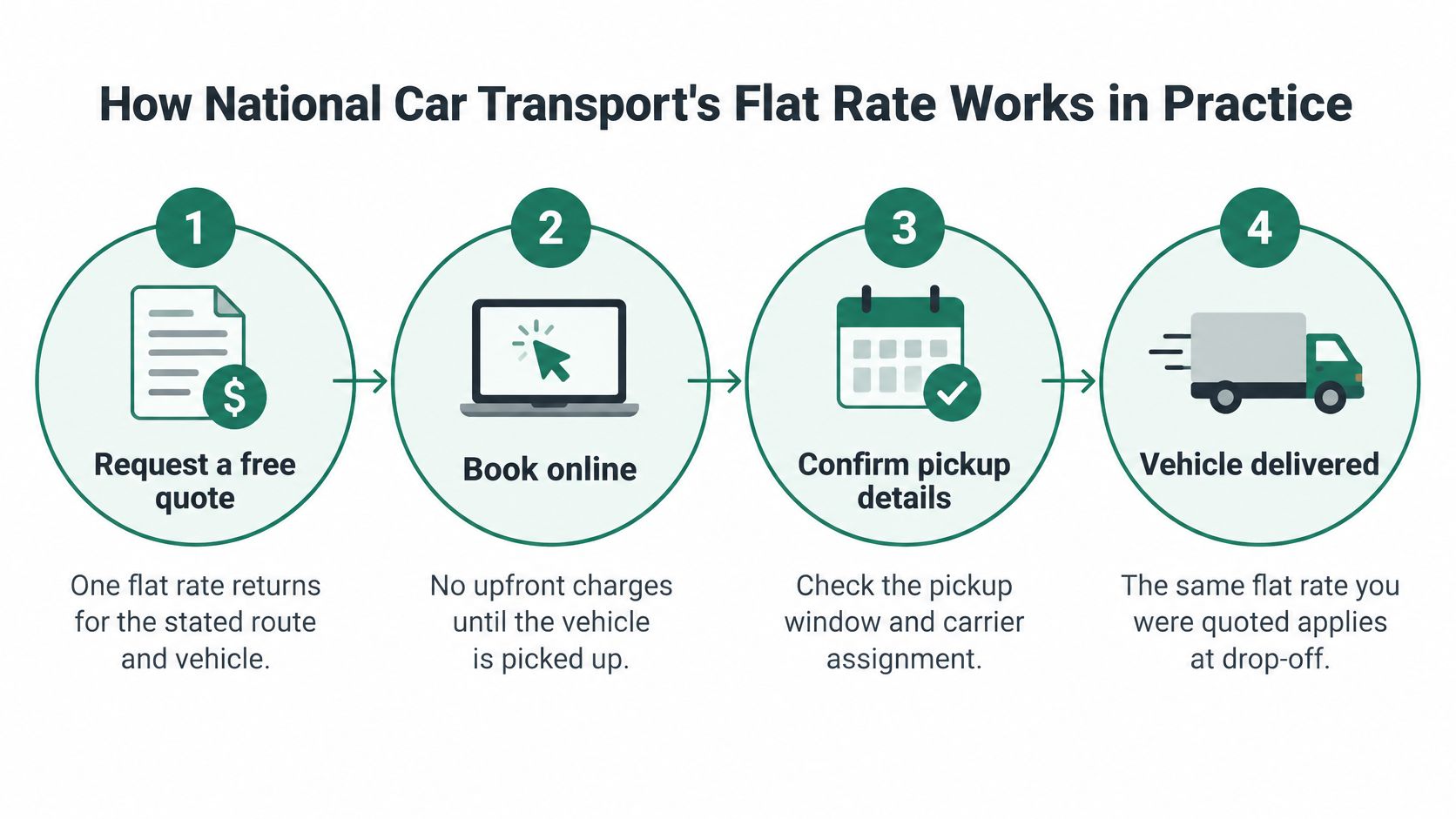
A quote can look fixed and still have boundaries. For example, the price applies to the vehicle, route, and shipping conditions described when it was prepared. A change to those details may change the cost, much as an airline fare depends on the ticket's terms.
- Request a quote: The written quote states the price for the listed route and vehicle. Check which services and conditions it covers.
- Review payment terms before booking: Ask when any deposit or other payment is due, what it covers, and whether it is refundable. Get the terms in writing before paying.
- Carrier assignment: Dispatch arranges a carrier for the shipment. Confirm how you will be notified about the carrier and pickup timing.
- Pickup inspection: The driver records the vehicle's condition, including existing damage. Review the inspection report before the car is loaded.
- Transit updates: Ask how to get shipment updates and who to contact if the schedule changes.
- Delivery inspection: Compare the vehicle with the pickup record and note any new damage before signing the delivery paperwork.
Inspection records create a useful before-and-after comparison if damage is reported. Carrier authority and insurance are separate questions to check; the FMCSA insurance filing requirements page explains federal filing requirements.
Puerto Rico estimates from the mainland
The figures below are illustrative budget ranges, not a current tariff or a guaranteed offer. They are not tied to a stated quote date, so use them only for broad comparison. Ask for a dated written quote for your route, vehicle, and requested shipping window. Transit estimates can also shift with sailing schedules and port handling.
| Mainland origin | Illustrative price range to San Juan | Estimated total transit time |
|---|---|---|
| Miami / South Florida | $895 to $1,195 | 7 to 10 days |
| Orlando / Tampa / Jacksonville | $895 to $1,295 | 7 to 10 days |
| Atlanta | $995 to $1,295 | 8 to 12 days |
| New York / New Jersey / Philadelphia | $1,095 to $1,495 | 9 to 14 days |
| Boston / Hartford | $1,095 to $1,495 | 9 to 14 days |
| Chicago | $1,195 to $1,545 | 10 to 14 days |
| Houston / Dallas | $1,195 to $1,595 | 10 to 14 days |
| Los Angeles / West Coast | $1,395 to $1,795 | 12 to 16 days |
The final price depends on the details in the written quote. Before booking, confirm what payment is due and whether port or other charges are included. National Car Transport describes its service as supported by bilingual English- and Spanish-speaking agents based in the United States. A flat quote sets a clear price for stated conditions; it does not remove the need to confirm those conditions and payment terms.
Confirm the Flat Price Before You Book
A flat quote is easier to compare when you know its boundaries. Before paying, check what the price covers and which specific conditions could change it.
- Written scope: The quote names the route, vehicle, and open or enclosed transport.
- Validity window: It shows when the quote was issued and when it expires.
- Repricing conditions: It explains how an inoperable vehicle, oversized dimensions, remote access, or storage could affect the price.
- Carrier credentials: Check the assigned carrier's authority and insurance status.
- Bill of lading: Make sure it identifies your vehicle by VIN or equivalent information.
- Condition reports: Confirm that inspections and photos will be taken at pickup and delivery.
- Puerto Rico costs: Ask whether port handling and documentation are included. Budget separately for the vehicle's Puerto Rico excise tax.
For interstate for-hire carriers transporting nonhazardous property in vehicles with a gross vehicle weight rating of 10,001 pounds or more, the Federal Motor Carrier Safety Administration generally requires at least $750,000 in financial responsibility under 49 CFR Part 387. The FMCSA new entrant insurance guidance explains how minimums vary by carrier type. This is a compliance floor, not a promise that every loss is covered. Ask for the applicable policy details, exclusions, and claims terms.
Before you budget: Confirm the current Puerto Rico excise tax amount with your agent. It is separate from the transport price.
Request a free quote and ask for its terms in writing. Before paying, confirm the deposit and booking rules, then compare the quoted scope and validity period with any other offer. A representative with 25+ years of experience can walk through the price line by line. Call or text (800) 320-1050 with questions.
National Car Transport offers flat-rate quotes for mainland moves and shipments to and from San Juan, Puerto Rico. The company states that there are no upfront charges until your vehicle is matched with a carrier. Request a free quote, review its scope and validity window in writing, and discuss the details with an agent before booking.