
Your driveway in Levittown fits two cars if nobody's parked on the street. The hauler scheduled to collect your sedan on Tuesday is a tractor-trailer with a 55-foot deck, and it needs a legal place to stop, a clear path in, and room to swing around. That gap between what a quote assumes and what your block allows is where a lot of Long Island to San Juan shipments get more expensive than the number in the email.
Shipping a car from Long Island to Puerto Rico isn't one move. It's a truck leg to a mainland port, an ocean leg into the Port of San Juan, and a tax filing with Hacienda that runs entirely separately from the carrier's invoice. Miss any one of those pieces and the cheap quote stops being cheap.
Table of Contents
- What Sets Your Long Island to San Juan Car Shipping Quote
- Open or Enclosed Transport for Long Island Cars
- Pickup Logistics and Truck Access at Your Long Island Address
- Shipping a Long Island Car to Puerto Rico
- Shipping a Car From San Juan Back to Long Island
- Is Shipping Worth It for a San Juan Move
- Confirm Your Quote and Book Your San Juan Shipment
What Sets Your Long Island to San Juan Car Shipping Quote
Most of a Long Island to San Juan quote is set before anyone negotiates. Your car, your street, your dates and the port a carrier books decide the number, and a dispatcher who quotes without those four things is guessing.
The short answer is that six inputs move the price, and Puerto Rico's excise tax isn't one of them, because Hacienda collects that from you rather than from the carrier. Here's how each input behaves, and what to confirm before you ask for a rate.
Factors that move a Long Island to San Juan car shipping quote
| Price factor | How it moves the quote | What to confirm |
|---|---|---|
| Vehicle size and type | Sedans and compacts take the least trailer space; SUVs, pickups and vans cost more to move | Exact year, make, model, and whether it is a pickup or van |
| Transport type | Open carriers are the lower-cost default; enclosed carriers add protection and cost more | Whether the car is a daily driver or a classic or high-value vehicle |
| Route and port | The U.S. port used (Jacksonville, FL or Philadelphia, PA) sets the routing to the Port of San Juan | Which port the carrier uses and the full delivery address in Puerto Rico |
| Pickup access | Narrow streets and low-clearance spots can force a nearby meeting point and extra handling | Street type, driveway size and any parking restrictions at the address |
| Operability | Inoperable vehicles need extra handling and winch equipment | Whether the car runs, rolls and steers, and whether keys are available |
| Season and timing | Summer and snowbird windows draw more demand; a range of days fits carrier schedules better than one fixed date | Earliest and latest pickup dates you can accept |
| Island tax | Puerto Rico excise tax (arbitrios) is separate from the carrier price and depends on the assessed value | VIN for a SURI estimate, budgeted separately from the quote |
Vehicle, port and pickup access in practice
A compact sedan takes the least room on a multi-level trailer, so it earns the lowest rate. A Suburban, a lifted pickup or a Sprinter van eats deck space and adds weight, and carriers price that difference in. State up front whether the car runs, rolls and steers, because an inoperable vehicle gets quoted with winch equipment as a separate line.
This lane loads at two mainland ports, Jacksonville, Florida and Philadelphia, Pennsylvania. The carrier picks whichever fits its schedule, and that choice sets the sail date, the arrival window in San Juan, and how long the car sits in a terminal yard. A quote that never names the port isn't a quote yet.
For budgeting, our estimate for a car shipped from New York, New Jersey or Philadelphia to Puerto Rico is $1,095 to $1,495 with 9 to 14 days total transit, and SUVs, trucks and enclosed trailers to the island get quoted on request rather than at the standard sedan rate. That's a starting band, not a promise, for the same reason what actually drives a car shipping cost turns on access and season rather than miles alone.
Pickup access is the line item most quotes leave blank. A residential street in Oceanside or Port Washington with parked cars, low branches and a tight cul-de-sac can be physically impossible for a loaded hauler, and the meet point that solves it may add handling or reshuffle the schedule.
The rule for fair comparisons: every quote has to cover the same vehicle, the same port, the same date window and the same pickup address. Change one of those and the numbers stop meaning anything.
Summer moves and the October-to-January snowbird window pull on the same carriers that handle Florida freight, so a flexible three- or four-day pickup window schedules faster and often prices lower than one locked date. Budget the island tax on top of all of it, from a VIN estimate.
Open or Enclosed Transport for Long Island Cars
The default on this lane is open transport, and for a daily driver that's the correct call. An open multi-level trailer holds more vehicles, runs more departure dates and costs less than any enclosed alternative. For most auto transport Long Island bookings, that's the whole decision.
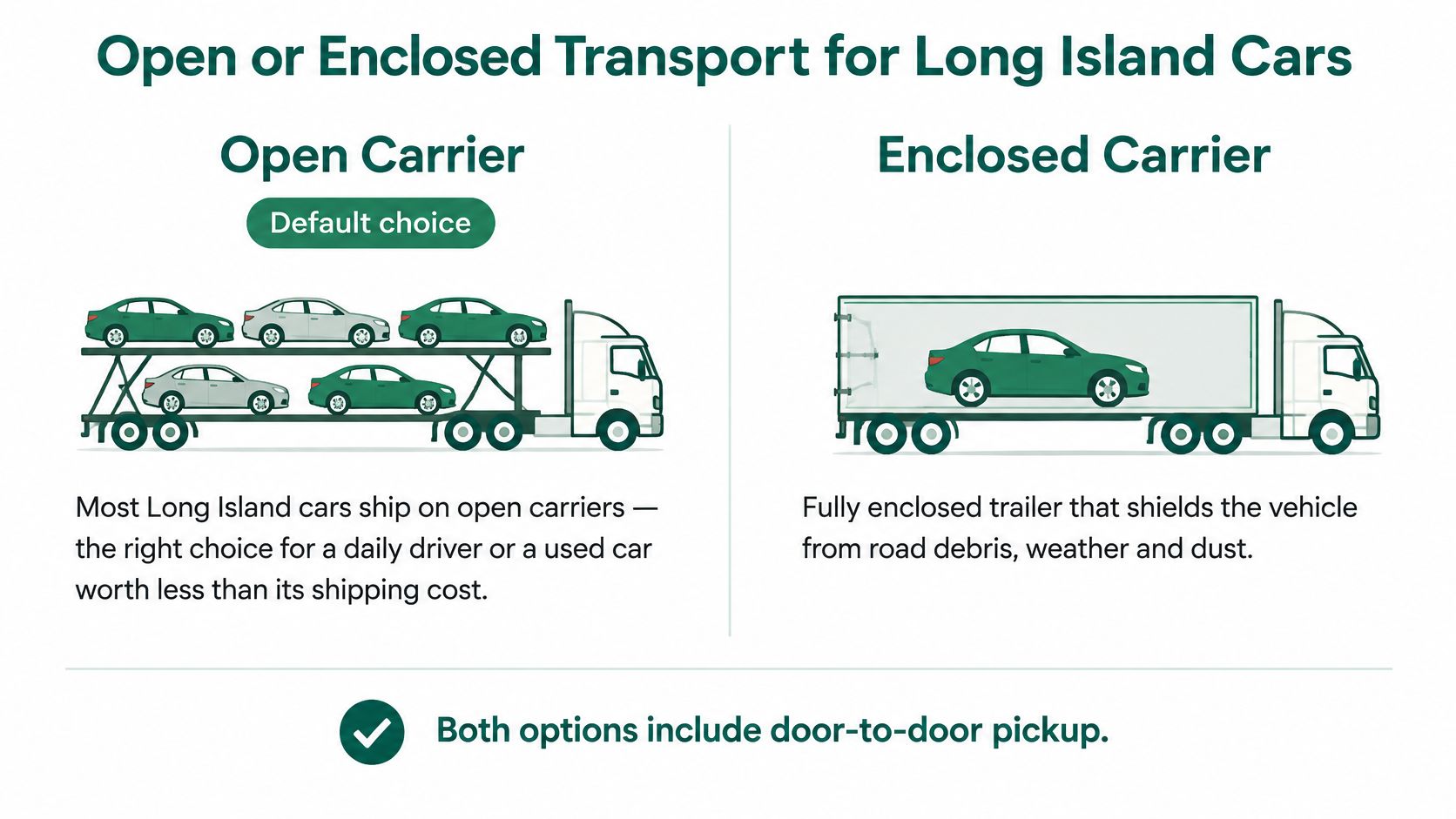
What you accept with open transport is exposure. Debris thrown up by passing trucks, weather, and road salt on the northern legs are normal conditions on an open deck. For a ten-year-old Camry, that's a fair trade. For a restored Chevelle, it isn't close.
Open versus enclosed carriers compared
| Criterion | Open carrier | Enclosed carrier |
|---|---|---|
| Typical cost | Lower base rate and the most common choice | Higher rate, quoted separately from open |
| Protection | Exposed to weather, road salt and road debris | Covered from weather, debris and dust |
| Best fit | Daily drivers, used cars, most SUVs and pickups | Classic, luxury, exotic, show or high-value cars |
| Trailer capacity | Carries more vehicles per load | Carries fewer vehicles per load, so scheduling can be tighter |
| Availability | Wider carrier pool and more departure dates | Fewer carriers, so book earlier |
| Low-clearance cars | May need a loading check at the ramp | Usually handled with low-clearance loading equipment |
When enclosed earns its premium
Enclosed transport pays for itself in any situation where paint or undercarriage damage would cost more than the difference in freight. That means classics, exotics, new luxury SUVs, fresh paint and low-mileage special editions. Enclosed trailers also load with hydraulic low-clearance equipment, which matters for a car that would scrape a fixed ramp.
The trade-off is capacity. Enclosed trailers carry a maximum of six vehicles per load and fewer carriers run them, so departure dates are tighter and you book further out, especially inside the snowbird window. A February move up the I-95 corridor is the clearest case for paying up.
Compare the car's value, and what a repaint or a rust repair would cost, against the price gap between the two trailers. If the car is worth more than that gap, enclosed is the cheaper insurance.
Whichever way you go, ask for the carrier's cargo insurance certificate and its coverage limit before the truck arrives, and get the answer in writing. A carrier who can't produce one isn't a carrier you want holding the keys. Open versus enclosed car shipping comes down to that single comparison.
Pickup Logistics and Truck Access at Your Long Island Address
A carrier can be on the right route and still fail to reach your driveway. For a Long Island pickup, check the final approach before booking: narrow residential streets, parked cars, low bridges and limited turning room can prevent a full-size tractor-trailer from getting to the vehicle. If access is uncertain, agree on a meeting point in advance. A failed residential pickup can mean re-delivery, storage or a tow, costs that may not be included in the original quote.
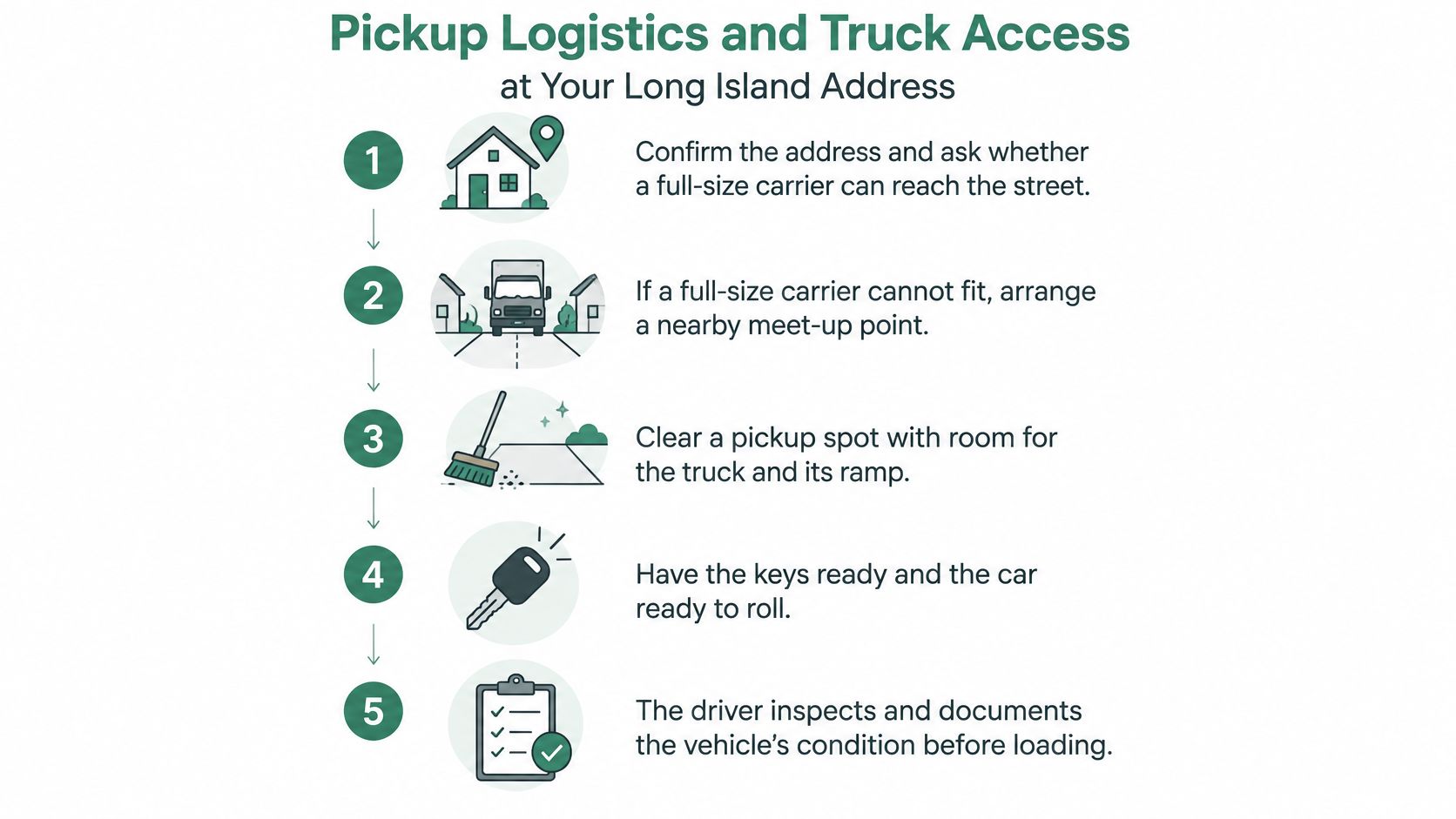
Use this checklist to settle the practical details before the driver is on the way.
Check the street and route to your address. City truck routes and bridge clearances can limit tractor-trailer access, even when the main highway is suitable. Consider the full approach, including tight turns, low overhead structures, parked vehicles and any restrictions on where a large carrier can stop. If the truck cannot reach your street or turn safely, arrange a nearby location with enough room to load.
Confirm the meeting point and contact person. Choose a wide street or suitable commercial lot where the carrier can stop without blocking traffic. Make sure someone is available to meet the driver, hand over the keys and complete the pickup paperwork. Set this up when booking, not after the driver arrives.
Describe the vehicle accurately. Tell the carrier if the car does not run, has no keys, or sits low enough to need special loading arrangements. A vehicle that cannot roll or steer may need a different plan, so disclose its condition before pickup. Remove personal items and have the keys ready.
Document the car before loading. Take clear photos of the exterior, including the roof, glass and wheels, and record the odometer reading. Walk around the vehicle with the driver and compare its condition with the inspection report. Sign only after you have reviewed the recorded condition.
Keep the paperwork. Hold on to the bill of lading and your copy of the inspection report. They record the vehicle's condition at pickup and provide a reference if you need to raise a damage claim.
Check the carrier and truck details. Ask how the truck will reach the agreed meeting point and whether the carrier has the required authority for the vehicle combination it is operating. New York's truck registration and weight rules cover registration and weight requirements. The state's moving guidance is also a useful reference when arranging a move. Keep the focus on the practical questions: who is collecting the car, where the handoff will happen, and what paperwork you will receive.
Repeat the inspection at delivery. Take photos again, check the odometer and walk around the car before signing the delivery paperwork. Keep your pickup and delivery records together.
National Car Transport's New York-to-Miami pickup coverage includes Brooklyn, Queens, Long Island and northern New Jersey. Pickups can be arranged at homes, offices, dealerships or auction lots. The pickup location still needs to work for the carrier, so confirm access and any alternate meeting point directly when booking. For a practical overview of truck pickup and delivery, review the handoff details before the scheduled collection.
Shipping a Long Island Car to Puerto Rico
For a Long Island to San Juan shipment, pickup access and port handling can matter more than mileage. A missed residential pickup can lead to re-delivery, storage, or towing charges that may not appear in the original quote, so confirm the pickup plan and mainland port before booking.
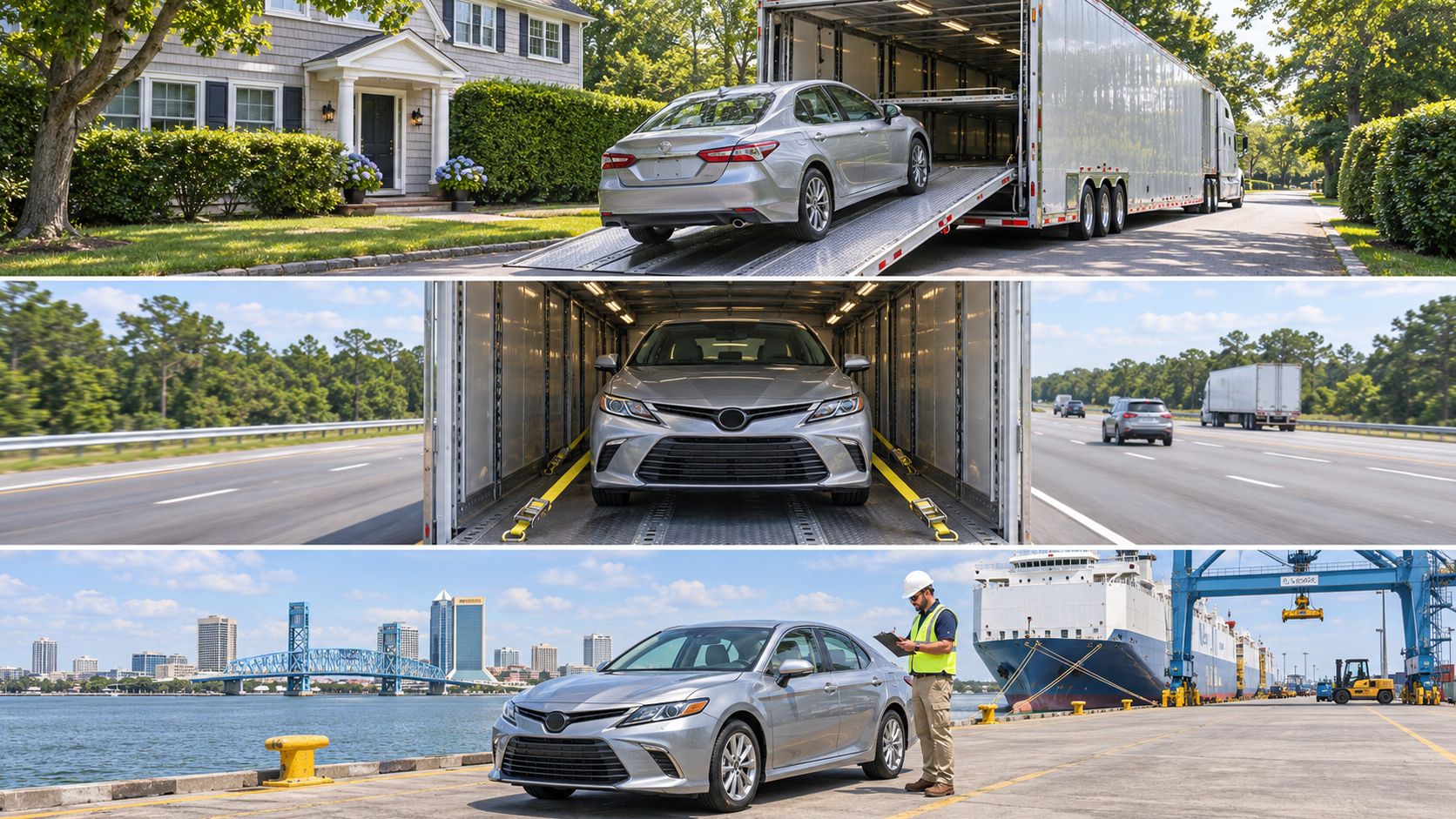
For Puerto Rico shipments, a carrier picks up the vehicle at your door anywhere in the U.S. and trucks it to a mainland port, such as Jacksonville, FL or Philadelphia, PA. The vehicle then sails to the Port of San Juan, where it is released to the importer or a local delivery agent. The condition inspection is documented at pickup, so check the vehicle with the driver and keep the paperwork for the port handoff. National Car Transport offers car shipping to Puerto Rico from the U.S..
The Hacienda filing that comes after the ship
Puerto Rico's Department of the Treasury, Hacienda, requires an excise-tax declaration when a vehicle is imported. Supporting documents include the commercial invoice, bill of lading, and, for motor vehicles, the Motor Vehicle Inspection Document used to establish assessed value, as set out in Hacienda's excise declaration requirements. File and pay through SURI, Hacienda's online system.
Get a tax estimate before booking, rather than waiting until the car arrives. Hacienda's excise estimator for vehicles accepts a VIN or the vehicle's make, model, and year. The VIN is the most effective search method and can be found on the dashboard plate near the driver's side or on the title. If the estimator returns no value for an older vehicle or a current-model-year vehicle, Hacienda directs owners to a designated office for a Black Book valuation.
Use this order to keep the freight and tax steps straight:
- Gather the title, photo ID, and registration.
- Find the VIN and request an estimate through SURI.
- If no value appears, get the Black Book valuation before setting a shipping date.
- Book the door-to-port leg and retain the bill of lading.
- Budget freight and island tax separately.
Hybrid and alternative-energy vehicles may qualify for partial excise-tax reimbursement. Hacienda's Form SC 2116 reimbursement procedure requires the form, a copy of the Puerto Rico vehicle license, and a copy of the bill of lading. File within 180 days of purchase or importation. The administrative determination caps reimbursement at $2,000 of excise tax paid. Confirm eligibility before including a reimbursement in your budget.
Shipping a Car From San Juan Back to Long Island
The island-to-mainland direction reverses every step, and the sequencing matters because you lose access to the car once it's released to the port.
A carrier picks up at your address in Puerto Rico or at the Port of San Juan, moves the vehicle by vessel to a mainland port such as Jacksonville, FL or Philadelphia, PA, and then trucks it to your Long Island door. Which port the carrier books determines the final leg and the delivery window, so settle that question before the car leaves. Port-to-door service is exactly this: the vehicle ships from the island, clears, and is delivered to the mainland address you provide.
Documents to settle before the car leaves the island
- Title in the shipper's name. A car sold mid-move needs the transfer completed before the vessel booking, not after.
- Photo ID and registration for the person named on the paperwork.
- Export or release documents. Ask both the carrier and Hacienda which ones the origin side requires, because the list isn't identical for every vehicle and every owner.
- The bill of lading. Keep it with every receipt, since it's part of what Hacienda reviews on import questions.
Inspect the car at the port with the driver and sign the condition report before it moves, then repeat the photo and odometer routine on arrival. Sign the delivery sheet only after walking the vehicle.
At the Long Island end, apply the same access check you'd apply outbound. Confirm the truck can reach the street, agree on a wide road or commercial lot if it can't, and name the person receiving the car. Military families moving on orders should keep copies of those orders with the vehicle file, and snowbirds returning for a season should book delivery before the seasonal window tightens carrier availability. Start with Puerto Rico car shipping and work backward from your move date.
Is Shipping Worth It for a San Juan Move
For a San Juan move, the decision is whether to ship your car, sell it and buy on the island, or bring only a vehicle that would be difficult or costly to replace. Since you cannot drive to Puerto Rico, compare the full cost of shipping with the cost and convenience of replacement.
Better local transit is changing how some Long Island households value keeping a second car. That may affect whether it makes sense to ship every vehicle in a household, but it does not change the calculation for a car you need daily or cannot readily replace.
Ship the car or sell and buy locally by situation
| Situation | Shipping likely makes sense | Selling and buying locally may be enough |
|---|---|---|
| Relocating household needing one car daily | Yes, if the car is needed from day one and replacement costs are high | Yes, if the car is older or low in value |
| Snowbird with a seasonal home in San Juan | Often, when the car is needed for months at a time | Usually not for a short stay |
| Military family on orders | Often, when the household needs a vehicle at the new post | It depends on the timeline and the car's value |
| Classic or high-value car owner | Yes, enclosed transport can protect the vehicle | Rarely, unless the car cannot be insured or moved safely |
| Student or short-term worker | Rarely | Usually, selling or leaving the car is enough |
Compare total costs, not just the freight quote. Include the carrier's written rate, the excise tax shown in a SURI estimate, and any extra transit insurance you plan to buy. If you sell, compare those costs with replacement transport, such as a rental, and the price of buying an equivalent vehicle on the island.
The honest test: if shipping plus excise tax comes close to the car's value, selling before the move may make more sense. If the total is well below the cost of replacing the car you want, shipping is worth considering.
A twelve-year-old sedan with a rebuilt title may not justify the expense. A rust-free truck, restored classic, or car with family history may be harder to replace, making shipping more practical. For a high-value vehicle, enclosed transport adds protection, but the higher transport cost belongs in the comparison too.
Confirm Your Quote and Book Your San Juan Shipment
A Long Island pickup can change the cost more than the mileage to San Juan. Confirm the access plan before comparing rates: a truck that cannot reach your address may mean re-delivery, storage, or towing charges.
Give each company the same shipment details so the quotes cover the same service:
- Year, make and model, whether the car runs, rolls and steers, and whether both keys are available.
- Full pickup and delivery addresses, including street type, driveway length, and parking restrictions at the Long Island address.
- Port and delivery coverage: confirm trucking to the Jacksonville, FL, port and the delivery point in San Juan.
- Backup pickup arrangements if the carrier cannot reach your street, including who will meet the driver at the alternate location.
- USDOT number and cargo insurance limit, provided in writing.
- VIN-based SURI estimate for excise tax, listed separately from the shipping rate.
- A pickup date range, rather than a single fixed morning.
Check that each quote states who handles port transport, what happens if residential access fails, and whether any extra charges apply. Keep excise tax separate from the carrier's rate. A clear access plan helps prevent a missed pickup from turning into added delivery, storage, or towing costs.
National Car Transport ships vehicles to and from Puerto Rico and offers flat-rate pricing, with no upfront charge until your vehicle is matched with a carrier. A dedicated bilingual English and Spanish agent coordinates the shipment and keeps you informed from pickup inspection through delivery.
Send the vehicle details, both addresses, and your date window to National Car Transport for a written plan and rate before scheduling.