

You've requested three auto shipping quotes for the same route. One is $600, another is $850, and the third is $1,100. The lowest quote carries a bright “zero fees” badge, while the middle quote keeps mentioning a deposit. You're left wondering whether the cheapest company is being honest, whether the other quotes include protection the first one hides, and whether an add-on will appear after you've already handed over the keys.
That uncertainty affects first-time shippers, snowbirds moving between seasonal homes, military families changing duty stations, students buying vehicles online, dealerships, and businesses managing several cars. Zero fees can be a useful pricing structure, but it can also be a vague marketing phrase. The practical question is simple: what does the quote remove, and what costs can still arise because of the route, vehicle, payment method, or shipping event?
Table of Contents
- Why Zero Fees Matters When You Shop for Auto Shipping
- What Zero Fees Actually Means in Car Transport
- What a Zero-Fees Quote Covers and What It Does Not
- Consumer Protections Behind Zero-Fees Auto Shipping
- How Zero Fees Works on Puerto Rico Car Shipping Routes
- How National Car Transport Applies Its Zero-Fees Policy
- A Simple Checklist Before You Book a Zero-Fees Shipment
Why Zero Fees Matters When You Shop for Auto Shipping
A low quote isn't automatically a good quote, just as a higher quote isn't automatically more complete. The difference often comes from how each company presents the carrier rate, booking payment, dispatch work, port charges, and possible changes to the shipment.
Suppose the $600 quote means no booking deposit, but it doesn't include an inoperable-vehicle charge or terminal storage. The $850 quote may include more coordination but require a payment before dispatch. The $1,100 quote might reflect enclosed transport, a difficult pickup location, or a route with fewer available carriers. Without a written breakdown, you can't compare the three offers fairly.
Why the wording creates pressure
First-time shippers may assume every advertised price covers the same service. Snowbirds often have firm departure and arrival plans, so a surprise charge or delayed carrier assignment can disrupt housing, flights, and seasonal travel. Online car buyers may never see the vehicle before shipping and therefore depend heavily on the broker's description of condition, pickup access, and delivery terms.
The phrase “zero fees” tends to attract attention because it appears to remove risk. But removing a booking charge isn't the same as removing the transport cost. The carrier still needs to move the vehicle, fuel the equipment, schedule the route, and cover operating expenses.
Practical rule: Treat “zero fees” as a question to verify, not as proof that every part of the shipment is free.
A useful comparison starts with three questions:
- What do I pay before dispatch? Ask whether the company requires a booking deposit, broker fee, or dispatch fee.
- What does the quoted rate include? Confirm the carrier type, pickup and delivery method, vehicle condition, and route.
- What can change the final amount? Request a written list of event-based charges, including storage, port-related costs, special equipment, and payment processing.
This approach turns a slogan into a pricing test. A company that explains its exclusions clearly may be more trustworthy than one that uses “zero fees” in large lettering but leaves the invoice details vague.
What Zero Fees Actually Means in Car Transport
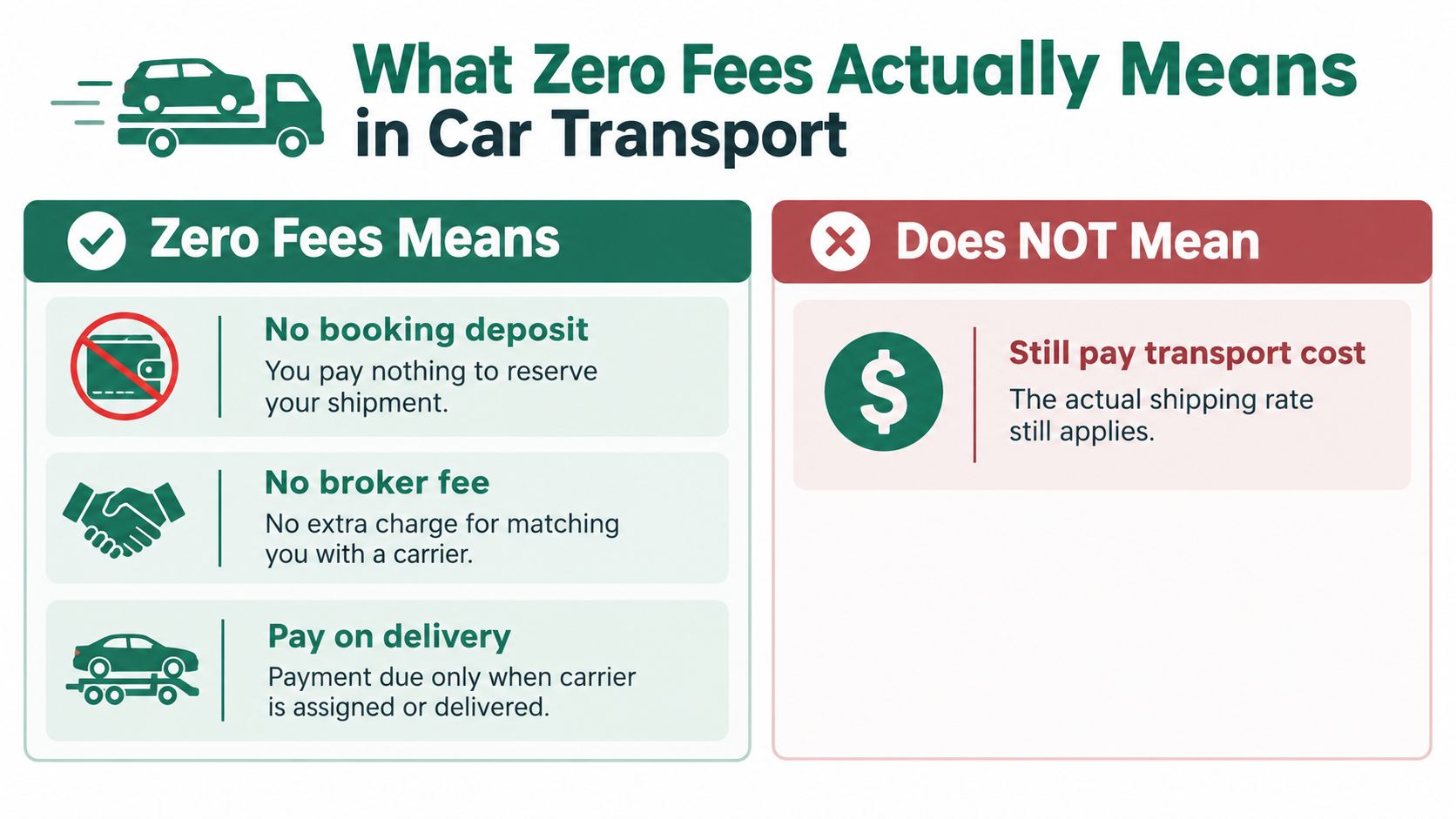
In auto transport, zero fees usually means zero booking-time charges, not free vehicle movement. Depending on the company's terms, that can mean no booking deposit, no separate broker fee, and no dispatch fee added before a carrier is assigned. The transport rate itself still applies.
Separate the operational meaning from the slogan
Think of a flat-rate hotel stay. The room price may cover the room, but a resort fee can appear separately if the terms allow it. Auto transport works similarly. A quote can look simple while leaving room for a fuel surcharge, an equipment upgrade, a terminal charge, or a payment fee.
The banking comparison helps too. A checking account described as free may avoid a monthly service fee while still charging for an ATM withdrawal, overdraft, bounced check, dormancy, or printed checks. The Consumer Financial Protection Bureau's explanation of “free” and “no cost” financial products illustrates why customers should read the exclusions instead of relying on the headline.
For car shipping, ask the provider to define the phrase in practical terms:
- Booking: Is money required to reserve the shipment?
- Broker service: Is a separate fee added for finding and coordinating a carrier?
- Dispatch: Does the company charge before a carrier accepts the order?
- Payment timing: Is the balance due at pickup, delivery, or another point?
- Changes: What happens if the vehicle is inoperable, oversized, unavailable, or delivered to a terminal?
A legitimate no-upfront-charge offer should tell you when payment is due and which services the quoted amount covers. It shouldn't imply that the carrier works without compensation. Instead, the customer may pay the transport rate later, often when the carrier is assigned or when delivery occurs, depending on the written agreement.
Zero fees can remove an early payment barrier, but it doesn't erase the cost of transporting a vehicle.
That distinction matters across mainland routes in the 48 contiguous states, including moves between cities such as New York, Los Angeles, Chicago, Houston, Phoenix, Miami, Atlanta, Denver, Seattle, and Boston. It matters even more on island routes, where port handling, documentation, taxes, and vessel procedures can sit outside the mainland trucking portion.
What a Zero-Fees Quote Covers and What It Does Not
A useful quote separates the core transportation service from charges triggered by a special circumstance. The core amount may cover the carrier's transportation rate, fuel used for the planned movement, dispatch coordination, and standard cargo liability coverage during transit. Your agreement should state whether those items are included rather than leaving you to infer it from a badge or headline.
The phrase can become misleading when a company shifts a cost instead of removing it. In card payments, for example, a merchant may add a customer surcharge instead of absorbing processing expenses. Interchange remains a cost paid to the issuing bank, and the rate varies by card type and transaction method. The card-payment explanation of zero-fee and interchange-plus models gives a concrete illustration: a $100 purchase can become $103.50 for a credit-card customer with a 3.5% service fee, while the merchant receives the original $100.
Auto shipping can use a similar structure. A company may advertise no broker fee while passing a carrier-specific amount, payment charge, or route adjustment to the customer. That isn't necessarily improper if the charge is disclosed, but it isn't the same as an all-inclusive price.
Compare the quote line by line
| Line Item | Included in Zero Fees? | Why It Can or Cannot Change |
|---|---|---|
| Carrier transportation rate | Usually included | The vehicle still has a transport cost based on route, timing, equipment, and availability. |
| Fuel for the planned route | Often included in a flat quote | A change in route or service request may require a revised quote. |
| Broker or dispatch fee | Should be excluded under a genuine zero-fees promise | A separate coordination charge contradicts the stated policy if it wasn't disclosed. |
| Standard transit coverage | Should be identified in the agreement | Coverage terms and exclusions depend on the carrier and contract. |
| Enclosed transport | Usually an upgrade | High-value, classic, luxury, or restored vehicles may need specialized equipment. |
| Top-loading request | May cost extra | The request affects trailer placement and carrier planning. |
| Inoperable vehicle service | Usually an additional charge | Winch or special loading equipment may be needed. |
| Terminal storage | Usually not included | Storage is an event-based cost caused by pickup or delivery timing. |
| Door-to-door access limits | Route-dependent | Narrow streets, low bridges, restricted communities, or unsafe access may require a nearby meeting point. |
| Card-processing charge | Depends on the payment terms | The fee may be shifted to the customer rather than removed. |
For a deeper look at the variables behind an auto transport price, review this car shipping cost guide. Ask for the final quote in writing and have the representative mark each row as included, excluded, or conditional.
A useful zero-fees quote doesn't promise that nothing can ever change. It tells you which events can change the amount, who controls those events, and when you'll be notified.
Consumer Protections Behind Zero-Fees Auto Shipping
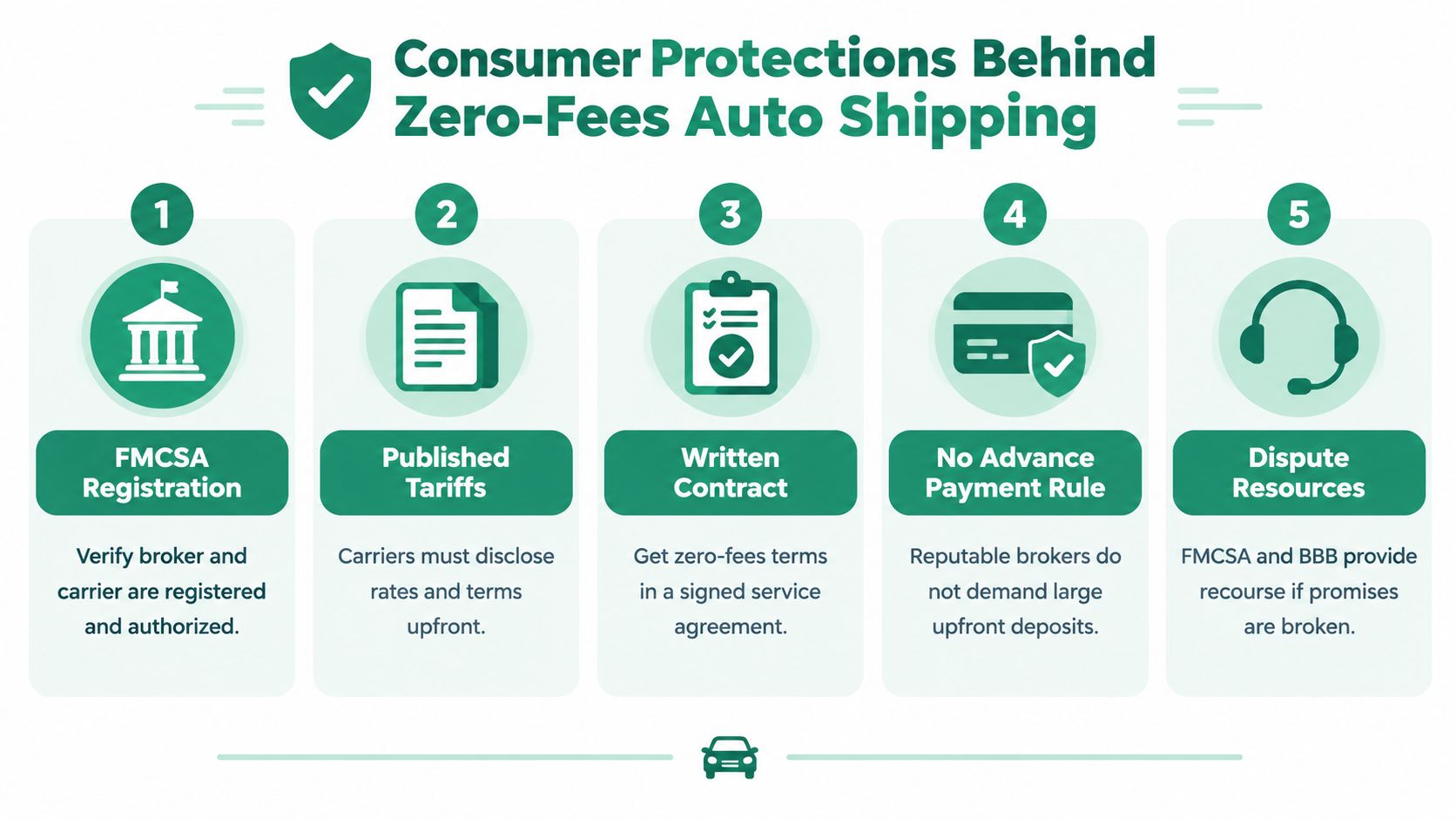
A zero-fees promise becomes more meaningful when the company can identify the business entity, explain the contract, and document the carrier assigned to the shipment. Start with basic verification. Ask for the broker's or carrier's FMCSA registration, DOT number, MC number where applicable, insurance information, and written service terms.
The Federal Motor Carrier Safety Administration provides the SAFER Company Snapshot search tool, which lets customers review registration and safety information. The record won't answer every pricing question, but it can help confirm that you're dealing with an identifiable transportation business rather than an anonymous quote form.
What to request before signing
A written tariff or rate sheet can show how the carrier describes its transportation charges and conditions. A binding quote or tariff is more useful than a verbal assurance because it gives both sides a reference point when a dispute arises.
A signed service agreement should identify the vehicle, pickup and delivery locations, service type, payment timing, cancellation rules, and conditions that can change the price. Read the language around deposits carefully. “Zero upfront” and “refundable deposit” are different offers.
Insurance documentation should identify the carrier's active cargo coverage and any limitations. Ask who performs the pickup inspection and how pre-existing damage gets recorded. Take your own photographs before handing over the vehicle.
State rules can also affect deposits, refunds, contract wording, and advertising practices. Requirements may differ depending on where the broker operates, where the customer lives, and where the transaction occurs. If a company refuses to put its zero-fees promise in writing, treat that refusal as a risk signal.
Save every quote, email, text message, payment receipt, and dispatch update in one folder. Clear records give you something concrete to use if the final invoice doesn't match the agreement.
The Federal Trade Commission's guidance on truth in advertising provides a broader consumer-protection principle: an advertised “zero” claim shouldn't conceal a mandatory charge that the customer couldn't reasonably identify before booking. Ask direct questions, verify the company, and compare the contract with the sales conversation.
How Zero Fees Works on Puerto Rico Car Shipping Routes
A sedan moving from Miami to San Juan doesn't follow the same pricing path as a car traveling between two mainland cities. The ocean segment introduces port handling, vessel scheduling, documentation, inspection procedures, taxes, and release requirements. A zero-fees quote can still be useful, but it must identify which parts are included in the transport rate and which are paid as transparent pass-through charges.
For Puerto Rico shipments, the vehicle must have one-quarter tank of gas or less, and the shipper is responsible for the vehicle import tax. The Puerto Rico shipping instructions also state that an arrival notice is sent by email when the vehicle is ready for pickup at the San Juan port.
What the shipper must prepare
Before drop-off, remove personal belongings and valuables. The vehicle must be completely clean and empty, and random port inspections may occur. The Puerto Rico preparation and tax guidance explains that exceptions for items left inside the vehicle are limited, so cleaning and unloading aren't optional details.
Puerto Rico law also requires carriers and transport enterprises moving motor vehicles to or from the island to notify the Puerto Rico Police for each request. The notice includes the requester and owner identities plus vehicle details such as make, model, color, plate number, VIN or body serial number, engine number, and horsepower. If authorities question title or detention status, they may require a bond before authorizing shipment. Review the Puerto Rico maritime shipping requirements before scheduling.
| Line Item | Included in Zero-Fees Quote | Typical Source |
|---|---|---|
| Mainland pickup coordination | Usually included | Broker or carrier |
| Mainland trucking to the export point | Usually included if listed | Auto carrier |
| Ocean or container movement | Must be identified separately or included clearly | Vessel or ocean carrier |
| Port handling | May be a pass-through charge | Port or terminal |
| Import tax | Shipper responsibility | Puerto Rico authorities |
| Arrival notice | Operational communication | San Juan port process |
| Cleaning and fuel preparation | Shipper responsibility | Port instructions |
| Title, registration, or ownership paperwork | Shipper responsibility | Government and carrier requirements |
| Storage after arrival | Usually event-based | Terminal |
For a route-specific service overview, review Puerto Rico car shipping options. The key test is disclosure. A flat rate can include the company's transportation work while separately identifying government, port, vessel, or customer-preparation costs that the company doesn't control.
How National Car Transport Applies Its Zero-Fees Policy
National Car Transport presents a zero-upfront arrangement on mainland routes, with a small booking deposit used to secure carrier assignment and the balance paid at delivery. Because the available publisher information describes both zero upfront charges until a vehicle is matched and a booking deposit structure, customers should confirm the exact payment schedule in the service agreement before signing.
That clarification matters. A deposit can reserve operational work, while a zero-upfront offer delays payment until a carrier is assigned. Those aren't identical policies, and a reliable advisor should explain which one applies to your route, vehicle, and service type.
A human advisor handles the exceptions
Auto transport isn't uniform. A compact sedan in a wide residential street differs from an inoperable SUV at a restricted-access building, and an enclosed shipment for a classic car differs from open transport for a daily driver. A shipping advisor can confirm the vehicle's condition, pickup access, carrier type, delivery expectations, and possible extras before the quote is finalized.
National Car Transport describes a U.S.-based operation with 25+ years of experience, an A+ BBB rating, transparent flat-rate pricing, and a nationwide network of 25,000+ vetted carriers. Those figures and ratings come from the publisher's supplied company information, so customers should still review the assigned carrier's current documentation and the written terms for their individual order.
The company also supports mainland moves across all 50 states, Puerto Rico, Alaska, and Hawaii, with open, enclosed, container, and ocean shipping options described in its service materials. Its bilingual English and Spanish agents are based in the United States and have over 20 years of experience in auto transport logistics, supporting individuals, snowbirds, students, military families, dealerships, auction operations, and businesses.
Not one vehicle transport is alike. The advisor's job is to make the differences visible before they become charges.
You can review the company's service information at National Car Transport. Ask for the exact amount due at booking, the amount due when a carrier is assigned, the delivery payment method, and every condition that could change the flat rate. That conversation is more valuable than relying on the words “zero fees” alone.
A Simple Checklist Before You Book a Zero-Fees Shipment
Keep this checklist beside you while you call carriers or compare online quotes:
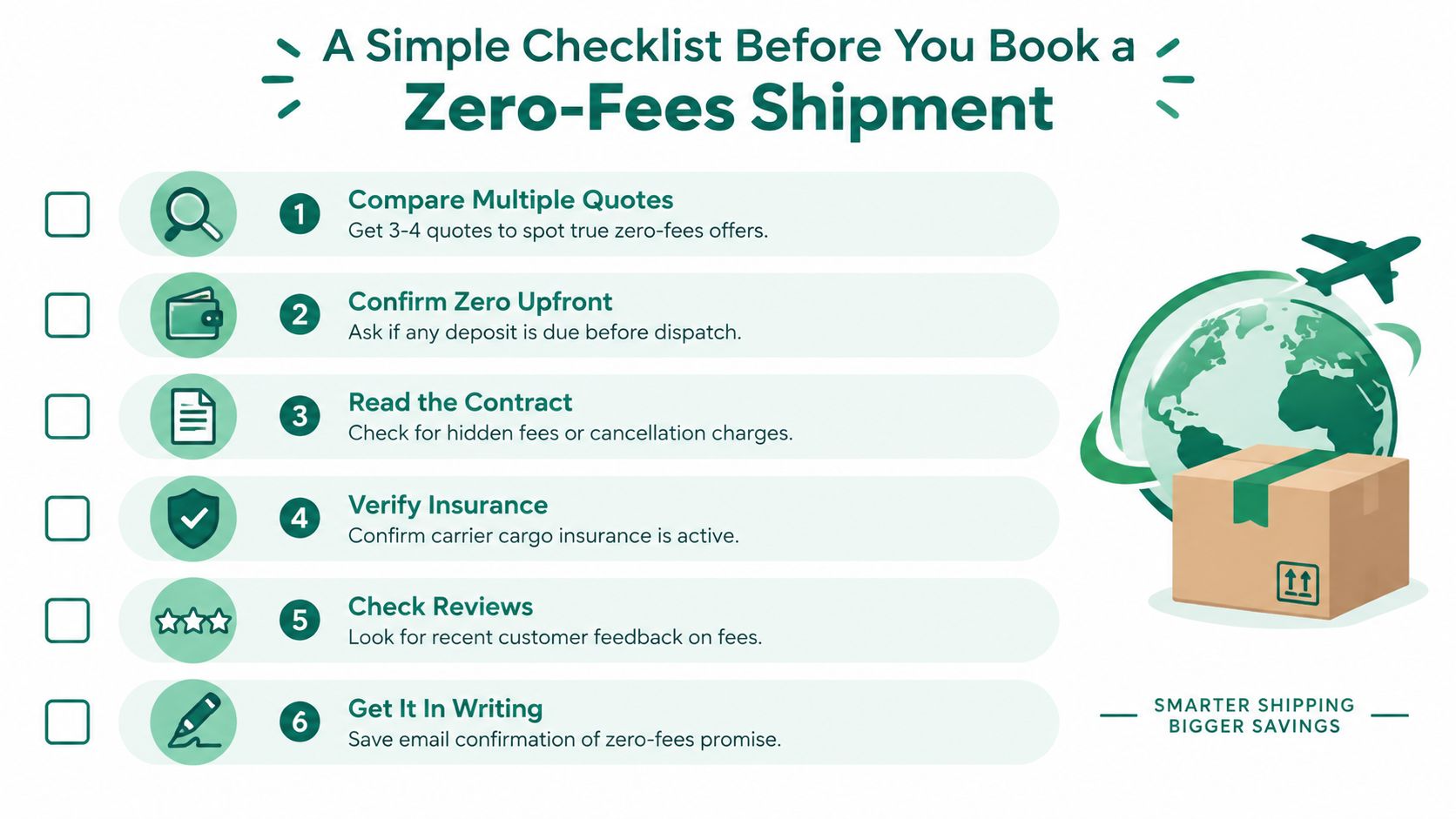
- Confirm the payment timing: Ask whether the offer means no upfront payment, a booking deposit, or payment only after carrier assignment.
- Request line items: Get the carrier rate, service type, fuel treatment, insurance terms, and coordination charges in writing.
- Identify event charges: Ask about card-processing fees, port costs, storage, special equipment, inoperable vehicles, oversized tires, and paperwork.
- Check the carrier: Verify registration, insurance, equipment, and the assigned driver before pickup.
- Read cancellation terms: Find out whether a deposit is refundable and what happens if the carrier cancels or the vehicle isn't ready.
- Compare equivalent quotes: Place each offer side by side with the same pickup method, delivery method, vehicle condition, and equipment.
A real zero-fees policy removes or delays booking-time charges, but it doesn't make disclosed route-specific or event-based costs disappear. If a representative uses vague language, won't provide a written breakdown, or introduces a last-minute add-on, pause before signing.
For a transparent flat-rate quote, zero-upfront options, and guidance for mainland or Puerto Rico vehicle shipping, visit National Car Transport. Speak with a U.S.-based bilingual English and Spanish agent who can review your vehicle, route, paperwork, and payment terms before you book.