
You’re usually not searching for wyoming car shipping because everything is calm and predictable. You’re moving for work, sending a student’s car ahead, buying a vehicle from out of state, heading south for the season, or trying to coordinate a shipment before weather changes the route plan. Wyoming adds its own layer to that decision. Distances are long, pickup points can be remote, and one stretch of highway can look clear in the morning and turn difficult by afternoon.
That’s why the shipping process matters as much as the price. A good shipment isn’t just a truck assignment. It’s route judgment, pickup timing, realistic expectations, and clear communication when conditions shift. Recent Wyoming shipping data notes a 15% rise in expedited shipping requests as climate volatility affects logistics, which tracks with what many customers are dealing with now. More people need a plan that can adjust, not just a quote.
For Wyoming moves, especially when Puerto Rico is part of the route, the difference-maker is usually the agent guiding the file. One vehicle might need a standard open carrier from Cheyenne to another mainland state. Another might need inland pickup in Wyoming, transfer to port logistics, and ocean coordination for San Juan. Those aren’t the same job, and they shouldn’t be handled like they are.
Table of Contents
- Your Guide to Shipping a Car to or from Wyoming
- Understanding Wyoming Car Shipping Costs and Timelines
- Choosing Your Carrier Type Open vs Enclosed
- Navigating Wyoming’s Unique Shipping Challenges
- Your Step-by-Step Guide to Booking Vehicle Transport
- How to Prepare Your Car and Understand Your Insurance
- Frequently Asked Questions About Wyoming Auto Transport
Your Guide to Shipping a Car to or from Wyoming
A Wyoming shipment often starts with a simple question that gets complicated fast. “Can you move my car from a small town outside Casper?” or “Can you get my SUV from Florida back to Wyoming before I arrive?” The route may be straightforward on a map, but real transport depends on truck access, weather, schedule flexibility, and whether the carrier can work your pickup into a viable lane.
That’s especially true for people relocating on a deadline. Military families, snowbirds, and students usually aren’t just comparing rates. They’re balancing move-in dates, hotel stays, storage timing, and work schedules. When the route touches a low-density area, the right move is often to build a realistic pickup window and stay flexible on exact timing rather than chase a promise that doesn’t fit Wyoming’s road reality.
Practical rule: In Wyoming, the smoothest shipments usually come from solid route planning, not overly aggressive scheduling.
Experienced coordination matters more on this state than on many denser lanes. A bilingual agent who handles English and Spanish communication can be especially useful when the shipment involves multiple parties, such as a family member in another state, a dealership, or a Puerto Rico handoff that needs mainland and island logistics lined up in the right order.
National Car Transport fits that kind of move because it works across all 50 states and Puerto Rico, uses flat-rate pricing once a carrier is secured, and supports shipments through a large vetted carrier network with dedicated U.S.-based agents. For Wyoming customers, that matters less as a marketing point and more as an operational one. Sparse routes punish sloppy coordination.
Understanding Wyoming Car Shipping Costs and Timelines
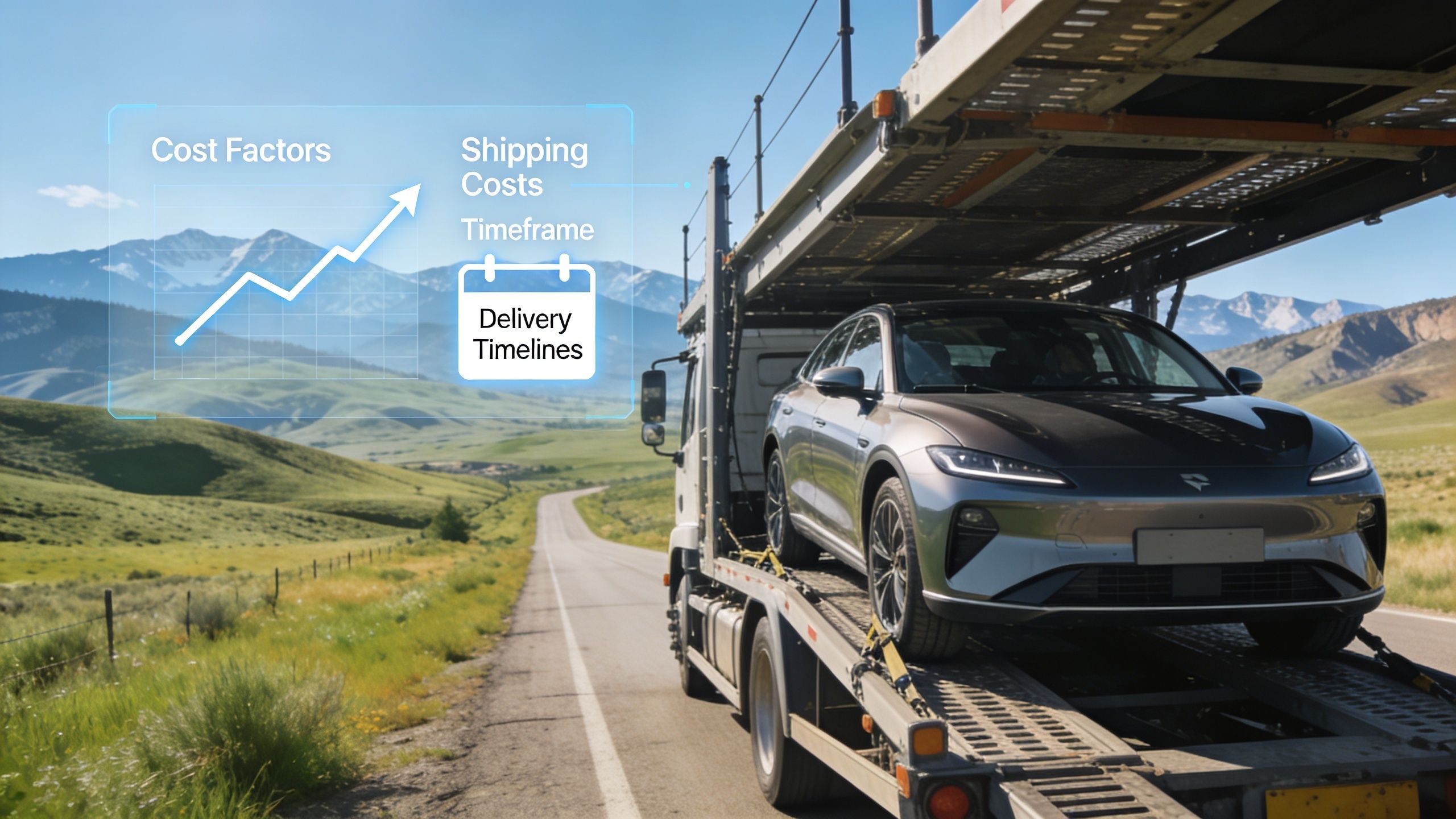
The first number people want is the quote. The better question is what’s behind it. Wyoming car shipping prices move with distance, lane demand, the type of vehicle, and whether pickup or delivery happens in a major corridor or a low-volume area.
For standard open transport, Wyoming car shipping typically ranges from $781 to $1,365, with per-mile pricing averaging $0.60 for long hauls over 1,000 miles and up to $1.70 for shorter distances. Cross-country routes such as Wyoming to Florida can take 4 to 12 days. Those figures are useful because they set expectations, but they don’t mean every lane behaves the same.
What usually drives the quote
A few cost drivers matter more than the rest:
- Distance and lane efficiency: A common interstate corridor is usually easier to price than a shipment starting far from main trucking lanes.
- Vehicle type: Larger vehicles take more trailer space and affect the carrier’s load planning.
- Seasonality: Summer relocations and other busy periods tighten availability.
- Transport method: Open is the baseline for most vehicles. Enclosed costs more because capacity is tighter and the service is more specialized.
- Pickup conditions: Rural access can change the equipment and routing needed.
Another point customers appreciate once they’ve shipped before is pricing structure. A clear flat-rate quote after carrier assignment is easier to work with than a vague estimate that leaves room for surprises. In practice, that helps with budgeting hotel stays, move dates, and dealership turnover schedules.
What delivery timing really looks like
Transit time and pickup time aren’t the same thing. Customers often focus on how many days the truck is on the road, but the full job also includes dispatch timing, load building, and the practical reality that carriers move multiple vehicles on one route.
A workable expectation for Wyoming shipments is to think in windows, not exact hours. A truck may need to adjust because of road conditions, a previous stop running long, or the need to meet the route efficiently. That doesn’t mean the shipment is off track. It means the carrier is operating the way multi-vehicle transport works.
The best shipping timelines are realistic enough to survive road conditions, driver hours, and Wyoming geography without turning a normal adjustment into a customer emergency.
If you’re shipping on a tighter timeline, ask early whether the route is flexible, whether terminal-style meeting points might help in a difficult access area, and whether your dates line up with active carrier traffic on that lane.
Choosing Your Carrier Type Open vs Enclosed
Most Wyoming shipments go one of two ways. Either the customer needs practical, budget-conscious transport for a standard car, SUV, or pickup, or they need higher protection for something that’s expensive, restored, low-clearance, or hard to replace. That’s the open versus enclosed decision.
The trade-off isn’t complicated, but people often overthink it. Open transport is the normal choice for everyday vehicles. Enclosed is the premium option when the vehicle itself justifies the extra protection and tighter handling requirements.
Open vs Enclosed Car Transport for Wyoming
| Feature | Open Transport | Enclosed Transport |
|---|---|---|
| Typical use | Daily drivers, family vehicles, dealership inventory | Classics, luxury vehicles, exotic cars, low-clearance vehicles |
| Exposure | Vehicle is transported on an open carrier | Vehicle is shielded inside an enclosed trailer |
| Cost profile | Lower-cost option for most lanes | Higher-cost option |
| Availability | Usually easier to match on common routes | More specialized and may require more scheduling flexibility |
| Best fit in Wyoming | Standard relocation, student moves, snowbird transport | Harsh-weather concern, collector vehicles, show cars |
A large network matters here because the right trailer type has to line up with the right route. National Car Transport offers both open and enclosed service through a network of 25,000+ vetted carriers, which gives customers practical options instead of forcing one method on every shipment.
How to decide without overpaying
Use the vehicle itself as the decision point.
Choose open transport if the car is a standard commuter vehicle, family SUV, work truck, or recently purchased used car that just needs dependable movement from one place to another. It’s the default because it handles that job efficiently.
Choose enclosed transport if any of these apply:
- High-value finish: You want added shielding from road grit and changing conditions.
- Collector status: Replacement parts, paint work, or originality make risk tolerance much lower.
- Low ground clearance: Specialty ramps and more careful loading may matter.
- Presentation matters: You’re shipping to a show, event, or high-end buyer.
What doesn’t work is paying for enclosed service just because Wyoming has rough weather in part of the year if the vehicle is an ordinary daily driver. On the other hand, trying to save money on a rare car often looks smart only until loading, route exposure, or delivery risk becomes the bigger concern.
Navigating Wyoming’s Unique Shipping Challenges
A Wyoming shipment can look straightforward on paper, then change quickly once the truck gets close. The route may be clear on the map, but the key questions are whether the carrier can reach the property safely, whether weather is building along the pass, and whether the handoff point makes sense for a commercial trailer.
Access is usually the first issue to solve. Wyoming geography can increase cost because special rural access fees may add 10% to 20% for pickups in low-volume areas such as Jackson Hole. The same source also notes that Wyoming has no emissions testing requirement, which simplifies relocation after delivery. That combination is common in Wyoming. Pickup and delivery can take more planning, while the paperwork after arrival is often simpler than in stricter states.
Remote pickups, winter roads, and mountain passes
A full-size carrier does not belong on every road. Drivers have to account for grade, shoulder strength, low branches, tight turns, snowpack, and room to load without blocking traffic. On ranch roads, in small mountain communities, and outside town limits, the safest plan is often a nearby truck-friendly lot, wide store parking area, or another agreed meeting point.
That is standard logistics practice in Wyoming.
At National Car Transport, we see the same pattern repeatedly. The shipments that go smoothly are the ones where the address is vetted early and the customer is prepared for a practical handoff if the final road is not suitable for a commercial trailer. A dedicated bilingual agent helps here, especially when family members, ranch staff, or a buyer and seller are coordinating in English and Spanish across different locations.
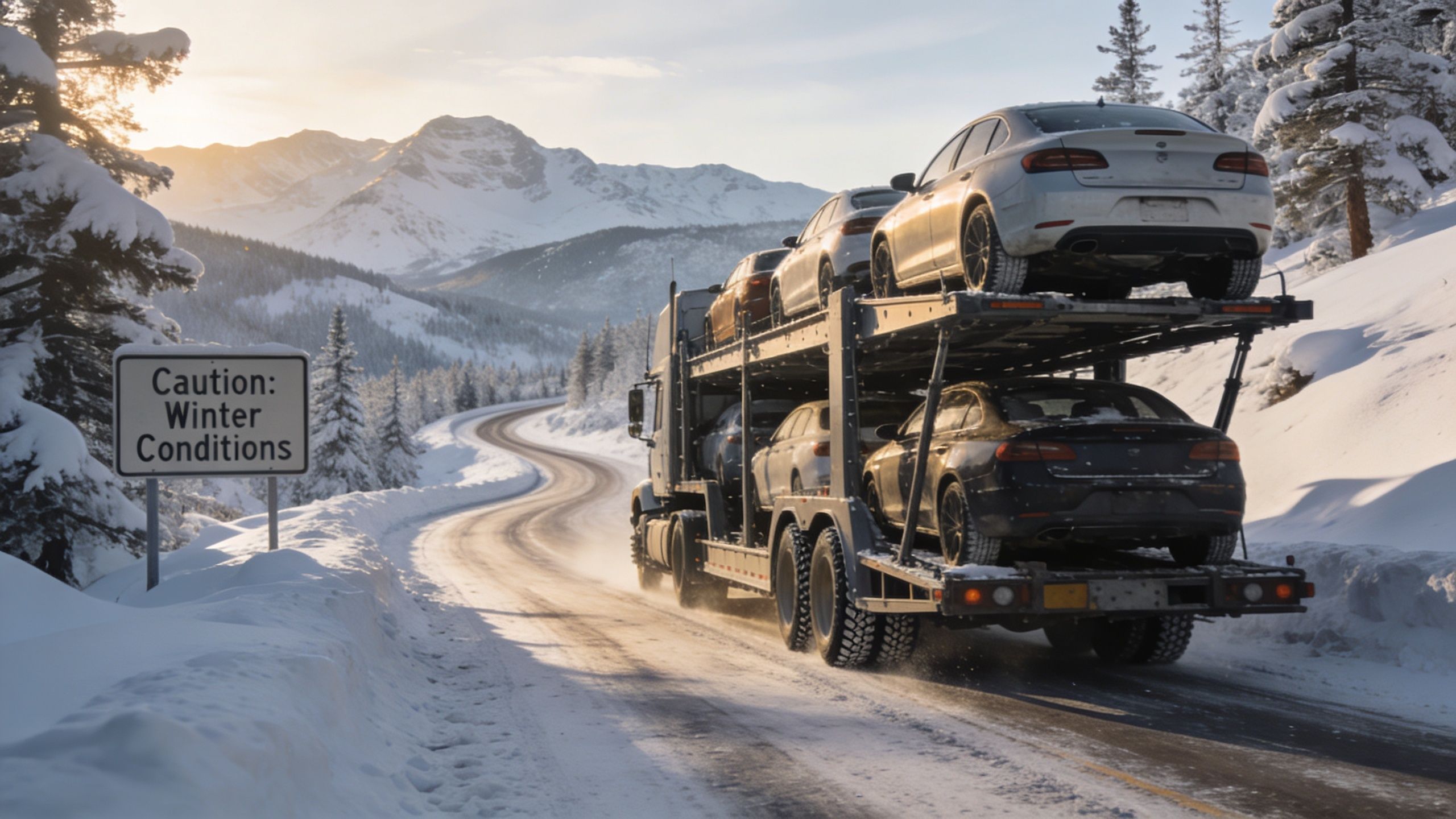
Weather changes the plan just as often as road access. Wind closures, snow, and chain restrictions can slow a carrier even when the pickup city itself looks clear. The right approach is to book with a realistic delivery window and stay reachable. A missed driver call can create more delay than the weather that caused the schedule shift in the first place.
A short visual overview helps show why planning around conditions matters:
Puerto Rico moves add another layer that Wyoming guides often skip. If the shipment starts or ends in Puerto Rico, inland Wyoming timing has to line up with port cutoff dates, title or lienholder paperwork, and handoff timing on both ends. That coordination matters more when the Wyoming side is rural, because there is less room for a late truck, a missed contact, or a rescheduled pickup. An experienced agent who handles both mainland and Puerto Rico shipments can prevent small communication gaps from turning into storage fees or missed sailings.
What gets easier after delivery
Wyoming does offer one practical advantage once the car arrives. The state does not require emissions testing, which removes a step that can slow registration elsewhere. For a relocation, that usually means fewer errands after delivery and a faster return to normal use.
That helps several types of customers:
- Military households: less follow-up during an already tight move schedule
- Seasonal residents: faster turnaround for a vehicle that needs to be ready soon after arrival
- Students and families: fewer local tasks during move-in or setup week
The strongest Wyoming shipping plans are simple. Confirm whether the address works for a large carrier, expect some flexibility around winter conditions and mountain routes, and use an agent who can coordinate rural Wyoming details and Puerto Rico port logistics without confusion.
Your Step-by-Step Guide to Booking Vehicle Transport
Booking wyoming car shipping shouldn’t feel like handing your keys into a black box. The process works best when each step is clear and somebody owns the details from quote to delivery.
Step one through step four
- Request the quote
Start with the route, vehicle, and timing. Give the exact pickup and delivery locations, not just the nearest major city if the car is outside town. In Wyoming, a few extra miles can change truck access in a meaningful way.
- Choose your schedule
Once the shipment details are reviewed, you’ll set the preferred timing and transport type. An experienced bilingual agent provides assistance. If English or Spanish communication is easier for you or your family, that support keeps the process cleaner, especially when more than one person is involved in pickup or delivery.
Confirm the pickup plan
Before dispatch, confirm who will meet the driver, whether the vehicle runs, and whether the address works for a commercial carrier. If the route includes Puerto Rico, this is also where inland timing has to line up with port paperwork and handoff sequencing. Those moves need tighter coordination than a standard mainland shipment.
Stay available through delivery
Auto transport is a live logistics job, not a parcel scan. Drivers may call ahead as they approach. If weather or access changes the handoff point, quick communication keeps the delivery smooth.
A few habits make the booking process easier:
- Be precise about the vehicle condition: Running, modified, oversized, or low-clearance status affects the right equipment choice.
- Use realistic date windows: Flexibility usually improves carrier matching.
- Name all decision-makers early: If a spouse, parent, dealership rep, or military contact will approve details, include them from the start.
What doesn’t work is vague information at booking and detailed expectations later. The more accurate the file is upfront, the less likely the shipment is to hit preventable friction.
How to Prepare Your Car and Understand Your Insurance
Preparation is where a lot of avoidable problems disappear. A vehicle that’s ready for pickup loads faster, inspects more cleanly, and gives both the customer and the carrier a better record if questions come up later.
Pickup checklist that prevents problems
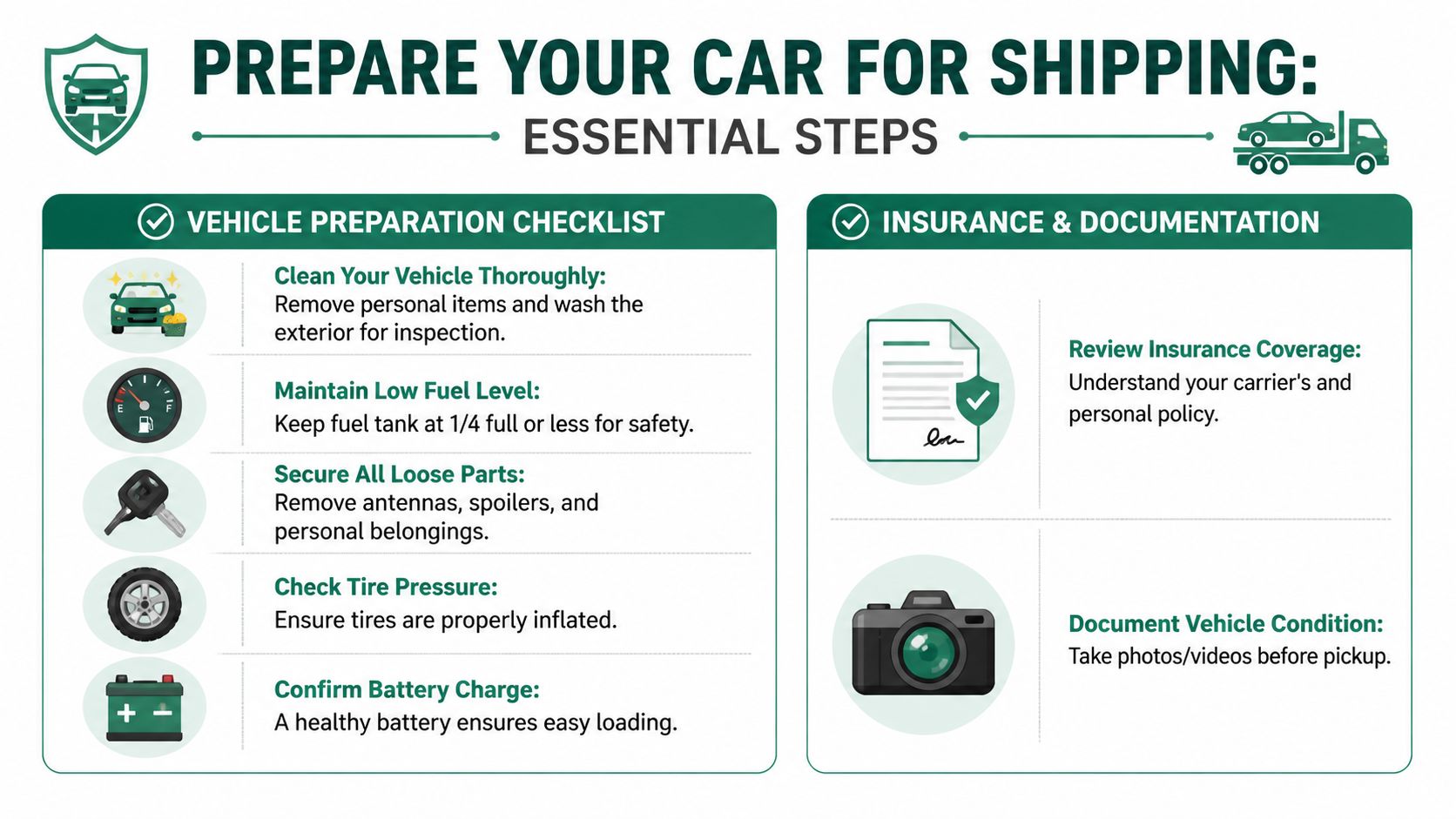
Use a short practical checklist before the driver arrives:
- Clean the vehicle: Dirt hides scratches, chips, and small dents that matter during inspection.
- Remove personal items: Carriers focus on transporting the vehicle itself, and loose contents can create issues.
- Secure detachable parts: Antennas, custom accessories, and anything that can shift in transit should be handled beforehand.
- Check basic operating condition: Battery, tires, and key access should be straightforward unless the car is being shipped as non-running.
- Keep fuel low: Enough for loading and unloading is the goal.
The most important prep step is documentation. Carriers recommend taking timestamped photos before pickup so you have a clear record to compare with the Bill of Lading at delivery. That advice is simple and valuable. If a question ever comes up, you want your own photo set from multiple angles, taken close to pickup time.
Bring the inspection process down to specifics. Photograph each side, the wheels, the roofline if visible, and any existing damage before the truck leaves.
How the inspection and insurance side works
The Bill of Lading is the core document in the handoff. It records the vehicle’s condition at pickup and then again at delivery. Read it, walk the vehicle with the driver, and make sure existing marks are noted before signing.
Insurance is where people sometimes assume too much or ask too little. The carrier should be properly insured, licensed, and bonded, addressing the transportation aspect. Your own auto policy may or may not overlap in useful ways, so it’s smart to check with your insurer before the shipment if you want clarity on your personal coverage.
A practical consideration:
| Document or protection | Why it matters |
|---|---|
| Pickup photos | Gives you a time-stamped condition record |
| Bill of Lading | Formal inspection record at pickup and delivery |
| Carrier insurance | Core transport coverage during shipment |
| Your auto policy review | Helps you understand any personal policy overlap |
What works is staying organized. What doesn’t work is treating paperwork like an afterthought and trying to reconstruct the vehicle’s condition later from memory.
Frequently Asked Questions About Wyoming Auto Transport
Some questions don’t come up until you’re close to booking. They usually have less to do with price and more to do with the exceptions, the awkward cases, and the routes that need extra coordination.
When should I book my shipment
Earlier is better, especially if your pickup point is outside the main interstate lanes or your dates are tied to a move, school start, military reporting schedule, or seasonal relocation. Wyoming lanes can require more route planning than denser states, so giving your agent room to build the right match helps.
If your schedule is tight, say that upfront. Expedited planning is possible on some routes, but timing works best when the dispatch team knows which dates are fixed and which ones have some flexibility.
Can you ship a non-running car in Wyoming
Yes, but say it upfront. Shipping a non-running vehicle to or from rural Wyoming is possible, though it often requires a carrier with a winch, and winch fees can rise by up to 25% in rural states because of the extra labor and equipment involved.
That matters because the wrong equipment assignment can derail pickup. A car that won’t steer, brake, or start may still be shippable, but the dispatcher and driver need to know exactly what condition it’s in.
Ask these questions before booking:
- Does the vehicle roll and steer
- Is it in a remote area or on uneven ground
- Will the pickup site allow a safe loading angle
- Does it need special handling because of clearance or modifications
What about Wyoming to or from Puerto Rico
Many state guides stop short of detailing moves like this. Wyoming to Puerto Rico, or Puerto Rico to Wyoming, is a multi-stage move. It usually involves inland transport on the mainland side, port coordination, ocean shipping, and final delivery or pickup planning after arrival.
The key is treating it as one connected shipment, not separate tasks stitched together at the last minute. That’s why experienced coordination matters so much on island routes. A delay in inland pickup can affect port timing. A document issue can affect release timing. Customers do best when one knowledgeable agent keeps the sequence aligned and gives them one line of communication through the job.
For people moving household vehicles, dealership inventory, or online purchases between the mainland and San Juan, the process is manageable. It just needs the right planning from the beginning.
If you need help with National Car Transport, talk with a U.S.-based bilingual agent who can review your Wyoming route, explain open or enclosed options, and coordinate mainland or Puerto Rico vehicle shipping without making you piece the process together on your own.