

If a carrier says your vehicle is covered under self-insured coverage, do you know who pays when your car is damaged, and whether that party has the money and authority to resolve the claim? Many shippers hear “insured” and stop asking questions. On a long domestic move or a mainland-to-Puerto Rico shipment, that shortcut can leave you discovering a coverage gap after the vehicle is already in transit.
Table of Contents
- What Self-Insured Coverage Means for Vehicle Shipping
- How Self-Insured Coverage Works in Auto Transport
- Self-Insured vs Fully Insured Carriers
- What to Check Before You Book Your Shipment
- Real Examples from Domestic and Puerto Rico Routes
- Choosing the Right Carrier and Coverage for Your Shipment
What Self-Insured Coverage Means for Vehicle Shipping
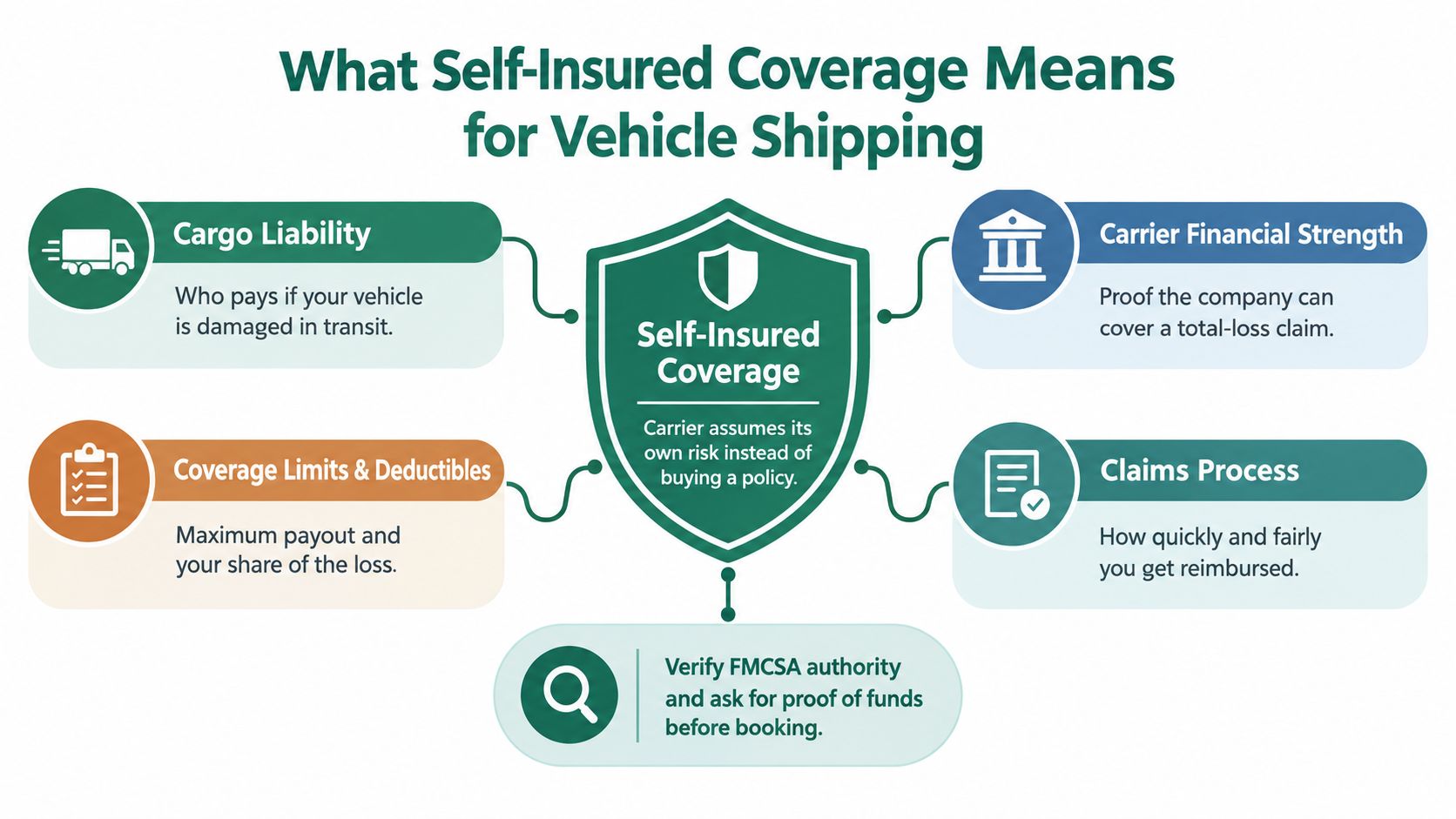
In plain language, self-insured coverage means a carrier accepts financial responsibility for potential losses instead of transferring all of that risk to a conventional insurance company. The carrier sets aside or otherwise controls funds for claims, subject to its legal authority, financial arrangements, and applicable limits. That doesn't mean every vehicle is automatically protected against every type of damage.
For auto transport, the practical question is simple: who pays if your vehicle is damaged, stolen, or declared a total loss while the carrier controls it? A fully insured carrier usually submits a covered claim to its commercial insurer. A self-insured carrier may handle the loss from its own funds, use a bond or another approved financial arrangement, or rely on excess protection above its retained amount.
The label matters less than the paperwork behind it. Ask whether the carrier has current operating authority, what cargo liability applies to your specific shipment, what exclusions or deductibles exist, and who handles the claim. A carrier that can't explain those points clearly shouldn't receive your keys.
Why the distinction matters on longer routes
Long-distance transport creates more handoffs, mileage, weather exposure, and scheduling complexity than a short local move. Puerto Rico shipping adds a sea leg and separate documentation, so a shipper needs to know whether the trucking carrier's responsibility continues through the port process or changes under a separate ocean transport arrangement.
Practical rule: Treat “self-insured” as a prompt for verification, not as proof that a claim will be easy.
Your bill of lading, pickup inspection, photographs, declared vehicle condition, and delivery inspection will often matter as much as the funding label. Record existing scratches, cracked glass, warning lights, and loose parts before pickup. Good evidence gives the claims handler a clear baseline, regardless of whether the carrier uses a commercial policy or self-funded protection.
How Self-Insured Coverage Works in Auto Transport
Federal rules give carriers more than one way to demonstrate financial responsibility. For interstate property carriers operating vehicles with a gross vehicle weight rating of 10,001 pounds or more and carrying non-hazardous property, the federal minimum level of financial responsibility is $750,000, and carriers may satisfy that responsibility through insurance, surety bonds, or self-insurance authority, as explained by the Federal Motor Carrier Safety Administration's insurance filing requirements.
That requirement is a financial-responsibility floor, not a promise that every type of loss will be paid without dispute. Higher limits can apply in some situations. FMCSA states that the required amount can vary based on factors such as passenger capacity, vehicle weight, and the commodity transported. A shipper should therefore match the carrier's documented authority and coverage arrangement to the actual equipment and route.
The three arrangements
Traditional insurance transfers covered claim risk to an insurer after the policy terms, limits, and deductible are applied. The carrier pays premiums, and the insurer typically investigates and adjusts qualifying losses.
A surety bond provides a financial guarantee under its own terms. It isn't identical to a cargo insurance policy, so you need to understand what the bond guarantees, who may make a claim, and how the process works.
Self-insurance authority allows an eligible motor carrier to meet federal financial responsibility requirements through an approved self-insurance arrangement. The carrier remains responsible for funding losses within the applicable structure. That makes the carrier's financial strength and claim administration especially important.
A carrier may also combine retained risk with excess protection. In that structure, the carrier handles losses up to its retained layer, while another arrangement responds only after the attachment point is reached. Shippers can often get caught off guard in this area. A policy may exist, but it may not respond to a smaller loss if the carrier's retention hasn't been exhausted.
For broader context on how cargo risks are structured across transportation operations, the cargo and logistics insurance guide from PTL Insurance Associates, Inc. is a useful reference. Read it to understand why the name of a financial product alone doesn't tell you how a particular claim will be handled.
Self-Insured vs Fully Insured Carriers
A self-insured carrier isn't automatically unsafe, and a fully insured carrier isn't automatically easy to deal with. The meaningful differences concern who funds the loss, who controls the claims process, and whether the documented arrangement fits the shipment.
FMCSA explains that motor carriers can be authorized to be self-insured. Its insurance guidance identifies $750,000 as the minimum amount in the applicable property-carrier example, with higher limits applying in some cases depending on passenger capacity, vehicle weight, and the commodity transported. You can review the agency's self-insurance and insurance guidance when checking a carrier's regulatory position.
| Factor | Self-Insured Carrier | Fully Insured Carrier |
|---|---|---|
| Who funds the initial loss | The carrier funds claims within its retained or authorized responsibility | An insurer responds to covered claims under the policy |
| Claims handling | The carrier or its administrator may investigate and resolve the loss | The insurer usually assigns the adjuster and manages covered claims |
| Main shipper concern | Liquidity, documentation, retention, and claim responsiveness | Policy exclusions, limits, deductibles, and insurer responsiveness |
| Potential advantage | The carrier may manage risk directly and tailor its financial structure | The carrier transfers much of the claim risk to an insurance company |
| Potential weakness | A weak financial position can delay or complicate payment | A policy can still contain exclusions or limits that don't match expectations |
The comparison is most useful when you connect it to the route. A collector car moving in an enclosed trailer needs different scrutiny from a standard commuter vehicle on an open carrier. A dealership shipment may involve multiple vehicles and repeated documentation. A Puerto Rico move may involve trucking, port handling, and ocean transport, so the booking party should identify each responsible operator.
Price shouldn't be the only deciding factor. Use a car shipping cost guide to understand the variables behind a quote, then ask whether the proposed carrier's coverage and claims process match the service being sold.
What to Check Before You Book Your Shipment
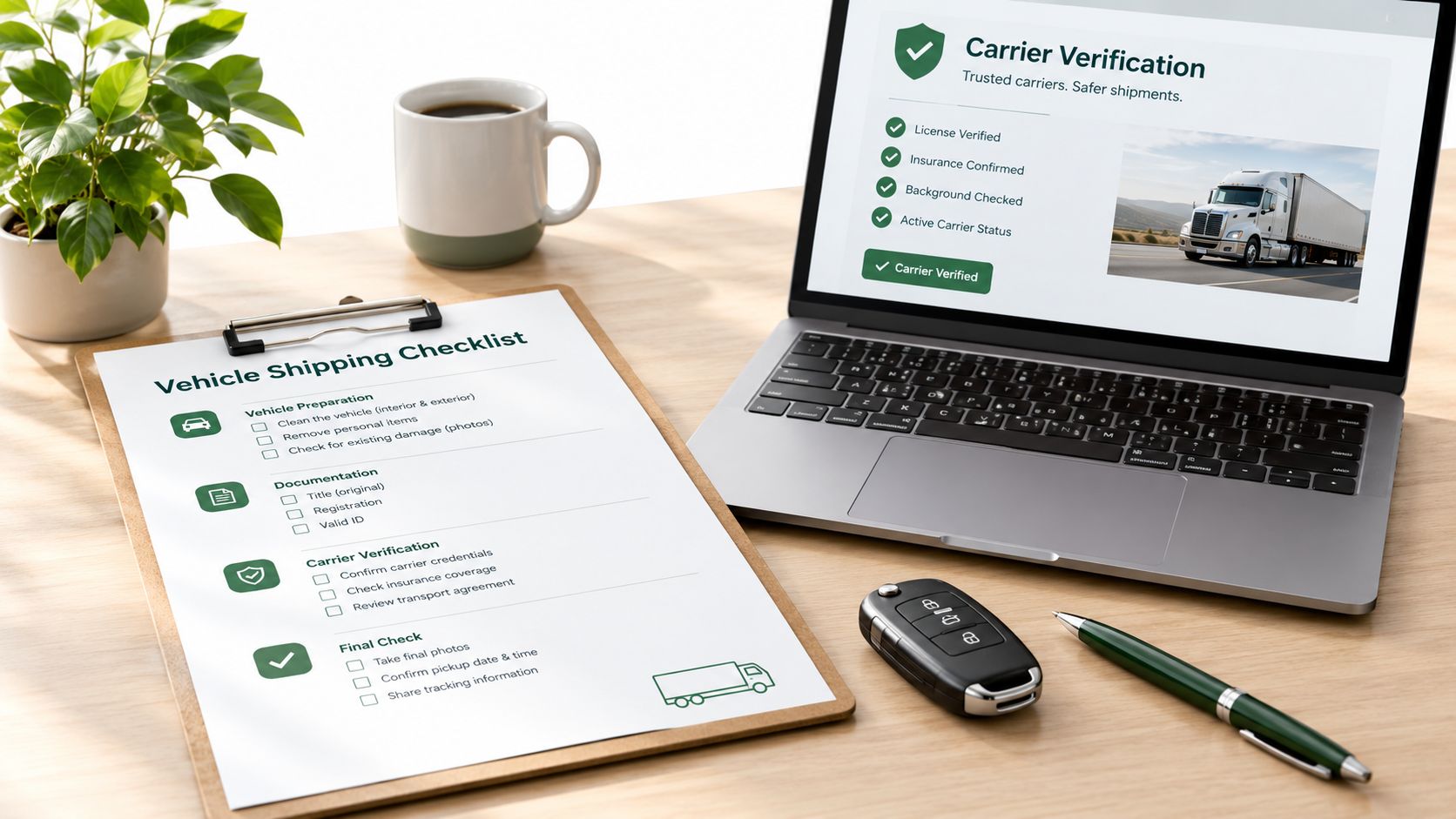
Don't book from a quote alone. Before handing over a vehicle, request enough information to identify the responsible carrier, confirm its authority, and understand how a damage claim would move from inspection to payment.
Start with the carrier record
Ask for the legal carrier name, operating authority information, and the name of the party responsible for transporting the vehicle. Brokers and carriers aren't interchangeable. A broker may arrange the move, while an authorized motor carrier performs the physical transportation. Your agreement should make that relationship clear.
Then ask for the current proof of financial responsibility. If the carrier says it's self-insured, ask what that means in its specific structure. Request the applicable authority or documentation, the retained amount if one applies, the claims contact, and any excess or secondary protection that responds above the retained layer.
Match the coverage to the vehicle
Provide an accurate description of the vehicle, including its condition, modifications, accessories, declared value when requested, and whether it runs. A standard open carrier may be appropriate for an ordinary daily driver. A classic, exotic, or high-value vehicle may call for enclosed transport and confirmation that the carrier's cargo limit is adequate.
Use this checklist before you authorize pickup:
- Verify responsibility: Confirm which company has custody during pickup, transit, port delivery, and final handoff.
- Review exclusions: Ask about personal items, mechanical failure, pre-existing damage, glass, accessories, and loading or unloading incidents.
- Confirm the claim route: Get the claims email, phone number, filing deadline, required photographs, and inspection procedure in writing.
- Document condition: Photograph every side, wheel, window, interior area, odometer, and existing defect before loading.
- Check the route: For Puerto Rico, ask which portions are handled by truck, port operator, and ocean carrier, and which documents each party requires.
- Read the bill of lading: Make sure the recorded condition, vehicle identification, pickup location, delivery location, and exceptions are accurate before signing.
The enclosed auto transport service is one option to consider when a vehicle needs protection from ordinary road exposure or requires a more controlled transport environment. It doesn't remove the need to inspect documents and confirm limits.
A short walkthrough can help you recognize the paperwork and questions that deserve attention before booking.
If a representative refuses to provide a clear answer, pressures you to skip the inspection, or says “the carrier is covered” without naming the responsible entity, pause the booking. The cheapest quote is expensive if you have to prove basic facts after a loss.
Real Examples from Domestic and Puerto Rico Routes
Consider a standard domestic move from Phoenix to Chicago. The vehicle arrives with a new scrape on the rear bumper. The pickup inspection shows no scrape, the delivery inspection records it, and the customer has time-stamped photographs. Whether the carrier is self-insured or fully insured, that evidence gives the claim a credible starting point. Without it, the parties may argue about when the damage occurred.
A different situation involves a non-running vehicle moving from Atlanta to San Juan. The customer assumes the same company controls the vehicle throughout the journey, but the shipment includes mainland trucking, port handling, and ocean transport. The booking documents should identify those stages and explain where responsibility changes. The vehicle's condition, keys, loose parts, and personal contents must be documented before the first carrier takes custody.
Puerto Rico shipments also have practical document requirements. The U.S. Department of Agriculture requires an original car-wash receipt for cars shipped to Puerto Rico, and vehicles shipped to the U.S. mainland don't need a U.S. Customs and Border Protection inspection, according to Crowley's Puerto Rico vehicle-shipping guidance. Missing paperwork can delay movement even when there isn't a damage claim.
What competent coordination looks like
For routes involving major cities across the 48 contiguous states, such as Miami, Orlando, Atlanta, Dallas, Houston, Denver, Phoenix, Los Angeles, Seattle, Chicago, New York, Boston, and Washington, D.C., the fundamentals stay consistent. The parties should identify the carrier, record the vehicle condition, confirm the coverage arrangement, and preserve the delivery inspection.
San Juan routes require the same discipline with additional ocean and port coordination. National Car Transport has operated for 25+ years, offers bilingual English and Spanish agents based in the United States with more than 20 years of auto transport logistics experience, and coordinates domestic and Puerto Rico vehicle shipping through its carrier network. Its Puerto Rico car shipping information can help customers understand the route-specific process before requesting a quote.
The useful lesson is not that one funding model always wins. It's that the documents, custody chain, and claims instructions must agree with what the sales representative promised.
Choosing the Right Carrier and Coverage for Your Shipment
Self-insured coverage isn't better or worse than a conventional commercial policy. Choose based on verified authority, suitable limits, financial capacity, route competence, and a claims process you can use.
For a routine vehicle, prioritize accurate condition records, a named responsible carrier, and clear delivery procedures. For a luxury or classic vehicle, ask about enclosed transport and whether the cargo limit fits the vehicle's value. For dealerships, auctions, businesses, and fleet operators, review how the provider handles repeated moves, multiple vehicles, and consolidated documentation.
Puerto Rico adds another decision layer. Confirm the inland carrier, port handoff, ocean segment, required paperwork, and final delivery responsibility before you compare prices. A resource such as cargo insurance for trucks from Florida All Risk Insurance can provide useful background when evaluating commercial cargo-risk questions, but your transport agreement still controls the specific service you purchase.
National Car Transport offers door-to-door vehicle transport, open and enclosed options, container and ocean shipping for island routes, transparent flat-rate pricing, and a nationwide network of 25,000+ vetted carriers. It also supports individuals, snowbirds, military families, students, dealerships, and businesses with bilingual English and Spanish agents based in the USA. That personal guidance matters because no vehicle transport is alike, and a knowledgeable agent can make the process simpler and quicker at a practical value.
For a shipment that needs clear responsibility and coverage verification, contact National Car Transport for a route-specific quote and questions about carrier documentation. Ask an agent to review the custody chain, vehicle condition requirements, and coverage arrangements before you release your keys.