

You've just bought a car in another state, received military orders, or decided to spend the winter in Puerto Rico. Then the shipping quotes arrive. One looks affordable until the fine print starts adding fuel adjustments, terminal charges, and carrier fees. Another costs more at first glance, but the number is clear enough to budget around.
That difference comes down to flat rate pricing, a model that matters in domestic auto transport and even more on routes involving ports, ocean freight, and island delivery. The right flat quote can protect your budget and remove stress. The wrong one can hide exclusions behind a reassuring headline price.
Table of Contents
- Two Quotes for the Same Car and Why One Felt Safer
- What Flat Rate Pricing Actually Means in Auto Shipping
- Flat Rate Pricing vs Variable Pricing in Car Transport
- What Is Included and What Is Not in a Flat Rate Quote
- Sample Flat Rate Calculations for Real Auto Shipments
- Why Flat Rate Pricing Wins for Most Auto Shipments
- How to Verify a Flat Rate Auto Shipping Quote
Two Quotes for the Same Car and Why One Felt Safer
Maria was relocating from Tampa to Denver and needed to ship her 2019 Toyota RAV4. She entered the same vehicle details, pickup window, and destination with two transport companies.
The first quote came back at $1,150. It showed one clear amount, explained the service, and didn't ask for a payment before a carrier was assigned. Maria could see what she was agreeing to, and the quote didn't contain a list of charges that might change after booking.
The second quote was $895. It looked like the obvious bargain until Maria read the notes. Fuel adjustments could apply. A carrier availability surcharge might be added. Certain accessorial and handling fees could change once the route was booked.
Practical rule: A low starting quote isn't a low final price unless the provider explains exactly what can change.
Maria's reaction was immediate. The $1,150 quote caused a little sticker shock, but it also brought relief. She could tell her spouse what the move would cost without adding a cushion for unknown fees. The $895 quote felt cheaper and less trustworthy at the same time. The price was lower, but the financial risk had moved from the shipping company to Maria.
That is the central appeal of flat rate auto shipping. The provider estimates the trucking, operating, coordination, and route costs, then gives the customer one predetermined price. The model works best when the quote clearly states what the price includes and identifies genuine exceptions, such as an inoperable vehicle or an unusual delivery location.
The same issue becomes more complicated on Puerto Rico routes. A shipment can involve mainland pickup, a stateside port, ocean transit, port handling in San Juan, documentation, and delivery on the island. The gap between a clean quote and a teaser quote isn't just a difference in wording. It can determine whether your budget survives the move.
The question is simple: what explains the gap between the two quotes, and when is paying more upfront the smarter decision?
What Flat Rate Pricing Actually Means in Auto Shipping
Flat rate pricing means the customer pays one predetermined amount for a defined transport service. In auto shipping, that amount is normally based on the vehicle, route, transport method, timing, and service requirements. The customer sees the price before booking, rather than watching the bill change with every operational variable.
A useful comparison is a set restaurant menu. You know the price before ordering, and the restaurant has already built its expected food, labor, and operating costs into the menu price. Variable pricing is closer to an open tab. You may start with an attractive base amount, but later charges can appear as conditions change.
A true flat quote can bundle several standard components:
- The trucking leg, from the pickup address to the delivery address or port.
- The carrier fee, which pays the assigned transport provider.
- Fuel and ordinary route costs, estimated into the original price.
- Standard cargo insurance during transit, subject to the provider's stated coverage and exclusions.
- Dispatch coordination, including carrier matching and shipment communication.
- Standard documentation, such as the bill of lading and required transport paperwork.
For an ordinary domestic shipment, that could mean one amount for moving a running sedan from a residence in Phoenix to a business in Atlanta. For a route from Texas to Puerto Rico, the structure is broader. The bundled figure may include mainland trucking, ocean freight, port handling, roll-on/roll-off processing, and standard Puerto Rico documentation.
That doesn't mean every possible cost disappears. A flat rate applies to the service conditions described in the quote. If the customer changes the destination, requests expedited service, adds an enclosed carrier, or sends an oversized or inoperable vehicle, the provider may need to reprice the work.
Why the wording matters
A provider can call a number “flat” while still leaving major charges outside the agreement. Read the quote for the words all-inclusive, locked-in, or an equivalent explanation, then check the exclusions. The strongest quote identifies the exact vehicle, pickup and delivery points, transport type, and payment terms.
Variable or market-based pricing isn't automatically dishonest. It passes more operating risk to the customer. Fuel costs, carrier capacity, seasonal demand, route access, and last-minute service requirements can affect the final amount. Your job is to find out whether the quoted figure is the price you'll pay or merely the amount needed to start the conversation.
Flat Rate Pricing vs Variable Pricing in Car Transport
The difference is easiest to understand when the two models sit next to each other.
| Pricing Factor | Flat Rate Quote | Variable Quote |
|---|---|---|
| Starting price | Usually reflects the defined service in one bundled figure | Often begins with a base amount |
| Cost changes | Ordinary route variation is absorbed by the provider | Changes may be passed to the customer |
| Budgeting | Easier to plan before pickup | Requires room for possible additions |
| Best fit | Cross-country, complex, port, and ocean-connected routes | Flexible, short, or highly competitive lanes |
| Main risk | You may pay more than a temporary market low | The final bill may exceed the first quote |
Flat pricing generally makes more sense when the shipment has several handoffs or a long distance between the origin and destination. A cross-country move already requires careful coordination. A Puerto Rico shipment adds port schedules, ocean movement, documentation, and delivery arrangements. Each added step creates another place where a stripped-down quote can become difficult to compare.
Variable pricing has a legitimate use. If your pickup date is flexible, the vehicle runs properly, and the lane has plenty of available carriers, a dispatcher may find a lower spot-market price. That advantage is strongest when you can tolerate waiting and won't be harmed by a later scheduling change.
If your budget depends on the number you saw in the first email, don't accept a quote that describes that number as a starting point.
For high-value, vintage, or delicate vehicles, also compare the equipment rather than focusing only on the fee. Enclosed auto transport can provide a different protection level from open transport, but the quote should state the equipment and coverage clearly.
My rule is straightforward: choose flat rate when certainty matters more than chasing the lowest possible market moment. Choose variable pricing only when you understand the adjustment rules and have enough flexibility to absorb them.
What Is Included and What Is Not in a Flat Rate Quote
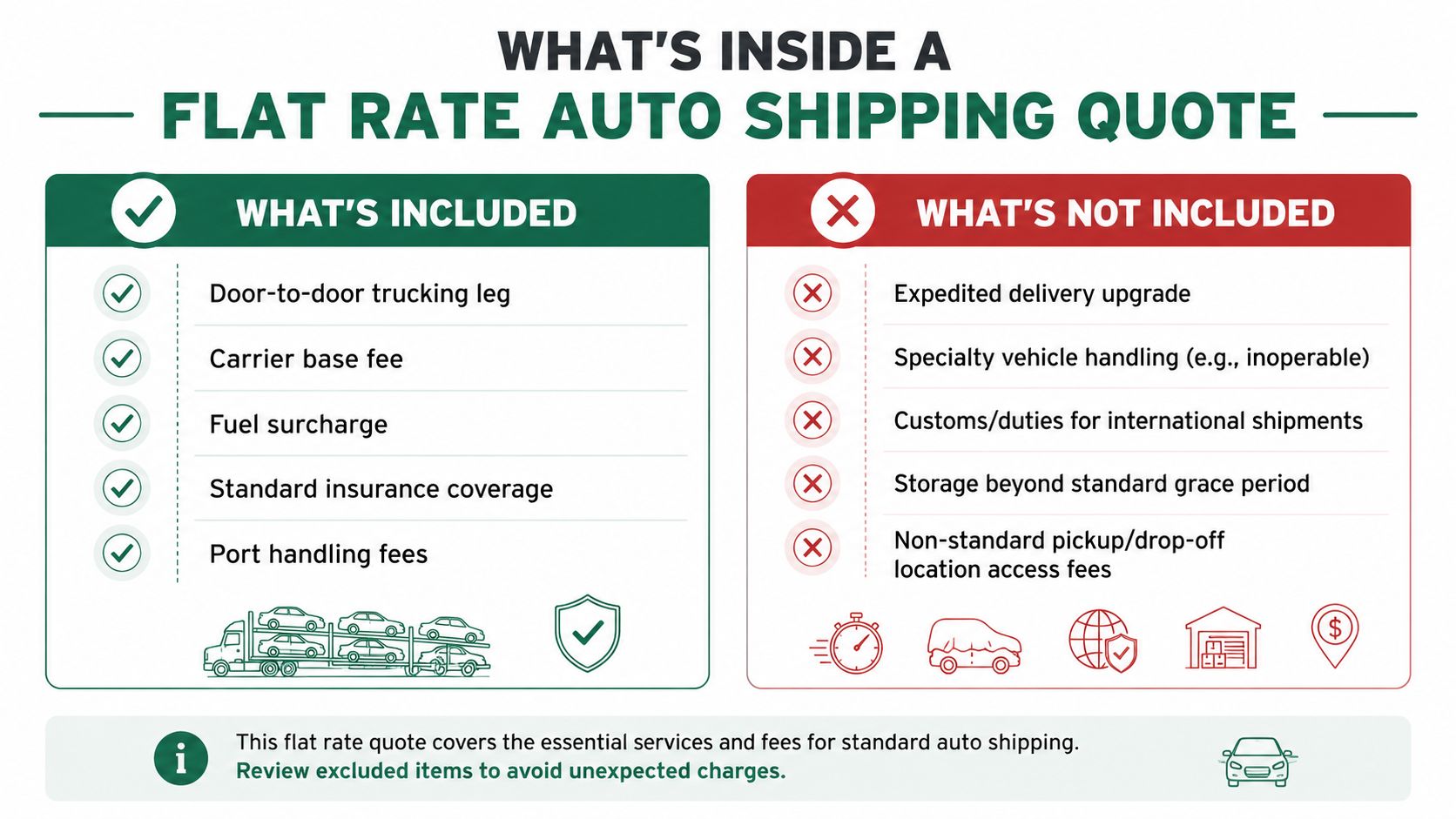
A flat auto-shipping quote should describe a complete service, not just a carrier's starting bid. For a domestic move, the usual bundle includes the door-to-door trucking leg, carrier compensation, ordinary fuel costs, standard transit insurance, dispatch coordination, and the bill of lading.
For a Puerto Rico shipment, the quote needs more detail. Mainland trucking may take the vehicle to a departure port, where port handling and roll-on/roll-off loading become part of the process. Standard paperwork may include the bill of lading, a Certificate of Title, and customs-related forms required for the Puerto Rico movement. Puerto Rico to mainland shipments also follow a different customs treatment from shipments going to foreign ports, so ask the provider to explain the documentation path rather than assuming every “international” fee applies.
Common exclusions
The following items often sit outside the standard price:
- Expedited pickup or delivery, when you need priority scheduling.
- Enclosed transport, if the original quote covers open transport.
- Oversized or specialty vehicles, including vehicles requiring unusual equipment.
- Inoperable vehicles, which may need winching or special loading.
- Residential or terminal access charges, where the truck cannot safely reach the requested location.
- Storage, if the vehicle remains at a terminal beyond the provider's standard period.
- Customs duties or government charges, especially where a charge isn't freight itself.
For example, a running sedan moving from a suburban home in one mainland state to a reachable address in another may fit a standard door-to-door quote. A lifted truck going to a restricted downtown street may need a revised access plan. A Texas to San Juan shipment may include mainland transport, ocean movement, and standard port processing, while storage or an unusual destination charge may remain separate.
Good pricing transparency means the customer can tell the difference before signing. The AutoProv pricing transparency guide offers useful context on why clear pricing should identify the service, included costs, and potential exceptions instead of relying on a headline number.
If your priority is residence-to-residence service, compare the wording carefully with door-to-door auto transport. “Door-to-door” still depends on legal truck access and safe loading conditions. A professional dispatcher should explain where the handoff will occur if the carrier can't reach the exact address.
Sample Flat Rate Calculations for Real Auto Shipments
A dispatcher doesn't create a flat price by guessing. The provider estimates the work required, accounts for ordinary operating risk, and adds the margin needed to complete the move. The exact amount changes with the vehicle, dates, route, equipment, and port conditions, so the examples below show the structure, not guaranteed market quotes.
Mainland open transport example
Consider a running sedan moving from Jacksonville, Florida, to Chicago, Illinois, on an approximately 1,100-mile trucking leg. A simplified internal estimate might look like this:
- Carrier transportation cost, estimated from the route and available equipment: $850
- Fuel allocation: $100
- Standard insurance and shipment administration: $50
- Dispatch coordination and route management: $100
That produces an all-in flat quote of $1,100. The customer sees $1,100, not a carrier amount followed by a separate fuel adjustment and dispatch charge. The actual quote could move within a reasonable range based on timing, vehicle condition, and market availability. The point is that the customer knows which assumptions created the number.
Texas to Puerto Rico example
Now consider a running vehicle moving from Houston, Texas, to San Juan, Puerto Rico. The service may involve mainland trucking to a port, ocean RoRo freight, port handling, documentation, and delivery coordination after arrival.
| Cost Component | Jacksonville to Chicago (Open Truck) | Houston to San Juan, PR (Ocean RoRo) |
|---|---|---|
| Mainland trucking | $850 | $450 |
| Fuel and operating allocation | $100 | $100 |
| Ocean freight | Not applicable | $950 |
| Port handling and loading | Not applicable | $250 |
| Documentation and coordination | $150 | $250 |
| Customer-facing flat quote | $1,100 | $2,000 |
The Puerto Rico figure illustrates why island shipments need a written scope. San Juan is the island's primary shipping point, and mainland routes can connect through stateside ports such as Jacksonville, Florida, or Pennsauken, New Jersey, depending on the service plan. Port-to-port service is generally more economical than adding residential pickup, while door-to-port service includes the mainland pickup leg.
Use a route-specific car shipping cost guide to understand the factors that influence a quote, but don't treat any online estimate as a promise. The final flat figure should match your vehicle, addresses, service type, and requested schedule.
Why Flat Rate Pricing Wins for Most Auto Shipments
Flat rate pricing wins because certainty has practical value. You may be moving for work, reporting to a military assignment, sending a student to school, or transporting a dealership vehicle to a buyer. In each case, a quote that changes after booking creates a problem beyond the shipping bill.
A transparent flat rate absorbs ordinary fluctuations in the route plan. That can include fuel movement, carrier availability, and the need to coordinate a rebrokered assignment when the first carrier can't complete the job. On a Puerto Rico route, the value is even clearer because trucking, ocean freight, port handling, and paperwork must align.
Customers also respond to the psychology of a known bill. Behavioral research describes a flat-rate bias, where consumers may prefer a fixed tariff even when measured billing could cost less, because a fixed fee reduces uncertainty and the fear of an unexpectedly high bill. Research on flat-rate bias and tariff choice also helps explain why a customer may knowingly choose the safer-looking quote.
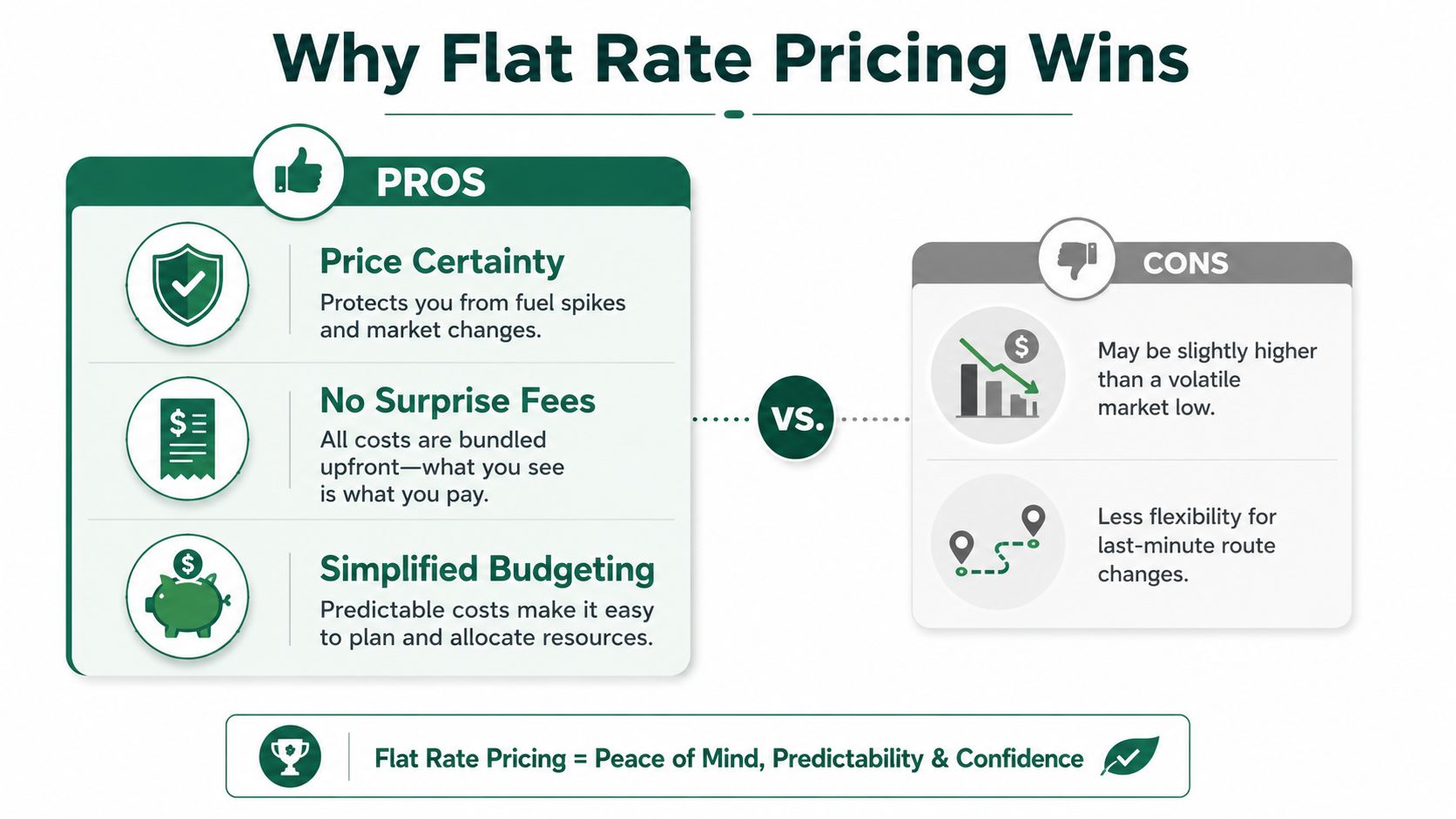
Flat pricing isn't always the cheapest option. It can lose when your pickup window is wide, your route has abundant carrier capacity, or you can wait for a favorable spot rate. A short move may also produce a lower variable quote, and a large shipment may qualify for a dedicated equipment arrangement that a standard flat model doesn't capture.
Pay a premium for certainty only when the provider has defined the certainty in writing.
National Car Transport describes a model with zero upfront charges until a vehicle is matched with a carrier, along with flat-rate service, standard insurance inclusion, and domestic and Puerto Rico transport options. It also works with English and Spanish-speaking agents based in the United States, including agents with more than 20 years of auto-transport logistics experience, which matters when a shipment has several moving parts.
How to Verify a Flat Rate Auto Shipping Quote
Before you sign, verify the details that determine whether the quote is usable.
- Confirm the route: Check both pickup and delivery ZIP codes, or the port pair for an island shipment.
- Confirm the vehicle: The year, make, model, and operating condition must be accurate.
- Confirm the equipment: Make sure the quote says open or enclosed transport.
- Confirm the bundle: Ask whether carrier compensation, fuel, insurance limits, and documentation charges are included.
- Confirm payment timing: Ask whether the deposit is refundable and when the carrier receives payment. A provider that collects nothing upfront until carrier assignment should state that policy clearly.
- Confirm legitimacy: Check the company's FMCSA MC/DOT information, BBB profile, and recent customer feedback on Transport Reviews and the Better Business Bureau.
Watch for phrases such as “rates from”, missing terminal charges on ocean shipments, and demands for full payment before a carrier is assigned. Those signs don't prove a company is unreliable, but they do mean you need written clarification before committing.
For a Puerto Rico move, also confirm the VIN, title, registration, vehicle condition, port destination, and government vouchers or fees that may be required. Shipping guidance identifies a $10 voucher, Code 5122, and a $2 voucher, Code 842, for each vehicle, along with documentation and condition requirements, so don't assume those charges are part of freight pricing. Puerto Rico vehicle shipping documentation guidance explains the paperwork and vehicle requirements that customers should review.
If you want a clearly scoped flat-rate quote for domestic transport or a mainland to Puerto Rico shipment, visit National Car Transport and provide the exact vehicle, route, condition, and timing. Their bilingual English and Spanish agents based in the United States can help individuals, snowbirds, military families, students, dealerships, and businesses understand what the price includes before they book.