

Door-to-door auto shipping means a vehicle is collected from a location as close as safely and legally possible to its origin and delivered to a nearby accessible point at its destination, with the service potentially coordinating trucking, ocean shipping, and port handling. In fiscal year 2023, door-to-door delivery services in Japan handled a record 5.01 billion packages, showing how direct-to-recipient logistics has become core infrastructure in a major delivery market.
You may be moving for a new job, sending a car to a student, returning a seasonal vehicle to a snowbird home, or arranging delivery after buying a vehicle online. The phrase sounds simple, but many customers misunderstand what “door” means and who manages each part of the trip.
For cars, door-to-door shipping describes the scope of service, not a specific transport mode. A provider might use an open carrier, an enclosed truck, rail, ocean roll-on/roll-off service, a container, or several of these together. Your vehicle can begin at a residence in Texas, travel by truck to a port, move by ocean vessel to Puerto Rico, and continue by truck to a final island destination under one coordinated booking.
Table of Contents
- Understanding Door to Door Car Shipping
- How the Door to Door Shipping Process Works
- Door to Door and Terminal to Terminal Shipping
- Typical Costs and Transit Times
- Insurance and Inspection Basics
- Who Benefits Most From Door to Door Service
- When Door to Door Shipping Is the Right Choice
Understanding Door to Door Car Shipping
Suppose a family is relocating from Atlanta to Denver. With door-to-door service, the carrier doesn't require the family to drive the vehicle to a distant terminal. Instead, the driver arranges pickup at the home, or at the closest practical meeting point, then transports the car toward the new address.
The moving-house analogy helps. A moving company may load your furniture outside the home, use different trucks or facilities during the journey, and unload it at the new property. You still hire one coordinated service even though several operational steps may occur behind the scenes. Auto shipping works similarly.
The important limitation is that “door” doesn't always mean the exact driveway. A carrier needs a legal, safe route and enough room to approach, load, and depart. Low branches, narrow streets, low bridges, weight restrictions, gated communities, HOA rules, steep roads, or parked vehicles can prevent a tractor-trailer from reaching a residence. In that situation, the driver may meet you on a nearby wide road, in a parking lot, or along a major thoroughfare.
Practical rule: Confirm the largest accessible meeting point near both addresses before pickup day. A clear plan prevents last-minute driving and scheduling problems.
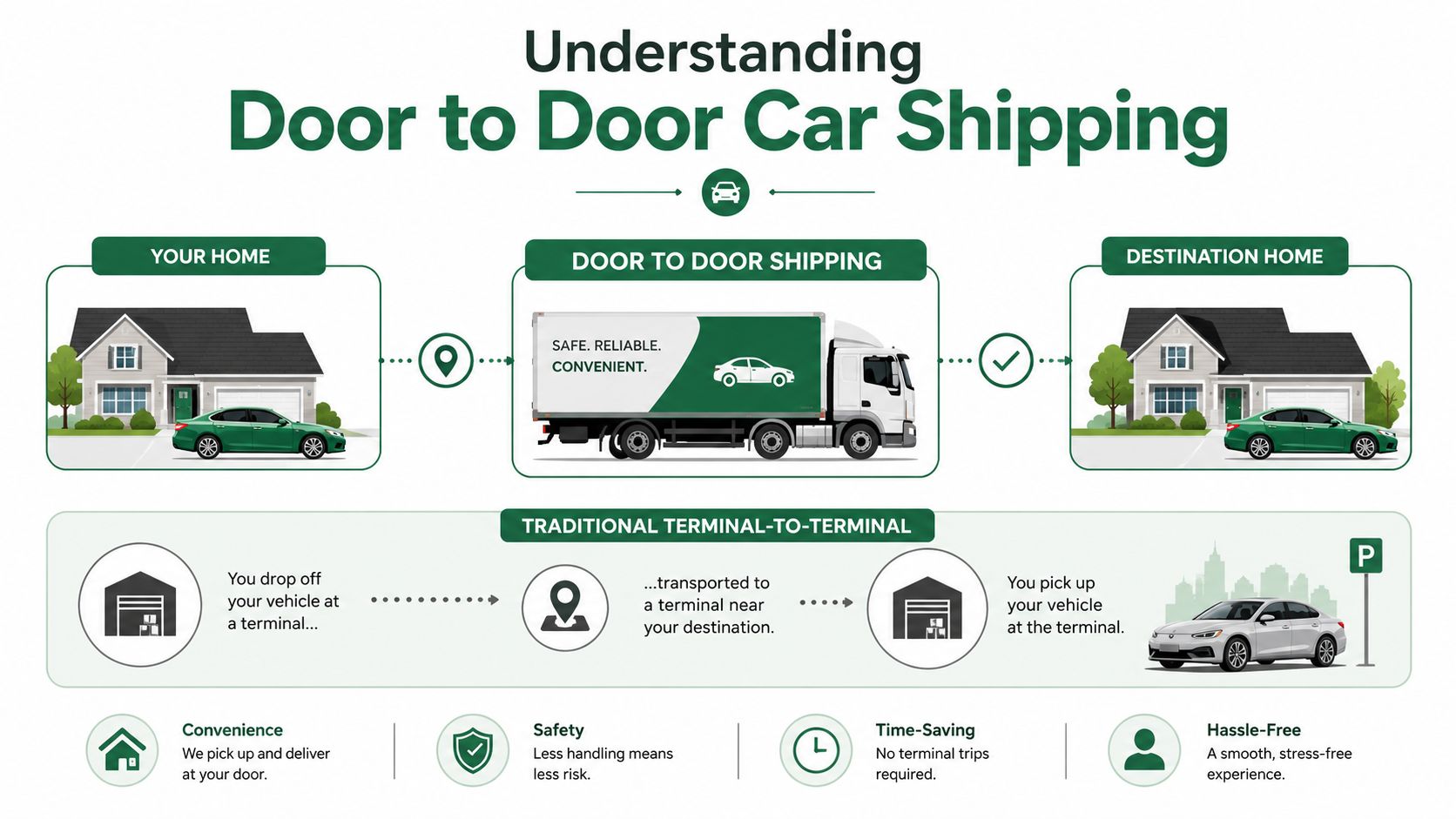
What the service includes
A domestic shipment across the 48 contiguous states may involve truck pickup, a long-distance truck route, and delivery near the destination. An international or island route can add port receiving, export processing, ocean movement, container handling, and final-mile trucking.
For Puerto Rico, the practical meaning is a coordinated move from a mainland residence or accessible pickup point to a designated handoff area or delivery location on the island after the ocean leg. The provider must synchronize the mainland carrier, port schedule, vessel movement, and Puerto Rico delivery instead of leaving you to arrange every handoff independently.
The technical benefit of intermodal shipping is that the vehicle can be loaded once at origin and opened at destination, which can reduce unnecessary handling between transport modes. Intermodal door-to-door shipping guidance explains how truck drayage, rail or ocean linehaul, and destination drayage can operate as one route.
How the Door to Door Shipping Process Works
The process begins with information, not a truck. You provide the vehicle's year, make, model, condition, operating status, pickup ZIP code, destination ZIP code, preferred dates, and whether you want open or enclosed transport. For a Puerto Rico move, the coordinator also needs the mainland location, island destination, and the appropriate port plan.
Once the route and service details are confirmed, you receive booking information. A coordinator then works on dispatch and carrier matching. The carrier needs the equipment, route, timing, and access conditions to fit together, so pickup often occurs within a multi-day window rather than at an exact guaranteed hour.
The shipment sequence
- Quote request: The provider reviews the vehicle, addresses, route, and transport preferences.
- Booking confirmation: You approve the service details and receive instructions for preparing the vehicle.
- Dispatch and matching: A suitable carrier is assigned based on route, equipment, timing, and access.
- Pickup window: The driver calls ahead, confirms the meeting location, and completes the initial inspection.
- Main transport: The vehicle travels by truck, or enters an ocean and port process when the route requires it.
- Final delivery: The driver or final carrier confirms the destination handoff and completes the delivery inspection.
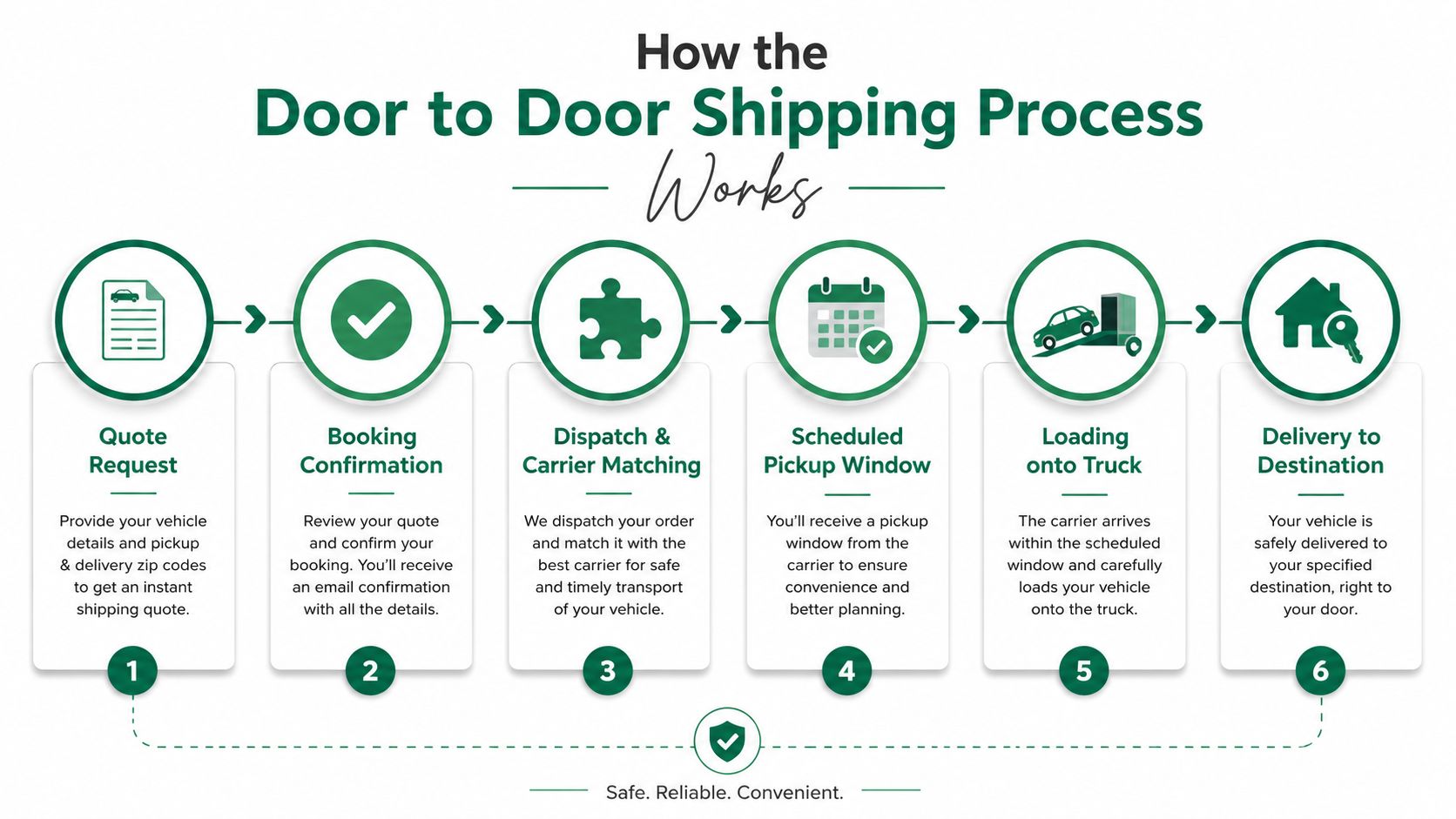
A Texas-to-Puerto Rico shipment shows why door-to-door is a service scope rather than a single mode. A truck collects the vehicle in Texas, takes it to the selected port, and the shipment moves through port and ocean operations before island delivery. Customs and document review can affect the timing, even when the customer has booked one coordinated itinerary.
The bill of lading matters at both ends. At pickup, you and the driver record existing marks, dents, scratches, mileage, fuel level, and vehicle condition. At delivery, you compare the vehicle with that record before accepting it. Delays at pickup, port receiving, vessel transfer, or final trucking can affect later milestones, which is why one coordinator tracking the whole route is valuable.
For open transport details, review National Car Transport's open car transport information and confirm exactly what the quoted service includes.
Door to Door and Terminal to Terminal Shipping
Door-to-door and terminal-to-terminal shipping solve the same basic problem, but they assign different responsibilities to the customer. Door-to-door service brings the carrier closer to the origin and destination. Terminal-to-terminal service requires you to deliver the vehicle to a designated facility and collect it from another facility, usually during that location's operating hours.
| Factor | Door to Door | Terminal to Terminal |
|---|---|---|
| Convenience | Higher, with fewer customer-arranged trips | Lower, because you manage both endpoints |
| Coordination | Provider coordinates the route and handoffs | Customer coordinates travel to and from terminals |
| Pickup flexibility | Meeting point can be near the home or office | Limited to terminal location and hours |
| Delivery flexibility | Delivery can occur near the destination address | Pickup occurs at the receiving terminal |
| Vehicle handling | Fewer customer transfers between locations | Additional driving and terminal handling may be required |
| Cost | Often reflects added first-mile and final-mile service | May cost less when terminals fit the route |
| Access risk | Residential restrictions may require a nearby meeting point | Terminal access is usually more predictable |
Door-to-door is especially useful when the vehicle doesn't run, the owner has limited mobility, or the customer is moving a long distance and can't make extra terminal trips. It also reduces the chance that a customer arrives at the wrong facility or misses a limited pickup window.
Terminal service can still make sense. A flexible shipper in a dense shipping corridor may prefer to handle the first and last miles personally. Someone living far from a carrier's normal residential route may also find a terminal or nearby commercial meeting point more practical. The trade-off is clear: terminal shipping can shift cost and coordination work back to you.
The right choice depends on the person, vehicle, route, and schedule. Door-to-door usually fits households and complex island moves, while terminal-to-terminal suits experienced shippers who can manage the endpoints without creating new transportation problems.
Typical Costs and Transit Times
A door-to-door quote covers the service scope from the agreed pickup area to the agreed delivery area. Distance is only one part of the calculation. Route demand, vehicle size and condition, season, fuel costs, carrier availability, and access at both addresses can also affect the price. Open transport is usually the practical budget choice, while enclosed transport may fit classic, luxury, collectible, or highly protected vehicles.
Puerto Rico introduces port and ocean dependencies that mainland routes do not have. The provider may coordinate mainland trucking, port receiving, roll-on/roll-off or container movement, vessel timing, island handling, and final trucking. A published estimate therefore works best as a planning range, not a guaranteed result.
Route examples
The table below shows planning categories for common routes. A quote is still required because the same origin and destination can produce different costs when vehicle details, access, equipment, or scheduling changes.
| Route | Typical Transit | Estimated Cost Range | Key Variables |
|---|---|---|---|
| New York to Florida | Route-dependent | Quote required | Distance, seasonal demand, vehicle size, pickup access |
| California to Texas | Route-dependent | Quote required | Long-distance routing, carrier availability, open or enclosed equipment |
| Florida to Puerto Rico | Route-dependent | Quote required | Port handling, sailing schedule, final-mile access, vehicle details |
National Car Transport's published vehicle shipping information provides a route-specific reference point for mainland-to-Puerto Rico planning. Its published example for Miami to San Juan lists about $895 to $1,195 and an estimated 7 to 10 days. Treat those figures as estimates, since the origin, destination, vehicle, access conditions, and season can change the result.
A port handoff can also make timing less predictable than a mainland move. The vehicle may wait for receiving procedures, vessel scheduling, island handling, or final-mile coordination. Pickup windows have similar limits because a carrier may combine several vehicles on one route.
Expedited pickup, enclosed equipment, difficult residential access, oversized vehicles, and inoperable cars may increase the quote or require special arrangements. Ask which services are included before comparing offers. The car shipping cost guide explains the variables behind an estimate.
Confirm whether the price includes pickup, port or terminal handling, final delivery, insurance, and any work needed to load an inoperable vehicle. If a truck cannot safely reach the address, the provider may set a nearby meeting point. That change affects the service scope and should be agreed upon before dispatch.
Insurance and Inspection Basics
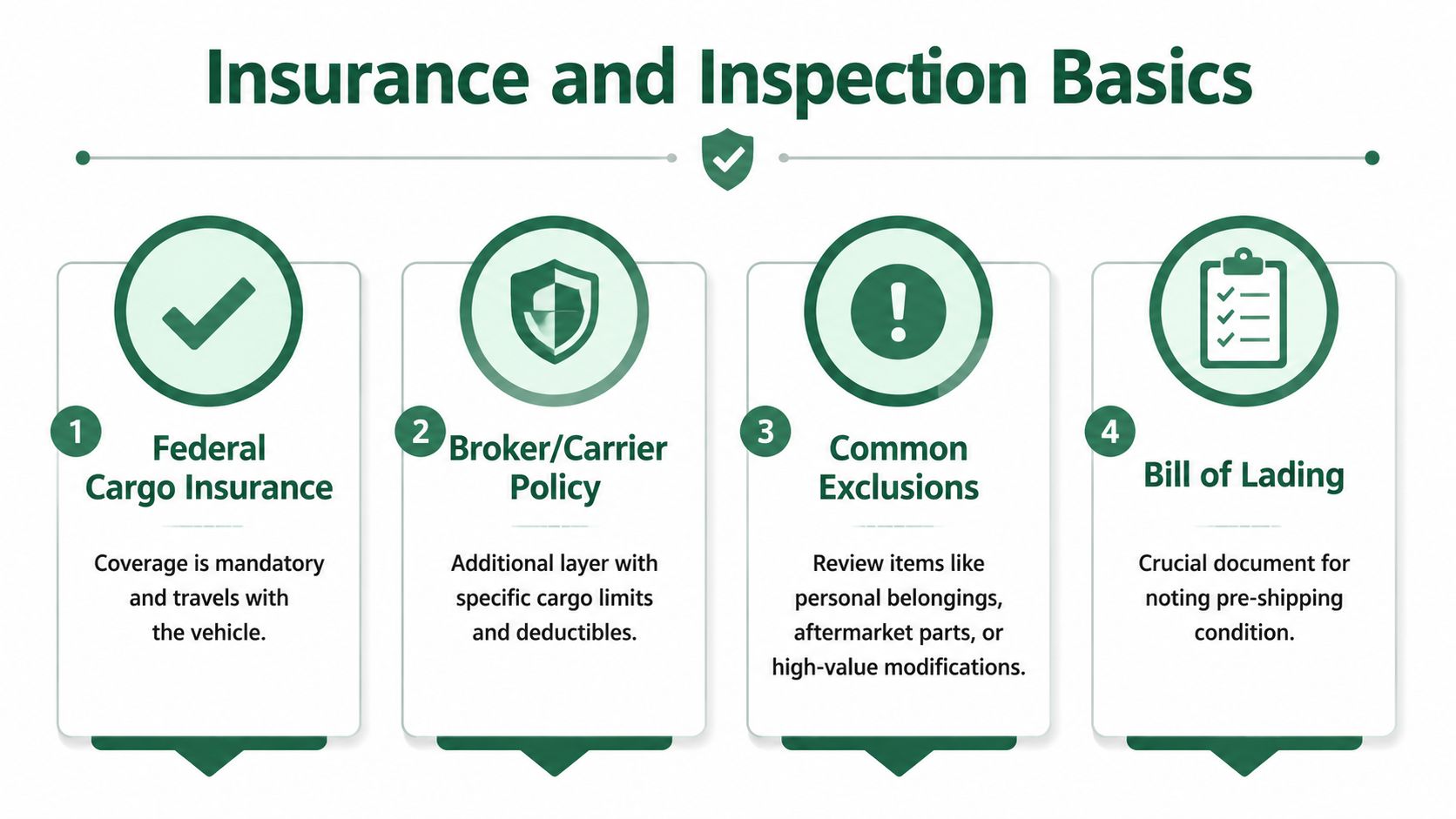
Insurance questions deserve attention before the vehicle moves. Ask whether the carrier's cargo coverage applies during every transport leg, what limits and deductibles apply, and whether the policy excludes personal belongings, mechanical problems, aftermarket parts, or high-value modifications.
The provider or carrier should explain the applicable policy rather than offering a vague statement that the vehicle is “insured.” Coverage for transport damage is different from coverage for a mechanical failure that existed before pickup. Personal items inside the vehicle may also fall outside the carrier's responsibility.
Create a condition record
The inspection at pickup establishes the starting point. Wash the vehicle when practical, remove clutter, and take clear, timestamped photos of every side, the roof, wheels, glass, interior, odometer, and existing damage. Walk around the car with the driver and make sure the bill of lading describes visible marks accurately.
At delivery, inspect the vehicle before signing the final condition report. Compare the car with the pickup record, check the same areas, and photograph anything that appears different. If you notice damage, record it on the delivery paperwork and contact the provider promptly.
Prepare the paperwork
Requirements vary by route and shipment context. Keep identification, registration, title or lien authorization, and the vehicle keys available when requested. Puerto Rico routes can involve additional port and customs procedures, so ask for the exact document list before the vehicle is accepted.
For practical background on coverage questions, including what customers should review in transit insurance, consult this guide from Gentle Giant Removals. On Puerto Rico-to-mainland shipments, Crowley's vehicle shipping guidance explains that reservations should be made in advance, vehicle drop-off uses its Isla Grande facility during weekday hours, and customs-related documentation isn't required for shipments to the U.S. mainland in that stated context.
A residential address may still require a nearby handoff if the carrier can't legally or safely enter the street. That isn't a failure of door-to-door service. It's the normal adjustment that protects the driver, vehicle, and property.
Who Benefits Most From Door to Door Service
Door-to-door service helps most when the endpoints create more work than the actual drive. A household relocation is a good example. The family may already be handling movers, utilities, school records, and travel, so taking a car to a terminal and arranging a separate ride from another terminal adds an avoidable task.
Snowbirds face a similar problem. One person may leave a vehicle at a seasonal home in Florida while flying to a residence farther north, or reverse the route later. A nearby pickup and delivery plan means the car can move without the owner driving long distances or maintaining two vehicles at both locations.
Military families on Permanent Change of Station orders often work around firm reporting dates. A coordinated pickup and destination handoff can reduce the need for a service member or spouse to make an extra terminal trip while managing housing and family logistics.
Different customers, different pressure points
- Students: A student moving to college may need the vehicle delivered near campus or family housing, without navigating an unfamiliar terminal or arranging local transportation.
- Dealerships: A dealer transferring inventory between locations needs predictable collection and delivery records, especially when several vehicles move on different schedules.
- Businesses: A company relocating fleet vehicles can assign pickup and delivery locations without asking employees to drive each vehicle across the country.
- Online buyers: Someone buying from a private seller, auction, or online marketplace may never meet the seller in person. Door-to-door coordination connects the seller's location with the buyer's address and makes inspection documentation more important.
- Puerto Rico customers: A mainland owner sending a vehicle to San Juan, or a Puerto Rico resident shipping a vehicle to the mainland, benefits from one party coordinating the road segment, port handoff, ocean movement, and final delivery.
Vehicle value can change the equipment decision. An everyday commuter may fit open transport, while a classic or luxury vehicle may justify enclosed auto transport because the owner wants added protection from exposure during the road portion.
The main benefit isn't just that a truck comes near the home. It's that the customer has fewer separate parties to contact when the shipment includes unusual access, multiple transport legs, or a port.
When Door to Door Shipping Is the Right Choice
Choose door-to-door service when convenience, route complexity, and support matter more than controlling every individual leg. The strongest indicators are a cross-country relocation, a narrow delivery window, an inoperable vehicle, a vehicle purchased sight unseen, or a Puerto Rico shipment that would otherwise require separate mainland trucking and port arrangements.
A household moving from California to another state may value a single delivery plan because the owners are traveling separately. A snowbird may prefer not to make a long seasonal drive. A military family may need the vehicle aligned with a new duty station. A student may not know the local terminal or have a practical way to reach it.
The vehicle itself also matters. A high-value car may need enclosed equipment and careful inspection. A non-running car can't be driven to a depot, so the provider must confirm loading equipment and access. A business moving fleet vehicles may prioritize consistent documentation and scheduling over managing the lowest-cost endpoint.
Use this decision test
Ask five questions before booking:
- How much convenience do you need? If an extra terminal trip would disrupt work, school, family travel, or a move, door-to-door has a stronger case.
- Can a carrier reach each address? Check street width, overhead branches, gates, local restrictions, and available space. Plan a nearby accessible meeting point if necessary.
- Does the vehicle need special handling? Consider enclosed transport, loading assistance, or a container for an unusual or valuable vehicle.
- How complex is the route? Puerto Rico moves and other multi-leg routes benefit from coordinated responsibility.
- How much guidance do you want? First-time shippers may prefer a dedicated advisor who explains documents, inspections, scheduling, and delivery expectations.
Terminal or hybrid service may be smarter for a flexible customer on a dense route, someone who lives near a suitable facility, or a business shipping oversized commercial equipment that needs specialized planning. It can also work for an experienced driver who wants to manage the first and last miles personally.
Before pickup, confirm: access at both ends, removal of personal items and toll transponders, dated damage photos, insurance limits and deductible, vehicle preparation, and availability of keys, title, and identification.
Door-to-door isn't a promise that a carrier can enter every residential street. It's a coordinated plan that gets the vehicle as close as safety and law allow while reducing the number of endpoint tasks you manage.
National Car Transport coordinates door-to-door vehicle shipping across the mainland United States and Puerto Rico, including trucking, port handoffs, and ocean options where needed. Its U.S.-based bilingual English and Spanish agents have over 20 years of auto transport logistics experience, and you can visit National Car Transport to discuss your vehicle, access conditions, route, and delivery plan.