
The most common advice about wedge car trailers is also the most misleading: if the deck has three loading positions, the trailer can haul three cars. That's only the physical answer. The actual answer depends on curb weight, trailer tare weight, axle ratings, tongue weight, the tow vehicle's limits, route restrictions, and how the vehicles are positioned.
A three-car wedge may carry three light vehicles on one trip, but three heavy SUVs can exceed legal or practical limits before the final vehicle is secured. For private owners, dealerships, military families, snowbirds, students, and businesses arranging transportation across the United States or toward San Juan, the useful question isn't “How many slots are there?” It's “Which exact vehicles can this combination move safely and legally on this route?”
Table of Contents
- Wedge Trailer Capacity: Deck Slots Versus Legal Payload
- Design Geometry and Historical Evolution
- Calculating True Payload and Axle Limits
- Comparing Wedge Setups to Flatbeds and Multi-Level Carriers
- Navigating Route Constraints and Federal Safety Rules
- The Value of Professional Auto Transport Networks
Wedge Trailer Capacity: Deck Slots Versus Legal Payload
A wedge trailer's advertised vehicle count describes deck space, not the number of vehicles the combination can legally deliver. The calculation includes the trailer, tow vehicle, cargo, passengers, tools, fuel, tongue weight, axle ratings, and the actual curb weights of the vehicles loaded.
A design may physically accept two or three vehicles while the loaded combination exceeds its GVWR, axle ratings, or gross combined weight rating. Three compact cars may fit within the available payload. Three large SUVs may not. Open positions, long ramps, and correctly inflated tires do not compensate for a failed weight calculation.
Slots are not the same as payload
Begin with the manufacturer's ratings. Subtract the trailer's empty weight, then account for every item added before departure. One documented example lists a 12,000-pound GVWR and an empty weight near 4,780 pounds, leaving roughly 7,220 pounds of theoretical cargo capacity before accessories, tools, fuel, and uneven distribution are considered. See this wedge trailer payload example.
That remaining figure does not mean the same amount of vehicle weight can be placed anywhere on the deck. Vehicle position changes axle loading and tongue weight. The trailer may stay below its total rating while one axle is overloaded or the tow vehicle has too little payload capacity left.
Practical rule: A 7,220-pound payload figure is a starting point, not a verdict. Axle loading and tongue weight decide whether the planned load works.
Why three vehicles often become two
Wedge decks stagger vehicles vertically and longitudinally. This arrangement saves space, but it changes the center of gravity and how weight reaches the axles and hitch. A vehicle too far forward can create excessive tongue load. One too far rearward can reduce stability and increase sway risk.
The operator should not drive a single car all the way forward by default. Public vehicle guidance warns that loading position affects balance and stability, so the trailer manufacturer's loading instructions control the setup. With a sedan and two SUVs, the safe decision may be to carry only the sedan and one SUV, reposition the vehicles, or select another carrier.
That is why dispatch starts with a vehicle-by-vehicle worksheet, not a slot count. The worksheet records each vehicle's weight, dimensions, position, and destination before equipment is assigned. A carrier moving vehicles between New York, Chicago, Atlanta, Dallas, Denver, Los Angeles, Seattle, Miami, and other major markets needs that inventory before dispatch.
The same discipline applies to mainland shipments bound for San Juan. A trailer can accept the vehicles physically and still prove unsuitable once port handling, route restrictions, axle limits, and the tow vehicle's capacity are included. In day-to-day logistics, a three-car wedge often becomes a two-car load because the legal margin matters more than the unused deck position.
Design Geometry and Historical Evolution
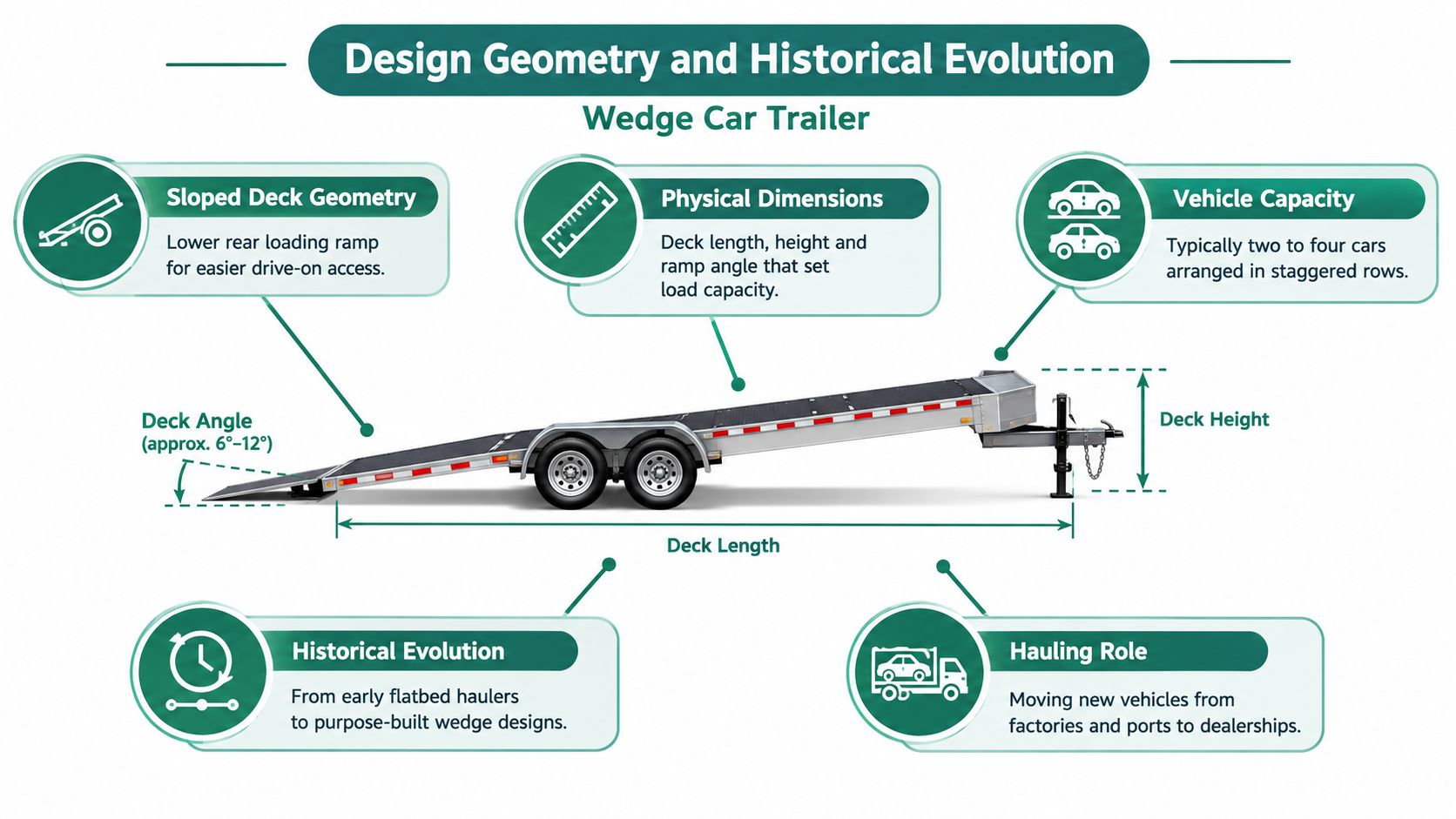
A wedge trailer's usefulness comes from its geometry, not just from the number of visible deck positions. An angled or stepped deck places vehicles at different heights and lengths, allowing a compact trailer to carry multiple vehicles without using a fully flat platform. A typical 35-foot design has a 10-foot level section and a 25-foot slope, with a 90-inch deck width and an approximate 66-inch deck height when level. Those dimensions show why the layout can fit several vehicle positions while still creating different loading and clearance demands.
The slope changes how a vehicle reaches the deck. A lower rear approach can reduce contact risk for a low-clearance bumper, spoiler, or underbody component compared with a steep transition onto a raised flat deck. It does not remove the need for careful ramp placement. The operator still has to check the tire path, suspension compression, approach angle, deck height, and securement points before loading.
From early car haulers to specialized wedges
Purpose-built vehicle hauling grew from a practical delivery problem at the end of the nineteenth century. In 1896, automobile manufacturer Alexander Winton needed a way to deliver completed cars without requiring buyers' vehicles to accumulate long road mileage before sale. After selling its first 22 cars in 1898, Winton developed a modified automobile with a separate wheeled cart. By 1899, the Winton Motor Carriage Company was manufacturing the hauler for its own use and for other manufacturers, according to the Institute for Transportation's history of the semi-trailer.
The link to modern wedge car trailers is structural. A towing vehicle pulls or supports a specialized platform that carries another vehicle. Later gooseneck, wedge, and multi-level designs refined the same basic objective: concentrate the load on a purpose-built frame, distribute weight through an articulated connection, and move vehicles without adding road mileage to the transported cars.
Early rigid carriers generally handled approximately three or four cars. Hydraulic multi-level designs later introduced independently adjustable decks that could be raised, lowered, and angled for vehicles with different dimensions. Kaufman identifies 1992 as the year it built its first U.S. wedge car trailer, followed by two complete redesigns, as described in Kaufman Trailers' multi-car trailer overview.
That history explains the wedge's continuing role. It is suited to specialty, regional, dealership, motorsport, and private hauling where loading flexibility and a compact footprint matter more than maximum volume. In practice, those design advantages still have to fit the vehicles, axle limits, and route assigned to the load.
Calculating True Payload and Axle Limits
A useful payload calculation starts with the trailer's rating and ends with the complete loaded combination. Don't stop at the number printed on the trailer plate.
Use this sequence before accepting a load:
- Record each vehicle's curb weight. Use the actual vehicle configuration, including options and installed equipment.
- Record trailer tare weight. Include ramps, spare tires, winches, toolboxes, tie-down equipment, and other permanent or carried items.
- Add people and cargo. Passengers, fuel, tools, parts, luggage, and shipping accessories reduce available capacity.
- Check the trailer GVWR and axle ratings. The lower practical limit controls when axle loading and total weight differ.
- Check the tow vehicle's ratings. Tongue weight counts as part of the tow vehicle's load, and the gross combined weight rating governs the complete combination.
- Verify distribution. The load has to be balanced across the deck and axles, not merely kept below a total scale number.
Manufacturer guidance generally recommends about 10% to 15% of loaded trailer weight on the hitch, with roughly 60% of the load toward the front, as summarized in this vehicle towing guidance from Hyundai. Those figures are operating guidance, not permission to ignore the specific trailer's instructions or ratings.
A worked mixed-load example
Consider a hypothetical dispatch with a sedan and two mid-size SUVs. The worksheet below deliberately leaves curb weights open because the correct figures must come from the actual vehicles, not a generic body style.
| Vehicle Type | Curb Weight | Physical Slot | Payload Impact |
|---|---|---|---|
| Sedan | Confirm from vehicle records | Lower or level position | Uses available payload and affects front-to-rear balance |
| Mid-size SUV one | Confirm from vehicle records | Sloped or staggered position | May add substantial axle and combined-weight demand |
| Mid-size SUV two | Confirm from vehicle records | Remaining physical position | Could make the full load exceed practical limits |
The calculation is simple in form: trailer tare weight plus vehicle weights plus cargo must remain within the applicable limits. The hard part is that several limits apply at once. Two heavy vehicles may consume nearly all practical payload even when the deck still has room for a third.
Position changes the outcome
Loading the heaviest vehicle closest to the hitch may increase tongue weight beyond what the tow vehicle can carry. Loading too much mass behind the axles can reduce hitch loading and make the rig unstable. A wedge's changing deck elevation also changes vehicle center-of-gravity height and axle loading, so the operator should inspect the combination after each vehicle is secured.
A trailer can be physically full and legally underloaded, or physically half empty and already overweight. Only the actual weights and distribution answer the question.
Rejecting a vehicle isn't a failure of planning. It's the correct result when the combination can't meet its ratings. A professional dispatcher may split the order, assign a different carrier, reposition a vehicle, or move the heavier unit separately rather than gamble with braking, sway, tire loading, or roadside enforcement.
Comparing Wedge Setups to Flatbeds and Multi-Level Carriers
A three-car wedge is not automatically a three-car shipment. Legal payload, axle loading, vehicle dimensions, and the route can reduce its practical capacity before the third vehicle reaches the deck. Equipment selection should start with the shipment and delivery conditions, not the number of available positions.
Where each setup works best
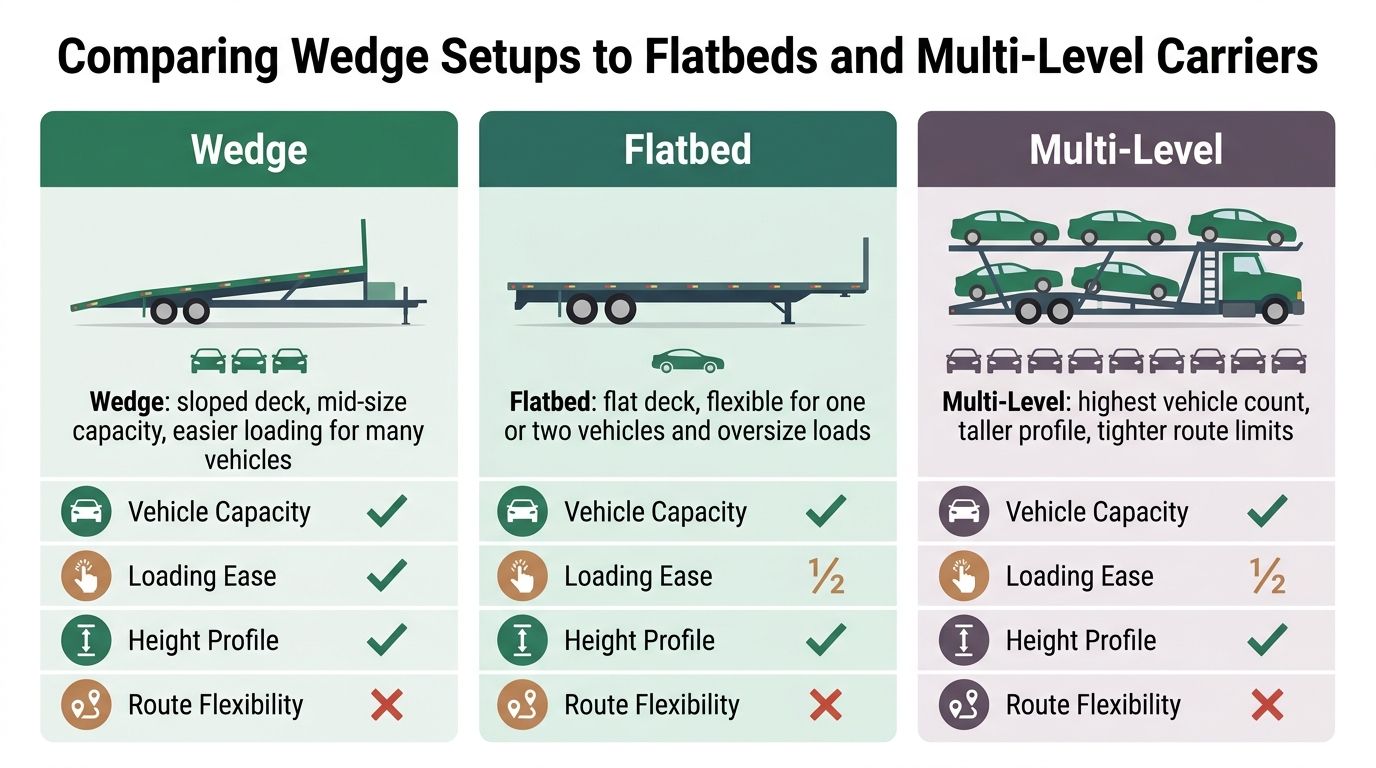
A wedge works well for regional moves, auctions, motorsport teams, private haulers, and dealerships that can match compatible vehicles to its staggered deck. Its compact footprint and sloped loading surfaces can simplify access at locations that are difficult for larger equipment. The trade-off is direct: large trucks or SUVs may consume the usable payload even when a physical position remains open.
When a vehicle arrives disabled, unusually wide, or oversized, the wedge's changing deck elevations may be the wrong tool. A flatbed offers one continuous working surface, making winching, specialized loading, and unusual cargo placement easier. It may carry fewer vehicles, but that lower density can reduce handling complications and accommodate a vehicle that cannot be positioned safely on a staggered trailer.
Volume changes the calculation for commercial carriers. Multi-level equipment suits dealership transfers and predictable long-distance lanes where several compatible vehicles can be collected and delivered in an efficient sequence. Its height, turning radius, loading order, and pickup geometry can create problems at tight streets, low-clearance sites, or locations without enough room to stage the rig.
For a standard customer shipment, open car transport service often provides a practical balance of availability, protection, and cost. That service is different from personally operating a wedge, even though both use open transport equipment.
Route and shipment fit
A wedge may be the better choice for a constrained pickup street, a regional dealership transfer, or a specialty vehicle requiring a careful approach angle. A larger carrier can be more productive on a predictable interstate lane with compatible vehicles and suitable delivery access. For Puerto Rico, the decision also includes port handling, ocean movement, and the receiving roads available after arrival.
The lowest equipment cost can produce the highest total move cost. Detours, permits, extra handling, rejected pickup sites, and a vehicle left behind because of payload limits can erase the apparent advantage of a fuller trailer. Good dispatching compares the complete move, including legal weight and route access, rather than counting deck slots alone.
Navigating Route Constraints and Federal Safety Rules
A legal load still needs a legal route. Dimensions, operating authority, state rules, driver requirements, insurance, bridge clearances, toll facilities, and pickup geometry all affect whether a wedge trailer can complete the move without an avoidable disruption.
Federal motor-carrier rules depend on the vehicle, the type of operation, whether the move is for-hire, and whether it involves interstate commerce. FMCSA identifies a commercial motor vehicle generally within the federal framework when its gross vehicle or combination weight rating is 10,001 pounds or more, as explained in its state regulations and enforcement overview.
The pre-dispatch audit
Before the truck rolls, the dispatcher or owner should verify:
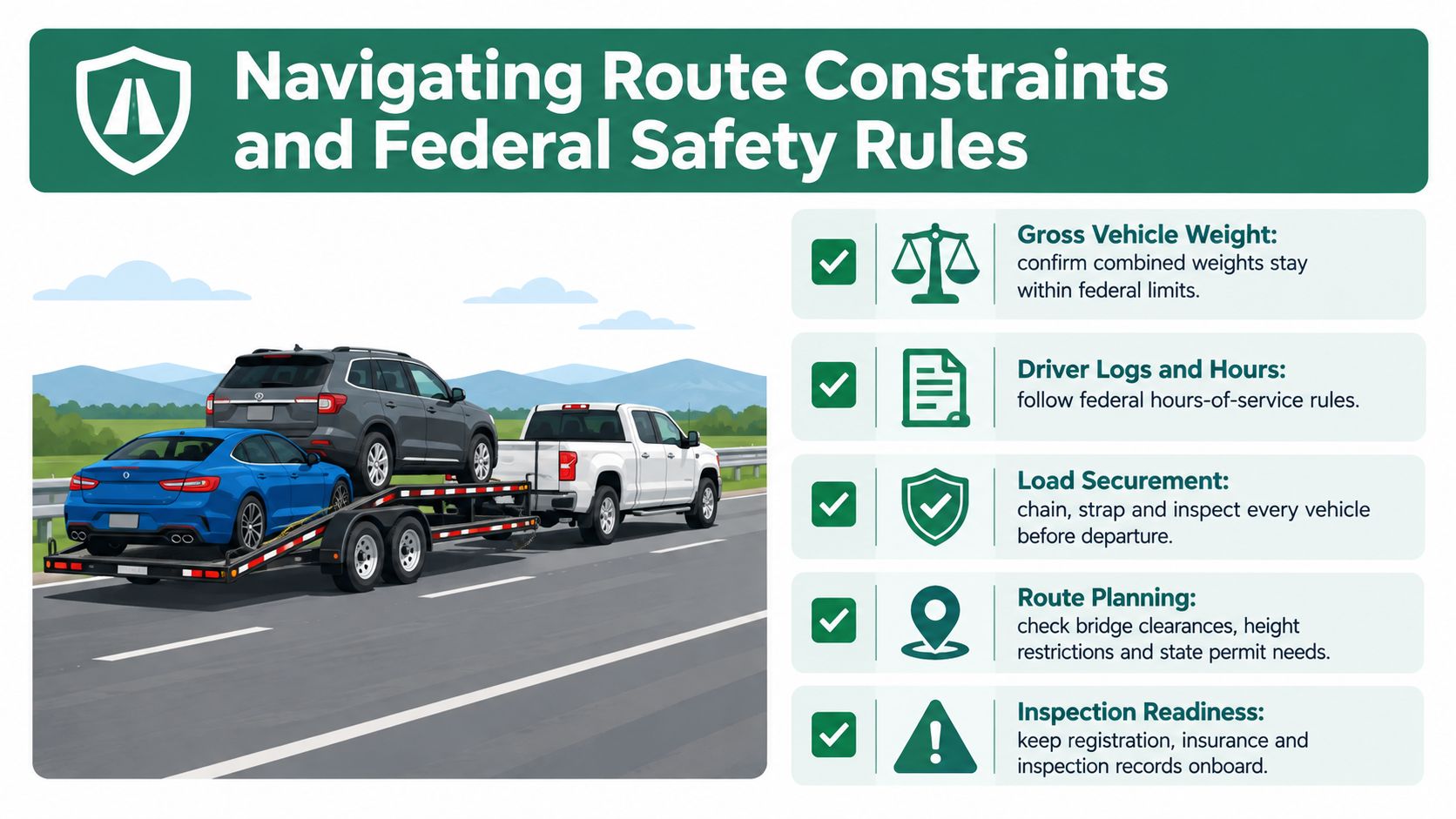
- Weight and licensing: Confirm GVWR, combined ratings, axle weights, and whether the driver's license requirements apply to the combination. A combined GVWR of 26,001 pounds is commonly relevant to U.S. licensing rules, but the actual classification and jurisdiction must be checked.
- Dimensions: Measure loaded height, overall length, width, and deck position. Double-deck equipment may require approximately 14 feet 6 inches of clearance in many jurisdictions, which can rule out bridges, residential streets, fuel stations, toll facilities, and some delivery locations.
- State requirements: Registration, fuel-tax obligations, permits, and equipment rules can differ by state. FMCSA advises interstate operators to contact the agencies in every state where they operate or pass through.
- Connection and securement: There is no single federal rule that answers every trailer-to-vehicle connection question. The operator must reconcile equipment ratings with applicable state requirements and inspect chains, straps, brakes, lights, ramps, and tie-down points.
- Site geometry: Confirm that the pickup and delivery locations have enough room for approach, loading, turning, staging, and safe unloading.
For-hire interstate property carriers transporting nonhazardous property on vehicles with a GVWR of 10,001 pounds or more may be subject to a $750,000 minimum financial responsibility level, according to FMCSA's financial responsibility guidance. Customers should verify the carrier's legal name, authority, and insurance status through federal records instead of relying only on an advertisement or quote.
Mainland moves and Puerto Rico logistics
Shipping a vehicle to or from Puerto Rico adds a port and documentation layer. A mainland route toward San Juan may involve state compliance on the road leg, carrier authority, port appointment procedures, ocean handling, and local delivery limitations. A trailer that works between Dallas and Atlanta may not be the right tool for a port approach or a final-mile street in San Juan.
Puerto Rico's Department of the Treasury requires an importer to submit a detailed declaration of imported merchandise, even when the property may be exempt from sales-and-use tax rules. Its SURI tool estimates vehicle excise tax using the VIN or the vehicle's make, model, and year. The published schedule lists a $637.50 minimum tax for a vehicle with a contributory price up to $6,170, while higher brackets range from 10.2% to 34.0% on specified portions of value, with the highest listed bracket applying above $44,890, according to the Puerto Rico Treasury importer guidance.
That means a transport quote isn't automatically the landed cost. Owners should ask about declarations, excise tax, port charges, registration, and receiving requirements before booking the mainland leg.
For door-to-door planning, door-to-door auto transport is best evaluated against the actual pickup and delivery addresses, not just the city names. Residential streets, ferries, port gates, and final-mile clearances can determine whether the carrier delivers directly or uses a nearby safe meeting point.
The Value of Professional Auto Transport Networks
DIY towing makes sense for an experienced operator with the correct truck, trailer, ratings, securement equipment, route knowledge, and time to manage inspections and paperwork. For many individuals and businesses, however, the difficult part isn't finding three deck positions. It's coordinating the right carrier for the exact vehicles, route, timing, insurance requirements, and delivery conditions.
A professional network can evaluate whether open transport, enclosed transport, a container, or ocean service fits the move. That matters for ordinary daily drivers, classic vehicles, dealership inventory, auction purchases, military relocations, student moves, snowbird travel, and mainland shipments connected to Puerto Rico. Owners of high-value or condition-sensitive vehicles can also review enclosed auto transport when weather and exposure control matter more than maximum shared capacity.
The same operational discipline used in vehicle logistics applies to equipment reliability. For readers assessing maintenance and failure risk across automotive operations, this automotive asset reliability guide offers useful context on keeping critical assets dependable.
National Car Transport brings more than 25 years of experience, an A+ BBB rating, transparent flat-rate pricing, and a network of 25,000+ vetted carriers, based on the company information provided for this service. Its bilingual English and Spanish agents are based in the United States, with more than 20 years of experience in auto transport logistics service, helping customers with scheduling, vehicle condition, route requirements, port coordination, and delivery updates.
That human guidance matters because no vehicle transport is alike. A sedan moving from Boston to Miami has different risks from an SUV moving from Colorado to San Juan, and neither should be reduced to a generic three-car trailer quote. A knowledgeable agent can make the process simpler and faster while helping the customer avoid an unsuitable load, unclear pricing, or a route that looks workable until the final mile.
If you're shipping a vehicle across the 48 states or arranging mainland transport to San Juan, National Car Transport can match the move with open, enclosed, container, or ocean-connected service and coordinate the route details. Visit National Car Transport to request a clear quote and speak with a bilingual U.S.-based agent who can guide your shipment from pickup through delivery.