
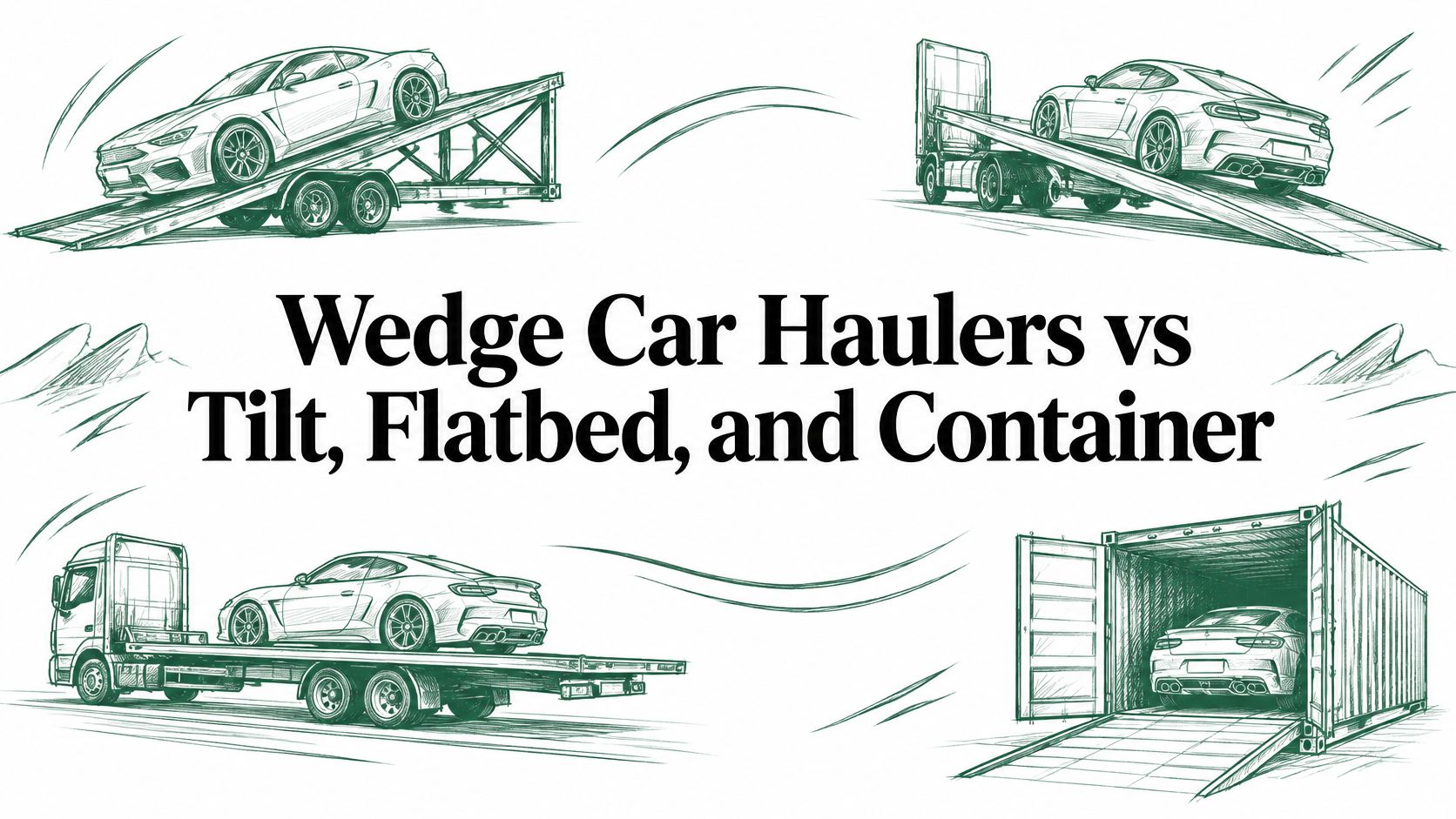
A wedge car hauler is an angled multi-vehicle trailer that typically carries two to four small cars, but legal payload, not the car count, determines what it can haul.
Shopping for an empty trailer slot is the wrong starting point. Start with your heaviest vehicle, its lowest clearance point, and whether the route includes an ocean crossing. Those details determine which equipment can carry the shipment safely, what handling it needs, and how the service should be priced.
Table of Contents
- What a Wedge Car Hauler Is
- Choosing Between Wedge, Tilt-Deck, Flatbed, and Container
- Payload and Car Count Before You Book
- Loading Angles and Cargo Securement Rules
- What Shared Wedge Loads Cost to Ship
- Confirm the Load Then Book the Move
What a Wedge Car Hauler Is
A wedge car hauler has a deck that rises toward the front, allowing vehicles to occupy different heights along the trailer. Unlike a large articulated auto carrier with adjustable decks, a wedge uses a relatively straightforward sloping platform, wheel runners, and loading ramps.
Say a household is relocating a sedan and an SUV. Both vehicles may look as though they fit, but the dispatcher still needs their weights, dimensions, and running condition before assigning a trailer. A dealer moving compact auction purchases faces the same calculation, even when every vehicle has a confirmed parking space on the deck.
The principle dates to 1899, when Alexander Winton's Cleveland company manufactured a dedicated vehicle-hauling trailer to avoid driving new automobiles to distant buyers, a development widely credited as the first semi-trailer, according to Iowa State University's Institute for Transportation.
What the design means for your shipment
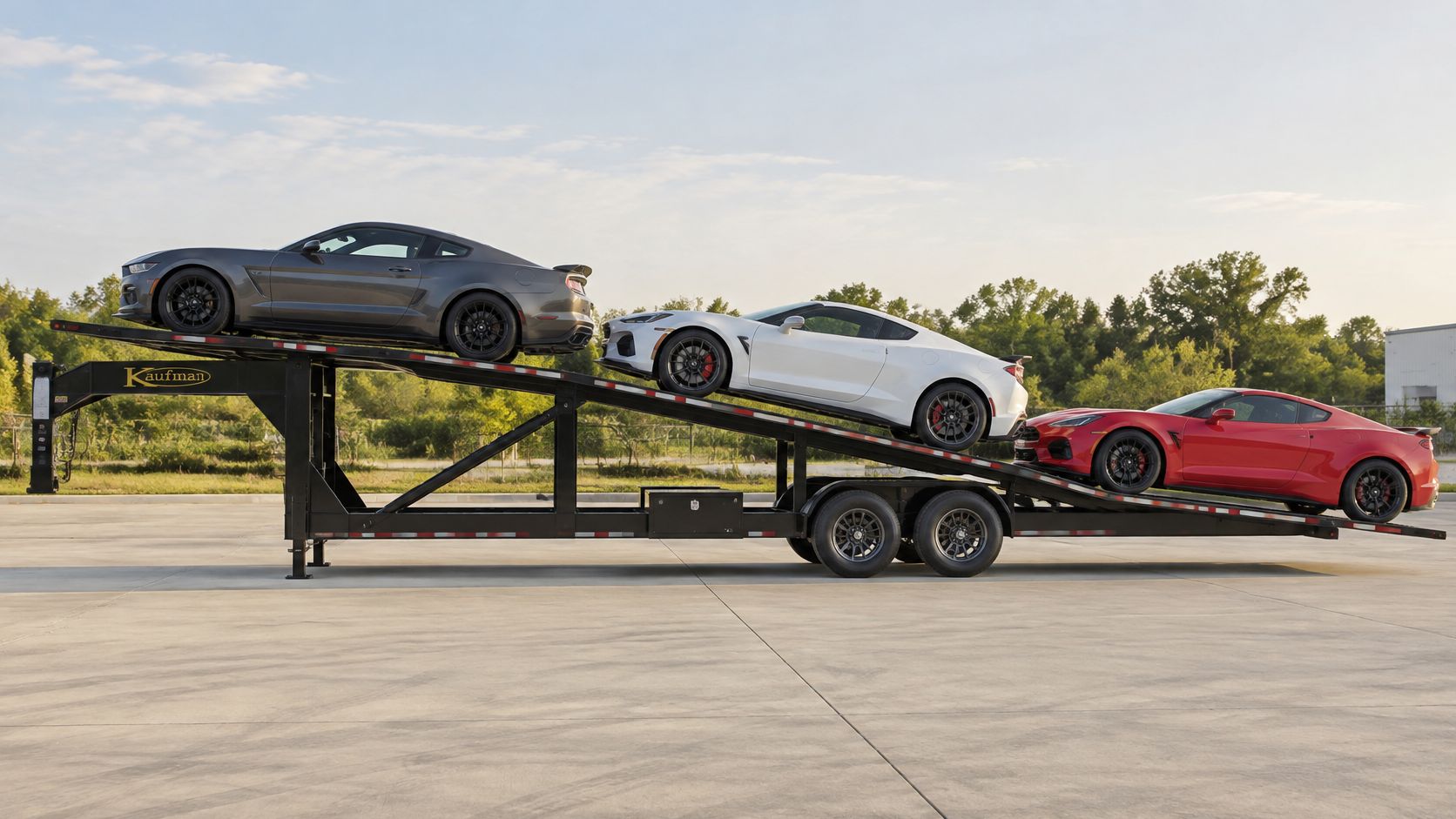
The angled layout makes wedge car haulers useful for consolidating compatible vehicles without using a full-size commercial auto carrier. Flip-outs on larger designs extend the loading surface, but extra deck space doesn't create extra weight capacity.
This example shows how vehicles occupy different positions along the sloping platform.
For relocating households, snowbirds, military families, students, dealerships, auctions, and online buyers, the service is vehicle transportation, not trailer rental. You provide the shipment details; the carrier supplies the truck, trailer, driver, and loading plan.
- Mainland delivery: Confirm whether the truck can reach the requested address or needs a nearby meeting location.
- Island transport: Treat the highway movement and vessel movement as separate handling stages within the same itinerary.
- Special-condition vehicles: Disclose modifications and mechanical problems before anyone reserves equipment.
Practical rule: A vehicle that fits between the ramps isn't necessarily compatible with the trailer. Weight, wheel position, clearance, and securement access all matter.
A wedge can be a sensible shared-load option, but its shape alone doesn't tell you whether it's the right equipment for your car.
Choosing Between Wedge, Tilt-Deck, Flatbed, and Container
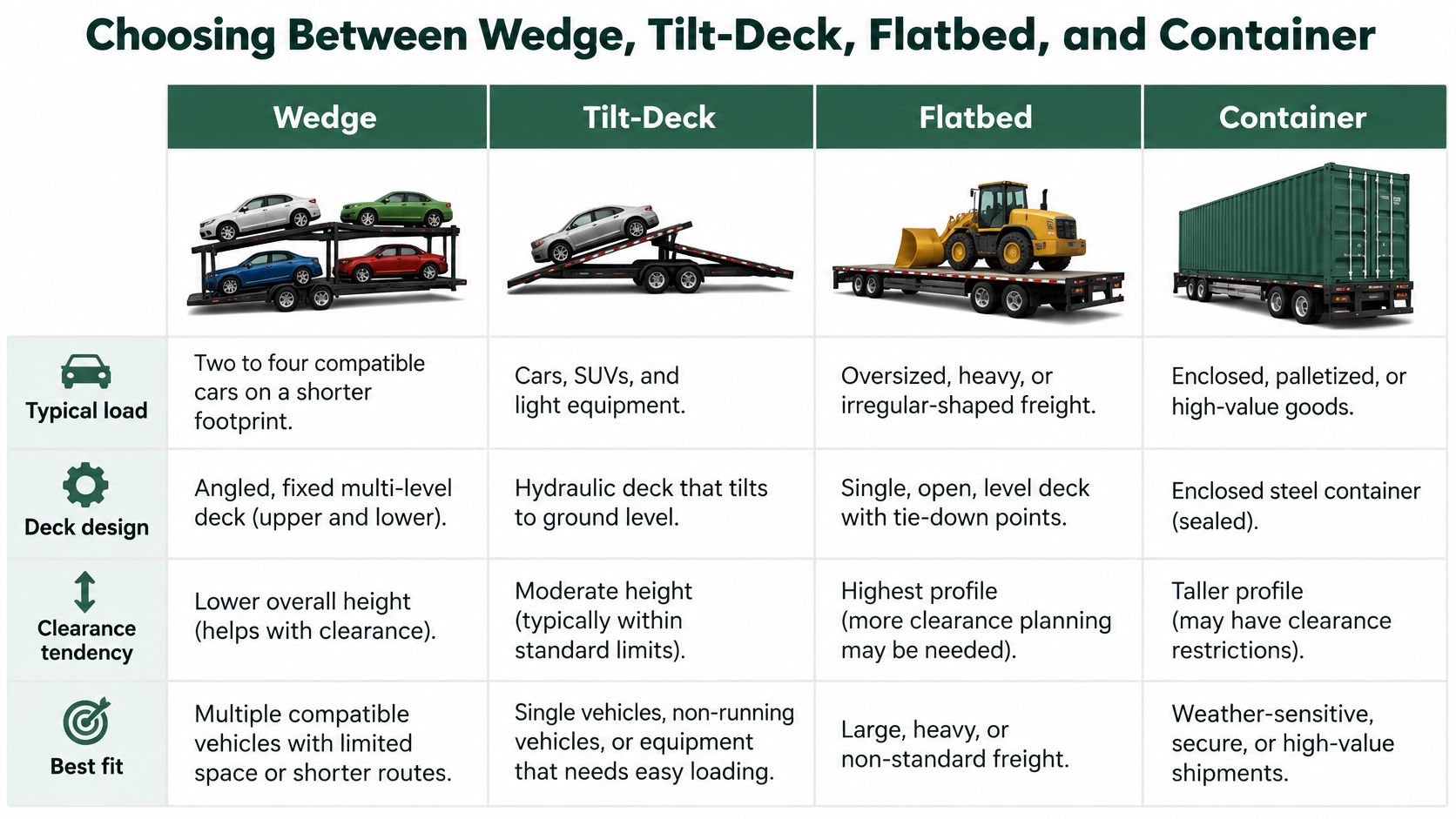
Wedge, tilt-deck, flatbed, and container at a glance
| Method | Typical load | Deck and loading | Clearance tendency | Best fit |
|---|---|---|---|---|
| Wedge car hauler | Two to four small, compatible cars | Angled deck; larger designs use flip-outs and slide-in ramps | Low-profile floors help initial approach; wedge transitions can still scrape | Shared dealer, auction, and relocation loads |
| Tilt-deck | Usually a single vehicle | Entire deck tilts to form a drive-on surface | Can provide a gentler approach, subject to deck geometry | Inoperable cars, equipment, dedicated moves |
| Flatbed | Usually a single vehicle; paired loads require suitable dimensions and ratings | Level deck loaded by ramps, winch, or lifting equipment | Tall decks require particular attention to ramp angle | Oversized vehicles, unusual cargo, vehicles needing a level platform |
| Container | Often a single customer's vehicle for an ocean shipment | Vehicle enters a closed freight container and is secured inside | Entry clearance and terminal handling require separate checks | Containerized island shipments and protected ocean handling |
These are equipment categories, not interchangeable service promises. A container doesn't pick up your car at home, and a flatbed doesn't guarantee a gentle loading angle. Ask what equipment will perform each part of the move.
The comparison below illustrates those differences.
Match the equipment to the shipment
Dealership and auction transfers. Several compact cars moving between Atlanta, Dallas, Chicago, or Miami can suit a shared wedge load when their combined weight and placement work. The dispatcher should evaluate the complete collection, not approve each car independently and assume the total will work.
An everyday household sedan. You generally don't need a dedicated trailer for a standard running car. A shared wedge or conventional open car transport service can accommodate the shipment without making you responsible for trailer ownership or operating logistics.
A Puerto Rico relocation. A student, snowbird, or military family needs a truck-plus-ship itinerary rather than a particular highway trailer all the way through. For a Jacksonville-to-San Juan plan, confirm the mainland collection, terminal delivery, vessel booking, and island release arrangements. Ask whether the ocean booking uses a container or another vehicle-shipping service; a highway equipment description doesn't answer that question.
A lowered sports car or exotic. Choose a loading method based on the lowest bodywork and underbody components. Enclosed transport may provide desirable protection, but enclosure alone doesn't guarantee a suitable ramp angle. Request confirmation of the actual loading equipment.
A non-running auction vehicle. Tell the dispatcher whether the wheels roll, the steering turns, and the brakes release. A winch can pull a rolling car, but locked wheels may require skates, dollies, or different recovery equipment. Don't describe every disabled vehicle as non-running.
An oversized pickup. A level flatbed or reduced shared load may be more appropriate when the truck consumes too much available capacity or won't sit correctly on wheel runners. Provide details about lift kits, extended mirrors, oversized tires, and aftermarket bumpers.
Why a low floor isn't the whole answer
Kaufman's low-profile wedge specifications list a 23-inch floor height and a selected 14,000- to 18,000-pound GVWR for its 50-foot model. Those specifications describe a particular trailer, not every wedge on the road.
A lower floor can help a bumper clear the initial approach. However, a long-wheelbase car can still contact the transition where the loading surface changes slope. Ask the carrier to assess both locations rather than approving the load from floor height alone.
Choose the loading method for the least forgiving vehicle in the shipment, not the easiest car to load.
Watch the equipment with those questions in mind, especially the transition from ramp to deck.
Payload and Car Count Before You Book
A “four-car” label describes a layout, not a promise that four of your vehicles will fit. The useful figure is the payload left after the heaviest vehicle is accounted for, with each vehicle's dimensions and the trailer's ratings considered separately.
| Configuration | Empty weight | GVWR or listed towing capacity | Rated payload | Realistic load |
|---|---|---|---|---|
| Enclosed 18-ft, light | Not stated | 7,000 lb GVWR | Not stated | A light car within the weight and dimensional limits |
| Enclosed 18-ft, heavier | Not stated | 9,900 lb GVWR | Not stated | A compatible SUV; paired cars require independent length checks |
| Enclosed 28-ft, same rating | Not stated | 9,900 lb GVWR | Not stated | More deck length, with payload dependent on the equipped trailer's weight |
| Open four-car wedge, about 56 ft usable | About 6,300 lb | About 18,000 lb listed towing capacity | Not stated | Four small cars only if every applicable rating permits |
| 48/53-ft three-car wedge | About 8,500 lb | 21,000 lb GVWR | About 12,500 lb theoretical | Advertised car count remains subject to axle and combination limits |
| 50-ft triaxle low-profile | Not stated | Selected GVWR controls | Not stated | Compatible vehicles within the certified loading plan |
The Steinbach Pro Series wedge specification sheet lists GVWRs of 7,000 pounds and 9,900 pounds for its 18-foot models, and 9,900 pounds for the 28-foot configuration. It does not provide the empty weights needed to calculate payload for those rows.
The open four-car wedge listing gives an approximate 6,300-pound empty weight, about 56 feet of usable area, and approximately 18,000 pounds of listed towing capacity. The three-car wedge's empty weight and GVWR are not established by a relevant source here, so use the specific trailer's certified ratings and equipped empty weight rather than treating those figures as universal specifications.
Calculate the remaining margin
Trailer payload equals GVWR minus actual equipped empty weight. Count installed winches, spare tires, ramps, and securement equipment in the empty weight. Without both figures for the actual trailer, its payload cannot be calculated reliably.
The enclosed examples show why more deck length does not automatically mean more carrying capacity. A longer trailer can weigh more while retaining the same GVWR, leaving less room for vehicles.
Keep the trailer calculation separate from the truck's limits. Check the truck's gross combination weight rating, axle ratings, hitch limits, and pin or tongue load. Fuel carried by the truck affects truck and combination calculations; equipment carried on the trailer uses trailer payload.
Start with the heaviest vehicle
Suppose a dealer is shipping compact sedans with a full-size electric SUV. Account for the SUV first. Then check the remaining payload and whether the other vehicles fit within the trailer's usable space and loading plan.
- Compact sedan: Confirm its curb weight and dimensions, including anything carried inside.
- Full-size SUV or pickup: Its weight and footprint may reduce the advertised car count or change the loading positions.
- Electric vehicle: Check the exact version's weight rather than using a similar-looking gasoline model.
A trailer can be under its total weight rating while one axle, tire, or hitch is overloaded. The carrier must distribute the vehicles within each applicable limit.
Loading Angles and Cargo Securement Rules
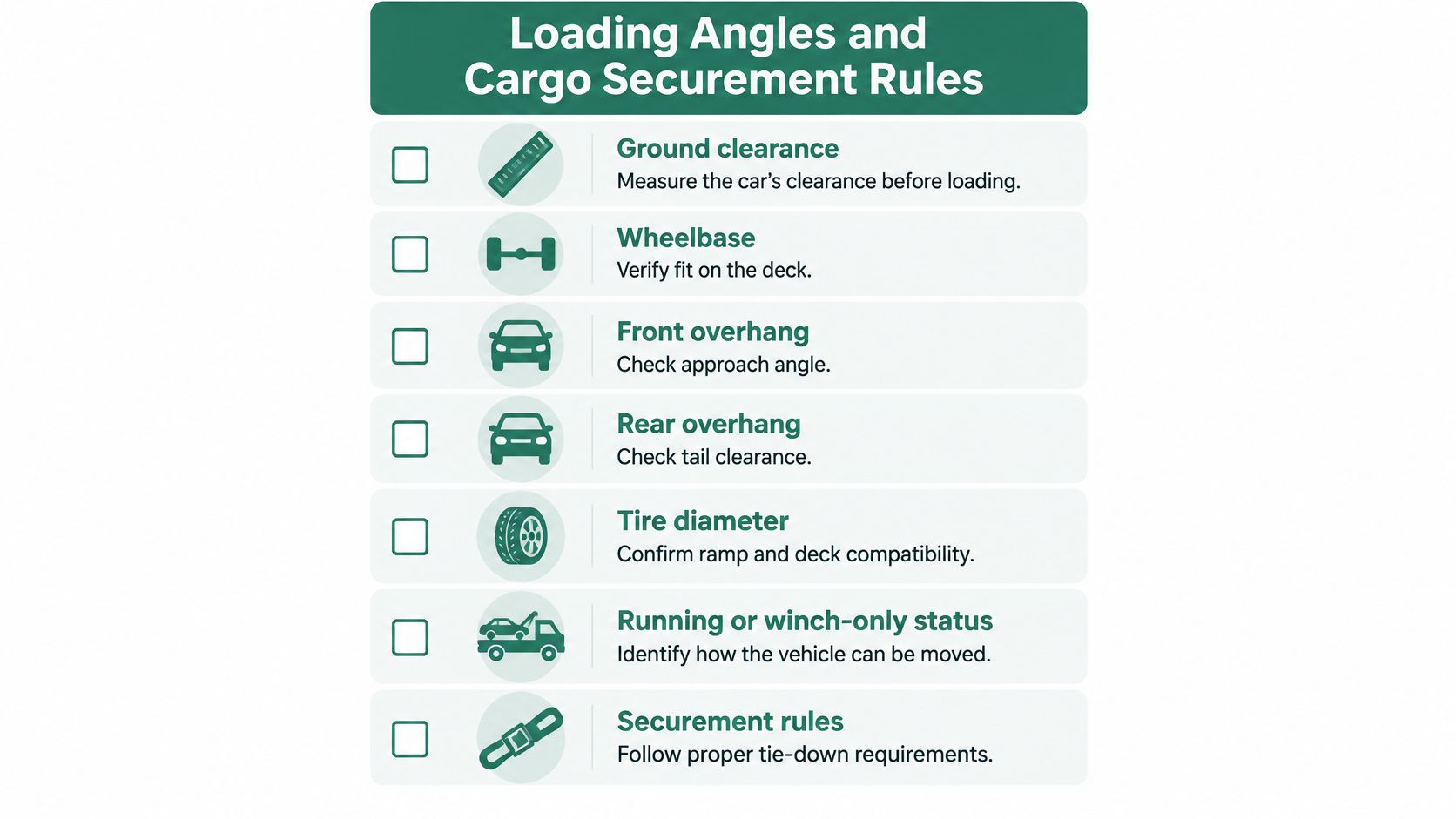
Before pickup, give the dispatcher a usable measurement and condition record:
- Ground clearance: Measure the lowest splitter, exhaust component, battery shield, or aftermarket part on level ground.
- Wheelbase: Provide the distance between axle centers so the carrier can assess transitions.
- Front overhang: Show the distance and shape between the front tires and the leading bodywork.
- Rear overhang: Include exhaust tips, diffusers, hitches, and other projecting components.
- Tire diameter: Identify nonstandard tires, missing wheels, and tires that won't hold air.
- Running or winch-only status: State whether the vehicle starts, rolls, steers, and brakes.
- Pickup surface: Photograph driveway slopes, auction lanes, gravel, curbs, and the intended loading area.
Check approach and breakover separately
Approach angle concerns the front of the car reaching the ramp without contact. Breakover clearance concerns the underside passing across a change in slope. Departure clearance matters at the rear.
A longer ramp may improve the initial approach without fixing a sharp transition farther along the deck. On a tall level flatbed, the principal obstacle may instead be the climb from the ground. The carrier should evaluate the entire path, including unloading.
Use this checklist when collecting vehicle details.
Securement is a performance requirement
For automobiles, light trucks, and vans weighing 10,000 pounds or less individually, FMCSA's cargo-securement rules establish performance requirements of 0.8 g forward, 0.5 g rearward, and 0.5 g lateral, with aggregate tiedown working-load limits of at least half the secured cargo's weight under the applicable calculation. Heavier vehicles fall under different equipment-specific provisions.
That doesn't mean any strap arrangement with a sufficiently large label is acceptable. The carrier must use suitable anchor points, sound securement devices, and a method appropriate to the vehicle. Owners shouldn't direct drivers to attach restraints to suspension or body components without confirming those attachment points are suitable.
FMCSA's Motor Carrier Safety Planner also explains the broader cargo-securement obligations, including inspections during operation. Interstate highway transport to a mainland port remains a commercial road movement, even when the destination is Puerto Rico.
Disclose a dead battery, damaged steering, inoperable brakes, body kits, and missing tires before dispatch. These details can change the equipment assignment rather than merely add time at pickup.
Before the driver arrives: Send a photo or video condition record and obtain written confirmation that the assigned equipment suits the car. That's more useful than a generic open-versus-enclosed label.
What Shared Wedge Loads Cost to Ship
A wedge trailer's purchase price is not the price of a customer's shipment. Advanced Trailers listed a 2025 wedge trailer for $15,450, but that is an equipment purchase. The carrier also has operating costs; the customer pays for the transport service.
Price the itinerary, not just the mileage
On a shared load, a carrier can spread operating costs across compatible shipments. A dedicated tilt-deck or flatbed move has less opportunity to share those costs, so compare the full service rather than the trailer type alone.
Puerto Rico shipments add an ocean leg and port handoffs. Request an itemized itinerary that identifies mainland trucking, ocean freight, terminal arrangements, and island delivery if included. For a Jacksonville routing, ask which departure terminal is planned and how vehicle release is handled in San Juan.
Quote requests by mainland origin
| Mainland origin | Price items to request | Transit details to confirm |
|---|---|---|
| Miami, South Florida, Orlando, Tampa, Jacksonville | Vehicle-specific rate, mainland pickup, ocean freight, and any terminal charges | Pickup window, Jacksonville departure terminal if applicable, and San Juan release arrangements |
| Atlanta | Inland transport to the port, ocean service, and terminal charges | Truck scheduling, sailing itinerary, and San Juan release arrangements |
| New York, New Jersey, Philadelphia | Complete mainland-to-island rate, including inland transport and port charges | Pickup window, port handoffs, and San Juan release arrangements |
| Boston, Hartford | Inland collection, ocean freight, and terminal charges | Collection window, sailing itinerary, and island delivery timing if included |
| Chicago | Highway transport, ocean service, and terminal charges | Carrier scheduling, vessel itinerary, and San Juan release arrangements |
| Houston, Dallas | Transport from the exact pickup address, ocean freight, and terminal charges | Inland routing, sailing itinerary, and island delivery timing if included |
Request a vehicle-specific quote that reflects the actual car, pickup location, running condition, and service scope. A car-shipping cost quote should make clear which transport and terminal charges are included.
Mainland coverage requires local pickup details
A mainland-to-San Juan shipment can start in a major city or at an address that requires a separate pickup arrangement. Access conditions at the exact location may affect where the carrier can collect the vehicle.
- Northeast: Portland, Maine; Manchester, New Hampshire; Burlington, Vermont; Boston, Massachusetts; Providence, Rhode Island; Hartford, Connecticut; New York, New York; Newark, New Jersey; Philadelphia, Pennsylvania.
- South: Wilmington, Delaware; Baltimore, Maryland; Richmond, Virginia; Charleston, West Virginia; Charlotte, North Carolina; Charleston, South Carolina; Atlanta, Georgia; Miami, Florida; Louisville, Kentucky; Nashville, Tennessee; Birmingham, Alabama; Jackson, Mississippi; New Orleans, Louisiana; Little Rock, Arkansas; Oklahoma City, Oklahoma; Dallas, Texas.
- Midwest: Columbus, Ohio; Indianapolis, Indiana; Chicago, Illinois; Detroit, Michigan; Milwaukee, Wisconsin; Minneapolis, Minnesota; Des Moines, Iowa; Kansas City, Missouri; Fargo, North Dakota; Sioux Falls, South Dakota; Omaha, Nebraska; Wichita, Kansas.
- West: Denver, Colorado; Cheyenne, Wyoming; Billings, Montana; Boise, Idaho; Salt Lake City, Utah; Las Vegas, Nevada; Phoenix, Arizona; Albuquerque, New Mexico; Los Angeles, California; Portland, Oregon; Seattle, Washington.
Ask which title and identification documents are required, how Puerto Rico excise taxes known as arbitrios apply, and whether terminal charges are included. Confirm which costs are paid separately and what payment milestone reserves the booking.
Confirm the Load Then Book the Move
A trailer's advertised car count is only a starting point. Before dispatch, confirm the load against the heaviest vehicle's weight, its lowest ground clearance, and the route, including any port handoffs.
- Identify each vehicle. Provide its year, make, model, trim, approximate curb weight, running condition, and modifications. For a dealership batch, list every vehicle separately.
- Check the proposed load. Ask how the carrier will account for the heaviest vehicle and confirm that the truck, trailer, tires, and hitch can support the planned combination. Car count alone does not confirm payload capacity.
- Plan for loading. Send clearance measurements and condition photos in advance. Confirm who will supply skates, a winch, or other equipment needed to load the vehicle.
- Confirm Puerto Rico handoffs. If Jacksonville is the chosen gateway, verify the itinerary, San Juan release procedures, required documents, and who handles collection at each end.
- Get the price and terms in writing. Ask for the flat service rate, what it includes, payment terms, cancellation conditions, and delivery arrangements.
Put an advisor in charge of the handoffs
For a domestic move, clarify what door-to-door auto transport means at both addresses. A narrow residential street, low branches, or a restricted campus entrance may require meeting the driver at a nearby accessible location. For an island move, confirm who will communicate terminal deadlines and release instructions.
National Car Transport is a U.S.-based coordinating option with 25+ years of company experience, an A+ BBB rating, and transparent flat-rate pricing. Its nationwide network includes 25,000+ vetted, licensed, and bonded drivers. Its bilingual English/Spanish agents, with some Portuguese support, can coordinate open, enclosed, and ocean shipping arrangements.
A clear plan ties the equipment choice to the vehicle's weight and clearance, then spells out each handoff. That gives individuals, military families, students, snowbirds, and business buyers a way to address loading and delivery details before pickup.
National Car Transport coordinates mainland and Puerto Rico vehicle shipping, with equipment selected for the vehicle and route. Visit National Car Transport with the vehicle details, clearance concerns, and pickup and delivery locations to request a flat-rate quote and review the loading plan with an advisor.