
You're probably in one of a few familiar situations right now. You're moving from Miami to New York, sending a car to a student in Texas, relocating on military orders to California, heading south for the winter, or trying to get a vehicle between the mainland and San Juan, Puerto Rico without getting blindsided by vague pricing.
And the quotes don't line up.
One company gives you a low number that feels suspicious. Another gives you a broad range that tells you almost nothing. A third starts talking in industry jargon instead of answering the basic question: what is this going to cost, and why?
That confusion is normal. Vehicle transport service cost isn't random, but it does depend on several moving parts. A sedan going from Atlanta to Chicago isn't priced the same way as an SUV going from rural Montana to Los Angeles. And shipping to Puerto Rico adds another layer because you're combining mainland ground transport with port handling and ocean freight.
The good news is that the pricing logic is understandable once you know what carriers and brokers are looking at. If you're shipping between major cities like Los Angeles, Phoenix, Dallas, Houston, Chicago, Orlando, Jacksonville, New York City, Boston, Seattle, Denver, Nashville, Charlotte, or San Juan, the same core rules apply. The route matters. The vehicle matters. The timing matters. The service level matters.
Table of Contents
- Why Is My Vehicle Transport Service Cost So Hard to Pin Down
- The 5 Key Factors That Determine Your Car Shipping Cost
- Open vs Enclosed Transport The Biggest Cost Decision
- Shipping Your Car to Puerto Rico What to Expect
- Understanding Extra Fees and Insurance Coverage
- How to Get a Fast and Accurate Transport Quote
- 5 Practical Tips to Lower Your Vehicle Transport Cost
Why Is My Vehicle Transport Service Cost So Hard to Pin Down
A lot of people expect car shipping to work like ordering a package. Enter two ZIP codes, get one fixed price, done. That's not how auto transport works.
A carrier isn't just moving your one vehicle. They're building a route, balancing trailer space, matching pickup windows, accounting for vehicle size, and deciding how far they need to leave a main corridor to reach your address. That's why a car going from Orlando to Philadelphia can price differently from one going from a small town outside Albuquerque to Seattle, even if the mileage looks similar.
Students run into this when they need a car near campus by a certain date. Military families see it during PCS moves when timing is tight. Snowbirds feel it every season when they want a vehicle in Florida, Arizona, or back up north without driving it themselves. Puerto Rico customers deal with even more variables because the mainland pickup is only one part of the job.
Practical rule: If a quote seems fast but nobody asked about your vehicle size, your route access, or your date flexibility, it's probably not a reliable quote.
The hardest part isn't that pricing is mysterious. It's that too many companies skip the explanation. They throw out a number before they've checked whether your car is a standard sedan, a lifted truck, an inoperable vehicle, or a luxury car that should be enclosed.
That's also why two honest quotes can still differ. One company may be pricing for a tighter pickup window. Another may assume open transport from a major metro area. Another may already know your delivery point is harder for a large carrier to access.
A real-world pattern
Take three customers:
- A snowbird shipping from Boston to South Florida wants open transport and flexible timing.
- A dealership buyer needs enclosed shipping from Los Angeles to Houston for a higher-value vehicle.
- A family in Ohio needs ground transport to a mainland port, then ocean shipping to San Juan.
Those are all “car shipping” jobs, but they're not the same job. That's why the vehicle transport service cost can't be pinned down with one generic national number.
The 5 Key Factors That Determine Your Car Shipping Cost
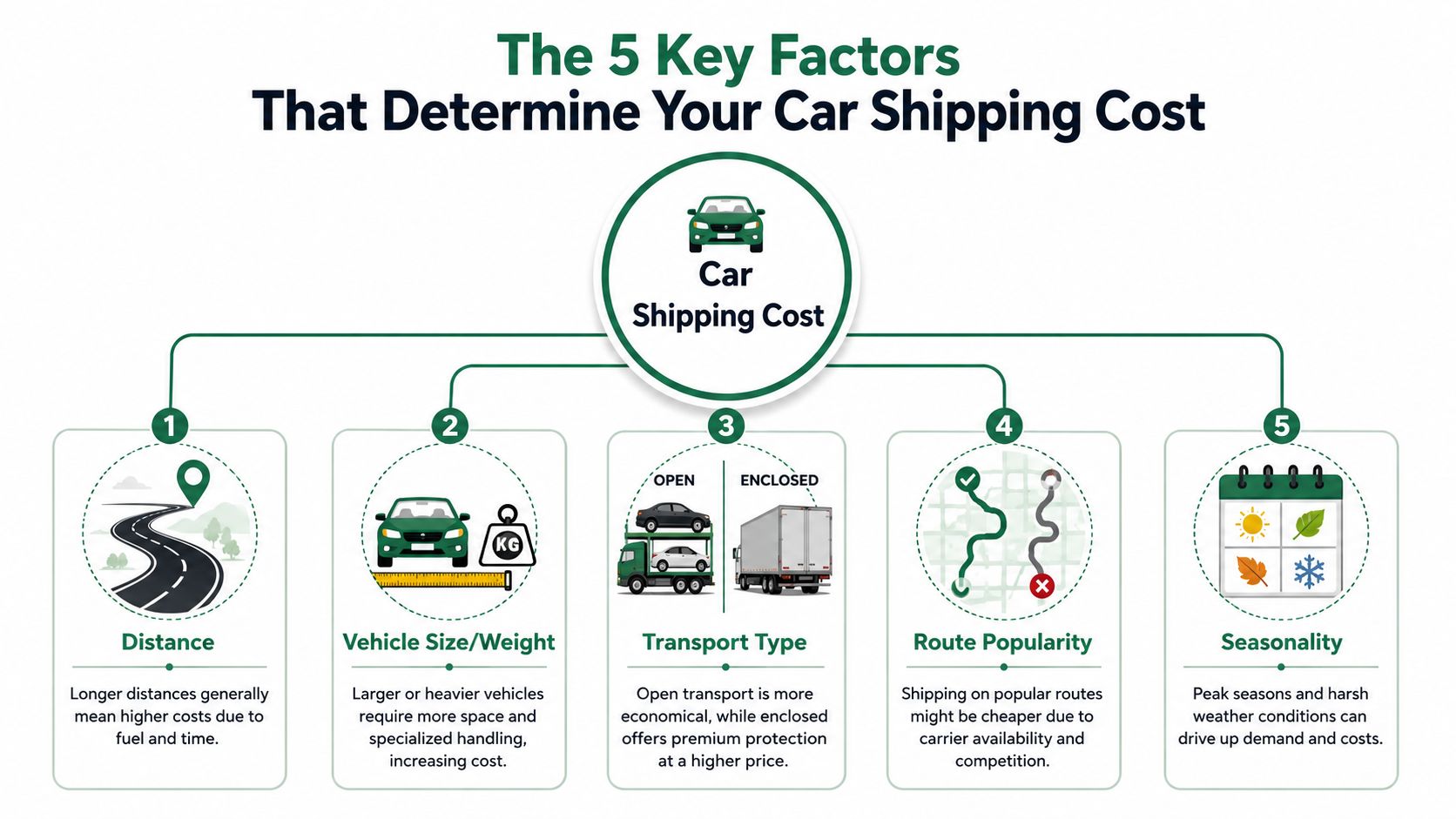
The clearest way to think about pricing is to treat it like transportation capacity, not parcel shipping. You're buying space on a moving carrier, on a live route, during a specific window.
Distance sets the baseline
Distance is still the anchor. The average cost to ship a car across the continental United States is approximately $1,128, with shorter distances under 200 miles around $2.92 per mile and trips over 1,000 miles dropping to about $0.78 per mile.
That tells you something important. Longer routes usually cost more in total, but less per mile. Short trips are less efficient for carriers because loading, scheduling, dispatching, and unloading still take work even if the haul is brief.
Here's a simple planning table for common route types.
| Route | Approximate Distance (Miles) | Estimated Cost Range |
|---|---|---|
| New York City to Florida | 1,000+ | Around the national average to above it, depending on timing and exact cities |
| California to Texas | 1,000+ | Often benefits from lower per-mile long-haul pricing |
| Chicago to San Juan | Combination of mainland and island routing | Usually priced separately because mainland and Puerto Rico legs are different services |
The route examples above are directional guides, not quoted rates. For exact pricing, carriers need full shipment details.
If you've ever looked at how window cleaners price services, the logic feels similar. You're not paying for one simple unit. You're paying for labor, access, service level, and job conditions layered together.
The other four cost drivers
Distance starts the conversation. These four finish it.
- Vehicle size and weight: A compact sedan is easier to place than a large SUV, van, or pickup. Bigger vehicles take more deck space and affect trailer planning.
- Transport type: Open transport is the standard option. Enclosed costs more because the equipment is specialized and capacity is lower.
- Route popularity: Major corridors between cities like Dallas, Atlanta, Miami, Chicago, Phoenix, Los Angeles, and Charlotte are easier to price competitively because carriers run those lanes more often.
- Seasonality: Demand shifts. Weather shifts. Availability shifts. If your shipment lands in a busy relocation window or severe weather period, pricing usually moves with it.
Pricing gets easier to understand when you stop asking, “How much does shipping cost?” and start asking, “What kind of shipment am I actually booking?”
That question matters in every state. A vehicle moving between major cities in California, Texas, Florida, New York, Illinois, Georgia, North Carolina, Arizona, Washington, Colorado, Nevada, Tennessee, and Puerto Rico will usually be easier to route than one requiring long detours off primary carrier lanes.
Open vs Enclosed Transport The Biggest Cost Decision
For most customers, this is the biggest choice that changes the final bill.
What open transport is really for
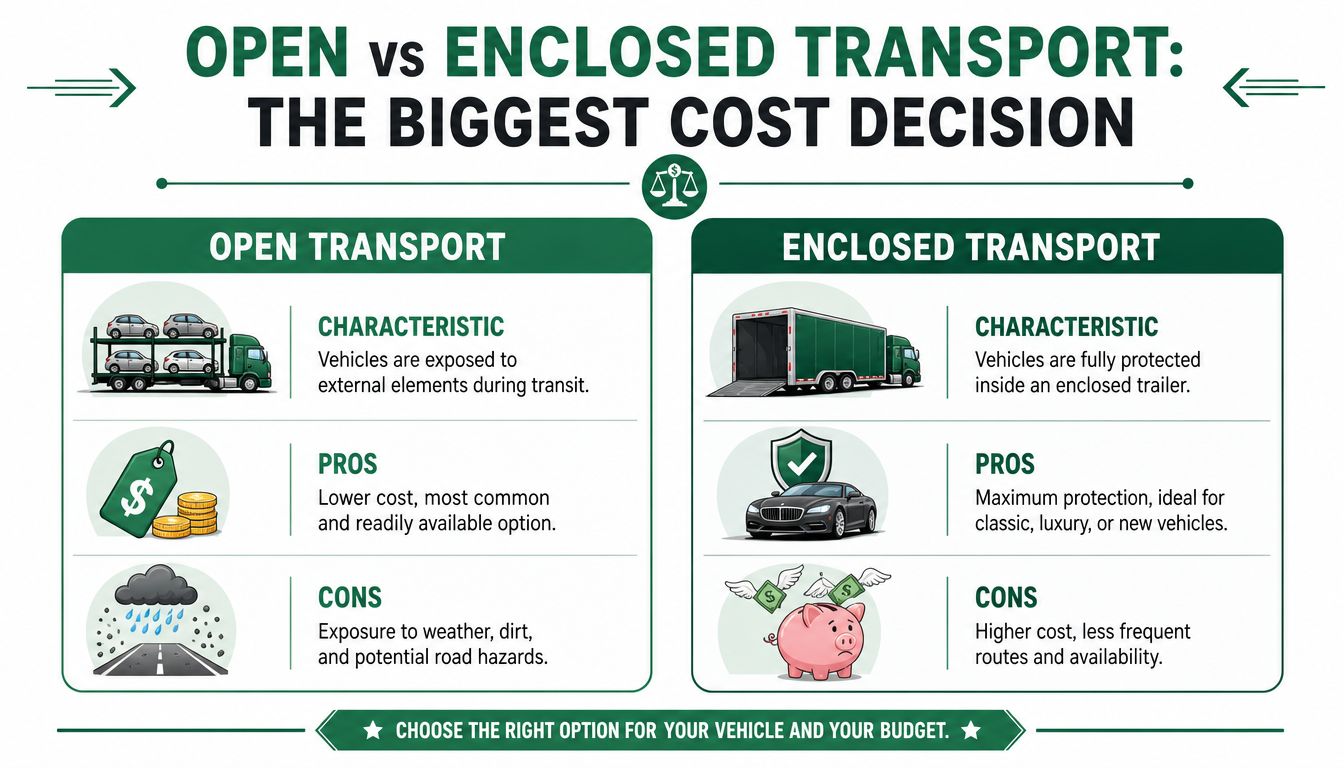
Open transport is the industry standard. It's what you see on highways every day carrying new and used vehicles. It's the practical choice for daily drivers, student cars, family SUVs, dealership transfers, and most relocation moves.
It costs less because carriers can load more vehicles and run more frequently on standard routes. It's also easier to book because there are more open trailers on the road than enclosed ones.
Choose open transport if your main priorities are:
- Keeping cost down: This is usually the most budget-friendly option.
- Getting broader route availability: Open carriers serve more lanes and more schedules.
- Shipping a regular-use vehicle: If it's a standard commuter, family car, or secondary vehicle, open usually makes sense.
When enclosed transport is worth it
Enclosed transport is a premium service. It's built for classic cars, luxury vehicles, exotic models, show cars, custom builds, and newer vehicles where extra protection matters to the owner.
That premium exists for a reason. The trailer is covered. Capacity is lower. Scheduling can be tighter. The customer is paying for protection from weather and road debris, plus more specialized handling.
A quick way to decide:
| Priority | Better Fit |
|---|---|
| Lowest practical price | Open transport |
| Maximum exterior protection | Enclosed transport |
| Widest scheduling availability | Open transport |
| Collector, luxury, or custom vehicle | Enclosed transport |
A short walkthrough helps here:
If you'd be upset seeing your vehicle ride on the same kind of trailer used for everyday cars, book enclosed and move on. The extra cost is easier to accept than second-guessing the decision for days.
Shipping Your Car to Puerto Rico What to Expect
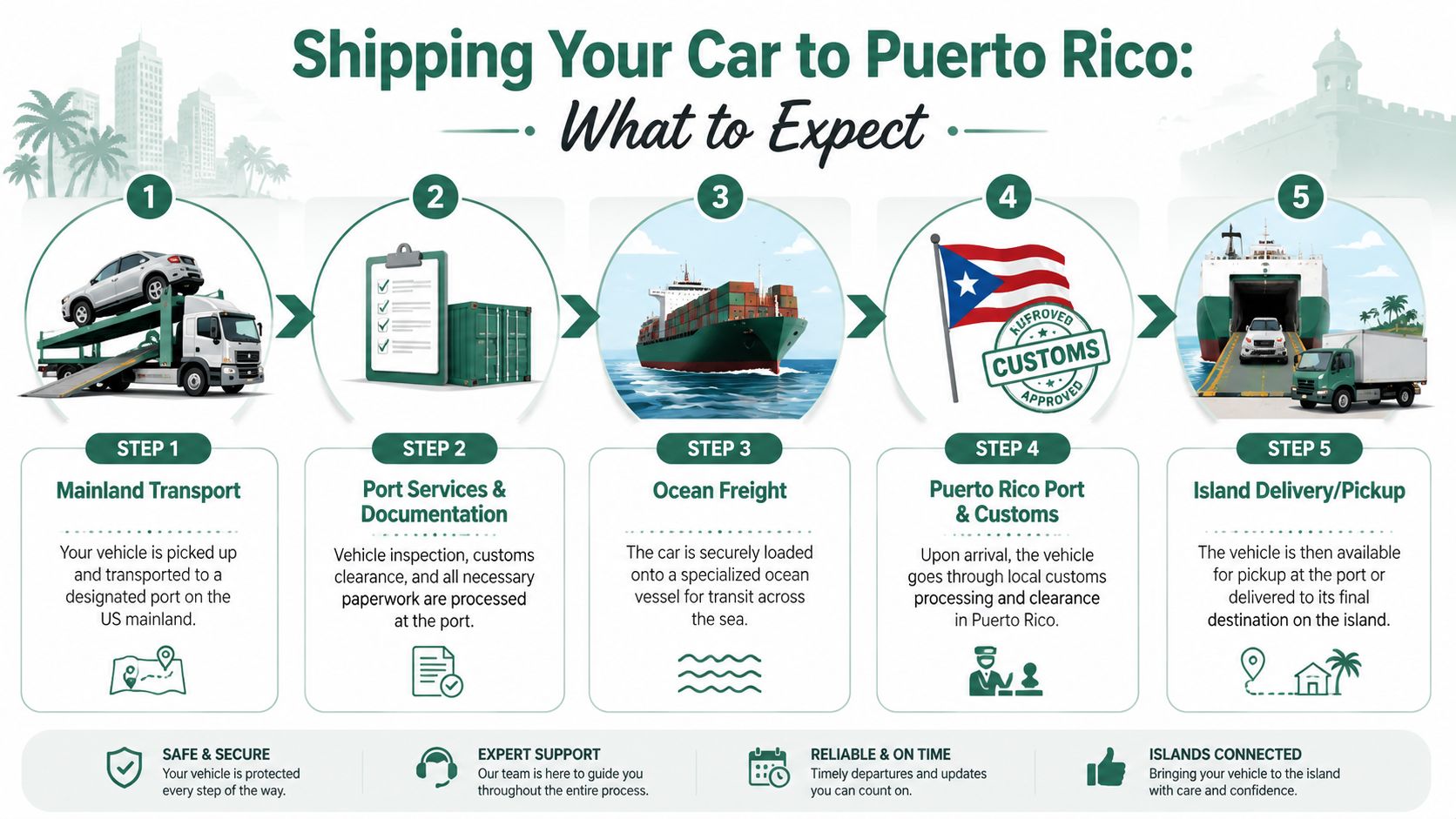
Puerto Rico shipping deserves its own explanation because it's not just a longer domestic route. It's a combined logistics move with mainland transport, port handling, ocean freight, and final pickup or delivery on the island.
Puerto Rico shipping is a two-part move
The mainland portion gets your vehicle from a U.S. origin point, such as Orlando, Tampa, Jacksonville, Atlanta, Charlotte, Houston, Dallas, Chicago, Newark, or another city, to the assigned port. Then the ocean carrier handles the Puerto Rico leg.
That's why pricing can vary so much. The total cost to ship a car from the U.S. mainland to Puerto Rico typically ranges from $1,500 to $5,000, depending on vehicle size, distance to the port, and season, and the ocean freight portion is often calculated by cubic feet using (L x W x H in inches) / 1,728.
Size matters more here than people expect. On a domestic lane, vehicle size affects trailer space. On Puerto Rico lanes, size can also affect ocean pricing directly because the vessel operator may use cubic-foot calculations.
A separate published benchmark helps ground expectations. Shipping a standard passenger vehicle from Jacksonville, Florida to Puerto Rico costs $1,210 for vehicles under 82 inches wide and 76 inches high, while taller vehicles from 77 to 100 inches cost $1,310, with listed fees included.
Documents and port details matter
Puerto Rico transport gets complicated when people treat paperwork like an afterthought. Don't.
Have these ready before you book:
- Proof of ownership: Title or other accepted ownership paperwork.
- Registration documents: Current vehicle registration when required.
- Photo identification: The shipper's ID must match the transaction details.
- Vehicle measurements if requested: This matters for island pricing and vessel fit.
The process usually follows this pattern:
- Mainland pickup or drop-off.
- Port inspection and documentation review.
- Ocean transit to Puerto Rico.
- Arrival processing near San Juan.
- Port pickup or final island delivery.
For individuals, military families, students, businesses, and Puerto Rico dealerships, bilingual guidance proves invaluable. Island moves involve coordination, timing, and paperwork. One missed document can stall a shipment that was otherwise ready to go.
Understanding Extra Fees and Insurance Coverage
The base quote matters. The fine print matters just as much.
Where surprise charges usually come from
Most surprise charges show up because the first conversation was too shallow. A customer says “I need to ship my car.” But the company never asks whether it's in a remote area, whether it runs, or whether the vehicle has modifications that affect loading.
Location is one of the most overlooked examples. Rural or remote ZIP codes can add 15% to 25% in fees, often averaging $150 to $400 extra, because carriers have to detour from major highways and deal with limited access.
That's why a pickup in central Phoenix or outside downtown Dallas is different from a pickup far outside a major route. Car carriers are large commercial trucks. They can't always get into narrow neighborhoods, low-tree streets, steep driveways, gated communities, or remote roads without losing time and money.
Other fees can appear for practical reasons:
- Inoperable vehicles: If a car doesn't roll, brake, or steer properly, loading gets harder.
- Oversized vehicles: Lifted trucks, large SUVs, and dually setups create spacing issues.
- Port-specific handling: Puerto Rico shipments can involve separate handling steps tied to port requirements.
A related budgeting move that smart households make is to review related transportation costs at the same time. If you're also updating coverage after a move, it's worth taking a look at how to compare auto insurance rates before your vehicle arrives.
What the Bill of Lading actually does
Insurance questions usually sound more complicated than they are.
The critical document is the Bill of Lading. It's the condition report and transport receipt tied together. At pickup, the driver notes the visible condition of the vehicle. At delivery, that condition is checked again.
Check the car in good light at pickup and again at delivery. Don't rush the inspection because the paperwork is what protects both you and the carrier.
This is also why personal items inside the vehicle are a bad idea. They create liability confusion, add weight, and distract from the actual condition check.
If you want a clean transaction, insist on a careful inspection and keep your own photos. That's not paranoia. That's basic discipline.
How to Get a Fast and Accurate Transport Quote
Accurate quotes come from accurate details. That sounds obvious, but people skip this step constantly.
What to have ready before you ask
Before you request pricing, pull together the basic shipment facts:
- Pickup ZIP code
- Delivery ZIP code
- Vehicle year, make, and model
- Whether you want open or enclosed transport
- Your first available shipping date
- Whether the car is operable
- Any modifications that affect size or ground clearance
That list is short, but it does most of the heavy lifting. Without it, the quote is just a guess.
If you've ever dealt with household relocation pricing, the same logic applies to getting an accurate moving quote. The more precise your details, the fewer surprises you'll face later.
Why accurate details save time and money
Customers often think a broad quote range is safer because it gives them “options.” Usually it just delays the actual answer.
A good quote depends on whether your addresses are easy for a carrier to access, whether your vehicle fits standard assumptions, and whether your dates are tight or flexible. If you leave those details vague, you'll either get a number that changes later or a number padded to cover unknowns.
Use this checklist before you book:
- Confirm the exact cities and ZIP codes. “Near Orlando” or “outside San Antonio” isn't enough.
- Describe the vehicle accurately. Don't call a full-size SUV a standard car.
- Be clear about timing. A flexible pickup window and a fixed must-pick-up date are not the same thing.
- Say if the vehicle doesn't run. That affects equipment and scheduling.
- Ask what is included. You want to know whether the quote reflects realistic access and service assumptions.
Not one vehicle transport is alike. That's why experienced guidance matters. A strong transport advisor will ask better questions than a form alone can handle, especially if your route includes Puerto Rico, a military move, a college deadline, a dealership transfer, or a hard-to-access address.
5 Practical Tips to Lower Your Vehicle Transport Cost
You can't control every part of pricing, but you can control more than is commonly understood.
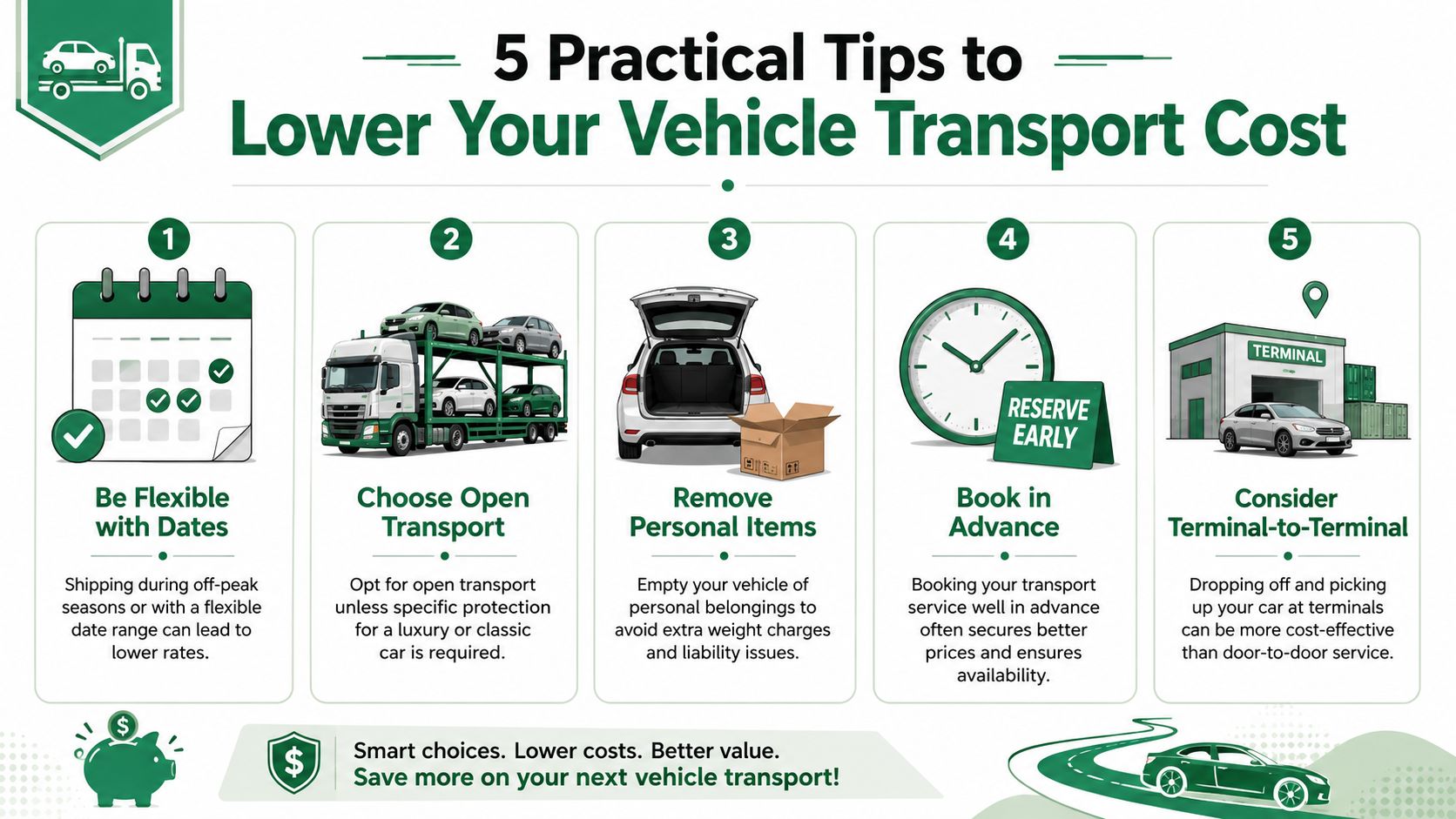
Use flexibility as a pricing tool
The easiest way to lower your vehicle transport service cost is to stop treating your schedule like it's immovable unless it really is.
Seasonality and weather can increase transport costs by 15% to 25% for several weeks during hurricane season in the Gulf and Atlantic due to carrier delays and increased demand. If you're planning around Florida, Louisiana, the Gulf Coast, or Atlantic routes, don't wait until a weather disruption is already affecting capacity.
Five practical ways to save:
- Be flexible with pickup dates: If you can give a wider availability window, dispatch has more room to match your vehicle to an efficient route.
- Book before the rush: Snowbird moves, military relocations, and school-related shipping get tighter when everyone waits until the last minute.
- Choose open transport for standard vehicles: If your car doesn't need premium protection, don't pay for it.
- Meet near a major road when possible: If your address is difficult for a large truck, a nearby shopping center or open lot can reduce access issues.
- Make sure the car is ready to load: An operable vehicle is simpler and cheaper to move than one that needs special handling.
Cut avoidable costs before booking
A few small decisions can keep the quote from creeping up later.
- Remove personal belongings: It keeps the vehicle lighter and avoids disputes over what's inside.
- Don't hide modifications: Oversized tires, lowered suspensions, roof racks, and lift kits affect loading.
- Use realistic delivery expectations: Fast service usually costs more. If speed isn't critical, don't price it like an emergency.
- Ask about practical handoff locations: Door-to-door is convenient, but sometimes a nearby accessible location is the smarter move.
- Review Puerto Rico paperwork early: Mainland-to-island shipments get expensive when a port issue causes delay.
The cheapest shipment isn't the one with the lowest first quote. It's the one that doesn't need corrections, rush changes, or avoidable surcharges after booking.
If you want a quote that reflects the actual job, not a vague teaser number, talk with National Car Transport. They handle auto shipping across the U.S., Puerto Rico, Alaska, and Hawaii with transparent flat-rate pricing, no upfront charge until a carrier is assigned, and support from USA-based bilingual agents who've spent over 20 years in auto transport logistics. With 25+ years of experience, an A+ BBB rating, and a network of 25,000+ vetted carriers, they're set up to help individuals, snowbirds, students, military families, dealerships, and businesses move vehicles without making the process harder than it needs to be.