
Shipping a car in the continental U.S. usually costs $800 to $1,500 on standard open transport, and a 1,000-mile trip averages about $1,020, or roughly $1.02 per mile. That's the right starting point, but your actual rate changes based on distance, vehicle size, operable condition, trailer type, timing, and, if Puerto Rico is involved, a completely different pricing model.
If you're looking at quotes right now, you're probably seeing numbers that don't line up. One company gives you a low teaser. Another sounds high. A calculator spits out a price that seems clean and simple, then you find out it doesn't account for your SUV, your non-running car, your schedule, or the port side of a Puerto Rico move.
That confusion is normal. Auto transport pricing isn't random, but it also isn't one-size-fits-all. Some routes are straightforward interstate truck moves. Others involve port handling, container logistics, and flat-rate island pricing that standard mainland calculators do not adequately explain.
Experience matters. Not one vehicle transport is alike. A student shipping a sedan from a campus city isn't dealing with the same variables as a military family relocating to San Juan, a snowbird moving seasonally, or a dealership repositioning inventory between major metros. The good news is that once you understand how vehicle transport rates are built, the quote stops feeling mysterious and starts looking predictable.
Table of Contents
- Demystifying Your Vehicle Shipping Quote
- The 5 Key Factors That Determine Your Rate
- Sample Vehicle Transport Rates Across the US
- Choosing Your Service Open vs Enclosed Transport
- The Special Case Shipping Your Car to Puerto Rico
- Actionable Tips to Lower Your Transport Costs
- How to Get a Reliable Flat Rate Quote Today
Demystifying Your Vehicle Shipping Quote
A transport quote should never feel like a guess. It's a pricing decision built from route economics, equipment availability, vehicle specs, and timing.
That matters because this isn't a tiny niche. The U.S. Vehicle Shipping Services industry is valued at $10.5 billion in 2026, with over 7,000 businesses operating in the sector, according to IBISWorld industry data on vehicle shipping services. A market this large gives you options, but it also means you need to separate serious operators from quote collectors and bait-and-switch brokers.
What a quote is really measuring
A real vehicle shipping quote answers five practical questions:
- How far is the vehicle going?
- What exactly is being shipped?
- Does it run and steer?
- Is open or enclosed equipment required?
- How easy is it to move on your requested dates?
If you don't know those answers yet, your quote will be sloppy. If a company doesn't ask those questions, the quote is probably sloppy too.
Practical rule: A clean quote starts with clean information. Exact pickup and delivery locations, correct vehicle details, and an honest timeline matter more than shopping for the lowest number first.
Who needs the clearest pricing
Some customers can tolerate a little flexibility. Others can't.
- Military families: PCS schedules don't leave much room for pricing games.
- Snowbirds: Seasonal timing can change route demand fast.
- Students: Budget matters more than bells and whistles.
- Dealerships and businesses: Repetition exposes weak logistics fast.
- Puerto Rico movers: Mainland rate calculators often break down completely on island moves.
If you're moving between major cities in the lower 48, quotes are usually easier to benchmark. If you're shipping from places like Miami, Houston, Jacksonville, Newark, Los Angeles, Chicago, Dallas, Phoenix, Atlanta, Seattle, or to and from San Juan, Puerto Rico, the transport plan can involve more moving parts, especially once a port enters the picture.
What smart customers do first
Before you compare rates, decide what kind of shipment you have.
| Shipment type | Best first question |
|---|---|
| Standard sedan, mainland route | What's the realistic open carrier range? |
| SUV or pickup | Will size and weight push the price up? |
| Luxury or classic car | Is enclosed worth the premium? |
| Non-running vehicle | What loading equipment will be needed? |
| Puerto Rico shipment | Is this quoted as flat-rate or container pricing? |
That last one is where many people get burned. A mainland per-mile mindset works fine until it doesn't.
The 5 Key Factors That Determine Your Rate
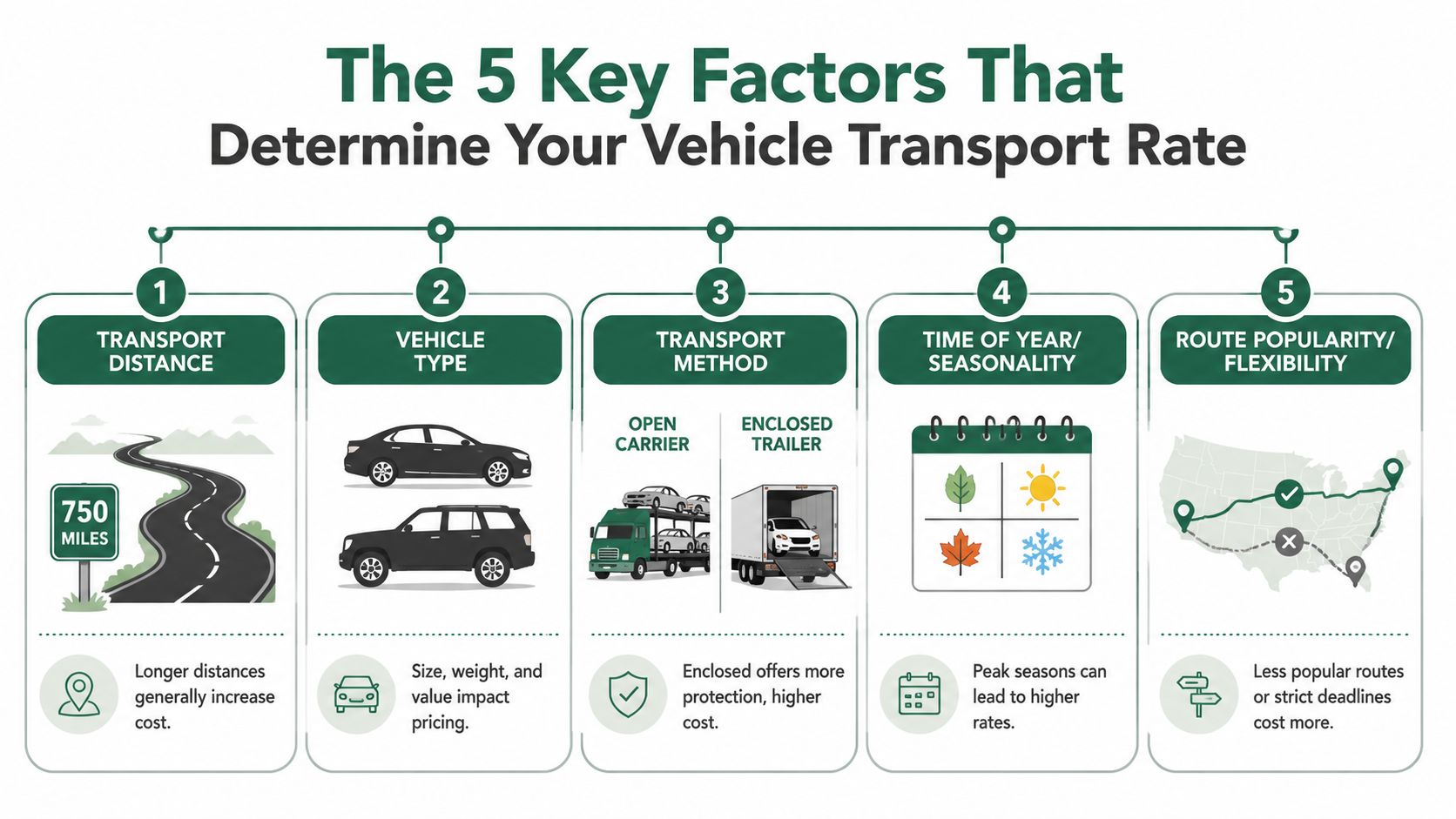
A shipping quote is built on a few pricing variables that carriers care about every day in the market. If you understand those variables, you can tell the difference between a fair rate, a bait rate, and a quote that will get revised later.
Distance changes the math
Distance drives price, but not in a straight per-mile line. Longer shipments usually cost more overall and less per mile. Short shipments often look expensive on a per-mile basis because the truck still has to cover dispatch time, fuel, loading, unloading, and route positioning.
Analysts at FreightWaves report that short-hauls under 500 miles often run $1.55 to $2.50 per mile, while 1,500+ mile moves can fall to $0.50 to $0.95 per mile. That pricing pattern is normal. It does not mean a local or regional quote is inflated.
Vehicle size and weight always matter
Carriers price around trailer space and weight capacity. A standard sedan is the reference point. A full-size SUV, long-bed pickup, cargo van, or lifted vehicle takes up more room and limits what else can go on the trailer.
That matters fast on multi-car loads. One oversized unit can force a carrier to leave a spot empty or rebalance the entire load, and that lost flexibility gets priced into your quote.
If your vehicle is larger than average, compare your quote to similar vehicles only. Comparing a heavy SUV to a compact sedan benchmark is bad math.
Open versus enclosed changes the equipment
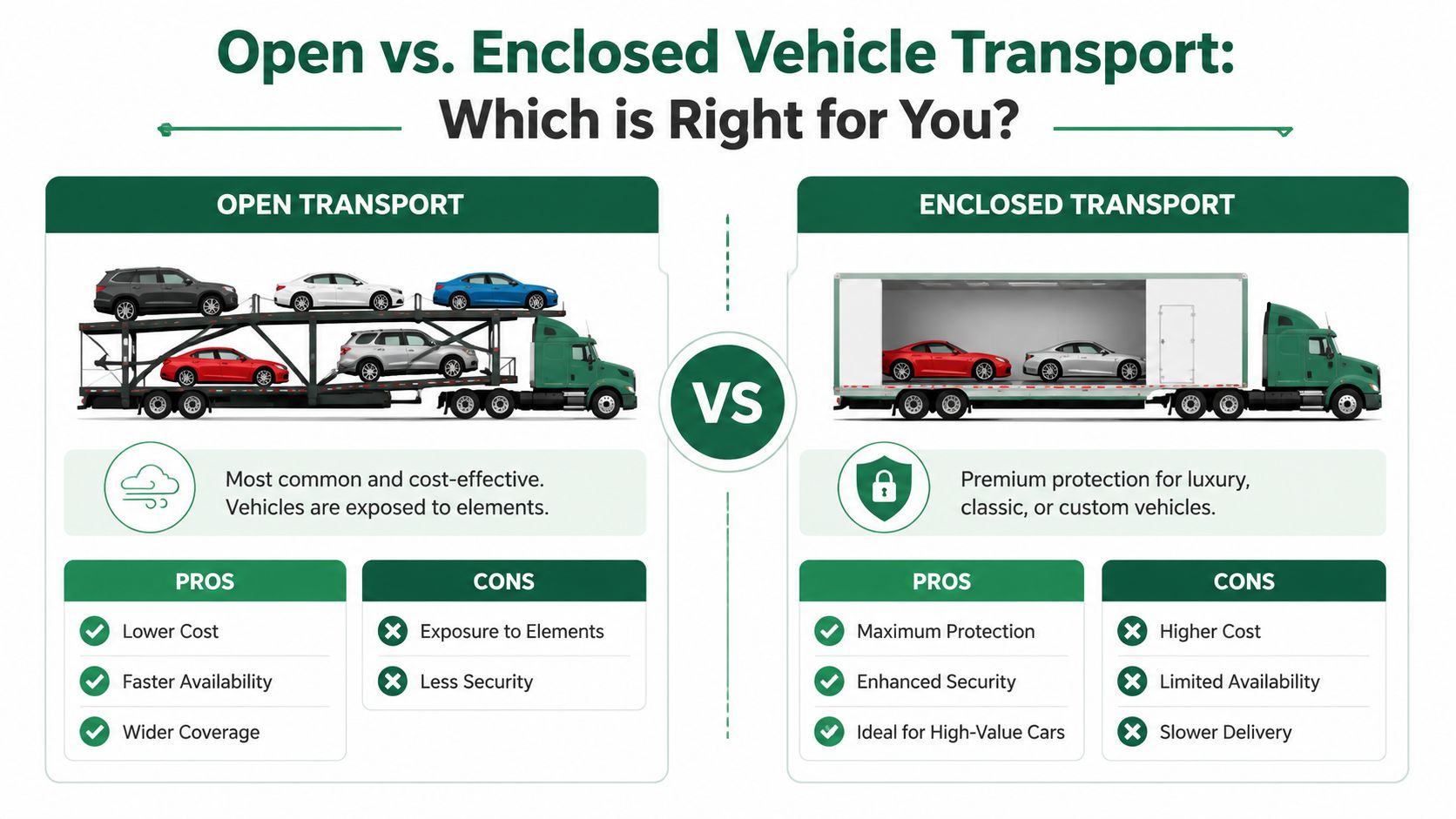
Equipment choice changes the rate because it changes capacity, risk exposure, and the kind of carrier that can take the job. Open transport is the standard option for everyday cars. Enclosed transport is built for vehicles that need more protection from road debris, weather, and extra handling.
Expect enclosed service to cost more. The trailer carries fewer vehicles, the operating costs are higher, and the carrier pool is smaller. For a daily driver, open transport is usually the right call. For an exotic, collector car, restored classic, or high-value luxury vehicle, enclosed is the better decision.
The right trailer matches the vehicle and the owner's tolerance for risk.
Operable condition affects labor
A running vehicle is easier and cheaper to move. A non-running vehicle changes the job because the carrier may need a winch, extra loading time, or specific trailer access.
That also narrows the list of available drivers. Some carriers will not take inoperable units at all, and the ones that do will price for the extra labor and equipment. If the car does not run, disclose it upfront. Hiding that detail is one of the fastest ways to turn an initial quote into a revised invoice.
Timing and route flexibility move the final number
Your dates matter. So does your lane.
A vehicle moving between major metro areas on a busy corridor is usually easier to assign than a pickup in a remote town far from the interstate. Tight scheduling also raises the price because the dispatcher has fewer options. If you can give a wider pickup window, you usually give the carrier more room to price the job sensibly.
Puerto Rico deserves its own pricing mindset here. Mainland routes often move on lane density and timing. Puerto Rico shipments add port coordination, vessel schedules, and handoff points that many online calculators fail to price correctly. That is why island moves are often quoted as flat rates tied to the port pair and service plan, not as simple mainland-style per-mile math.
Sample Vehicle Transport Rates Across the US
Benchmarks help, but only if you use the right ones. For mainland shipping, one of the cleanest reference points is the average cost of a standard open transport move over longer distance.
The Move.org vehicle transport cost guide puts the average cost to ship a car across the continental United States at about $1,128, and it places a typical 1,000-mile journey at $1,020. Use that as a budgeting anchor, not as a guaranteed quote.
Estimated open carrier transport rates for a standard sedan 2026
| Route Distance | Estimated Cost Range | Average Cost Per Mile |
|---|---|---|
| Under 500 miles | Qualitatively higher due to short-haul pricing | $1.55 to $2.50 |
| Around 1,000 miles | About $1,020 | About $1.02 |
| 1,500+ miles | Qualitatively lower per-mile than short-haul routes | $0.50 to $0.95 |
| Cross-country continental U.S. | About $1,128 | Use route-specific math rather than one flat rule |
How to read the table correctly
Don't force every route into a perfect formula. A 1,000-mile move has a strong benchmark. A short-haul move can look expensive per mile but still be completely normal. A cross-country move can have a lower per-mile rate while still carrying a higher total bill.
This is why someone moving a sedan from Los Angeles to Chicago may find the rate more efficient per mile than someone moving a car between two cities a few hundred miles apart. The truck earns differently on those lanes.
If you want to judge a quote fairly, compare it to the right distance bracket first. Most bad quote decisions happen because people compare a short-haul price to a long-haul rate structure.
Major city reality check
Most domestic shipments involve large metro areas because that's where carrier density is strongest. Think New York, Newark, Philadelphia, Miami, Orlando, Atlanta, Charlotte, Nashville, Dallas, Houston, San Antonio, Phoenix, Las Vegas, Los Angeles, San Diego, San Francisco, Portland, Seattle, Denver, Minneapolis, Detroit, Chicago, St. Louis, Kansas City, and Boston.
Those routes usually move more smoothly than remote locations because there are more trucks cycling through. If you're booking from or to a smaller market, expect the quote to reflect reduced convenience and carrier access even if the mileage doesn't look extreme.
For students, relocating families, online car buyers, and dealerships, this is the most useful mindset: budget from the average, then adjust for your vehicle, your route, and your timing. Don't budget from the lowest ad you saw online.
Choosing Your Service Open vs Enclosed Transport
The service choice is simple. Open transport is the practical option for most vehicles. Enclosed transport is the protective option for vehicles that deserve more shielding.
Open transport fits most people
If you drive a normal daily-use sedan, crossover, SUV, or pickup, open transport is usually the right answer. It's widely available, moves on the broadest range of routes, and keeps your budget under control.
This is the same basic method you see when new cars are delivered to dealerships. Your vehicle is exposed to weather and road grime, but for standard shipping needs, that tradeoff is usually acceptable.
Open transport tends to work best for:
- Relocations: Household moves across the mainland
- Snowbirds: Seasonal moves between northern states and southern markets
- Students: Practical transport without paying for premium equipment
- Dealerships: Inventory movement where efficiency matters
- Military moves: Reliable scheduling on mainstream routes
Enclosed transport is for protection first
Enclosed transport is the right call when the vehicle's condition matters more than the cheapest rate. That includes classic cars, exotic cars, high-end luxury vehicles, rare collector cars, and some motorcycles.
The cost premium is real. As noted earlier in the article, enclosed service generally runs higher than open because the carrier uses specialized trailers with reduced capacity. But if the vehicle has custom paint, very low ground clearance, restored trim, or high replacement value, the added protection makes sense.
Here's a straightforward way to decide:
| Vehicle type | Best fit |
|---|---|
| Standard commuter car | Open |
| Family SUV | Open |
| Work truck | Open |
| Collector car | Enclosed |
| Luxury vehicle | Enclosed |
| Show car or custom build | Enclosed |
Which one should you book
People overthink this. Most shouldn't.
If your question is, “Can I save money and still ship safely?” the answer is usually open transport. If your question is, “How do I reduce exposure and handling risk for a vehicle I hold dear?” the answer is enclosed.
There's also a comfort factor. Some owners sleep better knowing the car is in an enclosed trailer. That matters. Shipping is logistics, but it's also trust.
Pay for enclosed when the vehicle is hard to replace, hard to repair correctly, or hard for you to stop worrying about.
The Special Case Shipping Your Car to Puerto Rico
Puerto Rico is where most pricing advice online falls apart.
Mainland vehicle transport rates are usually discussed in per-mile terms. That works reasonably well inside the continental U.S. It does not work well for island shipments. Shipping to Puerto Rico, especially to San Juan, follows a different model built around port handling, ocean freight, scheduling windows, and flat-rate or container pricing.
Why mainland calculators mislead Puerto Rico customers
Mainstream content often fails to explain that routes to Puerto Rico use flat-rate or container pricing, not standard per-mile quoting. That gap causes customers who rely on continental calculators to underestimate costs by 20% to 40%.
That's the key distinction. A mainland calculator may show a nice-looking number based on road mileage from somewhere like Orlando, Jacksonville, Miami, Houston, or Newark to a port. But that's only one part of the shipment. It doesn't capture the island leg properly.
If you're relocating from anywhere in the mainland U.S. to Puerto Rico, don't ask, “What's the per-mile rate?” Ask, “What is the full flat-rate structure from pickup through port and final delivery?”
What the Puerto Rico shipment actually involves
A Puerto Rico move usually includes several stages:
- Mainland pickup or drop-off
- Inland transport to the departure port
- Port processing and documentation
- Ocean movement
- Arrival handling in Puerto Rico
- Delivery or pickup coordination in San Juan or elsewhere on the island
That's why these shipments demand cleaner planning. Military families, snowbirds, students, businesses, and Puerto Rico dealerships all run into the same issue. The inland trucking part may look familiar, but the ocean portion changes the pricing logic.
The advice I give every Puerto Rico shipper
First, stop treating Puerto Rico like a longer Florida route. It isn't.
Second, demand flat-rate clarity. You want to know what the quoted number includes, how the paperwork is handled, and whether the provider understands both the mainland and island side of the move.
Third, work with people who know the lane. Puerto Rico shipping is not the place for a generic quote desk. You want U.S.-based support and bilingual guidance because paperwork, timing, and customer communication matter more here than on a standard domestic lane. Having English and Spanish speaking agents who've spent over 20 years in auto transport logistics makes the process simpler, faster, and less error-prone.
If you're shipping to or from San Juan from any major mainland market, the best quote isn't the one that looks cheapest on a calculator. It's the one that reflects the job.
Actionable Tips to Lower Your Transport Costs
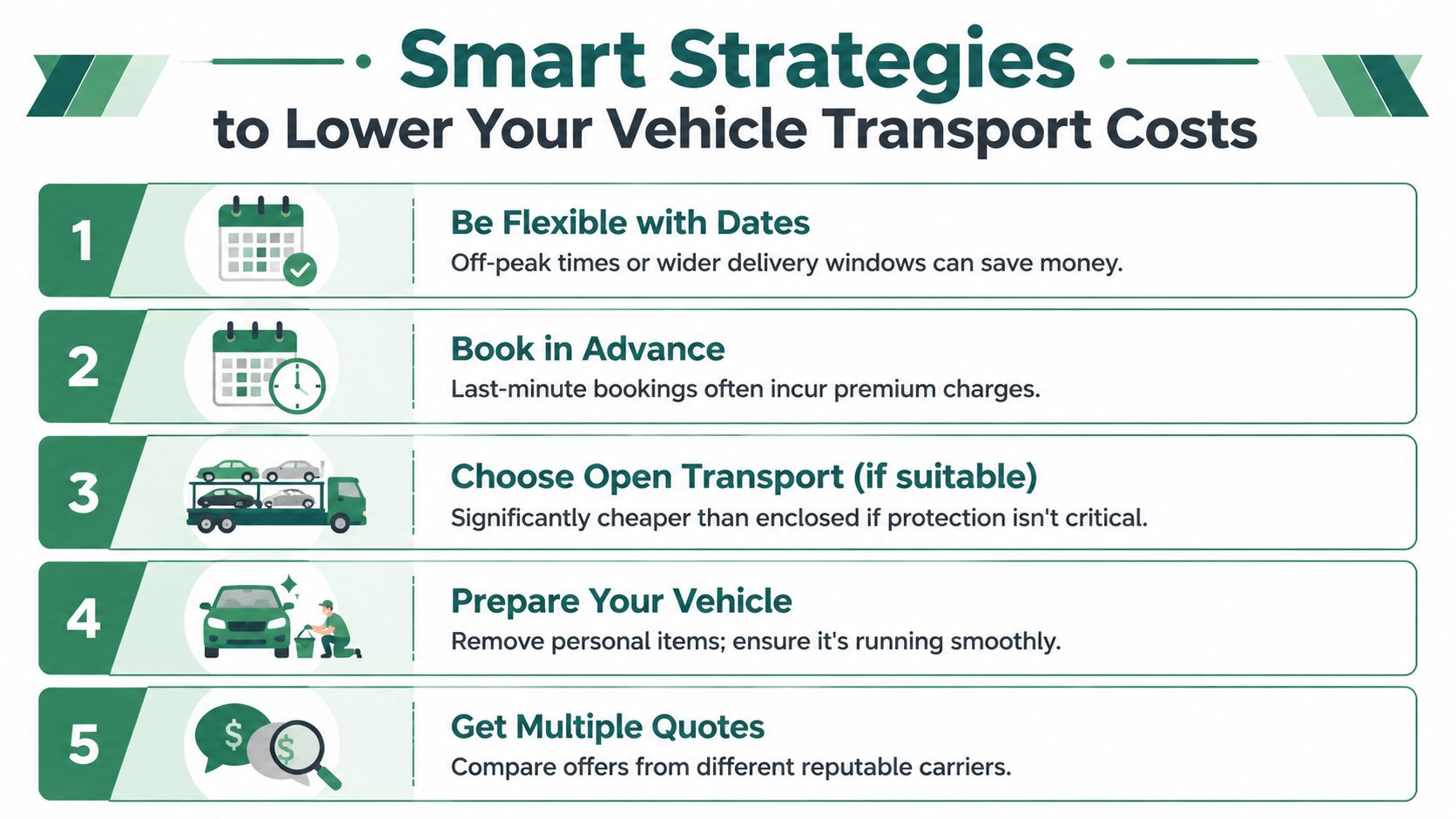
You can lower your transport bill without playing games or sacrificing service. Most savings come from better timing, wider flexibility, and choosing the right service level for the vehicle you own.
Use timing to your advantage
Old seasonal advice doesn't always match the current market. While summer is traditionally called peak season, recent overcapacity in 2025 to 2026 has pushed spot rates lower, and July or August may be cheaper than spring on some routes. Customers who ignore outdated seasonal assumptions can save 15% to 25%.
That doesn't mean summer is always cheaper. It means you shouldn't trust generic advice from old blogs or stale calculators.
Give the market room to work
The fastest way to pay more is to force a narrow pickup window. Carriers price flexibility favorably because it helps them build efficient loads.
Use these cost-saving moves when you can:
- Book early: More lead time usually means better routing options.
- Stay flexible on dates: A wider pickup window gives dispatch more room to match a truck.
- Choose open transport: If your vehicle doesn't need premium protection, don't pay for it.
- Be accurate about the car: Wrong size or condition details trigger repricing.
- Ship from accessible locations: Major city pickups are often easier than remote addresses.
Don't chase the lowest advertised number. Create the easiest shipment to schedule. That's what often produces the best real-world rate.
Avoid self-inflicted extra charges
A lot of “unexpected” costs are predictable.
If the vehicle is packed with personal items, dirty enough to hide inspection issues, or listed as operable when it isn't, the transport gets harder. Harder shipments cost more. Even when there isn't a formal fee, complications can still delay pickup or trigger a revised quote.
For Puerto Rico shipments, this discipline matters even more because documentation and handling standards are tighter. Clean information saves money.
How to Get a Reliable Flat Rate Quote Today
A reliable quote is clear, specific, and complete. It doesn't hide behind vague language. It tells you what service you're booking, what kind of trailer is involved, and whether you're looking at standard mainland pricing or a flat-rate island move.
Here's what a trustworthy quote process should feel like: you provide the route, vehicle details, and timing, then a real advisor gives you a usable number and explains what can change it. That's especially important on Puerto Rico shipments, where a flat-rate structure beats a misleading mainland calculator every time.
What to look for before you book
A serious provider should offer the basics without making you fight for them.
- Experience that matters: Puerto Rico, mainland, dealership, military, student, and seasonal moves aren't the same.
- Flat-rate clarity: You should know whether the quote is built for a road route or an island route.
- Carrier network depth: Access to more vetted carriers gives dispatch better options.
- Customer support that can solve problems: Bilingual U.S.-based agents are a major advantage when questions get specific.
- No nonsense on pricing: Transparent terms matter more than flashy advertising.
For people comparing overall relocation costs, it can also help to budget the rest of the move separately. A practical tool for that is this house move cost calculator, which helps frame the broader moving budget around your vehicle shipment.
Why a human advisor still matters
This is one service category where live guidance still beats automation. A calculator can estimate. An experienced agent can catch the details that change the job.
That's especially true when:
- your vehicle is oversized,
- the car doesn't run,
- the route is off the main lane,
- you need enclosed shipping,
- or the move includes San Juan and ocean handling.
A good advisor keeps the process simple and quick. That's not marketing language. It's operational reality.
For a closer look at how the process works in practice, watch this short overview.
National Car Transport fits what most careful shippers should be looking for. The company has 25+ years of experience, an A+ BBB rating, transparent flat-rate pricing, and a network of 25,000+ vetted carriers. Its bilingual agents are based in the U.S. and bring over 20 years of auto transport logistics experience, which makes a difference when the shipment isn't routine. That includes Puerto Rico moves, where paperwork, timing, and coordination matter more than a cheap headline quote.
If you want a quote that accurately reflects the job, not a guess, get one from National Car Transport. You'll get U.S.-based bilingual support, transparent flat-rate pricing, and guidance from advisors who know mainland and Puerto Rico auto shipping inside and out.