
You’ve booked your household move. Your car is either headed to the port or already on the water. Then Hawaii’s registration rules hit your to-do list, and suddenly a basic question gets complicated fast: how does vehicle inspection hawaii work when your car arrives from the mainland?
That confusion is normal. Hawaii’s inspection system is different from what many drivers are used to, especially if you’re relocating from a state where registration and inspection happen in a simpler order, or where emissions testing is the main hurdle. In Hawaii, the primary challenge for shipped vehicles usually isn’t the mechanical check itself. It’s understanding the sequence.
For military families, students, snowbirds, online car buyers, and anyone relocating permanently, the smoothest moves happen when the inspection plan is built into the shipping plan from the start. If you wait until the car is delivered to figure it out, you can lose time chasing paperwork, finding the right station, or making a second trip you could have planned for.
Table of Contents
- Your Guide to Navigating Hawaii Vehicle Inspections
- Understanding Hawaii's PMVI Safety Check Program
- How to Get a Hawaii Vehicle Safety Inspection
- The Out-of-State Vehicle Challenge for Shipped Cars
- Preparing Your Vehicle to Pass the Hawaii Safety Check
- Seamless Shipping and Inspection with an Expert Partner
Your Guide to Navigating Hawaii Vehicle Inspections
New residents often expect the hard part of moving to Hawaii to be the ocean shipping. In practice, one of the more frustrating moments comes after delivery, when the vehicle is on island but not yet fully usable because registration and inspection have to be handled in the right order.
A common example is the mainland family that arrives with a clean, well-maintained SUV and assumes a local safety check will be quick. Mechanically, the vehicle may be fine. Administratively, they still run into Hawaii’s separate process for out-of-state vehicles. That’s where delays begin.

Drivers coming from states with a more familiar annual program often assume Hawaii works the same way. It doesn’t. If you want a useful comparison point, these Texas state inspection requirements show the kind of mainland expectations many people bring with them before learning Hawaii has its own workflow.
Practical rule: Treat Hawaii inspection as part of your arrival logistics, not as an errand to handle later.
That mindset changes everything. Instead of asking only, “Will my car pass?” ask three better questions:
- When can I physically access the car? Port release and delivery timing matter.
- What paperwork will I have in hand? Registration, shipping documents, and ID need to line up.
- Which island am I landing on? Access is different on Oahu than in less dense areas.
When people plan around those three points, the process feels manageable. When they don’t, the same car can turn into a string of extra trips, missed appointments, and preventable downtime.
Understanding Hawaii's PMVI Safety Check Program
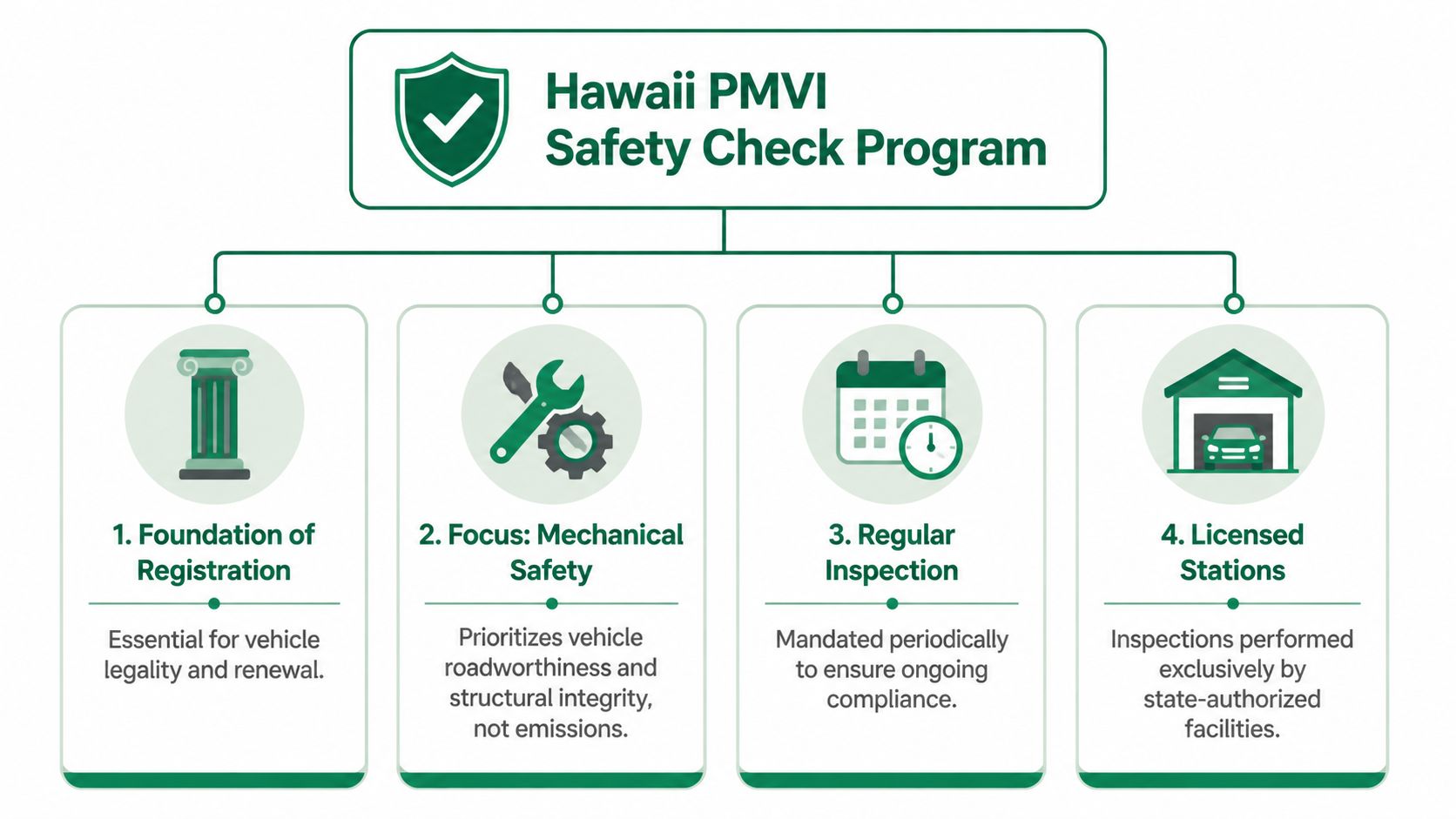
Hawaii uses a Periodic Motor Vehicle Inspection program, or PMVI, for passenger vehicles and light trucks. For vehicles rated at 10,000 pounds or less, the state requires a yearly safety inspection. For people shipping a car in from the mainland, that timing matters. Delivery to the port or your driveway is only one checkpoint. The car still has to clear Hawaii’s local safety process before your paperwork is fully in order.
A lot of new arrivals expect Hawaii to mirror the inspection routine they knew on the mainland. It does not. Hawaii’s program centers on roadworthiness and required safety equipment, and as noted earlier, it does not include routine emissions testing for this standard safety check.
What Hawaii checks and why it matters
According to Oil Changers’ overview of Hawaii’s safety inspection process, inspectors first verify basic documents, including registration, proof of insurance, and a driver’s license. They then inspect safety equipment and core vehicle systems such as brakes, tires, lights, structure, and parts of the engine and exhaust. The same overview says the visit typically takes 10 to 30 minutes.
This is a compliance exam. A dealership-style multi-point vehicle inspection may look similar on paper, but Hawaii’s PMVI is tied directly to legal operation and registration. That difference catches online buyers, military families, and relocating households all the time. A car can drive fine, arrive on schedule, and still get rejected for a small item that was easy to miss before shipping.
The trouble spots are usually predictable:
Brakes and tires
Inspectors check brake condition and usable tire tread. The station overview above notes a minimum tread depth of 2/32 inch.Lighting and signals
Headlights, brake lights, turn signals, and other required lamps need to work properly.Windshield, windows, and mirrors
Visibility problems can lead to a failed inspection, especially if cracks or damage affect the driver’s view.Horn, wipers, and seat belts
These are basic items, but they fail often because owners stop noticing gradual wear.
One burned-out bulb can cost you another trip.
What the PMVI program means for shipped vehicles
For shipped cars, the practical issue is sequence. The vehicle arrives first. Then the owner works through Hawaii’s inspection and registration steps with whatever documents are available after release. That is why I tell customers to treat PMVI as part of the shipping timeline, not as a separate errand for later in the week.
That approach reduces avoidable delays. If the car lands with worn wipers, a cracked lens, or a tire close to the limit, you lose time after arrival instead of fixing the issue before transport. For mainland movers, that trade-off is usually the difference between one clean handoff and several extra appointments.
A vehicle can be mechanically sound and still fail over a simple safety item that never looked urgent before shipment.
How to Get a Hawaii Vehicle Safety Inspection
Your car has cleared the port, you have the release paperwork in hand, and the next question is usually simple: where do you go first, and what should you bring so this does not turn into two or three extra trips?
For Hawaii safety inspections, the answer is preparation and timing. Inspection stations are common, and the process itself is usually routine, but the appointment goes much better when you treat it as part of your shipping and registration schedule instead of a separate errand after the car arrives. Fees were updated statewide in mid-2025, as noted earlier, so it is smart to confirm the current amount and accepted payment method before you head over.
What to bring to the station
Bring the documents that let the inspector identify both the vehicle and the owner presenting it. In practice, these are the items that save time at check-in:
Current or expired registration
This helps the station verify the vehicle record tied to the car you brought in.Valid driver’s license or ID
The station needs to confirm who is presenting the vehicle.Proof of insurance
Some stations expect to see it as part of intake, and having it with you avoids an argument at the counter.Payment for the inspection fee
Ask in advance whether the station takes cards, cash, or both.
A quick phone call before you leave home is worth it, especially on a new island or after shipment. Hours, payment rules, and document preferences can vary enough to waste half a day.
What happens during the appointment
The visit usually starts with paperwork. The inspector checks your documents, records the vehicle information, and then inspects the car’s required safety items. If everything lines up, you receive the inspection paperwork and emblem. If something does not, the station will issue a report showing what has to be corrected.
For shipped vehicles, I tell customers to separate the visit into two parts in their mind.
Paperwork and status
The registration path has to match the vehicle’s current status, especially if the car just arrived from the mainland.Safety condition
The vehicle still has to meet Hawaii’s standards for the items the station checks.
That distinction matters because inspection delays often come from paperwork issues at the counter rather than mechanical faults under the hood.
If the car fails for a repair item, ask one question before you drive away: how does this station handle re-inspections? Many locations allow a return visit within a limited period after repairs, but the details are set at the station level. Knowing that policy on the first visit helps you decide whether to fix the issue nearby, bring the vehicle back later, or hold off until your registration steps are in order.
That is the practical way to avoid wasted trips. For movers, service members, and online buyers, the cleanest plan is to line up port release, inspection paperwork, and registration steps in the right order from the start.
The Out-of-State Vehicle Challenge for Shipped Cars
Vehicle inspection hawaii often becomes confusing for mainland shippers for this reason. The issue isn’t that your car is necessarily unsafe. The issue is that Hawaii treats an out-of-state vehicle as an out-of-state vehicle first, and a safety-check candidate second.
The practical consequence is important. For shipped cars, the first inspection visit often produces a fail report because the vehicle still carries out-of-state registration. That result surprises people who expected a normal pass-or-fail mechanical inspection.
According to Honolulu safety inspection procedures, out-of-state vehicles automatically fail the initial inspection for that reason, and owners then use the failed report to obtain Hawaii registration before returning for the valid emblem. The same guidance notes that this can create delays, especially because inspection access is denser on Oahu and more limited in rural areas on other islands.
Why mainland vehicles do not pass on the first visit
This isn’t a trick and it isn’t a mistake by the station. It’s part of the workflow.
For most shipped vehicles, the sequence looks like this:
- Take the vehicle to an authorized inspection station
- Receive the initial failed inspection report because the vehicle is still registered out of state
- Bring that failed report and your registration paperwork to the appropriate county office or satellite city hall
- Obtain Hawaii registration
- Return to the inspection station for the valid emblem
That’s the part many movers don’t hear clearly enough before the car arrives. If you only schedule “inspection day” and don’t leave room for the registration step in the middle, your timeline falls apart.
A military family on Oahu can usually work through this with less friction because there are more nearby options. Someone taking delivery on a less densely served island needs a tighter plan. One missed day can turn into several if the station, registration office, and your own schedule don’t line up.
The first fail for an out-of-state vehicle is often a paperwork milestone, not a sign that the car has a safety defect.
This walkthrough is useful if you want to visualize the kind of process shipped vehicles go through after arrival:
How to line up shipping paperwork with registration
The safest approach is to treat your shipping file and your registration file as one package. Don’t wait until delivery day to gather title copies, ID, insurance details, and shipping records.
What works well:
Keep your bill of lading easy to access
Shipped-car registration usually moves faster when you’re not searching through email on a parking lot curb.Read the delivery paperwork before you leave the port or meet the carrier
Confirm names, VIN details, and condition notes are correct.Check island-specific logistics early
On Oahu, more station density gives you more flexibility. Elsewhere, timing matters more.
What tends to go badly:
- Assuming a mainland registration card is enough for the full Hawaii process
- Booking personal appointments too tightly after delivery
- Waiting to ask about county-specific registration handling until after the first failed inspection
If you’re buying a vehicle online and shipping it directly to Hawaii, this issue becomes even more important. The shipping leg, ownership paperwork, and registration sequence all intersect. Any mismatch in names, VIN, or supporting documents creates a longer path to the final sticker.
Preparing Your Vehicle to Pass the Hawaii Safety Check
The cheapest repair is the one you catch before the station does. In Hawaii, a little preparation saves time, extra driving, and the aggravation of fixing something obvious after you’ve already taken time off work.
That prep is worth taking seriously. Evidence discussed in Hawaii’s legislative and research materials shows inspection states such as Hawaii have lower rates of vehicle defect complaints, with the broader safety benefit summarized in the Hawaii legislative reference material on periodic motor vehicle inspection. For drivers shipping a car in, the practical takeaway is simple. Preparation isn’t bureaucracy for its own sake. It reduces delays and supports safer operation once the car is back on the road.
The issues that commonly trip people up
Most inspection failures that frustrate owners aren’t mysterious. They’re the kind of defects people live with on the mainland because the car still drives.
Look over these areas before your appointment:
Tires
Check tread and overall condition. A worn tire can look acceptable at a glance and still create trouble.Exterior lights
Test headlights, brake lights, and turn signals with another person if possible.Windshield and lenses
Small cracks or broken lamp lenses are easy to ignore until they’re officially examined.Horn and wipers
These are classic “I forgot that was broken” items.License plates and basic hardware
Make sure plates are mounted securely and doors, hood, and trunk operate normally.
If your car came from a snowy mainland state, pay close attention underneath. Surface corrosion and undercarriage wear don’t always show up in seller photos or on a casual driveway walkaround.
For owners trying to decide whether a warning light or drivability issue needs attention first, a plain-language reference like T1A Auto's diagnostic guide can help you separate a quick check from a real repair conversation with a mechanic.
Fix the obvious items before inspection. Don’t pay a shop to confirm what a driveway check could have caught.
Hawaii Safety Inspection Pre-Checklist
| Component | What to Check | Pass/Fail Criteria |
|---|---|---|
| Tires | Inspect tread depth and look for uneven wear or visible damage | Tire should meet the 2/32 inch minimum tread guidance and appear roadworthy |
| Headlights | Test low and high beams | Lights must function properly |
| Brake lights | Press pedal and confirm both sides illuminate | Non-working brake lamps can cause failure |
| Turn signals | Check front and rear operation | Signals must flash correctly |
| Windshield | Look for cracks or chips in the main field of view | Damaged glass can be rejected |
| Horn | Press and confirm normal operation | Horn must work |
| Wipers | Run wipers and inspect blades | Wipers should operate effectively |
| Mirrors | Check interior and exterior mirrors for secure mounting and visibility | Mirrors must be present and usable |
| License plates | Confirm plates are attached securely | Loose or unmounted plates can create problems |
| Doors and latches | Open and close doors, hood, and trunk | Components should operate as intended |
A good pre-check doesn’t require special tools. It requires attention. That’s usually enough to turn a stressful errand into a routine stop.
Seamless Shipping and Inspection with an Expert Partner
A Hawaii move often feels under control until the car arrives. Then the main timeline starts. The vehicle has to clear delivery, line up with county registration requirements, and, for many mainland vehicles, move through inspection steps that are easy to mistime if no one planned for them before pickup.
That timing problem shows up most often with PCS moves, household relocations, and online purchases. A car can reach the port on schedule and still sit because the owner is missing a title document, a bill of lading copy, or the right expectation about VIN verification and safety check sequencing. As noted by Pep Boys’ Hawaii inspection overview, some out-of-state vehicles, especially rebuilt or classic cars, may need extra inspection attention after arrival. The cost is rarely just inconvenience. It can mean extra trips, delayed registration, and more time without the car available for daily use.
Experienced shipping support helps prevent that.
The job is not limited to booking ocean transport. Good coordination ties the shipping file to what happens after the vehicle lands, so the owner is not trying to piece together inspection and registration requirements from scratch.
What that usually looks like in practice:
Document review before pickup
Title, registration, photo ID, lienholder details if applicable, and shipping paperwork should be checked early. Small errors here often create bigger delays after arrival.Clean delivery records
The bill of lading and release paperwork need to be accurate and easy to access. Customers often do not realize how important those records become once they start county registration and inspection steps.Planning for special cases
Rebuilt vehicles, classics, financed cars, recent auction purchases, and vehicles bought online usually need closer coordination because the paperwork trail is less straightforward.A realistic arrival plan
Good support means setting expectations for what happens first, what may require an in-person visit, and where extra time may be needed after the car reaches Hawaii.One informed point of contact
That matters when a family is relocating, a service member is working around orders, or a buyer is trying to receive a vehicle and make it road legal without repeated delays.
The best shipping partner helps you line up transport with the inspection path, not treat them as separate errands. That is how customers avoid the common mistake of focusing on port delivery and only later learning what Hawaii requires to get the vehicle fully road-ready.
If you want help coordinating the shipping side before Hawaii registration and inspection begin, National Car Transport can guide the process with U.S.-based bilingual agents, more than 25 years of auto transport experience, an A+ BBB rating, transparent flat-rate pricing, and a network of 25,000+ vetted carriers. Every move is different, especially for Hawaii, Puerto Rico, military relocations, students, snowbirds, dealerships, and online vehicle purchases. Having an experienced advisor who can keep the paperwork, timing, and transport details organized makes the process much simpler.